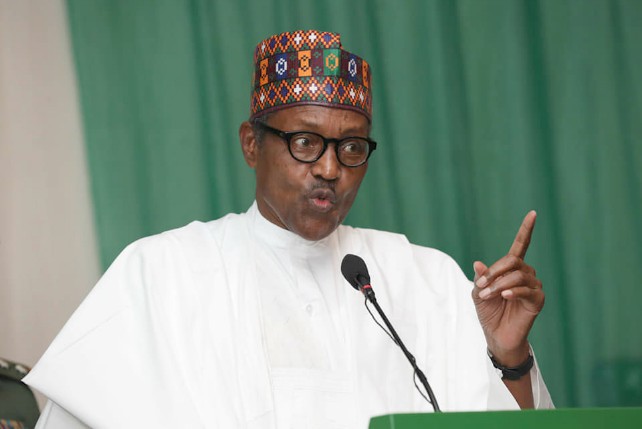
PRESIDENT Muhammad Buhari has said he “always” try to be loyal and obedient to the Nigerian constitution so long as it is “humanly possible”, adding that he would ensure equity and fairness that put the ordinary Nigerian on top priority.
President Buhari made the statement while addressing speakers of the state House of Assembly on Thursday in Abuja, according to a press release signed by Femi Adesina, his special adviser on media and publicity.
The president had told the lawmakers that he would continue to focus on health, education, infrastructure and improving lives through social intervention programmes.
Noting that the constitution upholds the standards for all public officers and institutional operations, President Buhari said it could be adhered to, or altered to reflect some dynamics of the country.
He told the state lawmakers that the autonomy of state legislatures had been constrained by the constitution, adding that they should place the interest of the people first in all deliberations and negotiations.
“I try as much as I can to always be loyal and obedient to the constitution so long as it is humanly possible,’’ he said.
He said his administration would keep “pursuing the prosperity of all Nigerians by creating more jobs for the people, and plugging the weaknesses exploited by many to make quick money”.
“The 8th National Assembly sometimes kept the budget for seven months. And I had to call the Senate President and the Speaker then. I told them by delaying passage of the budget you are not hurting Buhari, but the people,’’ the President said.
He added that administration had dedicated “significant resources” to key social services sectors especially in health and education.
“I also want to assure you that we remain committed to ensuring that equity and fairness prevail in governance. I will ensure that we consult your conference to further enhance the positive impact of our interventions across the country,’’ Buhari said.
The Chairman of the Conference of Speakers, Mudashiru Obasa who is also the Speaker of the Lagos State House of Assembly, urged the President to consider supporting the devolution of powers to states on some issues on the exclusive list like railway and the police for more effective governance.
Meanwhile, many Nigerians hold a contrary view to the claim of the President about being loyal and obedient to the constitution.
The arrest and detainment of Omoyele Sowore, the publisher of Sahara Reporters by the Department of State Security Service have been described by some Nigerians, national and international organisations as a deprivation of the respect to the rule of law.
Sowore, who was arrested for convening a Revolution Now campaign, has spent 111 days in detention despite having been granted bail by the Federal High Court and fulfilled the conditions.
Professor Wole Soyinka had recently pleaded for the rule of law to reign in the country, saying the failure to obey the law could lead to the death of ordered society.
THE Federal High Court Sitting in Lagos has ordered the permanent forfeiture of N280,555,010.65 to the Federal Government, linked to embattled Nigerian entrepreneur Obinwanne Okeke, also known as Invictus obi.
The Economic and Financial Crimes Commission (EFCC) had filed an ex – parte motion to seize the money, stating that the funds were “reasonably suspected” to be proceeds of cyber-crime, requesting that the judge ordered a forfeiture.
The presiding judge, Rilwan Aikawa, had ordered the EFCC to publish the interim forfeiture order in a national daily and adjourned till November 21 for anyone interested in the money to appear before him to give reasons why the money should not be permanently forfeited to the Federal Government.
At the resumed hearing on Thursday, the EFCC counsel, Rotimi Oyedepo, said the anti-graft agency had published the interim forfeiture order as directed by the court but there was no opposition.
However, the said amount was traced to the bank accounts of Invictus Oil and Gas Limited and Invictus Investment Limited and the EFCC noted that two firms were owned by Invictus Obi whom it described as, “a strong leader of a cyber-crime syndicate that specialises in business e-mail compromise”.
The Commission, therefore, asked that the judge order the permanent forfeiture of the money to the Federal Government.
“I have seen the application seeking the final forfeiture of the sum of N280.5m warehoused in the two bank accounts, which was reasonably suspected to be proceeds of unlawful activities.
“I am satisfied that the requirements enumerated under Section 17 of the Advance Fee Fraud and other Related Offences Act have been met by the applicant in this suit; consequently, this application is hereby granted as prayed, as it remains unchallenged.
“The sum of N280.5m found in the bank account of Invictus Investment limited, who is the second respondent in this suit, is hereby forfeited to the Federal Government of Nigeria,” the judge ruled.
The United States Federal Bureau of Investigation FBI had apprehended Okeke, 31, over $11M fraud, allegedly defrauding some US citizens “through fraudulent wire transfer instructions in a massive, coordinated, business e-mail compromise scheme”.
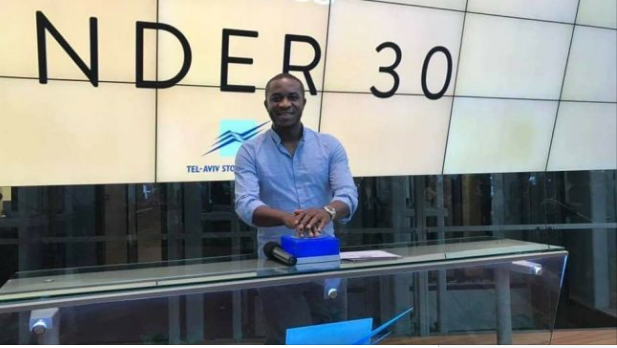
In 2016, Invictus Obi was celebrated by Forbes as one of Africa’s “most outstanding 30 entrepreneurs under the age of 30”. He was described by the magazine as “proof that there is hope for Africa”.
Okeke holds a master’s degree in International Relations and counter-terrorism from Monash University Australia, and he is the founder of Invictus Group – a conglomerate in construction, oil, gas and agricultural development.
He has investments in real estate development, energy and construction. His company, Invictus Group, operates in three African countries: Nigeria, South Africa, and Zambia.
A CIVIL society organisation, Connected Development (CODE), said its Follow The Money initiative has been able to track an estimate of 113 million dollars across 181 communities in 25 states of Nigeria since its establishment in 2012.
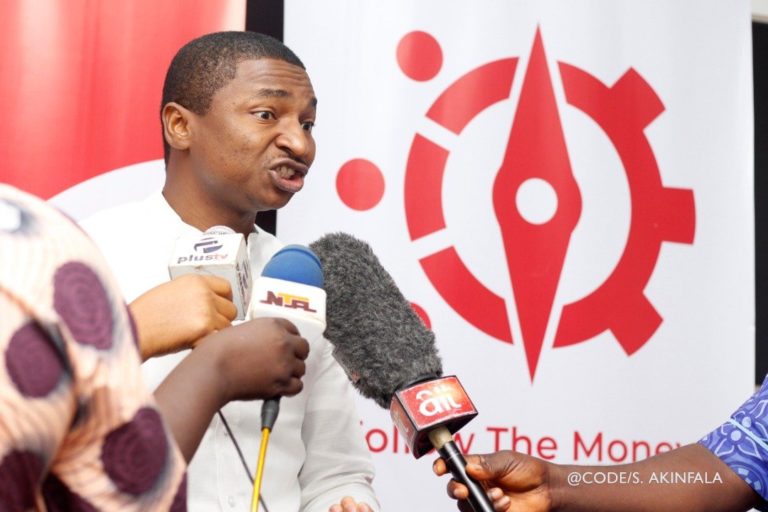
Speaking at a Press address in Abuja on Thursday, the Chief Executive Officer of CODE, Hamzat Lawal told reporters that the fund that it tracked were funds that are budgeted for community projects.
He said the organisation has been able to save the government of over N15 billion naira because of the leakages that it has been able to block.
He said the initiative has now been established beyond the borders of Nigeria where the movement began in 2012.
According to Lawal, Follow The Money initiative is now established in Malawi, Cameroon, Kenya, Liberia, Gambia, Zimbabwe as well as Nigeria.
Lawal also disclosed that the movement is now collaborating with the Economic Financial Crime Commission (EFCC) to track government-funded projects.
He said the Acting Chairman of EFCC, Ibrahim Magu confirmed this during an interactive session with the organisation on Wednesday in Abuja.
“The Chairman has promised to provide government and security protection for our personnel during the discharge of their duties,” Lawal said.
He added that Magu also promised to create a Follow The Money Desk at the EFCC office in Abuja where the organisation can easily access the EFCC.
Celebrating the CODE’s seven years of existence, the organisation presented cash awards and medal of honour to three winners of the Follow the Money challenge.
Busayo Motunrayo, the community engagement manager with CODE, said the Follow The Money challenge required citizens to go into their communities and track government-funded projects.
He added that out of the nine finalists of the challenge, only three of them were picked from three states.
CODE Communication Lead, Kevwe Oghide told pressmen that a few weeks ago, Follow The Money movement won the 2019 Council of Europe’s Democracy Innovation Award in Strasbourg, France.
She said the award presented at the Council’s World Forum for Democracy 2019 recognised Follow The Money as one of the leading groundbreaking initiatives in the world.
Stressing on the importance of the award, Oghide said the council of Europe has 49 member states which Nigeria or Africa is obviously not one of them, but out of 27 Democracy Initiatives of the world, Nigeria won it.
“Honestly, I think it is ironic because we don’t even practice Democracy in this part of the world and Nigeria won the award in Europe where things are functioning,” she said.
She noted that the award should serve as a wakeup call for Nigerian Leaders to act more responsibly and improve inclusive public service delivery across the Nation.
The three winners of the challenge, Kehinde Akinsola from Kwara State, Ukeme Anwan from Akwa Ibom state and Muhammed Kime from Yobe state were presented a cheque of N100,000 respectively.
The ICIR reporter asked Lawal on what the organisation has been able to achieve in other African countries where CODE is established.
Lawal said Follow The Money has been able to monitor about 27 million dollar fund released to The Gambia by the European Union.
He also said the group followed the $10,000 dollars released for provision of facilities in a Kenyan Slum and efforts on sexual and reproductive health fund in Malawi.
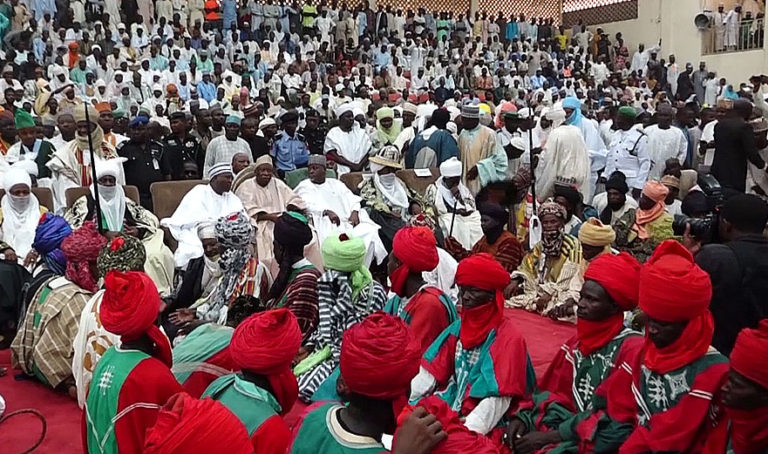
ON Thursday, a High Court sitting in Kano nullified the appointment and creation of an additional four Emirates in the state on grounds, the appointment followed no due process.
The creation of the additional Emirates comes on the heels of a passage of the bill by the State House of Assembly, seeking the establishment of four additional Emirates, namely; Rano, Gaya, Karaya and Bichiin.
The state governor, Abdullahi Ganduje had assented to the bill and issued letters of appointment to the four new first-class emirs.
Those presented with the letters of appointment include Aminu Ado Bayero, the son of Late Emir of Kano, Ado Bayero, as the Emir of Bichi; Ibrahim Abulkadir as the Emir of Gaya; Tafida Abubakar as the Emir Of Rano and Abubakar Ibrahim II as the Emir of Karaye.
However, in May, a former minority leader of the State House of Assembly, Salisu Gwarzo had filed a suit challenging the legitimacy of their appointment and the deposition law 2019 that led to the creation of the additional Emirates.
So, in the hearing on Thursday, Justice Usman Na’abba saidthe Kano State House of Assembly violated section 101 of the Nigerian Constitution which gives the assembly the power to enact its rules and guidelines of proceedings.
He nullified the proceedings of the state assembly conducted on May 6, 7 and 8 which had created the new Emirates, stating that the legislature’s rules should have been in accordance with the Nigerian Constitution.
The judge also dismissed preliminary objections which had earlier challenged the jurisdiction of the court to handle the case and the right of the plaintiff to challenge the new Kano law.
Na’abba noted that the plaintiff, being the minority leader in the state assembly, had sufficient reasons for filing the suit and thus had the ‘locus standi’ to do so.
The judge restrained the four new emirs appointed by Ganduje to desist from parading themselves as first-class emirs.
Moreover, while it was reported that the creation of the four Emirates would make Kano traditional system more efficient, some others, claimed it was illegal and would incite unnecessary spending of funds.
Rather, they urged the government to concentrate on pressing issues, such as depletion of revenues, healthcare, security and educational challenges in the state.
Similarly, on November 20, Seyi Makinde of Oyo State withdrew the crowns of the twenty-one chiefs in Ibadan who were elevated to the status of kings by the former governor, Abiola Ajimobi.
Such development had caused a long rift among the Olubandan and some of the chiefs-in-council which led to Makinde opting for an out-of-court settlement to help restore peace between the Olubadan and his estranged chiefs.
Tertiary Education Trust Fund (TETFund) is the backbone of infrastructural development, training and equipment procurement in public tertiary institutions. However, JUSTINA ASISHANA reports that contractors’ failings, poor project implementation and opaqueness of project procedures are undermining the impact of the fund.
IN 2010, the Federal University of Technology (FUT) Minna had only one capital project – construction of Cyber Security Science Department – funded by the Federal Ministry of Education. Nine years later, the project has not been completed because of inadequate funding. However, between 2010 and 2018, over 10 projects, embarked upon and funded by the Tertiary Education Trust Fund (TETFund) in the university, have been completed.
Juxtaposing these situations, it is not surprising that most tertiary institutions execute projects through TETFund. They have come to rely heavily on this fund for the structural, physical and academic development of their institutions.
The 2011 TETFund Act established the intervention agency, with specific responsibility for managing, disbursing and monitoring the proceeds of the two percent education tax on assessable profits of registered companies. It is for public tertiary institutions.
Section 7(i) to (e) of the TETFund Act 2011 provides, among others, for the provision and maintenance of essential physical infrastructure for teaching and learning, instructional materials and equipment, research and publications, academic staff training and development and ‘any other need, which in the opinion of the Board of Trustees is critical and essential for the improvement of quality and maintenance of standards in higher educational institutions.
The Director, Central Research Laboratories of the University of Ilorin (UNILORIN), Prof. Musa Toyin Yakubu, said: “If there was no TETfund, our universities will not survive. In this university, we live and breathe TETfund. Our buildings, most researches and staff development are always done under the auspices of TETfund. I think they should just name all universities, Universities of TETfund”.
This observation may not be far-fetched, especially as an investigation conducted on some federal tertiary institutions in the North-Central confirmed that TETFund has been crucial to capital development in universities, polytechnics and colleges of education.
However, even with the impact TETFund is making, it is not all smooth sailing. On the surface, it seems institutions have done well with the intervention funds. However, some of the funds are not being accessed because of sharp practices by contractors who may be conniving with the departments saddled with the responsibility of assigning projects to contractors.
Investigation showed that most of the funds allocated to universities were not being accessed as allocated yearly, because of the inability of contractors to meet the deadlines given to them. As a result, approved funds are not usually accessed until years later.
How contractors delay work
The contract awarding process involves biddings, and institutions usually give preference to the lowest responsible bid. However, The Nation learnt that some of the contractors do not provide accurate information about their capabilities.
Such was the case of the contractor who was first awarded the contract for the construction of the School of Engineering and Engineering Technology Phase II at FUTMinna.
It was gathered that the contractor was given the contract on July 7, 2015 – same day the construction of the School of Agriculture and Agricultural Technology Phase II was given to another contractor. The contracts were supposed to be completed on July 19, 2016.
An investigation by The Nation revealed that while the contractor in charge of the School of Agricultural Technology delivered on time, the contractor handling the School of Engineering dilly-dallied until the contract was revoked.
When questioned over the delay in the project, FUT Minna Vice-Chancellor Prof. Abdullahi Bala said the contractor diverted the funds to another project. He added that during recession, in early 2016, prices rose and the contractor could not meet up.
He said: “The contractor handling the School of Engineering project, instead of putting efforts in making sure that he goes by the terms of the agreement, he mobilised his resources elsewhere to some other projects, so the project in FUT Minna suffered. When the recession came in late 2015 and 2016, the prices doubled, and he came back asking for variations. He told us that he was being affected by the depreciation of the naira.
“However, if he had done his work within the specified period, the depreciation of naira would not have affected him. Therefore, a project that would have been completed in 2015, we are still struggling with it, and this is 2019. It is just about now that we had to get another contractor to come in for us to complete it.”
In a document obtained by the reporter, the contractor of the contract was stated as Messrs Gridtech Construction. The total sum of the contract is N176,165,959.
A similar issue of incompetence or clear fraud may have been suspected in a contractor’s handling of the construction and furnishing of a lecture theatre for the Institute of Education Phase II, at the permanent site of the University of Abuja (UNIABUJA).
The contract, awarded to CF Cofel International Ltd Suleja, Niger State, was terminated while it was only 10 per cent complete. The contract sum was N410,877,888 and the contract was awarded in September 2015 and expected to be completed in February 2016.
Documents obtained revealed that N230,091,617 was released. However, the reporter could not get any information on whether this amount was given to the contractor. No member of the university management was willing to cite the reason the contract was terminated. It is also not clear if the contract has been re-awarded to another contractor.
This reporter could not reach the contractor to get his side of the story.
When contractors delay execution of projects, institutions experience delays in accessing TETFund grants. The Nation discovered that just as contractors do not provide adequate information about their capacity to do a job, they do not disclose their ability to assess funds to implement the project or provide the necessary equipment.
Therefore, while the monies wait for disbursement, there are delays in the project as most institutions like the FUT Minna and UNILORIN claimed they would not release any fund unless the project followed due process.
FUT Minna VC said: “The delay in projects is not because of non-payment because the monies are already there waiting as TETFund releases money to the institution who will in turn release to the contractors according to the work done. So you see, some contractors, they will delay and delay because of inadequate capacity.”
TETFund projects (2015-2019)
Between 2015 and 2019, at UNIABUJA, of 11 projects awarded under TETFund, only one, the construction and furnishing of library/resource centre building for the Institute of Education Phase I, at the permanent site, has been completed.
Other projects such as the supply and installation of two generators, construction of power equipment house and entrance gate for the Institute of Education Phase I, construction and furnishing of an administrative building for Phase I and II, construction of entrepreneurship centre some of which were awarded in 2015 are still ongoing and are at different stages (40-80 percent) of completion.
At the FUT Minna, within the period under review, 25 projects were awarded of which 16 have been completed while nine are still at various stages of completion. The Federal University, Lafia, has had 26 projects with 17 completed and at in various stages of completion.
At the Federal University, Lokoja, majority of the 28 projects initiated had been completed when our reporter visited in August.
One of the students said the multipurpose complex was inaugurated earlier in the year while the other projects were being used. Going round the institution, to the block of laboratories and classrooms complex, it was observed that the laboratories were equipped and had some students were carrying out practical sessions.
At the University of Jos (UNIJOS), out of 10 TETFund projects (2015-2018), seven have been completed and handed over to the institution. The projects remaining include the construction of the Faculty of Management Sciences, Faculty of Engineering, and the rehabilitation of the burnt Library – all at the Naraguta campus, Jos.
At UNILORIN, none of the building projects under 2013 to 2016 merged TETFund annual interventions have been fully completed.
The construction of the extension of the main library has already been roofed and awaiting finishing touches and fixing of the windows, doors, and others; construction of the administrative block for Environmental Sciences, Department of Quantity Survey, Estate Management, Surveying, and Geo-informatics are still underway.
Workers were seen on site in the proposed departments of Estate Management, Surveying, and Geo-informatics. However, they were jittery upon sighting this reporter and disallowed her from taking pictures. They also refused to answer questions on the project and threatened to beat her up.
Shoddy Work or Poor Maintenance?
In some of the institutions visited, it was discovered that the walls of recently completed projects were already cracking and the paint peeling off while some of the infrastructures, especially the chairs brought with TETFund grants for the lecture rooms had already broken down.
At the Federal University, Lafia, the collapsible chairs in the Department of Computer Sciences, tagged TETFund 2013, had broken down in some of the lecture rooms.
At UNIJOS, some of the projects like the proposed Faculty of Management Sciences, and the proposed centre for film and communication arts, as well as the faculty of engineering, despite having been completed still needed painting or furniture.
At the Federal University, Lokoja, a visitor is greeted with rows of blocks of classrooms and laboratories that already have their paints peeling and walls cracking. Although the new structures constructed from 2018 are still standing, other structures with inscriptions of 2011-2013 already show signs of wear and tear.
At UNILORIN, it was also observed that TETfund projects, which are not up to 10 years, had cracks appearing on most of the buildings. Part of the block in the Faculty of Life Sciences showed serious signs of decay while the Center for Laboratory Research had cracks and peelings.
However, this reporter was unable to ascertain if the decay was a result of poor maintenance or shoddy work by the contractors.
Some of the workers said that not all the projects were given to experts. One, who preferred not to be named, said increased supervision of project implementation was necessary.
“One question the school needs to ask itself is if these buildings constructed stand the test of time and do the contractors do what they are meant to do?
“On my part, I think they need more supervision both from TETFund and the institution. If this is done, I am sure the contractors would do the right thing and not cut corners unnecessarily.”
Pointing to one of the TETFund buildings already peeling, he said, “Look at that building, the plaster is already peeling off. This project was done under 2009 intervention which means the project was completed sometime in 2010 or 2011. The right contractors should be given the job, those who know the job, give it to someone who knows his onions and they will do the job better.
“If you go round the university, you will see buildings with cracks all over, these are buildings that are not more than 10 years. I built my own house earlier than that and there haven’t been any cracks.”
A CAC search revealed that some of the contracts were not given to experts. An example is Elnita Nigeria Limited whose objectives, according to a CAC search, “include to carry on the business of hotel, restaurant, tavern, beerhouse, and lodging, housekeepers, licensed wine, beer, and spirit merchant and to run amusement and gambling, casino and to do all things incidental thereof and holiday camps and to organise, promote and carry on all amusement businesses.”
However, Elnita Nigeria Limited won the contract for the electrical installation of the School of Agriculture and Agricultural Technology Phase 2 at the FUT Minna. Though the project has been completed and students are using the facilities, time will tell if the work will stand the test of time.
Help in time of need
In October 2016, the three-storey building housing the UNIJOS Library, the faculty of social sciences and management sciences was gutted by fire.
In a bid to provide relief to the institution, TETFund intervened and the award for the rehabilitation of the central library was given to Amber Blaze Limited in March 2018. The library building at the time when the reporter visited the institution in July was about 85 percent complete.
While the previous library complex housed some faculties, the new library complex is being entirely used for library activities.
A source told this reporter that in addition, some equipment was bought for the library but not currently in use.
“It is looking nice now. Everything brought in the library is brand new. There are also ICT machines in here and servers. We were told that this whole building will be used for the library now. We do not know what will be put downstairs but upstairs, which is currently locked, have all the furniture and other infrastructures”, a student told the reporter.
The rehabilitation of the burnt library is to gulp the sum of N701,203,727 but, according to one of the Staff, only N485,011,887 has been received while the balance is being awaited to complete the rehabilitation.
Secrecy over disclosure of process
The procurement process for the TETFund projects are usually handled by the Department of Physical Planning or the TETfund Desk officers in the institutions, however, the officials in charge of these departments do not easily give information about projects.
At the Federal University Lokoja in Kogi State as the Vice-Chancellor, Prof. Angela Freeman Miri was not around and did not respond to calls and messages to her phone. The meeting with the Registrar, Mr. Usman Suleman Obansa did not yield any result as he said, “it is only the VC that can give you such information or give theTETfund desk officer the go-ahead to give you information. You know it is the office of the Vice-Chancellor that handles the TETfund issue.”
When approached, the TETFund Desk Office said he could not share information without the VC’s permission.
The Vice-Chancellor of the Federal University, Lokoja, Professor Angela Freeman Miri/ File copy
Officers at the Federal University, Lafia diplomatically avoided setting up a meeting despite assurances following the submission of an FOI request.
The Vice-Chancellor was said to have traveled on an impromptu trip. All promises that all information will be mailed to this reporter were not fulfilled.
At UNILORIN, efforts to get information on the procedural process in the award of the projects led nowhere as the office of the Vice-Chancellor, when contacted, directed the Reporter to two Professors, Adeola Abdullah Adedeji of the Department of Civil Engineer and the representative of the Faculty of Engineering and Technology in the institution’s TETFund Committee and Musa Toyin Yakubu, the Director of the Central Research Laboratories.
However, the two Professors could not provide the details and directed the Reporter to the Department of Physical Planning. There, the Director of Physical Planning, Dr. Adams Bashir Olajide said he would not attend to the Reporter unless with express permission from the Vice-Chancellor, Prof. Sulyman Age Abdulkareem. All efforts to get the Vice-Chancellor to speak on the projects proved abortive as his Secretary said he was out of the office.
It was the same scenario at UNIJOS. The institution’s Public Relations Officer, Abdullahi Abdullahi who readily gave out information about TETFund projects, could however not give details of how the projects were awarded. This Reporter could not meet with the VC, Prof. Seddi Sabastian Maimako because he was out of town when the Reporter visited.
However, at FUTMinna, the VC, Prof. Bala explained that the award of contracts must follow due process, especially as VCs are the ones to answer queries regarding the projects.
“I have told the Department of Physical Planning and Bursary to keep me informed of everything that has to do with TETfund. There is nothing unusual there. I am in charge of the institution and should know what is happening to our projects.”
However, many workers were of the opinion that the procurement process was skewed in favor of those who are known by the Departments of Physical planning in the institutions.
The VC of FUT Minna said that some of the officials’ in charge of this task do not carry out their duties judiciously while he stressed the need for adequate technical evaluation before a project is awarded to a contractor.
“There is also, the problem of capacity of the contractors, some of them could not do the kind of work but again, I blame it on the institution because of the procurement law demands that you must do a technical evaluation, in doing the technical evaluation, you pay due diligence to what you are doing, sometimes, you should be able to identify such problems.”
“Our university sometimes sends our staff to confirm some of the projects claimed to have been done by the contractor; they will need to have the physical evaluation to confirm the claim. These are some of the little things and the problem that comes in to delay the projects but the problem itself is not from TETFund, it has to do with the procurement process, some of the capacity within the university, some of the capacity with respect to the contractors but TETFund has been very supportive in many of these cases. Sometimes, even when the university has not done its bit, TETFund tries to see how they can help in making sure that we make progress on these projects.
Consultancy Services
This Reporter’s discovered that the Federal University Lokoja awarded huge amounts for consultancy services. In the 2014 normal intervention project, N52 million out of N53 million allocated to Mevic Consultancy limited for consultancy services; while in the 2013 special intervention projects, Mevic consultancy was paid N77.2 million out of N90.8 million allocated for consultancy service. The nature of the consultancy remains opaque like every other procurement process of Nigerian universities.
This investigation was supported by the John D. and Catherine T. MacArthur Foundation and the International Centre for Investigative Reporting (ICIR).
AMOS ABBA, an oil and gas reporter at the International Centre for Investigative Reporting, ICIR, has been shortlisted for the annual Fetisov Journalism Awards, reputed to be the “biggest prize in the history of international journalism”.
The shortlist, which was announced on Wednesday, lists 39 journalists from 21 countries, with six of them—the highest number—from Nigeria. Four of the entries had multiple authors.
Abba was shortlisted based on his report, How Nestle Nigeria contaminates water supply of its host community in Abuja, published in April. It exposed how a water factory belonging to Nestle and located in Abaji Local Government, Abuja, led to the contamination of the host community’s source of water, destruction of farmlands and road networks.
Two days after the publication, the multinational company redeemed its pledge to the people by completing a previously abandoned water project.
Abba’s report was shortlisted in the Excellence in Environmental Journalism category. Other celebrated areas are “Outstanding Investigative Reporting”, “Contribution to Civil Rights”, and “Outstanding Contribution to Peace”.
Three winners in each category will share a cash prize of CHF 130,000 (N47.5 million). The grand prize winner will receive N36.5 million, and the runners-up get N7.3 million and N3.7 million respectively.
The mission of the awards is “to promote universal human values such as honesty, justice, courage and nobility through the example of outstanding journalists from all over the world as their dedicated service and commitment contribute to changing the world for the better”.
Names of the winners in all four categories will be announced at the award ceremony scheduled for January 2020, in Luzerne, Switzerland.
Other Nigerians who made the shortlist include Punch’s Azeez Hanafi, Peter Nkanga, AbdulAziz AbdulAziz of PremiumTimes, Damilola Banjo of Sahara Reporters, and Business Day’s Isaac Anyaogu.
Abba was, in September, also shortlisted for the 2019 Thomson Foundation Young Journalist Award and then shortly after the 2019 Kurt Schrock award for journalists.
DESPITE the government’s commitment to reducing inflation, prices of commodities keep rising in Nigeria as the value of Naira erodes nearly on a monthly basis.
The National Bureau of Statistics released the inflation data for October which indicates that inflation has risen to 11.61 from 11.24 in September.
That’s about 3.2 per cent higher than it was in September and 5.4 per cent higher than it was in August. This is perceived as a direct effect of the closure of land borders in August by the Federal Government.
The Central Bank of Nigeria apparently had hoped the initiative would improve both the demand and supply of locally manufactured commodities such as rice. The effect was soon to be noticed by Nigerians when food prices started increasing in the market.
According to a report by Proshare, the price of a 50kg bag of imported rice, which was selling at N14,500 before the closure of the border, now sells for N27,000. Locally produced rice has not been left out of the party as the price of Lake Rice, a product of an alliance between Lagos State and Kebbi State, has increased by 22 per cent to N16,500 from N13,500 before the closure of the border. There are those who sell it at as high as N19,000.
2019 Inflation Rate
The spike in the price of rice in the market is linked to the principle of demand and supply. A restriction on the importation of a commodity translates into dipping supplies. This then leads to an increase in price because of unmet demands. As a result, a single commodity such as rice which is a staple food can push the headline inflation high if not taken care of appropriately.
According to the United States Department of Agriculture (USDA), Nigeria is still unable to meet up with its local rice demand. Nigeria’s local production for 2017/2018 is 4.73 million metric tons while it imported 2.1 million metric tons and its domestic consumption was estimated as 6.9 million metric tons.
In 2018/2019, Nigeria’s local production increased to 4.79 million metric tons, while its import rose to 1.8 million metric tons and its domestic consumption increased to 7.0 million metric tons.
On the 15th of October, CBN governor, Godwin Emefiele called on Rice Millers Association of Nigeria and other stakeholders in the rice production sector not to increase the price of rice due to border closure. He claimed that the border closure is meant to benefit Nigerians and promote the growth of the country’s economy. A further claim was made that the policy will ensure Nigeria is self-sufficient in rice production.
This looks like a clear attempt to shift the blame of a bad policy on the millers and stakeholders.
In a recent tweet by the apex bank, it claimed that “CBN Intervention funds to farmers will bring down the cost of production. “Price hike on rice is a temporary phenomenon that will fizzle out soon,” the tweet says. The CBN acknowledges price hike as a result of the border closure which has had a ripple effect on the inflation rate on all items.
To take cues from India, the Asian country is known for its great onion crisis. Local production of onions doesn’t meet up with its demand and this has caused more than a 200 per cent surge in onion prices. This, of course, had an adverse effect on Indian headline inflation. To fix the crisis and curb increasing prices, India planned to import 100,000 tons of onions to increase the supply and distribution of onions to meet up with its demand. This strategy will surely place an ease on the price of onions in India and improve the distribution of onions in the country.
Nigeria still has a long way to go in terms of enhancing local production and meeting up with its demand and local consumption. If it must continue to close its borders, it must put in place strategies to increase supply and reduce the cost of production.
A TOTAL of 614 cases of measles, Lassa fever and yellow fever has been recorded in a week across states of the federation, according to the Nigeria Centre for Disease Control (NCDC) weekly epidemiological report.
Published on Wednesday for week 44 of the year which fell between October 28 and November 3, the report stated that four people died as a result of the three preventable and curable diseases.
Measles accounted for the highest number of cases with 403 Nigerians suspected to have contacted the disease in the week. This figure is higher than the one from week 39 to 43.
There has been a steady rise in the case of measles since week 39. The weekly reports revealed that every week, more persons come down with the vaccine-preventable disease.
Going through the previous report, in week 39, there were 260 reported cases of measles. In week 40, it rose to 270 and it was 272 cases in week 41. In both weeks 42 and 43, the recorded cases of measles were 378 and 384 respectively. And in the latest week, the persons that came down with measles were 403.
The occurrence of the disease cut across 126 local government areas in 29 states and the Federal Capital Territory, according to the report.
Infographics credit: Rebecca Akinremi
It also revealed that two people died from measles during the week which was against previous reports where no death was recorded since week 38.
The condition of measles became worsen in 2019 as the number of cases so far in the year was three times more than the whole of 2018 figure. NCDC had recorded 15,518 cases in 2018, while as of November this year, 57,255 cases have been recorded.
The number of deaths due to measles so far was 277 against 123 deaths of 2018.
On November 16, the Federal government launched a campaign targetting the vaccination of 28 million Nigerian children against measles and meningitis in 19 Northern states. The government through the National Primary Health Care Development Agency (NPHCDA) and the World Health Organization (WHO), with support from Gavi, the Vaccine Alliance founded by Bill and Melinda Gates kicked off the immunization exercise on Saturday in Bauchi, Benue, Borno, Kano, Katsina, Plateau, Taraba, Niger and Adamawa states.
Other states are Gombe Jigawa, Kebbi, Nasarawa, Yobe, Zamfara, Kwara, Kaduna, Sokoto and the Federal Capital Territory.
According to the World Health Organisation (WHO), the best protection against the disease is through receiving two doses of the measles vaccine. The newly published National Demographic and Health Survey stated that 14.8 per cent of Nigerian children received the second dose of the measles vaccine in 2018, 54 per cent had only the first dose.
Apart from measles, more than a hundred people were also affected by Yellow Fever with one death in week 44.
There were 110 suspected cases of Yellow Fever reported from 56 LGAs in 22 states and FCT. So far, 40 people have died as a result of yellow fever in 2019. This represented many deaths in the year against only one death recorded in 2018.
And Lassa Fever also affected 101 people across 40 LGAs in 11 states and FCT.
Edo State has the highest cases of Lassa Fever with 54 persons; followed by Ondo State with 21 reported cases.
THE Central Bank of Nigeria said it disbursed N29. 4 billion to oil palm producers in Nigeria following a Presidential directive to stop the importation of palm oil.
CBN said the 24 billion distributed to the oil palm producers is aimed at strengthening the sector to its past glory as a major contributor to forex earnings.
The Nigeria apex bank said the action is in line with the Federal Government’s economic diversification programme targeted at ensuring improved massive production of palm oil to meet local market demand and as well increase export to conserve foreign exchange, decrease importation of the commodity and create job opportunities.
Godwin Emefiele, the Governor, Central Bank of Nigeria, during a one-day palm oil value chain stakeholders’ forum noted that Nigeria was the world’s leading producer and exporter of oil palm in the 1950s and 1960s.
He added that Nigeria had about 40 percent of the global market portion in Palm Oil during that period.
He lamented that currently, the country barely produces up to 3 per cent of the global supply of palm oil which has led to a huge loss of $10 billion annual foreign exchange earnings.
CBN said in prompt compliance to the presidential directive to stop the importation of palm oil, the financial institution has developed an active work plan with the Bankers ‘ Committee to subsidise interest rates for palm oil producing companies, who were the first beneficiaries of the intervention.
He said the palm oil companies are to expand their oil palm plantations with the N29.4 billion disbursed.
He added that consequently, in order to meet the Bank’s target of ensuring the local production of 7million tonnes of palm oil by 2020, the bank is set to enhance large-scale palm oil producing companies that will be working with the local farmers to obtain high-quality oil palm seedlings and ultimately boost palm oil outputs.
THE Petroleum Products Pricing Regulatory Agency, PPPRA, in its latest report has shown that the Nigerian National Petroleum Corporation, NNPC currently subsidises the cost of petrol by ₦19.37 per litre.
The report published on Tuesday also shows that Nigeria’s current daily consumption of petrol is valued at 55.8 million litres, while NNPC spends an average of ₦1.06 billion on every litre of petrol consumed in the country daily.
The landing cost of petrol for November 18 was ₦144.7 per litre, while the distribution margin was put at ₦19.37 per litre.
The total cost of petrol, adding the landing cost together with the distribution cost is ₦164.07 per litre but the NNPC takes the distribution costs off the private marketers as subsidy.
Petrol is sold at a fixed price of ₦145 per litre at filling stations across the country.
According to a Reuters report, the Senate in May had approved ₦129 billion as payment to cover debts to local oil firms related to a fuel subsidy programme.
For over two years, the NNPC has imported close to 90 per cent of the nation’s petrol because the difference between the price cap and international fuel costs made it expensive for private marketers to import the product.
In another development, the Group Managing Director, GMD, of the NNPC, Mele Kyari, at the 37th National Association of Petroleum Explorationists, NAPE, Conference & Exhibition in Lagos announced there will be a licensing round for ultra-deepwater assets next year.
“As we are all aware, the ultra-deepwater is completely unexplored today. Before the end of this year or next year, God willing, I believe there will be some form of bid rounds in that space,” he said.
Kyari said the nation’s crude oil reserves had fluctuated around 37 billion barrels in recent years due to stalled exploration, saying that there might be “a massive depletion in the available resources.”
He added that the amendment of the Deep Offshore Act was a requirement of law, saying the conditions required to make changes were met since 2003.
President Muhammadu Buhari signed into law the bill amending the Deep Offshore and Inland Basin Production Sharing Contract Act earlier this month.