Home Blog Page 2257

Bayelsa/Kogi election: Report raises alarm over arms stockpiling, recruitment of political thugs

A new report released by YIAGA Africa, a Non-Governmental Organisation (NGO), on Tuesday warned of arms stockpiling and recruitment of political thugs ahead of the November 16 governorship elections in Kogi and Bayelsa States.

Except there is proactive security intervention, the scheduled peaceful election may be marred with violence and irregularities, the report stated.

Hotpots identified include Okabo community in Ankpa Local Government Area (LGA), Okehi and Idah in Kogi State as well as Yenagoa, Sagbama LGAs in Bayelsa State.

The report is the second edition of the Watching the Vote (WTV)Election Observers Project of YIAGA Africa.

“The reports highlights possible threat to the peaceful conduct of the election with the observation of the presence of small arms and weapons in some LGA’s, LTOs identified a community called Okabo in Ankpa LGA, being used for the storage of ammunition and the recruitment of thugs,” the report states.

“Though, the ammunitions were discovered to have been stored prior to the 2019 General Election. Other reports of recruitment of political thugs were from communities in Yenagoa and Sagbama LGA in Bayelsa state and in Okehi and Idah in Kogi state.”

The ICIR had earlier reported the incident of vote-buying in at least one in every three local governments in both states.

WTV also highlighted cases of violent physical and verbal attacks during political activities ahead of the poll.

These are prevalent in locations such as Southern Ijaw, Yenagoa, Brass, Nembe and Sagbama in Bayelsa state and Kabba/Bunu in Kogi.

Moreover, incidents of clashes among political party supporters over the issues of lecturers being partisan and supporting a particular candidate have been reported.

“With the emerging trends, the election campaigns are becoming more competitive and fiercely contested,” the report added.

YIAGA Africa has therefore recommended that the Independent National Electoral Commission (INEC) t develop effective communication and practical dialogue for a credible poll.

Other recommendations include better engagements with security agencies, tackling violation of electoral codes – buying and selling of PVC and voter inducement and electoral violence indicators.

The security agencies also are urged to investigate and manage the report of recruitment of thugs and stockpiling of arms.

“Security agencies should investigate and arrest people engaged in buying and selling of PVCs, and any form of voter inducement, to serve as a deterrent to others.

“Security agencies should engage in active engagement and communications with citizens on the principles regulating security deployment and its operations ahead of the election.”

According to the INEC, there are 45 gubernatorial candidates in Bayelsa, eight LGAs, 105 electoral wards, 2,244 polling units, 923,182 registered voters, 889, 203 Permanent Voters Cards (PVC) collected and 33,874 uncollected PVCs.

In Kogi, 23 candidates are contesting for the governorship seat in 21 LGAs, 239 electoral wards, 3,508 polling units, 1,646,350 registered voters from which 1,485,828 PVCs have been reportedly collected and 160,522 uncollected.
NHRC, civil society groups seek police accountability, improved service delivery

CIVIL Society Organisations (CSOs) and Community-based Organisations (CBOs) have called for accountability and improved policing from the Nigeria Police Force (NPF).

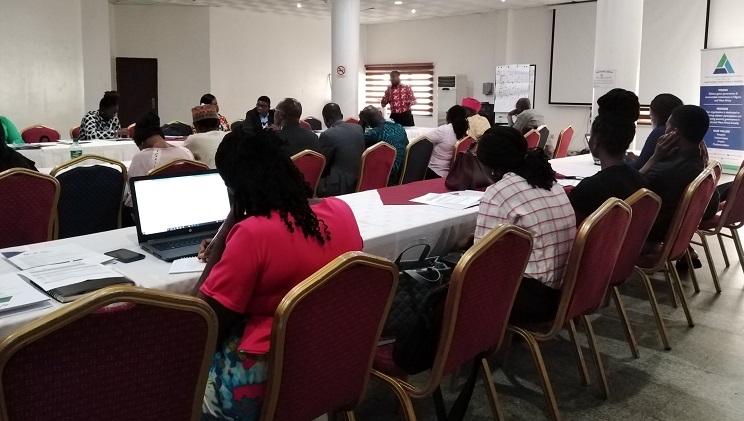
This is part of the focus of a two-day capacity building organised by Nigeria Policing Programme (NPP) in collaboration with  National Human Rights Commission (NHRC) and Partners West Africa Nigeria (PWAN) which started in Abuja today.

Okechukwu Nwaguna, Executive Director of Rule of Law and Accountability Advocacy Centre (RULAAC), said police accountability is important as it would hold individual police officers responsible for effectively delivering basic services of crime control and maintaining order while incorporating the human rights principles and standards.

He said the stakeholders have roles to play to ensuring improved service delivery by the NPF, but this could be done successfully, said Nwaguna, when each stakeholder understood the policing objectives. 

Referring to the Police Act, section four prescribed NPF functions to include the prevention and detection of crime, apprehension of offenders, preservation of law and order, protection of life and property, while section 23 empowered the police to undertake criminal prosecutions. 

He said there should be an expansion of police duties to incorporate human rights principles and obligations dwelling on the passage of the police reform bill (2018) into law. 

In a discussion based on Police internal control systems that include Gender Desk, Complaints Response Unit, X-quad and Human rights unit, the participants held that the systems were in a dysfunctional state.

Innocent Chukwuma, advisor of the Nigeria Policing Programme said torturing should be excluded from police culture when trying to get information from suspects. To him, torture was a crime and any police officer that did such committed a crime.  

The other organisations represented at the roundtable are CLEEN Foundation, International Centre for Investigative Reporting (ICIR) and Lawyers Alert.

Group warns Senate against alleged bill to monitor, punish internet users

PARADIGM initiative Nigeria has cautioned the Senate 9th Assembly against passing oppressive legislation on an alleged proposed bill to monitor and punish internet users.

In a press statement, the organisation said a bill titled “Protection from internet falsehood and manipulations bill, 2019 had been presented to the Senate for first reading.

The bill is said to have appeared in the Senate order paper for 5th November 2019 sponsored by the Senator representing Niger East, Mohammed Sani.

Advising against the bill, PIN said although they do not have full knowledge of the content of the bill but a bill with the same name exists in Singapore.

According to them, in Singapore, the bill prevents electronic communication from false statements and also provided measures to be taken by the government in cases where it occurs.

“We have sufficient cause to believe that this Bill contains elements that may affect the right to free expression of internet users in Nigeria and we intend to follow up on it as it goes through the legislative process and is officially gazetted,” the statement read.

PIN asserted that the recent change of name of the Ministry of Communications to Ministry of Communications and Digital economy was a step forward and must not reprobate.

They said if the bill is passed, it will restrict speech and repress freedom in the digital space.

Program Manager at the Paradigm Initiative, Boye Adegoke said the digital space must remain open with an emphasis on positively affirming and protecting the rights of internet users as opposed in the proposed bill.

PIN is a non-governmental organisation that advocates for digital rights of under-served Africans and on development of public policy for internet freedom.

The organisation operates in Nigeria, Lome, Togo  Yaound, Cameroon  Arusha, Tanzania (East Africa) and Lusaka, Zambia.

“We, therefore, call on the Nigerian Senate and the National Assembly not to pursue such repressive legislation that will serve no good to Nigeria and Nigerians,” Adegoke said.


2020 Oscar Awards: Lionheart rejected for “too much English” dialogue

0

First-ever Nigeria’s entry for the international feature film Oscar category was disqualified by the  Awards Academy because it contained too much English dialogue.

According to TheWrap, The Academy announced the disqualification of “Lionheart” to voters in the category in an email on Monday.

The movie scheduled to screen for voters as one of the entries under the international film feature category on Wednesday did not meet with the Academy’s 13th rule as the movies are expected to be predominantly non-English dialogue track.

 “Lionheart” which premiered in Toronto International Film Festival on September 7, 2018, has only 12 minutes of dialogue that is in the Igbo language-native to Southeastern Nigeria, while the rest of the 94-minute pictures is in English.

The comedy directed by Genevieve Nnaji, and co-wrote by Chinny Onwugbenu and featured top Nigerian veteran actors- Pete Edochie, Nkem Owoh and Onyeka Onwenu including some celebrated Nigerian musicians  showed Nnaji playing the role of a woman who tries to keep her father’s struggling company afloat in a male-dominated environment

The decision of the academy to disqualify the film has been criticised by the Nnaji, Nigerians and fellow actors on Twitter. She called out the Oscar committee on its decision stating that the rejection based on language violated the recognition of English as Nigeria’s Official language.

“This movie represents the way we speak like Nigerians. This includes English which acts as a bridge between the 500+ languages spoken in our country; thereby making us #OneNigeria.” She added, “It’s no different to how French connects communities in former French colonies. We did not choose who colonized us. As ever, this film and many like it is proudly Nigerian.”

Other Twitter users have also said that the disqualification of the film is one of the recent negative impacts of colonialism in Africa.

The global streaming giant Netflix had acquired the film for worldwide distribution at an undisclosed price.

Forerunners in the category include South Korea’s “Parasite,” Spain’s “Pain and Glory” and France’s “Les Miserables.”

Although it has been disqualified from its category, the film is not excluded from entering other Oscar categories, including consideration for the best picture.

The rejection of “Lionheart” dropped the number of films competing for the award to 92 from what had been a record 93 entries.

FG withdraws corruption charges against Pinnick, others

0

THE Federal High Court, Abuja Division, on Tuesday, struck out the case of fraud brought against the President of the Nigerian Football Federation, Amaju Pinnick.

Premium Times reports that the court decision was made following the federal government application to withdraw the case against Pinnick and others accused of mismanaging money gotten from the Federation of International Football Association (FIFA).

President of the Nigerian Football Federation alongside four others had in May arraigned by the federal government on 17 counts for allegedly diverting the sum of $8.4 million, which was given to the NFF as fees for appearing at the last Russia 2018 World Cup.

The four others include Seyi Akinwumi, NFF’s First Vice President; Shehu Dikko, the second Vice President; Mohammed Sanusi – General Secretary, and Ahmed Yusuf Fresh, an NFF executive member.

They were also alleged to have contravened the law by failing to declare their assets and were arraigned by the Special Presidential Investigation Panel for the Recovery of Public Property (SPIP).

Okoi Obono-Obla-led panel that investigated the case has since been dissolved by President Muhammadu Buhari. Obono-Obla himself is also wanted for allegedly forging a WAEC certificate.

Lawyer representing the NFF officials, Mohammed Katu while making his submission said, “We asked that since the prosecution has applied to withdraw the charges, the defendants should be acquitted. The court invoked section 355 of the Administration of Criminal Justice Act to withdraw the charges.”

Section 355 quoted empowers the prosecution to withdraw its charges against the defendant where necessary.

However, this trial is separate from that being conducted by the anti-graft agency, EFCC, against Mr Pinnick and others.

Details later…

OPEC predicts shrinking market sales for member nations, as India, China set to lead global oil consumption

0

THE Organisation of Petroleum Exporting Countries, OPEC, on Tuesday disclosed that oil demand would shift from industrialised countries to India and China, leading to the growth global consumption of oil till 2040.

At the presentation of OPEC’s annual oil report in Vienna, Austria, it was projected that global demand will clock 105.6 million barrels per day in 2025, which is 6.9 million barrels per day higher than the global oil demand in 2018.

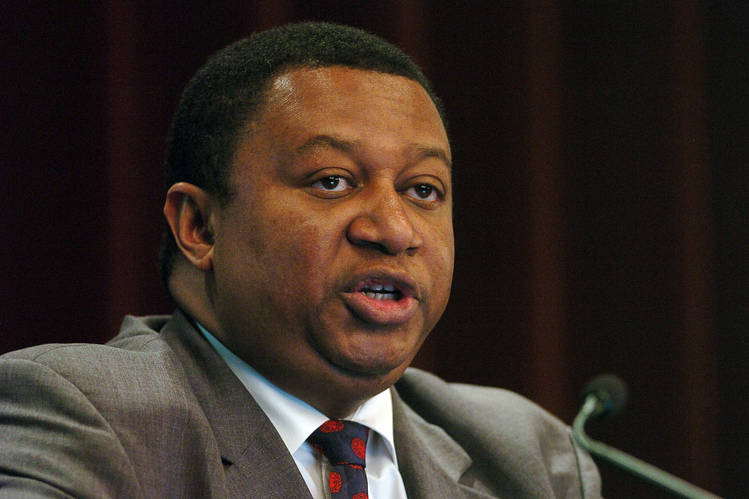
Mohammad Barkindo, Secretary-General of OPEC, said the oil market for OPEC was shrinking, a factor he blamed on rising supply and fluctuating demand of crude oil.

“Signs of stress have appeared in the global economy, and the outlook for global growth, at least in the short- and medium-term has made OPEC revise its benchmark for global oil demand growth repeatedly over the past year,” he said.

The report highlighted that developing and emerging economies would play a huge role in the oil market outlook, with projections that India’s growing middle-class consumers will need an additional  5.4 million barrels per day to its current usage while China will increase its current quota by 4.4 million barrels.

“India is projected to be the country with the fastest oil demand growth and the largest additional demand,’’ the report stated.

However, North America, Western Europe, Japan, South Korea and Oceania will consume 9.6 million barrels per day less according to the long term forecast. It also anticipates that the 14 nation OPEC countries, will experience a declining demand for their crude oil products until around 2025 when US crude oil output is envisioned to start falling.

India replaced the US in 2013 as Nigeria’s biggest exporter, this is prompted by a shift in crude demand by the US which turned its attention to shale production. As a result,  Nigeria suffers a 43.2 per cent drop in crude sales.

This development suggests that for Nigeria to remain fiscally viable, and grow its economy in the short – term, it has to retain India as a customer.

“We have already started seeing a deceleration of growth in the United States. The shale patch in the U.S. is facing a tremendous amount of headwinds as a result of the unprecedented growth that we have seen in the last couple of years,” Barkindo said.

OPEC expects supply from non-OPEC producers to hit a high of 72.6 million barrels per day in 2026 and fall to 66.4 million barrels per day by 2040.

“In the long term, it is OPEC that will be expected to meet the majority of oil demand requirements,” Barkindo said.

UN Secretary-General has ‘no plans’ for proposals on journalist safety

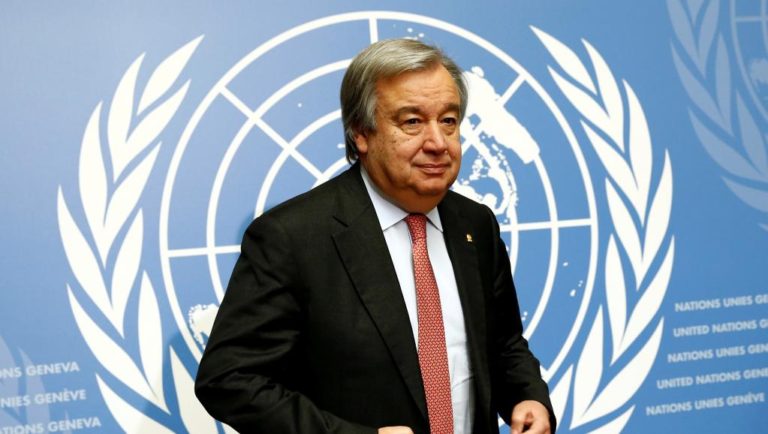
THE United Nations Secretary-General, Antonío Guterres has ‘no plans’ to effect proposals submitted by 72 media groups and non-governmental organisations (NGOs)to name a representative for the safety of journalists across the globe.

A United Nations spokesman said to Eye on Global Transparency that there are no such plans by the UN to announce such a position.

In 2018, Guterres named his senior adviser Ana-Maria Menéndez as his point person on the safety of journalists, an initiative media group officials applauded as a place to submit their concerns but noted it was not enough.

After the commemoration of the International Day to End Impunity for Crimes against Journalists on November 2, the Eye on Global Transparency said it sent series of inquiries to the Office of the UN Secretary-General as regards rumours that he is not interested in setting up a representative.

Before the confirmation by the UN spokesman, there were speculations that the UN may reject the proposal by the media groups.

Deputy General Secretary of the International Federal of Journalist, Jeremy Dear, said there is clearly some strong political obstruction within the UN systems (member states).

He added that some countries have put pressure on other states not to host meetings or take part in events that have to do with it.

Agnes Callamard, UN Special Rapporteur on Extra-Judicial Executions said she made the recommendation to the UN to set up a representative on safety of journalists across the globe after she was assigned to investigate the killing of Washington Post Reporter, Jamal Kashoggi.

She suggested that it will serve as a road map to curb the extrajudicial killing of journalists in all countries of the world.

In 2018, Christophe Deloire, secretary-general of Reporters without Borders, said his organisation had made the call for such a representative within the UN in 2018.

He said the proposal was backed by more than 130 media outlets, NGOs and labour unions throughout the world but without effect.

Callamard in her reaction to the statement of the spokesman tweeted that impunity is not a fatality but a man-made curse that is politically made.

She said it is politically sustained and should be fought charging the UN and states to move beyond denunciation and establish actual effective tools to end impunity for killings of journalists.


Buhari appoints ex-CBN deputy gov, Sarah Alade as SA on Finance and Economy

0

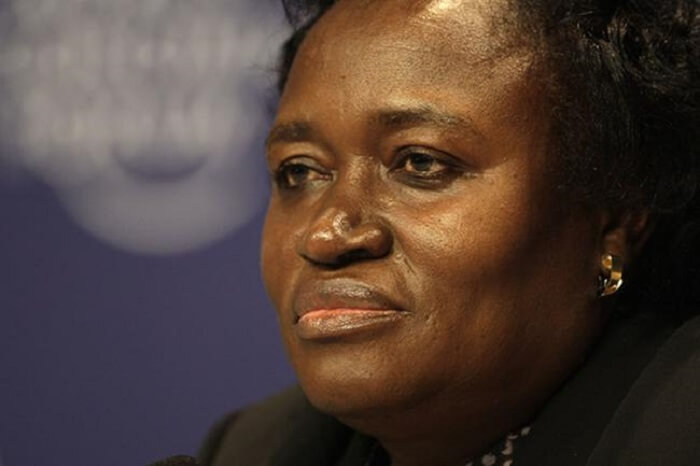
ON Tuesday, President Muhammadu Buhari appointed Sarah Omotunde Alade as the Special Adviser to the President on Finance and the Economy.

The information was disclosed through a statement on Nigeria’s Presidency Twitter handle @NGRPresident.

According to the statement, Alade’s appointment as the adviser on finance and the economy to the president is domiciled in the Ministry of Finance, Budget, and National Planning.

The statement said Alade holds a BSc in Economics and a Ph.D. in Management Science (Operations Research). It stated that she retired from the Central Bank of Nigeria (CBN) as Deputy Governor in 2017 after spending 23 years in the apex bank.

“She had also acted briefly in 2014 as the CBN Governor,” the statement read.

Market grows in Africa for weaponised spyware aimed at activists, journalists

0

By Lisa Vives

IF you’re worried about robocalls offering a dubious sale of bitcoins, a new technology aimed at political dissidents will chill you to the bone.

Pegasus, an all-seeing spyware, worms its way into phones and starts transmitting the owner’s location, encrypted chats, travel plans – and even the voices of people you meet – to servers around the world.

Citizen Lab, a Toronto-based internet watchdog, is notifying journalists, human rights activists and other members of civil society whose phones have been targeted using the spyware.

On the list of targeted individuals, many are said to be from Rwanda and include a journalist living in exile in Uganda; a senior member of the Rwanda National Congress, an opposition group in exile; and an army officer who fled the country in 2008 and testified against members of the Rwandan government in a French court in 2017.

“It’s a grave violation,” says Placide Kayumba, a Belgium-based member of Rwanda’s FDU-Inkingi opposition party, who was informed by Citizen Lab that his phone was targeted.

“It’s scary, not only due to the information I exchange as a human-rights activist and politician, but my conversations with family, friends, all the private details I have shared on the phone.”

“All of my colleagues at the center of the party are monitored and threatened on a daily basis with assassination, disappearance, imprisonment,” he says.

Last year, Citizen Lab, in a report titled ‘Hide and Seek’ identified 45 countries in which infected devices had been traced. Twelve African countries were on the list: Algeria, Cote d’Ivoire, Egypt, Kenya, Libya, Morocco, Rwanda, Togo, Tunisia, Uganda, Zambia and South Africa.

The NY-based Committee to Protect Journalists issued a safety advisory: “This spyware gives the attacker the ability to monitor, record, and collect existing and future data from the phone… The spyware can remotely activate the camera and microphone to surveil the target and their surroundings … Journalists will likely only know if their phone has been infected if the device is inspected by a tech expert.”

“The threat this poses to journalists can’t be overstated,” said Avi Ascher-Shapiro, a NY-based technology and foreign affairs journalist at the Columbia Journalism Review.

Developed by the Israeli cyberarms firm, NSO Group, Pegasus is not alone in the domestic spying field. In Uganda, the Chinese firm Huawei developed spyware to break into opposition leader Bobi Wine’s WhatsApp chat group, causing cancellation of street rallies and the arrests of Wine and dozens of his supporters.

Lisa Vives writes from New York City

One feared dead in fire outbreak at Balogun Market ──Witness says

0

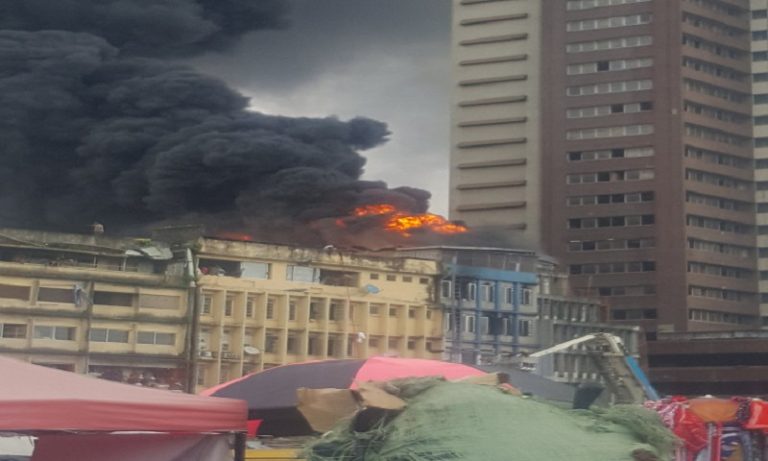
POPULAR Balogun market in the business district of Lagos state has been gutted by fire, leaving one person feared dead.

The fire reportedly started at the early hour of Tuesday morning, and the social media have been awash with videos and photos of the incident.

Speaking to The ICIR, a trader who identified herself as Chidinnma Favour Benson said the fire had started in a building, known as former Radio Nigeria complex.

She said the building is behind her business place, and one of the Good Samaritans helping to douse the fire got cut up in the inferno and died.

“The burning building is at the back of my building opposite the Great Nigeria House. It is about 20 kilometres before my own place.

“One of the people that went to off the fire died and all of the goods in that building got burnt.

“The fire service showed up and they were the ones that quenched the fire,” Benson said.

Benson who is a trader at the Balogun market said the operatives of the Fire Service had arrived same time she also arrived at her business place which was at 10 am on Tuesday morning. However, she said the fire had started even before her arrival.

She said tension has been doused as at 12: 31 pm, but another fire outbreak started a few minutes later, but the cause of the Fire had not been established.

The Lagos State Emergency Management Agency (LASEMA), Nosa Okubor and that of the fire service, Adeleke Ashimi, had confirmed the incident to The Punch stating they were not aware of the extent of the fire.

“Our men are on their way there as well. We don’t know the extent of the fire yet,” Ashimi said.

She also confirmed that another complex on Dosumu Street, about 500 meters from Martin Street, was on fire.

https://twitter.com/adeFAYE_/status/1191661368333807617