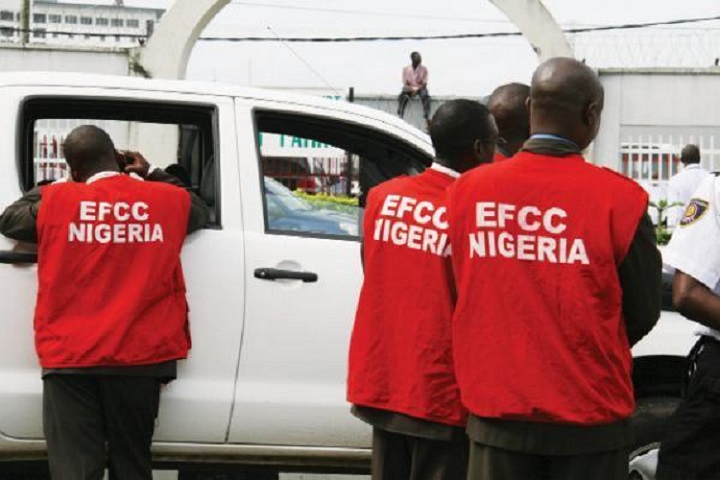
WITNESS of the Economic Financial Crime Commission (EFCC) has testified against the former minister of Aviation, Femi Fani-Kayode, ex-minister of finance, Nenadi Usman and two others as the trial resumed on Tuesday.
Shehu Shuaibu told the court that the ministry of external affairs paid N800 million to a company, Joint Dimensions Limited with the absence of evidence of the contract.
Femi Fani-Kayode, Nenadi Usman, Danjuma Yusuf and Joint Trust Dimensions Limited appeared before the court as 1st, 2nd,3rd and 4th defendants respectively on 17 counts.
While the defendants pleaded not guilty, Shuaibu led by the EFCC counsel, Rotimi Oyedepo presented Exhibit E8 which is the statement of account that belongs to Joint Trust Dimensions Limited.
Shuaibu said he found, from the statement of account, an inflow of N800m from the Ministry of External Affairs on January 16, 2015, which one Darbisu and one Benjamin were signatories to the firm’s account.
He said the two signatories are ex-officials of the Ministry of External Affairs, adding that they currently work with the National Intelligence Agency.
Under cross-examination, Shuaibu agreed with the first defence counsel, Chief Ferdinand Orbih (SAN), that “neither of the defendants had any input in making entries in Exhibit E8.”
The Judge, however, adjourned till October 31, 2019, for the continuation of trial.
Fani-Kayode and the others are being prosecuted in connection with campaign funding for the failed re-election bid of ex-President Goodluck Jonathan in 2015.
Fani-Kayode was the Director of Publicity of ex-President Goodluck Jonathan’s presidential campaign organisation for the 2015 election and was accused of conspiring with the others to, directly and indirectly, retain various sums which according to the EFCC, were proceeds of crime.
One of the counts read that Fani-Kayode, Nenadi Usman and others are being prosecuted for conspiring among themselves to indirectly retain the sum of N1,500,000,000.00 which sum they reasonably ought to have known forms part of the proceeds of an unlawful act to wit: stealing.
According to the EFCC, the four allegedly retained N300m, N400m and N800m respectively, which are all proceeds of corruption.
LAST Thursday 24th October, a coalition of Civil Society Organisations (CSOs) under the aegis of Concerned Nigerians approached the Economic and Financial Crimes Commission (EFCC) to submit a petition against Bola Tinubu, National Leader of the All Progressives Congress (APC).
The petition bothers on how two bullion vans, driven into Tinubu’s Ikoyi residence on the eve of the 2019 Presidential election reportedly transported cash for the purpose of vote-buying.
Yet, the anti-graft agency, since the February 23rd poll has remained silent on the incident until the interest group led by Deji Adeyanju filed the petition.
Tinubu, who spoke shortly after casting his vote on the election day admitted in video footage that the vans were conveying money. He thereafter described those complaining about the bullion vans driving into his house as mischief-makers.
What is your headache? He asked journalists who queried him. “Are those ballot papers?” he said referring to the van. “So, even if I have money to spend in my premises, what is your headache?” he added.
The Bullion Vans entering Tinubu’s House File Copy
“Excuse me, if I don’t represent any agency of government and if I have money to spend…., if I like, I give it to the people free of charge, as long as is not to buy votes…..who are those watching my house looking for bullion vans, they must be mischief-makers.”
Tinubu is a strong loyalist of President Muhammadu Buhari, and also a major political kingpin in the ruling APC. In 2012, he conceived the merger of about four political parties to realise the APC, which eventually became the ruling party since 2015 general election.
However, the EFCC on Monday told The ICIR it already acknowledged receipt of the petition. But indication has shown that the petition may not get the desired attention anytime soon due to scores of petitions the commission has received both at its physical offices and through its website.
“Once you submit a petition, there is a waiting time. We receive hundreds of petitions throughout the country everyday,” says Wilson Uwujaren, the EFCC Head of Media and Publicity. “…Investigation takes time. We are not police station where complaints come and we make an arrest. No, EFCC does not work like that. As people submit petitions in our offices the same way they drop petitions online.”
The spokesperson said once a petition is received, it would undergo a review process; the evidences are checked before the actual investigation commences if the claim has merit.
But, considering the status of the personality involved, The ICIR asked if there was a timeline to the investigation, Uwujaren only responded on the anticipated result of the petition. He could not provide an answer as to when exactly the accusation against the former Lagos State Governor would commence.
“I don’t know about that,” he stated. “Let’s look at the issue we have on ground first. I don’t want to get into a matter that is not before me at the moment. They have dropped petition, let’s wait for the outcome of the petition.”
“Our procedure is this, once we receive a petition we look at it. If it has merit, we will invite the petitioner to come and justify the petition, so there are times it takes some time because there are hundreds of petitions submitted daily.”
Meanwhile, prior to the petition, Segun Awosanya, Convener of the #EndSARS campaign had accused the EFCC of being docile over the vans allegation, despite picture evidence and popularity of the tweet, revealing the alleged crime.
Awosanya responded to the EFCC’s tweet which boasted of its constitutional mandate, citing Section 7 (1) of the EFCC Act 2004. It says it has the mandate to probe any persons if it appears such a person’s lifestyle and properties are not commensurate to his earnings.
But in his reaction, the activist said, “I’m sure this section only gives you an erection when it concerns Yahoo Boys and opposition politicians. While the miraculous self-aggrandisers in bed with those the head of the EFCC worships are immune to investigation.”
“Daylight bullion van exhibition of Bourdillon is justified right?” Awosanya had stated.
The commission in a tweet has tasked concerned citizens to file petitions on suspected corrupt practices, and some CSOs have already responded.
EFCC responds to a complainant via social media on how to reach out to the commission
EFCC is our partner but we lack prosecution power
Rotimi Lawrence, Spokesperson for the Independent National Electoral Commission (INEC) while reacting to the petition excluded INEC’s involvement in the entire process but said except the anti-graft commission is able to investigate and establish the indictment; it may be difficult to comment on the matter.
Though the commission admitted vote-buying as an offense, which its partner the EFCC made several arrests during the same poll, it is more interested in corrupt incidents that occurred at the 176, 000 polling units nationwide.
His words: “Of course, we work with the EFCC to help us track any suspicious activity which could be linked to vote-buying. And because the EFCC is so experienced in tracking those involved, they are the ones to tell us.
“These are the things that cannot be answered except EFCC confirms that they received a petition, they investigated and this is linked to vote-buying. That is when INEC will be involved. We can only have case files to help prosecute whoever is involved. As it is now, we don’t have any say in the matter. Let the appropriate organisation investigate and make a determination.”
According to him, the essence of partnership with the Independent Corrupt Practices and Other Related Offences Commission (ICPC), Police and EFCC was to reduce incidences of vote-buying during elections.
What does the money laundry Act say
The Anti-Money Laundry Act put a cap of N5 million on cash that could be handled by private individuals. This implies that any cash transaction beyond N5 million should be done via bank. Though it’s uncertain what the content of the bullion van was, many assumed it was cash meant to influence the electorate. It is also assumed that it would be a tough decision for the anti-graft agency to probe the party chieftain. For instance, Arewa Youth Consultative Forum (AYCF) believed the accused would not be prosecuted due to his political affiliation.
Barrister Kayode Oguntuase, a practising lawyer at Ace Solicitors while reacting to the incidents said it is assumed that such a large sum, to be expended is more than the acceptable cash in possession of the party chieftain.
While emphasising that bullion vans are not to convey a little sum of money, he said every reasonable person would assume he was transporting large sum to his compound.
“Of course, you don’t need bullion van to transport N2 or N3 million and we have the anti-money laundry act, amended in 2016. It fixed a limitation on the amount of cash individual or corporate body can spend at a given time, N5 million for individuals and N10 million for corporate bodies.”
However, Oguntuase noted that the EFCC has the responsibility to intervene in the matter once prima facie is established. “Adeyanju has written a petition already, requesting the EFCC to query the matter. Tinubu is also a politically exposed person and he insisted it was his money, so I will be surprised if he is not probed by the EFCC.”
Another lawyer, Barrister Chukwunonso Akah, Head of Chambers, Ace Solicitors added that though EFCC may not respond to all petitions but once there is prima facie against the accused, there is no basis for the commission not to act on the matter.
Deji Adeyanju’s tweet days prior to the submission of the petition to the EFCC. Source: Twitter
Barrister Ifedayo Oluseye, Head of More Solicitors, in his reaction, also argued that considering the timing at which the bullion vans were driven to the accused person’s apartment – it calls for a question. He described the incident as abnormal, saying it is a criminal offense to have such vans in Tinubu’s apartment. According to him, it amounts to flouting the Anti-Money Laundering Act.
“It is abnormal to see a bullion van entering into someone’s apartment. Of course, we all know what the bullion van conveys. It is money…when you put 2 and 2 together; of course we know it contains money.”
But he emphasised on proving the case with reasonable evidence that the vans contained money. This, he noted how Tinubu granted an interview on the day of election affirming it was his money which he could spend at will. Aside, he recollected how the politician boasted he did not get any contract from the federal government but worked for his money.
“So, that is an admission that the content of the bullion van is money and it is a crime which calls for an investigation.”
He specifically mentioned the anti-money laundry and electoral acts as laws the former governor violated.
On INEC’s response that the incident did not occur at the polling units, Oluseye disagreed but emphasised on the timing the vans were driven to the politician’s apartment.
“At that point, it could be established that you have lots of would-be voters in his house because it was televised and this thing happened a day to the election.”
But Abiodun Salami, APC spokesperson in Lagos State disregarded the petition stressing that it lacks evidence.
“Let them come up with the proof. The man is a private citizen and he has been out of government for the past 12 years,” salami stated.
“If he has decided to spend his money on his party, how is that a problem? Let them come up with proof that somebody’s money is missing.”
A COUNCILLOR representing Kakuri Hausa, Ward, Kaduna South Local Government of the state, Theophilus Madami, has been arrested for offences bordering on alleged criminal breach of trust and misappropriation of funds to the tune of N11,080,000.
The EFCC in a statement signed by its Head, Media and Publicity, Wilson Uwujarem on Tuesday said Madami was arrested by the Kaduna Zonal office of the commission.
The statement read in part: “The suspect, allegedly approached one, Ibrahim Ringim Haruna, Chief Executive Officer of Pyramid Supplied Services Limited, a distributor of pasta products, with claims that his council needed pasta products for distribution to its citizens”.
The anti-graft agency said the company consequently supplied products to Madami worth N16.8 million, who paid a deposit of N5 million, leaving a balance of N11.8 million balance.
The statement noted that after delivery of the goods, the suspect diverted the proceeds to his personal use and refused to pay up his debt as agreed.
The EFCC said Madami would be charged to court as soon as investigation is concluded.
THE Minister of Information and Culture, Lai Mohammed has decried the alarming rate of fake news in the country, saying it is an imminent danger to the survival of Nigeria’s democracy.
Mohammed at a press briefing in Abuja on Tuesday said the present administration has no intention of muzzling the media or stifling free speech, but was focused on the fight against fake news and hate speech in the country.
In solving the menace of fake news, the minister said a campaign was launched to rid the nation’s airways of fake news and hate speech. He noted that a committee was also formed to ensure its implementation.
Mohammed said the committee was formed at the recommendation of President Muhammadu Buhari “to inject sanity into the country’s broadcast industry, flooded with unprofessional and unethical conduct of some broadcast stations, especially before and during the last general elections”.
The committee, according to him, is also saddle with ending all forms of monopoly detrimental to the actualization of the immense potential of the broadcast industry. He said the implementation would take effect once the committee submits its report.
“Gentlemen, since I launched the committee on the implementation of the approved measures, there have been reactions. Many have hailed our efforts at seeking to bring sanity to the airwaves, while some have attacked us and accused us of trying to stifle press freedom or gag journalists,” he said.
He said no amount of attacks, sponsored or otherwise, will stop the implementation of the approved recommendations, stating that only non-patriots and anarchists would kick against measures aimed at putting an end to fake news and hate speech, especially in our broadcast industry.
“However, if you engage in disseminating fake news or hate speech, you need to be worried, because we will not spare you.
“We cannot allow fake news and hate speech to become free speech, because these Siamese Twins of Evil are capable of inflicting untold damage on our democracy and threatening our national unity.
“Gentlemen, since we launched our reform of the broadcast industry, many Nigerians have reached out to us, demanding that we also look into how to sanitize the social media space.
“No responsible government will sit by and allow fake news and hate speech to dominate its media space, because of the capacity of this menace to exploit our national fault lines to set us against each others and trigger a national conflagration.
THE National Agricultural Seeds Council (NASC), Catholic Relief Services (CRS) and National Root Crop Research Institute (NRCRI) have commenced training of 18 third-party agents for cassava seeds inspection in Benue state.
The inspectors are expected to assist the seeds council on certification of quality cassava seeds to smallholder cassava farmers.
Phillip Ojo, the NASC Director-General while declaring the training open Monday in Makurdi, Benue State Capital, said the project is to develop a sustainable cassava seed system and well-trained third-party agents for the stakeholders in the sector.
According to him, in the last three years, the project developed technologies such as the Semis Autotrophic Hydroponics (SAH) for speeding up the propagation of clean cassava planting materials and the cassava seed tracker.
“The Council embarked on nationwide training of seed certification officers for cassava certification. In 2017 and 2018, the Council-certified 650 hectares and 1000 hectares of cassava seed fields respectively,” says Ojo.
However, he disclosed plans to increase the production of improved cassava materials, hence an increase in hectares of cassava seed production.
“You may wish to note that the number of seed companies has witnessed a dramatic increase from 156 in 2017 to 314 as of today with over 250 applications from prospective entrepreneurs.”
The DG thereafter warned that any agent found guilty of compromising seed quality would be sanctioned.
Hemant Nitturhen, the project director for the International Institute of Tropical Agriculture (IITA) noted that since cassava is a major staple crop in the country, the training would boost better production and increase quality cassava seeds certification for smallholder farmers.
Though Nigeria is considered the world’s largest producer of cassava with 47.4 million tons as of 2014, in terms of value addition and international market penetration, it’s not doing so much.
As of March 2006, it annually produced 38 million metric tons but currently produces one-fifth of world cassava production put at 253.4 million tons with over N20 trillion potential in revenue generation.
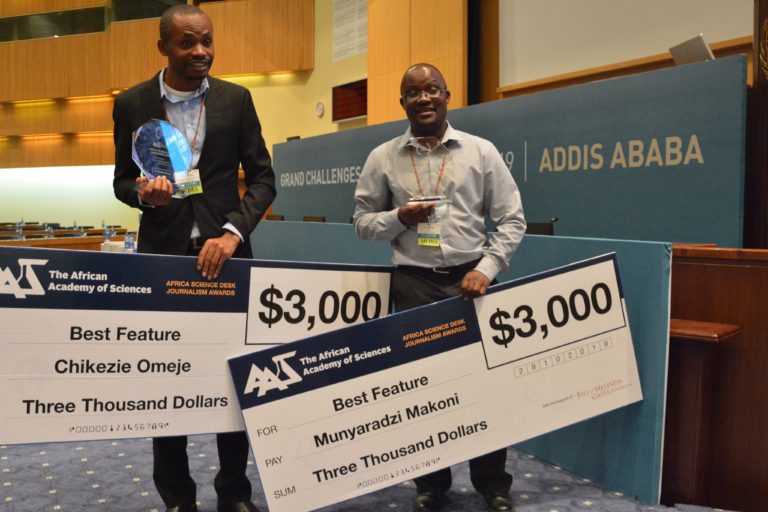
HEAD of newsroom, senior investigative and data reporter of the International Centre for Investigative Reporting (ICIR), Chikezie Omeje and Zimbabwean reporter Munyaradzi Makoni have bagged cash prize award of $3,000 each in Addis-Ababa, Ethiopia for their reports in science journalism.
The award was presented during the Grand Challenges Annual meeting in Addis- Ababa, a meeting that brings scientists and policy makers together, creating solutions to global health problems.
The recognition was sponsored by the African Academy of Science, a non-governmental organisation based in Nairobi, Kenya with support from Bill and Melinda Gates Foundation.
Omeje is currently at the Columbia University Graduate School of Journalism in New York majoring in Data Journalism.
His report on the mental injury inflicted on children by the Boko Haram insurgency in the northeastern part of Nigeria won him the award.
Capturing the experience of Blessing and Aisha who are Boko Haram victims, Omeje wrote about how the two teenagers witnessed the murder of their parents in cold blood and how the experience haunt them till date .
“Without psycho-social help, the girls have been forced to develop their own ways to cope with the anguish. They cuddle and pray. ‘I ask Allah to help us,’ Aisha says, drawing a retreating veil that reveals her cornrow braid to her forehead. ‘I pray to Jesus to deliver us’ adds Blessing, appearing a little taller than Aisha in her white gown,” Omeje wrote.
The second winner of the award, a Zimbabwean freelance journalist Makoni who is based in Cape Town, South Africa won with his report on solar-tracking bracelet for nomadic pregnant women in Kenya.
His story detailed the use of the solar powered GPS embedded in a bracelet given to nomadic pregnant women in semi-arid area of Marsabit County in Kenya in order to prevent maternal mortality.
Baby are delivered at home in this region, and mothers die from bleeding during childbirth and babies too, due to malnutrition.
Makoni showed how the disappearance of the funding in September may end the project targeted at saving lives of pregnant women.
He quoted Denis Kalikdane the handler of technology for the programme who emphasised that solar was the best option to power the GPS because only a few would have been able to afford it if it was on battery.
The bracelets are charged via a tiny fitted solar panel that absorbs light while on the wristwatch, Makoni wrote.
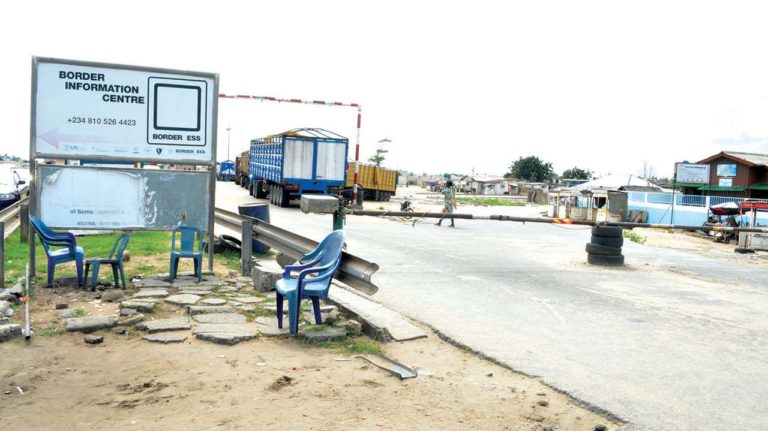
SINCE the Federal Government launched a border closure policy in late August, the decision has triggered mixed reactions from Nigerians, neighbouring countries and regional bodies.
Farm produce from neighbouring nations such as Benin Republic, Togo, Ghana meant for the Nigerian market rots away daily due to the government’s policy. And the cost of food items in Nigeria, particularly rice, is on a steady rise.
For instance, prior to the land border closure, a 50kg bag of rice that was sold at N13, 000, now goes for N25, 000.
After the border closure, the rigours they go through and tricks smugglers employ in bringing the so-called imported rice to Nigeria – storing it in a car bomber, fuel tank as seen here is incredible! pic.twitter.com/hRqigycBgG
As at 2011, Nigeria annually spent N24.5 trillion importing food items into the country. Five years after, a different report put the figure of four major imported commodities – Wheat, Rice, Sugar and Fish at $11 billion (4 trilliion). Experts have argued that Nigeria’s fertile soil places it at advantage to grow rice in over 18 states across the country, thus feeding itself with the commodity which has an annual estimated import figure of N356 billion.
For reasons partial border closure appears to be the right decision, the above figure is invariably assumed good enough to create local jobs. Rather, what we have are continued job exports through persistent food imports. Former Ministers of Agriculture and Rural Development, Dr. Akinwumi Adesina and Chief Audu Ogbeh, as well as former Agriculture Minister of State, Heineken Lokpobiri, have repeatedly claimed rice and frozen foods illegally imported through the land borders lack good nutritional value compared with local varieties. They argued further that such imports keep crippling local capacity and government efforts to promote farming, especially among the youth. Ironically, more than 18 states from the 36 across the country have the potential to grow rice.
Some of the states include Kebbi, Ogun, Kaduna, Adamawa, Sokoto, Kano, Katsina, Cross Rivers, Ebonyi, Benue including the Federal Capital Territory (FCT) to mention but few.
Most importantly, the sector has significantly enjoyed the attention of repeated administrations either in terms of funding or policy. Aside from Levy and Excise Duty-free tariff for agricultural commodities, the sector has enjoyed World Bank loans through the FADAMA projects and recent FADAMA Additional Funding I and II. The CBN, as at April 2019 says it has so far disbursed N174.48 billion to farmers via the Anchor Borrowers Programme (ABP). And since the border closure, the federal government boasted to have raked in N1.4 billion and arrested 319 suspected smugglers.
But, despite these interventions and the recent land border closure, believed good enough to ensure self-sufficiency in rice production, the nation might continue to witness higher costs of rice except deliberate and sustained actions are taken in selected areas. The ICIR identifies these to include farm mechanisation, extension services, subsidy for farmers such as the Growth Enhancement Support Scheme (GES), establishment of more rice milling centres, improved finance – single-digit interest rate; banks until lately have been recalcitrant to lending to farmers and even those who do do so at high-interest rate; addressing infrastructure deficit and awareness creation on insurance or early warning system against flooding or natural resources that could affect farm harvests.
Farm Mechanisation
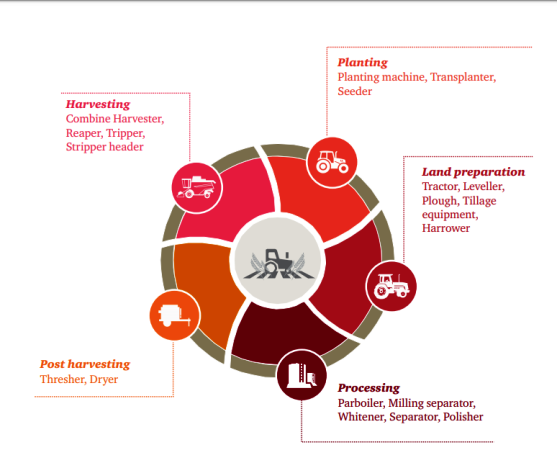
Machinery and Equipment Requirement Across the Rice Value Chain. Source: PWC 2017 Report on Boosting Rice Production through Increased Mechanisation
Statistics have shown that Nigeria’s large population is fed by subsistence farmers largely in rural communities. Majorly, 80 percent of rice grown in the country which is about 3.7 million tonnes is produced by smallholder farmers while the remaining 20 percent is cultivated by commercial farmers. Yet, local consumption of staple food stands at 6.4 million tonnes as of 2017.
Invariably, this implies an almost 50 percent deficit in local consumption. Cultivation has also been manual, usually through the use of cutlasses, hoes and other crude equipment; hence the level of production output. As such, Nigeria clearly has a high deficit in farm mechanisation, a factor threatening local rice sufficiency target.
A 2017 report from the PriceWaterCoopers (PWC) titled Boosting Rice Production through Increased Mechanisation revealed that agricultural mechanisation in the country has remained so low at 0.3hp/ha unlike 2.6hp/ha in China and 8hp/ha in India.
The report further put the estimated figure of tractors in the country at 22,000 farm machines, relative to 1 million in China and 2.5 million in India – all top rice-growing nations.
“We estimate that increasing the mechanisation rate in Nigeria from 0.3hp/ha to 0.8hp/ha in the next 5 years, can double rice production to 7.2 million tonnes. To achieve this, we estimate that Nigeria will need to at least triple its current stock of machinery over the same period,” the report says.
Extension Services
The role of extension services to farmers cannot be overemphasised. Their responsibility is mainly to enlighten farmers either as groups or through other means on better agricultural practices. Oftentimes, the extension workers are domiciled in the State and Federal Ministries of Agriculture and Rural. They go round to sensitise the farmers of the right choice of seeds, rain onset and offset to guide farmers towards better harvests.
However, the ratio of extension workers to farmers is low.
The National Agricultural Extension Research Service (NAERLS) in a report criticised the population of extension service to the farmers. As a result, a digital platform to share information across to farmers was established. But again, how many farmers are digitally literate?
Farm Subsidy
Several experts have argued that for the nation to realise its food sufficiency target, there should be a constant and strategic subsidy for farmers. Such incentive was provided to farmers during the administration of Adesina, the former Minister of Agriculture and Rural Development. The local farmers across the nation were provided with subsidised seeds and fertilisers.
The model was such that the Federal Government pays 50 per cent for the farm inputs, the State was responsible for 25 per cent while the interested but captured farmers only paid 25 per cent. Ogbeh, the immediate past agriculture minister also maintained the same argument attributing lack of subsidy to farmers as a reason for the increasing price of local rice.
“Agriculture should be subsided, but strategic subsidization at the point of providing general incentives that give enabling environment for farmers to achieve optimum production,” Prof. Oluwole Fatumbi, Lead Specialist at the Forum for Agricultural Research in Africa (FARA) added at recent training in Abuja.
“….only 2 per cent of Americans are farmers on the farm while 13 per cent are in value chain development, processing and financing which brings growth and reduction in the price of the commodity. So, I am not against government efforts, they are trying, but they need to channel the efforts and energy in the right direction to ensure that agriculture delivers for the larger population.”
Rice Milling Centres
Rice generates more income for farmers than any other cash crop in the country. This singular reason led to a steady increase in local production despite the poor mechanisation. For instance, in 2017, the United Nations’ Food and Agriculture Organisation put the value of harvested rice paddy at 4,912,650 but mainly affected by milling capacity.
Rural farmers are mostly faced with the challenge of logistics to transport rice paddy to millers. Some would often travel kilometres to mill but local access roads are usually in bad states while corruption trails distribution of milling machines.
Though new mills are springing up via private sector involvement such as the 250 tonnes daily milling capacity Amarava Rice Mill, Kano state, local access to farm mechanisation remains abysmally low.
In July 2018, the former Agric. minister signed N10.7 billion deal on behalf of the government with MV Agro Engineers, to make available integrated rice mills for the use of local farmers. It is to be delivered in December this year. Hopefully, this promise will be fulfilled by the set date.
Single Digit Interest Rate
Except for CBN interventions with special interest on rice, farmers’ access to credit from commercial banks has been a huge challenge. This situation also extends to rice farmers which, in most cases, the commercial banks prefer to give loan more than other businesses.
Until August 2018, commercial banks gave loaned to farmers with an interest rate of about 30 per cent, an initiative Ogbeh repeatedly described as non-sustainable.
“That the Central Bank considered working with the Bankers’ Committee to finance agriculture from the commercial banks’ huge reserves, running into billions of naira, is a cause for optimism in the agricultural sector.
“This is more so as the single-digit interest rate of nine per cent on long-term credit of a minimum tenor of seven years will support stable agricultural investment and predictable increase in food production. The multiplier effect of this initiative at a time of a restructured and recapitalised Bank of Agriculture will be a reduction in uncertainties and avoidable risks in agricultural investments where farmers will enjoy wider latitude of access to loans from either commercial banks or BOA with less hassles,” Ogbeh had stated. Yet, farmers wanted a 5 per cent rate instead of the existing 9 per cent.
Infrastructure Deficit
One of the major challenges of rural farmers is basic infrastructure such as access roads to transport agricultural products from farms to markets. This is evident in Benue State where farm produces rots away, especially during the rainy season due to lack of motorable roads. Also for rice, transporting paddy from farm to milling machine has reportedly been a huge problem – far worse during the wet season.
Awareness Creation
The Nigerian Agricultural Insurance Commission (NAIC) is an agency of government responsible for insuring farm produce against flooding and other forms of disasters, but, most farmers are unaware of its existence yet annual budgetary allocation goes to the agency. Aside, most farmers are still ignorant of how to access financial supports from the government despite huge sum disbursed since the commencement of the Anchor Borrowers Programme (ABP).
More so, information on the free import duty for agricultural machinery is not so popular among rural farmers. These, among others, are to be addressed if the nation must achieve its rice sufficiency target.
Meanwhile, Aminu Goronyo, President of the Rice Farmers Association of Nigeria (RIFAN), conclusively maintained that border closure was to promote patriotism and not to enrich rice farmers.
“Before 2015 Nigeria, spent nothing less than N368 billion for rice importation but today that same money is in circulation within the country’s business community….However, the closure is not to enrich rice farmers but a devotion to the welfare of the country and commitment to compete with other nations,” he said.
The Federal Capital Police has denied a news report that two persons were kidnapped at Rubochi Community in Kuje on Sunday.
According to a media report, there was a shooting by gunmen at midnight on Sunday and it led to the kidnap of a police inspector and one other person.
Meanwhile, Istifanus Sunday Bako, Police public relations officer (PPRO) for Zone 7, Abuja said there was nothing like the abduction of anyone at the Kuje community on Sunday. And no police inspector was kidnapped, he said.
Bako said the report received from the Kuje area on Monday morning did not include cases of kidnapping and shooting.
“I made some contact also, there is nothing like that”, he told The ICIR during a phone call.
The report had stated that the kidnappers demanded a ransom of N10 million.
The ICIR also contacted three other police spokespersons but they were yet to comment on the issue. Those contacted were Frank Mba, National Police PRO; Adeniran Aremu, Deputy National PRO and Anjugurijesse Manzah, the FCT police PRO.
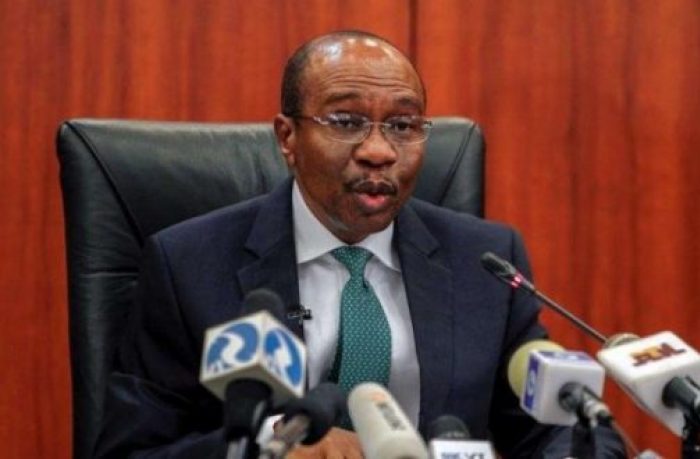
GOVERNOR of the Central Bank of Nigeria, Godwin Emefiele, has stated condition at which Nigerian borders would be opened following the closure in August.
Nigerian President, Muhammadu Buhari had ordered that all Nigerian land borders be partially closed in August 2019, a decision that has sprung national and international reactions.
Emefiele after a closed-door meeting with Buhari on Monday before the latter left for Saudi Arabia, addressing the State House correspondents that before the nation’s borders can be opened, neighboring countries must agree to implement mutual anti-smuggling policies.
He said that the Nigerian rice and poultry farmers have been the major benefactors from the border closure because they have been able to sell all their accumulated produce which have before now remained unsold due to illegal smuggling and importation from other countries.
Emefiele said Buhari, the leadership of the CBN and some state governors launched the WetSeason Rice Farming in Kebbi state in November 2015 and that there has been an immense growth in the numbers of farmers going into farming and production has largely gone up.
He also said that 2015 hither-to, Nigeria has also seen an astronomical rise in the number of companies, corporate and individuals that are setting up mills, integrated mills and even small mills in various areas.
“We have been embarking on a programme where we are saying if you are involved in the business of smuggling or dumping of rice in the country, we close your account in the banking industry and that is very effective”
Stating the reasons behind the border closure, he said the chairman of the Rice Processors Association who owns Umza Rice in Kano called, saying all the rice millers and processors are carrying nothing less than 25,000 metric tons of milled rice in their warehouses.
He said the rice has been unsold because of the smuggling and dumping of rice through the Republic of Benin and other border posts that are in the country.
Emefiele also said that members of the Poultry Association of Nigeria complained that they have thousands of crates of eggs that they could not sell; even some of the processed chickens that they could not sell, also arising from smuggling and dumping of poultry products into Nigeria.
“A week after the borders were closed, the same rice millers association called to tell us that all the rice that they had in their warehouses have all been sold,” he said.
STUDENTS and graduates from over 70 Nigerian universities have shared their campus-based experiences in a newly launched anthology, the Memoirs of Nigerian University Students (MONUS).
The publication of over 100 true-life stories is an initiative of a Tell!, a start-up run by students at the University of Ibadan.
The institutions featured in the anthology include the University Of Ibadan, Ladoke Akintola University of Technology, University of Lagos, University of Benin, Babcock University, Ahmadu Bello University, FUOYE, and various others.
“With stories cutting across themes such as sexual harassment, cultism, rape and institutional irregularities, the publication serves as a means of reflection on the state in which our universities have degenerated into,” the start-up said in a statement shared with The ICIR.
“The organisers hope that the stories can attract both national and international attention to University education in Nigeria for the purpose of inciting sustainable change and development in the universities.”
They also said proceeds from the sale of the anthology will be partly used “to support at least 10 students from low-income families across various universities, with a sum of N100,000 education grant”.
MONUS was guest-edited by award-winning investigative journalist, ‘Fisayo Soyombo, and its foreword was written by Tijani Mayowa, Business and Development Editor at TheCable.
It was created in partnership with Okadabooks, Bambooks, and the University of Ibadan Literary and Debating Society.