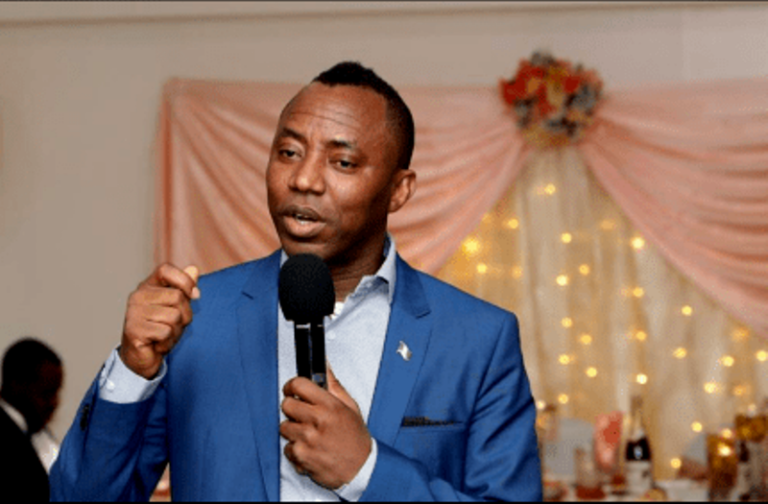
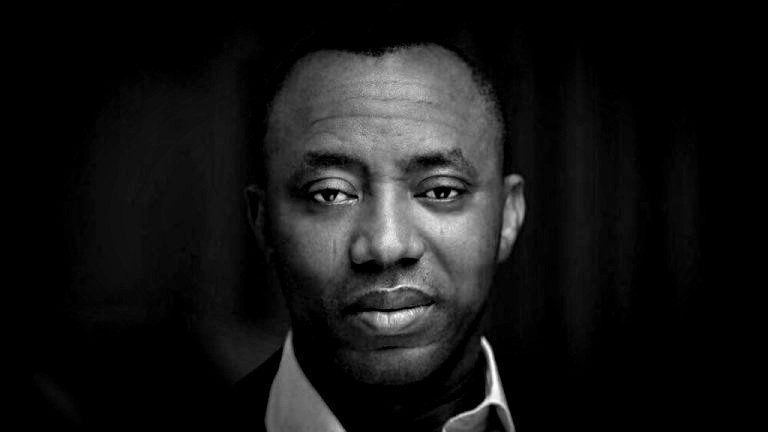
OMOYELE Sowore, founder of Sahara Reporters and 2019 presidential candidate of the African Action Congress (AAC), has filed a fresh bail application to the Federal High Court, Abuja, asking to be released from detention.
He was arrested at about 11 pm on August 2 by operatives of the Department of State Services (DSS) for calling for a revolution and “threatening public safety, peaceful co-existence and social harmony in the country”.
Relying on a provision of the Terrorism (Prevention) Amendment Act 2013, the Federal High Court in Abuja had, five days later, granted the DSS permission to keep him in detention without trial for 45 days. Sowore’s application to upturn this, in August, was not ruled upon by the court.
Sowore’s latest application, filed by Falana & Falana’s Chambers, is seeking bail on self-recognisance (with the condition being only a personal assurance of appearing for trial) or “upon any condition the court may reasonably deem to impose in the circumstance of the case”.
The motion, a copy of which was obtained by The ICIR, noted that Sowore’s arrest was made without a warrant and argued that even someone detained under the anti-terrorism law can be admitted to bail.
It submitted that Sowore is entitled to bail since he has cooperated with the DSS and the government agency has “concluded investigation of this case and announced its findings”.
“The Applicant had also volunteered a statement to the Respondent since the 7th and 8th August,” it further stated.
“The persons, who participated in the protests of 5th August 2019 were charged with unlawful assembly at the Magistrate Courts at Ebute-Metta, Lagos State, Oshogbo in Osun State, Calabar, and Lagos State.
“The arraigned persons were all promptly released on bail upon arraignment.”
The motion also stated that Sowore has never been charged with any criminal office is entitled to rights of fair hearing, dignity of human person, liberty, health and freedom of movement as guaranteed by law.
KAYODE Fayemi, Governor of Ekiti State has directed the state Police Commissioner, Amba Asuquo, to urgently commence an investigation that would identify the culprits behind the killings of the two students of the Federal University of Oye Ekiti (FUOYE) during a protest.
Fayemi gave the directive in a statement he released through the official Twitter account of the state government Sunday evening.
“I have directed the State Commissioner of Police to urgently commence an investigation into the circumstances that led to the unfortunate shooting incident with a view to identifying possible culprits within and outside the Force,” he ordered.
In the meantime, before the conclusion of the investigation, Fayemi suggested to the police authorities to explore the use of non-lethal rubber bullets in managing public protests.
Fayemi who is also the Chairman of the Nigerian Governors Forum, said the Forum would take the suggestion up at the highest levels in government.
“Taken together with the ongoing investigation by the university management, we will consider the need for an independent panel of inquiry, if necessary once these fact-finding investigations are concluded,” he said.
Two students of the university — Oluwaseyi Kehinde and Joseph Okonofua had died when protest by their colleagues poor power supply at Ikole and Oye, the two host communities of the university turned violent.
An unnamed eyewitness had said that the violence that led to the shooting and deaths of the two students broke out when a confrontation ensued between the aggrieved students and the security operatives accompanying the wife of the governor of Ekiti State, Erelu Bisi Fayemi, who was on a tour across the 16 local governments in the state.
But in the statement, Fayemi exonerated his wife, stating that she and her convoy were victims of the incident.
“I note the initial public statement by the university authorities and its Students Union body. We welcome the conclusion that neither the wife of the governor nor any government official directed the shootings.
“Indeed it is obvious that the wife of the governor and those on her entourage are victims of this unfortunate incident,” Fayemi said.
The governor noted that in no circumstances would the government have directed that deadly force be used on any of the citizens freely expressing their right to protest.
“Having heard from all parties to the incident, it is pertinent that I now personally convey my deeply felt sorrow for the loss of two promising young lives and for those who suffered injuries. I have in the last few days agonised over the incident that took place at FUOYE on Tuesday, September 10, 2019.
“Any death is a tragedy. Any shooting arising from legitimate protests diminishes our fledgling democratic dispensation and calls to question, our commitment to fundamental human rights,” he said.
Fayemi outlined the other actions taken by the government in the matter to include the visitation of the high-level delegates to the families of the deceased.
“This will not be a one-off intervention,” he vouched for his support to the relatives of the deceased students.
The governor also promised that the students who were injured as a result of the violence would also be given support saying “…their hospital expenses will be defrayed by government,” he said.
Fayemi said the issue that led to the protest has been the subject of intense disagreement and negotiations with Benin Electricity Distribution Company (BEDC) since he resumed the governorship office.
“Only last week, my Commissioner for Infrastructure and Public Utilities was still in Benin to see BEDC management on the matter of inadequate and inconsistent supply of electricity in Ekiti State.
“Though governors do not have any control over privatised power distribution companies, the four governors from the states covered by the Benin DISCO have consistently expressed dissatisfaction with the services of BEDC and taken the matter up with the Vice President who chairs the Privatisation Council.
“In addition to this, I have been talking to the Rural Electrification Agency about including FUOYE in the next round of their University Electrification Project,” he said.
THE Ekiti State Police Command has warned the National Association of Nigerian Students (NANS), against its planned mass action scheduled for this week in reaction to the killing of two students of the Federal University, Oye-Ekiti (FUOYE).
NANS had on Saturday announced its relocation to Ado-Ekiti “in mourning the departed comrades and seeking justice on their behalf”.
In the statement signed by its National Secretary, Farouk Umar, the association directed affiliate unions “to mobilise in solidarity with the oppressed students” of FUOYE.
It’s also planned visits to the victims’ families as well as many stakeholders including the state Commissioner of Police and the State Director of SSS. The students’ umbrella body hinted that its members will also be demonstrating and submitting a protest letter to the Ekiti State Government.
The state’s Police Command, however, through a statement signed by Caleb Ikechukwu, its Public Relations Officer, and released on Sunday, warned against any plan to “ferment [sic.] and precipitate trouble” or break law and order in the state.
“The Ekiti State Police Command through intelligence gathering have been reliably informed that some group of person(s) who tag themself ex-graduates who are not currently students of any Higher Institution of Learning in Ekiti State are presently moving into Ekiti State with the sole aim of fermenting and precipitating trouble, and also to incite peace-loving Youth and People of Ekiti State,” Ikechukwu said.
“However, the Police Command is using this medium to warn anyone or group of person(s) against any unlawful assembly with an intent to cause breach of peace.
“The Police Command have the constitutional mandate to maintain law and order and also to stop or advice any gathering which it thinks might break law and order,” it added.
The command said it “shall deal decisively with anyone” who takes law into their hands. Such individual, it said, will be arrested and prosecuted “no matter how highly placed”.
“The police Command would want to advise that their [sic.] are channels and procedure for addressing issues,” the statement concluded.
Barely four days after The ICIR reported how residents of Dada and other communities in Ilorin, Kwara State, live in perpetual fear of an epidemic outbreak owing to poor sanitation, governor of the state, Abdulrahman Abdulrasak, has set up a committee to undertake a comprehensive assessment of environmental issues in the state.
The reportrevealed how the residents engage in indiscriminate dumping of refuse and open defecation due to the failure of the state government to provide waste disposal options in public spaces.
“We have also set up a committee in place headed by Justice Raliat Elelu to look at the issue top down on environment and once they submit their report things will start changing.
“If you drive through our major roads, you will see rubbish all over the places. But give us time, all these will be a thing of the past,” a statement on the official website of Kwara State government quoted the governor as saying.
The 15-member committee chaired by a former Chief Judge of Kwara State, Justice Raliat Elelu, is to look into environmental issues such as unlawful dumping of waste and other violations that hurt public planning and endanger public health, the Chief Press Secretary to the governor, Rafiu Ajakaye, who issue the statement explained.
Replying to a text message sent to him by this reporter, Ajakaye confirmed the new development and further reiterated his principal’s commitment to change the narratives in the state.
“Yes it is correct. The panel has been inaugurated on Monday and is chaired by retired Justice Raliat Elelu,” he said.
“Work is currently ongoing at the Ministry of Environment to clear refuse that litter the metropolis and other communities.”
Ajakaye, however, said he was in transit and would only be abreast with new developments of the panel once he returned to the state capital, Ilorin.
His words: “I heard of a similar story about a week ago before I travelled, I don’t know the stage they are now (referring to the committee) until I get back to Ilorin,” he said.
“All I know is that there is an ongoing effort to clear the communities. The picture I saw in the story is a big dump site which will take concerted efforts to clear because definitely it has to be addressed.”
DEMOCRACY is freedom; freedom to exist and to exercise the full catalogue of natural rights. The quality of democracy in an ordered system is assessed by the quantity and level of freedom the citizens enjoy.
Any type of government – military, fascist or totalitarian – can deliver services of material nature to its citizens; building hospitals, schools, roads and providing other social amenities. But not all types of government can allow citizens be citizens — not subjects or minions. This is where democracy stands out.
The office of the citizen is a critical one in a real democracy as legitimacy resides with the people, and they accord it to whichever government that deserves it.
Also, the government exists because of the people. When citizens live in fear and are wary of raising their voice against the establishment, democracy is in manacles.
Joseph Stalin was a brutal Soviet dictator. Though he transformed the defunct USSR from an agrarian state to an industrial hub and even strengthened the military might of the country, making it a rival superpower to the US; he is most remembered for being an executioner and violator.
People will remember more how you treated them than what you did for them. It is true that the late Sani Abacha, through the Petroleum Trust Fund, invested in building roads and other infrastructure across the country, but today, the memory of him is that of sorrow, tears and blood.
When citizens in their homes are abducted in the dead of night and thrown into the pits of silence by security agencies for raising their voice and for doing their bounden duty of holding the government to account, totalitarianism reigns.
Boss Mustapha, secretary to the government of the federation, said last Thursday that “there cannot be real democracy without the freedom of the press’’. But I doubt if he understood the weight of his statement, considering how the actions of the administration he serves run antithetical to this aphorism.
No one is spared. Journalists are hounded and intimidated. Activists are pursued and imprisoned. Citizens are threatened and attacked.
Omoyele Sowore, publisher of Saharareporters, was abducted by the DSS and sectioned in a hovel. Locked up and shut out without justification.
The secret police say he “planned to violently overthrow the government through a protest; he planned to join forces with the Shiite group to bring down the government; he planned to mislead the public to overthrow the government, and that he formed an alliance with Nnamdi Kanu to launch attacks on Nigeria and topple the government”.
It is enervating that we are at this curve. It is now the norm for security agencies to arrest citizens and rustle-up farcical charges to keep them silenced. “Threat to national security” is the defence, however vacuous, for this violation.
No matter how long it takes, some Nigerians will not glide by until Sowore is released unconditionally.
Ohimai Amaize (Mr Fix Nigeria), anchor and creator of Kakaaki Social; a popular, novel programme on AIT now suspended, had to flee the country after potent threats to his life by agents of the state for only doing his job. He now lives in exile.
Abubakar Idris, better known as Dadiyata, was abducted in his home by men suspected to be security agents, and since this incident, there has been no word of his whereabouts.
But why is the Buhari administration dutiful in making political prisoners and exiles?
Former President Jonathan, with all his flaws, did not keep a single political prisoner. This was despite the insults and defamation he suffered from even the likes of Nasir el-Rufai, who today is highly sensitive to criticism and brooks no opposition.
Why is the government resolute in creating fear and breaking citizens to become mutes – if they cannot be its mouthpiece?
Why does the government harass and arrest journalists, activists, citizens, but pardon, and beg bandits with monetary inducements? Is violence the only pidgin the government understands?
History is unkind to ‘’strong men’’. If the strong man in Aso Villa cares; he should glean some lessons from the ashes of other strong men long gone.
THE Economic and Financial Crimes Commission (EFCC), Sokoto Zonal Office, says it has arrested Abdullahi Sa’idu, the Director-General of Sokoto Marshall Agency, over alleged diversion of workers salaries to the tune of N10 million.
A statement issued by EFCC spokesman, Wilson Uwujaren, said the director-general was arrested alongside the agency’s accountant, Bashar Dodo-Iya, on September 13.
The statement said that the arrest was as a result of a petition jointly signed and presented to the Commission by 39 workers of the agency, alleging that their three months salaries were being withheld without any reason.
“They further alleged that the suspects refused to pay their salaries and diverted the money for their personal use, and all efforts made to get their salaries paid, proved abortive.
“However, a preliminary investigation revealed that the two conspired and diverted about N10 million funds meant for the Marshalls’ salaries,” it said.
It added that the suspects would be charged to court as soon as investigations were concluded.
In criticism of what he terms ‘publicity’ given to criminals and terrorists through the social media, Chief of Army staff, Lt.-Gen. Tukur Buratai, has called on Nigerians to stop glorifying such groups, noting that such acts help to boost the image of criminal gangs and enables them assume larger than life status.
In a statement issued by Acting Director, Army Public Relations, Col. Sagir Musa on Friday in Abuja, Buratai was said to have made the plea while visiting troops in the North East.
According to him, it is wrong for any person to eulogise or support murderers, bandits and armed robbers, which he posits that the Boko Haram terrorist group has become. The army chief said that giving publicity or support to criminal gangs on social media would amount to encouraging criminality, including terrorism.
Buratai said that it is also important to note that the sole purpose of these criminal gangs is personal gains, adding that “it is common knowledge that the criminals no longer pretend to be championing any cause other than quest for materialism as manifested in murder and terror on hapless people.”
He pleaded that as peace loving people, Nigerians should not glorify criminals by calling them by any name other than “criminals,” “rapists,” “kidnappers”, “armed robbers” and “murderers.”
“Unfortunately, many Nigerians are not aware that giving prominence to the criminal activities of the terrorists group through sensational headlines and fake news in both electronic and print media could also amount to tacit support to terrorism which violates the Terrorism Prevention Act 2011.”
Buratai further noted that it is important for Nigerians to rally round the gallant troops as they fight these criminals in the country, as their support to the efforts would boost their morale would be highly appreciated.
“All troops have been enjoined to henceforth go all out to deal decisively with these criminals. They are nothing but bandits and armed robbers. Let’s support our military to ensure a secured Nigeria,”Buratai said.
A member of the House of Representatives, Akin Alabi has revealed how a community forfeited an electricity transformer over demand by the youths of the community to be “settled” before the transformer could be delivered.
Alabi, who is representing Egbeda/Ona Ara Federal constituency of Oyo State in the House of Representatives while sharing his experience on Twitter said he instructed that the transformer be taken to another community in the constituency which also requested for it.
“I bought a transformer for a community that requested for it in my constituency. When the delivery people got there, the “youths” there said they must “settle” boys before they drop it. They called me and I told them to take it to another community that asked as well. Their loss, ” he tweeted.
I bought a transformer for a community that requested for it in my constituency. When the delivery people got there, the “youths” there said they must “settle” boys before they drop it. They called me and I told them to take it to another community that asked as well. Their loss.
Following his tweet, some Twitter users also shared their encounters with people over the act of demanding before getting things of public interest done.
I remember negotiating with a community in the lekki axis on behalf of a client who owned a factory and wanted to build a proper road from his factory to the Lekki expressway. The Baale demanded we pay 12M for the privilege, mind you the existing road was untarred w/out gutters
It’s the same with some estates in Lekki. If you buy a big generator or are carrying new furniture that’s big, the agbero boys will asked to be settled before they let the moving truck pass. I mean what’s the settlement for? Right of passage? Is it kings landing?#zenmagazine
Ameachi did a similar thing in Rivers. This time with road. The road passed through a community that demanded money, Ameachi asked the contractors to skip the community and continue elsewhere.
Speaker of the Ekiti State House of Assembly, Funminiyi Afuye has spoken over the protest of students of Federal University Oye-Ekiti (FUOYE) and the subsequent shooting by men of Nigeria Police on Tuesday, which led to the death of two students.
The Speaker expressed his concerns over the ugly incident and the death of the students via his Twitter handle @FunminyiAfuye.
In a Twitter thread he posted on Friday, Afuye said he recognised the right of students to protest and vowed to investigate the matter.
“I had issued a statement on the matter recognising the right of students to peaceful and civilised protests. I indicated that the unfortunate incident will be investigated by the Ekiti State House of Assembly,” he tweeted.
“I represent justice. The Governor represents justice. The Wife of the Governor is a social justice activist. Indeed the programme that was disrupted by unscrupulous elements is social justice and empowerment engagement by the Wife of the Governor.
“It’s indeed saddening that there were reported casualties when the events had ended and everybody had left.
“As a parent, I commiserate with the affected families,” he concluded by expressing his sympathy over the casualties recorded as a result of the incident.”
This was as the State Government on Saturday sent delegates to visit the families of the two deceased students who live at Ido-Ekiti and Usi Ekiti.
The ICIR reported how the violence that turned bloody claimed the lives of Oluwaseyi Kehinde who was shot in the eye and Joseph Okonofua who was hit in the stomachs and died hours afterwards.
Several Nigerians had condemned the shootings and demanded justice for the dead students.
The ICIR also reported that SERAP, a non-profit legal and advocacy organisation, condemned the unlawful and extrajudicial shooting of students on Tuesday.
Also, Kolapo Eleka, a former deputy governor of Ekiti State and 2019 governorship candidate reproved the action.
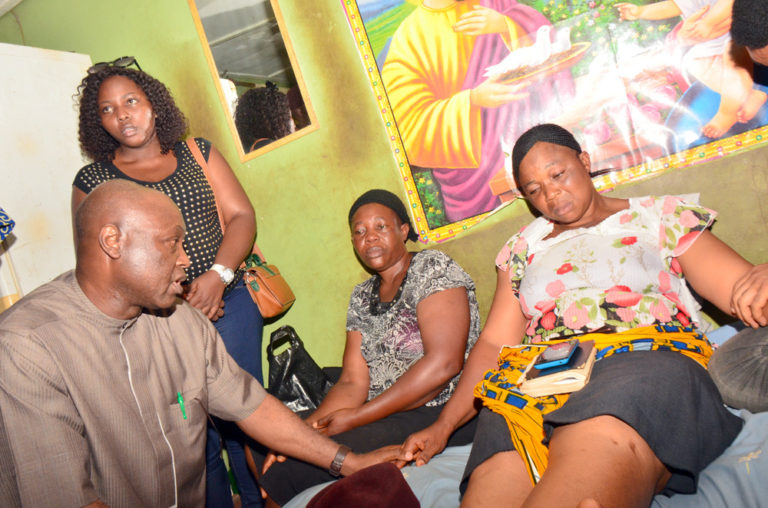
Secretary to the Government of Ekiti State, Biodun Oyebanji who led the delegates condoles with the families of one of the deceased FUOYE students.
Meanwhile, Ekiti State Government also has commiserated with the families of the two deceased students through its official Twitter handle @ekitistategov.
Biodun Oyebanji, Secretary to the Government of Ekiti State who spoke during the visit said it was to demonstrate that the government shared in the grief of the parents and to sympathise with them over their loss.
“Oyebanji said the visit was at the instance the State Governor, Dr Kayode Fayemi; who was saddened by the unfortunate incident, adding that the visit was to demonstrate that the state government share in their grief and to encourage them during the trying period,” the message on the twitter handle read.
The delegates to the deceased’ families were Biodun Oyebanji, Secretary to Ekiti State Government; Moji Fafure, Commissioner for Women Affairs and Social Development; Gbenga Ageyo,Commissioner for Environment; Abiodun Fawekun, Lawmaker representing Ido/Osi 1 at the State Assembly and Eunice Oladimeji, Permanent Secretary, Ministry of Women Affairs.
The Nigerian Prisons Service recently changed its name to the Nigerian Correctional Service; however, the name change has not taken away the reality of the overcrowded prisons, long list of awaiting trial inmates as well as child prisoners languishing in the country’s system. In this Blueprint Weekend exclusive report, AMEH EJEKWONYILO brings gory insider details of Nigerian children in chains.
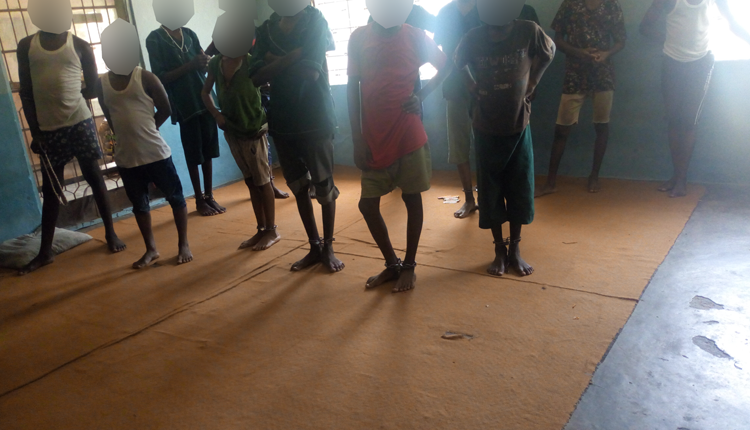
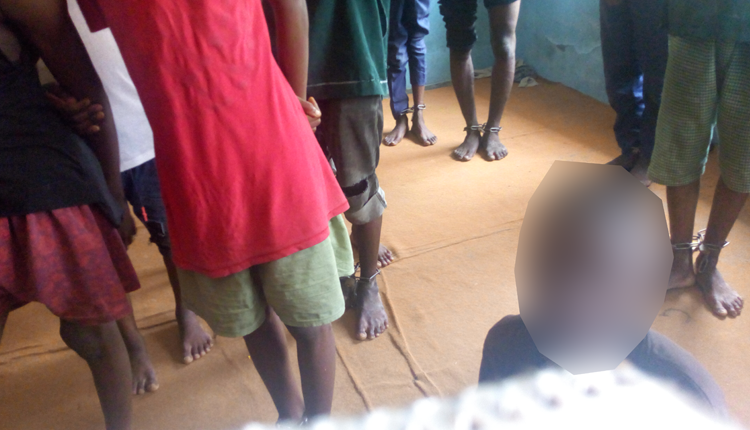
INSIDE the dormitory of the Minna Remand Home in Niger State, not up to the size of a normal room, without mattresses and fans to reduce the effect of the scorching heat in the month of March, about 30 children are held in chains for various offences.
An overpowering stench from the crowded dormitory welcomes any first time visitor.
With their emaciatedbodies in torn clothes, they hurried to their open bathroom taking turns for ablution for the 4.00 p.m. Muslim prayers.
At mealtime, they scooped cooked rice from the little bowl on the floor.
“ We are suffering here,” said Suleiman Adamu, a 12-year old boy and pupil of Alfitra Primary School, Tunta, Minna, who was brought to the home in March 2019 over loss of parental control.
“I was brought here by my father whom I was living with together with my step-mother. My step-mother accused me of stealing her wrapper. Immediately I got here, I was put in chains so that I do not runaway; you can see I’m still in chains and I don’t know who will rescue me from this problem,”Adamu explained almost in tears as he urged the reporter to reach out his parents who live inAbdulsalam’s Quarters in Minna metropolis.
Most of the under aged inmates standing criminal prosecution by the police have not been taken to court for trial.
Harande Buba, 13 who was remanded for alleged culpable homicide based on the orders of the Chief Magistrate Court 1 in Minna on April 12, 2017, said he had not been charged to court.
Narrating the incident that led to his incarceration, Harande said what started as a mere child’s play soon developed into a serious fight that led to his victim’s death.
“The boy I was fighting hit me with a stick and in retaliation, I used a machete on him which led to his death.
“Since I came to this home in April 2017, I have not been to court. Nobody cares to check on me. We do not feed well here, because we don’t have food. We wash our clothes without soap, and that is why our room smells. Life is so difficult here,” Harande said.
Located in the heart of Minna capital city, the remand home brims with children whose hopes and dreams have been dashedfor alleged violation of the law.
For Usama Haruna, a 12-year-old boy who aspires to be an engineer, the thought of being held in shackles at the home is the worst experience of his life.
“Though my parents are poor with mother doing menial jobs such as dish and clothe washing in private homes and restaurants, and my father a scavenger, it is my dream that someday I will work hard to become an engineer, then I will take care of my parents and siblings.
“ I regret the offence that has brought me into this remand home. My parents do not know my whereabouts. We were arrested by the police from Suleja and brought to Minna. Please go to Suleja and inform my mother that I’m being held here,” Usama appealed to the reporter as tears welled up his eyes.
On visiting Suleja a satellite town of about an hour 30 minutes’ drive from Minna, due largely to the deplorable state of the Minna-Suleja highway, our correspondent met Usama’s mother, Fatima Huruna, in Suleja at Saida Low Cost Housing Estate, where the family resides in one – room gatehouse.
“One evening in March 2019, we waited for Usama to come home because he used to accompany his father to his scavenging work. He was nowhere to be found, we began to ask after him. Someone told us that he might have been arrested by the police and taken to Minna.
“ But we have no money to travel to Minna to look for him. That is why we are praying to Allah that one day he would return home,” Usama’s mother told the reporter.
Usama is being tried at the Magistrates’ Revenue Court 3B of Angwan Daji in Minna for the alleged defilement of 6-year-girl. An offence he allegedly committed in Suleja in February 2019.
But Haranda, Suleiman and Usama are lucky as they are at a remand home, not locked up with adult inmates in a regular prison system. Not so for Happiness Kure, a 16-year-old girl, who is languishing at the Suleja Medium Prison, Niger State.
The Suleja Medium Prison, which is sandwiched by residential buildings, was built in 1914, according to prisons authorities.
Though our correspondent was not allowed into the female section of the Suleja prison, Happiness told our reporter that shares her prison cell in the awaiting trial inmates’ block with eleven other adult inmates.
The boys said their condition of living at the homes is nothing to write home about.
“Our condition of living here is miserable. When I first got to this prison in February last year, we were initially five in our room; I had my own separate mattress from other women. But later, one after the other, we are now eleven in the same room that is meant for five of us, including my mother who is breastfeeding my kid sister.
“ Our toilet and bathrooms are very dirty with broken pipes. Water is a big problem for us. We don’t feed well. Whenever my kid sister falls sick here in the prison, there is no clinic to take care of her. Some of the prison warders often help us to buy drugs from outside, and whenever lawyers visit, that is when they bring some drugs and food items for us. The situation we are facing at Suleja prison is terrible,” Happiness lamented.
Her tortuous journey to incarceration began in February, 2018 following the alleged murder of her father by her fleeing boyfriend, the embattled teenager told our correspondent.
Though standing trial alongside her nursing mother, Asabe Kure, at an Abuja High Court at Gwagwalada, the police is yet to call a single witness in the case.
“Since I came to this prison in February 2018, my education came to an end. You can see that my mother and little sibling who is just twelve months old are also being held here for the same alleged offences. Our condition here is unbearable. The most painful part of our situation at the Suleja prison is the fact that I cannot go to school. Does that mean our lives are over?” Happiness wondered in a cracking voice.
From Minna to Suleja, Markurdi to Port Harcourt, there is not much difference in the conditions of the children who are languishing in prisons/borstal institutions across the country; without education in most cases and locked up in adult prisons contrary to constitutional provisions.
According to a Prison Census report of 2016 by the Prisoners Rehabilitation and Welfare Action (a non-governmental organization) with over two decades of critical interventions in prisons reforms in Nigeria, child prisoners make up 43.2 per cent in Enugu, 25.9 per cent inKano and 30.9 per cent in Lagos prisons respectively.
The Child’s Rights Act of Nigeria enacted in 2003 makes ample provisions for children who are in conflict with the law. According to Part Two Section 11 of the Act, “Every child is entitled to respect for the dignity of his person and accordingly, no child shall be subjected to torture, inhuman or degrading treating or punishment, held in slavery or servitude, while in care of a parent, legal guardian or school authority or any other person or authority having the care of the child.”
Similarly, Section 15 dwells on the Right of a Child to Free, Compulsory and Universal Primary Education. It says, “Every child has the right to free, compulsory and universal basic education and it shall be the duty of the government in Nigeria to provide such education.” While Section 212 borders on Detention Pending Trial, Sub-section (2) provides that, “While in detention, a child shall be given care, protection and necessary assistance including social, educational, vocational, medical and physical assistance, that he may require having regard to his age, sex and personality.”
When asked why fetters are put on the inmates’ feet, the Officer-in-Charge of the Children Remand Home in Minna, Hajiya Hadiza Mohammed, explained that it is to prevent them from absconding.
“We do this to especially new children that are brought into the home, because we are not familiar with them. We also put the chains on stubborn and badly behaved inmates. But after a while, when we must have observed that the inmates have improved in their behavior, let them off the chains,” Hajiya Mohammed said.
While the child inmates in Niger State are chained, the situation is different at the Port-Harcourt Remand Home in Rivers State as they are allowed to move freely within the compound located at Nembe Street, Borokiri.
The home, according to the Officer-in-Charge, Mrs. Joy Ololube, is however overwhelmed by the daily challenge of inadequate feeding and others.
“We are overwhelmed by the challenges of difficulty of conveying the children to court during the hearing of their suits. Most of these inmates have not been to court for trial for the past two years. Also, the Approved School which is supposed to provide education and skills for the children has since closed down due to lack of resources to run the school,”
She also disclosed that when inmates fall sick, there are no healthcare facilities to deal with emergencies.
“We rush them to the nearby Naval Base hospital which is directly opposite our home. But at a point, the Naval authorities became tired of our problems and they began to reject our children. These are the challenges we battle with every day,” Mrs, Olulube said.
An 18-year-old inmate, Daniel Okon, said he was remanded at the home in 2015 for murder charges when he was 14 years old by the Juvenile Court 2, Port-Harcourt, and since then had not been to court due to non-availability of a vehicle that would convey him to court.
” I was a JSS 2 student of Community Secondary School, Udung-Uko in Akwa Ibom State. But since I came to the remand home, my education has stopped. Now, I do not know what to do. I want to appeal to both the governors of Akwa Ibom and Rivers States to come to my aid. I need to go back to school and complete my education,” Okon pleaded.
Another inmate, Tuanwii Joseph, a 17-year-old was only 14 years old when he found himself in the remand home in Port-Harcourt.
“I came into the Port-Harcourt Remand Home in 2016 as a result of murder case. The problems we are faced with here is the fact that our trials are stalled and we don’t have the opportunity to continue with our education. I got here when I was Junior Secondary School 3. But since I was remanded by the Juvenile Court 2, I have not been to court and there is no school for me to attend in the remand home. Life is so difficult for us here. You can see for yourself that this home is a place of suffering. We need help,” Joseph stated.
Asked why the Port-Harcourt remand home was left unattended to by the Rivers State government, Mrs. InimaAguma, Commissioner for Social Welfare, explained that arrangements were being made to reposition the facility for better service delivery.
“ Before I was appointed commissioner, there were issues of feeding and lack of vehicles to convey the inmates to court, I have ensured there is proper feeding. I have also ensured that a doctor comes in once in a while to examine the children. Also, the Rivers State government is working assiduously to get the Approved School back on stream for the inmates,” Mrs. Inima disclosed.
The plight of inmates at the Benue Remand Home in Gboko, is equally heartrending as the children also lack access to both formal and informal education.
With the roofs of the main building meant to house the inmates blown away, the sixteen children are crammed into a small room where they share one bathroom and toilet.
Mrs. Apaa Dorathy who is the Officer-in-Charge of the Home, noted that the facility lacks water, electricity supply as well as a vehicle to ferry the inmates to court for trial.
She explained that trial of inmates had been stalled due to lack of legal representation.
While there is a furnished classroom stocked with books for the inmates, there are no teachers to impart the desperately needed knowledge that the children yearn for. This situation, Mrs. Apaa said, was caused by the precarious security situation in state, which has prevented the posting of members of the National Youth Service Corps (NYSC) to the home.
“This is the only correctional centre in the state that caters for the 23 local governments. We are being confronted by a number of challenges that require urgent intervention given the fact that these children who have come in conflict with the law are the future of the society, and therefore should be properly rehabilitated and reintegrated into the society.
“However, that is not the case as our mandate is hampered by the lack of resources like mobility to convey the inmates to court for trial. We lack water and electricity here as you can see. Our school lacks teachers, and therefore, it’s not functioning. So, how do we cater for the needs of transforming these inmates into better citizens,” Mrs. Appa said.
An inmate the Gboko remand home, ThankgodUnogwu (14), a JSS 2 student of Jesus Comprehensive College, Eke-Olengbecho in Okpokwu LGA of Benue State, was remanded at the home last October over cultism related offences.
“Life is difficult for us here. We just stay here without going to court, let alone going to school. Even feeding and water is big problem here. Only God can deliver us from what we have found ourselves. I regret the crime I have committed, but I need a second chance at life to become a better person,” Unogwu said.
The problems were corroborated by the Benue State Chief Judge, Justice Aondaver Kakaan, who described the conditions of the children as “horrible”.
“What the children need is reformation, but that is not the case. The state government has not been forthcoming in that regard. It is so sad that these inmates have to live in subhuman conditions.
“We have been making efforts to establish the Family Court as required by law. However, we don’t have the funds to execute the mandate. The issue of juveniles can only be tackled through reformation,” Justice Kakaan said.
However at the Borstal Institute in Kaduna State,the school authorities said their inmates have facilities for both formal and informal education.
“Our inmates have most of the facilities for formal education and skill acquisition. Our inmates take the Senior School Certificate Examination (SSCE). However, we have some challenges that require government interventions such as expansion of facilities in the institute,” a staff who pleaded anonymity told our reporter.
The staff who also declined to comment on the number of inmates being held at the Borstal Institute, equally turned down the request by our correspondent to go into the inmates’ dormitories to speak with some of the inmates.
“You know we don’t allow outsiders into the dormitories or interact with the inmates,” the warden said.
Upon arriving at the heavily guarded facility, located at Barnawa in Kaduna, the huge buildings and spacious premises give an impression of a fully functional home for children. However, a couple whose child was being held at the institution, was seen with a sack of food items like garri and provisions, among others.
When asked why they were at the home, the mother of the inmate who pleaded anonymity, said: “My husband and I come regularly to donate food items to the institution as a way of supporting them for better service delivery, because the children are too many and, as a result, they do not feed well. We can only appeal to the government to help us take good care of the children in the home by providing a suitable environment for their education.”
Constitutional prohibition against denial of basic education
The Federal High Court sitting in Abuja, presided by Justice John Tsoho in February 2017 held that children have the right to free, compulsory basic education.
Although the right to free education in Section 18(3)(a) of the Constitution was ordinarily not enforceable like all other rights provided for in the Chapter 2 of the Constitution, the Compulsory, Free Universal Basic Education Act of 2004 enacted by the National Assembly has elevated the right to an enforceable status.
This provision was the basis for the judgement of Justice John Tsoho of the Federal High Court sitting in Abuja.
In his verdict, the judge held that both the federal and state governments were constitutionally required to provide adequate funding for the free education scheme.
The judgment followed a suit filed by a group, the Legal Defence and Assistance Project (LEDAP).
Justice Tsoho held that the failure of any government at the state and federal levels to fund the scheme would constitute a breach of the Constitution of the Federal Republic of Nigeria.
Expert views on the issue
The Executive Director of PRAWA, Dr. Uju Agomoh decried the conditions in which under-aged children are being held.
“The current conditions of these homes are deplorable as they are consistently deteriorating. An urgent and sustainable intervention must be made by both the government and private individuals to reposition these homes for better service delivery. Anything short of that the society will pay for it dearly. The children must be rehabilitated in all ramifications,” Agomoh said.
Existing Borstal homes in Nigeria include: Borstal Training Institution in Barnawa, Kaduna State, Borstal Training Institute Ganmo, Kwara State and the Borstal Training Institute Abeokuta, Ogun State.
The Borstal Institutions and Remand Centres Act 1962 mandates the remand of offenders between the ages of 16-21.
During a recent visit to the Nigeria Prisons Akwa in Anambra State, the National Human Rights Commission (NHRC), disclosed that about 523 children were being held at the facility.
During the commemoration of the 2019 African Pre-trial Day themed: “Decriminalisation of Petty and Minor Offences,” the Anambra State Coordinator of the National Human Rights Commission (NHRC), Mrs. NkechiUgwuanyi, decried the high number of underage inmates at the prison.
Illegal trial of the inmates
According to the trial magistrate at the Rivers State Juvenile Court, Mrs. Ibiere Foby, the current circumstance where underage inmates are tried using the Child’s Rights Act with a properly constituted family court as prescribed by the law, constitutes a gross violation of the rights of the defendants to fair hearing.
She explained that an ideal family court should have a magistrate and two assessors to hear and determine suits concerning children who come in conflict with the law. But that is not the case.
“ You can see I am the only magistrate sitting in the Juvenile Court here.”
When asked on the legal implications, Foby said, “If matters tried by the Juvenile Court go on appeal, they will be dismissed on the grounds that the trial court is not properly constituted as required by the Child Rights Act. Here in Rivers we have the Young Persons Law, which is an archaic piece of legislation.”
Similarly, an official of the Rivers State Ministry for Social Welfare, who did not want his name in print said: “The remand home is basically for children whose parents have lost parental control over them, and children who are convicted of minor offences to be held for not more than six months. While the borstal home is a juvenile prison.
“So, what we are doing in terms of children who are in conflict with the law, is unconstitutional. But due to the non-availability of resources to do the proper things, we have to make do with what we have.”
Composition of the Family Court
Section 153 (3) of the Child’s Rights Act provides that, “The court at the Magistrate Level shall be duly constituted if it consists of – a Magistrate, two assessors, one of whom shall be a woman and the other person who has attributes of dealing with children and matters relating to children, preferably the area of child psychology education.”
The Child’s Rights Act of Nigeria enacted in 2003 makes ample provisions for children who are in conflict with the law. According to Part Two Section 11 of the Act, “Every child is entitled to respect for the dignity of his person and accordingly, no child shall be subjected to torture, inhuman or degrading treating or punishment, held in slavery or servitude, while in care of a parent, legal guardian or school authority or any other person or authority having the care of the child.”
Similarly, Section 15 dwells on the Right of a Child to Free, Compulsory and Universal Primary Education. It says, “Every child has the right to free, compulsory and universal basic education and it shall be the duty of the government in Nigeria to provide such education.” While Section 212 borders on Detention Pending Trial. Sub-section (2) provides that, “While in detention, a child shall be given care, protection and necessary assistance including social, educational, vocational, medical and physical assistance, that he may require having regard to his age, sex and personality.”
FIDA Nigeria’s Reaction to the Issue
The International Federation of Women Lawyers (FIDA) Nigeria described the plight of underage inmate in the country “disturbing.”
FIDA Nigeria’s President, Rhoda Prevail Tyoden, while reacting to our findings, said the country’s Child’s Rights Act which is meant to help children who come in conflict with the law, is not being implemented.
“We have the Child’s Rights Act that is meant to tackle the issue, but it is not being implemented. If the Act is fully implemented you won’t have a situation whereby children are locked up in prisons with adult.
“The Child’s Right Act and the Young Persons Law spell out how this group of people should be treated. But we have a system where these laws are not well implemented. The Act says we need to have Family Courts; comprising of Magistrates and assessors. The Family Court should be functional to address these issues, but it is unfortunate the courts are not working.
“Secondly, we should have borstal homes across all the states of the federation, but only three or four states have such facilities; when we have children in conflict with the law in all the states of the country.”
“FIDA Abuja which I belong as a branch; we go to Suleja Prison and we see teenagers there, and we try to get them out if it is a bailable offence. Sadly, these children are locked up together with adult prisoners. We often say the youth are the fulcrum of every national development, but when children are locked up in prisons, then where is the future of the country,?” Tyoden queried.
“Children who are in conflict with the law should not be dealt with as criminals, because they are supposed to be in a place where they would realise their mistakes and you take them through the process of rehabilitation.
“We have enough laws that can cover every kind of offence in Nigeria but the issue we have is the implementation of the law, the government has simply refused to implement this law.And that is why we are now advocating for the adoption of the VAPP Act. We now have ten states that have adopted it.”
The association recommended the sensitisation of Nigerians on the prevalence of social ills in the society as a way of helping to guide children away from crime.
“It is not enough to have the laws; we should rather go round sensitizing people through awareness programmes on the societal ills that our laws have failed to effectively tackle, because we have the laws but the laws are not effective.
“The political will to get the child right act implemented is not there. The law covers everything; the dignity of the child, everything should be done in the best interest of the child,” the FIDA President said.
* This investigation was supported by the Institute for War and PeaceReporting, IWPR, and the International Centre for InvestigativeReporting, ICIR.