SOUTH African drug firm Aspen has offered to pay the National Health Service £8m, as part of a wider package, to resolve competition concerns over the supply of a fludrocortisone acetate 0.1 mg tablets.
The offering comes off the back of an investigation by the Competition and Markets Authority (CMA) into suspected anti-competitive arrangements regarding the drug.
PharmTimes reports that the arrangement marks the first time the CMA will secure such payment to the NHS in one of its pharmaceutical investigations.
The CMA has been investigating claims that Aspen entered into arrangements with two rival companies in 2016, and confirmed that competition law had been broken by Aspen paying competitors to stay out of the market. The arrangements subsequently left Aspen as the sole supplier of fludrocortisone, with the ability to set prices without facing any competition.
The CMA has announced that as a result of the case, Aspen approached the organisation with a proposed package to resolve the differences, which includes admission of illegality: Aspen admits it was party to an illegal, anti-competitive agreement, by way of settlement, and compensation to address CMA’s concerns: Aspen will commit to pay £8 million to the NHS – without the Government having to launch court proceedings for damages.
This is intended to address the CMA’s concerns that as a result of the impact of Aspen’s behaviour, the NHS paid a higher price for fludrocortisone.
The disgraced company will also pay a maximum fine of £2.1 million, once the CMA has concluded its investigation if it reaches a formal decision that the law has been broken. The CMA is continuing its investigation given other companies are involved.
Andrea Coscelli, the CMA’s chief executive, said that the organisation launched the investigation because they consider it “unacceptable for the NHS – and the taxpayers who fund it – to have to pay millions of pounds more than they should for this life-saving drug.
“This is the first time a CMA investigation will secure payment for the NHS. The £8 million Aspen has agreed to provide will save the NHS the time and expense of seeking damages in court. Importantly, Aspen has also committed to ensuring there are more competitors in this market, giving the NHS the opportunity to secure better value for UK taxpayers’ money in the future.”
He added that the organisation “welcomes Aspen approaching” to find a new way of addressing the CMA’s concerns.
The CMA currently has other unrelated investigations open in relation to six other pharmaceutical drugs.
ABDULLAHI Babalele, the son-in-law to the former Vice President Atiku Abubakar, has been arraigned on a two-count charge bordering on money laundering.
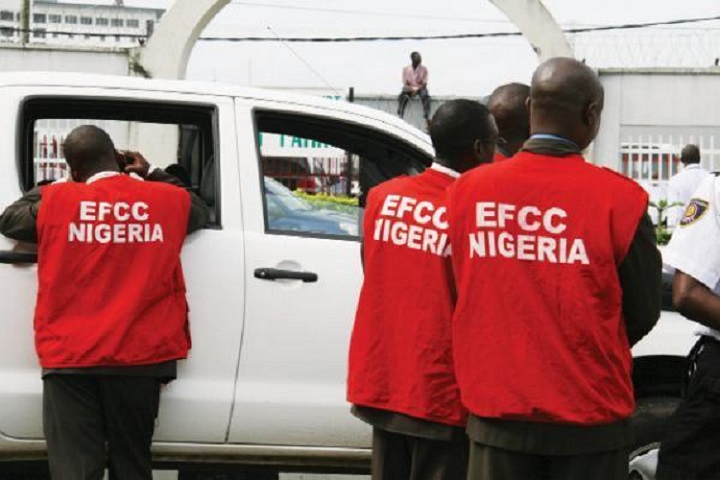
Babalele was on Wednesday arraigned by the Economic and Financial Crime Commission (EFCC) at Federal High Court in Lagos.
The EFCC on August 9th filed a two-count charge against Atiku’s son-in-law for allegedly aiding the cash payment of the sum of $140,000 without going through a financial institution.
The prosecutor of the EFCC, Rotimi Oyedepo who signed the charges said Babalele had committed the offence since February 2019.
The count read thus:
COUNT 1: That you Abdullahi Babalele on or about the 20th day of February 2019 in Nigeria within the jurisdiction of this Honourable Court. procured Bashir Mohammed to make a cash payment of the sum of $140,000. 00 (One Hundred and Forty Thousand United State Dollars) without going through a financial institution, which sum exceeded the amount authorized by Law and you thereby committed an offence contrary to Section 18(c) of the Money Laundering (Prohibition) Act, 2011 as amended and punishable under Section 16(2)(b) of the same Act.
Count 2: That you Abdullahi Babalele on or about the 20th day of February,2019 in Nigeria within the jurisdiction of this Honourable Court, aided Bashir Mohammed to make cash payment of the sum of $140,000. 00 (One Hundred and Forty Thousand United State Dollars) without going through financial institution, which sum exceeded the amount authorized by Law and you thereby committed an offence contrary to Section 18(a) of the Money Laundering (Prohibition) Act, 2011 as amended and punishable under Section 16(2)(b) of the same Act.”
However, Babalele before Justice Nicholas Oweibo pleaded not guilty to the two-count charge.
Also arraigned by the EFCC was a former associate of Atiku, Uyiekpen Giwa-Osagie and a legal practitioner on a three-count charge bordering on a $2million money laundering in the build-up to the 2019 general elections.
The EFCC disclosed that in the charge was Erhunse Giwa-Osagie, a brother to Atiku’s associate.
The antigraft said the two defendants had conspired to make a cash payment of $2million on February 12, 2019, without going through a financial institution.
The duo pleaded not guilty to the charges.
Consequently, Justice Oweibo ordered that Babalele and the Osagie brothers be remanded at the EFCC custody pending the hearing of their bail application on Thursday, August 15.
PEOPLE in the neighbouring communities under the Daura emirate in Kastina have decried a shortage in power supply, which only improves only when President Muhammadu Buhari is in town.
Leaders from the five local government areas under the Daura emirate made this statement during a courtesy visit to the president at his home in Daura during Sallah.
“Anytime the President is around we enjoy 24 hours power supply. But if he is not around, the power supply is not always stable,” Mohammed Saleh, one of the leaders,said.
The leaders requested that the president addressed issues plaguing the communities.
Earlier in May, the Daura emirate council had suspended all activities regarding the celebration of Eld-Al-Fitr, due to reported cases of insecurities ravaging some part of the state.
Amongst such cases was the kidnap of the district head of Daura, Umar Musa, who was reportedly abducted by suspected bandits.
Also, 34 people were reportedly killed in some part of the state, which led to the prescription of capital punishment for kidnapping, cattle rustling and armed robbery.
However, Buhari in his reactions to the leaders’ outcries, said his mission is to fight for the poor while ensuring that campaign issues, such as security, economy and corruption are resolved.
The Emir of Daura, Umar Farouq, during the Sallah Durbar held in his palace, urged Nigerians to show support to the president in overcoming the challenges faced by the country.
The president had also hosted the Presidents of Guinea Conakry, Alpha Conde, who celebrated the Eid in Nigeria.
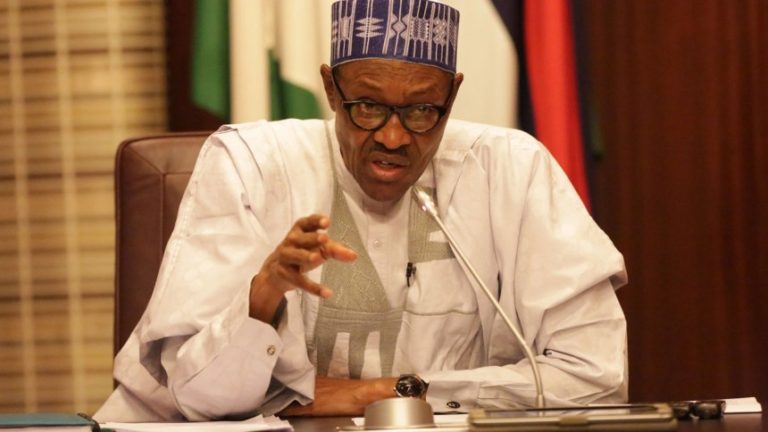
PRESIDENT Muhammadu Buhari on Tuesday said he had directed Godwin Emefiele, Governor of the Central Bank of Nigeria (CBN) to stop providing foreign exchange to food importers as the nation has grown sufficient food capable of feeding its citizens.
“Don’t give a cent to anybody to import food into the country,” Buhari instructed.
The President disclosed this when he played host to All Progressives Congress (APC) elected Governors as part of the Eid-el-Kabir celebration in Daura, Katsina State. He added that money kept in the foreign reserve would be spent solely to diversify the economy.
He emphasised the nation would no longer encourage food importation considering the high import bills.
President @MBuhari Tuesday in Daura, Katsina State, disclosed that he has directed the Central Bank of Nigeria to stop providing foreign exchange for importation of food into the country, with the steady improvement in agricultural production, & attainment of full food security. pic.twitter.com/2mwWlH0bpH
In 2015, the CBN said the nation spent $2.41 billion on rice importation between January 2012 and May 2015.
While Emefiele lamented on the huge sum expended on food imports, Audu Ogbeh, former Minister of Agriculture and Rural Development (FMARD) also put the figure at $22 billion annually.
“Nigeria spends almost $22 billion every year on food importation. If we don’t fix agricultural problems in the country where families can feed on less than 15 per cent of its budget, then the country is in trouble.” Ogbeh stated.
In March, the CBN governor stressed how the country spends $500 million annually importing palm oil, aside from another $40 billion spent on textile imports yearly.
The current administration’s claim on rice production has also raised doubts on exact local rice production capacity.
However, Buhari noted that some states like Kebbi, Ogun, Lagos, Jigawa, Ebonyi and Kano had already taken advantage of the Federal Government’s policy on agriculture with huge returns in rice farming, urging more states to plug into the on-going revolution to feed the nation.
“We have achieved food security, and for physical security, we are not doing badly,” he added.
In a statement issued by Garba Shehu, Senior Special Assistant to the President on Media and Publicity, Buhari expressed delight on increasing youth involvement, including graduates on agribusiness and entrepreneurship.
APC Governors meet President Muhammadu Buhari in Daura, Katsina State Photo Credit: Garba Shehu
The President informed that the incoming cabinet members would be enlightened, well guided and monitored to ensure they deliver on their responsibilities. According to him, their targets would as well be scaled up by the Office of the Secretary to the Government of the Federation.
He promised to attend the Presidential Policy Retreat organized for the ministers by the OSGF, insisting on compliance with laid down targets on key sectors of the economy capable of impacting the livelihood of the masses.
In his remarks, Dr John Kayode Fayemi, the Chairman of the Nigerian Governors’ Forum and Governor of Ekiti State, described the challenges confronting the states as ‘enormous’.
However, he assured the president of overcoming the problems.
Alhaji Atiku Bagudu, the Chairman of the Progressive Governors Forum and Governor of Kebbi State, applauded the President for his leadership style, maintaining a healthy relationship with the governors on an individual and collective basis.
“The country is more secure than in 2015, and the country is more prosperous than in 2015 because you are working for the majority of the people,” he claimed.
THE Gender Unit, a department under the Nigeria Police, lacks financial resources to investigate allegations of sexual abuse and prosecute offenders, says Dorothy Njemanze, an Abuja-based rights activist.
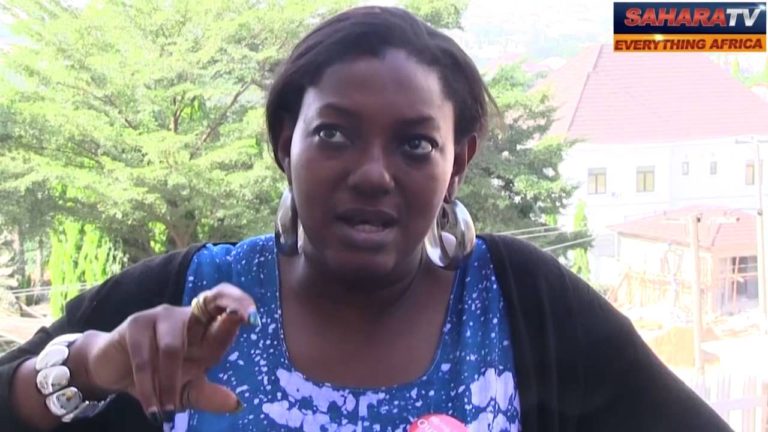
The founder of the Dorothy Njemanze Foundation said this in an interview with The ICIR, noting that it is an important point that has to be made clear.
“The Nigerian police does not have money for investigations,” she said. “So, whatever the case is, whether it is a child or an adult, the Nigerian police expect the people to bear the costs. We have a system that destroys cases and frustrates victims. It doesn’t make any sense whatsoever.”
She said the police often push the burden of prosecution to the victims who are ordinarily “struggling with their lives”. Because of this, she explained, her organisation has had to plead online for financial support to foot the bills having to do with criminal litigation for abuse victims.
She also mentioned a case reported by this paper in June, where the alleged rapist of two underage rape victims is yet to be apprehended after nearly two years, as a typical example of the shortcomings of the police.
“There is no money for investigations. There is no funding whatsoever for medicals,” she said emphatically.
“In fact, they mess up cases. Once, the accused has started giving them money, they start puncturing your story. We have seen so many cases that have been minuted to legal that were never taken up.
“There is a particular 14-year-old girl; her mother scolded her in my presence. At the end of the day, that matter was minuted to legal by Mrs Ehindero. Till today, it never made an appearance in court. Never. Never. Never. It is wrong. Totally wrong.”
Njemanze added that her organisation, set up to address abuse-related issues to aid the healing and reintegration of victims, has to pay for police investigations, medical tests and reports, and pays police prosecutors every time they make appearances in court.
“The only case where the person has not pushed us to make payments was after he found out I’m a mad person,” she said, “because I told him I’ll raise your money from the internet. It dawned on him I was going to go out and put the information out there. I pulled a few stunts and made the case viral.”
Particularly, the Gender Unit, which the non-governmental organisation has written to on several occasions, is also not self-sufficient as it has to rely on complainants to effectively investigate allegations brought before it.
“Put it out there that people who Gender Unit has investigated and did not need to pay should come out,” she challenged.
“Even for this Justice-for-Chloe case, we wrote to Gender Unit. They did not do anything. We usually do write to them. But when we found out that it’s ending up wasting our paper and ink, we just decided to deal with the frustration and then go head up… because what they claim Gender Unit does is not true.
“They tell a lot of lies. They’ll come and tell you the police has a gender unit and the gender unit … It’s a lie. They don’t do anything. They frustrate us. See, I battle depression, and part of it is because I sit down and wonder how irresponsible our government and people who occupy authoritative positions are.”
Njemanze complained that the Nigeria Police hardly takes action if an officer is accused of flouting the law. She further condemned victim-blaming among law enforcement agents and health professionals. She has seen, for example, women asked at police stations what they did to provoke their husbands into assaulting them.
“There is currently another case we are following up on,” she narrated. “The two children involved are both under ten years, and they were seen by different doctors. One of the doctors was saying, ‘Ah. This child has been raped but this time around it was not rape’. That the child went to have sex as usual.
“Children under 18 years cannot consent to sex. If the mindset of a doctor is that a child under 10 years old went to have sex as usual, then there’s a problem. That tells you the quality of the medical reports that’ll come out of that place, tenable in court.
“And that child had an infection. The person at the lab, to make the children open up for swabs, threatened the children and said, “If nah the people wey go give you N200 now you go open your leg, common open your leg before I beat you here!” and the children opened their legs. Is that not rape? Rape happened again.
“And then at the police station, the policewoman said to them, ‘They don come here before because of you. Nah only you get that area? If you bring this kind report here again, I go beat you’. Meaning if anybody rapes the child again, the child should keep quiet. That is the system we live in. We see a supposed support system further traumatising children.
“How many people have the police told as long as they’ve been disvirgined before, they cannot be disvirgined again? How many have been forced to settle out of court?”
The Dorothy Njemanze Foundation, she said, often advises complainants to ask policemen who extort them for their names “and tell them please I need to write your name because we’ll get a refund from the NGO and they need to know exactly who I gave the money to”. They’ve observed that this approach deters officers from making demands for money. But, oftentimes, it means they also stop taking the case seriously.
“And so we have so many cases that are hanging in limbo; the owners of these cases are very very frustrated,” she added.
In July, The ICIRreported how Okokon Udo, a prosecution lawyer at the FCT Criminal Investigation Department asked the father of a three-year-old rape victim to bring N20,000 to work on his case file.
The 2019 Global Corruption Barometer Africa report released also last month ranked the police as the most corrupt institution in Nigeria and stated the judiciary to be the third most corrupt.
SO far in 2019, Nigeria has recorded a total of 24, 994 confirmed cases of measles thereby, securing the fourth position in the world with highest recorded cases of the contagious disease.
This is according to a new measles surveillance data available on the World Health Organisation and published on Monday. The provisional data was based on member countries reports submitted monthly to WHO as of August 2019.
The WHO noted that between January and July 2019, reported measles cases were the highest that had been in any year since 2006.
It listed nine countries – Angola, Cameroon, Chad, Kazakhstan, Nigeria, Philippines, South Sudan, Sudan and Thailand- to be experiencing, currently, major measles outbreaks.
Five countries: Madagascar, Ukraine, Philippines, Nigeria and India had reported the highest number of cases this year. Nigeria had 24,994 confirmed cases of measles, preceded by Madagascar with 127,464 cases, Ukraine had 52,246, and the Philippines had 36,253. India number of reported cases was nearly up to Nigeria’s figure with 24,076 measles cases.
Breaking down the figure, in January, Nigeria had 2,983 measles cases, February was 4,905. The March figure was the highest with 7,120 cases. But there was a gradual reduction from April with 5,229, May with 3,536, June with 971 and to July with 250 cases.
The country’s figure skyrocketed in 2019 as each of the whole years of 2015 to 2018 did not reach up to 20,00 cases. In 2015, there were 12,391 confirmed cases of measles. The figures for 2016, 2017, and 2019 were 17581, 11,188 and 7,018 respectively.
Meanwhile, WHO has clarified that the number of reported cases in 2019 reflected a small proportion of the true number of cases occurring in countries. “Many cases do not seek health care or, if diagnosed, are not reported. In addition, there is a one to two month lag time in reporting,” it noted.
For those reasons, WHO said the data provided under-represented the true number of cases, particularly those occurring in the last one to two months.
The global health agency said the largest outbreaks were in countries with low measles vaccination coverage, currently or in the past, which had left large numbers of people vulnerable to the disease.
“In a number of countries, measles is spreading among older children, youth and adults who have missed out on vaccination in the past,” it said.
Cases of Measles in Nigeria
Nigeria had the highest number of unvaccinated children under one year of age against measles in 2017, according to a UNICEF coverage report on Vaccine in April. It estimated that about four million Nigerian children missed out the first dose of measles vaccine that year.
The WHO identified the reasons why people were not being vaccinated to include lack of access to quality healthcare or vaccination services, conflict and displacement, misinformation about vaccines and low awareness about the need to vaccinate.
As measles is one of the world’s most contagious diseases, the best protection against the disease is through receiving two doses of the measles vaccine described as “a safe and highly effective vaccine”.
“High rates of vaccination coverage – 95 per cent nationally and within communities – are needed to ensure that measles is unable to spread,” said the WHO.
Measles caused approximately 110,000 deaths in 2017 all over the world.
The first sign of measles is usually a high fever, which begins about 10 to 12 days after exposure to the virus and lasts four to seven days.
Later the symptom would develop to a runny nose, a cough, red and watery eyes, and small white spots inside the cheeks. After several days, a rash erupts, usually on the face and upper neck.
Serious complications are more common in children under the age of 5, or adults over the age of 30, especially malnourished young children and HIV/AIDS patients.
Health complications resulted from measles include blindness, swelling of the brain (encephalitis), severe diarrhoea, ear infections, and Pneumonia.
According to the Nigeria Centre for Disease Control (NCDC), Nigeria has recorded 89 deaths as a result of measles as of May 12. The latest NCDC situation report on measles released on May 18 noted that Borno State has the highest number of the diseases followed by Katsina, Yobe, Kano and Kaduna.
The Shehu of Bama Kingdom of Borno State, Kyari Ibn Umar El-Kanemi, has expressed delight after his people joined the rest of the world to mark the first Eid-el-Kabir celebration in his domains.
According to the monarch, this was the first time in almost five years the community partook in the religious feast celebrated across the globe by all Muslims.
“Today we are celebrating Sallah in Bama which we were not privileged to celebrate for the past five years,” an utterly elated Shehu told the News Agency of Nigeria (NAN).
“Indeed we have to be grateful to Allah SWT for sparing our lives and none among us here today that is thinking to live up to this moment to grace this Sallah celebration in Bama.”
Bama was the target of Boko Haram terrorists in the past, forcing natives and other inhabitants to flee their homes.
Umar El-Kanemi, the traditional ruler wasn’t spared as his wife and daughter were reportedly abducted in 2014 and released two years after.
The monarch, alongside his counterpart from Dikwa, Masa II Ibn Umar El Kanemi, even fled their communities to reside in Maiduguri.
However, peace has since been restored to the area thanks to President Muhammadu Buhari and the Nigerian Army under the dogged leadership of Lieutenant General Tukur Buratai.
As part of the rehabilitation and reconstruction process, the monarchs returned in July in the company of local government staff and primary school teachers accompanied by troops of Operation Lafiya Dole who regained the Kingdom back from Boko Haram terrorists.
An eyewitness account revealed that there was free movement of people around the town, especially in public places without fear of any violence or attacks by Boko Haram throughout the Sallah season.
There was also a mass prayer on Sunday for the first time in a long while, led by the monarch himself.
All these feats have been attributed to the gallantry of the Nigerian military and decisive leadership.
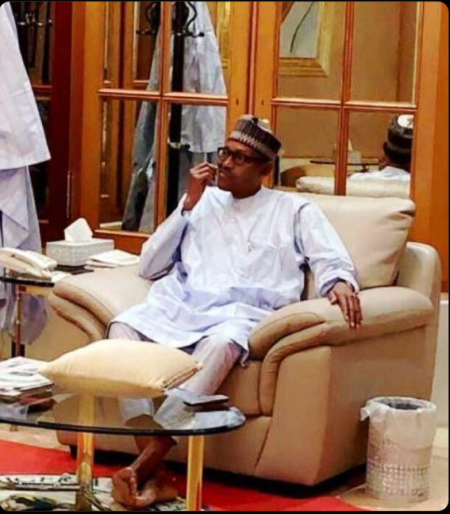
OBY Ezekwesili, former minister of education and pro-Buhari members on Monday exchanged banters over a trending picture of President Muhammadu Buhari.
The portrait, described as ‘Fiddling-Nero-type-picture’ by Ezekwesili was perceived as un-presidential and unworthy of public view.
Buhari was picking his teeth in the picture which has generated over 1,200 likes on Ezekwesili’s timeline.
That a Presidency @AsoRock and their allies found this unflattering “Fiddling-Nero-type-picture” of the @NGRPresident worthy of public view really does take their celebration of deadly Incompetence to a stratospheric realm.
But then, it really is Governance of tooth-picking???????? pic.twitter.com/OwIOUEyxlR
The President had earlier visited Daura, Katsina State for a nine-day official trip to celebrate Eid-el-Kabir with family members. He was later joined by Prof. Alpha Conde, President of Guinea.
“That a Presidency @AsoRock and their allies found this unflattering ‘Fiddling-Nero-type-picture’ of the @NGRPresident worthy of public view really does take their celebration of deadly Incompetence to a stratospheric realm,” Ezekwesili tweeted.
“But then, it really is Governance of tooth-picking”.
She further condemned what she described as incompetence among political appointees and other officials of the current administration including the judiciary.
Nigerians react
Adebiyi Kayode @CallyKayode also condemned the picture. “This photo is all shades of wrong, I must confess.”
Emmanuel Ayomanor @e_ayomanor noted that the picture shouldn’t have appeared on the public. “That picture shouldn’t have come to the public. Surely you don’t understand what madam is implying. You should have just waka pass if you can’t comprehend. Thanks, madam for opening our eyes to seemingly obvious details. Much more GRACE.”
However, Buhari’s loyalists were quick to respond to the critic. Her picture of mild romantic gesture with Chief Olusegun Obasanjo, the former President resurfaced.
When Madam was in government. She enjoyed her public show of _____ with Obasanjo, but she doesn’t want Buhari to enjoy his own private life. pic.twitter.com/5RJ0UTZsKc
— Adetola A. Kehinde (IGBOMINA) (@Optimistic_Ade) August 12, 2019
Tunde Obadimeji @Tunde said the former minister was seeking relevance.
“This grammar and post are not popular and I think this woman has outlived d public space, therefore she should quit, park somewhere and rest.”
Igbabu Terese @teresematt faulted Ezekwesili for her criticism describing it as hatred. “So a President cannot pick his teeth again. This isn’t a criticism but hatred”.
ON Saturday, August 10, the social media space was inundated with reactions as to why the official twitter account of the Vice President, Prof. Yemi Osinbajo was suspended.
The federal government last Thursday resumed the disbursement of the N10,000 Trader Moni for petty traders in Bayelsa state.
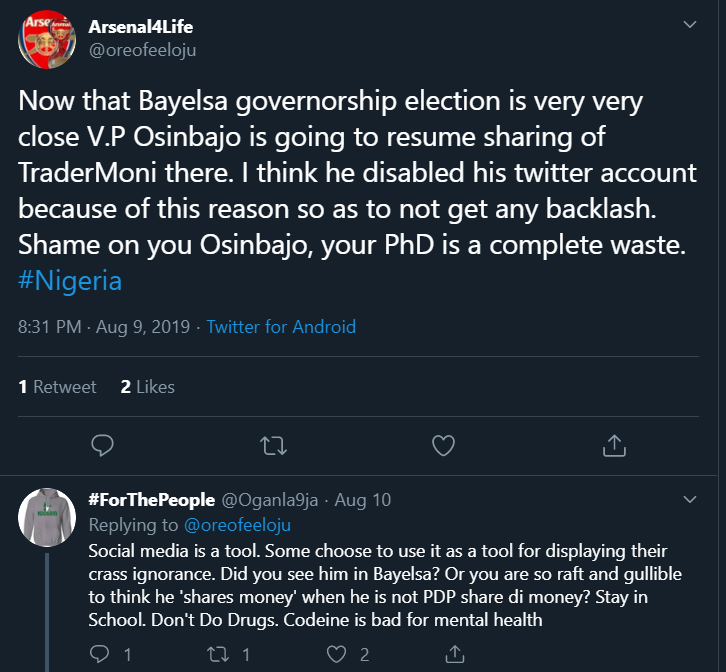
This generated mixed reactions among many people, with some alleging that the Trader Moni scheme was a tactical means of buying votes considering that the governorship election in the state is just some months away.
Digital analysis of the vice president’s twitter account showed that the account might have truly been attacked by trolls.
Trolls on social media are people who deliberately provoke others online by saying inflammatory and offensive things. They promote hate speech, attack an opponent’s character and say things to appeal to people’s feelings rather than their intellect.
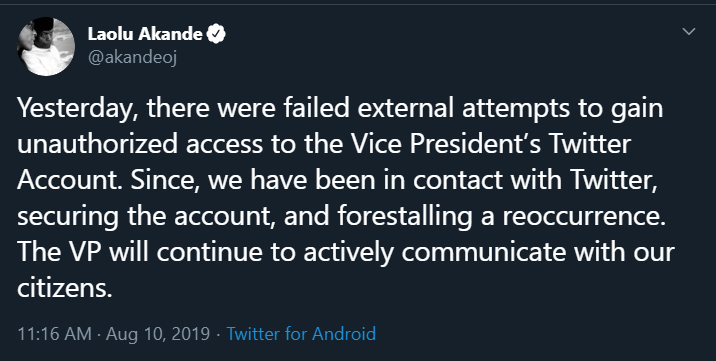
Laolu Akande, Senior Special Assistant to the Vice President on Media and Publicity on Saturday had tweeted about a failed attempt to hack into the Vice President’s Twitter account.
“Yesterday, there were failed external attempts to gain unauthorized access to the Vice President’s Twitter Account. Since, we have been in contact with Twitter, securing the account, and forestalling a reoccurrence. The VP will continue to actively communicate with our citizens,” Akande said in the post.
In reaction to the tweet, speculations by twitter accounts owners said the Vice President made a post about the Trader Moni which got his account reported for vote-buying and was later unverified and suspended.
A search of the Internet into previous tweets made by Osinbanjo using Wayback machine, an online tool that archives the internet itself debunks the speculation that the account was suspended on the ground of making a post on the Trader Moni because no post in that regard was found.
According to Twitter, the blue tick that indicates a verified account can be lost if the account intentionally misleads people by changing one’s display name or bio; if the account promotes hate and/or violence against, or directly attacks or threatens other people on the basis of race, ethnicity, national origin, sexual orientation, gender, gender identity, religious, affiliation, age, disability, or disease; Inciting or engaging in harassment of others; violence and dangerous behaviour.
From historical tweets recovered, no tweet from @profosinbajo appears to violate these conditions. Also from curated web shots, the name and bio remained the same, ruling out the first condition.
Again, according to Twitter, accounts can be suspended for the following reasons;
Spam: Most of the accounts we suspend are suspended because they are spammy, or just plain fake, and they introduce security risks for Twitter and all of our users. These types of accounts are against our TwitterRules. Unfortunately, sometimes a real person’s account gets suspended by mistake, and in those cases, we’ll work with the person to make sure the account is unsuspended.
Account security at risk: If we suspect an account has been hacked or compromised, we may suspend it until it can be secured and restored to the account owner in order to reduce potentially malicious activity caused by the compromise.
Abusive Tweets or behaviour: We may suspend an account if it has been reported to us as violating our Rules surrounding abuse. When an account engages in abusive behaviour, like sending threats to others or impersonating other accounts, we may suspend it temporarily or, in some cases, permanently.
According to Nana Nwachukwu, a public interest digital researcher, a common factor remains that somehow Twitter rules may have been violated not necessarily by the handle but in a manner that places the account security at risk, which also follows the same pattern of a troll attack on the account. This brings in the announcement by the Laolu Akande on attempted unlawful access to Osinbajo’s account.
Twitter operates through a community reporting system. Typically accounts like @profosinbajo which is verified and belonging to a high-ranking Govt official are usually suspended where suspicious activities are noticed by Twitter API.
Timeline of the troll attack on Prof Yemi Osinbajo’s Twitter account @ProfOsinbajo
On August 8, the federal government resumes TraderMoni in Bayelsa State
Reactions on Twitter;
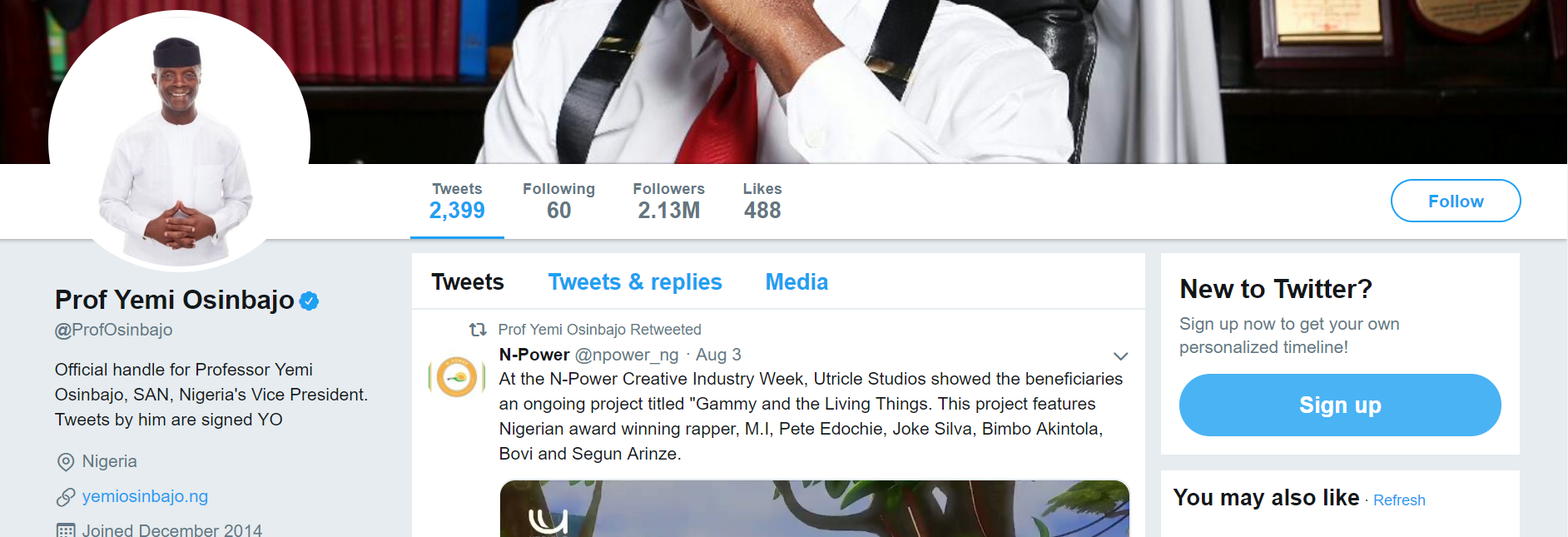
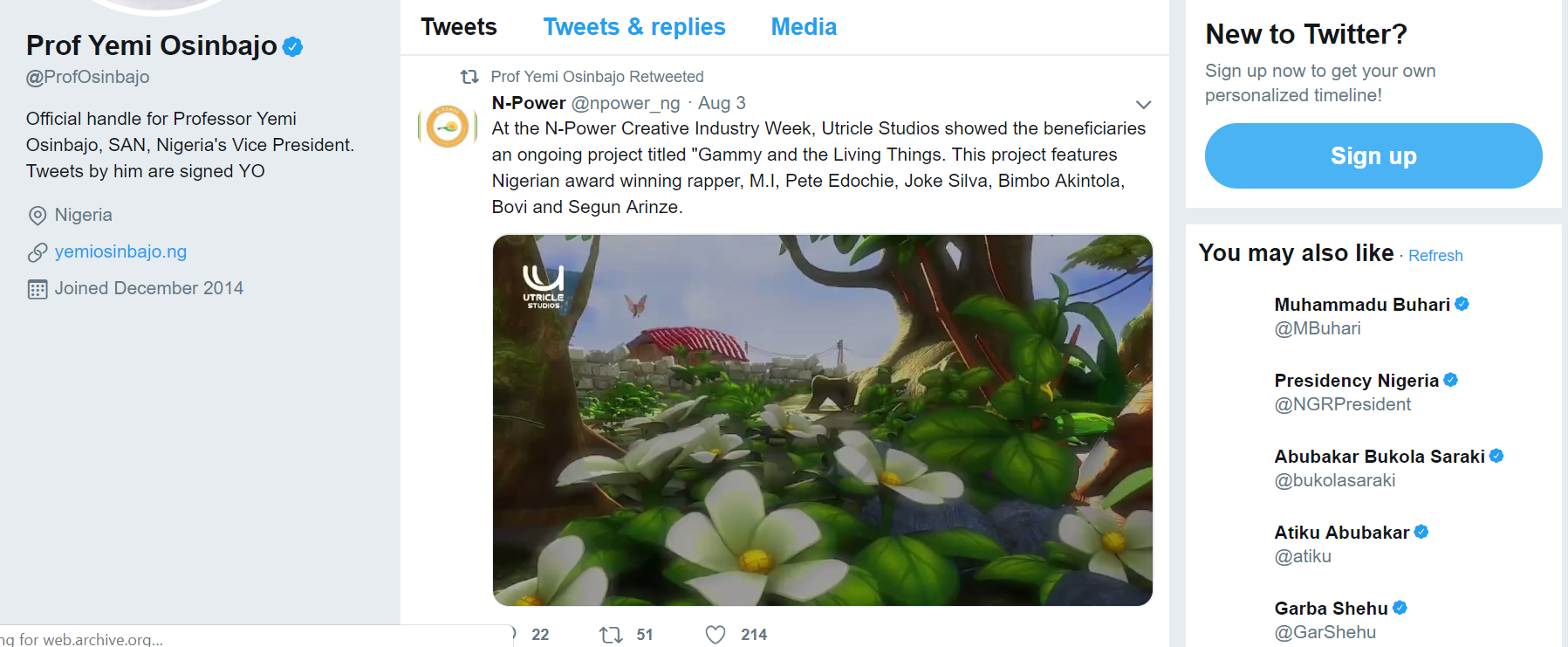
Image from Mark Graham’s Nigerian Archive on Wayback Machine
The last tweet by @ProfOsinbajo on August 8, 2019, was a retweet of NPower
On August 9, Web Capture from the account at 00:13:17 showed the account was still the same as above with no changes. (see image below)
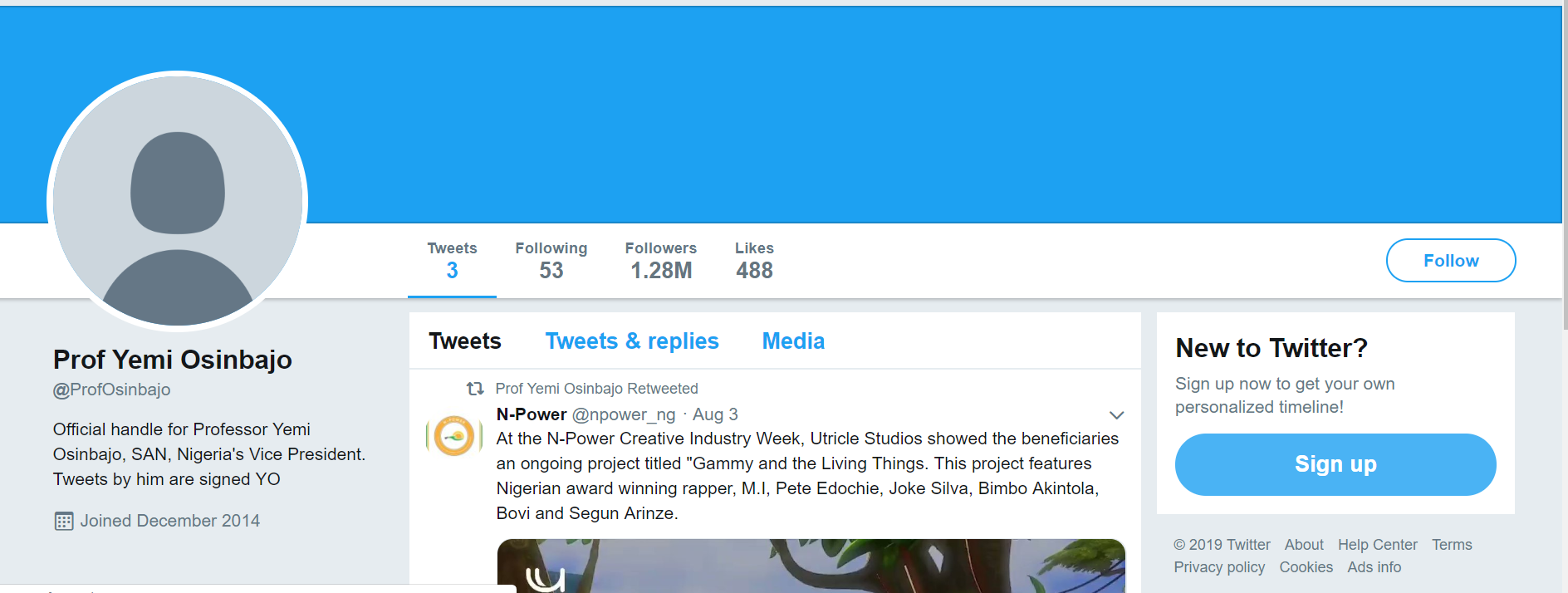
Image from Mark Graham’s Nigerian Archive on Wayback Machine
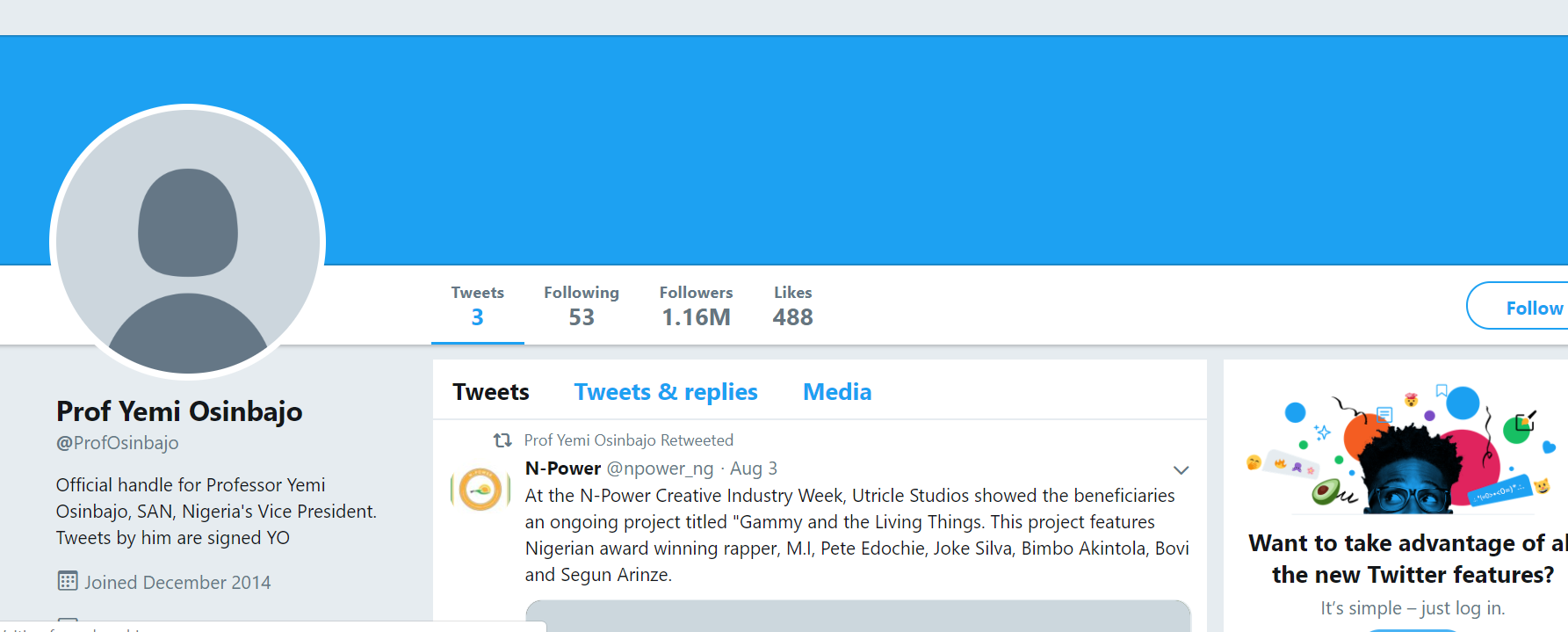
At 16:13:35 hours, the Vice President’s account had become unverified with follower count down to 1.28million from 2.13million and following only 53 persons from 60 previous followings with only 3 tweets as against the previous 2,399 tweets. There is no current record of those unfollowed at the time. This showed a troll attack pattern.
At 22:50:19, the account was still down and showed the exact same image above.
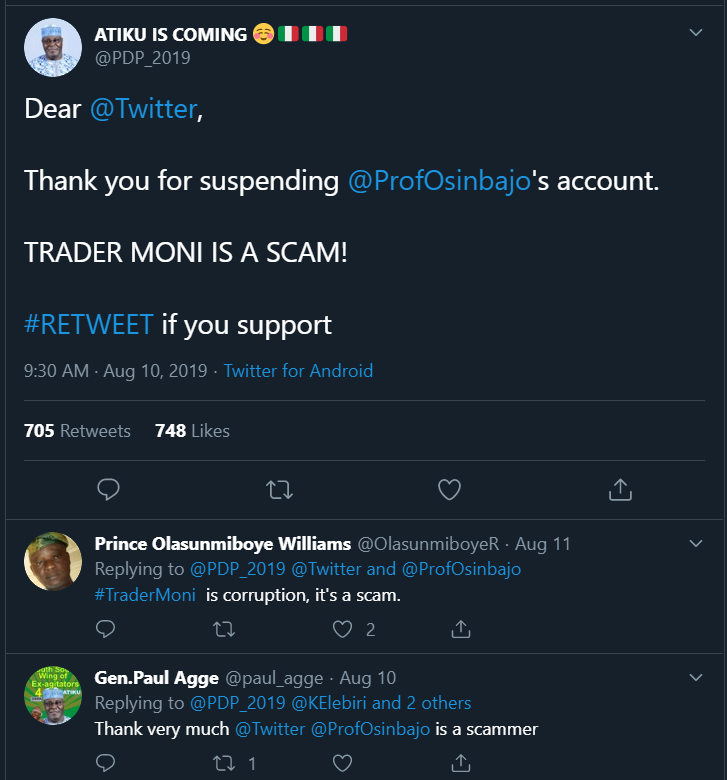
Twitter reactions to the account being down from known opposition sympathizers/members
On August 10, reactions on Twitter
Reaction from the Vice-President’s Aide
At 09:39:00, the account had been restored but without the verification and had the follower count down to 1.16million. It appeared the tweet archive had been deleted.
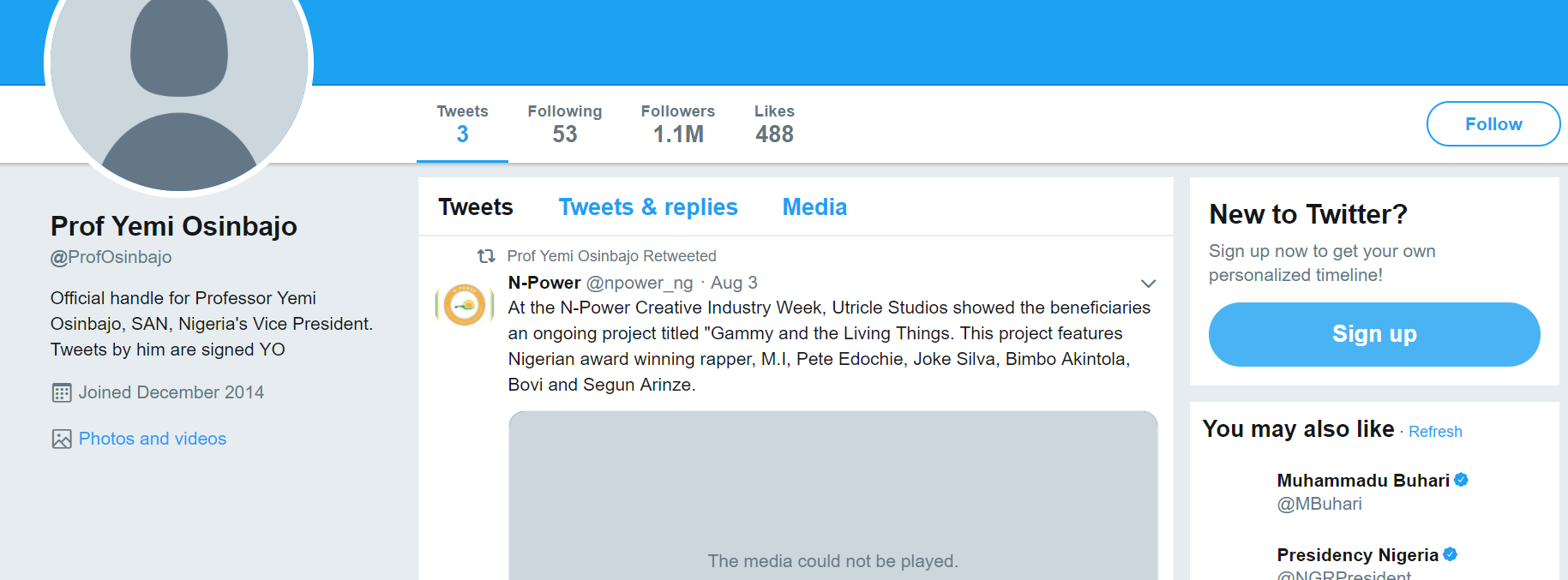
At 16:30:41 hours, the follower count had gone down to 1.1million followers (see image below) and the account was fully suspended.
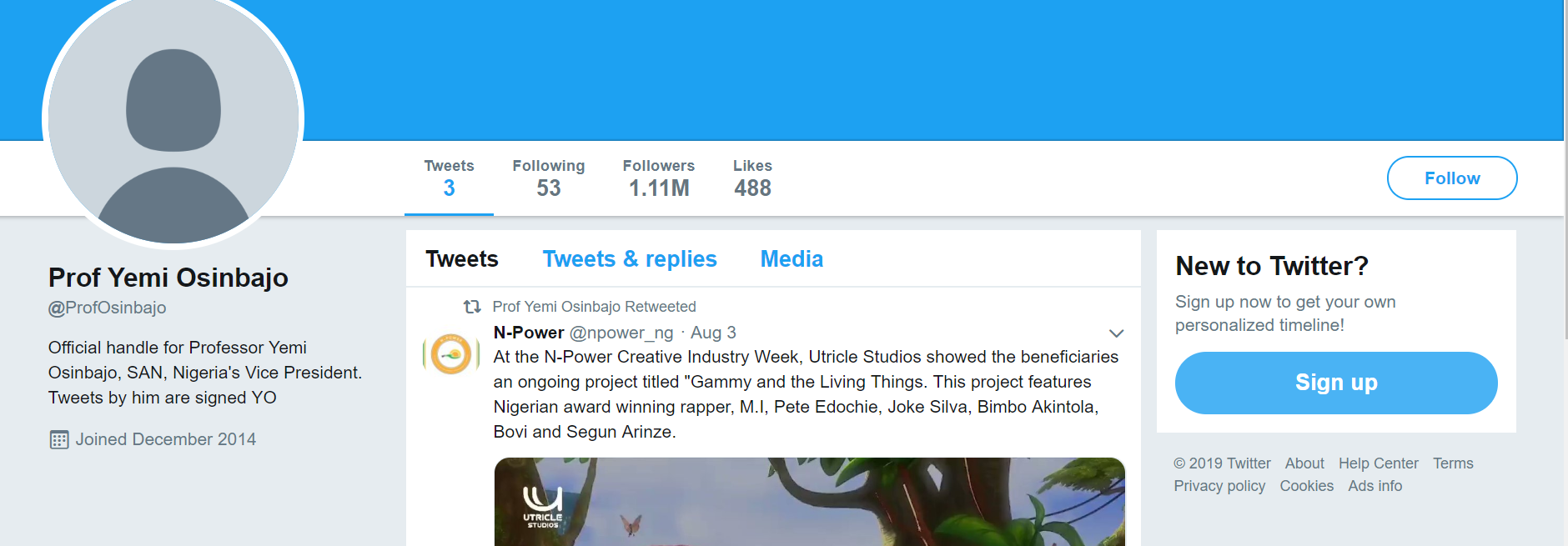
At 01:55:20, the account appeared restored and follower count climbed up to 1.11million as in the image below. The account was unverified and still did not have an image or header.
At 12:40:36, the account was climbing up in followership count
The account had been fully restored as at 17:00:00 hours and sent out Sallah messages to Nigerians at about 17:17:00 hours.
Conversations around the Trader Moni and Osinbajo can also be tracked here and here.
This report was put together by Damilola Ojetunde, Data Analyst at The ICIR and Nana Nwachukwu, a Public Interest Digital Researcher.
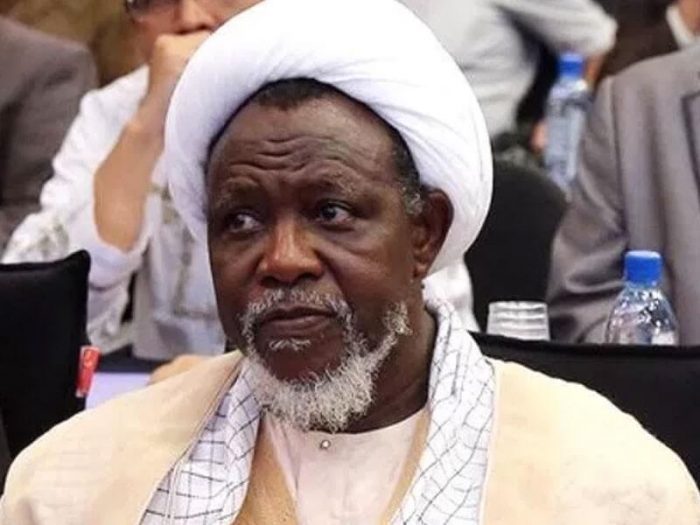
Not fewer than 186 Medical Doctors from seven countries have written to President Muhammadu Buhari, expressing their concerns over the deteriorating medical condition of the released leader of the Nigeria Islamic Movement (NIM), Ibrahim El-Zakzaky.
The doctors are from Pakistan, India, Iran, Afghanistan, Syria, Lebanon and Iraq.
According to a report by FARS News Agency, the Federal Government should transfer the Islamic clergy and his wife to a well-equipped hospital.
They claimed the victim is already suffering from acute insomnia, Ischemic heart disease which could lead to Myocardial Infraction, aside from heavy metal toxicity such as Lead deposit in his system.
El-Zakzaky and his wife were sighted at the Nnamdi Azikwe International Airport, Sunday preparing to journey to India for medical treatments.
They were temporarily released by Justice Darius Khobo of the Kaduna State High Court to seek treatment abroad after repeated demands by Femi Falana, the defense counsel as well as protests by the cleric’s followers.
The protesters were further proscribed as a terrorist group by the federal government for insisting on the release of their leader El-Zakzaky.
To the President of the Republic of Nigeria, Mr. Buhari.
In the past several months, the world has constantly received troubling news regarding the health of one of the prominent figures in Nigeria, Shaikh Ibrahim Zakzaky. Both Shaikh Ibrahim Zakzaky and his wife are kept in prison and the health status of both of them is very alarming.
We have chosen to be doctors even after knowing that this job is very difficult and troublesome, but we chose to save people’s lives and preferred the health of society over our personal interests.
According to the medical reports regarding the health status of Sheikh Ibrahim Zakzaky:
He is suffering from total blindness in the left eye and is also suffering from vision problems in the right eye including glaucoma and progressive macular atrophy. According to the diagnosis of the visiting physicians, Shaikh Zakzaky will lose his vision sooner or later if the current circumstances do not change.
He has shown symptoms of Ischemic heart disease which can lead to Myocardial Infraction.
He is also suffering from severe cervical spondylosis which has resulted to nerve root compression and symptoms are progressive causing insomnia.
The experiments show that he has heavy metal toxicity including Lead and Cadmium. Laboratory tests that are performed on May 31st, 2019 show that blood lead level is 171.94µg/dl. Later on June 18th, 2019 this level was reported to be 231.48µg while in the last laboratory test the blood lead level was three times more than the toxicity level (grade 5 of poisoning).
Based on the points highlighted above, Shaikh Ibrahim Zakzaky should be transferred to a well- equipped medical center that has Neuro-ophthalmologist, glaucoma specialist and low vision expert, cardiologist, orthopedist, and neurologist. Also, he may need to have surgery to reduce intraocular pressure.
We, doctors of different nationalities cannot take the health of any human for granted. This is something that is inherent in our obligation as doctors. Ignoring the critical health status of Sheikh Ibrahim Zakzaky can end up in irreparable consequences.
We request the government and parliament of Nigeria to immediately transfer him to a well-equipped hospital to prevent any unfortunate incidents. A group of doctors from Pakistan, India, Iran, Afghanistan, Syria, Lebanon and Iraq.
“Sheikh Zakzaky, a prominent Shiite leader, has been in detention along with his wife for close to four years despite the deterioration of his health conditions.
“Last Tuesday, in an exclusive interview with FNA, Dr. Pourrahim Najafabadi, MD, said Sheikh Zakzaky needs to be cured by an experienced medical team of physicians in a specialized multi-specialty hospital outside Nigeria, since there is no such medical center in the African country.
“With the current physical condition of the Sheikh, especially the virulent lead poisoning, Sheikh’s life is seriously at risk by delayed treatment. Meanwhile, there is a need for special medical care even in case of complete medical treatment. There is serious risk to Sheikh’s life if he is kept under detention,” said Najafabadi, the founder and spokesperson of a group of expert physicians who have volunteered to treat Sheikh El-Zakzaky.