ON Thursday the Economic and Financial Crimes Commission, EFCC, refuted the claims of a media publication which stated that Mohammed Adoke, a former minister of Justice involved in the ongoing Malabu trial was blameless in the $1.2 billion oil scandal.
The report indicated that former Minister of Justice and Attorney General of the Federation, Mohammed Adoke, was exonerated based on a ruling of Justice Binta Nyako on a 2017 civil suit marked FHC/ABJ/94/446/2017 which absolved Adoke of liability for his alleged roles in the OPL 245 deal on account that he was acting on the directives of the then President Goodluck Jonathan.
EFCC spokesperson, Tony Orilade, in a statement denounced the claims made in the publication saying the EFCC had a strong case in court.
“Logic was stood on its head in the said publication, given that Justice Nyako spelt out in no unclear terms that the reliefs Adoke got in the civil suit he brought before her was to the extent he subordinates himself to the directives of the president.
“In the matter of the OPL 245 and OPL214 deal did not make him ineligible to face criminal charges, arising from his actions in the same transaction,” he said.
Adoke and his accomplices are facing prosecution by the Economic and Financial Crimes Commission, EFCC, for alleged roles in the fraudulent allocation of Oil Prospecting License, OPL 245 and OPL 214, conspiracy, money laundering to the tune of over $1.2 billion, forgery of bank documents, and bribery.
Former President Olusegun Obasanjo had revoked the OPL 245, which the late General Sani Abacha granted to Etete, who was his Petroleum Minister and reassigned it Shell Nigeria Exploration and Production Company.
Etete’s Malabu Oil and Gas, however, reclaimed the oil bloc in 2006 through the court. While Shell challenged the decision, a fraudulent settlement and resolution came under Jonathan’s government with Shell and Eni buying the oil block from Malabu in the sum of $1.1 billion.
Investigations by the EFCC revealed that Adoke and others had fraudulently received an aggregate sum of US$ 801,540,000 (Eight hundred million, five hundred and forty thousand United States Dollars) from Shell Nigeria Exploration Production Company, Nigeria Agip Exploration Ltd and ENI SPA in relation to the oil prospecting license.
The investigation also showed that Adoke as the Attorney General and Minister of Justice abused his office in respect of the granting of the oil prospecting license OPL 245 to Shell and ENI.
A prima facie case, bothering on official corruption was established by the EFCC following the investigations, culminating in court charges against Adoke, Etete and others, which is still pending before the FCT High Court and the Federal High Court.
Tony maintained that “the arraignment of Mohammed Adoke SAN, Etete and others could not take place because they along with other defendants have remained at large, refusing to make themselves available for trial and Justice Nyako did not shield Adoke from facing criminal prosecution.”
While he got the relief, Justice Nyako made it clear that there was no nexus between declaratory reliefs he sought and the criminal charges against him in the EFCC suit.
“The pronouncements of the judge leaves no one in doubt that the court found no link between the criminal charge in Exhibit HAGF and the declaratory reliefs Adoke sought, prompting the court to declare that Exhibit HAGF was extraneous to the determination of this issue Adoke brought before her,” he stated.
He described the newspaper portrayal of Adoke as innocent as misleading with an intention to deceive the public.
“The THISDAY’S publication was an attempt to deceive the public because the attorney general had no need to write such a letter as his office has constitutional powers to take over and discontinue such criminal cases in court so the claims in the publication is not true,” he said.
THE on-going tracking of constituency projects by the Independent Corrupt Practices and Other Related Offences Commission (ICPC) and its partners through the Constituency Projects Tracking Group (CPTG) initiative has yielded yet another significant result with the recovery of six tractors meant for the use of farmers in six local government areas of Bauchi Central Senatorial District.
ICPC spokesperson, Mrs. Rasheedat A. Okoduwa, made this disclosure on Thursday.
The tractors formed part of a N430 million contract for the supply of pumping machines and other agricultural machinery to farmers in the senatorial district, which was awarded in 2015 by the Federal Government as part of Senators’ constituency projects across the nation.
One of the tractors seized by ICPC CREDIT: ICPC
The CPTG team for Bauchi discovered that N76.6 million was paid for the tractors in December 2015 and supplied in March 2016. They were supposed to have been distributed for the use of farmers in each of the six local government areas in the Senatorial District that included Misau, Dambam, Ningi, Warji, Darazo and Ganjuwa. It was found out that the tractors had obviously not been distributed as required in the terms of the contract.
In the effort to trace the tractors, Isa Hamman Misau, the then Senator under whose auspices the project was included in the budget to be executed by the MDG office, met with officials of ICPC in Bauchi and in a written statement claimed that the tractors were kept in Yuli village.
However, the CPTG team did not find any of the tractors there and some of the intended beneficiaries who were interviewed claimed not to have ever seen the tractors in the village as claimed by the Senator.
The Senator who was later contacted on telephone by the CPTG team, to ascertain the actual location of the tractors, could not offer any positive explanation during the conversation.
The CPTG team however gathered through intelligence that the tractors were being hurriedly moved to Ganjuwa local government headquarters and it then proceeded to the place to take custody of them.
The tractors which are already showing signs of dilapidation as a result of usage, with some leaking oil, have been seized by the Commission and handed over to the Chairman, Ganjuwa Local Government for safe keep pending further directives.
Equipment found in Mma Obot Foundation premises
The CPTG assessment and review of constituency projects across Nigeria by the Commission and its partners; Nigerian Institute of Quantity Surveyors, Bureau of Public Procurement, Budget Office of the Federation, The International Centre for Investigative Reporting, ICIR, Premium Times, BudgIT and Udeme.ng is aimed at ensuring satisfactory execution of all Constituency Projects across the country. It has so far led to multiple recoveries of items, hospital equipment, vehicles and funds. It has also forced many contractors who hitherto had abandoned projects to return to site to complete them.
Among the recoveries so far made by the CPTG team are dialysis machine, ECG monitor, oxygen regulator, Anaesthetic machines, generators and other hospital equipment meant for a cottage hospital in Ukana, Essien Udim Local Government Area of Akwa Ibom State, from premises of Mma Obot Foundation, alleged to belong to Senator Godswill Akpabio.
THE Defence Headquarters (DHQ) on Thursday denied reports of burying scores of Nigeria soldiers at secret unmarked graves to conceal figures of casualties in the ongoing war against insurgency in the Northeast.
The information was disclosed in a statement by the Director of Defence Information, Onyema Nwachukwu.
According to the military, such a report was an insinuation that emanated from an uninformed position of the author of the publication.
The military revealed that there was no secret graveyard in the Northeast theater, stating the Armed Forces of Nigeria has a rich and solemn tradition for the internment of its fallen heroes.
The army spokesperson maintained that the Armed forces of Nigeria do not indulge in secret burials, as it is “sacrilegious and profanity to extant ethos and tradition of the Nigeria Army”.
“It must be unambiguously clarified that the Armed Forces of Nigeria does not indulge in secret burials, as it is sacrilegious and a profanity to extant ethos and traditions of the Nigerian military,” the statement read.
The statement added that it was the tradition of the Armed Forces to duly honour its fallen heroes and paying the last respect in befitting military funeral of international standards.
The standards included; funeral parade, gravesite oration, solemn prayers for their rest of their souls, done by both by Islamic and Christian clerics, as well as gun salutes, aside from other military funeral rites.
“The cemetery described in the publication, which is situated in Maimalari military cantonment is an officially designated military cemetery for the Armed Forces of Nigeria in the North East theatre, with a cenotaph erected in honour of our fallen heroes.”
Nwachukwu said the official cemetery had played host to several national and international dignitaries, where wreaths were laid in honour of the fallen heroes.
“It is, therefore, a far cry from the sacrilegious impression being painted by the Wall Street Journal.” the statement read.
The army urged the general public to disregard “such a misinformed publication and see it as a figment of the imagination of the writer, whose knowledge of military valued ethos and traditions is grossly misplaced”.
The Wall Street Journal (WSJ) had in a report said the Nigeria Army had buried scores of soldiers at a secret cemetery, “at the northern edge of Maiduguri city’s sprawling military base; a vast field of churned soil conceals the hidden toll of a deadly offensive by the allies of Islamic State”.
It said after dark, the bodies of soldiers are covertly transported from a mortuary that at times gets so crowded the corpses are delivered by truck.
The report revealed that the bodies were laid by flashlight into trenches dug by infantrymen or local villagers paid a few dollars per shift.
WSJ disclosed, its report was based on accounts from Nigerian soldiers, diplomats, and a senior government official.
It said a soldier who spoke from the Maimalari barracks, where 1,000 are based, said, “Several of my comrades were buried in unmarked graves at night”.
“They are dying and being deleted from history.”
The report said, a senior government official noted that the secret graveyard at Maimalari is not the only one in Nigeria’s troubled northeast.
THE West African Examinations Council (WAEC) says it is set to acquire three Magic Scanners PS 1000 for authentication of documents and responses.
The council’s Head of National Office, Olu Adenipekun, made the disclosure on Thursday in Lagos State at a news conference to announce WAEC’s hosting of the 37th annual conference of the Association for Educational Assessment in Africa.
The annual conference will take place in Abuja from August 5 to August 9, with the theme: “Innovations in Educational Assessment,” according to Adenipekun.
He said that participants at the conference would come from all parts of the world.
He said the conference would enable the participants share knowledge on issues of evaluation and assessment, and sponsor international participation in the field of educational testing and assessment within member-countries.
“One thing that will be coming on board is how we can apply technology to improve our service delivery.
“The place of technology in the education sector is one thing that will take the centre stage by looking at how innovations and technologies can be deployed in the conduct of public examinations in Nigeria.”
WAEC, he said, has concluded plans to acquire three Magic Scanner PS 1000 from a UK company that has confirmed to showcase the technology at the conference.
“This Magic Scanner will be used to authenticate documents and responses before they are taken to the clouds, ‘’ he said.
A FEDERAL High court sitting in Ilorin on Thursday has ordered the final forfeiture of Asmau Plaza owed by Rasaq Momonu, Controller, finance and Account Kwara State.
The property valued at N150 million was supposedly acquired through illicit financial proceedings.
Nnaemeka Omewa, the Economic and Financial Crimes Commission, counsel on the case prayed the court to grant the final forfeiture of the property in pursuant to Section 17 of the Advance Fee Fraud and other Fraud Related Offences.
“I urge the Court to grant the motion,” he said.
Justice Sikiru Oyinloye granted the application and resolved all the issues raised in favour of the EFCC, said the commission fulfilled all the necessary requirements.
“The application brought by the EFCC is meritorious and granted; this Honourable Court hereby orders the final forfeiture of the landed property known as Asmau Plaza, Tanke Road, Ilorin, Kwara State to the Federal Government of Nigeria,” he said.
Momonu who is currently facing money laundering is alleged of being complicit in the diversion of state funds.
Evidence shown at court by Musa Gidado, EFCC investigating officer, showed that the accountant used the status of his office to award and inflate contracts for the construction of two classrooms at Ogbondoroko and Obanisuwa Community in Kwara State.
“The respondent who is a Civil Servant that earns less than N100,000 in a month cannot afford to build the house known as Asmau Plaza between 2010 -2012,” Gidado stated.
Momonu, whom the Commission had confronted on all charges, did not dispute the allegations and agreed to the forfeiture of the Asmau Plaza to the Federal Government.
The respondent is expected to appear before Justice Babangana Ashigar of the Federal High Court sitting in Ilorin on September 25, on charges of money laundering.
THE United Nations health and children agencies (WHO and UNICEF) are both campaigning for the provision of family-friendly policies to enable breastfeeding that included the enacting of paid maternity and paternity leave.
The campaign was set up to commemorate the World Breastfeeding Week holding between August 1 and 7. The week is celebrated every year to encourage breastfeeding, thereby, improving the health of babies worldwide.
“WHO is working with UNICEF and partners to promote the importance of family-friendly policies to enable breastfeeding and help parents nurture and bond with their children in early life, when it matters most,” according to the WHO’s statement on Thursday.
It included that enacting paid maternity leave for a minimum of 18 weeks, and paid paternity leave would encourage shared responsibility from parents of caring for their children on an equal basis.
“Being a parent is the most important job in the world. Parents need time to give their child the best start in life. Breastfeeding is one of them!” WHO also tweeted.
Importance of paid leave. Infographics credit: WHO.
Upon return to work after the paid leave, WHO said mothers also need access to a parent-friendly workplace to protect and support their ability to continue breastfeeding.
It asked for access to “breastfeeding breaks, a safe, private, and hygienic space for expressing and storing breastmilk and affordable childcare”.
Breastfeeding promotes better health for mothers and children alike. It decreases the risk of mothers developing breast cancer, ovarian cancer, type 2 diabetes and heart disease.
By increasing breastfeeding, WHO said more than 800, 000 lives could be saved every year, the majority being children under six months. It estimated that increased breastfeeding could avert 20, 000 maternal deaths each year due to breast cancer.
The global health agency recommended exclusive breastfeeding for babies within one hour after birth and six months old. Nutritious complementary foods should then be added while continuing to breastfeed for up to two years or beyond.
According to the Nigeria labour act, females employees are entitled to four months, 16 weeks, of paid maternity leave. But the law does not make provision for paternity leave.
At the state level, Lagos State civil servants are entitled to ten-day paternity leave within the first two months of a child’s birth.
The exclusive breastfeeding rates in Nigeria is low. UNICEF Nigeria said only 17 per cent of babies born, over the decade, were exclusively breastfed. “Just 18 per cent of children aged 6-23 months are fed the minimum acceptable diet in Nigeria,” it noted.
The result of the low-feeding is not far-fetched as the country has the highest number of stunted growth in Africa.
OLUREMI Tinubu, a senator representing Lagos Central, during the just-concluded ministerial nominee screening, begged and requested for employment slots for her constituency.
She made the request when Babatunde Fashola, former minister of Power, Works, and Housing, who has been nominated as a minister for the second time was being screened.
Senator Tinubu said while Fashola was a minister in his first term, she did not get a letter of employment for her constituency.
In her words, “I remember that during your first tenure, I didn’t get any chance to give employment letters to my constituents, so when you get there this time, just remember senators.
“We have people back home asking us for employment slots. I want you to put it in your agenda that as senators, we all need employment slots for our constituents,” she said.
https://www.youtube.com/watch?v=j6JhWeV2NWs
President Buhari on July 23 sent a list of his prospective cabinet members to the Senate for screening and confirmation after 55 days of his inauguration for the second term in office.
Top on the list are Babatunde Fashola, Festus Keyamo, former Director of Communications and Strategy to President Buhari during the 2019 election; Sen. Godswill Akpabio, a former Governor of Akwa Ibom State and 40 others.
The manufacturing Purchasing Manager Index, PMI in the month of July stood at 57.6 index points, the Central Bank of Nigeria (CBN) revealed in a new report.
Data made available from the “PMI July 2019 Report” published on Wednesday indicate expansion in the manufacturing sector for the 28th consecutive months.
However, the textile, apparel, leather & footwear subsector recorded decline in the review period.
The PMI is based on survey responses of purchasing and supply executives of manufacturing and non-manufacturing organizations in all 36 states in Nigeria and the Federal Capital Territory (FCT).
The survey is used to arrive at the changes in the level of business activities in the current month compared with the preceding month.
The Apex bank noted that the index grew at a faster rate when compared to the index in the previous month at 57.4 points.
“Of the 14 subsectors surveyed, the CBN said 13 reported growth in the review month, including the petroleum and coal products, transportation equipment, cement, printing and related support activities, and paper products.
“Others are food, beverage and tobacco products; furniture and related products, fabricated metal products, non-metallic mineral products, plastics and rubber products, primary metal, chemical and pharmaceutical products, as well as electrical equipment.
“However, the textile, apparel, leather and footwear subsector recorded a decline in the review period,” showed the index.
The financial regulator revealed that at 58.9 points, the production level index for the manufacturing sector grew for the 29th consecutive month in July.
According to it, the index indicates a slower growth in the month, when compared to its level in the month of June.
“Twelve of the 14 manufacturing subsectors recorded increased production level, while two recorded decline,” it said.
Similarly, the employment level index of the sector stood at 57.3 points in July, indicating growth for the 27th consecutive month.
The report said, “Of the 14 subsectors, 10 reported increased employment level, one reported unchanged employment level while three reported decreased employment in the review month.”
SUHAILA Ibraheem El-Zakzaky, daughter of the detained leader of Islamic Movement of Nigeria, (IMN) Ibraheem El-Zakzaky has debunked reports that members of the movement have suspended their protest to demand Zakzaky’s release.
It would berecalled that the IMN in a statement said it had suspended street protests in Abuja and was ready to take the government to court.
A statement reportedly signed by the spokesperson of the movement, Musa Ibrahim, said the suspension was decided upon in order to resolve the prolong detention of El-Zakzaky and ensuring his freedom.
However, speaking in a two minute, twenty second video made public via You tube on Thursday, Suhaila said Musa Ibrahim, who announced the suspension of protest in a press release, has no authority to speak on behalf of the movement.
The IMN, according to her, has no spokesperson, noting that Ibrahim is only a chairman of a media forum, such, as the numerous forums in the Islamic movement.
“I just wanted to clarify because I saw news agencies stating that spokesperson of this movement released the statement,” she said.
She noted that such information could jeopadise the motive behind the protest which aimed at making government to release her father from detention.
Zakzaky’s daughter further reiterated that the Shiite members would continue with their protests until their leader is released.
Suhaila revealed that Ibrahim was not part of the organizers of the protests in Abuja since its inception and would not be part of the future protests until El-Zakzaky is freed.
The ICIR reports that the news of the suspension of street protests by the Shiites came a few days after the government had proscribed the group’s activities.
El-Zakzaky was arrested on December 12, 2015, by men of Nigerian Army and detained, alongside his wife Zeenat El-Zakzaky .
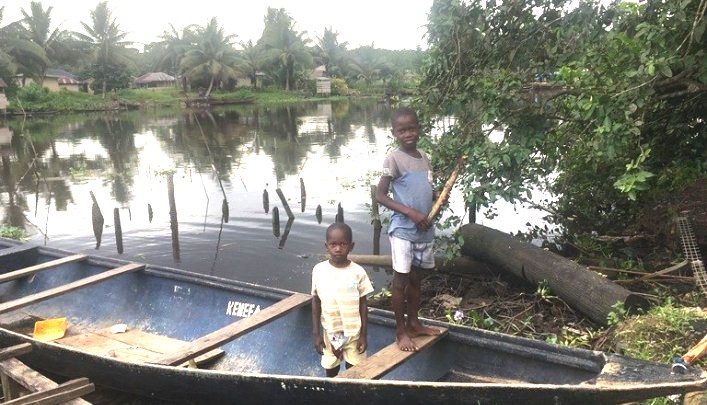
The ICIR reporter, Amos ABBA visited Azuzuama, in Bayelsa State where oil spills from pipelines belonging to Agip persistently occur without a commensurate remediation effort from the oil firm to clean up the affected sites.
Edited by Ajibola AMZAT
ESTHERGodspower, 22, gave birth to her second child in April but the occasion did not call for celebrations.
The exhausting hours she had spent on sessions with local midwives on how to take care of her baby, and the money spent on baby’s clothes and accessories suddenly became wasted.
“I was expecting the midwives to put the baby in my arms when I delivered but the expressions on their faces explained everything to me. The sacrifices I made during pregnancy to ensure I gave birth to a healthy child just seemed a waste,” she told The ICIR.
Esther gave birth to a baby who died barely an hour after delivery but she has no idea why the child died because she didn’t give birth in the hospital. The traditional midwives who attended to her also had no explanations to give her.
“I was depressed for several weeks with the thought that I had a baby who just died suddenly without any sign of illness, it took me a while to recover from that shock,” she said.
Esther’s tragedy is familiar to other mothers in Azuzuama, a pollution hotspot of crude oil spills in Southern Ijaw local government area of Bayelsa State, but since the community is without a functional hospital there are no medical answers to this problem.
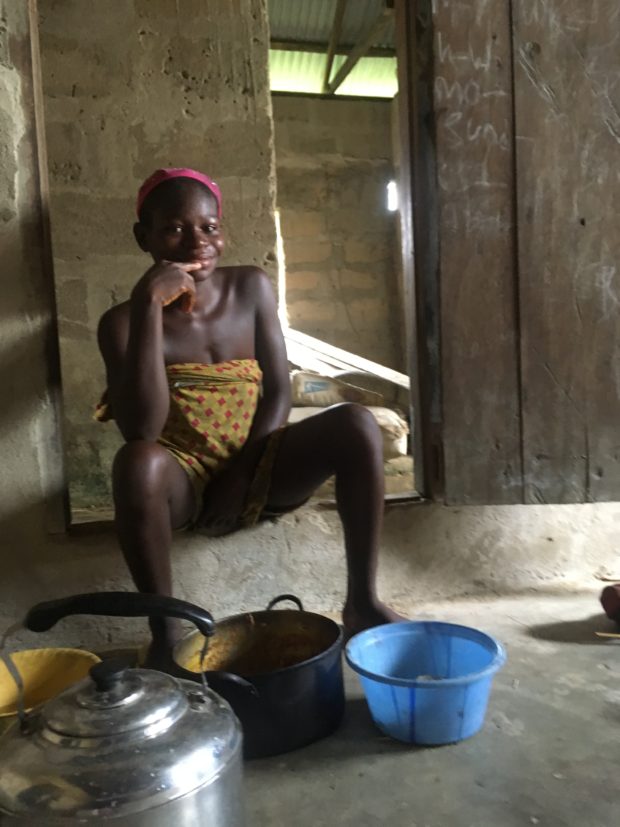
Esther Godspower sitting at the doorway of her house. Photo Credit: Amos Abba
However, researchers at the University of St. Gallen in Switzerland may have answers for women in the community.
A 2017 study carried out by Anna Bruederle and Roland Hodler which focused on the local effects of oil spills in the Niger Delta revealed that children born within 10 kilometres of an oil spill were twice as likely to die in their first month. Esther lives less than 10 kilometres to the site of a major oil spill in the community.
The study compared the health status of children born after a spill and their siblings born before a spill with its conclusion that the chances a baby dies within the first 28 days of life within 10 kilometres of oil spill site are high.
Esther’s experience captured in the research is not different from mothers in other communities where oil spill occurs regularly, whose babies die shortly after they are born.
A large-scale problem
Azuzuama in Bayelsa State is one of the host communities to Nigerian Agip Oil Company, NAOC where Oil Mining Lease, OML 63, its largest oil field in Nigeria in terms of acreage, is located.
The oil-rich community has been a money-spinning haven for Agip since 1978 when it started its oil production but Azuzuama does not share from its success story.
Statistics from the Ministry of Environment in Yenagoa revealed that from January 2013 to April 2017, a total of 1,031 oil spill incidents had occurred on pipelines belonging to Agip in Bayelsa State, an equivalence of over 20, 550 barrels of crude oil.
Azuzuama shares the bulk of the pipeline ruptures with 900 cases recorded by the Joint Investigation team carried out by a team comprising the National Oil Spill Detection and Response Agency, NOSDRA, an agency charged with ensuring compliance to environmental legislation in the petroleum sector, Ministry of Environment and Agip officials who assessed the impacted sites.
It also revealed that 431 impacted areas were expected to be cleaned up or remediated by Agip to prevent the spill from posing a potential risk to the health and livelihood of people in those areas.
However, the pollution of the ecosystem in Azuzuama by Agip’s oil activities has continued unabated for years without the intervention of environmental regulatory agencies mandated to regularly carry out inspections.
When The ICIR visited several spill sites in the community, mostly from Agip’s Azuzuama’s export pipeline, the sites were not cleaned up and where cleanups were carried out, crude oil extracted from the river was disposed on vegetation.
Other oil spill sites which the reporter accessed barefooted had pools of crude oil which had not been cleaned up for months, others for years.
Gibson Isedirikonghen, a teacher in the community told The ICIR how the spills have been destroying their source of livelihood.
“There are several onshore sites where there have been oil spills for years, but Agip has nothing to clean them up. So, what we do is leave those sites and move to where the oil has not affected. If you have farmland that is affected by the spill it means you have to start looking for an alternative source of income other than farming or get another parcel of land,” he said.
He lamented about the frequent contamination of the river from the spill sites that were not cleaned whenever it rains.
“Whenever it rains, crude oil from those spill sites flows from the mangrove forests into the river which is very dangerous to us. It’s poisonous because the smell is choking apart from the other toxic effects on our body. When you inhale it, your body system reacts badly to crude oil. It’s terrible,” he said.
However, data obtained from the Nigerian Oil spill monitor, a website run by NOSDRA which keeps track of oil spills in the country shows that there are over 1,000 spill sites in Bayelsa State but there are no details or information about cleanups or remediation carried out by the oil firms – Agip included–that is listed on the portal.
Between a rock and a hard place
Mabel Theophilus carefully slides down her eight-month-old baby strapped to her back and lays him on a local mat while she washes the fishing nets she had used for catching fish.
For the twenty eight year old, single mother of two who had been fishing in Azuzuama creeks in Southern Ijaw local government area of Bayelsa state for over ten years, the stinging throat and constant headaches she feels whenever she inhales air around sites where there is an oil spill has always been the worst effects of crude oil spills she had encountered.
In January, her three-year-old daughter, Natasha, had a strange strain of rashes on her body. Mabel told The ICIR she started noticing it after bathing her consistently with water from the river that is frequently contaminated with crude oil leaking from compromised oil pipelines in the community.
Mabel knew it was risky bathing her baby with the contaminated water, but she did not expect a skin disease could result from it.
“Whenever I bathe Natasha with water from the river or she swims in the water she always complains of itching on her body but I always thought it would go away when she uses the water consistently,” she said. She was wrong.
The rashes had spread to every part of Natasha’s body disfiguring her skin, leaving scars on her from head to toes.
Mabel took her to the Azuzuama health clinic but the medical personnel at the facility were not trained to handle such cases so she resorted to herbal remedies for cure which worsened Natasha’s condition.
Natasha, with blemished skin. Photo Credit: Amos Abba
When asked why she has not taken her daughter to the hospital in Yenagoa the capital city.
She explained that the exorbitant costs involved in getting orthodox treatment for her daughter were beyond her means as her fishing business is becoming less lucrative due to the frequent oil spills contaminating the river.
“I will set traps in the river for days but what I catch cannot sustain the family for a day, the fish are no longer in the water as before, and when I can’t feed my small family is it hospital bills we’ll be talking about,” she asked in a distressed voice.
Speaking further, she said, “The transport cost from Azuzuama to Yenagoa by boat is ₦3,500, which means I have to spend more than ₦10,000 only on transportation, apart from the hospital charges which I can’t afford currently because my fishing business is no longer as lucrative as before because of oil spillages.”
Though, a medical expert has not closely examined Natasha and diagnosed her case properly, Mabel is taking her chances with the fate that Natasha will be cured miraculously.
“I am praying that this strange skin rash should disappear because I don’t have money to spend on sickness when we have not eaten properly,” she said.
Her plight mirrors the struggles of residents in Azuzuama community whose attention to their health condition depends on their earnings from fishing and farming which has suffered setbacks from frequent oil spills that kill fish in their river and destroy crops.
Clinic without doctors
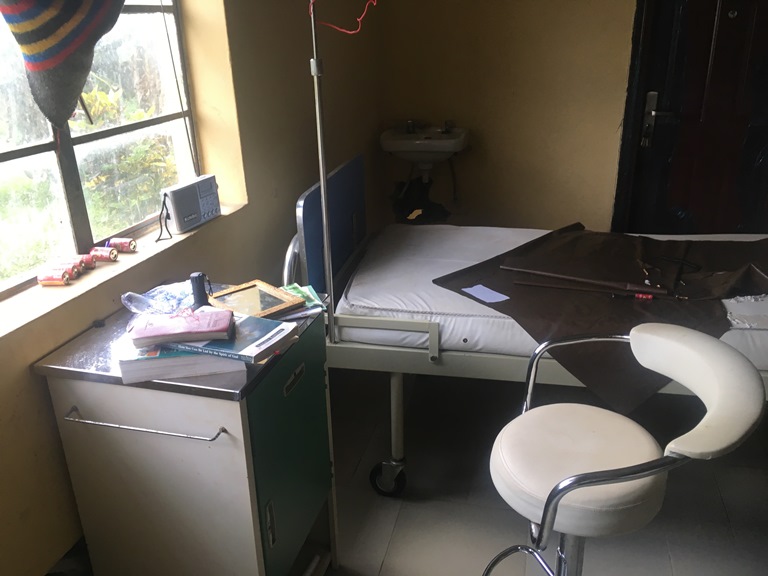
The only health facility in Azuzuama is without a signpost. It boasts of four admission rooms, a consulting room and a hall mostly for antenatal patients.
The building serves not only as a clinic but also as a residence for some of the health workers who converted two of the admission rooms to their personal use.
One of the wards in the clinic has been converted into a living residence for volunteers. Photo Credit: Amos Abba
A three-man medical team, of whom none is a doctor or nurse, manages the clinic. Apart from immunising children and conducting antenatal sessions, most cases brought to them are beyond their expertise.
Ibuomo Faforu, a health volunteer who arrived at the clinic in February described the conditions at the clinic as “difficult” because they rarely have drugs available so patients have to take a three-hour journey by boat to Yenagoa to get to a proper hospital.
“We buy drugs with our money to sell to the patients who come for treatment or bring their kids with mild cases of fever, measles, but when it comes to serious cases like typhoid they have to look for solutions in Yenagoa where there are hospitals because we don’t have drugs to treat such ailments. It has been difficult here,” she said.
There is one doctor per 5,000 people in Nigeria, according to Isaac Adewole, the former minister of health, compared with the World Health Organization, WHO, a recommendation of one per 600 people.
Azuzuama with a population of about 10,000 people is without a single doctor, leaving residents in the community vulnerable to contractible epidemics such as air and waterborne diseases.
Deborah Leighe, a tailor had passed out when she was given an injection by one of the volunteers at the clinic to bring down her high temperature.
She had a fever accompanied by high temperature. Her condition was deteriorating as she has started to have hallucinations.
Neighbours rushed her to the clinic where a volunteer in the clinic administered an unnamed injection to her.
“I fainted immediately the injection entered my body, people who were close to the hospital had to come in and pour water on me before I was revived.”
She said the clinic needs qualified doctors to function as a proper hospital.
“We don’t trust people at that clinic, even if there is no hospital in Azuzuama can’t we be entitled to a trained doctor,” she queried.
Losing the coin in the fish’s mouth
Azuzuama waterfront was known as a fishing hub until regular oil spills from Agip’s activities which started in 1978 changed the ecosystem.
Fishes in the river have become scarce and those available reek of crude oil, a condition that reduces their commercial value. Also, the fishes are thinner and smaller.
Ongbehe Udoma, deputy chairman of Azuzuama Community Development Committee, CDC, who spoke to The ICIR blamed the dwindling fortunes of fishing on the irresponsible practices of Agip in cleaning up its spills in the community.
“The size of fishes is no longer as it used to be, they are now smaller and when you cook it you perceive the odour of crude oil in the fish. The fishes I caught when I was a boy in this village are no longer in the river. Currently, as it stands you can’t use fishing to fend for your family in Azuzuama but it wasn’t always like this,” he recollects.
He says further, “The problem with Agip has always been cleaning up spills from their pipelines, if their pipeline is vandalized they say we are not entitled to compensation but we are saying clean up the spills so people whose source of living is tied to fishing and farming can earn a living.”
Tubotamuno Ilaye switches between farming and fishing to make ends meet but her resort to engaging in farming was an act of survival.
Tubotamuno Ilaye who left fishing for farming to avoid the dangers of oil spill. Photo Credit: Amos Abba
She had started fishing in 1998 but stopped two years ago after she escaped death when she almost choked in crude oil that spilt near the river after falling asleep in a canoe while fishing.
“I could no longer continue fishing as a business after I was rescued from drowning in crude oil because I was always falling sick at regular intervals. I had to start farming, but it’s difficult to get space for farming because the oil spill is everywhere. I started gathering bush mangoes (Ogbono) to sell and survive,’ she said.
She still goes back to fishing but not frequently, her fishing routine now revolves around setting traps for lobsters for food.
“I still try to fish in the dry season but it’s just to set a trap to catch lobsters,” she said.
Yet, she is not entirely free from exposure to crude oil.
“Whenever I step my feet in the water at some places to check my traps even where the water is waist-deep, crude oil that had sunk to the river bed will start coming to the surface. Even the lobsters I catch, are not safe for eating,” she said.
Nigeria consumes over 1.8 million metric tonnes of fish annually but produces a million, leaving a deficit of over 800,000 metric tonnes, which is imported annually according to the United Nations High-Level Panel of Experts on Food Security and Nutrition report in 2018.
The report suggests that if environmental degradation in the Niger Delta persists then Nigeria’s hopes of becoming self-sufficient in fish production may never materialise.
Ebikake Evire, Principal of Comprehensive High School, Azuzuama, explained some of the challenges faced by residents in the community.
“When crude oil spills on land, it is absorbed into the soil, and water table. As you’ve noticed in this community there is no potable water. We drink from that contaminated water, we wash our clothes there and every domestic activity carried in this community is done using that water. When you cook fish from that river it breaks into bits when it is cooked. It’s not like normal fish,” he said.
A law-breaking multinational
Eni holds over 98 per cent ownership stake of its Nigerian subsidiary, Nigerian Agip Oil Company, NAOC. The company had started oil exploratory activities in Azuzuama since 1978 but regular oil spills which pollute the ecosystem of the community has complicated its relationship with the host.
From 2013 to 2018, the oil firm had allocated a total of €1.247 billion on environmental provisions to cater for estimated costs for environmental clean-up and remediation of soil and groundwater in areas where it’s business activities had created pollution problems across the world.
The NOSDRA Act mandates oil firm to clean up or carry out remediation when reliable cost estimation is within 24 hours.
The pollution created in Azuzuama from Agip’s pipeline has continued unabated for over years without the intervention of environmental regulatory agencies mandated to regularly carry out inspections.
The ICIR reached out to Agip to get an interview appointment with the Public Affairs Manager, Evans Ijeoma but all efforts made was frustrated.
When The ICIR visited Agip’s corporate headquarters in Abuja to book an appointment with the Public Affairs unit, a security staff took extra measures in checking the credentials of the journalist before assigning him to another a guard who took him to the mailing room where he dropped the letter and was escorted out of the premises.
An official letter dated 1 July 2019 was hand-delivered and was duly received by the mailing department of the oil firm but until the time of filing this report, there was no response to the letter.
Reminders sent to Agip were also not acknowledged by the oil firm.
Helpless NOSDRA
NOSDRA is an agency charged with ensuring compliance with environmental legislation in the petroleum sector.
The agency ascertains the area where remediation or clean up work should take place, conducts inspection work and determines the compensation to be paid to those affected.
Oil firms managing a pipeline are saddled with the responsibility to clean up any outflow of oil along its pipelines and remediate the environment within 24 hours of a spill irrespective of the cause or nature of the spill as stipulated by the NOSDRA, Act 2005.
A fine of one million naira was pegged as a penalty to be paid by the defaulting oil firms for failure to clean a spill while failure to report a spill attracts a fine of five hundred thousand naira for each day the incident is not reported.
The Director-General of the National Oil Spill Detection and Response Agency, NOSDRA, Idris Mohammed, in an interview with The ICIR stated that his agency compels oil firms to clean up the environment where spills occur irrespective of the cause of the spill.
“The oil companies are mandated to cleanup whenever there’s a spill but I can’t deny that the rate of spills is higher than the rate of remediation no doubt about that because everyday pipelines are being vandalized in Bayelsa State. So, as an operator, you will have to choose between cleanup or operations.
“For example, Nigerian Agip Oil Company has a unit called search and repair where they use a chopper to monitor their pipelines and fix leaking ones. To that effect, we placed our officials on a rota duty so that our officers can keep tabs on them. That’s not what it’s supposed to be, but we still ensure they clean up,” he said.
Contrary to his claims, Azuzuama communities are still covered with a deluge of oil spills that have spread across farmland and river. And Agip, the company responsible to clean the environment continues to look away as if nothing has happened.
The vegetation in the community is losing its natural green colour. Photo Credit: Amos Abba
Chris Nku, an environmental activist with the Stakeholder Democracy Network, SDN, said the failure to pass the NOSDRA amendment bill has made the agency handicapped in its functions.
“NOSDRA has to be more empowered to do its job because they lack the capacity and manpower to fully carry out their function that’s why the NOSDRA amendment bill should be passed.
“Their challenge is autonomy where they have to be more independent, for instance, they depend on the oil companies’ to take the lead in carrying out cleanup or remediation because they lack capacity, if they don’t have that capacity then they won’t do their jobs,” he said.