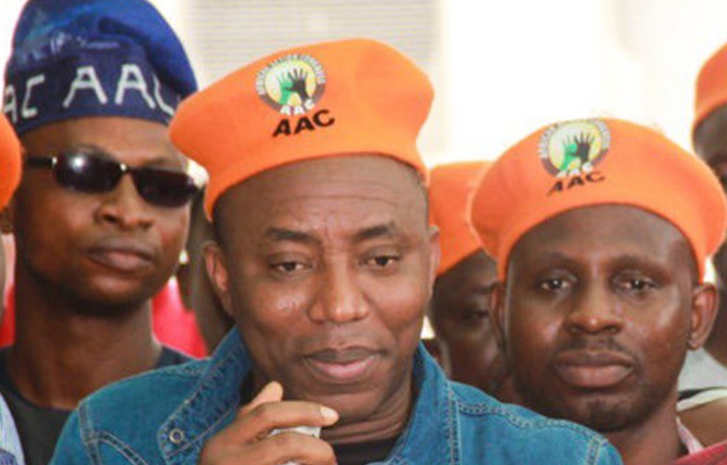
COUNTRY office of Amnesty International on Saturday appealed to the Federal Government to respect rights of Omoyele Sowore, former presidential candidate of the African Action Congress (AAC), who was taken by operatives of the Department of State Security (DSS) Saturday.
The international human right organisation also advised the government to follow due process, demanding for the release of the activist.
Sowore, Convener of #RevolutionNow had planned to stage a nationwide protest next Monday 5th August, an action which appeared to have unsettled the government authorities since the plan was made public last week.
The protest, according to the organisers, was meant to drive social change and foster a better Nigeria.
“Amnesty International is concerned about the arrest of Omoyele Sowore @YeleSowore by DSS operatives. We urge the authorities to respect his rights and follow due process. If not charged for any offence, he should be released immediately.”
AI Nigeria in another tweet also demanded the immediate probe of the sudden disappearance of Abubakar Usman, who was abducted Friday night.
“Since Friday night Abubakar Usman @dadiyata was abducted by gunmen from his home in Kaduna. His whereabouts are currently unknown. We call on authorities to investigate this and unite him with his family,” it tweeted.
However, it insisted that government’s action would not deter it from holding the federal government accountable.
Calls for ‘Revolution’ march is treasonable felony – Police
Mohammed Adamu, the Inspector General of Police (IGP) however warned against execution of the planned protest describing it as a treasonable felony.
He further described it as an act of terrorism targeted at forcing ‘a regime change in the country’.
PLANNED ‘‘REVOLUTION’’ MARCH, A TREASONABLE FELONY – IGP WARNS
The attention of the Nigeria Police Force has been drawn to a video circulating on the social media by the ‘Global Coalition for Security and Democracy in Nigeria and others’, inciting Nigerians, home and abroad,
“The Force wishes to state unequivocally that the call amounts to treasonable felony and acts of terrorism and will therefore not stand idly-by and watch any individual or group in the society cause anarchy in the land.
“While acknowledging the rights of Nigerians to embark on protest, the Force wishes to note that such rights should not translate to a violent and forceful change of government which clearly is the meaning of ‘revolution’.”
It reads further: “Needless to state that Nigeria is a democratic republic and has well-defined processes for change of government, exercised periodically during various cycle of elections.
“The Force therefore warns the organisers, sponsors, allies, supporters, associates and sympathisers of the group ‘Global Coalition for Security and Democracy in Nigeria’ to, in their own interest, steer clear of any such planned protest, demonstration, acts of incitement and proposed “revolution”, as the full wrath of the law will be brought to bear on any individual or group engaged or found participating in the above planned criminal act.
“Parents and guardians are therefore enjoined to impress on their children and wards not to allow themselves to be used in whatever form by any person or group of persons to cause breach of law and order in the country”.
Sowore: Calling for revolution in Nigeria ‘perfectly legal’, says lawyer
Bar. Uchena Amulu, a human right lawyer described the planned protest as legal as the police cannot arrest the protesters for an “offence that has not been committed”.
“They cannot arrest given that there is freedom of assembly, expression and association and you cannot take that away from any group of people.”
“Assuming it is illegal, the offence has not even been committed, so why the arrest?” The lawyer queried.
Calling for a revolution, he added, “is not illegal. If you feel the purpose for the protest is bad or against the law, you issue warning. You don’t arrest the person.”
Nigerians react
Emeka Nnadozie @ChNnadozie expressed worry the nation is under military dictatorship under the guise of a democratic system of government.
“Sowore has been arrested by the DSS for organising a protest against bad governance. Nigeria is now under a military-style dictatorship under a system that pretends to be democracy. #FreeSowore”
Another Twitter account owner, Dr Remi Adekoya @RemiAdekoya1 wondered why the ruling government should be scared of protest. “A government that arrests a man planning protests is a government running scared. Make no mistake, Nigeria’s thieving rulers are very aware that if the people ever rise up, they are done for. What they fear most is a Nigeria that does not fear them. #FreeSowore #RevolutionNow”
Comrade Deji Adeyanju @adeyanjudeji described the nation as ‘comedy central’ for recognising the planned protest as treasonable offence. “Just read the press statement of the IG of Police on #RevolutionNow protest. He said the planned protest is treason & that the organisers & its sympathisers should bury the idea. Ha ha ha. Oh God, Nigeria is a Comedy Central. These same guys negotiate with bandits, BH & Herdsmen”.
On his part, Femi Fani-Kayode, former Aviation Minister @realFFK also described the arrest of Sowore as unnecessary and uncalled for while he condemned action of the federal government.
“The arrest of @YeleSowore is uncharitable, unkind, unnecessary, uncalled for, unsustainable, indefensible and regrettable. I condemn this fascistic and Gestapo-like action by the DSS against him and I call for his immediate and unconditional release. #FreeSoworeNow #RevolutionNow”.
“I see all sorts of people trying to justify @YeleSowore ‘s arrest. STOP! ….you cannot arrest someone in the anticipation that he will commit a crime. All that preemptive nonsense started by #Bush is anti-democracy #FreeSowore”. Kadaria Ahmed @KadariaAhmed tweeted.
For decades, artisanal gold mining has been a daily activity in Osun State, yet left unregulated despite the severe danger it portends to the miners and the environment. Olugbenga ADANIKIN, in the part two of this series, reports about the failure of government to curb illegal mining in Osun State.
It’s farmland, not a gold site
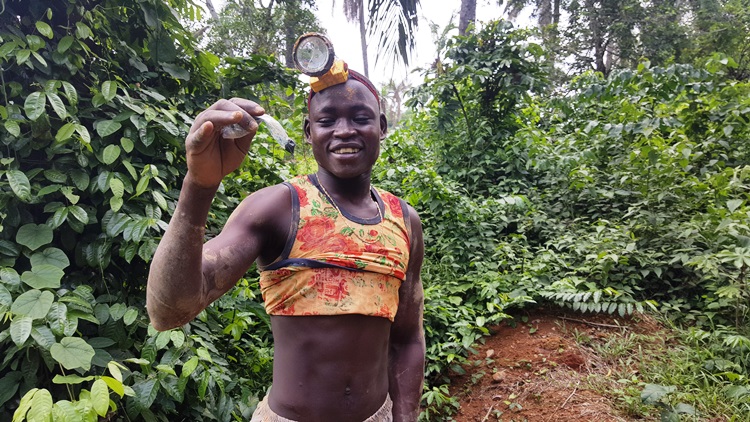
IF a northern labourer in Osun tells you he is heading to the farm, don’t be deceived, he is actually on his way to gold mining sites, spread across the state.
Luckily, lands come cheap for artisanal mining in the community.
For instance, in Ifewara, a piece of farmland with likely gold deposit, also known as ‘Gira’ goes between N60, 000 and N200, 000 depending on the bargaining power of the gold agent. But, the business is secretive, as visitors would hardly know whether the community is rich in gold deposit or not.
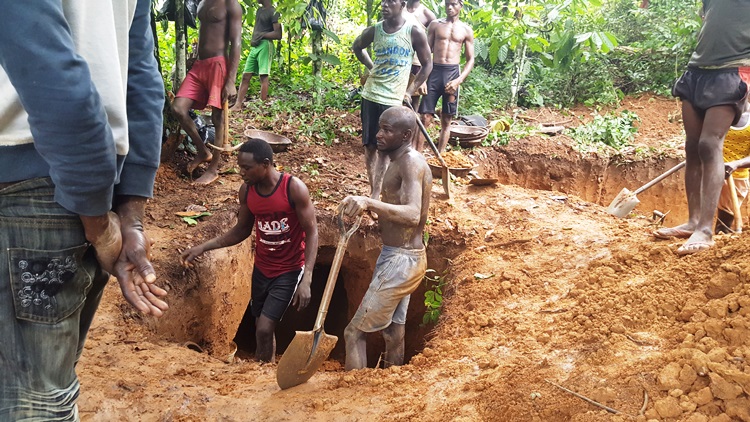
Gold Miners dig underground in search of gold at Kuku site, Ifewara, Osun State Picture Credit: Olugbenga Adanikin, The ICIR
“If there were technological support, the device will indicate where to dig, if digging will be 10 feet to the right or left. But with this one [refering to device in his hand ], they just hit a tiny rod into the ground; once they see any sign of gold, they make payment and start digging. Eventually, they may find nothing. So, they just take risks,” says Mr Sunday, a hairstylist close to the miners.
“It is like dipping your hand into a bowl of cassava flour, once you remove your hand, there will be particles of the flour on your hand. So, that’s the simple method they use which doesn’t work most times.”
Land acquisition without the King’s knowledge, a source said, could sell for N10, 000. If he is aware, the king is paid N30, 000 while ‘Soun’, an aide to the king gets N20,000 as his own fee.
The land is sold temporarily to gold agents for extraction purposes and subsequently left uncovered or remediated thereafter.
The ICIR gathered that the locals are either landowners or agents to wealthy investors.
Obviously, there is wealth in gold mining but it comes with great risk. “It’s too risky. Each time the ground collapses on them, they (miners) just say a short prayer, and continue with their job,” a local said.
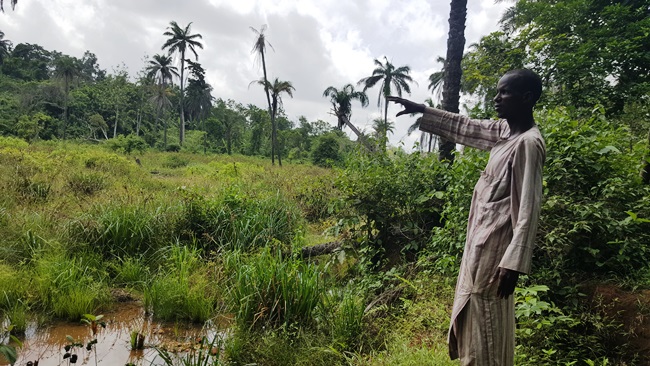
Alimi Turari, a miner turned middleman points at abandoned and non-remediated mines at the Sabo gold mining site, Ibodi Community, Osun State Source: Olugbenga Adanikin The ICIR
Across the several sites from Osu to Odubale, Kuku and Bowaje in Ife, illegal mining takes place daily and nights. In states like Zamfara and Niger, miners are exposed to several other threat such as killing or contact with the lead poison.
We are aware of illegal gold mining
Section 19 of the Nigerian Minerals Mining Act provides for partnerships with state governments on the exploration of solid raw materials even though mining is on the exclusive list of the federal government. The Federal Government said it has signed pacts with the relevant states under the State Minerals Resources and Environmental Management Committees (MIREMCOs), including Osun to collaborate on mine exploration. The government also said it has mobilised funds and operational vehicles to support the states, but nothing significant was met on ground when this reporter visited.
“Accordingly, we provided mobilisation funds for 10 State MIRENCOs, and also procured operational vehicles for the affected states. Our efforts in this regard are in the spirit of cooperative federalism in the sector, in order to deepen the participatory governance of the mining sector,” former Minister of Mines and Steel Development, Kayode Fayemi said.
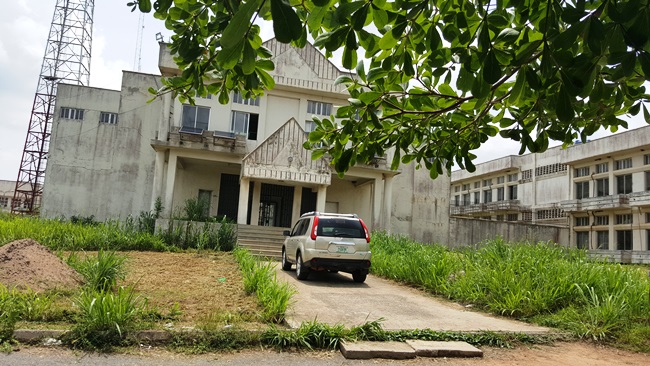
The Osun State government confirmed to The ICIR of the illegal gold mining activities. A top source at the Office of Forestry, Natural and Solid Minerals Resources shifted the blame on the federal government, saying mining is in FG’s exclusive control, thus it should develop the sector and prevent the illegal miners.
Office of Forestry, Natural and Solid Minerals Resources, Osun State Source: Olugbenga Adanikin, The ICIR
“It is the FG that gives directive on who gets licenses that is why it suspended mining in Zamfara. So mining is a national problem.”
He accused traditional rulers who dispose lands for illegal mining and held the belief that the federal government is not serious about the mining sector. “FG has not done anything serious in the mining sector. It is just the illegal miners so we are yet to explore our gold.
“The shovel cannot go 500 metres or 2 kilometres down…because it happens in the jungle, the miners are like nomads, so the state cannot create a database for them.” the source argued further.
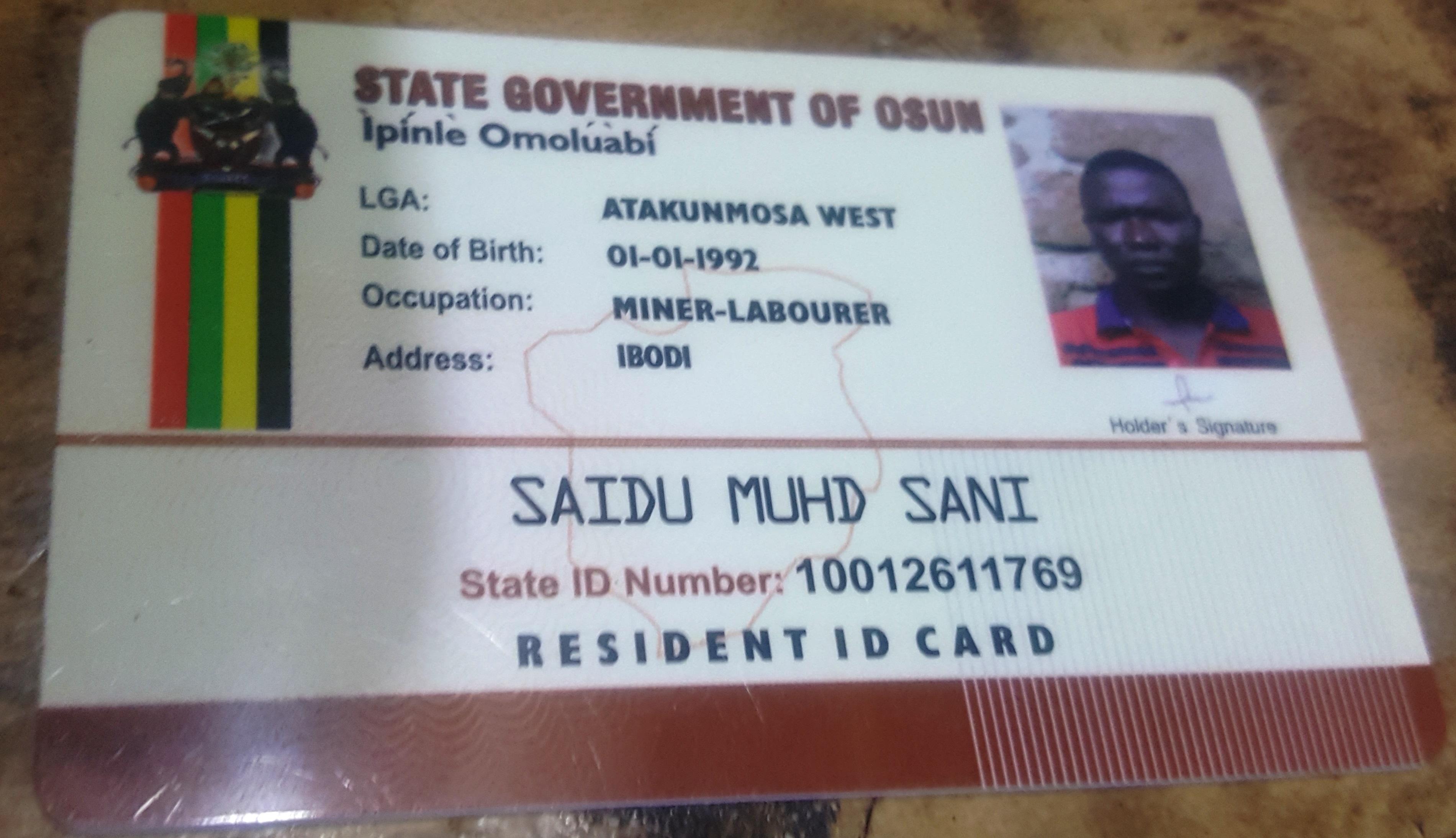
Though, this partly contradicts what this reporter met on ground. A number of the miners do have Identity Card issued by the state government. The former administration daily issued N 100 tickets to the miners. Miners, however, confirmed the issuance of tickets is currently on hold.
Saidu Sani, a registered miner captured as resident of Osun State. Photo Credit: Olugbenga Adanikin, The ICIR
Mr Gboyega Oyetola, the Osun State Governor, also recognised how haphazard mining activities in the state had been, denying the state of revenue and development. The state acknowledged several findings of The ICIR and promised to meet with the traditional rulers and security operatives.
Abdullahi Binuyo, Deputy Chief of Staff to the Governor, admitted to the illegalities in Osun gold mining communities. “We have since organised a security sensitisation programmes which includes the Kabiyesis, the local chiefs, heads of LGAs and local Serikis who supervise the illegal mining. They stand as guarantors to them (miners),” he told The ICIR.
“…We don’t want to make them illegal but formalise their activities through biometric capturing. Some of the miners are from Mali, Niger, Chad so we are planning to meet with the security chiefs to conduct enumerations.”
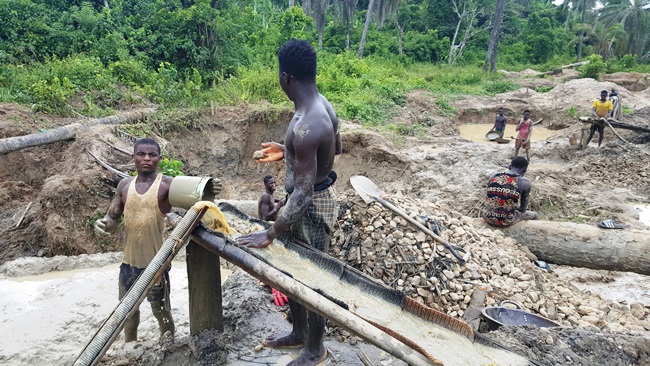
Miners manually processing mined gold at Ibodi site, Osun State Photo Credit: Olugbenga Adanikin, The ICIR
Failed promises, weak regulations, rising hopes
Since 2015, findings by The ICIR revealed there has been a steady budget increase to the sector yet it still remains undeveloped. From N10.43 billion in 2015, approved budget to the ministry grew to N16.73 billion in 2016, N22.84 billion in 2017, N22.94 billion in 2018 except 2019 proposed budget, which showed a decline of 10 percent. The budget is pegged at to N20.48 billion.
The presidency, last year, also disclosed that N644 million has been earmarked to strengthen the mining regulatory agency. In December 2017, the federal government further proposed to launch the National Gold Purchase Scheme, to increase revenue from gold, thus providing extension services, support and off-take gold mined by ASGM.
Though some of these supports were enshrined in the Nigerian Minerals and Mining Act, 2007 as well as the Solid Minerals Development Fund it is still yet to commence two years after.
However, the MMSD Press Unit offices were under lock as at 2 pm when The ICIR, visited to seek reactions. The reporter moved to the Department of Artisanal and Small-scale Mining (ASM), where the Director in- charge, Ojeka narrated travails of the sector.
He stressed how oil discovery led to the abandonment of the mining and agriculture sectors.
“Over time, Nigeria has over-depended on resources from oil. It has become detrimental because when international oil prices crash, the nation sneezes,” says Ojeka. But in 2015, the current administration, he said, commenced a reform of the sector where unused licenses were revoked yearly and re-issued to other investors.
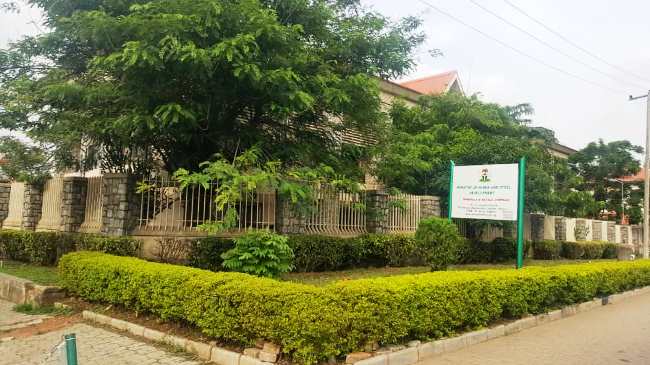
Headquarters of Ministry of Mines and Steel Development, Abuja Source: Olugbenga Adanikin, Abuja
He agreed that foreigners from Niger, Chad and others illegally work at the sites. He also alluded to the speculation about the Chinese prisoners working at the mines under purported quota system offered by the Federal Ministry of Interior.
Reacting to why the miners lack access to funds, the director, said the miners would need to satisfy requirements of the Bank of Industry (BOI) before they can qualify.
N5 billion has been set aside at the BOI to support artisanal miners, but: “the small scale-mining cannot access the fund because they are yet to meet-up with the conditions by forming a cooperative,” he disclosed.
“This is a 520-member cooperative group, minimum of 10 persons in a group,” the director said. “If we add it to what we have before, it will be over 1,200 cooperatives in the country.”
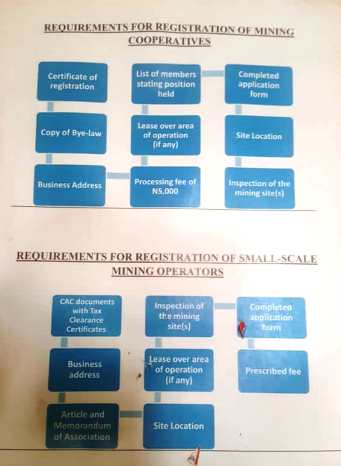
Procedures for registering Artisanal Mining Cooperatives pasted at the Ministry of Mines and Solid Minerals Development Headquarters Photo Source: Olugbenga Adanikin, The ICIR
The ICIR learnt that the miners ought to register with the Cooperative Unit of State Ministry of Trade and Commerce before accessing support forms at the MMSD, fill and pay a token of N5,000. With this process carried out to the letter, he said the miners would get needed supports.
Meanwhile, responding to the health and environmental impact of mining to both ASGM and the host communities, Engr. Sallim Salaam, MMSD Director, Department of Mines Environmental Compliance (MEC) confirmed the mining effects on soil quality, water resources, which includes loss of biodiversity-plants and wildlife, leaching among other environmental implications.
“Perhaps the most significant impact of a mining project is its effects on water quality…key questions are whether surface and groundwater supplies will remain suitable for human consumption and whether the quality of surface waters in the project area will remain adequate to support native aquatic life and terrestrial wildlife,” says Salaam.
While the environment department focuses on registering mining organisations that adhere to the Environmental Impacts Assessments (EIA), the department often awaits the go-ahead from the ASM to remediate debilitated mines.
Aliyu Jauro, NESREA DG Source: Oasis Reporters
When the National Environmental Standards and Regulations Enforcement Agency (NESREA) was contacted, the Director-General, Prof. Aliyu Jauro, said he was unaware of the environmental degradation.
“I am not aware of it. You know I just came in a few months ago but I will speak to the director in charge and we will do our best to ensure their compliance with the EIA.”
Environment expert calls for proper regulation
Abiodun Baiyewu, Executive Director of Global Rights, a civil society organisation that promotes human rights and environmental safety attributed the incessant mining collapses on workers to lack of Environmental Impact Assessments (EIA) and poor regulations.
“I raised an alarm a few years ago that it’s quite possible that if mining activity is not properly regulated and artisanal miners grouped into cooperatives, it may support terrorist activities until they are registered,” says Baiyewu.
“But if they are registered, you know the identity of members of this group and know how to trace where the minerals go to….every state should have minerals buying centre, but the government is not creating the centres so they just sell to anyone.”
She said the resources should be used to develop the host communities. “…Because of the failure to effectively regulate the mining industry, then you have situations where people do what they do.”
Dr Oloyede Johnson, former Head of Geography Department, Osun State College of Education, Photo Credit: Olugbenga Adanikin, The ICIR
“If there is a cooperative, the government can develop small EIA for groups of miners. Visit the communities and design mitigation plans,” she said.
Dr Oloyede Johnson, former Head of Geography Department, Osun State College of Education, an affiliate to the University of Ibadan, Ilesha was more worried on the imminent tremor that may devastate the environment due to massive excavations across the mining communities.
The security implication, he noted, could become worse, especially now that the government has suspended mining in Zamfara State. He called for proper regulation of artisanal miners and compliance with the EIA.
This investigation was done with the support of International Centre for Investigative Reporting (ICIR) and Ford Foundation.
IN response to the Federal government proscription of Shi’ite protests, the sect on Friday filed a suit to challenge the ex parte order, at the Federal High Court, Abuja.
The case was filed before Nkeonye Maya, challenging the ex-parte application filed before the court by the federal government.
According to the legal counsel, Haruna Magashi who filed the suit, the order was an infringement on the fundamental rights to a fair hearing, freedom of thought, religion and conscience.
He added that the court lacked the authority to hear the ex parte order against the sect.
Magashi prayed the court to discharge the ex parte order proscribing the existence of the sect in the country and that describing its activities as “amounting to act of terrorism and illegality”.
The government had earlier in July, proscribed the Shi’ite sect, after a federal high court in Abuja had declared it a terrorist group.
THE Convener of #RevolutionNow protest, publisher of SaharaReporters, Sowore Omoyele has been arrested by security operatives believed to be officials of the Department of Security Services (DSS).
According to multiple sources, the arrest of the presidential aspirant of African Action Congress (AAC) during the 2019 elections occurred shortly after midnight on Saturday.
Sowore posted a distress tweet at exactly 1:25 am just before his phone was confiscated from him, The 247ureports, an online newspaper said.
On his Twitter handle @YeleSowore, he posted a terse message at 1:25am which reads “DSS invades Sowore’s house”.
“He also tweeted ” Ja p”, confirming his phone must have been seized while trying to raise the alarm about his arrest,” Premium Times reported, quoting a statement from a close associate of Sowore.
“His arrest and detention are not unconnected to #RevolutionNow, a series of planned protests against bad governance in Nigeria scheduled for August 5, 2019.”
Sowore was coordinating a national protest, which he called ‘a day of rage’ in 21 states on Monday August 5 against the government of President Muhammadu Buhari over the maladministration and insecurity in the country.
He had promised to “shutdown” the country on the day of the protest – which he claims would hold simultaneously across the cities of the country.
The coordinators of the RevolutionNow protest claim to have already gotten twenty one [21] cities in Nigeria to sign up for the protest. And the social media are awash with video recordings by notable Nigerian musicians and youths who have come out in support of the protest.
FOLLOWING the death of Paul Offu, parish priest of St. James the Great parish, Ugbawka, priests in the Catholic Diocese of Enugu on Friday took to the streets on Friday to protest the alleged targeted killings of clergymen in the State.
The protesting priests carrying various placards, stormed major streets in Enugu metropolis to express their displeasure with the state of security in the state.
Before proceeding to the state government house and the state police command headquarters to press home their demands for a safer society for members of the clergy.
The protest was prompted by the death of Paul Offu, who was shot dead on Thursday evening by “some hoodlums suspected to be the notorious and murderous Fulani herdsmen, along Ihe-Agbudu Road in Awgu Local Government Area of the state” according to a statement on its Facebook post.
Benjamin Achi, communications director of the Enugu diocese, who spoke to The ICIR lamented the increased spate of attacks on priests in recent months in the State.
“This latest death is one attack too many on catholic priests specifically, the church is unhappy about it because in the past couple of months several priests have been killed along that road without any effort from the government to stem the tide,” he said.
He said the protest was the last resort to ensure that the government pays attention to the security threat posed by gunmen along that axis.
“The protest is to call the attention of the security personnel in the State because it doesn’t seem they are doing enough considering it lies within their competence to fish out the Fulani herdsmen behind the attacks,” he stated.
When asked if he had evidence to support his claims, he stated that accounts of victims who had survived their attacks suggest that line of thought.
” Apart from the fact of their past antecedents, people who have survived their attacks say their dressing and accents points to the fact that they are herdsmen,” he said.
Paul’s death on Thursday evening comes on the heels of a recent attack on Ikechukwu Ilo, another Reverend Father, along Nomeh axis of Nkanu East Local Government Area, on Wednesday, by suspected kidnappers who opened fire on him after he refused to stop his car.
He sustained gunshot wounds and is currently recuperating in an undisclosed hospital.
Clement Ugwu, who was the parish priest of St Mark Catholic Church, Obinofia Ndiuno in Ezeagu Local Government Area of the State, was also killed five months ago by gunmen.
Contradicting the claims of the Achi, Ebere Amaraizu, Enugu State Police spokesperson, told The ICIR the Police were yet to determine the identities of the gunmen and unravel the circumstance surrounding the death of Paul.
“What we can’t confirm right now is the identity of the people who perpetrated the act and the circumstance that led to the unfortunate incident the death of the priest. Immediately the case was reported to the police we swung into action and the commissioner of police, Sulieman Balarabe ordered a full-scale investigation to bring those behind this dastardly act to justice,” he said.
THE Director-General of the Federal Capital Territory (FCT), Emergency Management Agency (FEMA), says it is yet to find the FCT High Court Finance Director, Tony Okecheme, who was reportedly swept off by flood at Galadimawa roundabout, Abuja.
DG FEMA, Abbas Idris, had confirmed to THE ICIR in a phone conversation on Friday.
He noted that Okecheme was on his way to the National Airport, when he was stuck in the flood, and swept off afterward alongside his driver.
“It is true that we don’t know where he is because we are still searching for the body, but from the information, we had before us, that he was the director of finance of the FCT High Court,” he said.
Idris revealed that the Emergency Agency was currently on a rescue search for the Finance Director at the time this report was filed, and would not conclude on anything till he is found.
“As I’m talking to you, we are still here, carrying out our search; searching for him, and we cannot confirm him dead until we get him.
He might be somewhere waiting for rescue to come, and that is what we are doing now, it is only medical personnel that can confirm him dead or alive,” Idris said.
However, Idris expressed hope for a positive search outcome.
He also confirmed that the driver was responding to treatment at the Asokoro hospital, where he was taken to, immediately he was rescued by the agency.
The DG mentioned that the driver’s report was what helped, in revealing the identity of the flood victim.
Earlier on Friday, there were reports on a raging flood that swept off the FCT High Court Director.
The report also said the duo was stuck for about an hour before they were finally swept off by the flood.
It also noted that two young girls who claimed to be children of Okecheme were seen in tears at the scene of the incident.
FORMER presidential candidate of the African Action Congress (AAC) in the last general election, Omoyele Sowore and hundreds of other Nigerian youths have sworn to lockdown 21 states come Monday in a protest popularised on the social media as ‘a day of rage’.
The protest, scheduled to commence on Monday 5th August, across various states, is expected to cause social change and promote a better justice system that would culminate into a better Nigeria, the organisers have said.
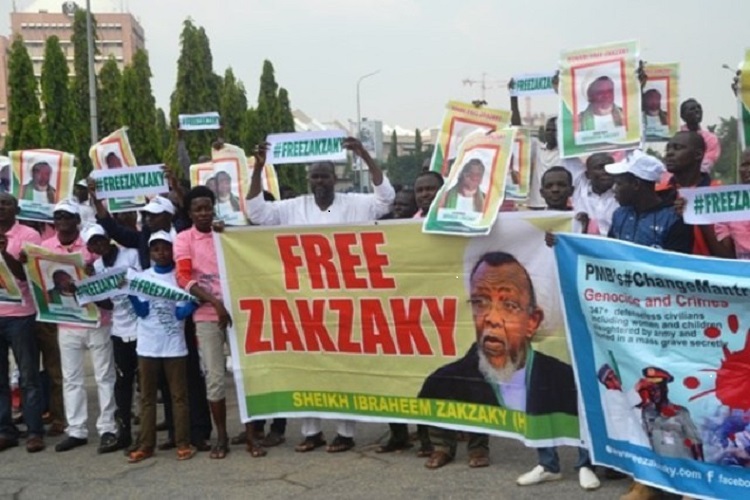
Some of their demands include placement of politicians on minimum wage salary, the release of Ibrahim El-Zakzaky, leader of the Islamic Movement of Nigeria (IMN) and provision of free and quality healthcare to all Nigerians.
“It is not a battle of wit that a democratic space will open for us to have a country where good people, good ideas can lead the country. As we chanted during our recent protest in Maryland, Lagos, a Nigeria where five people will be richer than over 200 million people cannot work,” Sowore stated in an online video on the social media.
“A Nigeria where your network bill (sic) is greater than your house rent cannot work. So the sceptics who say Nigerians are too hyperesthetic and divided to rise up to a revolution, I say this, hunger does not know ethnicity, and security does not know religion.”
He stated further in a-45 seconds video that, “…No matter where you are from, the time for revolution is now and they will not be televised.”
The social media has been agog since the planned protest was announced by Sowore, publisher of the Sahara Reporters newspaper. #RevolutionNow has been trending ever since with over 17,000 tweets.
NBA provides legal backing
Almost a two-minute video shared on Sowore’s timeline also revealed anticipated support of the Nigerian Bar Association (NBA), Lagos Chapter on the proposed protest. The association planned to provide legal ‘backup’ for the protesters with backings from the national leadership of the NBA.
“By so doing, we are not supporting what is unwholesome; we are supporting one of those things that will protect rule of law and the rights of every Nigerian to stage a peaceful protest if there is need for one.
“They are organising a peaceful protest to have good governance and accountability on the part of leadership in Nigeria. The NBA will be in support of them…if anybody is clamped down unjustifiably or illegally by the state operative.”
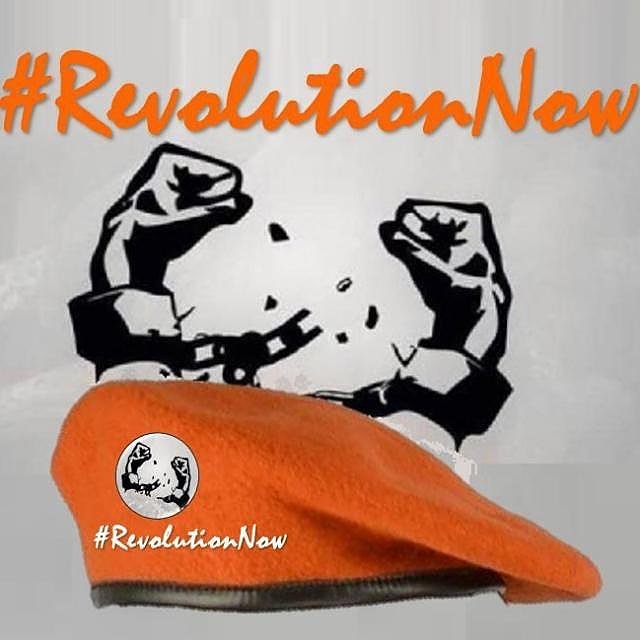
Revolution Protest Picture shared on the social media Photo Credit: Twitter
Nigerians react
However, ahead of Monday 5th August, set date for the protest, prominent Nigerians have reacted differently on the development with arguments that revolution does not often lead to social progress and economic development especially for a nation as Nigeria with many divides.
Dr Joe Abah, former Director-General of Bureau of Public Service Reform (BPSR), said if revolution must happen in Nigeria, there should be ‘unifying’ factors such that could pull the interest of everyone but noted it lacks such quality.
He argued through his social media handle @DrJoeAbah, “There are too many dividing factors. That’s why I don’t think a revolution is possible or feasible in Nigeria here.”
“My academic research on the matter suggests that revolutions only happen in homogeneous societies, often with a unifying characteristic. I don’t believe we have that in Nigeria.”
According to him, freedom fighters often end up as tyrants or far worse, thus such a move should be reconsidered.
“Then there was the Arab Spring. Has that revolution made the Arab a more just place? I am not sure. Then there was Occupy Nigeria. I think most of the leaders of that ‘revolution’ are in government today. We are still paying fuel subsidies, the reason for Occupy Nigeria,” he tweeted.
Dele Momodu, Publisher of Ovation Magazine @DeleMomodu also indicated interest in the protest but only shared his thoughts via his timeline.
“…..Nigerians are demanding for a brand new country. Old antiquated leaders must ‘bow and go away.”
Momodu, who has over 949,000 followers on the social media platform, has garnered over 1,900 likes and more than 900 retweets.
Sowore and other comrades
Ade of Nigeria @Hammdriller warned it may result in an unpleasant outcome.
“Dr Joe has always been consistent about following the “Rule of Law”. And if the rule of law isn’t serving, call for the change in that law.
“Subscribing to the mob will always be a bad idea, leading to bad outcomes”
Most nations that have experienced revolutions across the world include Chines, Iran, Haiti, Cuba, France, Russia among others.
Meanwhile, a number of youths have been seen in Lagos adorning public spaces with graffiti, calling other Nigerians to join the revolution slated for Monday, August 5.
THE Nigerian National Petroleum Corporation, NNPC seeks to extend Nigeria’s trade relations with Turkey beyond crude oil in a bid to improve increased economic broadband between both countries.
The Group Managing Director, GMD, of the NNPC, Malam Mele Kyari, made this disclosure on Thursday when the Ambassador of Turkey to Nigeria, Melih Uluren, paid him a courtesy visit in Abuja.
“We are looking forward to greater cooperation between NNPC and Turkish Petroleum such that we find a business in other areas like infrastructure development that both countries will be interested in promoting to the benefit of both countries,” he said.
In 2017, the trade volume between both countries was estimated at $490 million according to data from Trading Economics, a United Nations database on international trade.
Turkey boasts of about 270 million barrels of proven oil reserves and 218 billion cubic feet of natural gas reserves, but its production ranges from between 70,000 to 100,000 barrels per day and imports over 90 per cent of its oil and natural gas needs.
Proven reserves are those reserves claimed to have a reasonable certainty of oil and gas deposits expected to be recoverable under existing economic and political conditions, and existing technology.
Melih congratulated Kyari on his appointment as NNPC GMD, stressing that his choice for the position was well thought out as his reputation as an astute leader was well known in the diplomatic community.
In another development, the international oil benchmark, Brent crude, dropped for the second time in six days on Friday after the United States’ Federal Reserves reduced increasing interest rates in an attempt to stabilise the US economic market.
Brent crude, against which Nigeria’s oil is priced, fell by $3.93 to $61.12 as of 8:30 pm Nigerian time, while the US West Texas Intermediate crude dipped by $4.17 to $54.41 per barrel.
Though, the declaration of force majeure at Libya’s main oilfield may provide a boon to Nigerian crude, sales which have suffered following a glut of U.S. and North Sea grades.
SAUDI Arabia on Friday published new laws that loosen restrictions, allowing all citizens — women and men alike —above 21 years of age to apply for a passport and travel freely.
The new policies bring an end to a long-standing guardianship policy that had controlled women’s freedom of movement.
The kingdom’s legal system has long been criticized because it treated adult women as minors, requiring they have a man’s consent to obtain a passport or travel abroad. Often a woman’s male guardian is her father or husband and in some cases a woman’s son.
Other changes issued in the decrees allow women to register a marriage, divorce or a child’s birth, and obtain official family documents, which could ease hurdles women face in obtaining a national identity card and enrolling their children in school.
Reema Bandar Al-Saud, Saudi Arabia’s Ambassador to the United States on Tweeter hailed the move as”s holistic approach to gender equality that will unquestionably create real change for the Saudi women.”
I am elated to confirm that KSA will be enacting amendments to its labor and civil laws that are designed to elevate the status of Saudi women within our society, including granting them the right to apply for passports and travel independently. 1/4
Women are now also allowed to be legal guardians of their children, a right previously held only by men.
However, still in place, however, are rules that require male consent for a woman to leave prison, exit a domestic abuse shelter or marry. Women, unlike men, still cannot pass on citizenship to their children and cannot provide consent for their children to marry.
Amnesty International said Friday a lot remains to be done for women’s rights in Saudi Arabia but that the new laws could ease the guardianship system. Guardianship laws have “been a stifling system in the daily lives of women in Saudi Arabia,” said Lynn Malouf, Mideast’s research director at Amnesty.
These reforms really are a testament to the work of the brave activism and the suffering and the ordeals, Saudi women and men fought for in their calls for reform, she said.
Crown Prince Mohammad Bin Salman has been hailed for loosening social restrictions at the heart of his economic transformation plan for Saudi Arabia, which relies on diversifying away from oil and attracting foreign investment especially after the murder of Jamal Khashoggi, the Washington Post journalist in the Saudi consulate in Turkey on October which have brought lots of international condemnation to the kingdom.
There are 98 million Nigerians living in extreme poverty, according to a report by the United Nations. To survive, many, especially women engage in petty trading in various markets. But the youths in Rivers State communities, who force traders to pay multiple illegal taxes, have become a stumbling block to local businesses. In this investigation, KELECHUKWU IRUOMA visited six markets in Port Harcourt to expose on camera young men who extort traders.
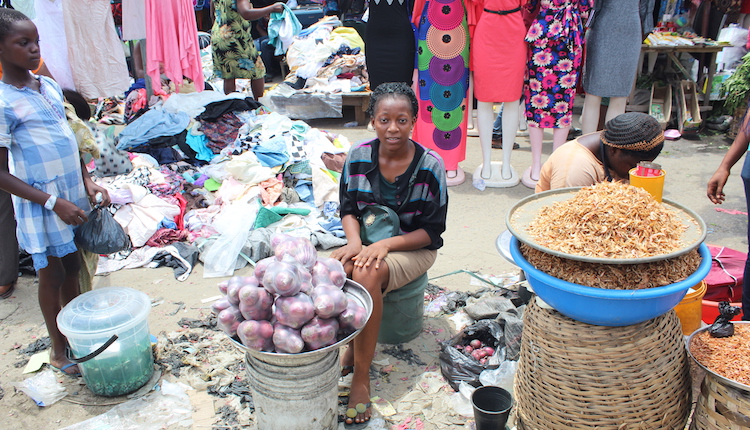
ON a Wednesday in May, the morning sun was already shining bright as early as 10:00 am. Miracle Onwuamaeze, 19, sits on an empty 15-litre paint bucket selling onions wrapped in white polythene nylons. The parcels of onions were placed on a stainless tray propped up by a white bucket.
She sells each wrap at N100, except the smaller ones kept in a blue sieve on the floor. Those are sold for N50. Onwuamaeze wakes up at 5:00 am on Wednesdays to sell at the popular Oil Mill Market in Port Harcourt, the capital of Rivers State in southern Nigeria. Her favorite selling position is at the roadside along Port Harcourt-Aba road, while her mother sells in a stall inside the market.
Miracle Onwuamaeze was forced to pay N200 for illegal levies
From nowhere, three young men approached her, demanding market levies. While two of them requested N100, the other also asked for N100.
They threatened to seize her onions if she did not pay promptly. Left with no choice, she reluctantly gave them N200. The value of her entire wares were about N3,000, but she paid no fewer than nine groups of tax collectors that day.
“If I don’t pay, they will carry my goods to their office and when I get there, I will pay double the amount I am supposed to give them initially,” she said bitterly.
This is what Onwuamaeze and other traders at various markets in Rivers State go through on a daily basis. Local government councils in the state are responsible for the collection of taxes in markets, according to Nancy Iheduru, a former vice president of Network of Entrepreneurial Women (NNEW), a non-governmental organization that advocates for the good business environment for women to operate and ensures their businesses grow. But community youths forcefully collect illegal taxes in the form of levies from traders, and they do not issue receipts. Traders who refuse to comply are harassed and their goods are seized.
A report from the Nigeria Bureau of Statistics (NBS) shows that Rivers State has the second highest unemployment rate in Nigeria with 36.4 percent as at the third quarter of 2018, with an unemployed population of 1.6 million.
These unemployed youths and the elderly are those who commonly engage in petty trading to survive, but they are being harassed, frustrated and driven out of business by community youths who tax them illegally.
How multiple illegal taxations affect the informal sector
The informal sector is a major contributor to the Nigerian economy, accounting for a significant portion of employment and national Gross Domestic Product (GDP). According to the International Monetary Fund (IMF), the Nigerian informal sector accounts for 65% of Nigeria’s 2017 GDP and employs over 75% of the country’s labour force.
Petty traders such as kiosk owners, fruit sellers, and roadside sellers are part of the informal sector, which is not subjected to government regulations. They are recognised as people who work in the informal sector and who do not declare their earnings and pay no income taxes.
Entrance of Mile 3 market in Port Harcourt
“I am not happy about how they are doing it [tax collection],” said Mercy Sylvanus, a mother of one who sells tubers of yam at the market in Rumuokoro. “Only one person should be collecting not many people,” she suggested.
She seats on a stool in front of the tubers placed on the roadside as she calls the attention of passers-by along the busy Port Harcourt-Owerri road to patronise her. “The fees are illegal,” she lamented. “I pay N500 daily here and N7, 000 every month to the council [Obio/Akpor local government]. When they [tax collectors] come, I give them money but any day I don’t have, they seize my tubers of yam. It is bad that they treat us that way.”
Mercy Sylvanus’s tubers of yam were seized for refusing to pay an illegal levy
Traders extorted for selling on roadsides
In most markets in Rivers State, traders usually create space on the main road to sell their goods. They complain that shops and stalls provided by the government inside the markets are exorbitant to afford. A stall at the market, according to Sylvanus, is over N200, 000 annually.
Hence, many resorted to selling by the roadside. But community youths tell traders the government doesn’t want them to sell by the roadside, and their job is to drive away roadside vendors except those who are ready to pay levies to the government. Many traders have discovered that this narrative is false, because in many cases, after paying the daily levies, the traders still are sent out of the roads by the government task force.
The reporter was at Oil Mill Market as early as 7:00 am to witness the scene of how youths struggled for tickets to collect levies in the market. “Na so dem dey fight because of the useless money dem dey collect,” a woman selling soft drink said in pidgin. “Sometimes dem dey wound themselves.”
The Police also use the community youths to collect their levies from the traders. They still tell the traders they collect the levy because they sell on the roadside. “Give me police money,” a woman on a dreadlock wig told a trader at Rumuokoro. She collects N200 from each trader that sells along the roadside.
She was harassing the trader and trying to seize her goods. When she noticed she was being filmed, she quickly stopped and left. She was accompanied by a young man whose wheelbarrow was used to seize the goods of traders who refuse to pay.
“We know selling here may be illegal,” Sylvanus admits. “They come to harass us that the government said we should not sell here and they still come to collect money from us. We don’t know who the government is. If they know they are the government, they should stop collecting money from us.”
Thug seizing the goods of a trader at the Rumuodumaya market
Amaka Asiegbu has been selling polythene nylons and condiments at the Rumuodumaya market for two years. She used to pay N200, 000 annually for a stall inside the main market she rented. “But my children are now grown and I can’t afford to pay that again,” she said.
“The levies being collected here are affecting me. They come every day and I pay N1, 000. Every month, I pay N5,000. They say they are the owners of the land. The Police people say because it’s walkway and they collect money from us for using the walkway. The community youths insult us and they must surely collect the money whether we like it or not,” she lamented.
A female tax collector on wig harasses traders who refuse to pay Police levy
Women are harassed
The reporter experienced a scene where a woman in her early 60s selling periwinkles was harassed by a tax collector who she refused to give N200. She begged that she had not sold and that she be given more time to sell. The tax collector was adamant. He picked up the stainless basin filled with periwinkles to seize it but the woman insisted. There was a drag. He then decided to throw the whole periwinkles on the floor. With tears on her face, she knelt and picked them up.
Lucy Uco who sells crayfish said she pays N800 daily for levies. Uco, who had one day almost been stripped naked and injured said she will not have made sells, collectors will come to tax her.
A female trader’s periwinkles were thrown to the ground for refusing pay a levy
Ellen Nkpor sells Bambara beans popularly known as Okpa with her mum at Oil Mill market. According to her, she pays 10 different groups of men N100 and N200. “I pay up to 4,000 on Wednesdays for my mother and me. It is too much. They will always carry our goods if we don’t have.”
One of the tax collectors was caught harassing a young lady selling African salad popularly called abacha at Sangana market in Mile 1. He requested N100 from her, which she refused to give. “Give me money make I commot here. If you make me vex, I go act film wey you go like and I go like, and two of us go follow watch am,” he threatened in Pidgin.
He had already seized her plastics plates used for takeaway when he noticed he was being filmed. He quickly left the scene and approached a stall where his colleagues were seated smoking cigarettes. “Investigators don come o,” he said to his colleagues repeatedly. With fear, he and two others entered a passage-way of a-story-building.
At the mile 3 market, levies are minimal. According to Sabina Onos who sells condiment, N50 levy is paid daily besides Saturday where N200 is paid to three different groups of men. “It is still good compared to other markets,” she says.
Rumumasi market is an exception
In Rumumasi market, there is nothing like levies. None of the community youths was seen around. The market is calm and quiet, with traders selling in shops and stalls assigned to them. No trader is allowed to sell on the roadsides. This is a way to stop the community youths from harassing market women and forcing them to pay illegal levies.
“The orderliness and sanity in the market depends on the market leaders and how they want to handle their government,” said Ngozi Adiele, Chairperson of the Market. “The heads of markets have meetings with the so-called community people. We have leaders that always say bring and let us share. I don’t allow such here. My belief is that whatever I sow, definitely I shall reap.”
Before she became the chairperson, levies were being collected but she brought a change to stop multiple illegal taxations. Community leaders came to persuade her to allow traders to sell on the roadsides so they will be collecting levies from but she refused. “People I am leading know the type of money they are supposed to pay. We pay for electricity and security only.”
Ngozi Adiele, Chairperson of Rumumasi Market who refused to entertain thugs to collect levies
Thugs collect illegal taxes to empower themselves
The local government denied having anything to do with the community youths who collect taxes from traders. Chairperson, Temporary Structure and Makeshift of Obio/Akpor local government, Ndidi Nsirim said, “On the problem of taxation, the council does not have a hand. It’s a community problem and not local government. They collect money from them (traders) more than three times daily.”
“That Rumuokoro road where they sell is a major road. We have shops and stalls inside but they feel people will not come inside to buy from them, that is why they come outside to sell, which is pure illegality. That is what warrants the community youths to be collecting the levies from them. If they sell in the shops, the local government has the power to levy the traders once yearly and issue receipts to them.”
He brought out the tax form. He insisted the council has nothing to do with the community youths but some of the goods seized by the community youths were kept in Ndidi’s office.
When asked why the local government does not want to stop and arrest the youths involved in collecting illegal levies, he said the youths use it to empower themselves and that the council has not had “strong petitions” to deal with the issue yet.
Traders selling on the roadside at Rumuodumaya market in Rumuoko
“If he [governor] will have to vacate them [traders], the communities will not be demanding money from them because all of them will go to the stalls where the local government will collect taxes, which is N3, 000 once a year,” he said.
Maxwell Nwala, President of Rivers State Market Traders Union blames the traders for selling on the roadside, which is what motivates the community youths to collect illegal taxes from them.
“Women refuse to enter where the government provided for them. They will stay on the road selling. These boys who always ginger them to remain there are community boys who like to group themselves. Some will come in the morning, afternoon and evening and they collect various levies. In the end, women pay a huge sum of money. I have talked and they refused. They rather prefer to sell along the road.”
“Collecting illegal taxes are a reward for political roles played
The illegal tax situation is so tense,” said Iheduru. “It has its consequences. In the entire day, a woman’s life can end. The people that come to collect some of the taxes are unknown faces.” She frowns at the way the traders are being manhandled by the tax collectors. “Beating them up is the worse situation. We have to tell the government to act.”
“As a married woman, I don’t want them to naked me because of N200. I have to give them the money they ask. How will my husband feel when he sees me naked?” asked Uco.
Nancy Iheduru said collecting illegal taxes are a reward for political roles played during elections
Iheduru said the government knows about the illegal levies being collected by the thugs across markets in the state but keeps mum.
“Levy collection is a reward given to them for the roles they played during elections,” she said, urging the local and state governments to stop the youths from collecting illegal levies and ensures levies are paid once by a trader.
“It is an issue of not knowing who to pay and what amount to pay because many tax collectors come into the market and traders have to pay.”
Implication of multiple illegal taxation
The Partnership Initiatives in the Niger Delta (PIND) is a non-governmental organization working to increase the production and profits of small businesses and traders in the Niger Delta such as Rivers State. Its Senior Market Development Advisor and Program Manager for business linkages initiative Precious Agbuno said multiple taxations affect small business in ways that may be termed illegal.
“Different community boys come to extort money from the market women and it is on the same thing. You will always have to pay at the community, local government levels, and others. The levies discourage investments and the activities of the community boys worsen this.”
“What we try to tell them to do is to get the right permit and have it pasted somewhere. Still, it doesn’t help.” He said the best way to solve the illegal taxation is to engage all the stakeholders and make them understand how it affects the small businesses, which he said PIND is planning to do.
If significant efforts are not taken by the government to arrest these community youths and address the problem of multiple illegal taxes in Rivers State and other states of the federation, many traders will be driven out of business increasing unemployment rate.
The World Poverty Clock has predicted that Nigeria’s unemployment figure could further increase to 120 million by 2030 if problems, like multiple illegal taxes, causing unemployment are not tackled. This will also have an impact on public safety, with many young people with no income, engaging in criminal activities.
“They should stop collecting these levies from us,” pleaded Onwuamaeze. “If they want to collect, they should collect once. If not, businesses will be affected.”
This Investigative Report is supported by the Ford Foundation and the International Centre for Investigative Reporting, ICIR.