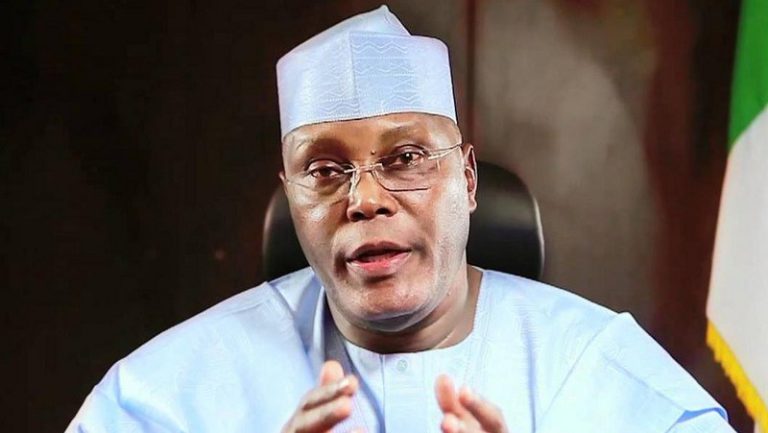
THE Presidential Election Tribunal has rejected the request made by the People’s Democratic Party (PDP) and Atiku Abubakar, its presidential candidate, to inspect the electronic server of the Independent National Electoral Commission (INEC) used for the 2019 presidential election.
In a ruling on Monday, the five-man panel unanimously dismissed the application, stating that the tribunal could not delve into the server issues at the interlocutory stage of the sitting, ChannelsTV reported.
The panel headed by Mohammed Garba said that the request was dismissed because issues have been joined by parties on the existence or otherwise of the servers.
Atiku and the PDP, through their lawyers led by Levy Uzoukwu, have prayed the court to order INEC to grant them access to scrutinise the electronics server and the smart card readers used during the February 23 election.
However, INEC through its counsel, Yunus Usman told the tribunal on June 13 to dismiss the application. He said the electoral umpire did not adopt electronic transmission for the collation of results.
“They are asking us to bring something we do not have,” Usman had denied the existence of server.
But a fact-check by The ICIR revealed that INEC actually included in its budget, money for procurement and upgrade of servers. The over two billion naira was approved for INEC, and its utilisation has been reported in the document obtained from the budget office. Besides the budgetary report, some of the INEC top officials in different interviews before the election acknowledged the existence of the election server.
Atiku and his party’s petition to the tribunal claimed that he won the 2019 presidential election. The petition noted that Atiku defeated Muhammadu Buhari of the All Progressives Congress by 1.6 million votes. This claim, PDP said, was retrieved from INEC server.
With the purported server’ result, Atiku said he won with 18,356,732 votes against 16,741,430 votes of Buhari. But the result of the manual collation announced by INEC on February 27 declared Buhari the winner after securing a total of 15,191,847 votes against Abubakar’s 11, 262,978 votes.
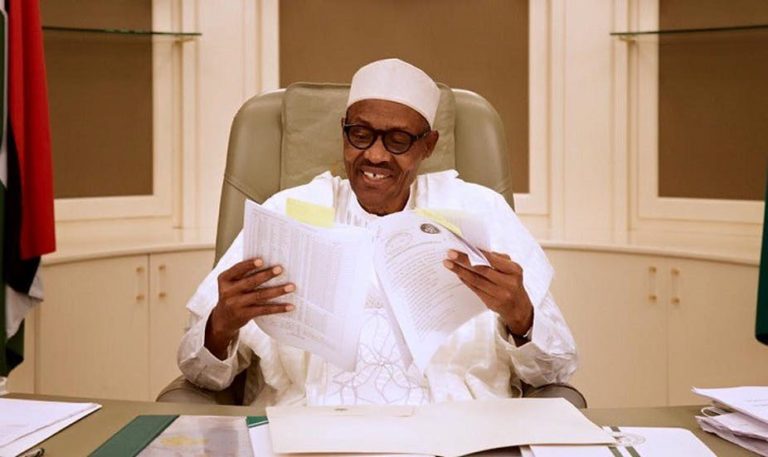
MORE than any of his elected predecessors, President Muhammadu Buhari is taking more time to name his cabinet for his second term despite high expectations from Nigerians.
It is getting to 30 days that he was sworn-in for another term of four years, yet the president has not submitted the list of his proposed ministers to the National Assembly, heightening speculations that he may again take a long time as he did in 2015.
This is despite assurance by his Special Adviser on Media and Publicity, Femi Adesina that the president would not delay in appointing ministers for the second term.
“The circumstances are no longer the same. So, there would be no delay. When you land in the mud of poor and delayed handover notes as happened in 2015, with a vandalised economy and a polity with different types of challenges, the delay would be understandable. But now, we have the good fortune of transition from government to government headed by the same President and Vice President, things can then be done more expeditiously,” Adesina was quoted as saying.
There are no clear signals from the presidency as to when the cabinet will be ready despite rumour that the president may send his list to the National Assembly in July as the new lawmakers are due for resumption on July 2 from their recess after the inauguration of the 9th Assembly.
The president has always attracted criticisms for his snail-speed approach to governance. The president also did not shuffle his cabinet once for the four-year period in his first term. He was reported to have said that “he was not in a hurry to do anything.”
His late formation of the cabinet was partly blamed for the country’s recession in August 2016.
Former presidents Olusegun Obasanjo, late Umaru Musa Yar’Adua and Goodluck Jonathan took less time to form their cabinets.
President Buhari after taking the oath of office in 2015 did not name his cabinet until November 11 —six months after his inauguration.
His spokesperson, Garba Shehu said then that the delay was to allow the president assemble credible ministers to lead his government. But many critics thought the delay was bad for business.
He was also defended by the former Minister of Power, Works and Housing, Babatunde Fashola, who argued that forming a cabinet was not an easy task.
“I think I must have taken about three months before I constituted my team. And it is a very painstaking process, first because of our constitution”, Fashola said.
How long did it take Obasanjo, Yar’Adua, Jonathan to form cabinet?
Former President Olusegun Obasanjo
In 1999, former president Obasanjo sworn-in his ministers on 1st July – 47 of them. That was just 32 days after he took the oath of office. The ministerial nominees’ list was sent to the Senate shortly after May 29.
When he was inaugurated for his second term in 2003, he forwarded the list of his proposed ministers to the National Assembly in June.
Late Musa Yar’Adua formed his cabinet of 39 ministers on July 27, 2007 — exactly 58 days into the duration of his government. The late president who later took ill also named another cabinet on December 17, 2008, comprising 37 ministers before his eventual demise on May 5, 2010.
Goodluck Jonathan who first took over as acting president following the sickness of Yar’Adua also dissolved the cabinet on March 16, 2010, and named another one on April 16 same year after a pronouncement by a Federal Court and confirmation by the Senate as the acting president.
On July 11, 2011, Jonathan also unveiled his new cabinet having won an election as the substantive president of Nigeria. It was exactly 42 days after his swearing-in.
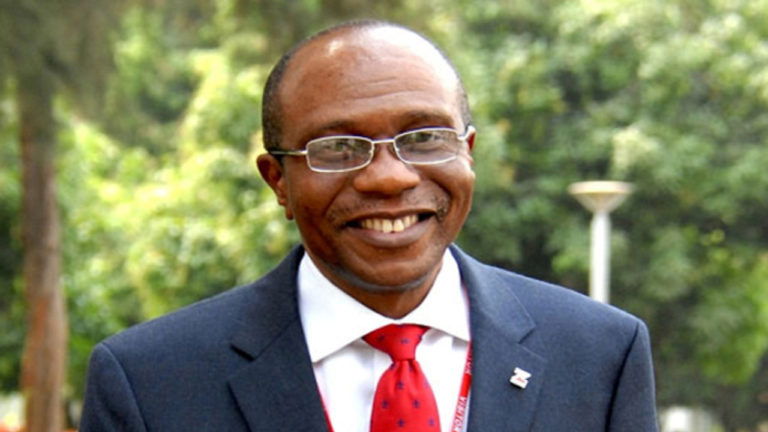
GODWIN Emefiele, Governor of the Central Bank of Nigeria, on Monday unveiled the monetary policy roadmap for his 2019-2024 economic plan for the country, promising to recapitalise banks within the next five years to make them contribute significantly to economic growth and compete on a worldwide platform.
During a media briefing held at the apex bank headquarters in Abuja, Emefiele said he would work with Deposit Money Banks in the next five years to ensure financial system stability while boosting credit to the real sector as well as the creative and education sector.
“We will continue to improve our on-site and off-site supervision of all financial institutions, while leveraging on data analytics and our in-house experts across different sectors, to improve our ability to identify potential risks to the financial system as well as risks to individual banks.
“In the next five years, we intend to pursue a program of recapitalising the Banking Industry so as to position Nigerian banks among the top 500 in the world. Banks will, therefore, be required to maintain a higher level of capital, as well as liquid assets in order to reduce the impact of an economic crisis on the financial system.”
In mid-2008, the global financial crisis had an adverse effect on both the oil and gas sector and the Nigerian capital markets. A sharp deterioration in the quality of banks’ assets followed, which immediately led to liquidity constraints across all the banks.
Concerned about the state of some of the Nigerian banks and the overall stability of the financial system, the Central Bank of Nigeria (CBN), commissioned special examinations on all 24 banks in Nigeria.
The examination showed clearly thatnine banks were in ‘grave situation’. They were Oceanic Bank International Nigeria Plc, Union Bank of Nigeria Plc, Intercontinental Bank Plc, Bank PHB Plc, Afribank Nigeria Plc, Finbank Plc, Equitorial Trust Bank Ltd, Spring Bank Plc and Wema Bank Plc. A tenth bank, Unity Bank, was not deemed to be in grave danger, but still declared to have insufficient capital and unacceptable levels of non-performing loans (NPLs).
Recapitalization which is the process of restructuring a company’s debt and equity mixture is often a measure taken make a company’s capital structure more stable.
Some of the proactive measures undertaken by CBN under the leadership of Sanusi Lamido Sanusi, former governor of the Apex bank were to prevent further deterioration instead of revoking licenses or handing the banks over to the Nigerian Deposit Insurance Corporation (NDIC). CBN injected N620bn as a convertible loan that amounts to Tier II capital into the affected banks.
Second, it replaced the chief executives and executive directors of eight of the banks with competent managers with experience and integrity, and finally, introduced the guarantee of the local interbank market to ensure continued liquidity for all banks and guaranteed foreign creditors and correspondent banks’ credit lines to ensure confidence and maintain important correspondent banking relationships.
In addition to preserving domestic macroeconomic and financial stability, Emefiele also said the CBN would foster the development of a robust payments system infrastructure that will increase access to finance for all Nigerians, continue to work with the Deposit Money Banks to improve access to credit for not only smallholder farmers and MSMEs but also consumer credit and mortgage facilities for bank customers, grow the nation’s external reserves.
Lastly, CBN will support efforts at diversifying the economy through the various intervention programs in the agriculture and manufacturing sectors.
THE African Centre for Media and Information Literacy (AFRICMIL) has called on the Nigerian government to make the protection of whistleblowers a priority in its fight against corruption.
Chido Onumah, Coordinator of AFRICMIL, said in a statement that unless the federal government ensured the safety and protection of whistleblowers, the fight against corruption would not benefit from the input of citizens.
“Without effective protection, there is no way citizens, especially those in the public service who witness acts of corruption on a daily basis, would be encouraged to blow the whistle on corruption or any wrongdoing for that matter, knowing that at the end of the day you are on your own, faced with all kinds of victimization, ranging from loss of jobs, intimidation, redeployment to sinecure positions and even threat to live,” Onumah noted.
June 23 every year is celebrated as World Whistleblower Day, an occasion to reflect on the strong ethics, determination to do what is right, and sometimes outright bravery shown by those who decide that they cannot turn a blind eye to corruption. The brave individuals who report wrongdoing at work are vital for exposing corrupt schemes and actions.
AFRICMIL’s statement expressed disappointment that since December 2016 when the government introduced the whistleblower policy as a strategy to curb corruption in the country, the initiative had remained at the level of policy with no serious attempt to back it up with an enabling law.
“You would think that a government whose major campaign promise was to ensure a drastic reduction in corrupt practices in the country would in less than one year of initiating the policy come up with a strong law that would ensure honest implementation and protection of whistleblowers. But here we are, close to three years and government still seems uncertain what to make of the policy,” it said.
Describing whistleblowing as an important tool for fighting corruption, Onumah said AFRICMIL which, since the inception of the whistleblowing policy has been working with the administrators of the policy, the Presidential Initiative on Continuous Audit (PICA), in the Federal Ministry of Finance, on strategies for a successful implementation, is disturbed that whistleblowers are relentlessly persecuted in government offices and there appears to be no reprieve for them.
According to Onumah, in the last two years, AFRICMIL had taken up cases of persecution of five whistleblowers in different government offices.
“All were sacked for nothing but insisting that the right thing be done. We were able to ensure the reinstatement of three of them after an intense advocacy work with the support of our partners in the media and civil society, and we are working to ensure that others—Sambo Abdullahi of the Nigerian Bulk Electricity Trading Plc (NBET) and Joseph Akeju of Yaba College of Technology—are reinstated and their entitlements paid,” Onumah added.
Ahead of the 2019 Nigeria’s general elections, many Nigerians knowingly or ignorantly shared misinformation on the social media. Some of these purveyors of fake news have large followings on the social platforms such as Twitter and Facebook. Damilola BANJO and Shola LAWAL sifted through some of the widely shared posts that turned out to be fake news. Here is the excerpt of the report:
NIGERIA’s tightly contested general elections held three months ago amid pockets of violence and unrest. In Lagos, Rivers and Kano States, there were multiple reports of voter intimidation, assault, and even death. Across the country, at least 39 people died during that period.
These unrests have become characteristic of Nigerian elections and therefore are hardly surprising. But the chaos this year were also likely fuelled by violent propagandist messages spread on social media by agents of political parties, particularly supporters or opponents of the two major parties and their candidates: Incumbent president Muhammadu Buhari of the All Progressives Congress (APC) and former Vice President Atiku Abubakar of the People’s Democratic Party (PDP).
Photographs and videos of purported rigging and violent attacks by political thugs littered the walls of Facebook and Twitter. Many more were circulated on WhatsApp messenger – the most used messenger in Nigeria and across Africa, according to WeAreSocial.
We have analysed five of the most interesting and the most widely circulated propagandist messages in the form of videos and photos.
Professor of Falsehood?
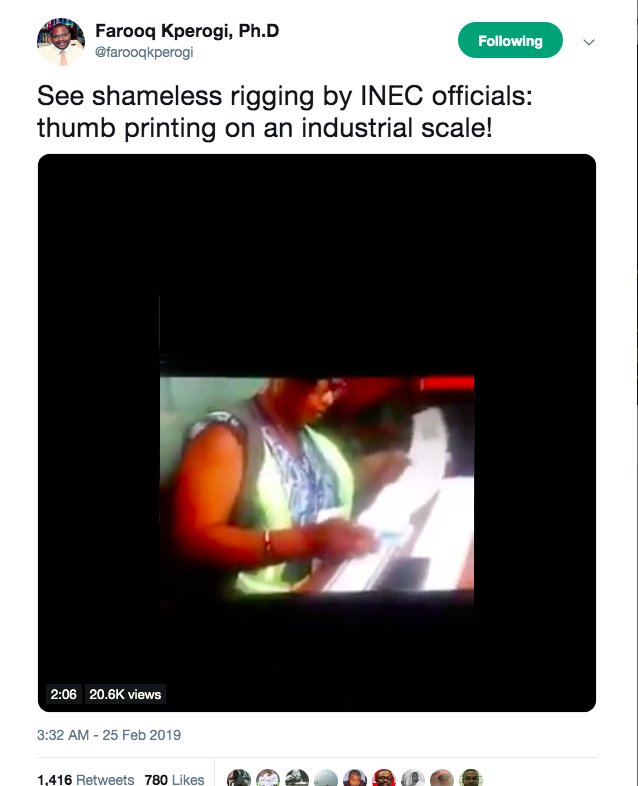
One of the videos shows a woman thumbprinting several ballot papers while casually chatting with a friend. The video was shared by several users on Twitter and WhatsApp.
Farook Kperogi/INEC official Screenshot
But a high-profile account share seems to have garnered a high number of views and engagement. Mr. Farooq Kperogi, an associate professor of Journalism at Kennesaw State University – according to his Twitter profile – shared the video with his over 30,000 followers. A quick scroll through Kperogi’s Twitter reveals he’s a staunch critic of the Nigerian Government led by President Muhammadu Buhari, and that gave us an idea of his political leanings. Mr. Kperogi also shared another interesting video – this one shows about 4 Hausa-speaking men thumbprinting massively, but we’ll come back to it.
In the first tweet, Mr. Kperogi claimed the woman in the video was an INEC official “thumb printing on an industrial scale”. The tweet, posted on February 25, implied rigging during the February 23 elections. It came just in time: Nigerians were anxiously waiting for the election results and violence in states like Rivers and Kano had already spiralled out of control. Those elections had to be put off till later dates. Many Twitter users pointed out that the video was fake, that it had no relation to the 2019 polls, but Mr. Kperogi paid them no mind. One seemingly frustrated user asked Mr Kperogi, “Are you a professor of falsehood?”
The video
It was tough to know exactly where this video was filmed. It had appeared on social media dozens of times with different captions, claiming a number of far flung locations. Apart from Mr. Kperogi, and some 1,414 people who retweeted the video from his account, we found the video across multiple social media platforms with a plethora of claims.
One Twitter user, @chrysaloy, who tweeted it two days after the elections claimed that the “INEC official”, was rigging for the APC, in favour of President Buhari.
We were fascinated by all these, so we dug deeper. Several image reverse searches later, coupled with repeated scrutiny on Google Maps, we cracked it.
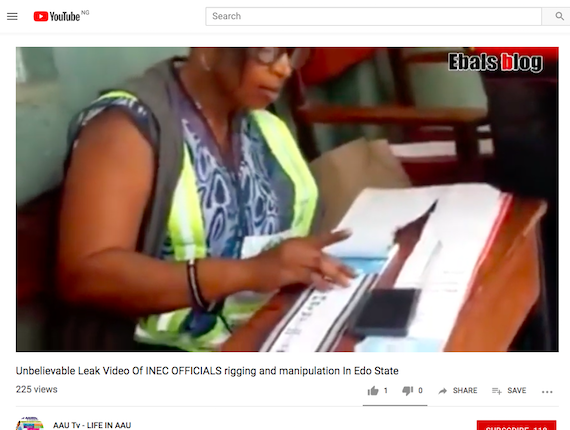
Our investigations revealed that this particular clip is actually a favorite for fake news accounts. The same video was shared on Youtube during the 2016 Edo State governorships and was captioned ‘INEC Officials rigging in Edo state’.
Ebal’s blog/INEC official screenshot
It turned out this video was that of an INEC official rigging elections. Only it was neither the 2016 nor the 2019 elections.
We know this because we found the original version of the video, and possibly the first Youtube upload, back in 2015.
As expected, the original version was sharper, with better resolution. We were able to look closely at the ballot paper and evidence that this is a ‘fake news’ video became clearer.
First, the ballot papers used in the 2019 elections were definitely different – bigger and a bit longer. The papers in the video are smaller and less colorful, closer to the ones used in the 2015 elections.
Also, since we now have a higher resolution video, it was easier to make out the exact party the official was thumbprinting for. If you look too, you’ll see that her thumb pressed on the logo of the first party on the list. We checked the 2015 ballot papers to confirm which party that was. It’s the Accord Party. The bright yellow logo of the party is unmistakably the same one the official repeatedly presses on. Besides, because the parties are listed in alphabetical order, the Accord Party often comes first on the ballot paper.
This clearly debunks the claim that the woman was thumb printing for the APC. But we were not done. We still wanted to know exactly where this incident happened.
Our search took us from Youtube to Nairaland. We discovered the Nairaland account of the original Youtube uploader, a blogger named Alex Report. Alex wrote on his page that the video was filmed in Ward 4, Aniocha North Local Government Area in Delta State. We believe this to be true because there wasn’t any information about the clip predating Alex’s report.
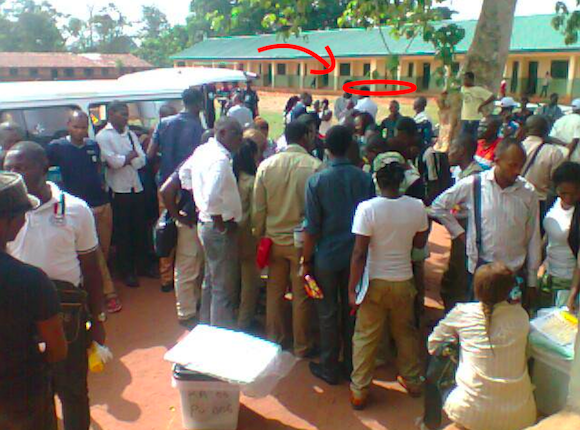
Other voters in that area left helpful clues in pictures posted on Twitter that helped us narrow the location possibilities. They showed pictures of polling units in other schools in Aniocha North. From Alex’s video, we already guessed that the woman was sitting on a school chair and desk, the type used in many government schools in Nigeria. In Ward 6, for example, the school blocks share the same colors with the class block in the video.
Screenshot Ward 6/ INEC Official video
Alex, the original poster was kind enough to leave the number of the Ward 4 supervisor. We used the Truecaller application to confirm the supervisor’s identity. Her name was revealed as Faith Nkechi Chiejile. We even called her. She denied knowing the person in the video but admitted being an ad hoc INEC staff at that ward during the 2015 elections. We pressed further. Surely, as the team leader, she must recognise the culprit. We sent her the video and followed up with questions. At this point, she stopped responding.
So, we concluded that the video was not recorded in 2019 as Mr. Kperogi would want people to believe, neither was the rigging in favour of APC as claimed by several Twitter and Facebook users.
Inferno During Election?
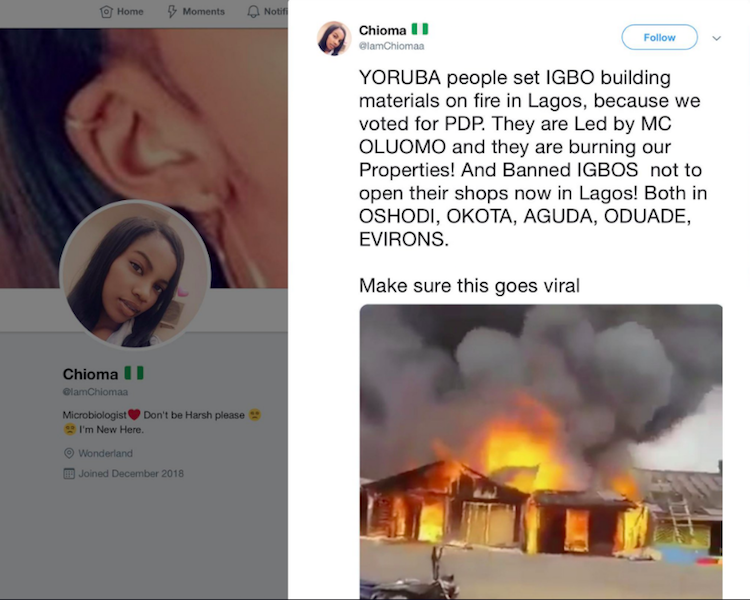
We analysed other interesting videos but none was as intriguing as that of a fire allegedly set off by Yoruba APC members in Oshodi, Lagos to intimidate Igbo PDP voters. It was first posted by Twitter user @iamchiomaa. The video circulated widely on WhatApp messenger with the same claim.
Screenshot Chioma’s tweet/Fire video
There had been political tensions among the Igbos living in Lagos, a predominantly Yoruba state. High ranking party officials of the APC had stoked this tension with comments suggesting that the Igbos should go back to eastern Nigeria. So this tweet played on emotions that were already running high. It was shared severally among Igbos who believed that shops of their kinsmen were getting burnt to the ground.
The same video was posted on Youtube; the caption implying it was taken during the elections, but this time, in Adamawa State. People fell fast for it on Facebook too, where it was similarly linked to violence in Adamawa.
It’s easy to see why this video was easy fodder for propagandists. The fire in question raged with intensity, taking a whole row of shops with it. A Twitter codec that distorts audio uploaded on Twitter affected the video. This meant that the versions uploaded on Twitter were not audible, making it harder for unsuspecting sharers to discern what the people in the video were saying. Luckily, a media researcher who had received the video on WhatsApp sent it to us for verification. The version sent on WhatsApp has better audio and we were able to analyse the voices from this version.
Not Lagos, not Adamawa, but where?
We knew the location of the burning shops was not Oshodi in Lagos, neither was it Adamawa. We pored over the video frame by frame. Our multiple reverse image searches only brought false positive results. But we kept looking because we had clues from the video that convinced us it was shot anywhere but Lagos or Adamawa.
For one, the language spoken in the clearer versions of the video was neither the Yoruba or Hausa spoken in Lagos or Adamawa. The women screaming as the fire raged were not covered with hijabs, as would be the case in majority-Muslim Adamawa.
Residents in Oshodi confirmed to us that there was no recent fire incidence in the area. We already had our doubts. But we still didn’t have a location.
The MTN signboard visible in the video points to somewhere in West Africa, where the telecom company operates. But the ‘POS withdrawal’ business sign post in the video is mostly found in rural communities with no bank presence. Again, this greatly reduces the possibility that the fire was in Oshodi, where banks are within proximity.
On the other hand, these withdrawal businesses are common in Nigeria’s south-south region – where customers POS machines serve as ATMs. We know because we’ve reported from the area and we’ve seen them. But at this point, we were still guessing. The presence of fuel kegs at the site of the fire outbreak reinforced our guess: It’s common to sell illegally-refined oil and petroleum products cheaply in roadside markets in the oil-rich Niger-Delta.
Still, all these were at best circumstantial. It didn’t point us to an exact spot.
So, we put the open source principle to use. We sought help within the open source intelligence community. People pointed us to Togo, Ghana, and Cameroon. But two Anglophone Cameroonians we spoke to said: ‘That’s definitely not Cameroon.’ Another said: ‘We don’t have those POS things’. Therefore, Cameroon was out.
We continued to look. We took screen shots and did several reverse searches again, while following trails left on social media and by the OSINT community.
Weeks after we put out the call, we stumbled on a clue on Facebook that would lead us to where the video of the alleged Oshodi fire was filmed.
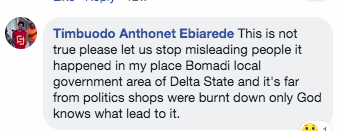
Screenshot commenter on Facebook/Fire video
A commenter on one of the many posts claiming the fire was from the 2019 elections said the fire had no connection to the polls and that it had, in fact, occurred in her locality.
We investigated this claim like hundreds of other pointers we had followed to deadends. We found that truly, a devastating fire had occurred in February in Bomadi Local Govt Area, Delta State. Only one news website reported it. Two children had been cooking noodles on a kerosene stove when it exploded, burning the shop they were in. Sixty more shops were razed in that incident, according to the article. The fire happened along Bomadi Gbaregolor Akugbene Ezebiri road.
Close up of screenshot 5
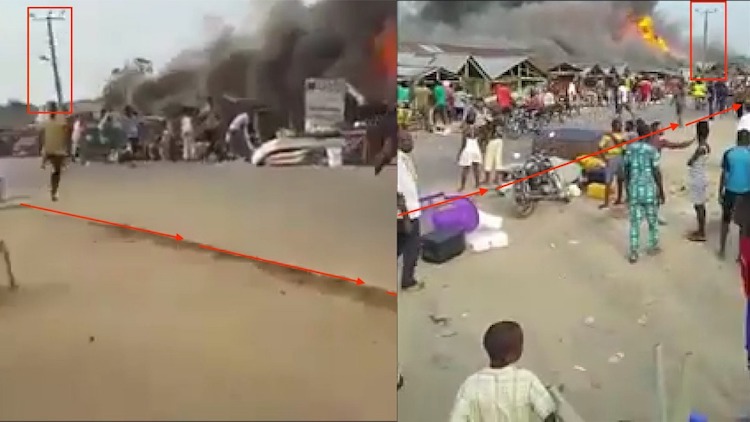
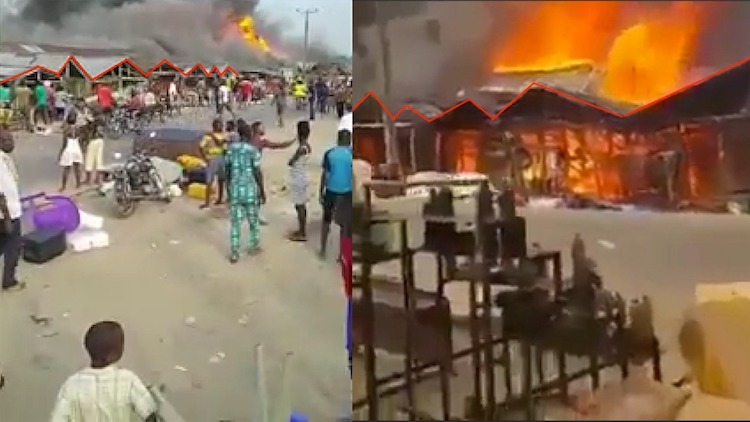
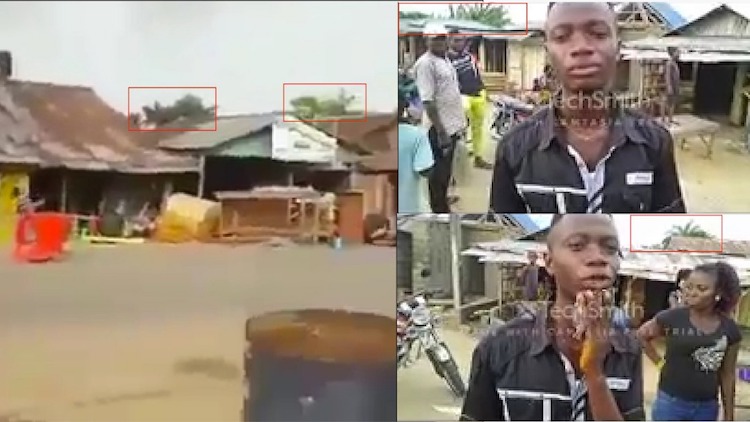
The article led us to another video of the fire that we had missed earlier. This new video was shot from a different angle, northwest of the location of the first filmer, who was standing right in front of the inferno. Fifty-two seconds of footage confirms that the fire was also in Bomadi, but doesn’t confirm the street. We are convinced that the two videos show the same fire because of matching clues in both.
The burning structures in the videos have similar triangle-like patterns, that matched.
Vegetation behind the structures in both videos are similar too.
We matched similar electricity poles, and the curves of the streets.
Note too, that the filmer in the second video says nothing about elections. It’s perhaps because the video was posted on the 21st of February, 2 days before the elections. That puts the fire on or before the 21st of February. It most definitely had nothing to do with the February 23 polls.
Although the initial poster on Twitter deleted the video due to pressure from those who would not stand for tribalism and misinformation, the damage was already done. The video had already spread on other sites, including WhatsApp. And the truth, sadly, could not catch up.
Misrepresented
Before we go back to the second video we linked to Mr. Kperogi, let’s talk photographs.
There were scores of pictures shared depicting violence during the elections. Things got worse during the turbulent supplementary elections in Kano State. Many of the posts were gory, showing stab wounds, fresh blood and dead bodies. It is hard to tell just which ones were real or fake – the pictures revealed nothing after reverse searching. But a few shared on the official Twitter accounts of the PDP and Senator Dino Melaye, a Nigerian lawmaker, caught our attention.
Senator Melaye, an already controversial politician, tweeted out the photo of a dead man laying in his own pool of blood. He claimed the man was killed in election-related violence that had erupted in Kano.
He went ahead to call for the suspension of elections in the state, using the photo as the basis for which he called on the electoral commission to cancel the Kano State governorship elections.
This tweet – retweeted by 655 accounts and liked by double that number – is in fact, deliberately misleading. It took us just one image reverse search to unravel the truth. We found a 3-year old article with the same image now posed off as a casualty from Kano State elections. The picture first appeared in a 2017 article detailing a clash in Nairobi, Kenya.
We contacted Senator Melaye to know who his source was and how he got the picture. We got no response. We left him text and Whatsapp messages. The double, blue ticks that signified message had been read came up on Whatsapp, but no response followed. We did contact Mr. Kperogi for information on his sources too but we were ignored. We tried to reach Mr. Kperogi through his social media accounts – Facebook and Twitter – where he commands over 76,000 followers combined. Although his Direct Message, DM as commonly called, on Twitter is not open, meaning that only those he follows can send him a direct message, the same message was sent to his Facebook messenger. We also requested comment through his WhatsApp messenger, like Senator Melaye, we only saw the blue ticks.
Senator Melaye, an already controversial politician, tweeted out the picture of a dead man laying in his own pool of blood. He claimed the man was killed in election-related violence that had erupted in Kano. He went ahead to call for the suspension of elections in the state, using the picture as the basis for which he called on the electoral commission to cancel the Kano State governorship elections.
This tweet– retweeted by 655 accounts and liked by double that number– is in fact, deliberately misleading. It took us just one image reverse search to unravel the truth. We found a 3-year old article with the same image now posed off as a casualty from Kano State elections. The picture first appeared in a 2017 article detailing a clash in Nairobi, Kenya.
The next photograph we looked at was uploaded on the official Twitter handle of the PDP.
The opposition party tweeted out the photo of an injured man and claimed that “APC thugs brutally attacked PDP agent in Kibiya Local Government Area of Kano State”.
The opposition party tweeted out the photo of an injured man and claimed that “APC thugs brutally attacked PDP agent in Kibiya Local Government Area of Kano State”.
This particular picture was shared on 23 March, the day of the supplementary elections. It is important to note that our analysis of these photographs is hardly open source investigation, but we thought it interesting anyway.
The appearance of these wounds raised suspicion: for purported fresh wounds, it is unsettling to see that the wounds were dry. There’s no blood gushing from the man’s head, but there’s somehow blood on his shirt.
Granted, they could have cleaned up before taking the picture but take a look at the wounds again. Does anything appear amiss? We thought so, too. We spoke to medical doctors for their expert opinions. The first doctor we showed the picture to said the wounds don’t seem fresh.
“Maybe a few days old,” Dr. Samuel Ezekwesili said, before adding that only close examination can truly reveal how long the wounds were before the pictures were taken.
Dr. Joshua Adeoye also thinks the wounds have been treated previously, contradicting PDP claims that the attacks happened “this morning”. “They’re not really fresh. At least, they’ve received some medical attention. You can see the first one has had cotton wool applied. And the second one, that wound on scalp and neck would not stop bleeding except it receives attention.
“Those places are vascular– very well supplied with blood. However, if the wounds were older than 2 days, you’d start seeing scabs on them, which seem absent on these ones. So, best guess is between 1 to 2 days.”
The experts’ opinions were clear; the wounds are not as recent as handlers of the PDP Twitter page would want Nigerians to believe. Again, even if the men were attacked “this morning”, as claimed, can PDP Twitter handlers, at least, acknowledge that the men have had a clean up and only wore their clothes back for photo session?
Senator Dino Melaye shared the pictures in question too. We asked again how he got them, and again, we got no response.
The online atmosphere in Kano State, where the injured man’s photos allegedly emanated from, was awash with political misinformation and misrepresentation, according to recent research funded by WhatsApp. With the surge of cheap internet enabled phones in northern Nigeria, the researchers found that social media users in the region were particularly vulnerable to propagandists motivated by personal gains, and who pay no attention to accuracy.
One of the machineries used by both APC and PDP, according to the research, were photographs wrongly captioned or outright falsehood. Our own findings corroborate this. “Accuracy is not always prioritised over political point-scoring, especially as these online operators are looking to illustrate their value to the party or candidate by creating viral content that increases their visibility,” the researchers wrote.
Now, back to videos
We mentioned a second interesting one shared by Mr. Kperogi. Watch it here.
In this video, some men and one woman wearing what look like official tags appear to be thumbprinting massively for a party. The reason we found this interesting is because we set out to debunk many videos we believed to be old or not related to the elections. We were not prepared to deal with actual, blatant rigging, not with the PVCs and not with the improved vigilance that was supposed to be a key feature of the 2019 polls. We had to know where this happened and what was really going on.
So, we checked the video for clues. One of the officials is wearing a 2019 tag, which immediately signaled to us that this is a recent case. On the tag, we could make out the phrase “Ward Supervisor”.
2019 printed on the tag
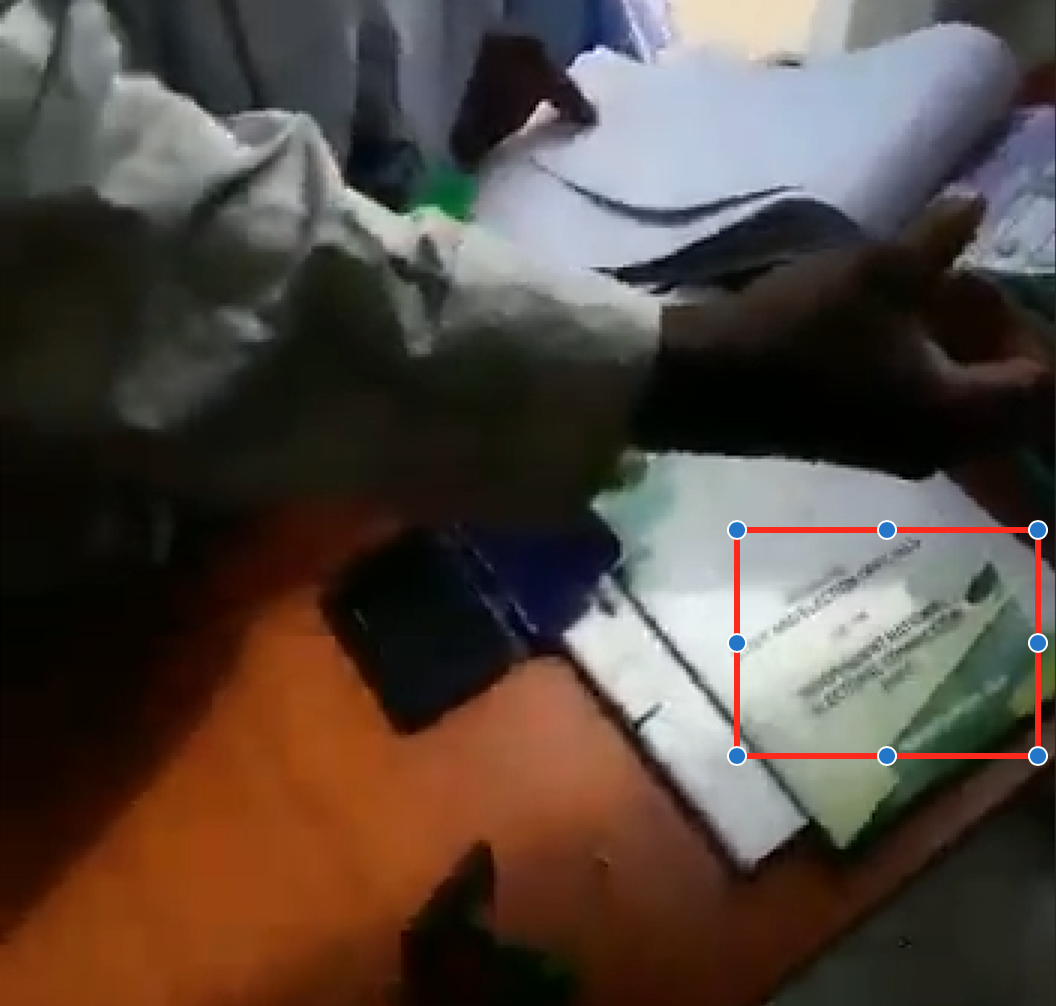
While we cannot emphatically state that those stamping and thumbprinting the ballot papers are INEC officials, we know for a fact that it is a recent voting exercise. Two people wear similar vests as won by INEC officials during the 2019 elections and there are materials on the table with ‘INEC’ printed on them.
We could not distinctly make out the party being thumb-printed but we could see from the video that it was the second party on the first column that received this illegal votes. We checked this information against the ballot papers used in Borno and Yobe. But, it is hard to tell.
INEC printed on a booklet
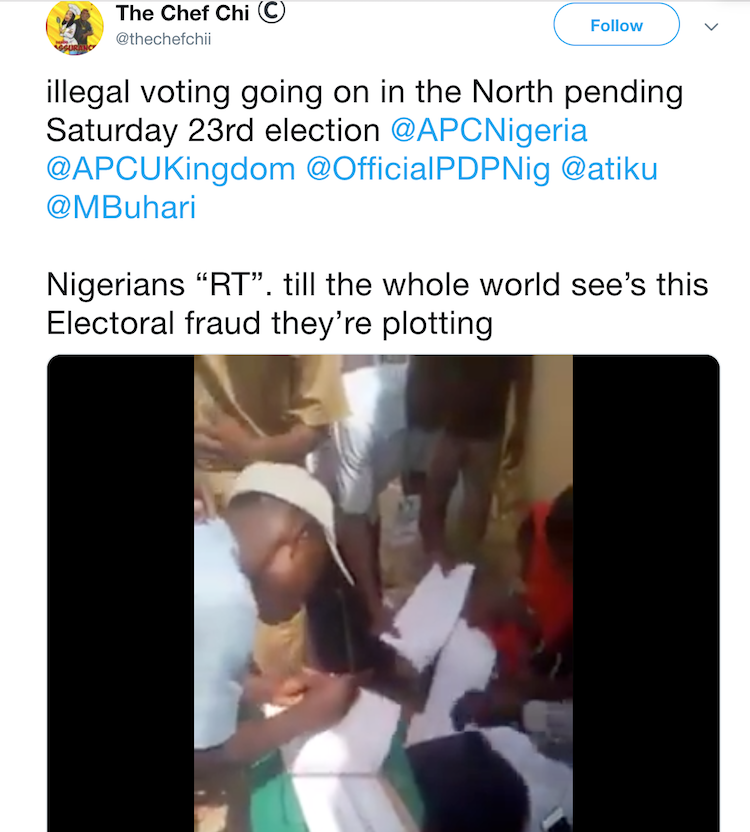
We analysed yet another video of men rigging in what we presume is a northern state because of the Hausa language being spoken. Twitter user @thechefchii with over 18,000 followers, posted a video showing illegal thumb printing of ballot papers. The user claimed that the rigging was in preparation of the February 23 elections, in favour of the ruling party, then urged Nigerians to “RT”.
The same video was shared by @LLumamba, another Twitter user. The caption was a bit different. “APC plus INEC rigging elections in Nigeria”, the handle claimed.
screenshot of Chef Chi
But more importantly, we found that the video was uploaded on Youtube in 2018 with the caption “Zaben kanana Hukumomi Ta Jahar Kano”. The phrase translates from Hausa to mean “Watch how Kano state vote today”. It had nothing to do with 2019. And so, we cracked another old ‘fake news’ video.
In the end, we only analyzed a few of the hundreds of fake photographs and videos shared during the elections and used as weaponry by party propagandists and loyalists. It is unclear how successful their work was or just how big the machinery that fueled the attacks is: and to be clear, these fake posts were attacks on the ordinary Nigerians who only wanted to vote, however you look at it.
The 2019 elections recorded the lowest turnout in Nigeria’s 20-year democracy. [Data for 2019 archived here, and 1999 here] Fear of violence caused many to shun the polls, and social media messages like the ones we’ve analysed here did nothing to allay people’s fears.
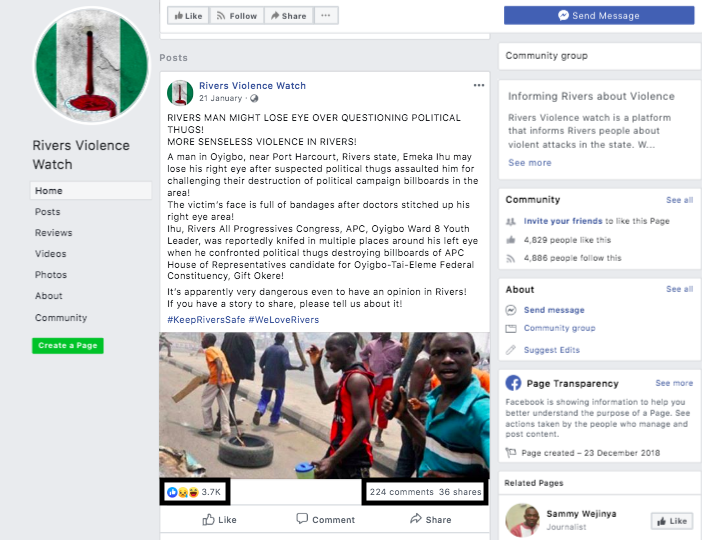
Rivers Watch Fake Facebook page (Source, DFR Lab
To get a sense of the scale of online attacks during the elections, we must connect these incidents to a recent development. Just last month, Facebook pulled 265 Instagram and Facebook accounts linked to Archimedes Group, an Isreali campaign agency. The accounts, posed as locals and local news agencies to spew fake election news in targeted West African countries, especially Nigeria. They reached a combined followership of almost 3 million people and spent almost a million dollars on advertising. The Digital Forensic Lab specifically found posts targeting both Atiku and Buhari’s supporters, suggesting Archimedes was lobbying for both sides simultaneously. The account managers were traced to locations in Israel, United Kingdom, Portugal and Senegal.
Twitter has failed to do a similar sweep, meaning there are likely hundreds more fakes on the platform. None of the Twitter or Facebook accounts we listed in this report have been linked to Archimedes Group and therefore have not been removed or sanctioned – to the best of our knowledge. But without a doubt, political information warfare is being commercialized and weaponised, and Nigeria remains highly vulnerable to such attacks because of low media literacy levels. High profile Twitter account holders such as Mr. Kperogi and Senator Melaye are still active on social media and it is conceivable they will share more fake news in the future. That makes us worry. What will they post next?
THE Socio-Economic Rights and Accountability Project (SERAP) has gone to court to challenge claim by the Code of Conduct Bureau (CCB) that it could not disclose details of asset declarations filed by successive presidents and state governors since 1999.
CCB last week refused a Freedom of Information request by SERAP, stating that: “Asset declaration form is private information.”
The bureau claimed that disclosing the asset forms “would offend the right to privacy of presidents and state governors.”
Human rights lawyer, Femi Falana, has also described CCB’s argument as illogical.
In the suit filed at a Federal High Court in Lagos on Friday, SERAP argued that asset declarations of presidents and state governors submitted to the CCB are public documents.
The organisation maintained that public interest in disclosure of the details of asset declarations it sought clearly outweighs any claim of protection of the privacy of presidents and state governors, insisting that they are public officers entrusted with the duty to manage public funds, among other public functions.
THE African Centre for Media and Information Literacy (AFRICMIL) has commended the Independent Corrupt Practices and Other Related Offences Commission (ICPC) for investigating and issuing a report on the petition alleging corrupt practices and abuse of office against the Managing Director and Chief Executive Officer, Marilyn Amobi, Nigerian Bulk Electricity Trading Company (NBET) Plc.
The report on the investigation of the petition sent to the Commission by a whistleblower, Sambo Abdullahi, and staff of NBET, indicted Amobi for violation of procurement laws. The Commission said she would soon be prosecuted.
Coordinator of AFRCMIL, Chido Onumah, noted in a press statement that the report was not far reaching enough as it was silent on its findings on the allegation of monthly over-payment of about N2billion to Olorunsogo and Omotoso power plants by the management of NBET.
This, Onumah described as a key part of the corruption in the power sector, and the foremost allegation in the petition.
“While we thank ICPC for the sense of duty to investigate and release the report when it was almost looking as if some powerful persons in government would not want the rot in NBET under Dr. Amobi exposed, we also observe with every sense of responsibility that the report was not far-reaching enough,” he said.
“The report was “shockingly silent” on its findings on the allegation of monthly over-payment of about N2billion to Olorusogo and Omotoso power plants by the management of NBET.”
The Coordinator said, “AFRICMIL is very disturbed that the ICPC report was shockingly silent on the huge payment of over N2billion to Olorusogo and Omotoso power plants when, in the face of credible evidence, they do not have Gas Purchase Agreement (GPA) and Gas Supply Agreement (GSA).
“In view of this obvious fact, we urge ICPC to revise the report by including its findings on this payment because it forms a significant portion of the massive fraud in the power sector,” Onumah stated.
He further stated that Abdullahi, who was the Head of Internal Audit in NBET, was being victimized alongside his colleague Waziri Bintube, former Head of Finance, for refusing to cooperate in defrauding NBET and denouncing abuse of office by their boss.
For nearly two years now, according to him, both have been denied their salaries and other entitlements, and removed from their jobs.
“We are happy, however, that both management staff have been vindicated, as the report absolved them of any wrongdoing and declared that they were ‘wrongfully dismissed but the matter has been referred to the office of the Office of the Secretary to the Government of the Federation,’” he said.
Onumah called on the Secretary to the Government of the Federation (SGF) to act quickly to restore the salaries and entitlements, as well as the offices of Messrs Abdullahi and Bintube in view of the findings and recommendations of ICPC.
According to him, “Since the ICPC report noted that the whistleblowers did not commit any offence, the SGF would do well to get them back to work and ensure the payment of whatever is due to them.”
Onumah said the matter of the persecution of the whistleblowers had since last year been referred to the SGF’s office when it could not be resolved by the Ministry of Power, Works and Housing, following the non-compliance of Dr. Amobi to two separate directives of the Ministry of Power, Works and Housing to refrain from treating the whistleblowers as if they had ceased to be NBET staff and withholding their salaries and emolument.
“Now is the time for the SGF to act in the interest of justice,” he noted.
Onumah implored the Head of the Civil Service of the Federation to also make public the report of the Joint Committee inaugurated to look into the NBET crisis which has been on for two years now, and has resulted in low performance in the power sector.
The Committee, headed by the Permanent Secretary (Career Management Office – CMO, has members from Ministry of Finance, Federal Civil Service Commission, Ministry of Power, Works and Housing, among others.
NIGERIA has a vibrant press media landscape. But freedom of the press is only rated as “partly free” by Freedom House, mostly due to the fact that news media are still susceptible to political pressures. There is also the external influence from ownership structures and the generally low wages of journalists. Favourable reporting of generous politicians remains a fairly common practice.
The extent to which these influences affect the quality of reporting remains insufficiently investigated. To address this gap we analysed how three newspapers with different political affiliations report on conflict in the run-up to the 2015 elections. Electoral violence reporting is particularly sensitive to political biases in the news media.
Our analyses showed that Nigerian news media reported on electoral violence relatively independently from political pressures. This was also supported by interviews with Nigerian media professionals who argued that political pressures lead to changes in editorial policies. But when electoral violence took place, the media “say it as it is”.
Our findings show that Nigerian print media played a crucial role in monitoring violence, and thereby deterring it, given the overall adherence to independent and professional reporting standards – even in the face of political pressures. But to reinforce this role, structural weaknesses – such as as lack of resources – will need to be addressed. This is particularly true during election times.
Without reliable evidence, national and international observers will find it increasingly difficult to make judgements on electoral violence in Nigeria and to denounce parties and candidates. This, in turn, poses a serious problem for the stability and democratic conduct of future elections in the country.
Our selection of these papers was guided by two principles: firstly we selected newspapers which were affiliated to one of the main political parties contesting the elections – the People’s Democratic Party (PDP) and the All Progressives Congress (APC). The second criterion was that the papers had to be relatively national in scope and have a wide readership. This mean that we excluded local, small-scale papers.
We had a major challenge determining affiliation or sympathy towards a party. For one of the papers, The Nation, this was more obvious since its ownership is linked to Tinubu, who is a major APC strongman in the south west region of the country. We selected The Guardian and This Day because, based on extensive consultations, it was fair to conclude that they sometimes had regional sympathies.
We conducted both qualitative as well as quantitative research. The qualitative research involved interviewing 15 Nigerian journalists and editors in Lagos and Abuja.
We examined how events related to conflict were covered by the three papers between April 2014 and March 2015. This was the year leading up to the elections. We recorded coverage of protests, riots, political kidnappings, armed conflict events, and suicide bombings and the actors involved. We then analysed to what extent the three newspapers sketched a different picture of conflict events over time, in particular events involving the two main parties.
We found that all three newspapers painted a similar picture of electoral violence patterns in the run-up to the 2015 elections. The All Progressives’ Congress was consistently more likely to be the victim of violence than the People’s Democratic Party.
As all three newspapers reported this pattern, it was likely to reflect a real trend in society. The discrepancy between events in which the All Progressives’ Congress was a victim of violence and events where the Peoples’ Democratic Party was targeted, was largest for the Nation.
But, overall our analysis indicated that biases in reporting were generally limited, and that while political pressures were real, they were most evident in editorial choices. In other words, decisions such as on which page the report appeared, the length of the article as well as what visuals were used.
Our analyses also revealed a more problematic feature of reporting on violence in Nigeria. But media outlets also lacked resources to conduct independent investigative reporting.
Lack of resources
The papers we looked at mostly depended on statements from political parties themselves. This led to parties using the media to make accusations against one another. For their part, reporters were unable to reveal the real culprits because they didn’t have sufficient resources to do their own investigating and reporting.
From the perspective of balance, accusations and counter-accusations were reported. But the real perpetrators and victims were rarely established or verified independently.
Yet independent verification of political claims is important because it means that journalists can provide context in an environment in which conspiracy theories are rife. The ability to be able to report events on the ground is crucial if the media’s watchdog role is to be sustained, and deepened. That, in turn, needs resources.
JUSTICE Adebukola Banjoko of the Federal Capital Territory (FCT), High Court, sitting in Gudu, Abuja, has convicted and sentenced former directors of the Rural Electricity Agency (REA), to various jail terms for their culpability in the N5.2billion scam.
The convicts were Samuel Ibi Gekpe, former Managing Director, REA; Simon Kirdi Nanle, an accountant in REA; Kayode Orekoya, Director of Projects; Abdusamad Garba Hahun, Assistant Director and Kayode Oyedeji, Head of Legal Department.
However, the second defendant, Abdullahi Aliyu, a former Permanent Secretary in the Ministry of Power was discharged and acquitted.
They were charged by the Economic and Financial Crimes Commission,(EFCC) for criminal breach of trust in fraudulently awarding a contract for Grid Extension and Solar Electricity from the amended 2008 Budget of REA.
The convicted former directors were alleged to have fraudulently facilitated the withdrawal of the sum of N119.7million from the account of the agency, domiciled in Central Bank of Nigeria (CBN).
In the course of the trial, the prosecution led by Kemi Pinheiro, SAN, called seven witnesses before closing its case.
Rather than open its defence, the defendants through Paul Erokoro, SAN, made a no case submission which was overruled by the court and thereafter were called upon to open their defences.
Abdullahi Aliyu’s “no-case” submission was, however, upheld on appeal and he was consequently discharged and acquitted.
The first and third defendants rested their cases on that of the prosecution. The fourth-sixth defendants testified in person.
Final addresses were filed, exchanged and adopted. Upon adoption of the respective final addresses by the prosecution and the defence, the court adjourned for judgment.
In a significant judgement, the court dismissed the application of Gekpe, the first defendant, which challenged the jurisdiction of the court to entertain the charge. On the substantive charge, the court found that the prosecution had established by evidence all ingredients of the offences against the defendants.
The defendants were accordingly convicted and sentenced as follows: First defendant sentenced three years imprisonment with an option of N5million fine; other defendants were sentenced to three years imprisonment with an option of N500,000 fine each.
ZAMFARA State government says that residents of six communities have on Thursday returned to their villages following improvement of peace in the state.
The information disclosed in a statement was made available to PREMIUM TIMES on Friday and signed by the Director- General, Press Affairs, Zamfara Government House, Yusuf Idris.
The state government noted that the residents returned to their homes through the effort of the office of the Senior Special Assistant to the governor on security Matters, Alhaji Abubakar Muhammad Dauran (Justice) because the security atmosphere of the state was calm.
“Some of the returned IDPs had spent over six months at Mada town area of Gusau local Government but with measures put in place by the present administration of Governor Matawalle, they were able to return home without any fear or threats to their lives and properties,” the statement reads.
The Governor, Mohammed Matawalle, on his part praised the measures put in place by the federal government in ensuring that sanity was restored in the various part of the state, by deploying more security personnel.
He enjoined farmers in the state to keep on with their regular farming activities, as the safety of their lives and properties have been taken care off.
Matawalle appealed to Nigerians to continually pray for the restoration of peace in the state.
He called on the people of the state to join forces with the security personnel deployed to the state to help rescue Zamfara from the menace of insecurity.
He further pleaded to the perpetrators of this crime to embrace peace, so they can also enjoy the dividends of democracy.
The media have reported several killings, kidnapping and banditry in Zamfara State in 2019 alone.
On April 23, the state noted that insecurity in the state had declined as a result of the massive deployment of military personnel, but locals were still at the mercy of bandits and kidnappers.
The media reported in May the adoption of students and teachers at a government secondary school, Moriki, in Zurü Local Government Area (LGA) of Zamfara State.
Also, in June, there were newsof killings by bandits in Kano village, Maru LGA, Zamfara.
Following this, the governor, on June 17, embarked on a journey to Dubai, United Arab Emirates (UAE), for a meeting on how to tackle the problem of banditry in the state.
In a bid to curb the menace, the Nigeria Governors’ Forum, (NGF) on June 20, disclosed its intention to set up a security committee at the National Economic Council (NEC) level with a view to addressing the appalling rise of insecurity in the country.