FEW weeks after MTN Nigeria went public on the Nigeria Stock Exchange, Airtel Africa Ltd, a subsidiary of Indian telecoms group Bharti Airtel Ltd, is considering a stock market flotation in London with plans to go public on the Nigeria Stock Exchange too.
The company on Tuesday said it was part of its efforts to expand its data and mobile money services across Africa, with plans to trade on the main market of the LSE and NSE.
Using its premium listing segment, which has more stringent rules than the European Union’s minimum requirements, Airtel intends to sell 25 per cent of new shares to reduce existing debt.
“The 14 countries where we operate offer strong GDP growth potential and have young and fast-growing populations, low customer and data penetration and inadequate banking infrastructure.
“These fast-growing markets provide us a great opportunity to grow both our telecom and payments businesses,” Raghunath Mandava, chief executive Airtel said in a statement.
The company is aiming to raise around $1 billion in a June equity offering, Reuters reported.
The cash injection from existing investors has already helped to reduce Airtel Africa’s net debt to $4 billion in March, compared to $7.7 billion in the previous year. Its net income reached $83 million in the year to March, compared to a net loss of $49 million a year earlier.
The telecom company operates in 14 African markets including Nigeria, Democratic Republic of the Congo, Kenya, Rwanda, Seychelles, Uganda and Zambia.
The company has appointed JP Morgan, Citigroup Inc, BofA Merrill Lynch, Absa Group Limited, Barclays Bank PLC, HSBC, BNP Paribas, Goldman Sachs International and Standard Bank Group Ltd as advisers if the flotation plans proceeds.
THE Economic and Financial Crimes Commission (EFCC) says its operatives have arrested the proprietor of a Yahoo Yahoo training school in Lagos, Frank Chinedu.
Chinedu, 22, was arrested alongside eight students of the unnamed training centre located at 14, Animashaun Street, Progressive Estate, Ojodu Berger, Lagos while receiving lectures in internet fraud activities.
This was contained in a statement issued in Abuja on Tuesday by Tony Orilade, Acting Head of Media and Publicity at EFCC.
Orilade gave the names of the students as Ahmed Musa, 24; Desmond Eze, 29; Preye Kingsley, 23; Benjamin Irabor, 21; Benjamin Opah, 19; Akapo Prosper, 22; Innocent Paul, 20 and Olamide Edun, 20.
He stated that the suspected internet fraudsters were arrested on May 22, 2019, following intelligence reports received by the Commission about their involvement in alleged criminal activities.
Orilade listed items recovered from the suspects at the point of arrest to include nine laptops, 16 mobile phones, an Airtel modem, Orange Wifi and one Toyota Camry with registration number EPE406FN.
He said they would be charged to court soon.
The ICIR had reported the arrest of Nigerian musician Afeez Fashola, popularly known as Naira Marley and four others in Lagos by the anti-corruption agency on May 10 on allegations of internet fraud. He is currently remanded in detention.
Only 2.8 million under-five children out of a population of 32 million in Nigeria have birth certificates. According to the law establishing the birth registration scheme in Nigeria, birth registration is free, and any child not registered legally does not exist. In the third part of the Birth Registration series, Jennifer UGWA reveals how officials of the Nigerian Population Commission (NPC) make birth registration difficult by extorting nursing mothers in Imo and Rivers States.
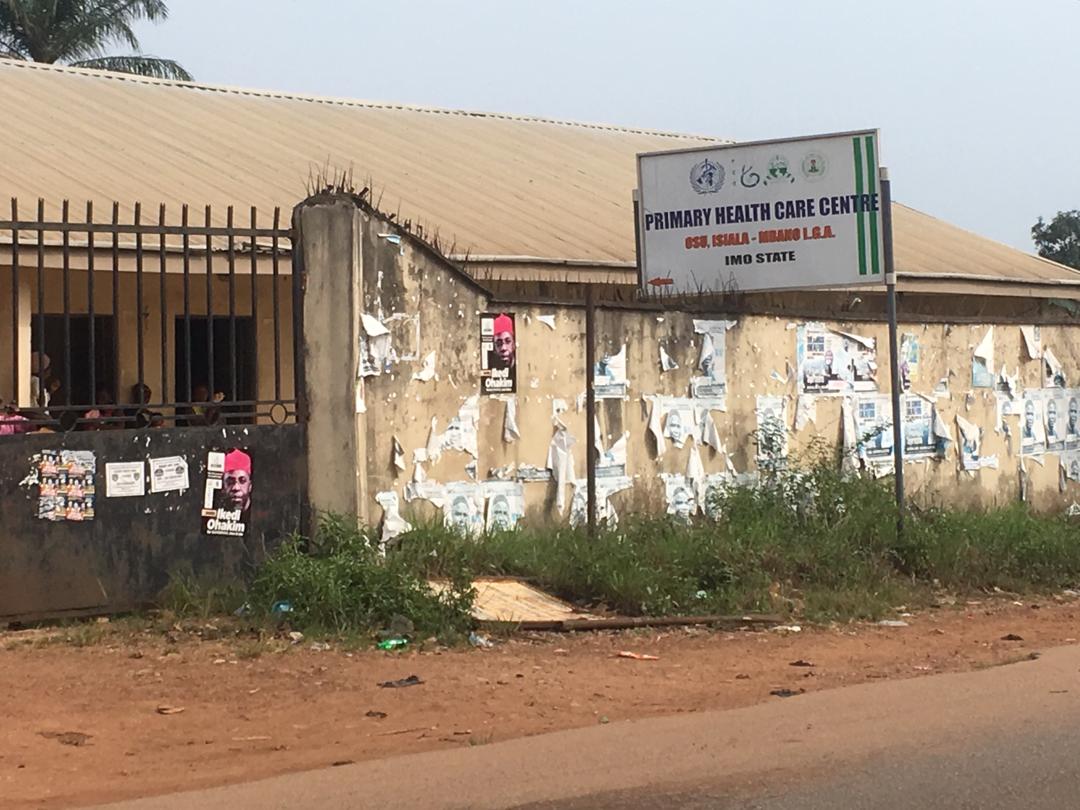
ON Thursday morning, at 8:00 am, March 14th, The ICIR reporter arrived at Isiala-Mbano Primary Health Care in Osu Isiala- Mbano Local Government of Imo State, the veranda of the health centre serves as the reception, with two long benches that had turned black with age. The centre was crowded with nursing mothers who came to immunise their babies.
The journalist struck up a conversation with one of the nursing mothers, Ngozika Wisdom, on how to get a birth certificate.
“Oh, that is easy, just meet Sister, she will give you, it does not take time,” she said, pointing at the entrance of the building.
Ten minutes later, the journalist was ushered in through a maternity hall leading towards the semi-detached office that served as the matron’s office. The cries of newly born babies filled the room, some barely a day old. They were held by their mothers who were surrounded by family or probably friends who cast questioning looks at the intruding journalist.
The matron, a soft-spoken lady, sat behind her desk in the small office stuffed with old files and medical equipment.
“The one I will give you does not have NPC logo, and it is N500, the NPC official that gives the official birth certificates is not here yet, but he will be here by 10 o’clock. That one will cost you the same amount or more, depending on the person,” she said.
But by 10 o’clock am, the NPC personnel was yet to arrive and the reporter was asked to visit the local government headquarters secretariat, a walking distance from the primary healthcare centre, to acquire the certificate.
Amongst the people waiting for the arrival of the registrar at the secretariat office was an elderly man who came to collect a birth certificate for his teenage daughter who just gained admission into the university. The father was surprised when he was told by others at the venue that he might have to pay to get the certificate.
“On my way to this place I lost N10, 000. The money I have with me is just the balance remaining from my transportation in my breast pocket. I don’t know anything thing about making a payment to the Local Government account,” he said, already frustrated by the news.
Isialla Mbano Primary Health care Centre
Vital or Civil Registrationis the system by which a government records the key events of its citizens and foreigners resident in the country. Vital Registration creates legal documents which may be used to establish and protect the civil rights of individuals, as well as providing a source of data which may be compiled to give vital statistics.
Generation 2030 United Nations Children’s Fund report in Child Demographics in Africa reveals that by 2050, a fifth (16 per cent) of children under 18 in Africa will be found in Nigeria.
In Nigerian schools, especially tertiary institutions, one is usually required to present one’s birth certificate as part of the registration process. Also, some employers also request a birth certificate from the newly employed staff and it is for this reason that the employees scramble to procure the certificate.
Back at the LGA headquarters, a light-skinned man drove in on a motorbike several minutes later and introduced himself as Martins Duru. Though Duru issued the reporter a birth certificate at N1,500, it did not have the NPC serial number or the logo.
“If you want the one from NPC, the person to talk to is Onyenawi Francis. He is the residing NPC official in the LG,” Martins said.
At Francis’ office, he did not hesitate to write a certificate for a child that was not presented before him. The reporter came up with phantom names: Name of Child – Ikechukwu Charles David; parents’ name – Ikechukwu Charles and Jennifer Ikechukwu both from Umuozu Ama Umuozu Isiala Mbano.
“Hope they know how much they are supposed to bring?” he asked Martins who had accompanied the journalist to the office darting a gaze at journalist simultaneously.
When the journalist insisted that the certificate should be free, a wide-eyed Francis wouldn’t hear of it.
“If you want the free one the procedures are different because I can tell you to fill that form and submit, and come back in six months’ time. Once you leave this office, I will just drop it somewhere.
“Look when I am returning this duplicates, the person that I will submit it to will ask for money too and they won’t believe I did not collect money to give it out. The government will tell you that it is free, but the same people saying that it is free are the ones that will ask for money.
“The person collecting these things from Abuja will even ask for money too but because you came with this my oga, give us N2,000,” Francis said
Finally, the deal was struck at N1,000 and the new certificate was acquired.
Wisdom who had earlier spoken to The ICIR, shared the experience of her difficulty in getting her three-week-old baby boy immunised because some of the healthcare centres use the certificate as a criterion for immunisation.
Some of the mothers said they have to pay between N200 and N500 to get a birth certificate.
“I just hope that the nurse will immunise us, maybe by next week I will pay, but for now I don’t have that money,” she said.
“Once you are coming to the hospital, just come with N500 and you will get it. It is easy like that,” another nursing mother who preferred to be identified as Mummy Chijindu, told The ICIR reporter.
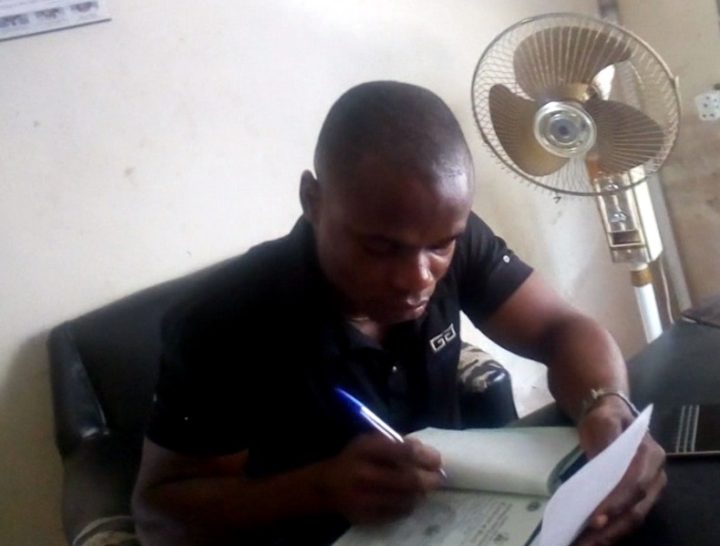
Francis: NPC registrar
The first conscious effort to have a universal system of registration of births and deaths in Nigeria began in 1988 when the then Federal Military Government promulgated the Births and Deaths Compulsory Registration Decree 39 of 1979 which implied that any child whose birth is not registered does not exist. The authority to register these events is domiciled with the National Population Commission (NPC) and clearly states that the registration is free!
At the Imo State University Teaching Hospital (IMSUTH), Orlu, a 50-minute drive from Owerri the capital, The ICIR was given the contact details of Ohuakwanwa Sylvanus, the NPC registrar charged with the registration of births at the healthcare.
Sylvanus who had left the hospital by 1.10pm that afternoon asked to be met at the famous Orie Orlu Market also known as Orlu International Market.
At the market, Sylvanus a fair man clad in white brocade outfit walked the journalist briskly into a pharmacy shop where he was to issue the certificate.
Sylvanus started inputting the data of Ikechukwu Charles without asking for any proof of relation or immunisation card since the child was not present.
“You will give me N1000,” he blurted immediately he was done writing.“I am not even giving you a high price, you know this thing is urgent and I treated it so for you,” he said.
He wouldn’t budge and finally, the reporter gave him the sum of N1,000.
Extortion at National Population Commission and local council
The narrative is no different at the National Population Commission headquarters, Owerri, the Imo State capital.
“You said the certificate is for your sister’s child, right? Hope it is not a case of adoption because there are ways we will have to handle that one,” a registrar at the NPC asked the applicants.
She quickly filled out the original and duplicate copies of the birth certificate for Ikechukwu Charles–David which might join other duplicates stacked carelessly in the empty hall.
“Oyibo, (fair lady) you will give mummy something. You will drop small money for us, it’s not as if is by force but appreciate us for the work we are doing.Getting this thing did not even waste your time, so just do something,” the middle-aged woman said.
She received the N500 note handed out to her.
This style of subtle extortion in the name of “appreciation” was also observed at the local government secretariat.
At Orlu Local Government Secretariat, The ICIR meet Augusta Emeka an NPC official, who also demanded “appreciation” after the certificate was issued.
“You know it is to ensure that the office is moving so you have to appreciate. Because most of these things we use, we are the ones that make it available. The government is not helping us. We have to print the receipt ourselves,” Augusta said.
She too collected N500 “appreciation” fee.
Smith Ijeomah works for NPC at Azuabie Primary Healthcare in Port Harcourt. Although she initially asked for a proof of the relation between the reporter and the child she intends to register, she later gave the journalist the Form B1 to fill in the details of Ikechukwu Charles- David and commenced the registration, and after, he demanded N500 before he would hand the certificate over.
“No, it is not free. Are you trying to tell me that you don’t have N500? You are coming from Abuja, you have to give me oh,” the Smith insisted.
Contrary to what obtained in the PHCs visited by The ICIR, the United NationsConvention of the Right of Child, Article 7 and 8 stipulates that: “every child has the right to a legally registered name, officially recognised by the government, right to a nationality, and right to have an identity – an official record of who they are”.
At Rumuepirikom Primary Health Care in Obi-Akpor LGA of Rivers State, Priscilla Kogbo, who attended to women that came for immunisation and birth registration, decided to raise the bar.
“You said the person is 16 years old right? Fill out this form and bring your N3,000, the person is already matured,” she said tersely.
The ICIR observed that the mothers willingly paid for the certificates. Priscilla billed the mothers using her own discretion, ranging from the sum of N800 – N1, 000.
“This money I am collecting from you is even small. Go to other places you will pay higher than this.
“You people should keep this certificate very safe because if you come back to replace it, you will pay N10,000. And don’t laminate it,” she cautioned her audience.
One of the mothers claimed that her relative had paid as much as N13, 000 to get a birth certificate at another centre, saying that Priscilla was actually being considerate on the amount she charged.
Finally, Priscilla collected the sum of N2,500 from this reporterfor the certificate of a non-existing Ikechukwu Adaeze Lisa born on the 14th of February 2003.
Jumobaraye Daka, the Director of the National Population Commission, Port Harcourt, told The ICIR, that birth registration of persons between the ages of 0-17 years of age is free. He stressed that any form of extortion from the registrars is punishable under the laws guiding the birth registration processes in Nigeria.
However, it appears the act of demanding money for birth registration remains widespread in Rivers State, as checks by The ICIR at Rumueme PHC has shown.
Birth certificates obtained in Imo state
2
3
4
5
Birth certificates obtained in Rivers
2
3
4
NPC Owerri – We are underfunded
Agwu Innocent, the Imo State Head of Vital Registration, told The ICIR in an interview that the commission was underfunded and that lack of funds was responsible for the subtle extortion being experienced at the various PHCs.
He also said there was nothing new in officials requesting for some sort of appreciation after rendering a service.
“We generate a human index and the fund required to generate this kind of data is very huge, and we are hampered,” he said.
“If not for the support we are receiving from United Nations Children’s Fund (UNICEF), we would have closed shop.
“The materials for the registration comes from UNICEF, even the birth registration certificates form that we are using currently is printed and supplied to us by UNICEF.
“In terms of capacity building, that is also from UNICEF, they provide what is called counterpart contribution, then the commission is supposed to make their own counterpart contribution before you get the main budget, but the commission is forced to work with what comes from UNICEF alone,” Innocent lamented.
In Port Harcourt, Daka, the NPC Director, said funds and material to work with are not serious challenges for the NPC as UNICEF and the Federal Government make proper provisions.
He said the major challenge facing the commission is manpower, ignorance, and phobia on the part of parents.
“We do not have enough manpower and this puts a strain on the advocacy part of the commission which is important because most parents still do not want to register their children,” Daka said.
“They are ignorant to the impact that the birth registration of their children will do in the life of the child in terms of security and social necessities.”
Daka insisted that the issue of extortion by the registrars was not a factor limiting birth registration.
“It is not the issue of extortion. Most times, it is not even our staffs that collect money from these people,” he said.
“From monitoring, we discovered that some of them are health officials in the hospital and just because we gave them the certificate to issue in the absence of the NPC registrars, they use it as an avenue to extort people,” Daka said.
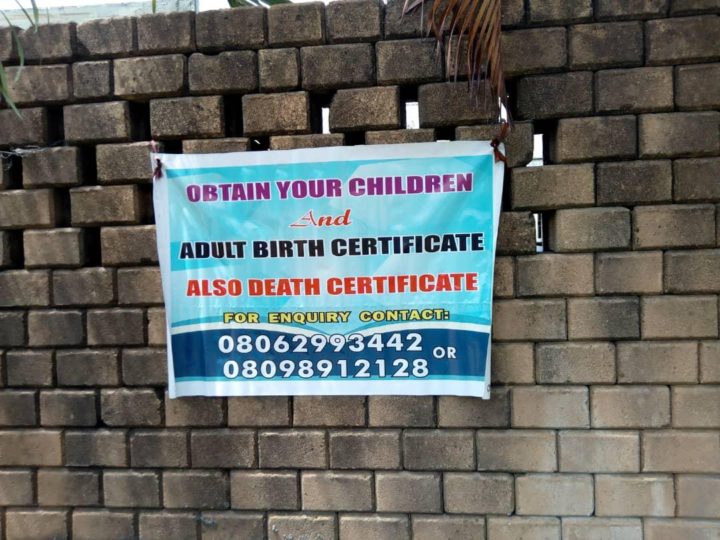
Birth registration advert on the street of Port Harcourt
Absence of birth registration equals zero planning
Chukwuedozie Ajaero, Director of Research and Capacity Building, School of Postgraduate Studies University of Nigeria Nsukka, said the importance of appropriate vital registration, especially birth registration, cannot be overemphasised if proper developmental planning in the country is to be put in place.
“For instance, when the federal government wants to provide healthcare facilities, some areas that do not need such structures are included and it is called under the federal character because there is no data to back up where they are supposed to erect such buildings,” Ajaero said in an interview with The ICIR.
However, the academic said extortion in the birth registration centres contributes only about 20 per cent to the problems of effective birth registration in Nigeria.
“The major problem is ignorance and the misunderstanding of the vital use of birth registration. Most people do not even know about it.
“Most people that get birth certificates do it when it becomes an absolute necessity. While some have very myopic view about it, they believe it is a way the government can keep tabs on them, know what they are doing at a particular time. It is a social-cultural problem.
“If we have the vital registration system working very well, even the census we spend lots of money to carry out will not be necessary.
Ajearo said it was the responsibility of the government to carry out proper advocacy and incorporate awareness for birth registration into the social syllabus to foster the exercise.
THE Federal High Court, sitting in Abuja on Tuesday, has granted an application for judicial review of the decision of the Code of Conduct Bureau (CCB) to decline access to asset declaration forms.
The International Centre for Investigative Reporting (ICIR), a non-profit news agency, had in January written a Freedom of Information (FOI) request to the CCB requesting for the “details of all asset declaration of all cabinet members in the present administration” as well as other key appointed officials.
In its response over two months after, the CCB however declined to provide the documents because the FOI Act “has exempted asset declarations of public officers from documents that can be accessed via reliance on the provisions”.
On February 19, The ICIR filed an ex-parte motion seeking a declaration that the bureau’s decision amounts to wrongful denial and a violation to the applicant’s right of access to information guaranteed by law.
Kingsley Nnajiaka, a legal officer at the Centre for Social Justice, represented the plaintiffs at the sitting on Tuesday.
Inyang Ekwo granted the ex-parte application for review “subject to an application for order of mandamus”. Judicial review is a process through which the court examines actions of other arms of government to determine whether they are in accordance with established laws.
“The process of judicial review is to be filed within fifteen days and the respondent is to be served at least seven days to the next hearing,” the honourable justice added.
The trial was adjourned by the court to Wednesday, June 26, at which time the CCB is expected to make an appearance for its defence.
The National Youth Service Corps (NYSC) has promised to blacklist tertiary institutions that are involved in fraudulent mobilisation of unqualified graduates.
Shuaibu Ibrahim, director-general of the scheme warned tertiary institutions against unscrupulous actions that may truncate the mobilisation process.
He gave the warning while addressing participants at a workshop organised for data entry officers from tertiary institutions as well as deployment and relocation officers from NYSC in Abuja on Monday.
The workshop is done ahead of the forthcoming mobilization of another set of graduates in June.
Ibrahim said unqualified graduates should not be enrolled in the Batch B, next month mobilisation. According to him, any institutions find doing so would be blacklisted while serving as a deterrent to other country’s institutions.
“Corps-producing institutions are warned not to enroll unqualified graduates into the mobilisation process of the scheme. I advise all of you, participants, not to fall into the temptation of unscrupulous elements that may want to truncate the mobilisation process,” he said.
“As leaders, do the right thing. Let us maintain good integrity and check your data correctly.”
NYSC, established in 1973, is a compulsory one-year service for graduates of tertiary institutions in Nigeria.
The corps members are currently earning N18,000. However, the finance minister, Zainab Ahmed has said earlier in May that the allowance would increase since a new minimum wage of N30,000 has been signed into law.
Online registration for the Batch ‘B’ prospective corps members is scheduled to begin on June 1 and end on June 12.
THE Federal government has planned to create about 20 million new jobs within the next four years in four sectors of the economy.
Okechukwu Enelamah, Minister of Industry, Trade and Investment, disclosed this on Monday at a stakeholders’ meeting in Abuja, according to Punch report.
The strategy was focused on job creation in the agriculture, transportation, services and construction sectors of the economy.
Enelamah who was represented at the event by the Permanent Secretary of the ministry, Sunday Akpan said it had become imperative to come up with a pragmatic approach to creating jobs for Nigerian considering the level of unemployment in the country.
He added that the ministry had directed the Industrial Training Fund to come up with innovative solutions to create 20 million jobs in four sectors of the economy within the next four years.
Explaining why the ministry was targeting the four sectors, the minister said agriculture, transportation, services and construction sectors “hold the key to the diversification efforts of the federal government”.
“…With the huge contributions of these sectors to the Gross Domestic Product of the Nigerian economy, it had become imperative to explore their job creation potentials to reduce the level of unemployment in the country,” he said.
“In order to sustain and build on the successes recorded in this regard in the first tenure of President Muhammad Buhari, we are articulating and strategising with a renewed impetus towards combating the twin evils of unemployment and insecurity.
“It is on this basis that the ministry charged the Industrial Training Fund to come up with revolutionary multi-faceted job and wealth creation strategies that would lead to a lasting solution to this hydra-headed problem.
From the ITF report, Enelamah said a pragmatic strategy has been proposed, stating that within the next four years, the government would generate about 20 million jobs from four key sectors of the Nigerian economy.
This is not the first time Buhari’s government would be promising millions of jobs for Nigerians. In 2015, he promised not less than 12 million new jobs.
But the Nigerian unemployment rate has been on the increase despite the promise.
According to the latest labour statistics published by the National Bureau Statistics, the total number of people classified as unemployed increased from 17.6 million in the fourth quarter of 2017 to 20.9 million in the third quarter of 2018. That is, the per cent of unemployed Nigerians increased from 18.8 per cent to 23.1 per cent in just one year under the Buhari’s watch.
SENIOR Special Assistant to the President on Media & Publicity, Garba Shehu on Monday explained why President Muhammadu Buhari rejected over 30 bills submitted to him for assent in the past four years of his administration.
The Presidential aide said the president was always thorough in his approach and thus, would not sign any ‘stupid’ bills into law.
He spoke Live on Monday during a popular television programme, Sunrise Daily, citing the Minimum Wage Bill, later passed into law as an instance.
“Let me say that the president is very methodical in dealing with matters such as this. A president could sit in that powerful office and act like he knows it all and I think in this country, we have had such presidents but President Buhari is different because whenever bills come for signature, he will ask that a long list of stakeholders be drawn up. For example, the minimum wage bill he signed.
“Prior to that, labour groups had been demanding that he sign immediately but he refused and identified all stakeholders, ministers and even the judiciary were made to sign off on it and when this process is on, it takes a lot of time,” says Shehu.
“Sometimes deadlines are issued and re-issued. However, the point is that at the end of it, a thorough job is done so that the president does not sign stupid documents and that is important for this country.”
Buhari is reported to have rejected 34 bills as at April, attributing several reasons for his rejection.
The bills among others include National Research and Innovation Council bill (2007), Stamp Duties (Amendment) Bill, National Institute of Hospitality and Tourism Establishment Bill (2018).
The presidential aide further blamed members of the 8th Assembly for frustrating the president, especially on the delayed 2018 budget.
Asked to react to claims that the 8th Assembly passed 306 bills, considered the highest number of bills approved by a legislative arm of government in Nigeria’s history while Buhari had the record for the highest number of rejected bills, he insisted that whatever action taken by the president on the delayed or rejected bills were for the benefit of the country.
“The delay which was experienced in 2018 in which the National Assembly held unto the budget for seven months is good enough for the Guinness Book of Records and the president lamented this,” he added.
THE Police in Abuja on Monday invited for questioning Chidi Odinkalu, lawyer and human rights activist, in connection with a petition issued by the Kaduna State government over allegations of inciting public disturbance, among other charges.
The invitation was in connection with statements purportedly made by Odinkalu during an interview with a television station early in the year in which he questioned claims made by Kaduna State governor Nasir el Rufai that 66 persons were killed in the Kajuru crisis in the state.
Apparently, the Kaduna State government, through its Attorney General, Umma Hakima, had on April 4 petitioned the Inspector General of Police, IGP, transmitting the order of a Kaduna Magistrate Court to causing an investigation into some charges brought against Odinkalu by the Kaduna State government.
It was learnt that the government had applied, through an exparte application, that the Magistrate Court presided over by Hon Ibrahim Musa, order that the charges brought against the respondent be investigated by the police.
Specifically, the underlying allegation contained in the ex-parte application dated March 28, 2019, is that in a television interview on 16 February, Odinkalu stated:
“I keep coming back to this Kajuru story because we must never allow that story to get away. 66 Nigerians killed; that’s 66 too many. If anybody claims that 66 people were killed in Kajuru this week, including the Governor of Kaduna State, let us go and verify. I’m not willing to allow that story to go away. It is not true.”
According to the application by the state government, reinforced in its petition to the IGP, by making this statement Odinkalu committed the following offences:
“Furnishing false information punishable under s. 104 of the Penal Code, Laws of Kaduna State 2017;
injurious falsehood, punishable under s. 373 of the Penal Code, Laws of Kaduna State 2017;
public nuisance, punishable under s. 150 of the Penal Code, Laws of Kaduna State 2017; and
inciting disturbance, punishable under s. 77 of the Penal Code, Laws of Kaduna State 2017.
Odinkalu, who noted that he arrived at the Federal Criminal Investigation Department, FCID, Abuja around 3.30pm, said he was asked to write a statement based on the allegation and that he denied all of them.
“I was asked to make a statement on the stationery of the Police under caution. I did. My statement essentially affirmed my name, occupation and identity. I also affirmed the words stated above as mine but denied clearly that I had any intention to or was indeed capable of or had committed any of the offences alleged.
“In particular, I did say that in the circumstances of the facts, the conduct of the Governor of Kaduna State appeared to have been designed to preclude the Nigeria Police Force from doing its lawful duties of investigating or verifying his allegations.”
He said he was hearing of the case against him at the Magistrate Court for the first time during the police questioning although the Magistrate, from the document he was shown, made the order since March 22.
Odinkalu has since been let go by the Police although he had to be granted bail on self-recognition and can be invited on the matter again.
PUBLISHER of Premium Times, Dapo Olorunyomi, was the centre of attention as friends, journalists, activists, and political leaders paid tribute to him at the launch of Testimony To Courage, a compilation of essays written in his honour.
The well-attended event took place in Abuja on Monday and was chaired by Kabiru Yusuf, chief executive officer of Daily Trust Newspapers.
Chido Onumah, executive director of the African Centre for Media and Information Literacy, said in his welcome address that very few journalists have impacted journalism in the democratic space in Nigeria the way Olorunyomi has done in the last three decades, adding that he has proven his capacity, tenacity, and ingenuity.
“My team members and I put together this book to celebrate Dapo, to share his experience through the views of his teachers, relations, friends, colleagues, and mentees,” Onumah said.
“We hope current and future generations of journalists and public administrators will gain from the fountain of knowledge and experience that Dapo represents, so aptly captured in the over 90 essays that make up the book. If there is any time courage and integrity are needed in our country, it is now. Our dear nation stands at the crossroads and journalists and the media need to once again rise to the occasion the way Dapo and many in his generation did years ago.”
He added on a lighter note: “I’ve always teased Dapo about the limits of investigative journalism. Work on this project started in November 2017, when Dapo turned 60, and we ensured he wasn’t aware of it until a few weeks ago. I thank my co-conspirators for keeping the book a secret until we felt it was too far gone to be aborted by this self-effacing man.”
In his keynote address, Kayode Fayemi, Ekiti State governor, said Olorunyomi risked his freedom and life to ensure that Nigeria is a democratic state where the liberties of people are not trampled on. “That we still have a country to call ours”, the former minister of solid minerals development stated, “is owed in no small measure to the role played by people like Olorunyomi.”
Fayemi also emphasised that democratic rule will atrophy while periodic elections will become a hollow ritual without the media promoting truth and transparency.
“Most people will argue that intellect is the most important asset the media intellectual brings to the fore in his or her interventions in public life. I agree. However, I will add that as important as the intellect of a media intellectual is in the project in the project of public life and in the pursuit of the public good, equally important if not more important is the civil courage of the media intellectual.
“Few media intellectuals in contemporary Nigeria can claim to rival Dapo Olorunyomi in intellect and civil courage. Dapo, my boss, my teacher, my mentor, my friend, my comrade, thank you for deploying all of these tools both in the service of our fatherland and humanity,” he said.
Chidi Odinkalu, former chairman of the National Human Rights Commission who reviewed the book at the occasion, described it as representing the diversity of Nigeria and her voices owing to the broad range of the contributor’s backgrounds. He said there is a lot of wit, humour, and depth in the published work.
“It is not just a set of testimonials to a really nice guy,” he said. “It is really much more than that. It is phenomenally an important contribution to Nigeria’s political history.
“In a country where those who are least deserving get the largest accolades while some who are deserving get their recognition after death and those of us who are comrades are content to mourn them when they are no more, Testimony to Courage is evidence that the supplication for civic canonisation does not always have to await earthly mortality. Sometimes, a generation must acknowledge its best if only to encourage many more not to give up on virtue.”
Odinkalu advised there should be a second edition of the book to fix certain glitches and also allow other close associates of Olorunyomi, such as Babafemi Ojudu, Musikilu Mojeed and Ifeanyi Uddin, contribute to the collection.
The celebrator, Olorunyomi, thanked the organisers of the event and attributed his successes to his parents, teachers, friends, and colleagues.
He added: “It is impossible on a global scale to have a democracy that is striving and working without a good media. Regardless of how poor journalism is being practised today, the challenge is to make it a better profession; and he’s [Ojudu ]right with all the observations about the poverty of practice today but our challenge is to make it better except we don’t want a democracy.
“If we want a democracy, the two central pillars that underpin this institution will be the media and judiciary; and if these two are not working well, we cannot have a good democracy. If we are stuck with the idea of democracy, let’s know that we all have to collectively build a strong media.
“Our country is a work in progress and journalism has a role to play,” he concluded.
The dignitaries at the launch were Vice President Yemi Osinbajo represented by Babafemi Ojudu, special adviser to the president on political matters; Bola Tinubu represented by Sunday Dare, his chief of staff; Femi Falana, human rights activist and Senior Advocate of Nigeria; Rauf Aregbesola, former Osun State governor; as well as Nuhu Ribadu and Ibrahim Magu, former and acting chairman of the Economic and Financial Crimes Commission.
Others at the event were Chris Anyanwu, publisher and former senator; Ropo Sekoni, Professor of Literature in English; Ajayi Boroffice, senator for Ondo North representing senate leader Ahmed Lawan; Barau Jibrin, senator for Kano North; Bello Mandiya, senator-elect for Katsina South; and Kole Shettima, Director of the MacArthur Foundation’s Africa Office. Representatives of the Canadian High Commissioner and French Embassy in Nigeria also attended.
A CHINESE company, Kwo Chief Investment Limited, has finally shut down its illegal charcoal production at Obimo in Nsukka local government area of Enugu State.
At the time The ICIR conducted investigation into the environmental threats by the Chinese company, the National Environmental Standards and Regulations Enforcement Agency (NESREA) said it was unaware of the charcoal production, and would not act against the company without a petition, despite the fact the company was producing charcoal without obtaining the necessary permits as specified in official policy.
The exposure led to public outcry that forced the NESREA to move against the company. In a press release on May 8, NESREA claimed that the facility had been shut down. The ICIR, however, obtained evidence the following day that the company was still in operation.
Aliyu Jauro, the director general of NESREA, had told The ICIR that the agency actually sealed off the facility in April but he was unaware that the company had continued the charcoal production. He thereafter assured that the agency would send enforcement team again to the charcoal factory.
On getting information about the pending visit by NESREA’s officials, the Chinese deserted the charcoal factory on May 16 and have not returned since then. NESREA’s officials subsequently visited the facility on May 23.
NESREA claimed that the operators of the illegal charcoal production would soon be prosecuted but findings by The ICIR showed that no Chinese has been yet arrested.