Home Blog Page 2370

Talkin’ about a revolution

By Simon KOLAWOLE

I ALWAYS hesitate to use the “R” word because I don’t understand how it really works, but a lot of Nigerians have been talking about “revolution” for a while. They say Nigeria will experience a revolution at a point in time, given the way the society has been going: the rich getting richer, the poor getting poorer; the fat getting fatter, the lean getting leaner. One definition goes like this: “Revolution is a fundamental and relatively sudden change in political power and political organisation which occurs when the population revolts against the government, typically due to perceived oppression — political, social, economic — or political incompetence.”

It sounds interesting but many have also argued that a revolution is not possible in Nigeria because “we the people” are “docile”. Some say Nigerians deserve the kind of leaders they have. They collect cash, rice and vegetable oil at election times to trade their votes and are inevitably bound by the choices they make. It is said that morally, therefore, they cannot rise up against the same leaders they put in office after selling their votes. Nigerians are also sharply divided along ethnic and religious lines, meaning there can never be a consensus to rise up against the government in power because it will be resisted by those who have the incumbency advantage.

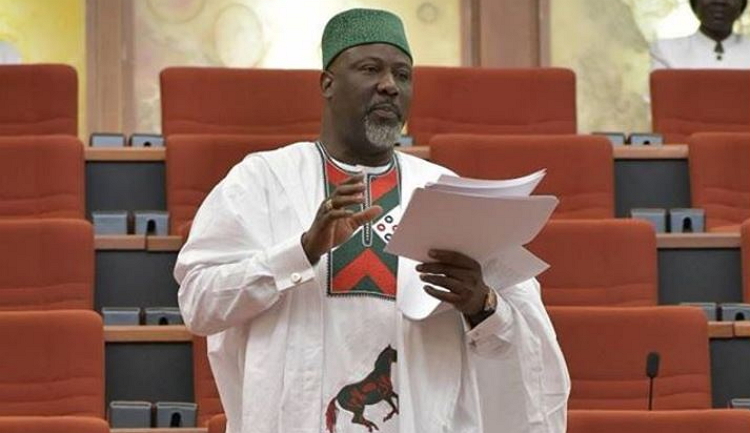
Revolution is too heavy an idea for me to discuss on the pages of newspapers, but Senator Dino Melaye got me thinking with his tweet on Thursday about the “revenge of the poor” and the “perilous times” that lie ahead. He tweeted: “I am afraid of the revenge of the poor, it happened in Russia, France and recently in Sudan. It can happen in Nigeria. Housing segregation put us the elite in jeopardy. Ikoyi, Banana, Maitama, Asokoro etc.  Our leaders + me beware of violent revolution. Perilous times loading.” Coming from a senator who has more fancy cars than the hairs on my head, the warning hit me like a half-hearted satire but I managed to survive it.

In my previous article, “Whatsoever a Man Soweth” (May 12, 2019), I did warn that nobody is safe in Nigeria, including those who think they are covered by a convoy of armed escorts. I also said that the rebellion by the vulnerable elements of the society seems to be in full motion as Nigerians groan under the pandemic of kidnapping, banditry, terrorism, internet fraud and all kinds of criminality. Unfortunately, the security system designed to protect the high and the mighty is failing. It is not just the poor and the lowly that are bearing the brunt, although it is only when the big fish are victims that we make so much fuss over the calamity that has befallen us as a people.

I don’t know if Senator Melaye actually meant what he was saying but I will, all the same, give us a few examples of how our legislators are contributing to the state of the union and how they are making “perilous times” inevitable — except they change their ways. As I will always argue, our leaders should stop thinking that Nigeria is like this because of some mistake or coincidence. No. We are only reaping what we have been sowing. What we failed to plan for yesterday is coming back to bite us today and unless we plan for tomorrow as a matter of urgency, the harvest is going to be bountiful but unpleasant. The ruling elite must chew over this again and again.

The first thing the lawmakers must realise (and I refer to both state and federal legislators because I don’t believe Abuja is the only problem) is that there is a link between their greed — the obscene allowances, extortion-driven oversight activities as well as padded budgets — and the poverty and insecurity in the land. It is a very simple matter. In a country where tens of millions are unemployed and those who have jobs are struggling to survive, each senator is pocketing N13.5 million “running cost” in a month. We still don’t know what members of the house of reps take home every month, neither can we say anything about state legislators. Maybe theirs is even fatter and juicier.

Imagine if the lawmakers — at all levels — are determined to live a decent life and are not obsessed with grabbing every naira in sight. Imagine they are working round the clock to hold the executive accountable for the budgets that are passed every year. Imagine that the lawmakers make sure what is budgeted for roads goes into roads, every kobo earmarked for education goes into education, and every naira allocated to health goes into health. Imagine that those public hearings are actually meant to hold MDAs accountable and expose the rot in the system. Imagine that the Auditor-General’s reports are used by the lawmakers to clean up the system rather than to extort.

Unfortunately, the lawmakers are a big burden on Nigerians. Not so long ago, the Bayelsa state house of assembly passed a bill granting themselves pensions. The speaker would take N500,000 monthly, the deputy N200,000 and the others N100,000. This, we must understand, is different from the severance package, which the rest of us are not privileged to know. We can only guess that it will not be miserly. All of this happening in a state where the majority of the people are struggling to make ends meet. So we run a society where the fat are getting fatter and are not ashamed to keep sewing bigger coats for themselves every day. But Nigerians are watching.

Not to be outdone, Kano state lawmakers have also passed their own law to award life pension to their principal officers. They will also be entitled to foreign medical treatment for life — while the people who voted them into office are not entitled to common paracetamol at the public hospitals. The lawmakers in several states, working as rubber stamps of incumbent governors, passed pension laws that awarded former governors new cars every three to four years, in addition to mansions in the state capitals and Abuja, foreign medical treatment and other sickening benefits. Nigerians are programmed to be exploited by their leaders in and out of office! The inequality is wicked.

The bazaar of budget padding by lawmakers is one of the most evil developments in this democratic dispensation. A former lawmaker once challenged me to define “budget padding” and I was wondering if he was pulling my leg. It so happens that an agency will prepare a budget of N10 billion and the supervisory legislative committee will tell the agency it can double the figure to N20 billion if they can bring a certain amount in cash upfront. Some lawmakers will even insist on nominating contractors for projects smuggled into the budget, and you and I know that the job may not be done at all. How can any society make progress that way? How can?

Melaye is talking about the coming “revolution”. Yes, the behaviours of the power elite are in the public domain. Nigerians are watching. They listen to the news every day and can tell you what the lawmakers are doing with our commonwealth. They are seeing pictures and videos on social media. They are reading the charges filed against politicians in court by the Economic and Financial Crimes Commission (EFCC). They know all these things. Nothing justifies criminality and I will never vote for criminality, but maybe it is time for Nigerian politicians — not just the lawmakers — to see how their greed and lifestyles are hurting Nigeria’s progress and breeding criminals.

You can always argue that we should not use poverty to explain the growing criminality in the land. But we need to step back again and again and ask the question: why are certain crimes becoming attractive to our young people? Many of those being arrested are university graduates and brilliant people whose energies have been deployed for the wrong use because they have nothing gainful to do. I will, therefore, conclude with the same admonition: the time has come for the Nigerian elite to have a “meeting” and agree to change their ways. Things cannot continue like this. They must forsake their greed and redirect our commonwealth from personal comfort to communal progress.

To make my admonition simpler: let our budgets and resources be utilised to build a society that prioritises the welfare of the majority and not the pensions, wardrobe allowances and DTAs of a tiny minority. Governors’ convoys must grow leaner and the presidential jets must reduce in population. Tracy Chapman, the American singer, sang in 1988: “Don’t you know/They’re talkin’ ’bout a revolution/It sounds like a whisper/While they’re standing in the welfare lines/Crying at the doorsteps of those armies of salvation/Wasting time in the unemployment lines/Sitting around waiting for a promotion.” Those who have ears, let them hear.

AND FOUR OTHER THINGS…

CHICKEN CHANGE

Abdulgafar Ayinla, a member-elect of the Kwara state house of assembly, has been arrested by the EFCC over an alleged N26 million property scam. Ayinla, a legal practitioner, allegedly defrauded a US-based client in a property deal. He is accused of collecting the money without delivering service and has allegedly confessed to the crime, promising to refund the N26 million to the petitioner as soon as he is inaugurated and he — wait for this — collects his “wardrobe allowance”! The lawmakers are really feeding fat on the treasury. Of course, he will be sworn in as a lawmaker. That is the way we roll. And we still wonder why Nigeria is like this. Honourable!

LOOT AND LAUGH

If you are a public officer in Bauchi state, I have some news for you: you can now loot and laugh all the way to the bank. The Bauchi state house of assembly has repealed the law on the recovery of looted public funds and properties. The law was passed on the floor of the house with only 13 out of 31 members in attendance. Governor Mohammed Abubakar had signed the law establishing Public Property and Funds Recovery Tribunal in 2017 allegedly to deal with his predecessor, but now that he is about to become a predecessor himself, he does not want to have a dose of his own medicine. And life will continue as usual. And we will keep wondering why Nigeria is like this. Licence.

SMOKING HOT

Is the grass greener on the other side? Rotimi Akeredolu, governor of Ondo state, has joined Omoyele Sowore, former presidential candidate, in stressing the value of marijuana business, which is projected to hit a global value of $145 billion by 2025. “We all know that Ondo State is the hotbed of cannabis cultivation in Nigeria… we would be shortchanging ourselves if we failed to tap into the legal marijuana market,” he said. Of course, there is a difference between medical use of marijuana, which has been identified as a cure for diseases such as epilepsy, and recreational use — which we regard as a vice. Marijuana is gradually becoming a burning issue in Nigeria. Highlight.

MYTH BUSTER

The full meaning of “sir” is “Slave I Remain”, isn’t it? It was a word introduced to Indians during the British colonial rule to make them subservient to their colonisers for life, according to the urban legend. While India was under various forms of British colonial rule from 1612 to 1947, the word “sir” entered the English language in 1297. That means it was in use about four centuries before India was colonised! Indeed, “sir” was a formal English honorific address for titled knights, not slaves, derived from “sire”. It was also used as a respectful address to “senior commoners”. Sir, sire, seigneur and senior all grew up together in the evolution of language. Fact.

Simon Kolawle is the founder and CEO of TheCable. He tweets @simonkolawole.
Hypertension still killing many Nigerians despite govt policy to reduce the number

WHEN Tanko Gwapna, a 46-year-old civil servant, felt continuous dizziness that affected his work, he had to listen to his wife’s advice to visit the hospital. He was earlier treated for Malaria, but the dizziness persisted. Eventually, he had his blood pressure measured and was diagnosed with hypertension.

That was in 2002. Tanko is still managing hypertension, 17 years later.

Hypertension, also known as high or raised blood pressure, affects millions of Nigerians.

Blood pressure is created by the force of blood pushing against the walls of blood vessels (arteries) as it is pumped by the heart.

The higher the pressure the harder the heart has to pump. Blood pressure reading comprises of two values: systolic and diastolic pressure. Any number above 140 over 90 is considered high.

This reporter met Tanko, now 63 years, on Thursday, May 16,  when he came for another routine checkup at the Wuse District Hospital, Abuja. His blood pressure was checked at the Medical Outpatient Department clinic, and measured 179 over 90, a figure that shows a high in the systolic pressure.

His treatment over the years has included a modified diet and a daily intake of anti-hypertension drugs.

“Whenever I get my salary, the first thing I do is to set aside the money for my drugs,” Tanko said to relate the importance of the medications to him. “Every month I set aside between N50 to N80 thousand”

“It is better living with a financial burden than not buying the drug and I die,” he said.

Though he is an National Health Insurance Scheme, NHIS, beneficiary, Tanko said he gets the medications paying out-of-pocket.

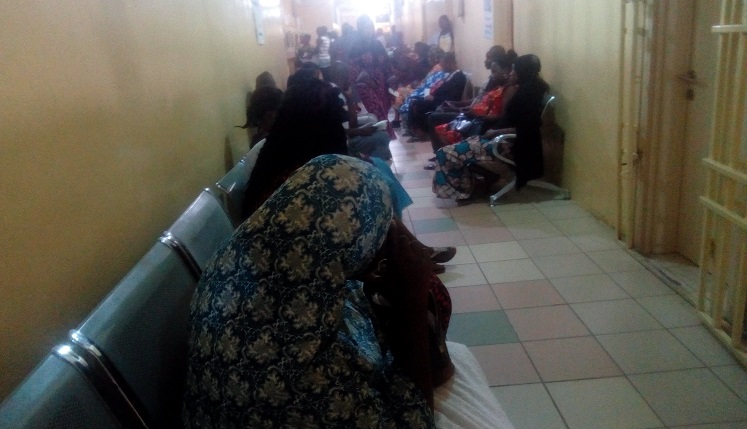
Tanko in white on a queue with other patients at the waiting area of MOPD clinic at Wuse District Hospital, Abuja. Credit: ICIR.

The disease, for Tanko, also came with complications. He had suffered a knee problem earlier between February and March. “You know when a man, as aged as I am, start crying out of pain, you should know that the thing must be very grievous,” Tanko narrated to The ICIR the pain he went through. Though after receiving a series of treatments, he said the condition disappeared.

Studies have shown that hypertension increases the possibility of knee arthritis, a condition that leaves the patients with a throbbing pain on the knees’ joints.

Tanko, who has been advised to be at the clinic on a regular basis, complained of the crowd in the clinic, causing patients to wait for too long.

“On some clinical days, I discover that this place is like a market. There are days I leave the clinic as late as 5:30 pm after arriving very early,” he said, stressing the shortage of doctors compared to the number of patients.

“Even that situation alone is enough to cause hypertension for me”.

The akara seller who suffers hypertension

Just like Tanko, Adamu Lami, a petty trader who sells bean cakes, commonly known as akara in Gwarinpa area of Abuja, also suffers from hypertension.

Lami was diagnosed as hypertensive in 2004 after a visit to the hospital due to a complaint of sleepless nights and persistent headaches.

Since then, Lami has been visiting the hospital on a monthly basis, but sometimes once in three months. As she does not have a personal blood pressure monitoring machine, she checks when she comes to the hospital after making the usual payment of N500 for registration.

At the hospital, she went straight for her blood pressure check. The figure was written in a paper for her, 163 over 103. It was high, the matron in the MOPD clinic told her.

“The madam (matron) advise me now to stop frying akara,” Lami said. “But wetin I go do,” the mother of six children said, agonising about how ending the business would result in financial difficulty.

Adamu Lami at the Medical Outpatient Department of the Wuse District Hospital, Abuja. Credit: ICIR
Adamu Lami, on Thursday, at the Medical Outpatient Department of the Wuse District Hospital, Abuja. Credit: ICIR


Efosa Obamwonyi, a Senior Registrar at the Obafemi Awolowo University Teaching Hospital (OAUTHC) told The ICIR that a very high BP, like Lami’s, was as a result of non-compliance with the drug prescription.

Hypertension is a disease that affects about 1.13 billion people worldwide, according to WHO statistics in 2018. Africa has the highest percentage of cases of hypertension.

According to the data, about 23.9 per cent of Nigeria’s population aged 18 years and above are hypertensive. That means that more than 38 million people have hypertension in country, a ratio of almost one in every four Nigerian.

Need to fight hypertension

Oladipupo Fasan, a consultant cardiologist at the National Hospital, Abuja told The ICIR that hypertension is a disease that one should not neglect.

Hypertension could lead to other diseases like stroke, heart failure, heart attack, eyes problem, knee arthritis and kidney failure, he said.

. “Anybody who is hypertensive can have these complications if not well managed.”

According to him, 80 per cent of Nigerians who develop hypertension may not know the specific cause. “Most of our patients fall into essential hypertension. We (doctors) cannot categorically classify what lead to their hypertension.”

He outlined the risk factors leading to hypertension as high salt consumption, obesity, excessive alcohol consumption, tobacco consumption, sedentary lifestyle with lack of exercise and a family history of hypertension.

For hypertension, there is no specific symptom, “that is why it is a silent killer”, Fasan said. He advised people should always measure their blood pressure regularly.

Hypertension on the rise despite government policy to reduce the number

There is a projection of 25 per cent relative reduction in hypertension prevalence by 2025, according to the targets contained in the national plan.

The national strategic plan of action on prevention and control of non-communicable diseases, including hypertension, was adopted in September 2015 to be achieved by 2025.

In the plan, hypertension was speculated as the commonest heart disease in Nigeria and the following targets were set to achieve a reduction in the modifiable factors that can lead to hypertension.

  • Tobacco: 30 per cent relative reduction in the prevalence of current tobacco use
  • Alcohol: 10 per cent relative reduction in overall alcohol consumption (including hazardous and harmful drinking).
  • Physical inactivity: 10 per cent relative reduction in the prevalence of insufficient physical activity.
  • Dietary salt intake: 30 per cent relative reduction in mean adult (aged ≥18) population intake of salt, with the aim of achieving the recommended level of less than five gram per day.

Four years after, however, there has not been any report on the progress made in realising the strategic plan.

In fact, the level of tobacco consumption has increased over the years not only among adults but in minors too. A report noted that one in four Nigerians aged below 18 has access to tobacco.

According to a research published on Pan African Journal, developing and implementing a strategic plan for physical activity are the best strategies that can help Nigeria move towards a more physically active population and society,

But Nigeria is yet to develop a national plan on physical activity, and this is part of the reason hypertension is on the rise in the country, Fasan said.

“Cases of hypertension is on the increase because we are yet to deal with all the modifiable factors in this country. There are no recreational centres in our communities, hence few Nigerians exercise regularly. And to take a walk sometimes, vehicular movements swarming around would even dissuade you to undertake such exercise,” he said.

Dressing Iran for barbecue

By Owei LAKEMFA

IT was Sunday, May 12, near the port of Fujairah, in the Gulf of Oman, United Arab Emirate (UAE). Four commercial ships were bombed. Two of them, Amjad and Al Marzoqah are tankers owned by Saudi Arabia; the third, A. Michel, a UAE flagged fuel bunker barge; and the fourth, a Norwegian tanker, the Andrea Victory.

The attacks fitted perfectly into the United States (U.S.) Maritime Administration’s alert of Thursday, May 9, which claimed that: “Since early May, there is an increased possibility that Iran and/or its regional proxies could take action against U.S. and partner interests, including oil production infrastructure, after recently threatening to close the Strait of Hormuz. Iran or its proxies could respond by targeting commercial vessels, including oil tankers, or U.S. military vessels in the Red Sea, Bab-el-Mandeb Strait, or the Persian Gulf.”

So what other proof is needed? Who does not know that Iran blew up the ships; is that not logical, or is it not what those preparing Iran for barbecue want the world to believe?

The Emirati minister of state for foreign affairs, Anwar Gargash announced “investigations” but said his country had already made its “own readings and conclusions.” He then made a rallying call that: “The international community (should) assume its responsibilities to prevent any parties trying to undermine the security and safety of maritime traffic.” It was a little veiled invitation for Western powers to carry out an invasion.

A day after the incident, the UAE invited the U.S. to “investigate” the situation. What gave the UAE the impression that it is the U.S. – which has announced its intention to destroy Iran – that is best suited to investigate? By inviting the Americans to investigate, the UAE had excluded the U.S. from any suspicion or complicity. By extension, it has also excluded American allies, because the U.S. is unlikely to indict its allies.

The UAE is not giving Iran the benefit of doubt. It is also not giving an ear to the cries of the Iranian Foreign Ministry that these attacks might be part of the: “plots by ill-wishers to disrupt regional security.”

Within hours of the American military investigation team getting to the UAE port, it made a predictable “initial” assessment, finding Iran guilty. The Americans leaked a report claiming that Iranian or Iranian-backed proxies used explosives to blow a 5-to-10-foot hole in, near or just below the water line of each of the ships.

That same Monday the U.S. was invited to “investigate” the attacks, its secretary of state, Michael Pompeo, flew to Brussels for talks with Germany, France and United Kingdom on how to handle Iran.

Saudi Arabia also has its own conclusions. Its energy minister, Khalid al-Falih said the bombings were part of plans to “undermine the freedom of maritime navigation, and the security of oil supplies to consumers all over the world.”

If we follow the Saudi logic, then which group or country has motives to endanger maritime navigation and oil supplies in the area? Certainly, it is not Iran because its national interests and economic survival are tied to free maritime navigation in its the Persian Gulf, which is an extension of the Gulf of Oman (Indian Ocean). Iran also has no reason to sabotage oil supplies because it derives 80 per cent of its earnings from oil, while 45 per cent of its workforce is in the industry. As such, despite American sanctions, military buildup and threats of invasion, it would amount to committing suicide for Iran to endanger oil supplies in the same waters it uses to sell its own oil.

Besides these, the unprovoked American sanctions against Iran are biting, while the Americans are flying their F-15s, F-35s and B-52 bombers in the Persian Gulf. The Iranians are seeking how to overcome these challenges and defend their country. Hence, it will make no sense for them to attack civilian ships in the UAE, including Saudi tankers and a European vessel. The Iranians are intelligent enough to know that such an act is likely to pitch them militarily against the combined forces of the Gulf Cooperation Council, which includes Saudi Arabia, UAE, Kuwait, Oman and Bahrain.

Again, we can ask, which groups or countries stand to gain in an armed conflict between Iran and the Gulf States? Which countries stand to benefit if the Muslim states attack each other or if their territories become battlegrounds? Which countries have been threatening to attack Iran and will, therefore, be glad if this job is done for them by the Gulf states? Which countries are supplying weapons in the Gulf and would want more sales? Which will be interested in getting their more modern weapons tested in a real war situation?

I suspect that the attacks were carried out to pitch the Gulf states against Iran or present a basis for declaring war against it. This deceptive art of levying war is an ancient one. When Britain decided to colonise Uganda in the 19th Century, it secured the services of a mercenary, retired Major Frederick John Dealtry Lugard to pacify its inhabitants. Lugard sent agents into the majority Muslim areas to kill Christians and blame it on the former, and then sent other agents into Christian areas to kill Muslims in supposed retaliatory attacks. This led to war and after the Ugandans had significantly weakened themselves, Lugard intervened to impose peace and colonialism.

Texas was part of Mexico. The emergent American state invaded Mexico and annexed Texas. Then in 1844, America offered the Mexicans $25 million to buy New Mexico. The offer was rejected, so America under President James Polk decided to engineer a pretence for war. It got General Zachary Taylor to carry out patrols on the uncharted American-Mexico border. This led to a skirmish and America declared war. Through such subterfuge, America extracted 500,000 square miles of land from Mexico.

When America and Britain eyed Iraqi oil in 2003, they manufactured the falsehood that President Sadam Hussein was supporting terrorist groups and that Iraq had weapons of mass destruction, which Prime Minister Tony Blair claimed represented: “a real and present danger to Britain”. On the other hand, American President George Bush lied that Sadam was importing large quantities of uranium from the Niger Republic to build nuclear weapons.

If the West wants war in Iran, it can do so under any pretext, including claiming to fight terrorism, defending democracy, rescuing the Iranian people from dictatorship, defending maritime trade or finding it guilty of bombing the four ships in the UAE port. However, it should think it through; a war against Iran can easily degenerate into a religious war leading to an international conflagration, which may consume a number of nations and send millions to early graves. It is cheaper to allow for peace.


Owei LAKEMFA, a former secretary general of African workers, is a human rights activist, journalist and author.

Nigeria keen to help Gambia replicate TSA policy

THE Office of the Accountant-General of the Federation, OAGF, says it will fully support the visiting Gambian team on its quest to learn operations of the Treasury Single Account (TSA).

A statement by Henshaw Ogubike, the Deputy Director, Press, OAGF, on Friday in Abuja, said Mohammed Usman, the acting Accountant-General of the Federation (AGF), gave the assurance.

Usman gave the assurance when he received the Gambian delegation who were in Nigeria to understudy the workings of the TSA.


READ ALSO:

He assured the team that the OAGF was prepared to share experience with it on TSA on its operates in Nigeria so it could replicate same in Gambia.

He said Nigeria would tap from the Gambians’ success story on Government Integrated Financial Management Information System (GIFMIS).

He also recollected how Gambia had hosted delegations from Nigeria on a study tour of GIFMIS about 15 years ago.

Usman itemised the activities lined up for the team which includes, lectures by subject matter experts, interactive sessions, and meeting with key stakeholders.

He added that the team would also visit Lagos where it was scheduled to meet some of Nigeria’s key players in the e-payments and FINTECH space whom he said were vital to an endeavour like TSA.

Sylva Okolieaboh, the Director, TSA, enjoined the visiting team to pay attention to every little item slated for discussion.

He promised to deliver on the promise of the Minister of Finance, Zainab Ahmed, to supply all their needs in terms of adequate knowledge of TSA so that the dream of a standard TSA in Gambia could be realised.

The team had earlier paid a courtesy call on the Minister of Finance who advised that relevant states that had implemented TSA successfully in Nigeria should either be visited or invited over to Abuja to avail the Gambian team their experiences. This, he said, was to equip them properly to successfully implement it in The Gambia.

The Gambian Team was led by the Permanent Secretary, Ada Gay, and Momodou Bah, the Accountant-General, Ministry of Finance and Economic Affairs.

They both spoke of their expectations of learning a whole lot from Nigeria to enable them break the bottlenecks that may likely impede their progress in the delivery of TSA.

(NAN)

Breach of peace, subversion by aggrieved politicians will not be condoned, DSS warns

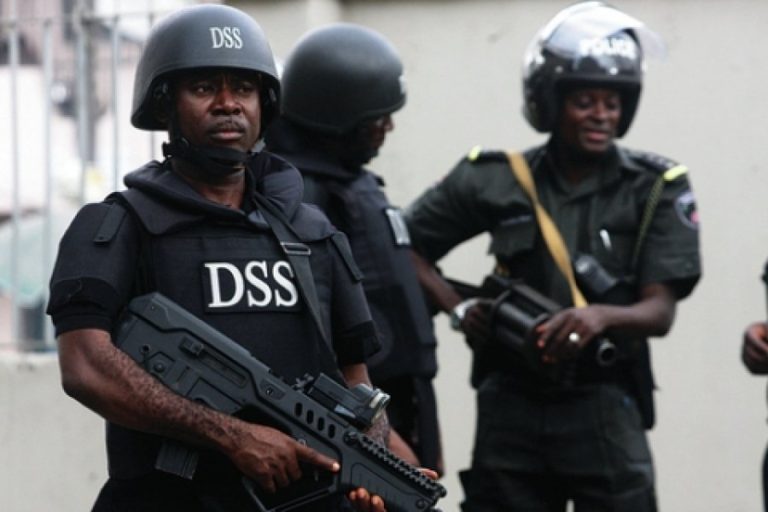
THE Department of State Services (DSS) has warned aggrieved politicians to desist from plans to take laws into their hands or engage in acts capable of breaching the peace.

It also warned that it would not condone any form of extra-judicial activities or methods designed or adopted by persons or groups to subvert constituted authorities.

“Instructively, defaulting persons will surely be brought to book,” DSS spokesman, Peter Afunanya, warned in a statement.

The secret police condemned the recent activities of some unscrupulous elements in the name of Nigeria Continuity and Progress (NCP) which it said: “unpatriotically called for a revolution and forceful change of government in the country”.


READ ALSO:

It said it is aware that the “group is working in tandem with a body of subversive agents and adversaries of the Nigerian state, with an aim to create an atmosphere of insecurity and use same to cause disaffection among the people.

“It is evident that the misguided group and its cohorts have also planned to instigate widespread violence against the government in order to actualise their infamous agenda of forceful change of regime.”

In line with the service’s mandate of ensuring the internal security of Nigeria, the DSS said it would stop at nothing to achieve calm in the nation and would continue to work with other agencies and stakeholders to ensure that every segment of the populace pursues their legitimate aspirations in an environment that is devoid of fear or hindrance.

“The DSS not only supports the consolidation of democracy in Nigeria, but will leave no stone unturned in rooting out persons or groups desirous of truncating the process or undermining the country’s peace and corporate existence,” Afunanya said.

“The service will, therefore, not condone any form of extra-judicial activities or methods designed or adopted by persons or groups to subvert constituted authorities.”

The Defence Headquarters (DHQ) had similarly on Tuesday disassociated the Armed Forces of Nigeria (AFN) from a document calling for the overthrow of the Muhammadu Buhari democratically-elected administration.

Muhammed Wabi, Deputy Director of Defence Information accused  NCP, of being behind the document.

Wabi alleged that the document called for the setting up of an “interim government’’ in place of the elected government.

“The Armed Forces of Nigeria (AFN) wishes to dissociate itself from the rascality and intentions as espoused in a document being circulated by a faceless group named Nigerian Continuity and Progress (NCP) calling for support of a revolution to oust the current democratically elected government and in its place establish an illegitimate interim government.

“The AFN condemns the undemocratic and demonic actions of the author of the document.

“Accordingly, members of the public are enjoined to discountenance the content of the documents being circulated by NCP and equally condemned in totality, the call to derail our hard-earned democracy,’’ the statement said.

Wabi said that the AFN was “very mindful of its constitutional responsibilities’’ and would not be misled into any act that would undermine democracy as enshrined in the 1999 Constitution as amended.

“The AFN remains unflinchingly loyal to the Constitution, as well as President Muhammadu Buhari and Commander-in-Chief of the Armed Forces of the Federal Republic of Nigeria.”

(NAN)

Court strikes out suit seeking to declare Saraki, Dogara’s seat vacant

A SUIT filed by the Legal Defence and Assistance Project (LEDAP), a Civil Society Organisation, seeking the removal of Senate President Bukola Saraki and Speaker Yakubu Dogara from office, has been struck out by the Federal High Court, Abuja.

Justice Okon Abang who presided over the case on Friday ruled that the plaintiffs had no locus standi to file the case in the first place.

LEDAP had approached the court asking it to order Saraki, Dogara, and the other lawmakers who defected from the All Progressives Congress (APC) to other parties in July 2018, to vacate their seats as their defection were not in keeping with the provisions of the constitution.

A total of 37 members of the House of Representatives, including Dogara, had defected from the APC on July 24, 2018. Thirty-two of them joined the PDP, four pitched tents with the African Democratic Congress (ADC) and one refused to announce the party he was joining.

That same day, about 15 Senators also dumped the APC for the PDP.

LEDAP based its suit on the provisions of Section 68 (1) (g) of the 1999 Constitution as amended which provides that a lawmaker would vacate his seat if, “he becomes a member of another political party before the expiration of the period for which that House was elected; provided that his membership of the latter political party is not as a result of a division in the political party of which he was previously a member or of a merger of two or more political parties or factions by one of which he was previously sponsored”.

However, in their response, the defendants asked the court to strike out the suit because LEDAP had no locus standi to file it in the first instance.

In his ruling on Friday, Justice Abang agreed that the plaintiff has no locus standi to file the suit even though it has merit.

Abang held that a Supreme Court ruling had clearly spelt out the conditions upon which a lawmaker could defect to another political party and that the respondents, in this case, did not meet that requirement.

He, however, added that “the plaintiff that instituted this case is not a political party that sponsored the election of the lawmakers”.

“Also, the plaintiff is not the Independent National Electoral Commission(INEC) that regulates the activities of political parties and monitor elections. The plaintiff is not a registered voter in Nigeria. They are not members of the National Assembly. None of the political party that sponsored the lawmakers is a party in this case. They (the plaintiff), therefore, lack the capacity, legal power to institute the case. The plaintiff’s case is incompetent and thereby struck out,” Abang held.

In the case of Godswill Akpabio, who also defected from the PDP to the APC, Justice Abang said Akpabio acted within his right as he was able to prove that his former party, the PDP, had expelled him from the party before his defection.

Facebook bans accounts owned by Israeli firm targeting Nigeria, other African countries

About 265 accounts were shut down by Facebook for ‘coordinated inauthentic’ accounts that originated in Isreali focused on Nigeria, Senegal, Togo, Angola, Niger and Tunisia along with some activity in the Latin America and Southeast Asia.

Nathaniel Gleicher, Head of Cybersecurity Policy for Facebook on Thursday through a statement on the Facebook newsroom revealed the people behind this network used fake accounts to run page, disseminating contents and artificially increasing engagement.

“They also represented themselves as locals, including local news organizations, and published allegedly leaked information about politicians.

“The Page administrators and account owners frequently posted about political news, including topics like elections in various countries, candidate views and criticism of political opponents,” he said

Gleicher said an internal investigation revealed that the individuals behind this network are linked to Isreali Company Archimedes Group.

“The people behind the phantom accounts spent around $812,000 (£634,941) for adverts between December 2012 and April 2019, Facebook said, and these were paid for in Brazilian reais, Israeli shekel and US dollars,” he said.

However, Gleicher said that the organization and all its subsidiaries are now banned from Facebook, and it has been issued a cease and desist letter.

It is yet to be verified if the company is connected to Isreali NSO that is alleged to be the brains behind the spyware that facilitated the killing of Jamal Khashoggi, Washington Post journalist killed in the Saudi consulate in Turkey.


S’Court strikes out River State’s challenge of Onnoghen’s suspension as CJN

THE Supreme Court has struck out the suit filed by the River State Government challenging the suspension of Walter Onnoghen as Chief Justice of Nigeria (CJN).

A five-man panel of justices, headed by Justice Paul Galinje, gave the ruling on Friday in Abuja, saying that the court does not have the jurisdiction to entertain the matter.

However, one member of the panel, Justice Mary Odili, gave a dissenting judgement saying that the application was in order and that Onnoghen’s suspension was against the laid-down procedures.


Read Also:

Onnoghen was suspended from office by President Muhammadu Buhari following allegations of corruption and false assets declaration. Buhari also swore in Tanko Mohammed to serve as Acting CJN.

Onnoghen would later tender his resignation to President Buhari.

Consequently, the Rivers State Government filed an application before the Supreme Court asking it to assume original jurisdiction on the matter in accordance with the provisions of section 232 (1) of the constitution.

The section reads: “The Supreme Court shall, to the exclusion of any other court, have original jurisdiction in any dispute between the Federation and a State or between States if and in so far as that dispute involves any question (whether of law or fact) on which the existence or extent of a legal right depends.”

However, the federal government, through the Solicitor General of the Federation, Dayo Apata, argued that the Supreme Court could only assume original jurisdiction where the matter in contention was between a state and the federal government. It argued that the case of Onnoghen’s suspension was not between the federal government and the Rivers State government hence the Supreme Court cannot assume jurisdiction on it.

Delivering the lead judgement on Friday, Justice Galinje agreed Apata’s submission that it lacked jurisdiction to entertain the matter since it was not originally between the federal government and the Rivers State government.

Galinje then ruled that the panel would not go into the merit of the substantive application, which is to determine whether Onnoghen’s suspension followed due process or not.

In her minority ruling, however, Justice Mary Odili pointed out that section 232(1) of the constitution also empowers the Supreme Court to assume original jurisdiction where the dispute involves any question on which the extent of a legal right depends.

She, therefore, held that the court had jurisdiction in the matter and decided to entertain the original application.

Odili, who is the wife of former Rivers State Governor, Peter Odilli, went on to uphold the application of the Rivers State Government, ruling that Onnoghen’s suspension by President Buhari was in violation of relevant provisions of the 1999 constitution as amended.

Why we demolished Abuja night club… FCT Minister

THE FCT minister, Mohammad Bello, said Caramelo night club was demolished because the property was being used for purposes other than that for which it was originally approved.

The minister said this during a press conference after Thursday’s Federal Executive Council (FEC) meeting chaired by Vice President Yemi Osinbanjo.

According to him, acquiring a land or property either by lease, hire or sale, especially in Abuja, is governed by rules and regulation.

“You do not lease or even sublease out a property meant for a hospital to be converted into a night club, without getting a right approval. Even if you get land, the purpose is very clear.  Any transaction you do on land, whether it is a lease, hire, or sale, is governed by rules and regulation.”

He said, that the decision reached on the demolition of the night club was a last resort and that by demolishing the building, the property now belongs to the government.

Caramelo Suites after Monday’s demolition.

“You can check the COO (Certificate of Occupancy) for the regulation if there are flagrant abuses, and all effort to correct that abuse is not done, it reverses back to the government,” Mohammed said.

The minister said that contrary to what the general public might want to believe, his administration is not usually in a haste to demolish the property and that demolition is usually the last resort.

“For every demolition made, may be a hundred was saved,” he said, adding, however, that people should always follow the rules in all that they do especially with regards to landed property in the Federal Capital Territory.

A few weeks back, officials of the FCT Administration conducted a raid at Caramelo night club and arrested about 100 ladies who were accused of prostitution. The development prompted wide condemnation from gender-advocacy groups and human rights activists, especially as no male offender was arrested in the raid.

The facility was demolished in the morning of Monday, May 13, and witnesses said the FCTA officials that carried out the demolition did not allow workers in the nightclub to evacuate any property, thus, equipment, furniture and drinks belonging to the club all perished.

Court asks ex-NNPC GMD, Yakubu to open defence in money laundering case

JUSTICE Ahmed Mohammed of the Federal High Court, Abuja, has struck out the no-case submission filed by Andrew Yakubu, former Group Managing Director of the Nigerian National Petroleum Corporation (NNPC) in the corruption charges filed against him by the Economic and Financial Crimes Commission (EFCC).

Tony Orilade, the spokesman of the EFCC, said Yakubu was ordered to open his defence as the trial judge ruled that the prosecution had established a prima facie case against him.

Recall how in February 2017, the EFCC, acting on information by a whistleblower, conducted a search on a building in Kaduna allegedly owned by Yakubu and recovered about $9.8 million and £74,000 in cash. The monies were kept in a fire-proof cabinet and the building was an ordinary-looking bungalow which nobody would ever suspect housed such a huge amount of money.

Yakubu would later explain that the monies were gifts by persons he refused to name.

The monies were confiscated and the EFCC filed a lawsuit asking the court to order the forfeiture of the money to the federal government. Yakubu was also charged with money laundering and fraud.

He was briefly remanded in Kuje Prison in the Federal Capital Territory but was later granted bail in the sum of N300 million. The court also granted an order forfeiting the $9.8 million and £74,000 to the government.

The EFCC closed its case against Yakubu in October 2018 after calling seven witnesses and presenting documents that were admitted in evidence. But the defence counsel filed a no-case submission saying that the prosecution had not established any criminal case against the accused person.

However, in his ruling on Thursday, Justice Mohammed said he agreed with the defence that some of the charges against the defendant had not been established by the prosecution, but added that there were cases to answer on the other counts.

“I agree with the defence counsel that the prosecution has failed to prove the essential element of transportation of money on counts five and six,” Mohammed said.

“Even though I am tempted to discharge the defendant on counts one to four, I am however constrained to ask the defendant to explain how he came about the monies recovered from his house.

“Fortified with my position, the defendant is hereby ordered to enter his defence in respect of counts one to four.”

The charges bothered on Yakubu’s failure to fully disclose the monies in his Assets Declaration form, as well as receiving a cash payment of the said sums without going through a financial institution, an offence under the Money Laundering (Prohibition) Act 2011.

The matter was thereafter adjourned to July 3, for Yakubu to open his defence.