Home Blog Page 2483

Boko Haram will continue killing soldiers

0

By ‘Fisayo Soyombo

… [how can] a soldier come up and say ‘I’m not well equipped’ yet you have a rifle; what do you want? You want APC, you want tanks? The basic weapon of an infantry man is rifle, so why should there be mutiny? Why? The basic weapon of an infantry man is rifle, so why should there be mutiny? — Alex Badeh, Chief of Army Staff (January 2014 – July 2015).

It initially started out as 44. Then 100, then ‘more than 100’. And now 118. There is even a chance it could, when all is said and done, end up more than 200. In the end, the truth is somewhere in between. In an attack that ranks among the deadliest this year, Boko Haram downed scores of soldiers in Metele, Borno State, on November 18.

With the benefit of hindsight, we now know the insurgents lurked around for the Army to dispatch a team to retrieve its killed or injured men. When that rescue, treatment and evacuation team arrived in Metele, the insurgents struck again. Among the victims of that first raid are five officers, including a Lieutenant-Colonel; and from the second raid, the fallen include the Major who led the rescue team.

The latest attack is a continuation of Boko Haram’s newfound confidence to take the battle to military zones in recent months, often yielding high casualty tolls. The past few days have been truly difficult for the political neutrals. The social media has been awash with mourning and gnashing of teeth, not only by the opposition, as the government and the Army are wont to always believe, but by those genuinely concerned about the failure of two governments running to pocket Boko Haram. This grand-scale attack has happened despite repeated government assurances of “decimating” and “technically defeating” the insurgents. So, the question goes: why, and three years after electing a Major-General as President, can Boko Haram so easily overrun hundreds of soldiers in one fell swoop?

As I have previously written, the Army is indeed waging a war against Boko Haram — not with weapons but with propaganda. In its trademark downplaying of its own casualties and exaggerating the insurgents’, the Army attempted to sweep the Metele attack under the carpet. And despite its protestations over the so-called “well-doctored” reports by the media, the Army has, after eight days, refrained from making definitive remarks about the attack, particularly the casualty on its side. A war that thrives on misleading the public, ostensibly including the President and Commander-in-Chief, is doomed to fail.

So is a war steeped in hypocrisy. Two soldiers who survived the Metele attack, and are set to desert the Army, released a now-viral video of the post-attack ruins. Laden with anger, frustration and despair, it is a video that should humble every true Nigerian patriot. It is a video that President Muhammadu Buhari — if his advisers have any idea what they’re doing — should have seen and self-analysed by now. But the shocking response of the Army has been to brand members of the public as “detractors or tacit supporters of the enemies of our beloved country” and to threaten them with court suits. This type of sickening hypocrisy should not be judged just on its face value but on its implications for decision-taking in the highest recesses of the Army. It is the same type of hypocrisy that caused Alex Badeh, as Chief of Army Staff in January 2015, to say soldiers cannot say they’re not well-equipped when they have a rifle, only for him to claim, at his pull-out ceremony six months later, that he was “head of a military that lacked the relevant equipment and motivation to fight an enemy that was invisible and embedded with the local populace”. Badeh had already rendered himself an accomplice to the damage that had been done. Unfortunately, this same strategy of misleading the government and the people has been adopted by the current Army hierarchy. Boko Haram can only be the beneficiary.

Everyone knows the most important move that must be made to whittle down Boko Haram’s powers. The foot soldiers know; the senior officers do. Even the insurgents themselves know. I found out in June 2016. During an undercover trip to the North-East in June of that year, I was in a hospital where a soldier receiving treatment for a gunshot injury was recalling events on the battlefield to his colleagues. He was one of 15 soldiers who ran into 18 insurgents in Kala Balge, the easternmost local government area of Borno, very close to Cameroon, on April 30, 2016. While the insurgents came in six motorcycles and carried a mortar Rocket-Propelled Grenade (RPG) and a General-Purpose Machine Gun (GPMG), the soldiers had only their trucks and their 1949-made Kalashnikov (AK-47) rifles. Still, it was the insurgents who took to their heels while the soldiers chased on with their trucks. One by one, the soldiers killed the insurgents until only two were left. Then they ran out of ammo. Tables suddenly turned, and the hunter became the hunted.

“When our ammo finished, we were looking at them and they were looking at us,” the soldier recalled. “We were about boarding the truck when three of us were fired at the same time with a GPMG.” In all, six of the soldiers were shot. I remember that soldier was filled with optimism about how Buhari’s coming would strengthen the weaponry of the Army. If that soldier is still alive — he promised to return to the field once his leg healed up — he must feel let down the coming of Buhari hasn’t altered the balance of weapons between soldiers and insurgents.

Much as it hurts to say, Boko Haram will continue killing soldiers. I have met quite a number of Nigerian soldiers involved in the counter-insurgency operations, and my conviction is that they are some of the bravest soldiers available anywhere in the world. However, if we’re stuck with fighting Boko Haram with weapons that are older than Nigeria itself (the AK-47 was made 11 years before Nigeria’s Independence), then our soldiers have no chance. No serious military should still be parading the T-12 in this age. This was a tank made between 1925 and 1931, and they are prone to mechanical failures; the soldiers in that video weren’t lying. As they said, Buhari must “interfere” in this matter. This is beyond intervening, the President, as the C-in-C should ‘interfere’ with the operations of the Military same way he does with the petroleum industry. At the very least, it’s time to establish the correlation between the Army’s armoury and the funds recently invested in this war. Until such a time when that gap is closed, expect high casualties on the Army’s side, from time to time.

Soyombo, former Editor of the TheCable and the International Centre for Investigative Reporting (ICIR), tweets @fisayosoyombo

Activists ask FG to cancel controversial oil deal with Shell and Eni over corruption

0

INTERNATIONAL and local activists are asking the Federal Government to cancel the 2011 resolution agreement that yielded ownership of the controversial oil block OPL 245 to Shell and Eni after evidence emerged that the oil giants undercut Nigeria to a record of $6 billion in projected revenue over the lucrative oil block.

Earlier report by The ICIR detailed how Shell and Eni cut out a deal that removed terms requiring them to pay royalty and profit oil on OPL 245.

Shell and Eni paid $1.1 billion in 2011 to secure ownership of the oil block after a protracted dispute over the rightful ownership among the Federal Government, Shell and Malabu Oil and Gas limited.

Activists say that the international oil companies made the payment not just to secure rights to the oil block but also to cut an unfair deal that will result in Nigeria losing $5.86 billion in revenue projected on an oil price of $70 per barrel.

A new report on the analysis of OPL 245 presented in Lagos on Monday indicates that Shell and Eni connived with government officials to alter terms of the agreement which drastically reduce the potential government revenue from the oil block.

“Some people actually signed off on the deal knowing full well that Nigeria was being scammed,” said Olarewaju Suraj, chair of Human and Environmental Development Agenda (HEDA).

Suraj said the officials of the oil companies knew that the payment of $1.1 billion for the oil block would be misappropriated but they did so with the aim of securing favourable terms that would rake in billions in profits for the oil companies.

“We can’t allow Nigeria to be treated like a banana republic where multinationals will conspire with locals to deprive the country of its entitlements,” Suraj said.

Barnaby Pace from the Global Witness said “Shell and Eni executives set the deal up so that Nigeria would earn an estimated $6 billion less than it could have. This scandalous deal must be cancelled.”

Antonio Tricarico of Re: Common also called for the cancellation of the oil deal. He said, “The Italian government is discouraging migrants trying to reach Italy by claiming that it will help them at home, but Italy’s biggest multinational, partly owned by the state, is accused of depriving the Nigerian people of billions. The OPL 245 scandal appears to show that Italian officials are not helping the poorest, but profiting from them.”

Nick Hildyard of The Corner House added that “Shell and Eni represented their OPL 245 contract as a production sharing agreement yet it includes no sharing of production for Nigeria. This shocking poor deal must be cancelled.

The new analysis of the controversial oil block was carried out by Resources for Development Consulting for Global Witness and NGOs HEDA, RE: Common and The Corner House.

While the campaigners are calling for the outright cancellation of the OPL 245 deal with Shell and Eni, the Minister of State for Petroleum Resources, Ibe Kachikwu, had advised President Muhammadu Buhari to accept the terms of the agreement which have been established to be disadvantageous to Nigeria.

Shell and Eni are currently facing bribery charges over the OPL 245 in a landmark trial that began in September in Italy.

Buhari disagrees with Oshiomhole, says aggrieved APC members can sue

PRESIDENT Muhammadu Buhari has disagreed with a directive by the All Progressives Congress (APC) National Working Committee (NWC), headed by Adams Oshiomhole, that members that had filed lawsuits against the party must withdraw the suits or be prepared to face sanctions.

Buhari, on Monday, said the directive was not acceptable to him, adding that anybody who feels he has been treated unjustly by the party has the right to seek redress in court.

The directive from the APC NWC had read in part:

“The Party intends to activate constitutional provisions to penalise such members as their action is capable of undermining the Party and hurt the Party’s interest.


READ ALSO:

“We hereby strongly advise such members to withdraw all court cases, while approaching the appropriate party organs with a view to resolving any outstanding disputes. In addition to this, aggrieved members are urged to take full advantage of the reconciliation committees the Party has put in place.

“APC members should understand that as a progressive party that operates on the principle of change, it is not a matter of choice to keep to the rules.”

But, Buhari thinks otherwise. For him, “we can’t deliberately deny people of their rights”.

“We agreed that party primaries should be conducted either through direct, indirect or consensus methods, and if anyone feels unjustly treated in the process, such a person can go to court.

“The court should always be the last resort for the dissatisfied. For the party to outlaw the court process is not acceptable to me.”

The President, however, advised aggrieved APC members to work with the reconciliation committees and not a purported presidential committee on reconciliation, as only the party authorities have the authority to constitute such committees.

FG, ASUU in talks to suspend strike

0

THE Academic Staff Union of Universities (ASUU) is expected to resume talks with the Federal Government at a closed-door meeting Monday over the ongoing strike action in public universities, the Union has said.

After last week’s meeting by ASUU and the federal government in which no conclusive decisions were reached, the two parties will meet on Monday (today) at the Federal Ministry of Education in Abuja.

In a phone interview with the ICIR, Abiodun Ogunyemi the president of the union reiterated ASUU’s position which he explained has remained constant.

“Our position has remained unchanged. We are calling on the federal government to honour the agreement they signed with us in 2017. There is no shifting of grounds today.  When they fulfil their own part of the bargain then we will go back to work,” he said.

“It’s high time we hold the government accountable for their actions and also be conscious of doing our duty for the growth of the country. I think this step we are taking is in the right direction for the benefit of our universities. It’s not uncommon to hear people say we are tired of this ASUU strike actions, but we see it as our community service, we are the barometer of the society to bring the corrupt in public offices to respect their agreements,” he said.

The Union embarked on strike three weeks ago over issues and demands by the lecturers which include better funding of Nigerian universities, non – implementation of previous agreements, non-payment of earned academic allowances, salary shortfalls and pension matters

Abiodun stated that the Federal Government’s insincerity in honouring agreements with lecturers is responsible for the backward state of Nigerian public universities.

” When public office holders fail to respect a gentleman’s agreement with lecturers about their welfare, will you expect them to give their best in class? Nigerian universities cannot globally compete with their peers when it comes to infrastructure and the quality of education received in our institutions but our politicians are able to send their wards to schools abroad neglecting the state of education in the home front. So how do you expect our universities to be able to compete globally?” he queried.

The Nigerian Labour Congress (NLC) and the National Association of Nigerian Students (NANS), on November 19 embarked on a solidarity protest to demand increased funding for education.

A total of N605 billion was allocated to the education sector this year which is higher in naira terms than the N550 billion allocated in 2017, but it represents only 7 per cent of the total budget.

This allocation falls short of the Global Partnership for Education (GPE) framework to which Nigeria is a signatory. GPE has prescribed education budget benchmark of 15 to 20 per cent of the  national spending. The government’s failure to increase spending on education and other welfare issues have led to an industrial action by the Union,  that has forced Nigerian universities to shut down since November 5.

2019 Elections: INEC promises disabled persons of full participation in electoral process

0

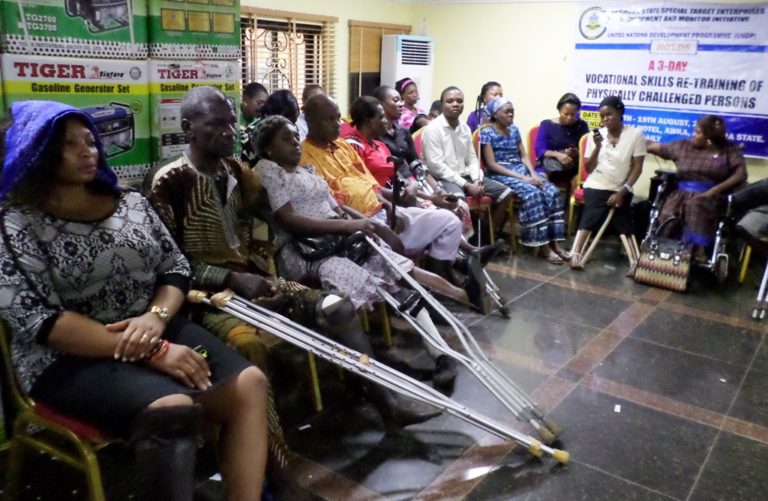
The Independent National Electoral Commission (INEC) has pledged to enhance greater participation of persons living with disabilities in the 2019 general elections.

Adekunle Ogunmola, the INEC’s national commissioner in charge of outreach and partnership committee made the pledge on Monday in Lokoja at the opening of a two-day strategic meeting on access and participation of persons with disabilities in 2019 general elections.

He said that the commission was desirous of deepening the democratic process in Nigeria.

He said part of the strategies was to ensure the participation of the marginalised and the disadvantaged groups across the country.

Mr Ogunmola, who was represented by the Resident Electoral Commissioner in Kogi, James Akpam said that the INEC had introduced some innovations to reduce all forms of barriers experienced by people living with disabilities in all aspects of electoral process.

“It has also provided ‘assistive’ and materials such as magnifying glasses at the polling units during elections, transcriptions of voter education materials to Braille and others to ensure their full and effective participation in the electoral process,” he said.

Mr Ogunmola explained that more interventions were needed as the 2019 general elections drew near, hence the strategic meeting on improving electoral access for persons with disabilities.

According to him, the strategic meeting is to facilitate discussions and sharing of information on existing and new plans towards better outcomes for people living with disabilities.“It is expected that the strategies developed at this meeting will enrich and complement efforts of the commission in improving the Electoral process,” he said.

In her remarks, the INEC Deputy Director in charge of civil Organisation, Mrs Dorothy Bello said that the meeting was organised to examine the role people living with disabilities in the forthcoming elections.

Simon Fanto, the Project Manager of the International Foundation for Electoral System ( IFES) , said that the organisation decided to partner with the INEC to organise the meeting as part of its global objective of enduring inclusiveness in electoral process.

Ekaete Umoh, the National President of the Joint National Association of Persons Living with Disabilities ( JONAPWD) commended the INEC for the measures taken so far to ensure full participation of her members in electoral process but stressed the need for more action.

Participants at the meeting include members of the Joint National Association of Persons Living with Disabilities, organisations of persons living with disabilities and persons with disabilities desk officers of the commission.

(NAN)


More than a third of women worldwide experience physical or sexual violence , says UN

0

MORE than a third of women worldwide have experienced either physical or sexual violence at some point in their lives, according to a joint UN statement issued today to mark the International Day of Elimination of Violence against Women.

The Executive Director of the UN Women, Phumzile Mlambo-Ngcuka, said  the day should serve as one to create awareness to the importance of listening to and believing survivors in order to end the culture of silence and to put the survivors at the centre of the response.

“The focus must change from questioning the credibility of the victim to pursuing the accountability of the perpetrator,” Mlambo-Ngcuka.

This year’s theme for the event is “Orange the World: #HearMeToo”, and it aims to honour and further amplify the voices of women across the world, whether a housewife at home, a schoolgirl abused by her teacher, an office secretary, or a sportswoman, as well as bringing them together across locations and sectors in a global movement of solidarity.

She said that though there is no comprehensive data to show the true extent of violence against women, as the fear of reprisals, impact of not being believed, and the stigma borne by the survivor—not the perpetrator—have silenced the voices of millions of survivors of violence and masked the true extent of women’s continued horrific experiences.

Furthermore, research indicates that the cost of violence against women could amount annually to around two per cent of global gross domestic product (GDP), this is equivalent to  1.5 trillion dollars.

Mlambo-Ngcuka highlighted movements both local and international movement that in recent time have acted as platforms of awareness and solidarity for women in general.

“In the recent past, grassroots activists and survivors, as well as global movements such as #MeToo, #TimesUp, #BalanceTonPorc, #NiUnaMenos, #HollaBack! and #TotalShutdown has converted isolation into a global sisterhood. They are making offenders accountable, exposing the prevalence of violence from high office to the factory floor. Today’s global movements are setting collective demands for accountability and action and calling for the end of impunity, to ensure the human rights of all women and girls,” she said.

In addition, Mlambo-Ngcuka, said that the focus must change from questioning the credibility of the victim to pursuing the accountability of the perpetrator.

“Those who have spoken out have helped us understand better just how much sexual harassment has been normalized and even justified as an inevitable part of a woman’s life.  Its ubiquity, including within the United Nations system, has helped it seem a minor, everyday inconvenience that can be ignored or tolerated, with only the really horrific events being worthy of the difficulty of reporting. This is a vicious cycle that has to stop.”

She said that laws must recognize that sexual harassment is a form of discrimination against women and a human rights violation, both expressing and re-generating inequality, that occurs in many.

Rescue efforts ongoing as victims remain trapped in collapsed building in Port Harcourt

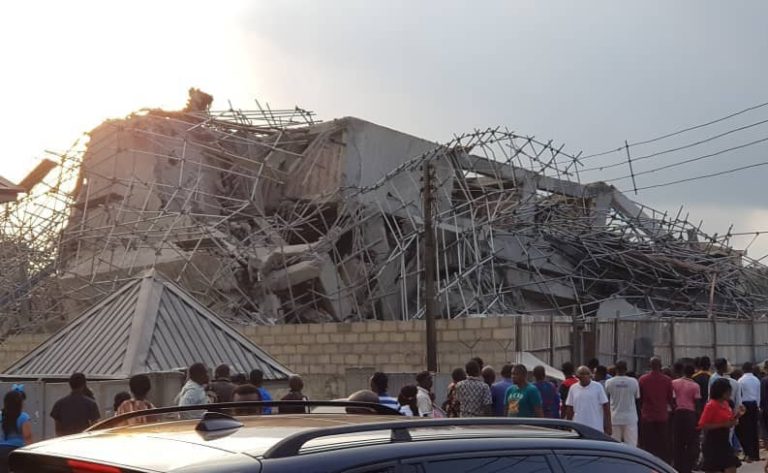
RESCUE efforts are currently ongoing as emergency workers look for victims believed to be trapped in a seven-storey building that collapsed in Port Harcourt, the Rivers State capital, late Friday.

At the last count, about 38 persons have been pulled from the rubbles alive, while six have been confirmed dead, but a yet-to-be-ascertained number of people are said to still be trapped in the building according to witnesses.

The collapsed building is located at Woji Road in the Government Reserved Area of the city, and several construction workers were at the site when the building gave way.

One of the victims who is believed to still be trapped in the rubble is a businessman, whose name was given simply as Ekene. The ICIR understands that he had supplied building materials to the construction site and had gone to collect his payment. He had been in the building for only a few minutes before the collapse occurred.

Meanwhile, the Governor of Rivers State, Nyesom Wike, has ordered the arrest of the contractor in charge of the collapsed building, as well as the owner and the official that approved it. He said this when he led a delegation of government officials to the site of the collapse.

“Whoever that approved this structure and those involved in the construction will face the law.  The government will take every necessary step to ensure that culprits are brought to justice,” Wike said.

“Whoever is involved, from the owner or the contractor or the officials of the state, they will face the full weight of the law.

“I feel so pained that we have to face this kind of calamity at this time. I commiserate with the families that have lost their loved ones who came to seek their daily bread. Government will do all it can to give them the necessary support.

“I have directed the Attorney-General of Rivers State to ensure that all legal steps are taken to do what is right within the ambit of the law.”

Wike pointed out that according to the master plan of the city, a seven-storey building is not allowed at that location, adding that the Rivers State government would take over the property.

ICIR-supported radio programme against human trafficking commences

By Rosemary Olufemi

THE effects of human trafficking pose a huge threat to Nigeria as the number of persons being trafficked for one purpose or another continues to rise across many states and regions of the country.

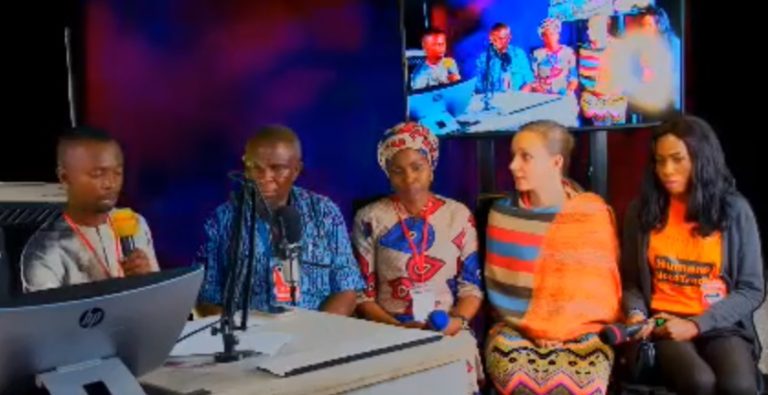
This was the position of Joseph Osuigwe, Executive Director of Devatop Centre for Africa Development, a non-governmental organization dedicated to combating human trafficking and female genital mutilation in Nigeria, during the first episode of a radio programme tagged ‘TALKAM’,( a pidgin English expression that means ‘Say it’).

The TALKAM radio program which airs every Friday by 10 am on Human Rights Radio 101.1 FM, Abuja, is aimed at creating awareness on the rising incidences of human trafficking, as well as exploring ways of tackling it.

The radio programme is a collaboration between Devatop and Human Rights Radio, with support from the International Centre for Investigative Reporting (ICIR) and the Institute for War and Peace Reporting (IWPR).

According to Osigwe, many Nigerians assume that human trafficking only happens in states like Edo or Delta, and only involves ladies travelling to Italy and other European countries to be engaged as commercial sex workers.

“Human trafficking is bigger than what we think, closer to us than we imagine, and happens in every state. In fact, what people think of human trafficking is just a tip of an iceberg compared to what is the actual fact” Osigwe said.

Watch the first episode of the TALKAM radio programme below.

Also speaking during the programme, Cynthia Ifeanyi, the Administrative Officer with DEVATOP, said the aim of the radio programme is to educate listeners that human trafficking can happen anywhere in Nigeria and can affect any family. It is also to enlighten listeners on the myth and truth about human trafficking in Nigeria, as well as stimulate the general public to speak out and take action against human trafficking.

Ms. Ifeanyi clarified that contrary to the general belief that only poor people living in rural areas fall victim to human traffickers, even the relatively rich and well-to-do persons can be trafficked.

Also, men and boys can fall victim of human trafficking, as well as the female gender, and human trafficking does not only occur when people are taken outside Nigeria. It can occur within the country, from rural to urban areas.

Other guest speakers at the radio program were Arinze Orakwue, the spokesperson of the National Agency for the Prohibition of Trafficking in Persons (NAPTIP) and Sanusi Imagbon, Executive Director, Women Trafficking and Child Labour Eradication Foundation (WOTCLEF).

Leaked emails, new analysis – How Shell, Eni deprived Nigeria of $6 billion in oil revenue

0

NEW findings suggest that Nigeria will lose $6 billion in revenue to international oil companies, Shell and Eni, over the deal on the controversial oil block, widely known as Oil Prospecting License (OPL) 245.

Leaked emails and confidential documents also showed that the oil giants might have used unethical means to secure the deal as they altered earlier terms on the oil block with the intention of depriving Nigeria billions of dollars of future revenue while raking in huge profits.

The latest revelations on one of Nigeria’s most potentially lucrative oil concessions is contained in a report from Global Witness called Take the Future. The report draws on an analysis from leading experts at Resources for Development Consulting commissioned by Global Witness and NGOs HEDA, RE:Common and The Corner House.

Two weeks before the deal was signed in 2011, Andrew Obaje, then Director of Department of Petroleum Resources advised the Federal Government not to accept the deal because it was bad.

Obaje’s advice was in response to Mohammed Adoke, the then Minister of Justice and Attorney General of Federation who sought his comment on the resolution agreement on the disputed oil block.

Obaje concluded in the letter that “the resolution agreement as proposed is highly prejudicial to the interests of the Federal Government, more so when there is considerable leverage on the part of the FGN irrespective of the outcome of the arbitration. Government should therefore re-evaluate the proposal with a view to securing for the FGN a more advantageous outcome from any resolution of the matter.”

Rather than follow Obaje’s recommendation, the Federal Government went ahead to approve the deal that stripped it of earlier favourable terms. The deal excluded Shell and Eni from paying royalty and Profit Oil on the OPL 245 which were part of the fiscal terms that were contained in the earlier contractual agreement with the oil companies in 2003 and 2005.

Assuming that oil price remains at $70 per barrel, Nigeria losses $5.86 billion projected revenue over the lifetime of the oil block when compared to earlier terms that had applied before the 2011 deal.

Barnaby Pace from Global Witness said “Shell and Eni execs set the deal up so that Nigeria would earn some $6bn less than it could have. This scandalous deal must be cancelled.”

Reacting to the analysis by Global Witness, Eni and Shell denied any wrongdoing.  Erika Mandraffino, Eni’s Senior Vice President, Global Media Relations and Crisis Communication, questioned the methodology of the analysis.

“We note that Global Witness draws conclusions on the appropriateness of Eni’s and its partner’s transaction and on the legitimacy of Eni’s conduct by referring to analyses carried out by unnamed partners whose competence or expertise is not substantiated in your letter,” Mandraffino  wrote

“We can understand that your organization, which is not engaged in business activities in the oil and gas sector, may not be best placed to assess the input, methodology and overall quality of such analyses and come to incorrect conclusions. In this respect, let us just note that the technical and contractual assumptions adopted as basis for the analysis appear to be partial and inaccurate, if not misleading.”

The assessment of the impact of different fiscal terms for government revenues from OPL 245 was carried out by Resources for Development Consulting whose responsibility is to assist resource-rich countries in securing a fair share of mining, oil, and gas revenues by analysing fiscal regimes, preparing revenue forecasts, assessing vulnerability to tax avoidance, and supporting cost monitoring and auditing.

To do the analysis, Resources for Development Consulting pointed out that it used discounted cash flow modelling which  is an industry-standard methodology used for valuation by oil companies and for revenue forecasting by governments.

“The field data contained in this analysis comes predominantly from the companies themselves: Shell and Eni. The basic field data comes from a 2006 Valuation document prepared by Shell in support of arbitration proceedings. This data has been updated based on information from subsequent Shell reports and information published by Eni in 2011 as well as public domain sources from analogous blocks in neighbouring countries.” the consulting firm wrote in its report.

It is inexplicable how Mohammed Adoke, then Attorney General of the Federation led the Federal Government to agree to the deal that altered the terms of the agreement in favour of the oil companies against the position of Department of Petroleum Resources.

In response to the analysis’ findings, Adoke stressing that the deal was concluded following consultations with relevant ministries, adding that no attempt was made to prevent civil servants from voicing their concerns.

He said the issues were resolved following inter-ministerial discussions. He said that the production sharing agreement between Shell and Eni was not within his remit.

The OPL 245, which covers nearly 2,000 square kilometres in the southern edge of the Niger Delta in water depths of more than 1,200 meters, was first allocated in 1998. The then Minister of Petroleum, Dan Etete allocated the oil block to Malabu Oil and Gas Limited, an indigenous company owned by him.

In 2001, Malabu offered Shell 40 per cent stake in the oil block. However, Malabu’s licence was later revoked by the Federal Government. The Nigeria National Petroleum Corporation (NNPC) later offered the block for bid which Shell won.

The NNPC In 2003 signed a production sharing contract (PSC) with Shell on the oil block. But Malabu went to court to restore its ownership of the oil block.  Malabu’s right to the oil block was restored in 2006 by the court.

Then Shell disagreed on the restoration of the oil block to Malabu and in 2007 instituted proceedings against the Federal Government at the International Centre for Settlement of Investment Disputes, seeking full restitution of its rights as set out in the 2003 production sharing agreement.

In 2011, a deal was reached for Shell and Eni to pay $1.1 billion to the Federal Government and Malabu to have full ownership of the oil block, a deal that has been trailed with bribery scandal.

Shell and Eni are currently facing bribery charges over the OPL 245 deal in a landmark trial in Italy, the first time a company as large as Shell or such senior executives of a major oil company have ever stood trial for bribery offences.

Eni’s current CEO Claudio Descalzi, and former Royal Dutch Shell Executive Director for Upstream, Malcolm Brinded CBE are facing charges of bribery and corruption over the oil block in the trial that began in Milan in September.

According to Global Witness, the case brought by the Milan Public Prosecutor alleges that $520 million from the deal was converted into cash and intended to be paid to then former President Goodluck Jonathan and other Nigerian government officials. The prosecutors further allege that money was also channelled to Eni and Shell executives, with $50 million in cash delivered to the home of Eni’s then head of African Operations Roberto Casula.

Two middlemen in the OPL 245 deal have already been sentenced to four years imprisonment, as well as confiscations of over €100 million by the Italian court. The offenders, Emeka Obi (Nigerian) and Gianluca Di Nardo (Italian) were found guilty of corrupt offences over the oil block.


SCORECARD: Buhari lists Dangote’s donation, Dasuki’s detention as achievements

0

PRESIDENT Muhammadu Buhari, through his media organisation, has listed a number of odd events, including a donation from Aliko Dangote and the unlawful detention of Sambo Dasuki, as part of his administration’s achievements during its first term.

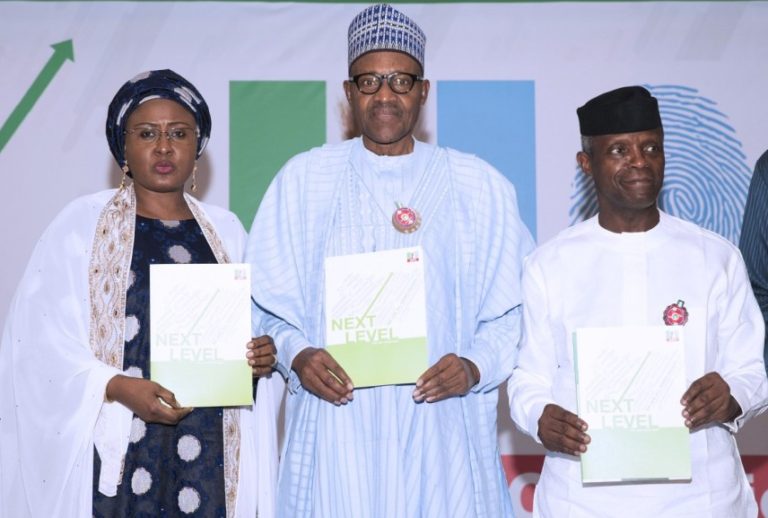
On Sunday, November 18, while presenting the All Progressive Congress’s campaign roadmap and report of stewardship themed ‘Next Level’, President Buhari said a foundation has been laid over the last three and a half years “for a strong, stable and prosperous country for the majority of our people”.

Evidence of this foundation was condensed into section one of a document that was released on the same day. Festus Keyamo, the official spokesperson of the campaign organisation, writes in the preamble that the manual “is devoid of too much complex data”, directing readers who may wish to further interrogate its content to a website: www.buharisachievements.com.

On this website, there is an abridged party manifesto and a list of achievements, ongoing and completed projects dealing with the economy, anti-corruption, and security. It also has a category for achievements “compiled by credible media and independent groups”, but wholly attributed to the Buhari Media Organisation. Some of the highlighted achievements, The ICIR has observed, are vague, misattributed, or clear violations of the rule of law.

Inaugurated vehicles donated by Dangote

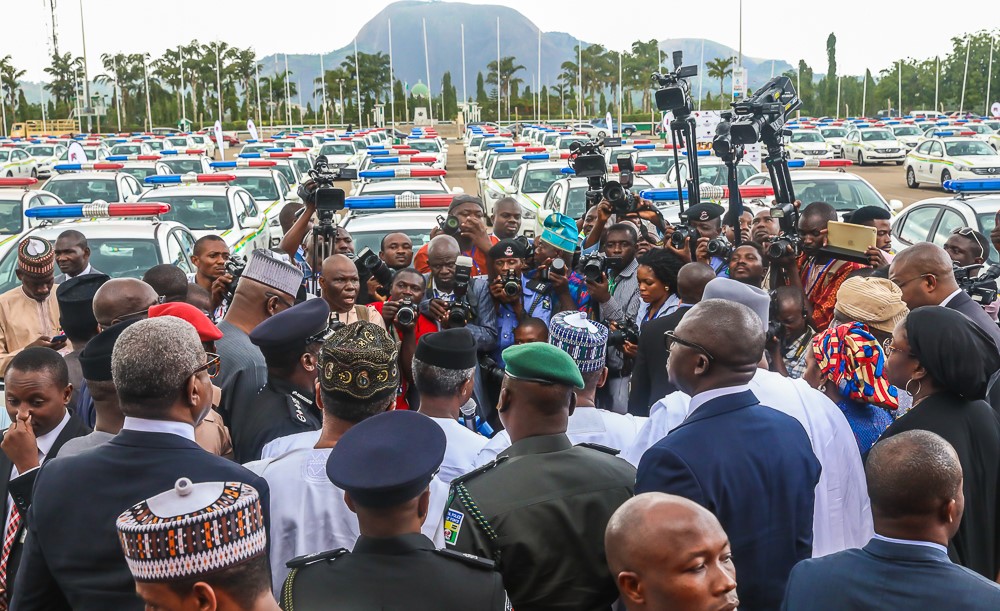
One of the very odd achievements highlighted by the Buhari Media Organisation, BMO, is listed close to the end of list on security. “The Buhari administration inaugurated 150 patrol vehicles donated to the Nigeria Police Force by the Aliko Dangote Foundation,” it is stated.

File photo: Dangote donates patrol vehicles to Nigeria Police

The donation, which took place in May, was recognised as the single largest by any private individual, and Dangote, at the ceremony, had said he might donate another batch in the future. It is difficult to see how the foundation’s gesture could be considered a noteworthy achievement on the part of the federal government, or any achievement at all. There are no reports indicating that the government made any active moves soliciting the contribution.

“The donation of 150 cars to the Nigerian Police Force is laudable and we thank Aliko Dangote Foundation for this rare gesture; that is characteristic of the person of Aliko Dangote. He has shown over the years to be an entrepreneur with a difference, a man that gives willingly to the poor,” Vice President Yemi Osinbajo had remarked at the ceremony.

Strangely, two bullet points after this item is another “achievement” that mentions Aliko Dangote: “The Buhari Administration ensured the arrest of two trucks belonging to Dangote Group loaded with foreign rice in the total of 365 bags of 50kg size by the Sokoto/Kebbi/Zamfara Area Command of Nigeria Customs Service.”

Dasuki’s 31 months in detention

The website dedicated to Buhari’s achievement, tagged “doing more with less… gradually killing corruption”, also glorifies the unlawful, continued detention of Sambo Dasuki, former National Security Adviser, alleged to have diverted $2.1 billion arms fund.

“A former National Security Adviser, Colonel Sambo Dasuki,” it states, “has spent 31 months in detention over an allegation of mismanagement of $2.1bn meant for the purchase of arms. Most of the other corruption cases involving top shots had their root in the Dasuki gate as it is now known.”

Dasuki has been granted bail by different courts on at least five occasions but still has not been granted freedom by the federal government. In 2015, he was granted bail by a Federal High Court in Abuja, only to be immediately rearrested at the gates of Kuje prison.

In October 2016, the ECOWAS Court also ordered the federal government to pay a compensation of N15 million to Dasuki for his “unlawful arrest”. Again, in January 2017, an Abuja High Court reaffirmed the validity of bail granted to the former NSA and five others.

In May, after pleading not guilty to all the charges, he was granted yet another bail by Justice Hussein Baba-Yusuf of an Abuja High Court.

Re-election of Oby Nwankwo to CEDAW

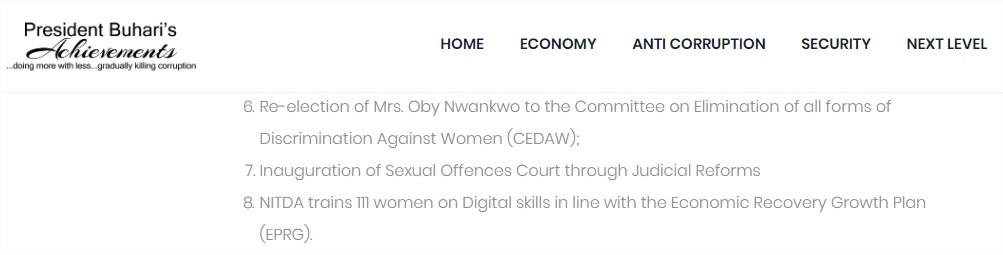
As part of the eight listed achievements of the administration on matters relating to women, the BMO includes the “re-election of Mrs. Oby Nwankwo to the Committee on Elimination of all forms of Discrimination Against Women (CEDAW).”

This logically implies that the government of Nigeria influenced or lobbied for the late Nwankwo’s second electoral success — which is neither desirable nor evidenced in media reports — rather than allowing her to be elected strictly based on her own merits.

Obiageli Theodora Nwankwo was one of Africa’s distinguished women’s rights icons before she passed away on December 9, 2017. She was elected as a member of the United Nations Convention on the Elimination of All Forms of Discrimination Against Women (CEDAW) Expert Committee in January 2013, and was re-elected to serve another four years in 2016.

A total of 104 experts have served as members of the committee since 1982, and these experts were originally nominees who had received the highest number of votes of the representatives of state parties. The election is conducted using the secret ballot system.

While the federal government is eager to share in Nwankwo’s successes, a good number of her campaigns for legal reform have so far hit the wall. These include her campaign for the domestication of CEDAW and the African Union Protocol on The Rights of Women in the country, as well as the passage of the Gender and Equal Opportunity Bill, which has been alleged to be at loggerheads with local customs.

Inauguration of Sexual Offences Court

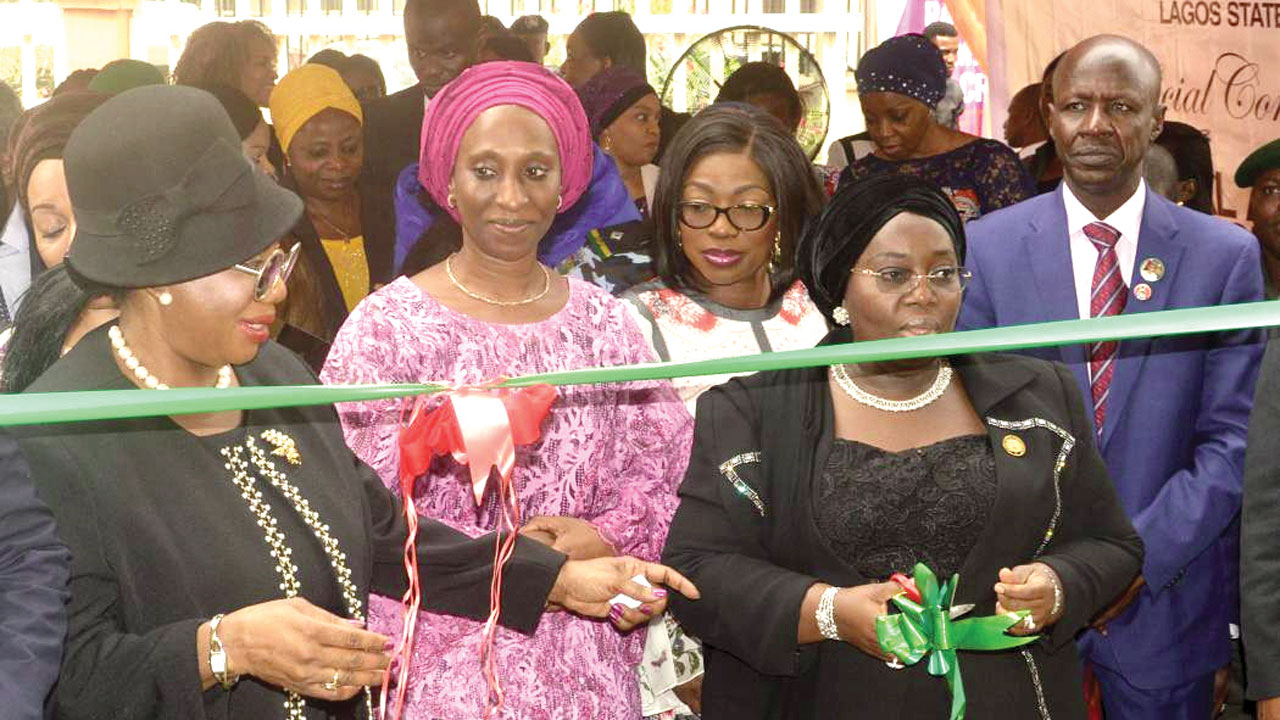
Also among the few achievements listed under women affairs category is what the BMO says is the  “inauguration of Sexual Offences Court through judicial reforms”. This achievement, it would appear, belongs more appropriately to the Lagos State Government.

Chief Judge of Lagos State, Justice Opeyemi Oko (left); the Wife of Vice President, Mrs Oludolapo Osinbajo; Deputy Governor of Lagos State, Dr Idiat Adebule and the acting chairman of the Economic and Financial Crimes Commission (EFCC), Mr. Ibrahim Magu at the launching of Special and Sexual Court Offences in Lagos. Photo credit: Guardian Nigeria

In February, the state government inaugurated four special courts, two tasked with the adjudication of economic and financial crimes and two with the trial of sexual offences — the latter acclaimed to be the first of their kind in Nigeria.

What the federal government may lay some claim to is the recommendation given in 2017 by Walter Onnoghen, the Chief Justice of Nigeria, that special courts should be created for the speedy dispensation of corruption cases.

Onnoghen, in a press statement released in May, had, in fact, passed the buck for the creation of these courts to the executive and legislative arms.  “It is the Executive that has the prerogative in conjunction with the legislature to set up courts, including the Special Courts, under our Constitution,” he said.

“It is not the duty of the Judiciary nor that of the Chief Justice of Nigeria. If the executive and the legislature, who have the powers, decide to establish a special Court or any other Court for that matter, the Judiciary will run it by providing the manpower.”

Other odd achievements noticed on the website include that, under President Buhari, “Chairman of the Christian Association of Nigeria (CAN) Borno State Chapter declared the 2017 Easter Celebrations as the best and safest since 2009”.

The BMO also lists under achievements on education that the “Nigerian university system added eight new universities (two state-owned, six private)” under the administration.

“Quite striking also in 2017 is that JAMB processed within a month, admission into the Nigerian higher education system of 1.7 million candidates compared to 1.6 million in 2016,” states another point.