THE federal government illegally diverted $1.05 billion (N378 billion at N360 to a dollar) sourced from the Nigerian Liquefied Natural Gas (NLNG) dividend funds to secretly fund subsidy payment on petroleum products.
The diversion details are coming amidst revelations from accusations the Nigerian National Petroleum Corporation (NNPC) has a $3.5 billion subsidy fund it is spending without appropriation by the National Assembly.
In October, a motion by Biodun Olujimi, (Ekiti-PDP) had triggered debates in the National Assembly on the purported $3.5 billion fund alleged to be managed by the state oil company.
But the NNPC said it had no such fund in its custody. Rather, it said it has a $1.05 billion fund it is using to stabilise petrol supply and distribution in the country.
While the NNPC, through its spokesperson, Ndu Ughamadu, initially claimed the corporation sourced the fund from an ‘international agency’, Maikanti Baru, NNPC group managing director, admitted last week that the money was sourced from the NLNG dividend fund.
Documents in the possession of this newspaper have now shown that the fund was sourced at the height of the fuel scarcity crisis between last December and January and was secretly diverted into payments on petrol supply and distribution.
The funds came from dividends paid to the federal government by the Nigeria Liquefied Natural Gas (NLNG) company, a firm in which the government owns 49 per cent equity.
The Nigerian government is represented in the NLNG shareholding arrangement by the NNPC with 49 per cent stake. Other shareholders are Shell (25.6 per cent), Total (15 per cent) and Eni (10.4 per cent).
Dividends from the gas firm are meant to be shared by the federal, state and local governments of Nigeria. The funds are supposed to be paid into the Consolidated Revenue Fund of the Federation rather than spent unilaterally by any tier of government.
But PREMIUM TIMES has now confirmed that the President Muhammadu Buhari-led federal government unilaterally — without required consultation with states and the national assembly– tampered with the NLNG funds. That was also done without the mandatory appropriation by the National Assembly.
Lawmakers say by his action, President Buhari has violated the nation’s appropriation law, and has therefore committed impeachable offences.
NLNG Plant
Denial
The administration has for years paid huge amounts as fuel subsidy (despite increasing the pump price of fuel), while denying making such payments. Federal lawmakers said the payments were surreptitiously and illegally done and have demanded an investigation.
The lawmakers say spending on fuel subsidy or related spending without the approval of the National Assembly is extra-budgetary and illegal.
Besides, the lawmakers said they were worried about the transparency of the arrangement, as only the group managing director of The NNPC, Maikanti Baru, and the corporation’s chief financial officer in charge of Finance & Accounts, Isiaka Abdulrazaq, were managing the secret funds without appropriation.
But the NNPC said through Mr Ughamadu that what was in existence was a $1.05 billion “revolving fund”, which was adopted by the NNPC as a strategy to comply with the directive by the National Assembly to find all ways possible to resolve the fuel supply crisis in the country late last year.
File photo: NNPC Group Managing Director, Maikanti Baru
He claimed the fund, dubbed the National Fuel Support Fund, is jointly managed by the NNPC, the Central Bank of Nigeria, the Federal Ministry of Finance, the Petroleum Products Pricing Regulatory Agency, the Office of the Accountant General of the Federation, the Department of Petroleum Resources and the Petroleum Equalization Fund.
On the source of funds, Mr Ughamadu claimed the agencies jointly sourced the money from an unnamed “international agency”.
But contrary to his claims, documents seen by this newspaper confirmed Mr Baru’s position that the source of the fund was the NLNG dividend account controlled by the corporation.
The flush fund
In a memo dated January 19, addressed to Mr Buhari, the NNPC GMD, Mr Baru, raised concerns over the depletion in the nation’s strategic fuel reserve.
This, he said, was occasioned by massive diversion and hoarding which manifested in the fuel crisis of last year.
To arrest the situation, he said there was a need to access the NLNG dividend fund to purchase the required petrol volume to flush supply and boost strategic reserve.
Mr Baru also complained about the daily consumption of petrol, put at 35 million litres per day at the time, which was becoming problematic for the NNPC to manage after oil marketing companies stopped importing the products.
He told the president petrol consumption had exponentially gone up to 47 million litres per day — even though the actual national consumption was estimated at 35 million litres.
“At the current depletion rate, there is the possibility that the available PMS stock that hovers between 18 to 15 days sufficiency will be depleted by the second week of February 2018 to dangerously low levels if no flush funds are secured,” the memo read. “This may adversely impact the current situation and could lead to social unrest.”
NNPC GMD’s letter to Buhari, apprising him on the measures taken to bridge the gap in PMS sufficiency — NLNG dividends.NNPC GMD’s letter to Buhari, apprising him on the measures taken to bridge the gap in PMS sufficiency — NLNG dividends.NNPC GMD’s letter to Buhari, apprising him on the measures taken to bridge the gap in PMS sufficiency — NLNG dividends.
The memo also advised Mr Buhari on the need to fix the Jebba-Mokwa road to ease distribution of petroleum products, engage the State Security Service in the monitoring of depots selling above NNPC approved prices, among other concerns.
The GMD addressed concerns raised by the president in a previous communication by explaining that by the status of NNPC’s balance sheet and its free cash position, the corporation would not be able to use its funds to import petrol.
He also explained how the government’s financing obligations limited the ability of the corporation to supply 13 cargoes of petrol, being what was needed for national consumption in the absence of private marketers.
He suggested also that the NNPC be allowed access to foreign exchange at the appropriate rate corresponding to the supply of petrol that will ensure stability in price.
The letter concluded by advising the president that NNPC did not have the cash flow to finance petrol importation that would meet immediate requirement of flush volumes and strategic reserve replenishment. Mr Baru advised the injection of 42 cargoes of petrol between January and April to flush supply.
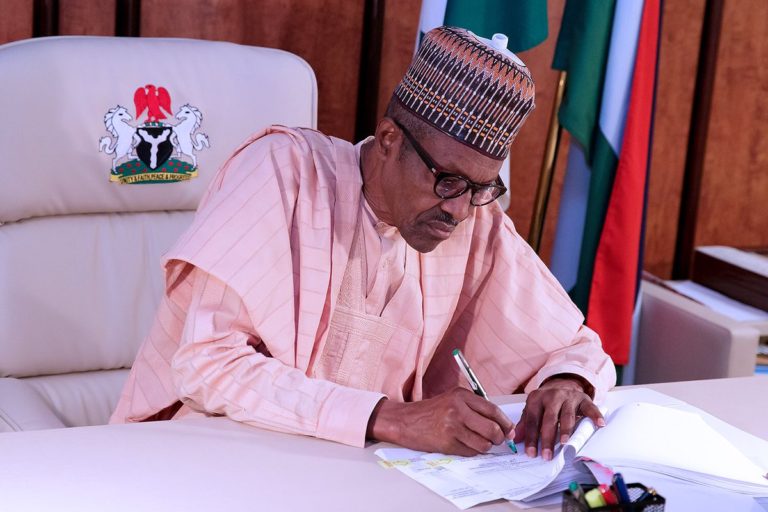
“There is dire need to arrest the erosion of PMS sufficiency with the injection of flush volumes immediately,” Mr Baru said in the memo. “In view of the foregoing, Your Excellency may kindly reconsider and approve our request to utilize $1.05 billion to finance the 42 PMS cargoes as contained in our letter to you dated 8th January, on the subject matter.”
In a separate memo, also dated January 19, the NNPC intimated the president on what it had done to deal with the fuel challenge while also advising the president to quickly approve its request for a flush fund.
Details of Mr Baru’s memos to the president were regurgitated when the NNPC chief appeared before an ad hoc committee of the Senate on the alleged application of $3.5 billion dollars by the NNPC last week.
Speaking at the hearing, Mr Baru claimed that the NNPC’s action to source funds to address PMS supply concerns was triggered by the directive of the Senate at the height of the fuel scarcity crisis that the corporation must do all it could to address the scarcity problems. He added that it was also because there has been no provision for subsidy in the budget since 2016.
Letter to Buhari on provision of flush volumes and the need to replenish onshore fuel reserve.Letter to Buhari on provision of flush volumes and the need to replenish onshore fuel reserve.Letter to Buhari on provision of flush volumes and the need to replenish onshore fuel reserve.Letter to Buhari on provision of flush volumes and the need to replenish onshore fuel reserve.Letter to Buhari on provision of flush volumes and the need to replenish onshore fuel reserve.Letter to Buhari on provision of flush volumes and the need to replenish onshore fuel reserve.Letter to Buhari on provision of flush volumes and the need to replenish onshore fuel reserve.
“This necessitated actions from government and of course in line with the federal government directive which of course was equally endorsed by this distinguished national assembly when during the hearing on the 24th of January 2018 on the fuel crisis, the joint committees of the national assembly directed us and I quote: ‘NNPC should do all it takes to flush the queue and restore normalcy and maintain the minimum of 30 days sufficiency’,” Mr Baru said in his submission. “For us to do that, we took certain actions, Mr Chairman.”
Kabiru Marafa, the Chairman Senate Committee on Petroleum Resources (Downstream), told PREMIUM TIMES the National Assembly indeed gave the NNPC a written marching order to end the last fuel scarcity.
The senator said although the state oil company indicated it was setting up a revolving fund to deal with the problem, the corporation did not indicate how it planned to source the fund.
Senator Kabiru Marafa
Another highly placed source in the National Assembly confirmed to PREMIUM TIMES Sunday that lawmakers never authorised the NNPC to embark on illegal remedial activities devoid of appropriation.
The source, who declined to be named because he was not authorised to speak on the matter, said the National Assembly was looking into the arrangement because it was not aware of its existence.
Again, it is now clear state governments were not intimated of the transaction. The NLNG shares belong to the Nigerian federation and the three tiers should share in the dividends.
The Chairman of the Nigeria Governors’ Forum (NGF), Abdulaziz Yari, said his Forum became aware of the utilisation of the fund after the fact.
“We are now trying to reconcile the balance sheet with the NNPC,” Mr Yari, who is also Zamfara governor, told PREMIUM TIMES. “We want to determine what has happened to the $1.05billion revolving fund and the situation with the entire NLNG dividend fund.”
Mr Baru in his submission at the Senate hearing said the $1.05 billion is being administered by a steering committee which is the central approving body and a working committee that is looking at the daily operations of the fund.
“This committees are comprised of the representatives of the office of the minister of finance, office of the minister of state for petroleum resources, the office of the Accountant General of the Federation, the Central Bank of Nigeria, the Petroleum Products Pricing Regulatory Agency, the Petroleum Equalization Funds management board, the Directorate of Petroleum Resources and the Nigerian National Petroleum Corporation,” he said.
“So the fund that we exercise from the Nigerian NLNG fund is being administered, transferred with laid down processes and governance and every cargo that is imported under this programme has gone through a proper checking process through which the most competitive supplier is selected.”
But a January 31 memo seen by this newspaper indicated the fund was being unilaterally controlled by the NNPC rather than by any steering committee.
Memo requesting GMD’s approval for delegating authority to process invoices on flush volume cargoes – NLNG dividends.
In the memo, Mele Kyari, the NNPC group general manager in charge of crude oil marketing department, was seen advising the GMD on huge fund transaction and seeking approval to process invoices on flush volume cargoes.
President Muhammadu Buhari and his Chief of Staff, Abba Kyari.
For long, the government has refused to come clean over the payment as the arrangement, considered illegal and unappropriated, has been shrouded in secrecy.
Last December, Vice President Yemi Osinbajo raised concerns among stakeholders when he said the NNPC and not the Federal government was paying for oil subsidy.
With this revelation, it is now clear the NNPC received the NLNG dividend fund and has continued to use it for fuel supply, as confirmed by Messrs Baru and Ughamadu.
Presidential spokesperson, Garba Shehu, did not answer multiple telephone calls and text message seeking his comment for his story. Mr Ughamadu too did not respond to messages sent to him.
NIGERIA’S election season has begun. With the main opposition formally picking its flag-bearer, we now know the presidential race will effectively be a straight contest between incumbent Muhammadu Buhari of the ruling All Progressives Congress (APC) and challenger Atiku Abubakar of the People’s Democratic Party (PDP).
Dozens of other candidates will be competing. These include: Oby Ezekwesili, the former minister and founder of the Bring Back Our Girls movement; Professor Kingsley Moghalu, the former deputy governor of the Central Bank of Nigeria; and Omoyele Sowore, the owner of the media outlet Sahara Reporters. But when it comes down to it, the presidential race will be a two-horse race.
This will not be the first time Buhari, 75, and Atiku, 71, have faced one another. Both men contested the 2007 presidential elections, coming a distant second and third behind the PDP’s Umaru Yar’Adua. In 2014, the two met again in the APC primaries, with Buhari emerging victorious.
These races offer little guidance, however, for how the 2019 presidential election between these two gladiators of Nigerian politics might play out.
THE ISSUES
Corruption
In 2015, Buhari drew heavily on his reputation as incorruptible as he vowed to root out corruption. In 2019, he will undoubtedly reiterate this promise and has some things to boast about. His government claims to have recovered N1 trillion in stolen assets. It has made giant strides in implementing the Treasury Single Account (TSA) to reduce leakages. And it has overseen the conviction of two former governors.
Many, however, see President Buhari’s war on corruption as disappointing. In particular, critics accuse the government of only targeting political opponents, while allowing its cronies to go scot free.
In this campaign, though, the ruling APC has a clear advantage on this issue. The PDP is remembered for plundering the state during its previous sixteen years in power. Meanwhile, its candidate, the former vice-president from 1999 to 2007, is one of the country’s richest politicians and has faced several allegations of fraud. In some circles, Atiku’s very name is synonymous with high-level graft.
Many of the fiercest accusations against the former VP have come from former president Olusegun Obasanjo. After the two fell out dramatically in 2006, Obasanjo repeatedly insisted that his former deputy was corrupt and unfit for office. That was at least until last week when Obasanjo changed track. It remains to be seen if this reconciliation will alleviate the cloud of corruption hanging over Atiku’s head.
Economy
Buhari’s main challenge in office has been the struggling economy, which plunged into recession in 2016. It has since recovered, but growth remains slow. Before Buhari took office in 2015, one US dollar bought between N199 and N220. It recently stabilised at around N360, having soared to an all-time high of N450.
Given this context, Atiku’s campaign will promise to revitalise the economy. While criticising his opponent’s record, he will emphasise his own sound knowledge of the sector. Atiku has business interests across Nigeria and claims to have provided 50,000 direct jobs and 250,000indirect jobs. He will also likely talk up the fact that he oversaw the privatisation efforts under Obasanjo, though the APC may respond by claiming Atiku fraudulently enriched himself through this same process. Abubakar Atiku is seen to be high powered with networks across the six geopolitical zone of Nigeria.Atiku campaign has always focused on the revitalisation of the economy and recently he has added restructuring as one of his focal points. He has said if he was elected as president, he would ensure that a minimum of 21 per cent of the budget is devoted to education, end the Boko Haram crisis, revamp security architecture and as well as fixing the economy. Atiku’selection of former Anambra State Governor, Peter Obian astute businessman as his running mate further boosts his economic credentials
For Buhari, the economy may be a weakness. But he will also have the advantage of incumbency. His administration is currently implementing social intervention programmes said to be touching the lives of thousands. Meanwhile, in recent months, it has also launched a collateral-freeloan schemefor micro-businesses, which could win sympathies among many across the country.
Security
In office, President Buhari has made significant progress combatting Boko Haram. The insurgents previously controlled a sizeable portion of the North East, but are now a weakened force. Buhari is lauded for his actions in this area, but Atiku may also seek credit for mobilising hunters to wade off the militants in his native Adamawa state.
While the threat from Boko Haram has diminished, however, insecurity pervades much of the rest of the country. Nigeria faces the escalating herders- farmers conflict, Biafra separationist agitations, armed banditryand kidnapping to name a few. Buhari has been seen to be slow to respond to many of these threats and has been accused of only caring about issues that affect his own ethnic group.
Electoral maths
Atiku can mount a serious challenge in the 2019 elections. He is up against a candidate who spent seven months in treating an undisclosed ailment and whose national approval rating is at just 40%. The PDP candidate can also rely on the full party machinery now he has won the primaries and draw on the influence of party stalwarts. Meanwhile, the formation of the opposition Coalition of United Political Parties(CUPP) means there will be fewer candidates to split the anti-APC vote/
That being said, this election is Buhari’s to lose.
Below is a breakdown of the race in Nigeria’s six geopolitical zones. For context, there are currently 84,271,832 registered voters nationwide. In 2011, Buhari got 12.2 million votes (32%) to Goodluck Jonathan’s 22.5 million (59%). In 2015, Buhari got 15.4 million votes (54%) to Jonathan’s 12.9 million (45%).
The president is credited with suppressing Boko Haram and bringing normalcy to Adamawa, Borno and Yobe states. At the same time, the area has benefited significantly from patronage politics under Buhari, who has recruited many of his top lieutenants from the North East. His approval rating here is 57%.
Atiku will struggle here even though he hails from the North East. He does, however, have some important allies in the zone. In Gombe, Governor Ibrahim Hassan Dankwambo of the PDP will help win votes for him. And in Taraba, Aisha Alhassan will also exert her influence. Known popularly as Mama Taraba, the former minister left the APC in October 2018. She is running for governor under the banner of the UDP, but back Atiku at the presidential level. Helped by popular frustrations at Taraba’s ongoing insecurity, Alhassan’s extensive influence means she is likely to help maintain the PDP’s record of winning this state.
President Buhari is adored by peasants in Northern Nigeria. He is popularly referred to in these part of the country as Mai Gaskiya, which translates roughly to “trustworthy” in Hausa.The incumbent will do well in this zone again in 2019. According to a source, the more Buhari is criticised, the more people in northern Nigeria love him.
The North West, by far Nigeria’s most populous zone, is similarly strong Buhari territory. In both 2011 and 2015, he won all seven states. His approval rating here is 58% according to the Buharimeter third-year survey. However, there is a widespread discontent from the APC primaries in the North East and North West.
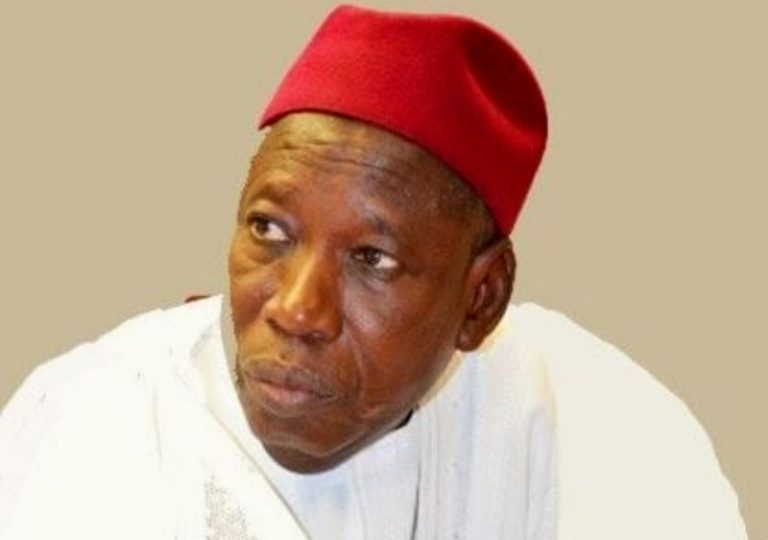
Kano state alone has 5,462,898 registered voters (as at August 2018), making it the country’s second biggest voting bloc after Lagos. Governor Abdullahi Umar Ganduje wields extensive influence in Kano and has promised Buhari a gargantuan 5 millionvotes in the presidential poll. The governor already delivered 2.9 million votes for Buhari in the APC’s questionable primaries. However, importantly Musa Kwankwanso who helped Buhari achieve his win is no longer in his camp. Kwankwaso has now declared for total support for the Atiku/Obi ticket. The followings commanded by Rabiu Musa Kwankwanso and his Kwankwansiyah movement will eat into the votes.
The North Central zone is traditionally Nigeria’s swing region. In 2011, Buhari only won in Niger state. In 2015, he did much better, winning four states (Kwara, Kogi, Benue and the Niger States) and losing in relatively closer races in Plateau and Nasarawa State, and the Federal Capital Territory (FCT), Abuja.
In 2019, Buhari may struggle here, not least because of the insecurity caused by herder-farmer clashes and political realignments in Benue, Plateau, Nassarawa, Kwara and Kogi. The herders-farmers conflict ravaging Plateau and Benue states and the administration support for ranching as a policy may contribute to the incumbent losing the state. The political realignments, in particular, the Saraki factor in Kwara State and the defection of the governor and other party stalwart in Benue state may negatively impact outcomes for Buhari in these states.Of course
The South East will likely vote en masse for the PDP. The APC and Buhari brand do not play well in this region.the South East are alleging marginalisation, the geopolitical zone is the only one in Nigeria with five states. The Zone have never produced a President and the last time, she produced a vice president was in 1983. Since the return to democracy, power has alternated amongst the South South, South West and North west within this 18 years. There is an ongoing agitation for the next president in the 2023 elections emerge from the South East. Importantly is all the handling of the Biafra Secessionist agitations. The manhandling of citizens during the operation Python Dance established in reaction to the IPOB crises, the arrest and detention of 112 women protesting for the release of Nnamdi Kanu and calling for a referendum also widen the divide between the people and the APC. Unfortunately for the PDP, though this zone has the lowest number of registered voters, which constitutes 12.04% of total registered voters as at August 2018 and also republican in nature with turnout as low as 39 percent in the 2015 presidential elections, but the PDP choice of former governor of Anambra state, Peter Obi may galvanise turnout for the party.
The South-South will also largely back the PDP. The combination of PDP governor Nyesom Wike, a powerful PDP mobiliser has been named as the zonal coordinators the South-South geopolitical zone. Importantly, Rivers state which WIke superintend over as PDP incumbent governor and governorship Candidate in the 2019 election is one of the country vote banks. The votes from Rivers State is expected to balance the votes from Kano state.in 2015 Presidential elections, the PDP defeated the APC by 1,487,075 votes to 69,238. The PDP also won majority votes in the other five states of the geopolitical zone. However, the defection two former governors to the APC – Akwa Ibom’s Godswill Akpabio and Delta’s Emmanuel Uduaghan – should ensure Buhari’s vote at least increases from the meagre 7.96% gathered in 2015.
The South West will be closely fought. In 2015, the PDP only won one of the six states here, but still managed to get 40.12% of the vote.There are believe in certain quarters that the chances of the APC in the south-west remains bright particularly with the posthumous award on the acclaimed winner of the 1993 presidential elections, Moshood Kashimawo Abiola popularly referred to as MKO and the declaration of the June 12 as democracy day as against the former May 29th.Importantly, all the six governors of the South West all belong to the APC coupled with the political machinery of APC National leader, Asiwaju Bola Ahmed Tinubu. However, the forthcoming elections may be different following the fallout from the APC primaries in the region, the perceived lacklustre performance of the administration and importantly the role the church may decide to the play in the forthcoming elections.
The church pulpit, in particular, has become a big rallying point to garner votes, will the leading Pentecostal church, the Redeem Christian church back incumbent vice president, a pastor in its rank, or will Tunde Bakare of the Latter Rain church who first publicly announced the candidature of the former World Bank Vice President, Oby Ezekwisili support her candidature.The Catholic Church exert huge influence in the South East, and do have a say in the forthcoming elections.
Idayat Hassan is director of the Centre for Democracy and Development (CDD), an Abuja-based policy advocacy and research organization.
THE Plateau State Police Command says it will soon commence the prosecution of the individuals that allegedly killed a retired Army General Idris Alkali.
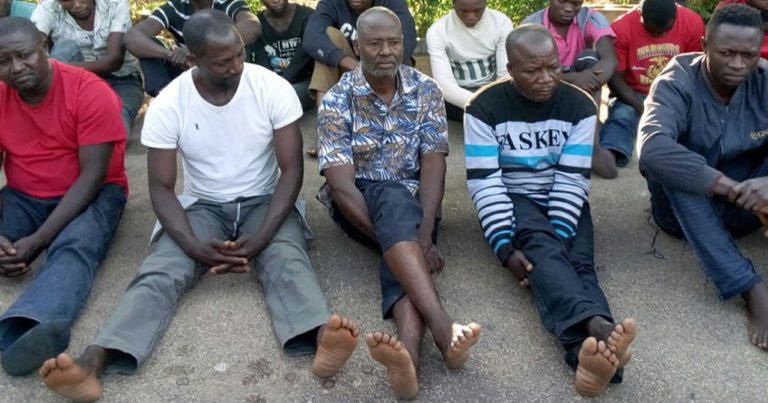
Terna Tyopev, the Public Relations Officer of the command, said this on Sunday when 19 suspects that were arrested in connection with the crime were paraded in Jos, the Plateau State capital, on Sunday.
Tyopev said 13 of the suspects were arrested by the army and handed over to the police, while the six had turned themselves in after they were declared wanted. Two others are said to still be at large.
The suspects are as follows: Pam Chuwang Kim (32), Pam Chuwang Dung (19), Michael James (22), Dung Pam (26), John Alkali (21), Rebecca Gyang Pam, (35), Yohanna Dung (61), Stanley Onuchukwu (34), Nenfa Jwanan (22), Michael Peter, Maxwell Dadel, Simon Sule (27), and Paul Bot Gyangzee (52)
The six others who turned themselves in are Stephen Chuwang, Timothy Chuwang, Mathew Chuwang Rwang, Yakubu Rapp, Pam Gyang Duns, and Moses Gyang.
The name of the principal suspect was given as Da Chuwang, also known as Mourinho, and he is still at large.
Tyopev said the suspects will be charged to court once investigations were completed.
Retired General Idris Alkali was reported missing on September 6. He had left Abuja to Bauchi on September 3 but was murdered in Jos by a group of youths who buried his body in a shallow grave, drove his car into a mining pond, and made away with his valuables. The youths would later exhume Alkali’s corpse and dumped it in a dry well.
After weeks of searching, the army recovered Alkali’s car from the pond and later traced the grave where his body was initially buried. Further investigations led the search party to retrieve the retired General’s body from the well where he was dumped.
Alkali was buried at the Gudu Cemetry in the Federal Capital Territory on Saturday, November 3.
ONCE upon a time, Boko Haram was a very peaceful group. Boko Haram — the same “dreaded”, “insurgent”, terrorist group — once went about its business very peacefully even if its doctrines themselves were unpopular. This was so for the first seven years of its founding. In fact, when he sought to become Governor of Borno State, Ali Modu Sheriff courted the support of the group; he parleyed with its members. When he won, Boko Haram was allowed to nominate a commissioner. Who would have thought that the same group that has wreaked everlasting havoc on the North East once had a relationship with the state government? The government knew them; they knew the government. Everything changed when the government began to deceive itself by thinking it could wipe out the sect with sheer force.
Isa Yuguda, then Governor of Bauchi State, is the first culprit. Taking advantage of his relationship with then President Umaru Yar’Adua, whose in-law he was, Yuguda received clearance to launch a military onslaught against Boko Haram in 2008. The Police and the Army arrested several members of the group; other members fought back, resulting in the death of an estimated 700 people.
For a moment, Yuguda thought he had won. He called his Borno counterpart and egged him on to act likewise. Sheriff sanctioned a similar crackdown in Borno, during which the Army arrested Yusuf Mohammed and handed him to the Police, who murdered him extra-judicially. Boko Haram’s reigns fell to Abubakar Shekau. Someone who personally knew Shekau in Mohammed’s days once told me he was then a “nobody” — quiet, anonymous, harmless and “always going on his own”. Shekau became belligerent and blood-thirsty in a quest to avenge the death of Mohammed and co. The rest, as they say, is history. Since then, Boko Haram has killed an estimated 100,000 people. In the last five years alone, it has displaced a minimum of 2.3million people.
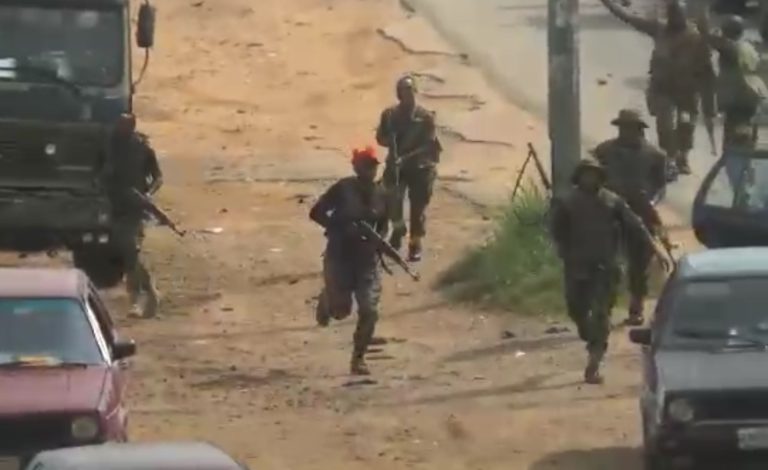
With this knowledge in mind, it is difficult to understand the Army’s obsession with Shi’ia blood. Over three consecutive days last week, the Army killed dozens of Shi’ites in its desperation to foil the ‘Arbaeen Symbolic Trek’ in Abuja, which was to hold along with the Free El-Zakzaky protests. The Army’s defence of the killings has been that its men were pelted with stones, which, according to US President Donald Trump, are “considered a firearm”. But that is secondary. The primary matter is that the Army should not have been there in the first place — they shouldn’t have been available for pelting.
The constitution is clear about the responsibilities of the military: defending Nigeria from external aggression; maintaining its territorial integrity and securing its borders from violation on land, sea, or air; suppressing insurrection and acting in aid of civil authorities to restore order when called upon to do so by the President but subject to such conditions as may be prescribed by an Act of the National Assembly; and performing such other functions as may be prescribed by an act of the National Assembly.
As the protesting Shi’ites were not external aggressors and their actions had no implications for the country’s territorial integrity, soldiers were not needed at all. Would they have been needed to assist the Police — who, by law, were the ones to restrain the Shi’ites — it would require an express demand by the President, effective only after it has been sanctioned by the National Assembly. Therefore, the argument that soldiers were pelted has been rendered superfluous by their presence at a location they shouldn’t have been.
Let’s assume, for a moment, that the soldiers were needed around the protesting Shi’ites for good reason. It would still have cost nothing to allow the Shi’ites entry into Abuja. At the end of the day, the right of every human to protest is fundamental. On Day 1 of the procession, there was trouble because the soldiers barred the Shi’ites from entering Abuja. On Day 2, the Shi’ites found alternative routes to arrive in town, still, the soldiers went after them. How did the Army ever hope to prevent hundreds of thousands of people from protesting without recourse to bloodshed? The better security strategy would have been to allow the protest; and if that was done, the soldiers wouldn’t have been pelted.
To be honest, Shi’ites can be overbearing. Their processions are infamous for lengthy hours of impending human and vehicular movement. I once witnessed a Shi’ia procession in Kaduna and it didn’t come without its trademark disruption to the schedules of non-Shi’ites. But what is three days of extreme traffic compared to the loss of lives accompanied by the potential for future loss of lives in multiple folds?
By referencing Trump’s video on its Twitter account, the Army suggests that a stone — the most dangerous object hurled at them by Shi’ites — should be considered a firearm.
This is incredulous. A firearm that cannot disseminate fire? Not one soldier was killed yet these soldiers fired live ammunition at unarmed protesters, killing many of them.
Just one reminder: this unprofessional use of military might is exactly how Boko Haram became violent and virulent. The Army hasn’t finished dealing with that insurgency; there’s no point kick-starting another.
Soyombo, former Editor of the TheCable and the International Centre for Investigative Reporting (ICIR), tweets @fisayosoyombo
THE number of Nigerians that die annually because of cancer has continued to rise, but the problem lies more in the cost of accessing treatment than in any other factor.
RISING cases of cancer and the cost implications of treatment are putting Nigerians on the edge of paying for cancer treatment with their lives, says Runcie C.W. Chidebe, Executive Director, Project Pink Blue Health and Psychological Trust Centre, a cancer-fighting organisation.
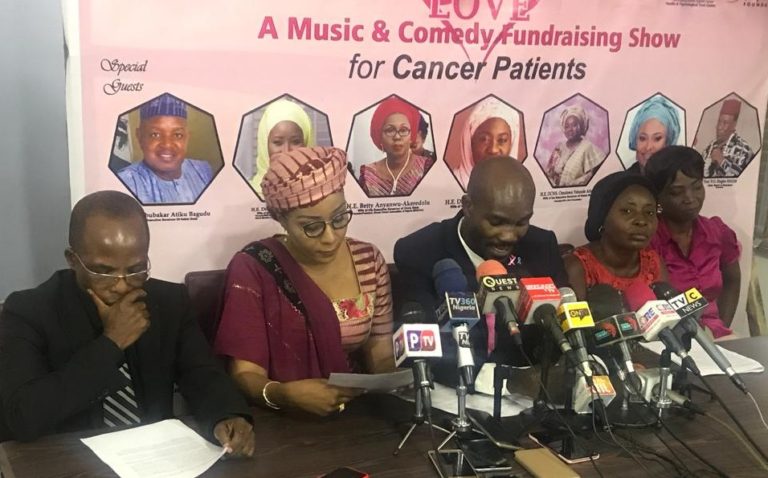
He said this at a press conference on Thursday to create awareness for the upcoming event titled ‘Show Love’, a music and comedy fundraising show for cancer patients billed to hold at the Transcorp Hilton, Abuja on November 15, 2018.
The event, which, is a fundraising programme of the organisation is focused on encouraging and engaging Nigerians to financially support indigent people suffering from cancer.
“We can create awareness, provide screening, oncology education, but, if we do not provide financial support to cancer patients for treatment, then our circle of care is not complete and very few lives can be saved,” says Chidebe.
According to a report on catastrophic health fund for oncology care, women in Nigeria needs about N2.1 million to N29.2 million to treat breast cancer depending on the type of breast cancer.
The woman would have to go through different stages of diagnosis, chemotherapy, surgeries among others to get treated. This includes eight series of diagnosis that cost between N232,000 to N311,000; three surgeries which cost N670,000 to N3.3 million; 10 sessions of chemotherapy that cost about N916,000 to N2.6 million and finally 10-23 sessions of radiotherapy, which may cost N138,000 to N360,000.
In April, the federal government launched the National Cancer Control Plan (2018-2022) through the federal ministry of finance. The five-year plan defined strategies and roadmap to undertake cancer control effort in the country. The plan aims to scale up survivorship of cancer patients.
The plan stipulates that Nigeria require N93 billion ($380 million) to reduce the burden of cancer in Nigeria for the next five years. Details from the 2018 budget show that N180,980,579 ($593,379) was allocated for cancer control programme.
According to the 2018 Wolrd Health Organisation (WHO)/Globacan report, there are 115,950 new cases of cancer annually and 70,327 cancer death in Nigeria.
Cancer control allocation in the 2018 budget can only rescue 2,573 people from dying of cancer as against the over 70,000 people who die of cancer disease annually in Nigeria.
THE World Health Organisation (WHO) describes Female Genital Mutilation (FGM) as all procedures which involve partial or total removal of the external female genitalia and/or injury to the female genital organs, whether for cultural or any other non-therapeutic reasons.
FGM has been described as a societal malaise militating against the sexuality of female folks, an act that is rooted especially in African traditions. The practice is documented in 28 countries in Africa, Asia and the Middle East and among these countries. The prevalence rate in Nigeria, according to the National Demographic Health Survey 2013, is 24 per cent.
Female circumcision is a cultural practice from time immemorial and the reason for practising it is borne out of the belief that unless it is done, a woman is incomplete. It is also seen as a means of preserving girls virginity, believed to help increase a girl’s chances at marriage.
According to Waris Dirie, “female genital mutilation targets little girls, baby girls- fragile angels who are helpless, who cannot fight back. It’s a crime against a child, a crime against humanity. It’s absolutely criminal and we have to stop it”
Various advocacy groups have risen against the practice which some describe as “evil”. According to an anti-FGM campaigner, Dare Olagoke-Adaramoye, girls and women who have been mutilated have either died from the complications afterwards or lost the urge for sex and other negative consequences.
Tosin, a traditional nurse in Ise Ekiti.
Effects of FGM ranges from complications at birth, infections, excessive bleeding, delayed or incomplete healing. And because many traditional circumcisers do not use anaesthetics on their patients, there is the possibility of damage to adjacent organs like urinary tract, infections, cysts and even death. Anti-FGM activists also believe that the practice has no clinical medical benefits but rather causes irreparable dangers to female folks.
As a result of the aforementioned dangers, there is a law in place that criminalizes female circumcision in Nigeria. The law was signed by former President Goodluck Jonathan. However, violators continue with the practice secretly.
At the heart of the investigation, is how the practice affects women; the present prevalence rate and the secret practice in spite of the prohibition law.
Preliminary investigations reveal that Southwest Nigeria recorded the highest rate of Female Genital Mutilation in the country. This is in spite of the high literacy level in the region. Asides that, various religious organizations have condemned the act.
According to the NDHS, the female genital mutilation prevalence rate in the South West is the highest in the country. Although little progress has been made from a prevalence rate of about 57 per cent in 2003 to 48 per cent in 2013.
File photo sourced from google
The practice is based on myths and religion passed down for many generations. Some communities believe that the clitoris contains powers strong enough to cause harm to a man’s reproductive organ or to damage or kill a baby during childbirth.
Genital mutilation has assumed a frightening and worrisome dimension in Ekiti, Osun, Oyo and Lagos where this investigation covered. Findings show that until recently, rural, illiterate and unenlightened old men and women have remained in the cultural habit of mutilating the virginal part of female babies, and they have their reasons. Chief among those reasons is to prevent young women from becoming promiscuous as they assume teenage age. The cultural belief is that a female tends to become promiscuous if her virgina is not “tamed” through the severance of that virginal part believed to make her want men so much.
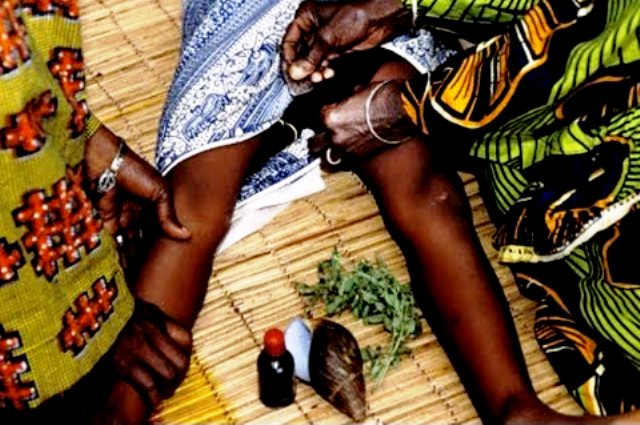
Unbelievably, the practice has gradually crept into the medical profession as you now have a situation whereby nurses, mostly auxiliary nurses who work with certified medical doctors in both public and private hospitals surreptitiously help parents “tame” the private part of both male and female children days after their birth. In Ise Ekiti, this reporter met with a lady named Tosin at a palm wine joint. She revealed how female circumcision is done in her hospital. She, however, refused to divulge the name of the hospital.
In some communities in the four Southwestern states, female genitals of uncircumcised women are considered ugly, unclean and unattractive.
This investigation started in Ekiti in communities like Emure, Eporo, Egbara-Odo, Ise Ekiti and other communities that are perceived to have a high prevalence for FGM/Cutting.
While in Emure, a priestess of a deity named Oloofin said female circumcision is rooted in the tradition of their town and Ekiti generally. The woman who is popularly called Iya Eku whose husband is from Aro lineage, the authentic circumciser in the town since time of immemorial, said people’s belief in female circumcision is so strong that even women who are in marriageable age are cut or get cut during childbirth because it is widely believed that the clitoris must not touch the head of the newborn baby because it could lead to death. Iya Eku also revealed that the cut part of the clitoris must not be thrown away anyhow. According to her, it must be carefully buried because if a dog eats it, the girl would become wayward and won’t able to control her sexual desire.
A traditionalist in the town, Alh. Lasisi Kareem Kayode, revealed that, the people in Aro lineage are legitimate circumcisers and that they pass the “trade” to their offsprings. He said it is disheartening that most women circumcisers were dying off while quacks were taking over.
Alhaji Lasisi
He noted that culturally, they so believe in the saying of the town’s appraisal which says: ‘Alakomola lojeremi julo’ meaning that Aro house is the deliverer of children from untimely death and the most benefactor from the town’s deity”. Alhaji Lasisi said this means that it is a must for females to be circumcised to avoid the untimely death of their children.
This reporter was also referred to one Iyamola Elekuru (Ekuru seller) whom many inhabitants of the town said circumcised their daughters. All efforts to see her at home were to no avail. After many tries, she was seen in the market. The reporter who disguised as a student with an ID card of the College of Health Technology, Ilesa, Osun State told her he was researching how circumcision is carried out, as part of the requirement for his final year project.
The old woman said: “I’m not from Aro house or lineage neither a medical practitioner, but I learnt and mastered it. There’s no available child now to show you the procedure of cutting the clitoris. But it is simple. And besides, we usually cut it in the morning before sunset to avoid complications. The reason for cutting it in the morning is to avoid uncontrollable bleeding and dangers that associate with it.”
She said, “There are types of cuttings, we can just cut the tip and leave it but cutting of the tip without pilling it can cause the wound not to heal fast. So, the best option is to finger dress the flesh down the clitoris and peel the flesh before cutting the tip of the clitoris. And after cutting it, tomato leaf is used to stop the bleeding and make it heal fast.”
When asked how they sterilise their cutting tools, she said there is a herbal liquid used to sterilise the tools to avoid infections.
This reporter through the assistance of a native of Emure travelled to Eporo Ekiti, a neighbouring town. The reporter spoke with a circumciser after introducing himself as a student. The circumciser named Iya Ajebidan, also a wife of all occultic initiates in the town, said she was no longer into circumcision of females noting that she did it before because of the belief that the female child that doesn’t do it will experience mortality during childbirth.
She said, “Today, it shows that it is a mere belief. Although people truly experience mortality during childbirth due to uncircumcision, it is witches that turn it to reality. We have female children outside the town who are not circumcised and they don’t experience mortality during childbirth.”
She said leaving female children uncircumcised would not make her sexually wayward, “but cutting them and not carefully keeping or burying the severed part of the clitoris would make the child unable to control her sexual urge. especially if a dog or any other animal ate it. But we must circumcise male children otherwise he will become impotent and that is why we only do male circumcision especially now that the government has prohibited female circumcision.”
But as this practice holds sway in many parts of Nigeria especially in Southwest states, there are pathetic tales of traumatised victims. According to sources in communities where this practice is common, many victims have died because of complications arising from genital mutilation while others who live are subjected to a life of pain and frustration. The story of one Nneka from Ibadan, was cited as one of the most pathetic cases.
A married woman, Nneka died as a result of the genital mutilation procedure she underwent as a baby in South East Nigeria some three decades ago. As part of cultural demands and traditional beliefs of that community, Nneka along with other girls was made to go through the process. As a way of preventing her from becoming promiscuous, Nneka’s parents made her undergo type 3 genital mutilation and cutting called infibulation, that is, the removal of all external female genitalia which leaves a small opening for the blood and urine. The procedure like this is usually performed by elderly women under unsanitary conditions, with scissors, razor blade or knives and no anaesthetics were used.
After Nneka got married, a surgical procedure was performed to correct the damage caused to her genitals when she was infibulated as a child. Her genitalia had to be opened up for the passage of penis and baby. Four years after marriage, she was unable to conceive and had to battle with infection traceable to genital mutilation. For her, sex with her husband was always painful experience as a result of the mutilation and as a result, she lost urge for sex because her clitoris and both the labia majora and minora had been cut.
She finally conceived five years after marriage. Again, her female genitalia had to be cut open to allow the passage of foetal head while she remained in serious pain. She was discharged from the hospital after some weeks, but disaster soon struck.
One day while her husband was away at work, the suture of the surgery tore open and she began to bleed. There was no one at home to help her to the hospital. by the time the help finally came, it was too late. She had lost so much blood and she died.
According to Adaramoye, one of the anti-FGM campaigners, there was also the story of Bolade, a nine-year-old girl, who had undergone Type 3 infibulation. The wound healed but it left a huge scar and a keloid in her genitalia. As she grew older and bigger, the keloid kept growing.
“At nine, it was already the size of a big apple,” Adaramoye said. “Her family and friends of the parents had to contribute money to make the girl undergo a specialised surgery to remove the keloid and hopefully still retain the genitalia to be intact for childbirth in future.”
Another anti-FGM campaigner, Gift Abu, told the story of another woman, who died, following the insistence of her family that she must go through the procedure. Gift, in whose arms the woman died, said the victim’s late husband had been the one shielding his wife from the razor of the circumcisers, who eventually had their chance after the man died.
Gift said: “She had been living a normal life without circumcision until she became pregnant for the second time and was due for delivery. While she struggled on her due date, community leaders insisted that it would be a taboo for their daughter to give birth uncircumcised. But as healthcare officers, we refused to allow that. During the melee, there was some delay in giving medical attention to the poor woman. She died in the process.
“Emmanuel, her five-year-old son then became an orphan, as he had lost his father two months earlier. Emmanuel’s father was protecting his wife from being cut, but after he died, the cutters found their chance. They tried to force her to undergo circumcision during labour and told me that I was to blame for her death because I told them not to cut her,” Gift, a midwife at the time, said.
Gift added that since the demise of the woman, the community abandoned Emmanuel, having declared him an outcast for being born by an unclean and uncircumcised woman.
Gift took Emmanuel and found him a safe home with a family friend, Grace, alongside two other girls, Chinwe, seven, and Faith, nine, who had also been rescued from undergoing the female genital mutilation procedure.
Gift said Chinwe and Faith’s mothers refused to have them cut but feared that if the girls stayed with them, they would be snatched and forced to undergo the procedure.
This and many other stories show the plight of women and girls in Nigeria, who have suffered the ordeal of undergoing the age-long cultural practice of female circumcision.
Speaking on behalf of the Oyo State government through Ministry of Health, the state Reproductive Health Officer, Mrs Bilikisu Olawoyin noted that parts of the state government’s activities to eradicate or reduce this barbaric culture to the barest minimum is an Enactment of Violence Against Persons’ law in 2015 that penalized anybody that engages or coerced another person in the act.
Bilikisu Olawoyin
She added that the state government is collaborating with UNFPA-UNICEF joint programme on eradication of FGM through carrying out the following as Training of judiciary, Training of law enforcement agents, Training of Community Champions, Constitution and inauguration of State and Local Technical Committees, Dialogues with different stakeholder at the community level, Consensus meetings with the community gatekeepers, Male engagement, Sensitization of different actors, Public enthronement via the media and during special occasions.
According to her, nobody has been arrested, arraigned nor convicted in Oyo State as there has not been any report yet.
She hinted that the psychological problem or consequences to FGM victims includes: Reduced or no sexual satisfaction, no desire for sex, fear and suppression of feelings, feeling of low esteem, Mental and Psychosomatic disorder, Constant feeling of betrayal, bitterness and anger, Poor interpersonal relationship, Depression, Puerperial, and Psychosis/maternity blues due to trauma during delivery.
On what may be the likely remedies for the victims of FGM to get over their predicament, she said: “We need to note that the part(s) removed cannot be replaced and their natural or physiological functions are gone with them. However, there is special health management to alleviate some of these effects which can be accessed in the healthcare centres.
And on the aftermath problems of each of these type of FGM to circumcised females, Olawoyin said: “because of Scar formation in all the types which vary according to the type, the following can occur during childbirth like prolonged / Obstructed labour, Perineal tear, primary and secondary paturm haemorrhage,
Ceasarian Sections, prolonged hospitalisation and for a problem with sexual life, includes above psychological problems and menstrual disorder, Dysmenorrheoa, Chronic Pelvic Pains
Pelvic Infections / Pelvic Inflammatory Disease, Accumulation of blood in the vaginal Infertility.
She also added that VVF is one of the complications of FGM especially type 3. According to her, Type 3 is total removal of the clitoris, labia manorial and majoral. In the process of performing it and other types, the circumciser can mistakenly cut the urethra, therefore, link urethra to the vaginal and make urine to be leaking uncontrollably into the vaginal. Secondly, if the wound is infected and not promptly or effectively treated it can also lead to VVF”, she explained.
There are four types of female circumcision. The first type is clitoridectomy, where the clitoris, which is the top part of the private part has been removed completely or by half. The second type is sunna, when the clitoris and inner lip is removed which is also known as Labia minora. The third type is infibulation when the clitoris, inner lip and the big lip, labia majora are removed. In this situation, the edges are stitched together leaving a tiny opening for the passage of menstrual flow as well as urine. The fourth type refers to the unclassified forms of female genital mutilation, which may involve pricking, stretching, cauterisation, or inserting herbs into the vagina.”
Immediate complications include excessive bleeding when the clitoris is removed, whether with scissors or blade.
Women with genital mutilation are exposed to recurrent urinary tract infection and vaginal infections that can prevent them from getting pregnant.
Other complications include pain during sexual intercourse and during the menstrual period and victims like this also stand the risk of contracting HIV. If the patient has Type 3 mutilation, she would have to be cut open again, as she wouldn’t be able to get normal penetration during sexual intercourse.
However, the investigation revealed that the prevalence rate of FGM in South West Nigeria is reducing. 2013 National Demographic Health Survey (NDHS) on National prevalence rate of FGM in Nigeria suggests that Osun was rated 77℅, Ebonyi 74℅, Ekiti 72℅, Imo 68℅, Oyo 66℅ and Lagos State 35℅. But according to 2016/2017 Multiple Indicators Cluster Survey (MICS) report, Osun State recorded 67℅ as highest prevalence rate following Ekiti with 62.6℅, Oyo with 55.0℅, Imo with 51.6℅ and Ebonyi with 43.2℅.
The report further suggests that children between age 0 and 4 years old who are cut in Ekiti are 41.7℅ followed by Osun with 34.6℅, Oyo with 29.6℅, Imo with 22.2℅ and Ebonyi with 5.2℅.
Personal study carried out in Ibarapa area of Oyo State suggests that the prevalence rate in the area is 66.7℅ compared to survey carried out by UNICEF-UNFPA Joint programme on FGM abandonment in 2013 which rated Ibarapa at 84.2 which was ranked 5th above Ibadan North, Akinyele, Ogbomoso and below Oyo West and Kajola local governments in the state.
This reporter carried out a survey with questions to mothers in the communities on whether their daughters are circumcised and if yes, whether it was in the hospital or from traditionalists and what prompted the parents to circumcise their children whether it’s belief on promiscuity or cultural belief.
The report revealed that 66.7 per cent of the parents have circumcised their children which is interpreted as a prevalent rate of FGM in the area. 88.9 per cent of the mothers said the children were circumcised in the hospital while other 11.1 per cent of the mothers said the circumcision was carried out by the traditionalists. 33 per cent of the mothers believes in promiscuity as the reason for circumcising their daughters while other 33.3 per cent of the mothers had cultural belief.
The survey suggests that Ibarapa North which consists of Ayete and Tapa communities has the highest prevalence rate of the FGM with 90 per cent followed by Ibarapa Central with 30℅ and Ibarapa East with 20 per cent prevalent rates.
The above statistical analysis shows that cultural belief on the need to continue with FGM in Ibarapa North is very high and there’s little or no awareness against the practice in this area followed by Ibarapa Central and Ibarapa East. In order to carry out a successful survey in this area, this reporter disguised again as a student.
During an interview with an Anti-FGM campaigner, Mrs. Aduke Obelawo in Osun State, she revealed that FGM in the state is a social norm which embedded in cultural practice just as it was gathered in other states. According to her, the forebearers that bequeathed the culture were oblivious of the dangers inherent in it and therefore see it as a cultural heritage that must be sustained from one generation to the other. But complications the patients suffer afterwards suggest that the practice must be abandoned.
Aduke Obelawo talking to the locals about dangers of FGM
She said, “The reason for stoppage is owed to the fact of complications during childbirth, infections and other problems that can lead to psychological disorder while some die by the complications.”
She added that the narrative is changing, now as more people are now more interested in stopping the practice saying before now, everybody sees female circumcision as a must but now, many people are refraining from it. ” Even the traditional leaders like Kabiyesi and others are interested in putting stop to it while communities are now making public declarations of stopping FGM”.
While revealing how they carried out the sensitization which has recorded success story, Mrs. Obelawo said: “We don’t ask direct questions, because direct questions will give us direct answers. Rather, we start by asking after the well-being of their children and gradually drifted to asking questions bordered on Female Genital Mutilation in the communities. We then continue to ask questions like why they do FGM and they start baring their minds to us.
“The common answers we get are that ‘because we don’t want our children to be promiscuous’, some will say the child’s head must not touch the clitoris, some will say the female child that is not circumcised will be having hitches and some will say the clitoris will be growing like penis and will be dangling the female thigh and therefore competing with male’s penis. Therefore, they see clitoris as an offensive organ that must be cut away.
“And after we have gotten a situational report of FGM in the communities through the questions, we would now start to sensitize them. We will start to make them understand the importance of every human organ God has created. And we will let them understand that as the eyes, leg, nose and other human organs are important also the clitoris they are cutting away is important especially during childbirth”.
According to Obelawo, research has shown that the rate women are dying is alarming. She said they make people in the communities understand that World Health Organisation, WHO as an authority in health sector globally has come up with findings that FGM is mostly responsible for the mortality rate.
Obelawo added that the people in the communities are made to understand that women whose genitalia has been mutilated won’t be able to give birth with ease because the stitched genitalia will inhibit the vulva to expand to allow baby to come out freely and this can cause tear and bleeding. She added that situation like this can lead to both mother and child mortality.
She continued, “In the time past, women were dying but there were no records to demystify the problem. But rather they traced the cause to witches and wizards. But research today has made us understand that practices like FGM are responsible for it.
Meanwhile, the reason for female circumcision and the need for the stoppage is ironical. According to the traditionalists, the essence of circumcision for female folks is to avoid children’s death at birth and to avoid females’ promiscuity. But according to Mrs. Obelawo, a survey which was conducted in Ojuelegba in Lagos among the sex workers revealed that more than 90℅ of them were circumcised.
She said this phenomenon can help to affirm that female circumcision is the cause for promiscuity because the study shows that the cut clitoris doesn’t make circumcised women get satisfied on time sexually.
“The way God created our sex organ is fashioned in such a way that men and women should enjoy themselves. But when a man has affair with a circumcised woman, by the time the man has reached orgasm, the woman is just having the feeling of sexual pleasure. By that time, the man is finished but the woman is just beginning to get aroused and not satisfied. As a result, a woman like this if she doesn’t have self control, will be looking for different men to seek sexual satisfaction from them.
“So, female circumcision is encouraging promiscuity compared to those that are not circumcised. But presently with the rate Anti-FGM sensitization has gone in the communities, they are now teaching themselves on the need to refrain from the practice”, Mrs. Obelawo said.
In his own submission, Dr. Wilson Imongan, Executive Director, Women’s Health and Action Research Centre, Benin City, maintained that promiscuity or prostitution is not determined by whether the clitoris is cut or not.
Dr Wilson Imongan
According to him, finding reveals that many girls who travelled to Europe for prostitution or in Nigerian brothels are circumcised. He said: “circumcision does not prevent girls or women from promiscuity or prostitution. To suffice my point, cutting clitoris has no value and that is the reason it is called mutilation.
One of the essences of circumcision is to reduce promiscuity but it is learnt that cutting clitoris to reduce the sexual drive is of no importance because the sexual drive is not only driven by the clitoris alone. There are other erotic points on the body.
But speaking on why tampering labia area can be more injurious to female folks during FGM procedure, Dr. Wilson said the role of labia is to play mobility role during intercourse but once it is cut, it bears scar and thus inhibits contraction during child labour.
“Even during sexual intercourse, a woman whose labia has been tampered will be feeling pain instead of feeling pleasure during intercourse. Labia that suppose to produce liquid for lubricant will dry and woman like this will suffer dryness during intercourse. The type 4 of female circumcision is the worst of all but what we are saying is that there is no need to do anyone because they have no benefit “, Wilson advised.
A personal survey was conducted on nursing mothers in communities in Osun State by this reporter, it seeks to know the age the mothers were circumcised the aftermath complications and other facts about female circumcision. Among the respondents, 52.1 per cent were circumcised while other 42.9 per cent were not circumcised.
The survey showed that 48 per cent of the mother were circumcised at age of 0-2 years. 4.8 per cent of them were circumcised at age of 3-10 years, 4.8 per cent were circumcised at age of 11-20 years while 42.9 per cent were recorded as nil. The following is the age demography of the respondents: 4.8℅ of the mothers are between age 10-20 years, 38℅ are between age 20-30 years, 29 per cent are between the age of 30-40 years, 10per cent are between the age of 40-50 years while 19 per cent of the women didn’t respond. And lastly, 89per cent of the women had a safe delivery without caesarian section procedure while 4.8℅ of the mothers delivered their baby through Caesarian section procedure. However, 19℅ of the women didn’t respond. The major setback in this survey despite explanation on its need is that the respondents feel inferiority complex for going through caesarian section because it is a popular belief that a woman gives birth through caesarian section are no longer medically fit. As a result, the reporter learnt the respondents gave a false response on whether they delivered their babies through a caesarian section or themselves.
But while reacting to whether female circumcision can lead to a caesarian section or not, Mrs. Osungbade Idowu, a nursing sister said some are not circumcised but delivered their babies through caesarian section. For example, she said: “if the position of the baby is not correct and other complications that have nothing to do with FGM, a woman can give birth through caesarian section. But most women that went through CS procedure are circumcised women whose stitched genitalia doesn’t allow them normal opening of the vulva to allow baby to come out.
Osungbade Idowu
“Our common experience is that the baby’s head causes a tear and leads to bleeding and a reason we refer them to the state hospital because this place is a primary healthcare centre. As a result, women like this will need to go through CS to have other children and we advise them that they stop childbirth early for their good health. Because we discover that circumcised women from age 20 years downwards don’t go through CS but from 25 years upwards has a tendency of going through caesarian section. Remember there are types of female circumcisions. Type 1 rarely go through CS because it doesn’t affect the contraction of vulva during childbirth but for type 3 and 4 which is rare, we don’t even advise them to go through labour at all but caesarian section.
Now that the practice is criminalized, it is a veritable mean to reduce FGM to the barest minimum but presently there haven’t been any recorded cases of arrest, arraignment or conviction. According to Dr. Wilson, though there are some cases of arrests, prosecutions and convictions have not been recorded.
He maintained that the reason for this is that it usually a family affair where for instance a grandmother who believes so much in the cultural practice takes her granddaughter to the circumciser, would you arrest your mother or mother in law? It is not possible. During a training organized for policemen in Edo State, it showed that most policemen are not aware that female circumcision has been criminalised. As a result of these above reasons, we have not seen one litigation even in Edo State where we started the anti-FGM campaign. The most important thing is that the concerned persons should continue with awareness and sensitization for people on reasons they should stop female circumcision.
During this investigation, this reporter encountered many challenges in unravelling the perpetrators of this practice. The circumcisers are very defensive especially the traditional circumcisers are ready to fight anyone who they suspect wants to reveal their secret practice of cutting girls with voodoo power.
Adaramoye said while in Ijeru community of Ogbomoso South Local Government of Oyo State, some people confessed that some circumcisers do sell the cut clitoris from the mutilated female to ritualists for a ritual purpose called ‘Awure’ otherwise known as a ritual procedure to attract fortunes.
This investigation is supported by the Ford Foundation and the International Centre for Investigative Reporting (ICIR).
THE West African Examination Council (WAEC) has disagreed with the presidency over whether or not President Muhammadu Buhari applied for an attestation of his school leaving certificate.
WAEC’s Registrar, Iyi Uwadiae, was at the State House on Friday to present an attestation to Buhari following the controversy surrounding his inability to produce his school certificate, which is one of the requirements for one to run for the post of president in Nigeria.
Uwadiae was accompanied on that visit by the Head WAEC’s office in Nigeria, Olutise Adenipekun; the Head of Public Affairs, Abiodun Aduloju; and the Zonal Coordinator in charge of Abuja, Olufemi Oke.
Garba Shehu, the Senior Special Assistant to the President on Media and Publicity, subsequently told Nigerians that Buhari did not apply for the document, but rather, WAEC, having seen the controversy being generated by the certificate saga, thought it wise to set the records straight once and for all by issuing the president an attestation of his O-level results.
In an opinion piece titled, “President Buhari, WAEC And PDP’s Toxic Air”, Shehu wrote: “The West African Examinations Council, WAEC, Friday, said the controversy concerning President Muhammadu Buhari’s school certificate is embarrassing and felt a sense of duty to produce and deliver to him a confirmation and attestation of his results, in form of a duplicate certificate.”
Joyous moments as President Buhari receives his attestation certificate.
He reiterated this during a phone interview with The Punch saying, “The President did not apply for the documents. I made this clear in an opinion I wrote on Friday. The presentation of the documents to the President was strictly an initiative of WAEC. They said they read about the controversy on the pages of newspapers and saw the need to save the integrity of the council.”
However, the spokesman of WAEC, Damianus Ojijeogu, also in an interview with The Punch, said that there was no way the attestation could have been issued to Buhari if he did not apply for it and supplied the necessary accompanying documents.
“We would not have given him the document if he didn’t apply. It is only Buhari or a court that can ask for the results. There is no other person. So he asked for it,” Ojijeogu said.
He also corroborated what WAEC had posted on Twitter that a certificate of attestation of results does not capture the subjects where the candidate had an F9.
The WAEC Twitter handle had also listed the documents to provide while applying for an attestation of result, namely: “a police report on lost or damaged certificate, photocopy of lost or damaged certificate, two recent passport-sized photographs of the candidate, sworn affidavit for collection of attestation of results and administrative fee of N20,000.”
The clarification became necessary as Nigerians wondered why the certificate issued to Buhari had his recent photograph on it.
But while the controversy of whether or not President Buhari actually applied for a new certificate, one thing is settled, at least for now, and that is that Buhari actually sat for the West African Certificate Examination.
Amnesty International has called on the Nigerian government and its American counterpart to stop the competition about who violates citizens’ right more than the other.
The organisation’s statement is the response to the Nigerian Army’s tweets using President Trump’s words to justify the fatal shooting of rock-throwing protesters and the subsequent issuing of a statement denouncing Amnesty International’s calls for accountability.
“Basic human rights are not subject to whims of the world’s leaders. Rather than engaging in a preposterous competition over who does a better job of violating human rights, the Nigerian government must hold its security forces accountable for the horrific killing of at least 45 peaceful protesters,” said the Amnesty International Nigeria Executive Director, Osai Ojigho said.
In the like manner, Executive Director of Amnesty International USA, Margaret Huang reprimanded the US President, Donal Trump for “encouraging and justifying human rights abuses” in his latest statements.
“No president should be embracing the horrific use of excessive force. The president’s outrageous threats against people fleeing violence and seeking a better life only compound their already precarious situation and exacerbate what he should be recognizing as a human rights crisis,” she said.
“Both the US and the Nigerian governments must abide by international human rights law and standards. International law is clear that security forces policing demonstrations must not use unnecessary or excessive force against protesters unless they pose an imminent threat of death or serious injury, and only if there is no lesser way to avert such threat. They must never use firearms as a tactical tool for the management of demonstrations: they may only be used for the purpose of saving another life.”
An investigation conducted by Amnesty International this week has shown that the “horrific use of excessive force by soldiers and police led to the killing of at least 45 supporters of the Islamic Movement in Nigeria (IMN) over two days when the Shi’a Muslim group held a peaceful religious procession around Abuja,” the report stated.
THE African Centre for Media and Information Literacy (AFRICMIL), a Civil Society Organisation (CSO), has called on the Economic and Financial Crimes Commission (EFCC) and the Independent Corrupt Practices and Other Related Offences Commission (ICPC) to probe the video clips purportedly showing the Governor of Kano State, Umar Ganduje, receiving bribes from contractors.
Coordinator of AFRICMIL, Chido Onumah, made the call via a statement issued in Abuja on Friday, saying that the video evidence was “too glaring to ignore.”
An online newspaper, Daily Nigerian, had alleged that Ganduje collected over $5 million from contractors working for the state government. The paper backed the allegation up with a series of videos on the social media.
“The allegations are weighty. The videos we have seen further lend credence to the accusation and have made the affair too serious to ignore,” Onumah said.
He stressed that the anti-corruption agencies “should rise to the occasion by going to the root of this issue and possibly document evidence for the eventual prosecution of all those found culpable”.
“We are aware that the hands of the anti-corruption agencies are somehow tied by constitutional immunity enjoyed by Mr. Ganduje. This, however, does not stop them from conducting preliminary investigations into the matter,” he noted.
Onumah said that there is nothing in section 308 of the Nigerian constitution that stops the anti-corruption agencies from interrogating Mr. Ganduje in the process of the investigation.
“Cases like this serve as litmus tests for the operational independence of our anti-corruption agencies and political will of the government,” Onumah stated further.
“ICPC and EFCC must thoroughly investigate these videos which have become a national embarrassment and prepare ahead for eventual prosecution of Gov. Ganduje if he is found culpable.”
The Kano State House of Assembly had set up a panel to investigate the allegations against Ganduje, but the governor failed to appear before the panel on Friday, sending his commissioner for information instead.
Jafar Jafar, the publisher of Daily Nigerian has since testified before the committee, narrating how an aggrieved contractor agreed to plant clandestine cameras on his kaftan to be able to get the video evidence of Ganduje collecting the bribes.
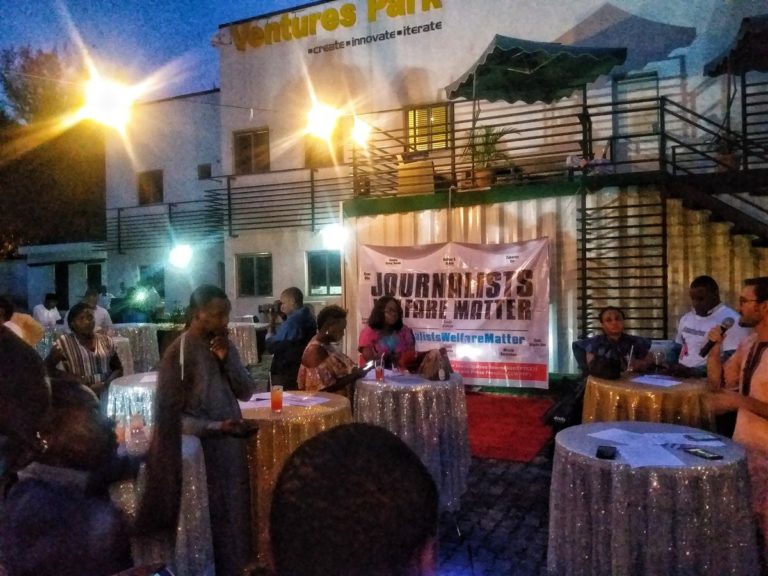
THE first International Day to End Impunity for Crimes Against Journalists was marked on November 2, 2013, in memory of Ghislaine Dupont and Claude Verlon, two French journalists killed while reporting in Mali earlier that year. Five years later, the story has not changed as journalists remain targets for embarrassments, illegal detentions and killings with the perpetrators, oftentimes, getting away with it.
The recent example of the state-sponsored gruesome murder of Jamal Khashoggi, a Saudi Arabian born US-based journalist, has sent cold shivers down the spine of many journalists across the world. Another example is that of 30-year-old Bulgarian journalist, Viktoria Marinova, who was brutally raped and murdered in early October.
So, to mark the 2018 day of no impunity against journalists in Nigeria, Reebot an international non-governmental organisation, in partnership with some media and civil society groups, organised a get-together for journalists and press lovers to unwind a bit while discussing the challenges they face in the course of doing their jobs.
Speaking at the event, Adam Talsma, Reebot’s Regional Director for Africa, commended journalists for constantly defying the odds and continuing to courageously hold the government accountable to the people.
Dapo Olorunyomi, the Publisher of Premium Times online newspaper, who was a keynote speaker at the event, said that the task of making Nigeria a country where the press is truly free is one that everybody should commit to.
He noted that “the founding fathers of Nigeria, most of them were journalists” and after the civil war that ravaged the country for 30 months between 1967 and 1970, the process of reconciliation was largely driven by the media, hence the need to ensure that journalists are free at all times to carry out their responsibilities.
Similarly, Dayo Olaide, a Deputy Director with the MacArthur Foundation in Nigeria, called for more support for journalists especially from the ordinary citizens whose interests journalists risk their lives to protect.
MacArthur Foundation’s Dayo Olaide and Premium Time’s Dapo Olorunyomi.
He cited an example with the case of Samuel Ogundipe, a reporter with Premium Times, who was arrested and detained for days by the Police for refusing to disclose his source but was released after an outcry and protests by citizens.
Ogundipe, being the most recent example of an attempt to stifle press freedom, and Taiye Edeni, a female reporter with the News Agency of Nigeria (NAN), who was punched in the eye by a policeman whilecovering the inauguration of the Kaduna dry port early this year, were also celebrated at the event.
Hamzat Lawal of Connected Development CODE) and a staff of Premium Times Centre for Investigative Journalism PTCIJ)
Tributes were also paid to all the journalists in Nigeria who had paid the ultimate prize as a result of carrying out their lawful responsibilities.



 “There is dire need to arrest the erosion of PMS sufficiency with the injection of flush volumes immediately,” Mr Baru said in the memo. “In view of the foregoing, Your Excellency may kindly reconsider and approve our request to utilize $1.05 billion to finance the 42 PMS cargoes as contained in our letter to you dated 8th January, on the subject matter.”