Home Blog Page 2495

NO IMPUNITY: Journalists gather to unwind, demand freer press

THE first International Day to End Impunity for Crimes Against Journalists was marked on November 2, 2013, in memory of Ghislaine Dupont and Claude Verlon, two French journalists killed while reporting in Mali earlier that year. Five years later, the story has not changed as journalists remain targets for embarrassments, illegal detentions and killings with the perpetrators, oftentimes, getting away with it.

The recent example of the state-sponsored gruesome murder of Jamal Khashoggi, a Saudi Arabian born US-based journalist, has sent cold shivers down the spine of many journalists across the world. Another example is that of 30-year-old Bulgarian journalist, Viktoria Marinova, who was brutally raped and murdered in early October.

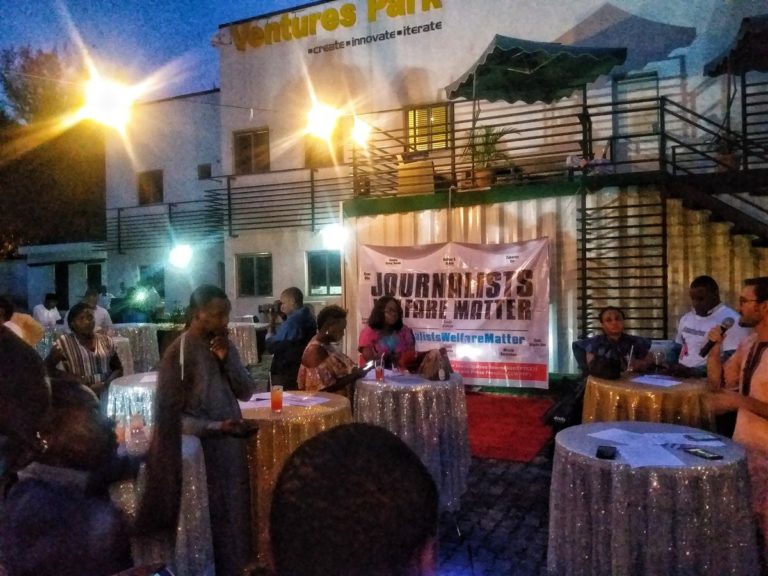
So, to mark the 2018 day of no impunity against journalists in Nigeria, Reebot an international non-governmental organisation, in partnership with some media and civil society groups, organised a get-together for journalists and press lovers to unwind a bit while discussing the challenges they face in the course of doing their jobs.

Speaking at the event, Adam Talsma, Reebot’s Regional Director for Africa, commended journalists for constantly defying the odds and continuing to courageously hold the government accountable to the people.

Dapo Olorunyomi, the Publisher of Premium Times online newspaper, who was a keynote speaker at the event, said that the task of making Nigeria a country where the press is truly free is one that everybody should commit to.

He noted that “the founding fathers of Nigeria, most of them were journalists” and after the civil war that ravaged the country for 30 months between 1967 and 1970, the process of reconciliation was largely driven by the media, hence the need to ensure that journalists are free at all times to carry out their responsibilities.

Similarly, Dayo Olaide, a Deputy Director with the MacArthur Foundation in Nigeria, called for more support for journalists especially from the ordinary citizens whose interests journalists risk their lives to protect.

MacArthur Foundation’s Dayo Olaide and Premium Time’s Dapo Olorunyomi.

He cited an example with the case of Samuel Ogundipe, a reporter with Premium Times, who was arrested and detained for days by the Police for refusing to disclose his source but was released after an outcry and protests by citizens.

Ogundipe, being the most recent example of an attempt to stifle press freedom, and Taiye Edeni, a female reporter with the News Agency of Nigeria (NAN), who was punched in the eye by a policeman while covering the inauguration of the Kaduna dry port early this year, were also celebrated at the event.

Hamzat Lawal of Connected Development CODE) and a staff of Premium Times Centre for Investigative Journalism PTCIJ)

Tributes were also paid to all the journalists in Nigeria who had paid the ultimate prize as a result of carrying out their lawful responsibilities.

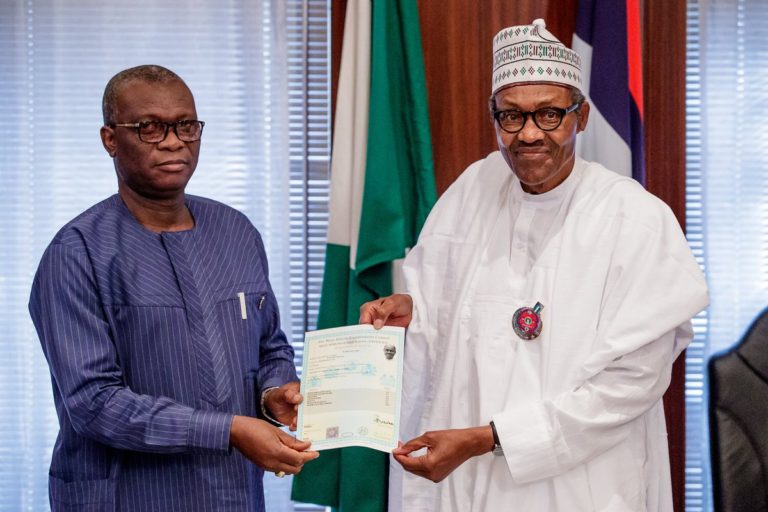
SETTLED: WAEC confirms Buhari sat for SSCE, issues him attestation

THE West African Examination Council (WAEC) has confirmed that President Muhammadu Buhari sat for the school leaving certificate examination.

WAEC Registrar, Iyi Uwadiae, issued Buhari an attestation and confirmation result at the State House on Friday.

The development should put a stop to the controversy that had surrounded Buhari’s credentials which came up again after the President submitted his nomination form for the 2019 presidential election, without including his school leaving certificate.

In the affidavit he deposed to as part of requirements by the Independent National Electoral Commission (INEC), Buhari stated that “All my academic qualification documents as filled in my Presidential form, APC/001/2015 are currently with the Secretary of the Military Board”.

A similar scenario had also played out prior to the 2015 general election as Buhari’s inability to provide some relevant academic credentials prompted series of lawsuits, all of which were later struck out.

Special Adviser to the President on Media and Publicity, Femi Adesina, took to Twitter to announce the recent development, as well as taunt those he described as “the naysayers”.

“WAEC presents attestation certificate and confirmation of school cert result to President Buhari. What will the naysayers say next?” Adesina tweeted.

The opposition Peoples Democratic Party (PDP) had threatened to go to court to challenge Buhari’s inability to present his school leaving certificate as required by the constitution.

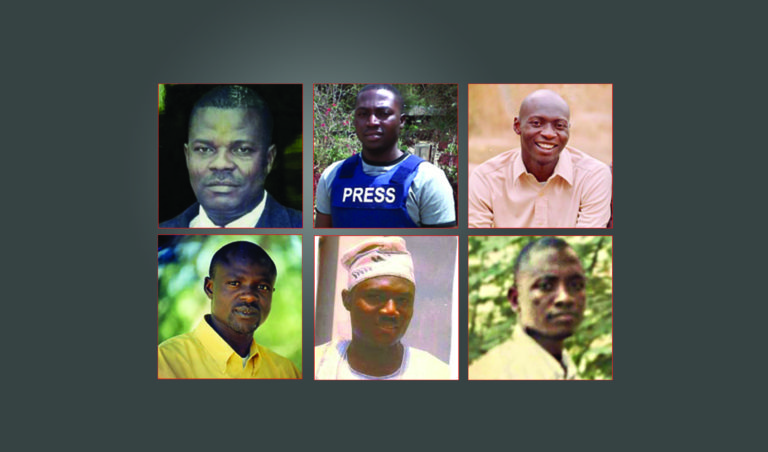
ROLL CALL: Here are 10 Nigerian journalists murdered with impunity in two decades

TODAY is the International Day to End Impunity for Crimes against Journalists. The Day was instituted after the UN General Assembly endorsed it in 2013.

The resolution for the commemoration of the day calls on UN member states to implement concrete measures to eradicate the culture of impunity against journalists.

Nigeria is one of the countries where murderers of journalists get away without the authorities ever bringing them to justice.

This year, Nigeria is ranked 13 out of 14 countries in the 2018 Global Impunity Index released by the Committee to Protect Journalists (CPJ), making it the sixth time that Nigeria is featured on the index since 2008 that CPJ began to compile the list.

In two decades, murderers of these 10 Nigerian journalists have still not been brought to justice. Here are the journalists murdered with impunity, according to CPJ:

Bayo Ohu

Ohu, 45, an assistant news editor The Guardian, was shot by unidentified assailants as he answered a knock at the front door of his house in Lagos on September 20, 2009. The six assailants took a laptop and cell phone, according to the journalist’s relatives and local news reports.

He was allegedly killed for his political reporting, especially his investigation into alleged fraud in Customs.  In May 2012, the court freed three suspects charged with Ohu’s murder on the grounds that the prosecution had failed to prove the case.

Enenche Akogwu

Unidentified gunmen shot Akogwu, 31, a reporter and camera operator with Channels TV, as he interviewed witnesses of terrorist attacks in Kano on January 20, 2012. Akogwu had just returned from a police news conference following coordinated bombings by the extremist Islamist group Boko Haram.

Fidelis Ikwuebe

Ikwuebe was a freelance journalist who contributed to The Guardian. He was abducted and murdered while covering violent clashes between the Aguleri and Umuleri communities in Anambra State on April 18, 1999.

It was not clear who was responsible for Ikwuebe’s death. It was alleged that the state military administration at that time was very sensitive about news coverage of the fighting, which left several hundred people dead, and the environment was a dangerous one for journalists.

Nathan S. Dabak and Sunday Gyang Bwede

Deputy Editor Dabak, 36, and reporter Sunday Gyang Bwede, 39, journalists for the monthly newspaper of the Church of Christ in Nigeria, were driving to an assignment when they were attacked by a mob in Jos, Plateau state on April 24, 2010.

They had chartered a motorcycle to travel to a scheduled interview with national parliamentarian Bitrus Kaze concerning ongoing outbreaks of deadly violence between Muslims and Christians in the area. Dabak and Bwede were stabbed by Muslim youths reacting to the discovery of a slain Muslim individual near a church.

Okezie Amaruben

Amaruben, the publisher of Newsservice magazine, was shot and killed by a police officer in Enugu State on September 2, 1998. Amaruben was checking on a printing job being done for him in a shop when police officers verbally and physically attacked him. One placed a pistol to his forehead and hit him with the gun after he had identified himself as a journalist.

People at the scene told the police officers that Amaruben was not the person they were looking for. He was being forced into a police vehicle when the officer fired his gun and the bullet pierced Amaruben’s skull. Authorities confirmed that the officer who shot Amaruben was arrested shortly after the murder.

Sam Nimfa-Jan

Nimfa-Jan, a journalist with the magazine Details, based in Jos, Plateau State, was killed in Kafanchan, Kaduna State, during ethnic clashes on May 27, 1999. He was on assignment covering riots between the Hausa Fulani and Zangon-Kataf groups that broke out over the installation of a new emir (traditional local leader) in the Jema’a area. Nigerian journalists, quoting local residents, said that Nimfa-Jan’s corpse was found with arrows protruding from its back. Suspicions were apparently high that Hausas had killed him.

Samson Boyi

Boyi, a photojournalist with the Adamawa State­owned newspaper The Scope, was killed when about 30 armed men attacked the convoy of the state governor, Haruna Bonnie, who was travelling from the state capital, Yola, to the town of Bauchi on November 5, 1999. Boyi was one of several journalists assigned to cover the trip.

Neither the identity nor the motive of the attackers has been determined. When they opened fire on the convoy, the governor’s security guards fired back. Boyi died in the crossfire. His colleague, Umar Mustaphar, a Yola-based reporter with the Nigeria Television Authority, sustained bullet wounds.

Tunde Oladepo

Oladepo, a senior correspondent with The Guardian newspaper of Lagos, was murdered by five masked gunmen, who entered his home early in the morning and shot him to death in front of his wife and children on February 26, 1998. Nothing was removed from Oladepo’s residence, ruling out robbery as a motive. Oladepo was until recently bureau chief of The Guardian’s state office in Ogun and was covering political affairs. Co-workers believe he was murdered because of his work as a journalist.

Zakariya Isa

Isa, 41, a reporter and cameraman for the Nigeria Television Authority (NTA), was killed in the Borno State on October 22, 2011. In an emailed statement issued after the killing, Boko Haram spokesman Abul Qaqa said the militants killed Isa “because he was spying on us for theNigerian security authorities.”

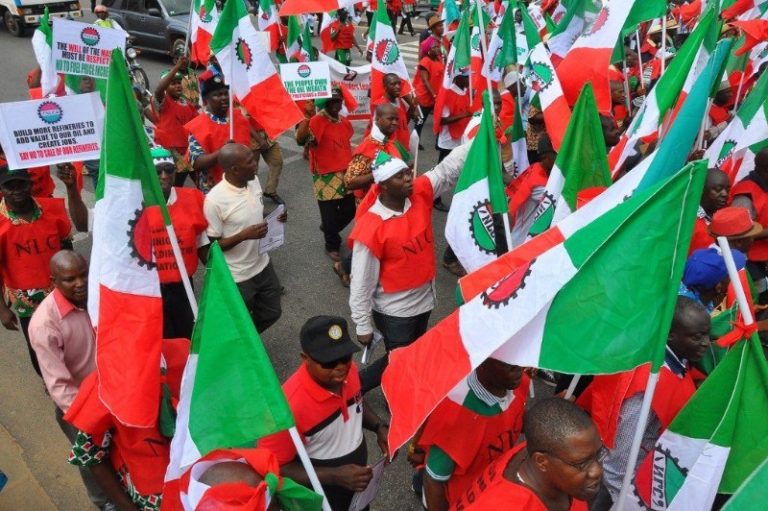
Court bars organised labour from embarking on strike over minimum wage

THE National Industrial Court (NIC) has granted an order restraining the Nigerian Labour Congress and the Trade Union Congress from embarking on strike over the issue of a new national minimum wage.

Both labour unions had planned to commence a nationwide indefinite industrial action from November 6, following the inability of the committee set up by the federal government to reach a concensus on a new national minimum wage.

Ruling on an ex-parte application filed by the federal government through the office of the Attorney General of the Federation, Justice Sanusi Kado of the NIC ordered the NLC and the TUC not to go ahead with the planned strike pending the determination of the suit before the court.

Justice Kado also restrained the NLC, the TUC and the Incorporated Trustees of the Nigerian Governors Forum (the first, second, and third defendants in the case respectively) from taking steps capable of destroying the subject of the dispute.

He said he was granting the ex-parte application so as to avoid the likely negative effect the strike could have on the nation’s economy and people. He subsequently fixed November 8 for the hearing of the main suit.

The current national minimum wage is N18,000, but the organised labour is demanding that the amount be increased to nothing less than N30,000, taking into consideration the hyper-inflation that is currently being experienced in the country. But the federal government said it can only pay N24,000, while state governments are proposing an even lower amount of N22,500.

Reacting to the recent development on Friday, National President of the NLC, Ayuba Wabba, said the union is yet to receive a copy of the court judgement, adding that the union will decide on the next line of action once it receives the court judgement.

He, however, insisted that the N30,000 is not too exorbitant an amount for the federal government to adopt as the new minimum wage. Wabba also said that some state governors, including those of Gombe and Bayelsa, have agreed to pay the amount being demanded by labour.

Army says Amnesty International’s report on Shiite protests is false

THE AI (Amnesty International) report on the clash between Nigerian soldiers and members of the Islamic Movement in Nigeria (IMN) some days ago is not a true reflection of what transpired, the Nigerian Army says.

This is in response to the allegation by AI that soldiers killed over 45 IMN members, also known as Shiite Muslims, during a procession in Abuja over two days.

AI said its research team “counted 24 bodies (23 male and one female)” while “trusted sources provided details of 21 others” killed by soldiers during the clashes.

“We have seen a shocking and unconscionable use of deadly force by soldiers and police against IMN members,” AI wrote. “This pattern clearly shows soldiers and police approached IMN processions not to restore public order, but to kill.”

But in a statement on Friday, the army denied the allegations by Amnesty International, describing them as “cooked up” and a figment of the body’s imagination aimed at painting Nigeria black among the comity of nations.

The military has never been sent to stop the protesting Shi’ites group at any given time. On the events referred to by the AI, the soldiers were not after the protesting Shi’ites, neither was there such a number of casualties,” the army explained.

“A convoy from the Army Headquarters Garrison Abuja was conducting a routine shipment of ammunition and missiles to a military formation in Kaduna escorted by troops when they ran into the protesters at Zuba in FCT.

“The protesting Shi’ites prevented the convoy from proceeding on its mission but rather attempted to overrun the escorts to cart away the shipment. Hence, the troops had to protect the goods and extricate themselves from the imminent mob action by applying minimum force.

“The IMN also had another confrontation with the military at a popular checkpoint along Nyanya – Mararaba road leading into the FCT. Those living in or transiting the FCT knows that the military checkpoint had been established since 2014 after the BHT attack on Nyanya Motor Park.

“Unfortunately, the group tried to overrun the checkpoint in which the military resisted. In all these attacks, the IMN was the aggressor while the military only acted in self-defence.”

The army, however, insisted that only six casualties were recorded in the two incidents, as against the 45 being claimed by AI, while seven members of the Shiite group and six soldiers were injured.

Earlier on Friday, the army, via its Twitter handle, shared a video of the US President, Donald Trump, urging the country’s military ‘open fire’ on rioters if they throw rocks at them.

“When they throw rocks, as they did at the Mexico military and police, consider it a rifle,” Trump said.

The Nigerian army shared the video perhaps as a justification for its actions during the clash with the Shiite Muslims.

Hepatitis B: Common, deadly but receives low attention in Nigeria

KHADEEJAH was in her final year at Al-Hikmah University, Ilorin, Kwara State in 2015, when she had fever and cough. She went for a routine checkup at the hospital where she was initially diagnosed with typhoid fever, but after subjecting her to further tests, she was confirmed to be hepatitis B positive.

Disturbed with the doctor’s report, she called her parents on phone to break the news to them with the hope to find succour.

But her parents became even more troubled for it is possible they also were infected with the disease. Though not genetic, Hepatitis B is a liver disease that can be caused by inherited conditions. The disease can be transmitted among family members.  But when her parents took tests to ascertain their status; no one was positive.

The disease could also be spread when someone comes in contact with blood from a person who has the disease. Hepatitis B (HBV) is 50 to 100 times easier to transmit sexually than HIV, studies have shown.

“I became worried because I have neither had a blood transfusion before nor had I undergone any surgical operation,” she said.

Her mother also was curious as to how she could possibly get the infection. Suspecting that  her mother was suggesting she could have got it from having a sexual intercourse, she told the old woman with emphasis: “I haven’t known any man, I had never had any intercourse with any man.”

That was three years ago.

The 23-year-old Khadeejah, now married with two children, has come to term with her medical condition.

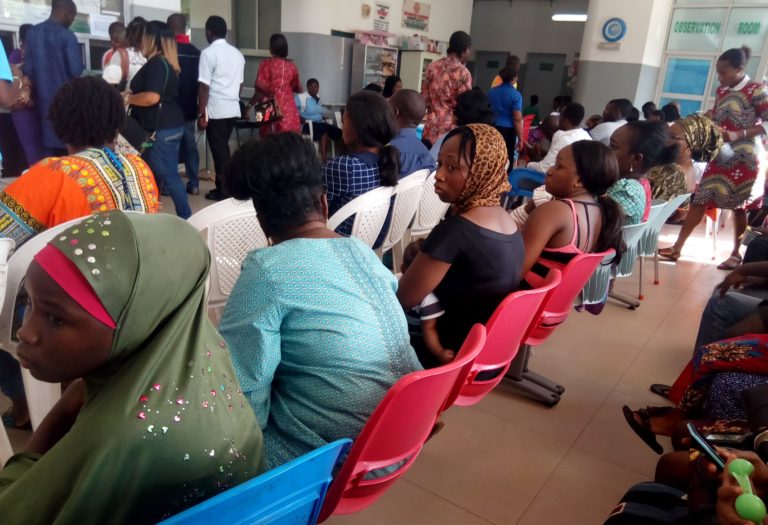
The ICIR reporter saw her last week at the consultation Room Two at the University of Abuja Teaching Hospital at Gwagwalada, Abuja, when she came for her usual medical checkup with a gastroenterologist (the specialist that treat hepatitis B patients).

She told The ICIR about the stigma and frustration she went through in the past years as a person living with hepatitis B. Just like HIV/AIDS, hepatitis B is infectious. And everyone who knows Khadeejah has being diagnosed with the disease has tried to avoid her, including her blood sister.

When I travelled to my sister’s house,  the usual reception has changed. 

‘Please don’t go near my children because I’ve not immunised all of them!’” she recalled her sister telling her during the visit.

“That was the first time I experienced stigmatisation from a family member,” she said.  The situation made her hate coming closer to children. “I don’t even touch them, and I don’t even want them to come close to me,” she said.

Khadeejah seems to have overcome her hypersensitivity after having children of her own. At the hospital where she was seen waiting for the doctor, her baby was burrowing head in her bosom. Then the baby became restless over what the mother could not understand, Khadeejah, noticing that, transfers the baby to the father who is waiting outside the consultation room.

The World Health Organisation described hepatitis B as a potentially life-threatening liver infection caused by the hepatitis B virus.

The disease attacks the liver, especially when it is chronic, and can be contacted through the blood or other body fluids of an infected person.

Ojonugwa Ameh, a consultant gastroenterologist at University of Abuja Teaching Hospital said that the disease, though a silent killer, is more deadly than HIV infection.  When it reaches the chronic stage, it affects the liver, leading to cancer of the liver and liver failure. So, when a patient is tested positive, there is a need to check if it is an acute or a chronic one.

The acute, Ameh explained, can be cured within six months of infection, as the body defence system builds up to eradicate the virus. After six months, there is no cure but a treatment which suppresses the virus from damaging the liver. The major part of the treatment is for patients to use their antiviral medication as prescribed –usually one pill per day.

The gastroenterologist said the symptoms include general body pains, stomach pains and malaria fever at an initial stage. Other symptoms are swollen of the stomach, legs and hands; vomiting;  stooling blood, and jaundice (the yellowish of the eyes), which shows when the kidney has been affected.

 Uzo Okwuasaba, a Senior Registrar, Gastroenterology Unit of Internal Medicine Department at National Hospital Abuja told The ICIR that the most common means of contacting the infection in Nigeria is through a mother-to-child contact which he called horizontal contact. This he said happened when a mother with the viral infection is not aware of her status and transfers the disease at birth.

Okwuasaba also said children under five years are more vulnerable to the viral infection, especially those who did not have immunisation, because these children could easily put a lot of dirty things in their mouth.

“The lifestyle of most of Nigeria’s babies is such that they play around, picking things easily into their mouth, and the children’s immune system is not always high,” he said.

In addition, Ameh said the infection could be transmitted through infected blood.  Other means are sharing of sharp objects like razors, clippers and using of unsterilised instruments for any procedures that go with the cutting of the body.

“People that cut their nails from the local nail cutters are at risk. The sterilisation of their instrument might not be very ideal, and hepatitis B is a tenacious virus that can survive on instrument and surfaces for a very long period,”  Ameh said.

The disease can also be contacted through sexual intercourse, and there are reported incidences whereby people contact the virus through saliva, but this is not common, Ameh said.

The high burden and awareness in Nigeria

The WHO  estimated that 11.2 per cent of Nigeria’s population is hepatitis B positive. The figure indicates that 20 million Nigerians are living with the viral infection.  And this represents that one in nine Nigerians has the disease.

Isaac Adewole, the minister of health, said during the 2017 World Hepatitis Day expressed determination of Nigeria to eliminate hepatitis B infection by 2021. The minister said it is achievable because the country already provides HBV vaccination as part of the national immunisation schedule for children and adults.

In addition, the country screens for HBV and hepatitis C virus (HCV) in all donated blood for transfusion and has a policy for injection safety.

However,  the screening and vaccination coverage among adults remains unsatisfactorily low in Nigeria due to a lack of awareness among the general populace, according to WHO.

Ameh confirmed that the level of awareness about hepatitis B is poor in Nigeria. “I see some professors who are ignorant of hepatitis B, he said. “If the elites can be ignorant of hepatitis B, what can we say about those in the villages.”

He added that the awareness of the hepatitis B screening is not adequate.  Most people do not know their status. Only when they come very sick, and most times at that stage, the damage has been done.

Similarly, the NHA doctor said there are lots of people with hepatitis B in Nigeria who do not know their status. This is because the only way they can know is by screening.

“We need as many screening centres, especially at the primary health care centres so that people can be tested and know their status early before liver diseases set in,” said Okwuasaba. He said hepatitis B has not received as much awareness like HIV, where it gets so many counselling and testing centres.

Checking through the Federal Ministry of Health budget between 2015 to 2017, a sum of 42.7 million was budgeted for test kits for hepatitis B and other transmissible diseases, but none of this allocation goes to the awareness campaign. The particular budget on test kits has been named for the three years as procurement and supply of transfusion-transmissible infections (TTIs) test kits and reagents for HIV, hepatitis B and C and syphilis for 500,00 blood samples.

However, the 2018 budget has included N90 million for campaign and screening of hepatitis B in three states in Nigeria. Out of this N90 million,  N30 million was budgeted for HIV, hepatitis, malaria, and Lassa fever awareness campaign in selected senior secondary schools in Kubwa, Abuja. Another N30 million for the screening and awareness campaign for HIV/AIDS, hepatitis and breast cancer in Zaki-Biam Ukum local government area in Benue State.

The last N30 million was budgeted for the screening and vaccination for hepatitis B at Aniocha and Oshimili federal constituency in Delta State.

Ganduje fails to attend bribery hearing as fourth video hits social media

GOVERNOR Umar Ganduje of Kano State has failed to attend the investigative hearing by the state’s House of Assembly into an allegation of bribery against him.

Ganduje sent his Commissioner of Information, Mohammed Garba to represent him at the hearing which was put together by a seven-man committee set up by the Speaker of the assembly,  Kabiru Rurum, to investigate the matter.

An online newspaper, Daily Nigerian, had accused Ganduje of receiving kickbacks amounting to over five million dollars from contractors that work for the state government.

Jafar Jafar, Publisher of the paper, has already appeared before the panel to reiterate the allegation, explaining how a contractor working for the Kano State government had agreed to attach cameras to his kaftan in order to capture the videos.

Jafar also stressed that the video clips were authentic and had not been doctored in any way.

However, Garba, who attended the hearing on Ganduje’s behalf on Friday, dismissed the videos as fake.

Meanwhile, Daily Nigerian has released another video clip (the fourth in the series) purportedly showing Ganduje collecting wads of dollar bills from someone whom the paper said was a contractor. The latest video, like the previous ones, was released via the social media on Thursday evening.

Nigeria Army ‘happy’ as Trump urges US military to ‘open fire’ on rock-throwing protesters

THE Nigerian Army has shared a video of the President of the United States of America, Donald Trump, urging the country’s military to ‘open fire’ if protesters throw stones at them.

Trump’s directive to the US military was broadcast live on television, but the Nigerian army shared it via its Twitter handle, perhaps as a justification for a similar scenario that occurred in various parts of the Federal Capital Territory (FCT) recently.

Several people were killed when security operatives, including soldiers and policemen, shot at protesting Shiite Muslims in Abuja between Saturday, October 27 and Tuesday, October 30, 2018. Videos of the clash which was all over the social media, showed the protesters hauling rocks at the security operatives, who returned the assault by opening fire on them.

In total, the Nigerian Authorities said six people were killed and many others, including security personnel, sustained various degrees of injuries. But many other reports, including one by Amnesty International, put the number of casualties as high as 45.

In the video which was shared on the Nigerian army’s Twitter handle, Trump urged the military to treat stone-wielding protesters as though they were carrying rifles.

“I will tell you this, anybody throwing stones, rocks, like they did to Mexico and the Mexican military and Mexican police, with the badly hurt police and soldiers of Mexico, we will consider that a firearm,” Trump said.

“Because there’s not much difference when you got hit in the face with a rock, which, as you know, it was very violent a few days ago. Very, very violent.

“Because they’re throwing rocks violently and viciously, you saw that three days ago, really hurting the military. We’re not going to put up with that.

“They want to throw rocks at our military, our military fights back. We’re going to consider, and I told them, consider it a rifle.

“When they throw rocks, as they did at the Mexico military and police, consider it a rifle.”

The Nigerian Army has been criticised by many local and international human rights groups for using excessive force on the protesters, leading to several deaths and injuries. But by sharing Trump’s comments about a similar incident, the army appears to be trying to justify its actions.

Meanwhile, a message being circulated on the social media, especially on Whatsapp, an instant messaging mobile application, is asking residents of Abuja to be cautious as there could be another round of protest by the Shiite group.

“There are indications that the IMN (Islamic Movement in Nigeria, also known as Shiites) is planning to converge at Sky Memorial Complex, Berger, Abuja and thereafter continue with its protest to demand the release of detained leader, Shiek El Zakzaky,” the message read.

“The potential for confrontation with security forces is high given the resolve by the latter to prevent the protest as we have seen over the past five days.

“Further reports indicate that the IMN members vow to continue protest at one of the Jumaat Mosque after Friday prayers.”

The ICIR cannot independently authenticate the message.

Alleged Certificate Forgery: Anti-corruption group petitions IGP, seeks investigation of NUJ president

0

THE Civil Society Network Against Corruption (CSNAC) has urged the Inspector General of Police, Mr. Ibrahim Idris, to investigate allegations of certificate forgery against the  president of Nigeria Union of Journalists (NUJ), Christopher Isiguzo.

In a petition forwarded to the IGP and signed by CSNAC’s chairman,  Olanrewaju Suraju, the Network said the requested action on Isiguzo, who was a two-term vice-president of the same union, is pertinent to serve as deterrent to future law breakers, especially amongst the elite and politically exposed persons.

According to CSNAC, its request is based on a petition to the NUJ Credentials Committee details of which was published on the 2nd October, 2018 by the International Centre for Investigative Reporting on its website.

The Network said the petition alleges that Mr. Isiguzo who was one of the seven presidential hopefuls of the NUJ, forged at least two of his certificates. It was also alleged that Mr. Isiguzo’s qualifications and eligibility for national office are being presently contested before a National Industrial Court in Enugu.

“Though, the committee claimed it found no substance in the allegations and cleared the candidacy of Mr. Isiguzo, Mr. Isiguzo himself disowned the published certificates as attributed to him and also were among those he submitted to ThisDay newspaper, where he is presently the South East Bureau Chief.

“The contested certificates includes a HND from Federal Polytechnic, Oko, issued in 1998 and a diploma in Public Administration from Hyles-Anderson College obtained in the same year.

“The certificates have irregularities pointing to the fact that they are forged, one of which is the fact that it is impossible to get two diplomas and a HND in August, November and December of the same year. Also, the Hyles-Anderson College certificate in his name is obviously forged as the school is a bible college and does not offer a course in Public Administration which Mr. Isiguzo claimed to have studied.”

The.petitIon said in addition to the above, the certificate claims to have been signed by the Rector and a Registrar, but none of the said designation exists in the institution’s management, rather the offices operated by the college include Chancellor, President, Academic Dean and Director of Admissions.

“According to The ICIR, the management of Hyles-Anderson college has confirmed that indeed the diploma in public administration is not authentic, as John Wilkerson, Pastor and Chancellor of the college, replying to an emailed enquiry, responded that while the document contains the institution’s name, address, and crest, it was not issued by them.

He said: “Neither do the names upon it represent any officiants or graduates of our college,” he added. “We do not issue degrees in public administration and we do not utilise the term, ‘rector.’ Thank you.”

“As regards the HND certificate, which supposedly originates from the Federal Polytechnic Oko, it is also suspect as when it was compared with another notification of result from the institution issued in 2002 for a 1999 graduate there are clear contradictions in the font, style, heading, recipient address underline, and page border thickness.”

The Network noted further that the most striking contrast, however, is in the stamps used.

“In the latter document we find that the words “Federal Polytechnic Oko, Anambra state…” are written in a cursive font, and the stamp has no border lines. But in Isiguzo’s certificate, not only are there two border lines, the font is different and in upper case and the stamp belongs to another university entirely: Anambra State Polytechnic, located in the same state as Federal Polytechnic, Oko.

“The ICIR also reported that sources at This Day informed them that the paper has issued Mr. Isiguzo a query and is expecting a response, following the forgery allegations against him. It was also gathered, however, that no independent investigation has yet been conducted to confirm the merits of those allegations.”

CSNAC noted that, “It is on the basis of the above facts that we as a concerned Civil Society Organisation bothered about the high incidents of certificate forgery in the leadership sector of society, hereby request that the police use the instrumentality of their good offices to conduct an urgent and robust investigation into the said allegations of certificate forgery and prosecute the suspect where found wanting.

“The requested action is pertinent to serve as deterrent to future law breakers, especially amongst the elite and politically exposed persons.

“This is with a view to stemming the menace from rapidly gaining grounds in society. If the media, especially at the leadership of its union, is enmeshed in credibility crisis, how does it discharge its constitutional role of watchdog of the society or even hold public office holders accountable with a leadership accused of unresolved forgery? This ultimately will compromise the integrity of the association and expose members of the union to the threat of a compromising leadership,” the petition read.

US urges Nigeria to probe recent killings of Shiite protesters by security personnel

THE Embassy of the United States of America in Nigeria has urged the federal government to investigate the recent deaths resulting from the clashes between security agencies and Shiite protesters in Abuja.

Official figures by the Nigerian authorities put the number of casualties at six, but other reports, including by Amnesty International, say the number is far higher.

In a statement on its website on Thursday, the U.S. Embassy said it is “concerned by the deaths resulting from clashes between Nigerian security forces and members of the Islamic Movement of Nigeria in areas surrounding Abuja”.

“We urge Government of Nigeria authorities to conduct a thorough investigation of the events and to take appropriate action to hold accountable those responsible for violations of Nigerian law. We urge restraint on all sides.”

In its report on Wednesday, Amnesty International had condemned what it described as the excessive use of force by security operatives on the Shiite Muslims whom the group said were observing a “peaceful procession”.

“We have seen a shocking and unconscionable use of deadly force by soldiers and police against IMN members. Video footage and eyewitness testimonies consistently show that the Nigerian military dispersed peaceful gatherings by firing live ammunition without warning, in clear violation of Nigerian and international law,” said Osai Ojigho, Director of Amnesty International Nigeria.

“Those injured were shot in different parts of the body – head, neck, back, chest, shoulder, legs, arms – and some of them had multiple gunshot wounds. This pattern clearly shows soldiers and police approached IMN processions not to restore public order, but to kill.”

The Shiite group were protesting the continued detention of their leader, Ibrahim El-Zakzaky who has been held by the Department of State Services (DSS) since December 2015, in spite of a court judgement ordering his release.

Many of the protesters were arrested during the protest and 120 of them were arraigned in court on Thursday.