Home Blog Page 257

Killings: Lawyer berates Benue governor for declaring public holiday for Tinubu’s visit

0

HUMAN rights activist and lawyer Inibehe Effiong has berated Benue State Governor Hyacinth Alia for declaring a public holiday to welcome President Bola Tinubu, who visits the state on Wednesday, June 18.

Tinubu is visiting the state to condole with hundreds of families who have lost loved ones to persistent attacks by gunmen within weeks under his watch and the state governor.

Alia declared the holiday in a statement signed by Secretary to the State Government, Deborah Aber, on Tuesday, June 17.

He encouraged the state residents to come out en masse to receive the president and his entourage.

“This is in honour of Bola Ahmed Tinubu, the President and Commander-in-Chief of the Armed Forces of the Federal Republic of Nigeria, who is scheduled for a one-day visit to the state.

“The visit is to commiserate with the government and people of the state over incessant security challenges,” the statement said.

Tinubu said on Monday that he would visit the state following pressure on him by Nigerians after last Friday’s attack in the Yelewata community that reportedly left over 200 residents dead.

Reacting to the public holiday declared by Alia for the president’s visit, Effiong wrote on his Facebook page: “The people of Benue State who are being slaughtered, have been told by their unserious governor to come out happily and colourfully and welcome the same President Tinubu who has failed to protect them. This is just inconceivable. We are not yet ready in this country.”

The ICIR reported that the Labour Party presidential candidate in the 2023 election, Peter Obi, had advised Tinubu to extend his visit to Mokwa, Niger State, where hundreds of people were killed in flooding recently.

Obi was among Nigerians who called out the president for not visiting Benue despite the magnitude of tragedies that have befallen the state from gunmen attacks.

In another development, Alia has rejected calls for self-defence in the face of increasing attacks on the state by gunmen.

The governor stressed that it is unwise for civilians to confront armed assailants, arguing that it would only worsen the crisis.

Alia said this while speaking on Focus Nigeria, a programme on African Independent Television (AIT), on Tuesday.

“You need to be trained to understand the dynamics of fighting guerrilla warfare. The Constitution permits all of us to defend ourselves, but to what extent?” he queried.

He endorsed community policing as a more strategic and sustainable solution to the crisis.

Zenith, Access, First Bank may suspend dividend payments until 2028, here is why

ZENITH, Access, and First banks are likely to suspend dividend payments to shareholders until 2028, arising from their loan exposure.

A new report titled ‘Nigerian Banks, Cash is King’, released by Renaissance Capital on Monday, June 16, indicated this.

It showed that most banks would likely suspend dividend payments for multiple years to meet stricter prudential standards imposed by the Central Bank of Nigeria (CBN).

The banks ranking highest in this loan exposure are Zenith Bank, First Bank, and Access Bank.

“Specifically, we anticipate that the banking arms of AccessCorp, FirstHoldco, and ZenithBank to potentially resume dividend payments in 2028.

“As such, we expect dividend payments henceforth to come from the non-banking subsidiaries of the above-mentioned Groups. Given that the majority of these groups’ income is primarily from their banking business, we do not see any substantial dividend payments from their non-banking subsidiaries,” the report explained.

In a notice on June 13, CBN had instructed all the banks with unresolved forbearance exposures to halt dividend payments, defer executive bonuses, and suspend all new investments in offshore subsidiaries.

It said the directive is aimed at strengthening capital buffers and ensuring adequate provisioning against impaired loans, especially those that risk breaching the regulatory Single Obligor Limit (SOL).

It expects the suspension to remain in place until affected banks have fully provisioned for their forbearance exposures and phased them out entirely.

According to analysts, a breach of the SOL means a bank had lent money to a single borrower, a group of related borrowers, or a sector above the required threshold.

Most banks have been in this state of non-compliance with the rule and have tended to favour the oil and gas sector over others.

In December 2023, The ICIR reported that First Bank’s total loans to the agriculture sector in five years were less than three per cent of the bank’s loans and advances to customers, relative to other banks.

In a recent interview in March this year, a former top banker hinted particularly at the challenges small and medium-sized enterprises (SMEs) face in accessing loans, despite accounting for 96.9 per cent of businesses, and 87.9 per cent of employment, which adds to the reasons many SMEs fail a few years after startup.

For most banks under its coverage, Renaissance Capital analysts expect both interim and final dividends to be paused indefinitely.

The report shows that among the tier-1 banks, Zenith Bank, First Bank, and Access Bank have significant loan exposures of 23 per cent, 14 per cent, and four per cent, respectively, of their gross loan books to rank highest among other banks.

Among the tier-2 banks, Fidelity Bank and FCMB have loan exposures of 10 per cent and 8 per cent of their gross loan books, respectively.

On the positive side, Stanbic and GTB have zero per cent loan exposure in their gross loans.

Forbearance amounts estimate

A breakdown of the loan exposure in absolute terms according to the Renaissance Capital report showed Zenith Bank has a significant $1.6 billion loan exposure, followed by First Bank, $887 million, and Access Bank, $304 million.

The figure presented in US dollars also showed Fidelity Bank’s loan exposure at $296 million, United Bank for Africa (UBA) at $282 million, and FCMB at $134 million.

“Of note, our estimates for Fidelity, FCMB, Access, GTCO, and UBA are based on recent engagements with management. However, our Zenith Bank estimates are based on our last engagement with management in December 2024.

“We support the CBN’s orthodox stance, and believe that this more rigid position on enforcement should provide a new policy standard on new directives; too often the market has expected a flip-flop in policy or enforcement timing,” the report stated.

It, however, noted that the cash reserve ratio (CRR), which the CBN has currently set at 50 per cent, is too high and should be cut to ease pressure on banks.

Immediate effect on the bank

Following the expected pause in dividend payments for most of the banks, this event will weigh on bank share prices as investors react negatively to the dividend suspension.

The analysts at Renaissance Capital believe that the shares of most banks may not be affected because of the steps they have taken in achieving the CBN recapitalisation requirements.

They, however, see a potential adverse impact for UBA, Fidelity Bank, and FCMB, as the banks still need to raise additional capital to meet the CBN’s N500 billion minimum paid-in capital requirement for internationally licensed banks.

Shareholders lament the CBN policy measure

President of the New Dimension Shareholders Association, Patrick Ajudua, told The ICIR that shareholders are very concerned about the CBN directive as it will no doubt hinder investors from getting their dividends from the bank.

It will also affect the capital appreciation of banks’ market price, he lamented.

“At this moment of economic difficulties and poor purchasing power, its effect will be catastrophic and unbearable,” he said.

According to Ajudua, investors in the capital market believe in the long-term benefits of this temporary suspension, which will ensure a stronger capital base and attract genuine capital for the affected banks.

“We take solace that this measure will affect only a few banks and believe that at the end of the period it will strengthen the resilience and stability of the banking sector, enhance transparent provisioning, and promote prudent internal capital retention within this transitioning period.

“Thus, we call on the CBN and the affected banks to work out a detailed plan that will make them exit the forbearance expeditiously and in the interest of shareholders, so that they can commence dividend payment in the shortest possible time,” Ajudua added.

On his part, the national chairman Progressive Shareholders Association of Nigeria (PSAN), Boniface Okezie, urged the CBN not to jeopardise the efforts of the commercial banks.

He said, CBN, having asked the banks to recapitalise to N500 billion, investors have continued to help the banks to actualise it.

He called on the apex regulator to borrow a leaf from its foreign counterparts, asserting that it is not the way to regulate the financial sector.

“The CBN is putting the bank in danger. Their pronouncement is already putting the banks’ stocks into a free fall now, and if not checked, it is going to affect investors to dump the shares of the banks, which is not good for the economy at this point,” Okezie said.

He noted the economy is not doing well at the moment, further urging the regulator not to worsen the already battered situation with its policy statements.

“They know banks that have forebearance. Not every bank on that radar, most banks that quoted on NGX (Nigerian Exchange Limited) are not there in CBN so-called forbearance, even the common man knows the one CBN have control of, but they are not on stock exchange lists.

“They must be careful and refrain from general statement that will affects the banks and its shareholders, whatever is left among banks non-performing oil gas loans in the banks they have providing for it on their profits whatsoever is lefts must be allowed to make provisions as they have been making without affecting their obligations to their shareholders from the profits they make,” Okezie said.

He further urged regulatory caution in technically dealing with issues in the financial sector in order not to affect the general well-being of the economy.


Why NBS inflation data is suspect, distorted – CFG Advisory

The Chief Executive Officer (CEO) of CFG Advisory, Tilewa Adebajo, on Tuesday, provided reasons why the May inflation data released by the National Bureau of Statistics (NBS) is highly suspicious and distorted.

The economic advisory firm argued that the delayed release of the gross domestic product (GDP) by the statistics office questions the exactness of the inflation data, since it wasn’t benchmarked against the actual current growth of the country’s economy.

“Lots of people have their purchasing power eroded. There’s a disconnect between what the NBS says and what the markets say. If you take a look at food prices in Ketu market, for instance, are they stabilising? If the NBS is not careful, the inflation numbers could go the way of unemployment figures it released recently,” Adebajo, who heads the Advisory firm, said in reaction to the May data released by the statistics office on Monday.

“The NBS is causing a bit of confusion without proper benchmarking. One of the things I had to say is that we hadn’t seen the first quarter GDP report. So, if you’re going to be going to compare the rebased inflation numbers, what are you comparing them against? Is it against the previous GDP numbers, which obviously would be distorted,” he added.

He further questioned the delay in releasing the GDP, adding that,” GDP figures as a key component that helps investors make investment decisions.

“We’re talking about rebased GDP, and where’s the figure? We’re already in June, and we don’t know how the economy is growing in Nigeria, according to the NBS. We all have to depend on our analysis and research of the market’s official data. This is confusing,” he stressed.

He added that Nigerians could be forced to produce their numbers if the statistics office produces numbers without explaining how the Nigerian economy is growing.

Tilewa Adebayo of CGF Advisory.
Tilewa Adebayo, the CEO of CGF Advisory.

The ICIR reports that despite rebasing of the inflation figures, the statistics office is yet to unveil the GDP figures for the year already cut in half, which the Advisory firm says test the authenticity of released inflation numbers.

“We’re currently in June, and we don’t know how the GDP is growing when the inflation figures should be benchmarked against the actual growth of the economy,” he said.

GDP stands for gross domestic product. It’s a widely used indicator of a country’s economic performance, representing the total value of goods and services produced within its borders over a specific period of time, usually a year.

It measures household spending on goods and services, spending but businesses on capital goods such as equipment and buildings, as well as the government’s spending on goods and services.

It also includes the total values of exports minus imports.

Recall, the statistics office on Monday, June 16, said Nigeria’s headline inflation dropped to 22.97 per cent in May when compared to 23.71 per cent in April.

The data marks the second consecutive month of decline in the inflation rate since the NBS rebased its consumer price index.

The NBS data also shows moderation in food inflation to 21.14 per cent in May from 21.26 per cent in April.

“The significant decline in the annual food inflation figure is technically due to a change in the base year,” the statistics office explained.

The advisory firm said it’s a contradiction if the inflation figure is moderated because of rebasing, while the NBS remains mute on GDP figures, which show how the economy grows in a specific period.

“It is important going forward that the NBS brings forward its GDP numbers for the first and second quarters. If they’re going to rebase the GDP.

“What we should be doing now is to look at the monetary policy committee meeting and see whether the inflation decline is enough to cut interest rates. That’s how we determine the inflation numbers by the day,” Adebajo said.

FCT’s 270 PHCs have only 117 nurses – NANNM Chairman

0

THE Chairman of the National Association of Nigeria Nurses and Midwives (NANNM), Federal Capital Territory (FCT) Council, Jama Medan, has decried inadequate manpower in public primary healthcare centres (PHCs) in the nation’s capital.

In an interview with The ICIR, Medan said only 117 nurses and midwives worked in 270 PHCs in the FCT.

Besides, he said the last recruitment into the PHCs was in 2008.

Despite the shortage, Medan noted that there were over 3,000 licensed but unemployed nurses in the FCT who could be recruited.

He argued that no matter how nurses migrate out of the country, there would be more than enough to recruit for the nation’s health facilities.

Medan spoke on the backdrop of the impacts of the over two-month-old strike embarked upon by healthcare workers in the six area councils of the FCT. In addition to health workers, all primary school teachers and area council workers have downed tools since late March this year over the council’s alleged failure to pay the N70,000 minimum wage and other arrears.

Medan said, “Let me tell you the truth; the last recruitment of nurses and midwives done by the area councils was in 2008. Since 2008, there’s been no recruitment. People have retired, some have died, and others have left the country. That’s why the numbers have dropped.”

He added that in some places in the FCT, some PHCs were closed down because “the government doesn’t care. How can you have 270 PHCs with only 117 nurses and midwives?” he queried.

He said shutting down primary healthcare centres had serious implications for the health and well-being of FCT residents.

He added that pregnant women and children were mostly at risk of dying if they could not access care.

The nurses’ leader said in February, before the strike, 104 pregnant women gave birth at the Karamajiji Primary Health Care near the National Stadium, and 28 women delivered their babies at the PHC Kuchigoro, while another 23 put to bed at the Kuje Health Centre.

He said the shutdown of the facilities had far-reaching consequences, including the failure of people living with tuberculosis (TB) and HIV not having access to their drugs for two months.

“Tuberculosis patients are not supposed to miss even one medication because of the risk of them developing resistance to their drugs. Since we closed these facilities for the past two months, those TB patients have not been getting their drugs, and they stand the risk of infecting other people,” he said.

He raised similar concerns about vaccination, particularly the oral polio vaccination.

Medan attributed the closure to the Area Council chairmen’s alleged refusal to pay the minimum wage and other workers’ entitlements, despite allegedly receiving funds for the payment from the government.

He cited a meeting at the House of Representatives where the chairmen were asked to explain the use of N4.1 billion, which he said was released to them, but they failed to provide a satisfactory account.

The NANNM chairman called on the National Assembly and the Presidency to intervene and call the Area Council chairmen to order.

He opined that the crisis sent the wrong signal to donors, including the World Health Organization (WHO) and Global Fund, which support healthcare programmes in the country.

Obi to Tinubu: Don’t ignore Niger flood victims after visiting Benue

0

LABOUR Party (LP) presidential candidate in the 2023 poll, Peter Obi, has challenged President Bola Tinubu to extend his planned visit to Benue State where hundreds of people have been killed in recent months by gunmen to Niger State that has lost a similar population to flooding. 

While thanking Tinubu on Tuesday, June 17, for “finally choosing to visit the site of the brutal killings in Benue State.” Obi urged the president to visit the victims of the flood in Mokwa, Niger State, also located in North-Central geo-political zone where Benue is.

“Both Benue and Niger States have lost over 200 lives each due to recent tragedies. In Mokwa alone, more than 200 people were confirmed dead, and over 1,000 are still missing following the floods. These are not just statistics; they are the lives of Nigerian families torn apart and their communities destroyed.

“The distance from Abuja to these affected areas is not far. Abuja to Makurdi is about 282 km, and Abuja to Mokwa is about 287 km,” Obi said.

The ICIR reported that Obi expressed concern over Tinubu’s failure to visit the two states, contrasting the president’s action with the swift responses of leaders in countries like India and South Africa during similar crises.

Obi highlighted how India Prime Minister, Narendra Modi, promptly visited the lone survivor of the Air India plane crash late last week, while the Nigerian government has not made any attempt to visit victims of Niger and Benue states tragedies.

Recall that Tinubu, during the inauguration of the Greater Abuja Water Supply Network, condoled with the people of Benue State over the attack on the Yelwata community, reportedly resulting in the loss of over 200 lives.

A few hours later, the president announced that he would visit the state on Wednesday.

Accountability Lab Nigeria sparks government actions in Edo, Ekiti

0

A RADIO programme aimed at amplifying citizen voices is making waves in Edo and Ekiti states, prompting the state governments to take concrete steps toward addressing long-standing infrastructure deficits, Accountability Lab (AL) Nigeria has said.

The initiative, Voices of the Community, launched by AL Nigeria, provides a platform for citizens to express their concerns about governance and service delivery, particularly in the areas of health and electricity infrastructure.

Through live call-in and discussions focused on public procurement, the programme has become a channel for civic engagement and policy influence, the organisation said in statement it mailed to The ICIR.

It noted that in Edo State, the programme drew attention to the deteriorating state of primary healthcare (PHC) facilities, adding that citizens called in to report issues ranging from broken-down clinics and the absence of medical personnel at work to a lack of essential drugs.

The episode, which centred on health-related procurement, captured the state government’s attention, it said.

Part of the statement reads, “We’ve always felt ignored when it comes to community infrastructure, but the radio programme gave us a platform to speak and be heard. Now, the government is acting, and it shows that change is possible, said Deborah, a resident of the state.”

Following the complaints raised on the programme, AL NIgeria said the state government, through the Deputy Governor, Dennis Idahosa, announced the government’s commitment to strengthening PHC services across the state.

He was quoted to have said that doing so aligned with Governor Monday Okpebholo’s SHINE agenda – an acronym for Security, Health, Infrastructure, Natural Resources and Agriculture, and Education.

“We are taking steps in our collective mission to strengthen the PHC system and improve healthcare outcomes,” Idahosa stated.

The Storytelling Development Officer at AL Nigeria, Blessing Anolaba, emphasised the impact of citizen engagement with the government. 

“After the episode aired, the government committed to improving PHC centres. We’re excited to see actions that benefit the people as a result of our advocacy,” Anolaba said in the release.

Meanwhile, in Ekiti State, the programme spotlighted power supply challenges. Residents of Housing Road in Ado-Ekiti, the state capital, shared their experiences of prolonged blackouts affecting homes and businesses.

This public feedback prompted the state government to initiate a transformer installation project in the affected area, restoring hope and electricity to the community, according to AL NIgeria.

“It’s good that people have a platform to raise complaints about what the government is not doing right,” said Otoide Kelly, one of the programme’s presenters was quoted as saying.

“Through AL Nigeria’s use of the “AI in Open Contracting” platform, citizens are becoming more aware of procurement processes and using that knowledge to demand accountability. The growing responsiveness from state governments signals a shift toward more participatory and transparent governance,” Kelly added.

Trump: ‘Iran cannot have a nuclear weapon’, urges evacuation of Tehran amid escalating Israel–Iran conflict

UNITED States President Donald Trump has urged Iranians to evacuate Tehran, citing the Iranian government’s refusal to accept a deal aimed at limiting its nuclear weapons programme, as clashes between Israel and Iran entered a fifth day.

The ICIR reported that Israel’s military targeted Iran’s nuclear and military sites through airstrikes on Friday, June 13.

President Trump departed the G7 summit early on Monday, citing the escalating Middle East crisis, but denied that his exit was related to any efforts to broker a ceasefire between Israel and Iran. His remarks came after French President Emmanuel Macron claimed the US had proposed a truce.

“Wrong! He has no idea why I am now on my way to Washington, but it certainly has nothing to do with a ceasefire. Much bigger than that,” Trump wrote on his Truth Social platform late Monday.

Earlier in the day, Trump reiterated his hardline stance on Iran, urging the country’s residents to evacuate Tehran and criticising its leadership for rejecting a nuclear agreement with the US.

“Simply stated, Iran cannot have a nuclear weapon. I said it over and over again! Everyone should immediately evacuate Tehran!” he posted.

Meanwhile, world leaders gathered at the G7 summit in Canada called for an immediate de-escalation of what they described as the most serious conflict yet between the two regional rivals. The leaders condemned Iran as a destabilising force and reiterated that it must never acquire nuclear weapons, while affirming Israel’s right to self-defence.

An Israeli strike on the central Iranian city of Kashan killed three people and injured four others, Iran’s Nournews reported on Tuesday.

Iranian media reported a series of explosions and intense air defence activity in Tehran early Tuesday, with smoke seen rising from the eastern part of the city following the suspected impact of Israeli projectiles. According to the Asriran news website, air defences were also activated in Natanz, located about 320 kilometres (200 miles) away and home to critical nuclear facilities.
Israel’s military announced on Tuesday that it had killed Iran’s wartime chief of staff and conducted widespread strikes on Iranian military targets, including missile launchers and weapons storage facilities.
Israel reported targeting Iran’s state broadcasting authority late Monday. Footage captured the moment a newsreader rushed from her desk as an explosion occurred, and the strike resulted in three deaths, according to Iranian state television.

In Israel, air raid sirens sounded in Tel Aviv shortly after midnight and again early Tuesday morning, followed by several loud explosions over the city. Reuters witnesses also reported hearing blasts over Jerusalem and Herzliya, where a building was reportedly damaged.

Iranian officials said the conflict has claimed 224 lives so far, mostly civilians. Israel, in turn, reported 24 civilian deaths. Israeli Finance Minister Bezalel Smotrich stated that nearly 3,000 Israelis had been evacuated due to damage caused by Iranian strikes.

The ICIR reported that at least eight people were killed and 100 others injured in Tel Aviv. The port city of Haifa was attacked during a series of retaliatory attacks by Iran, launched in response to Israeli strikes on its nuclear and ballistic missile programme.

Officials said the attack occurred before dawn on Monday, June 16, destroying several homes.

Emergency services said search and rescue operations were ongoing in Haifa, where around 30 people were injured, as dozens of first responders rushed to the impacted areas.

Nigeria inflation eases to 22.97% in May – NBS

NIGERIA’S headline inflation dropped to 22.97 per cent in May relative to 23.71 per cent in April, latest data from the National Bureau of Statistics (NBS) has shown.

The statistics office stated this in its monthly Consumer Price Index (CPI) report released on Monday, June 16.

The movement of the inflationary pressure indicates that headline inflation decreased 0.74 per cent compared to April 2025

It marks the second consecutive month of decline in the inflation rate since the NBS rebased its CPI.

However, on a year-on-year basis, the headline inflation rate was 10.98 per cent lower than the rate of 33.95 per cent reported by the NBS in May 2024.

The data also shows moderation in food inflation to 21.14 per cent in May from 21.26 per cent in April.

This means that on a year-on-year basis, food inflation was 19.52 per cent lower than the 40.66 per cent in May 2024.

“The significant decline in the annual food inflation
figure is technically due to the change in the base year,” NBS noted.

NBS further puts the food inflation rate on a month-on-month basis at 2.19 per cent, compared to 2.06 per cent in April.

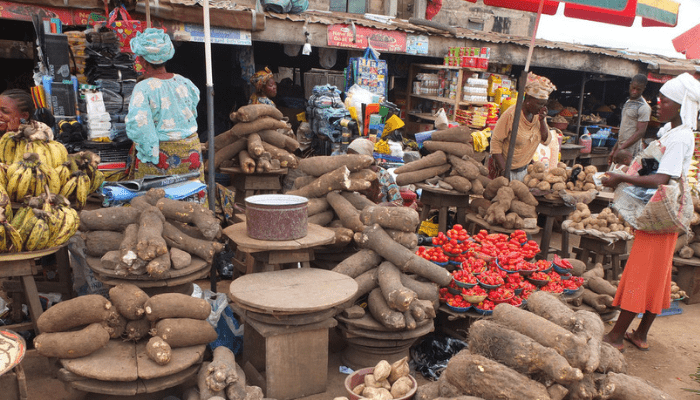
“The increase can be attributed to the rate of decrease in the average prices of Yam, Avenger (Ogbono/Apon), Cassava Tuber, and Maize
Flour, Fresh Pepper, Sweet Potatoes, etc,” it said.

It revealed further that food inflation was highest in Borno at 64.36 per cent, Bayelsa at 39.85 per cent and Taraba at 38.58 per cent but slowest in Katsina at 6.90 per cent,  Rivers at 9.18 per cent, and Kwara at 11.31 per cent.

The ICIR reports that the moderation in inflation rates since this year arises as a result of the rebasing exercise from the NBS, which has yet to reflect the surging prices of food items in the marketplace.

Early this year, the statistics office initiated the rebasing of the CPI by including more items in the inflation basket and comparing prices in 2025 with prices in 2024 instead of 2009.

According to the Statistician General and Chief Executive Officer of NBS, Adeyemi Adeniran, the rebasing was done to absorb the new ministries that the new government created, upgrade the CPI basket, and change the methodology of CPI and gross domestic product (GDP).

With the rebasing, the NBS believes that the rebased CPI reflects the current inflationary pressure and consumption pattern of people living in the country; however, the drop in inflation does not mean a decline in the general price level as costs of food items and others are seen increasing.

Court grants Emefiele ₦2bn bail over Abuja 753 duplexes

0

THE Federal Capital Territory (FCT) High Court has granted ₦2 billion bail to former Central Bank of Nigeria (CBN) governor, Godwin Emefiele.

The judge, Halilu Yusuf, on Monday, June 16, granted the bail after Emefiele was arraigned on an eight-count charge in which he is accused of, among other things, illegally acquiring a housing estate comprising 753 units and stealing billions of naira in proxy accounts.

Yusuf, in his ruling, stated that Emefiele had been granted bail in three other criminal cases pending against him and that there was no evidence that he had jumped bail.

The judge granted Emefiele bail, requiring two sureties with properties worth ₦2 billion in specified areas.

The judge mandated him to submit his travel documents to the court and directed that he must perfect the bail by Wednesday, June 18, failing which he would be remanded in custody.

The court ruled on the bail application after the defence lawyer, Matthew Burkaa, moved it, and the prosecution lawyer, Rotimi Oyedepo, didn’t object but suggested additional conditions.

The ICIR reported that the Economic and Financial Crimes Commission (EFCC) filed new charges against Emefiele, accusing him of unlawfully acquiring a 753-unit housing estate in Abuja and managing billions of naira through proxy accounts during his tenure.

In an eight-count charge filed at the Federal Capital Territory High Court in Abuja and reported by Premium Times, the EFCC alleged that Emefiele collaborated with an associate, Eric Ocheme (currently at large), to acquire the estate located at Plot 109, Cadastral Zone C09, Lokogoma District, Abuja. 

The property spans approximately 150,462.86 square meters and comprises 753 housing units.

The EFCC claimed that Emefiele collaborated with Ocheme to execute the acquisition in August 2021. 

The anti-graft agency also accused Emefiele of laundering billions of naira through companies, namely Kelvito Integrated Services and Ifeadigo Integrated Services, using multiple Zenith Bank accounts suspected to hold funds from unlawful sources.

In November 2023, Emefiele was sent to Kuje Correctional Centre over an alleged N1.6 billion procurement fraud after he was arraigned on a six-count charge before an FCT High Court.

In another case involving the former CBN governor in April 2024, a Lagos State High Court granted N50 million bail to him for abuse of office and other infractions.

The judge, Rahmon Oshodi, ruled on the bail application and admitted Emefiele on bail with two sureties in like sum.

The former CBN governor is still facing various cases concerning fraud in different courts.

CAN, Atiku, Obi, others condemn Benue killings, demand urgent govt action

THE Christian Association of Nigeria (CAN), former Vice President Atiku Abubakar, and other eminent Nigerians have condemned the recent killings in Benue State that left more than 200 people dead.

In a press statement signed by its president, Daniel Okoh, an Archbishop, on Monday, June 16, CAN described the killings as senseless, saying they caused immense pain to families, shattered communities, and deepened the insecurity threatening the nation.

“The Christian Association of Nigeria strongly condemns the horrific wave of violence that recently swept through Benue State, resulting in the tragic loss of over 200 lives in a series of coordinated attacks.

“We extend our heartfelt condolences to the bereaved and pray for the peaceful repose of the departed souls,” CAN said.

The ICIR reported on Saturday, June 14, that fresh attacks on two local government areas of the state resulted in the death of 26 persons.

The victims were killed in overnight attacks on communities in the Makurdi and Katsina-Ala local government areas.

Hours later, about 200 people were reportedly killed again in the state.

These attacks came shortly after top military leaders, including the Chief of Army Staff (COAS), Olufemi Oluyede, visited the state and promised to restore peace.

Expressing concern over the recurring violence in the state, CAN urged the Federal Government to take decisive action, including declaring a state of emergency in the worst-hit communities.

“CAN calls on the Federal Government to act with urgency and resolve. We demand the immediate deployment of reinforced security personnel to protect vulnerable communities and, if necessary, the declaration of a state of emergency in the most affected areas,” the group said.

The Christian body also demanded a transparent investigation to identify and hold those responsible for the massacre accountable, stressing the urgent need for justice and international support to break the “grip of impunity” driving the crisis.

Similarly, Atiku Abubakar urged the Federal Government and political leaders to take swift and urgent action to address the violence and bloodshed in the state.

Abubakar decried what he described as the continued silence and indifference of authorities in the face of the “brutal and heart-wrenching reality” in Benue and other parts of the country affected by violent attacks in a statement on his X handle on Monday. 

“The bloodshed in Benue State has reached a devastating crescendo — a brutal and heart-wrenching reality that can no longer be ignored. For years, families have buried their loved ones in silence, villages have been ravaged, and communities shattered, while those in power watch from a distance, offering nothing but hollow assurances,” he said.

The presidential candidate of the Peoples Democratic Party (PDP) in the 2023 election condemned the state’s response to public protests over the killings, stating that the use of force against demonstrators was a betrayal of true leadership.

“When citizens take to the streets to protest this injustice, they are not inciting rebellion; they are crying for help. To unleash force on grieving, defenceless citizens is not governance, it is cruelty,” he added.

The ICIR reported that youth and other residents protested against the killings in the state on Sunday, June 15.

Abubakar challenged leaders at all levels to place the value of human life above politics, warning that history would harshly judge those who “chose power over people.”

“This is a call to conscience to every leader at both the federal and state levels: stop turning a blind eye while Benue drowns in blood. Stop offering condolences and start offering solutions,” he said.

Labour Party (LP) presidential candidate in the 2023 poll, Peter Obi, also expressed concern over President Bola Tinubu’s failure to visit Benue and Niger states that have recorded tragedies in the past weeks, contrasting the president’s action with the swift responses of leaders in countries like India and South Africa during similar crises.

“Recently, we witnessed severe flooding in Niger State that claimed nearly 200 lives, with many still missing. Yet, not even a single presidential visit, this, in a nation where the scene of the tragedy is less than an hour away by helicopter.

“Just days ago, over 200 Nigerians, innocent men, women, children, and even soldiers, were massacred in Benue State. Again, no presidential visit. No physical presence at the scenes of pain. No genuine national mourning. No leadership face to comfort the grieving or give hope to the people.

“Yet, we have seen what true leadership looks like elsewhere: In India, after a plane crash killed nearly 200 people, the Prime Minister was physically at the scene within hours.

“In South Africa, when floods claimed 78 lives, the president went personally to the affected communities, stood with them, and took responsibility”, Obi said.

Also, the Nigerian Association of Resident Doctors (NARD) condemned the carnage in Benue, in which a young pharmacist, Matthew Lormba, was killed.

The NARD President, Tope Osundara, said in a statement on Monday that the crisis was taking a huge toll on an already strained and fragile healthcare system in the state.

“The killing of promising young pharmacist Matthew Lormba is a stark reminder that health workers are now an endangered species in the state and across Nigeria.

“The violent attack has increased threats to the safety of doctors, with several complaints about the security of our members. The increasing anxiety is negatively impacting their willingness to work in certain areas.

 “The mounting death toll is a potential for humanitarian crisis and epidemics, which will overwhelm the ability of health workers to cope. Unfortunately, it appears that the government lacks the necessary resources to protect life and property,” NARD said.