The Nigerian Supreme Council for Islamic Affairs (NSCIA), the umbrella body of Nigerian Muslims, has threatened to initiate legal actions and embark on massive protests if Firdaus Amosa is not immediately called to bar and compensated.
Amosa, a graduate of law from the University of Ilorin, had been denied access to the venue of her call to bar ceremony after she insisted on wearing the hijab.
The development has since sparked controversy, as many Nigerians take to the social media to express diverse opinions.
According to a statement issued on Tuesday by Salisu Shehu, Deputy Secretary General of the NSCIA, “Amosa has been victimized, humiliated and traumatised by the Nigerian Law School, the Body of Benchers and the Council for Legal Education on account of her faith”.
The NSCIA maintains that Amosa “has not violated any law” by insisting on wearing her hijab during her call to bar.
“She has been denied of rightfully joining her professional colleagues just because of her religion. She has been exposed to ridicule and opprobrium by standing for her religious rights,” the group stated.
“It begs the question that she is not the only Muslim lady among those concerned, as no one will stand for her when she appears before her Creator to defend the correctness and otherwise of her actions. We reiterate that she has not violated any law.
“The NSCIA demands that the Federal Government, through the Ministry of Justice, call the Council for Legal Education and the Nigerian Law School to order so that they will not stoke religious crisis in the country.
“Our Council patiently waits for what the Ministry will do as it puts other options on the table, including litigation and nation-wide protests.”
“Those who think they can ride roughshod on the rights of Muslims just because their co-Christian colonialists did it successfully will have to wake up and realise that Muslims are equal stakeholders in this country.”
The NSCIA further described the development as “the height of Islamophobia displayed by the authorities of the Nigerian Law School, the Body of Benchers and the Council for Legal Education”.
“Basically, the Constitution of the Federal Republic of Nigeria guarantees Nigerians their freedom of religion.
“There is a constitutional basis that holds and upholds the use of hijab as a fundamental and constitutional right of Muslims in this country.
“It beggars belief that the Islamophobic posturing of the Nigerian Christian establishment is legendary even if this dates back to the Christian colonial past and its vestiges.
“The hatred for Muslims and Islam appears to be a virulent cancer that has spread across the body of those who use religion to oppress and deprive others of their religious rights. We have maintained that Nigeria is a multi-religious country and that cannot be controverted.
“In the United States, female Muslim attorneys are granted their use of hijab as a piece of scarf on the head of a person doesn’t harm anyone.
“In Britain, where the Nigerian legal system originates from, the English lawyers and judges since July this year have started to break away from the centuries-old tradition of horse-air wigs that many consider anachronistic, uncomfortable and expensive.
“While the rest of the world is becoming progressive and pluralistic, the Nigerian religious bigots remain dogmatic, vicious and vindictive when issues concerning Islam arise.
“That the United States of America allows even female military personnel to use hijab and male Muslims to grow their beard as part of their religious rights is worthy of note.
“If Muslim female police officers in Britain that so desire use hijab without let or hindrance, what is the problem in Nigeria?
“What is wrong with the Islamophobic Nigerians who assume that Muslims must abandon their religion to co-exist with them in the Nigerian space?
“How does wearing hijab infringe on anybody’s right in Nigeria? Enough is enough of this chronic hatred and bigoted intolerance! Yours is your religion and ours is ours.
“We stand behind Abdulsalam Firdaos Amosa who acted within her constitutional rights and we insist that she must be called to the Bar and adequately compensated for the humiliation she was subjected to. Enough is enough!”
In July, Adamu Hussaini, Permanent Secretary in the Ministry of Education, acknowledged that the population of out-of-school children in Nigeria was an estimated 10.5 million.
This was in line with the United Nations’ proclamation that half of the world’s 22 million out-of-school children are from Nigeria.
But the figure is generally thought to be an under-estimation of the crisis, given that more children and parents are embracing informal education due to poverty and unemployment, and given Nigeria’s poor record-keeping reputation.
Some out-of-school children are into petty trading to support their family, while others survive by scavenging through heaps of rubbish.
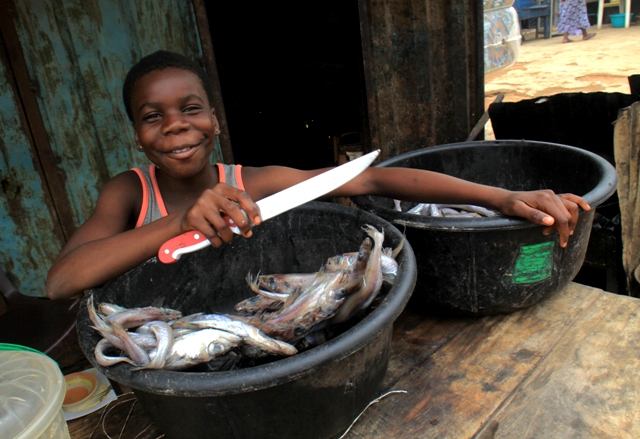
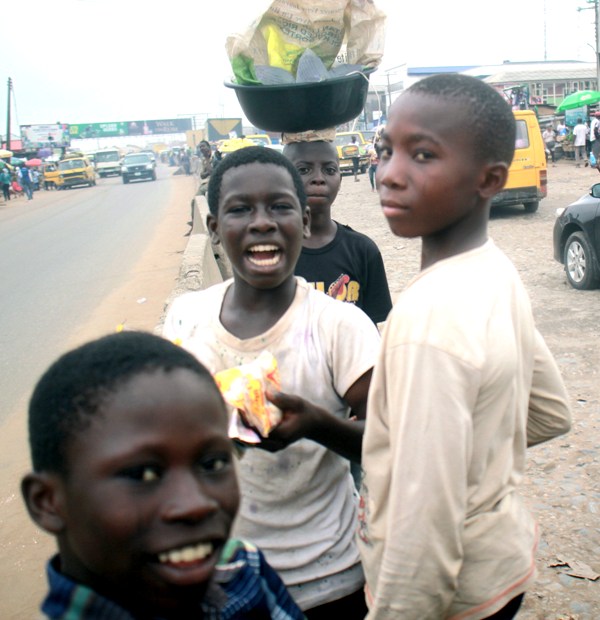
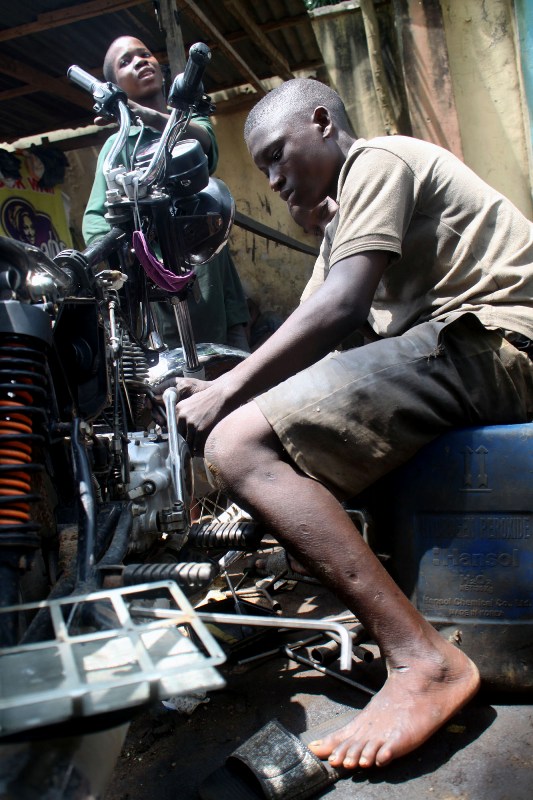
This photo story shows some school dropouts who now engage in all sorts of menial jobs.
After completing her primary education, Promise is waiting for her mother to determine the next step. For now she helps her mother fry fish for sale.
These boys could not continue their education due to lack of funds. To survive, they sell snacks and sachet water along Sango-Abeokuta Expressway.
Due to broken homes, many of these boys dropped out of school and left home to live on the streets. They survive by scavenging through rubbish dumps in search of scraps to sell.
Segun Adigun is eight years old, he never attended school but he is a mechanic apprentice at Jankara, Lagos.
This project, courtesy of the Wole Soyinka Foundation, was mentored by Gbile Osadipe. Ademola Akinlabi is Chairman of the Photojournalists Association of Nigeria (PJAN).
Experts on democratisation posit that a political society starts its journey to becoming a democracy by establishing an electoral democracy first, followed by polyarchy/liberal democracy, and then advanced democracy. They are all democracy but they differ in content.
Electoral democracy is one that is on the borderline between democracy and authoritarianism. Hence the notion of hybrid regime. It is sometimes referred to as pseudo democracy. Polyarchy, as Robert Dhal calls it, or liberal democracy, adds to democracy the classical liberal political liberties of free speech, freedom of association and the rule of law. These features enhance democratic consolidation by preventing its erosion. Lastly, advanced democracy is one that has completed the democratic journey and cannot reverse to authoritarian regime or electoral democracy. This is found in the global north.
Where then can we place Nigeria in this trichotomization? Having failed in delivering the desired deliverables of democracy in its 17 years of democratic experiment, with visible traces of autocratic tendencies on the part of the ruling elite, the country neatly falls under electoral democracy. Unfortunately, both scholarly and policy concern has been focused more on the need for increased democracy in Nigeria than the all-important issue of state-building. This view is commonly referred to as the “sequentialist debate”. Exponents of the “Stateness First” like Francis Fukuyama and Fareed Zakaria contend that “state-building and liberal constitutionalism must precede electoral democratization if democracy is to achieve stability and deepening”.
In other words, central to attaining and sustaining democracy is the construction of a strong State. Failure to adhere to this sequence would eventually lead to Samuel Huntington’s notion of “premature democratization”. This is the story of Nigeria and most democratizing states in Africa that lack the Weberian legitimate monopoly of force in their territory; which is essential in providing social order, which in turn paves the way for economic development and democracy to thrive. Conversely, others like Mazzuca and Munck maintain that “state construction can be confronted in the course of democratization or through democracy”. This seems to be the pathway taken by Nigeria since the attainment of political independence. Their line of argument stem from the widespread belief that it’s almost inconceivable to have a developmental sequence than the one which starts with electoral competition in contemporary times, largely because the pursuit of liberal democracy has become the zeitgeist of the late 20th century.
However, as persuasive as these contentions are, empirical evidence shows that the ‘stateness first’ sequence happened to be the Western sequence. Before the Industrial revolution, bellicose strategy was adopted in state formation by despotic European monarchs. Democracy was not the guiding idea in developing Europe at that time. During the industrial revolution between 1780 and 1840, Europe had no democracy. Western Europe and its satellite colonies first established a sequence of state-building, liberal constitutionalism, before large scale electoral participation. As we can see in this sequence, it was later in the course their history that measures of limiting state powers like rule of law and democratic accountability were introduced. As I will explain momentarily, this was also the sequence in some East Asian countries.
The failure to build a strong state, limited by the rule of law and electoral accountability, all of which contribute to deepening democracy explain why Nigeria is still a basket case that privileges electoralism which profits political entrepreneurs at the expense of state-building. Yes, democracy might have triumphed in some ideological sense as vociferously acclaimed in The End of History thesis. This is not sufficient to say liberal democracy is the one and only way for democratizing countries like Nigeria to follow in order to attain political development. Based on this, Thomas Carothers, an avid liberal scholar posited that: “it is a mistake to assume that democratization – especially open national elections – is always a good idea.
When tried in countries that poorly prepared for it, democratization can and often does result in bad outcomes”. These outcomes have been seen in Nigeria. If the “Democracy first” sequence was the surefire way to attaining political development and stamping out poverty, India, with an impressive democracy, would have accomplished this given it long democratic history. Rather, the country is extremely corrupt – 79 least corrupt nation according to the 2016 transparency international (TI) report – and cannot deliver democratic deliverables because it doesn’t have a strong state. Nigeria, which conveniently occupies the 136th spot, is also facing the same problem. This also applies to South Africa, which occupies the 45; and Brazil, which is on 40, and is also facing the risk of democratic breakdown.
However, China, which is not a democracy in the western sense, has done so well in terms of development. In spite of its sheer problems of human rights deficit, China has been able to achieve one of the world’s remarkable economic transformation in human history. This has seen it lift over 400 million people out of poverty (See, Weiwie’s China Wave: Rise of A Civilizational State), a figure which accounts for the bulk of global reduction in poverty. If you take China out of the equation you will be left with an abysmal result in this regard. China was able to achieve this because of its strong state system which is driven by Confucian tradition; establish long before it started modernizing. The country also has a merit base bureaucracy which has supported its development agenda. Conscious of this impressive achievement, Fukuyama remarked in 2011 that “U.S. democracy has little to teach China”. Interestingly, despite China’s phenomenal economic rise using it development model, “China has learnt so much from the West and will continue to do so for its own benefit…;” said Weiwei. There is a lot of wisdom in this which poorly governed countries like Nigeria where the Lincolnian idea of democracy has failed to work should learn.
Countries like Singapore, South Korea, and Japan first started out like China by building state first in line with Confucian tradition, before establishing democracy. The West does not see the China option as a viable alternative worth emulating by countries in search of development. This is to suggest that the Western liberal democratic model is the most preferred option as though it doesn’t have loopholes. The Western model itself is in deep trouble as seen in the protracted financial crisis in the global north in spite of its nuanced strengths, excessive money in politics and the role of special interests in the electoral process – America and Nigeria. Obviously, it is on account of these unpleasant developments in America that Joseph Stiglitz drew the conclusion that the U.S. market driven economic model only works for the top 1 percent than the bottom 99 percent. What this says clearly is that even liberal minded scholars are dissatisfied with the current structure of liberal democracy in the West.
Coming back to Nigeria, it’s no news that the country has been detained in the state of premature democratization for the past 17 years without any possibility of attaining political development should the country maintain the status quo. As I noted before, this is so because Nigeria does not have a strong and impersonal state. The state is essentially neopatrimonial in nature. Like America, Nigeria’s democracy is one that works for the elite. My argument is not suggesting that democracy is bad. Not at all! It is good because it engenders the existence of some basic freedoms that are central to the pursuit of happiness and development. But this will make no meaningful impact if the state, to which the institution of democracy is grafted is not strong enough to provide the foundation for democracy to flourish. Bearing in mind the Western and East Asian development sequence, I am of the opinion that Nigeria does not need democracy at the moment. Seventeen years of its practice has only kept the country perpetually in electoral mood at the expense of pursuing developmental courses. The country needs a strong state, after which it can take measures of limiting political power by instituting liberal democratic institutions.
Ihembe Martin, a political Scientist with research interest in political development, can be reached on 08023688848
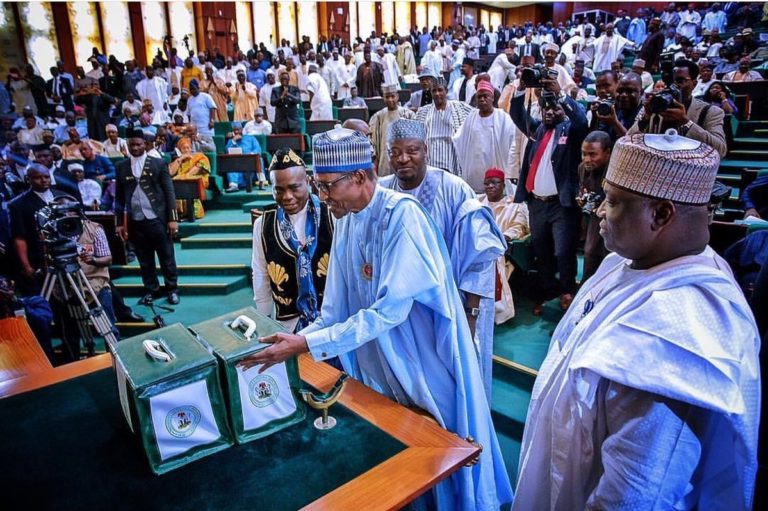
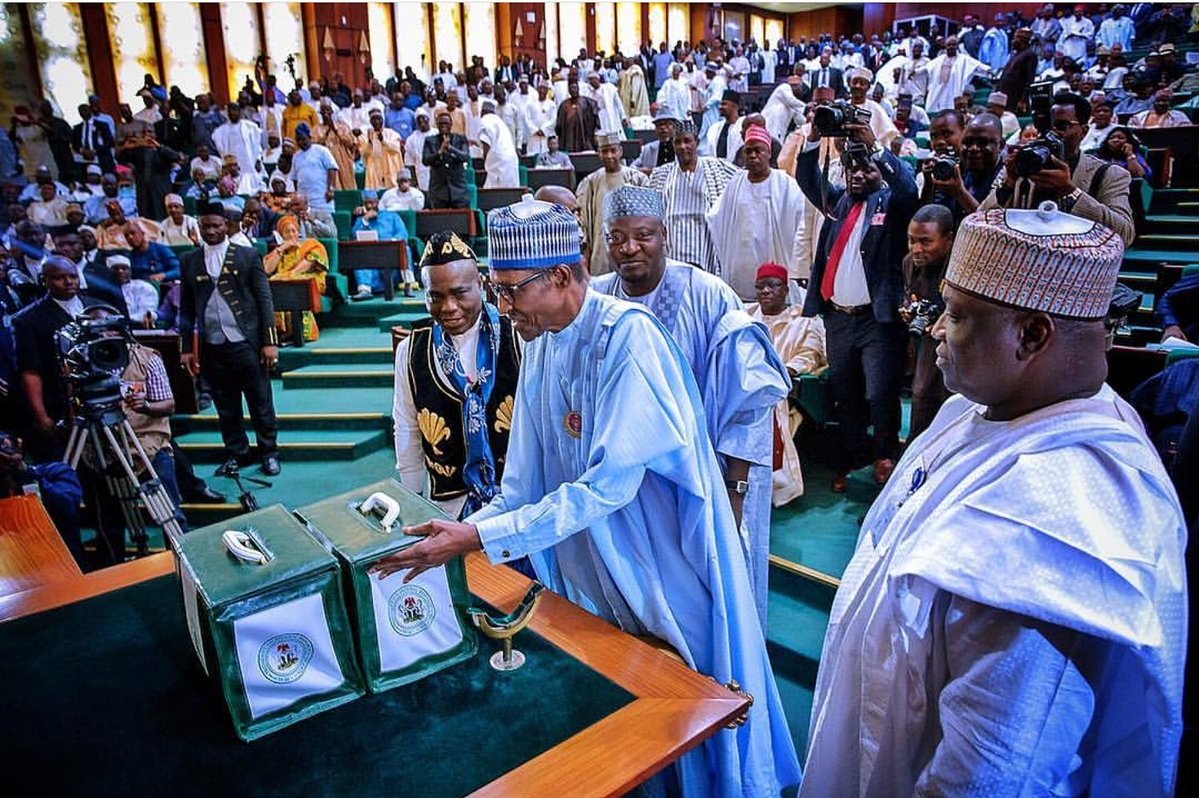
Several states of the federation recently followed President Muhammadu Buhari’s example by presenting their 2018 budgets to their respective state assemblies, but something that caught the eye was the funny, sometimes outrageous names these budgets bear.
Buhari’s 2018 budget was christened “Budget of Consolidation”, but with less than 40 percent of the 2017 budget – termed ‘Budget of Recovery and Growth’ – implemented so far, experts say there is little or nothing to consolidate on.
Bismarck Rewane, an economic expert, had described Buhari’s 2018 budget thus: “It’s a prudent budget, it’s a budget of consolidation but you only consolidate after you achieve the growth that you aspire to achieve.”
How did the states describe theirs?
AYADE’S KINETIC MOTION IN CROSS RIVER
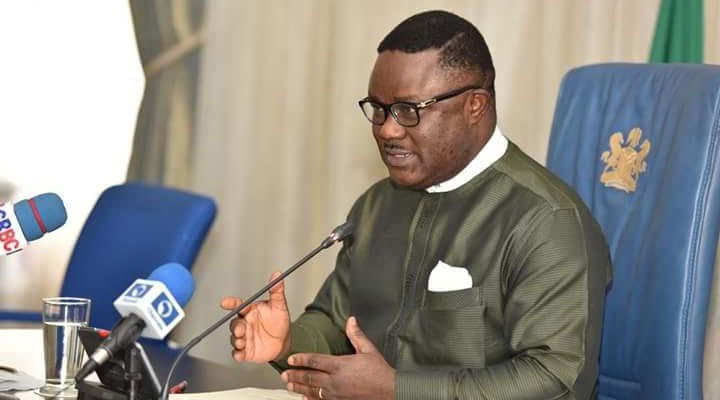
Of all the nomenclatures given to the 2018 budgets presented by the various state governors so far, none is more interesting, or better put hilarious, than that of Ben Ayade’s Cross River State, which he christened ‘Budget of Kinetic Crystallisation’. Whatever that means!
This is aside the fact that the budget amount is an eye-popping N1.3 trillion — the highest-ever by a state government.
This is “a kinetic budget that allows me flexibility to dream to the extent that God has given me the intellectual capacity to reach,” Ayade had said.
“It is a budget that crystallises the depth of our vision into action in the Year 2018. It is meant to draw the perspective of a humongous, large, ambitious budget.
“It is not enveloped by our purchasing capacity but by the capacity of our thought process. It is designed and tailored to fit our dream.”
OBIANO’S VALUE FOR MONEY
If Ayade’s budget of kinetic crystallisation is confusing, what then can be said of Willie Obiano’s ‘Budget of Value for Money, Economic Diversification and Job Creation’?
Obiano recenntly emerged victorious from a governorship election which, though adjudged “free and fair”, was also said to have witnessed high incidents of vote buying and selling.
According to reports from election monitors, all the major political parties in the state used money, and in some cases plates of cooked food, to entice voters.
Perhaps, Obiano, by saying the 2018 budget would be that of value for money, meant to tell citizens of the state that he would have to first get value for the money he spent in buying their votes, before leaving the crumbs for the people.
OTHERS
The list of the needless naming of annual budgets is endless, and at the end of the day they do not achieve anything.
Governor Umar Ganduje of Kano State termed his 2018 budget as ‘Budget of Reality’ but no one can say for sure (other than the man himself) what he actually meant.
In Adamawa, it is ‘Budget of Hope and Empowerment’. In Akwa Ibom, it is ‘Budget of Consolidation on Industrialisation’. In Delta State, it is ‘Budget of Hope and Consolidation’. Jigawa’s is ‘Budget of Economic Diversification and Self-sufficiency’. Nasir el-Rufai of Kaduna State christened his as ‘Budget of Consolidation’.
Katsina State has a ‘Budget of Actualization’, Kwara has a ‘Budget of Sustained Growth and Prosperity’, while Nasarrawa has a ‘Budget of Sustainable Development’. In Ogun, it is ‘Budget of Accelerated Development’! Really?
We cannot begrudge the governors for their style of christening their budgets, but it’s a real wonder how Nigerians are still wallowing in lack and penury with all these wondrous budget names.
Imagine if Ogun State were to experience “accelerated development” in 2018, or Nasarawa were to truly “diversify” its economy, or if Delta actually gave “hope” to the people. Unfortunately, we know that this time next year, we will still be discussing the very issues on which the respective 2018 budgets were built.
So, why have a name that has no meaning in terms abiding by its spirit? Only the governors can answer.
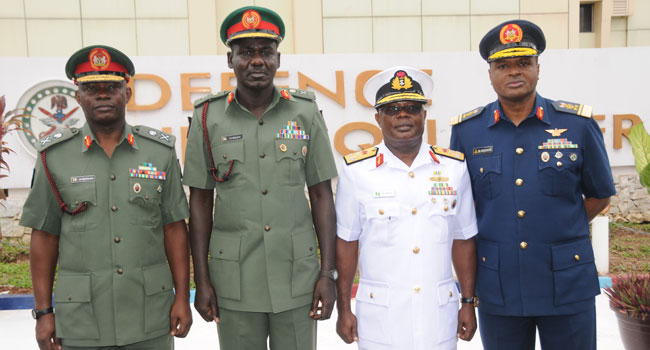
President Muhammadu Buhari has extended the tenures of all service chiefs: Abayomi Olonisakin, Chief of Defence Staff; Tukur Buratai, Chief of Army Staff; Ibok Ete-Ibas, Chief of Naval Staff and Sadique Abubakar, Chief of Air Staff.
According to a statement issued by Tukur Gusau, spokesman of the Minister of Defence, “the extension is pursuant to the powers conferred on the President and Commander in chief of the Armed Forces of the Federal Republic of Nigeria by section 218(1) and (2) of the 1999 Constitution”.
The statement added that Buhari approved the tenure extension after “having carefully reviewed the ongoing military operations across the country and the efforts of the service chiefs in the counter-insurgency operations in the North East coupled with the security situation of the Niger Delta region”.
The current service chiefs were appointed on July 13, 2015. According to the rules of the armed forces, the tenure of service chiefs is two years, after which the President could extend it provided the affected officer has not attained the mandatory retirement age of 60.
Earlier in July, Buhari, who at the time was receiving medical treatment in London, approved the extension of the tenures of the service chiefs until December.
The trio of Olonisakin, Abubakar and Ete-Ibas are long overdue for retirement going by their year of service and their age, but Buhari approved an extension of their tenures.
Buratai, on the other hand, being a member of Course 29 in the Nigerian Army, has not attained the retirement age or maximum length of service yet.
It is not clear for how long this current extension will last.
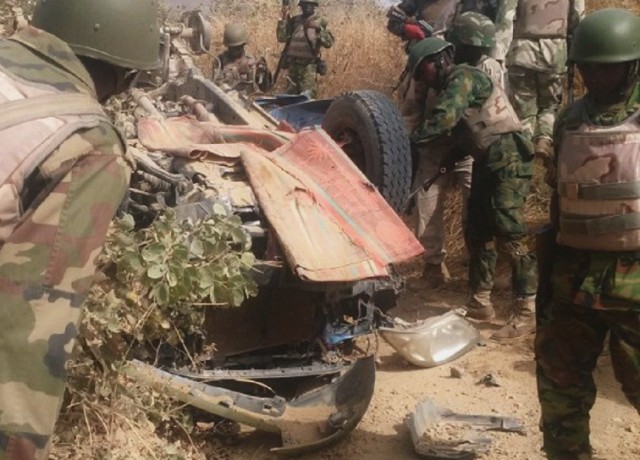
It is now clear that some Boko Haram terrorists ambushed team members of the World Food Programme (WFP) who were conveying relief materials — mainly food items — to an Internally Displaced Persons (IDPs) camp in a remote village in Borno State.
The team was accompanied by a convoy of security operatives, made up mostly of soldiers, to provide protection for the aid workers along the dangerous roads.
What is not clear, however, is the casualty toll of the unfortunate attack, whether on the side of the attackers, the soldiers or the civilian members of the WFP team.
WFP’S ACCOUNT
According to Adedeji Ademigbuji, WFP’s Communication Officer, Maiduguri area office, four persons were killed in the attack, including a driver of one of the food trucks and his assistant.
“WFP can confirm that a convoy escorted by the Nigerian military, including WFP hired trucks, was the subject of an attack by armed groups 35km southwest of Ngala in Borno State on Saturday (16 December),” Ademigbuji said in a statement.
“Four people, including the driver of a WFP-hired truck and a driver’s assistant, were killed in the incident. WFP extends its condolences to the bereaved families.
“WFP is working with the authorities to determine the whereabouts of the trucks.”
ARMY’S ACCOUNT
The Nigerian Army, however, provided an entirely different account from that of the WFP.
Rogers Nicholas, Theatre Commander of Operation Lafiya Dole, said no civilian was killed in the attack, adding that on the contrary, it was the soldiers that killed six of the insurgents and recovered several weapons.
“There was an ambush but the soldiers killed six Boko Haram insurgents and recovered weapons. No civilian was killed. I was in Dikwa that Saturday and this happened while I was within,” Nicholas said.
WHO ARE NIGERIANS TO BELIEVE?
It’s hard to tell at once which party to believe. But history hardly lies, does it?
Few hours after the kidnap of almost 300 Chibok schoolgirls, Chris Olukolade, then Director of Defence Information, told newsmen that all but eight of the girls had been rescued.
In his statement titled ‘More Students Of Government Girls’ Secondary School Chibok Freed; Normalcy Returns To Wukari’, Olukolade said: “More of the abducted students of Government Girls’ Secondary School, Chibok in Borno State have this afternoon been freed as troops pursuing the terrorists close in on the den of those believed to have carried out the attack.
“With this development, the Principal of the school has confirmed that only eight of the students are still missing. One of the terrorists who carried out the attack on the school has also been captured.”
Well… it turned out that none of the Chibok girls had been rescued or freed. It took the persistent cries of the parents of the abducted students, amplified by the ‘Bring Back Our Girls’ campaign, led by Oby Ezekwesili, for the military to recant their earlier position.
Today, three and a half years after the abduction. the number of girls still in captivity are more than the eight originally claimed by Olukolade. More than 100 of the girls are still with insurgents.
JUST SIX MONTHS AGO…
More recently, precisely in July, Boko Haram insurgents ambushed a team of oil explorers commissioned by the NNPC to search for crude oil in the Lake Chad Basin. Almost 50 persons, including soldiers, were killed in the ambush, and several others abducted.
But Sani Usman, the Army Spokesman, told Nigerians that all the kidnapped NNPC personnel had been rescued, and that only 10 persons — an army officer, eight soldiers and one civilian — were killed in the ambush.
“On receipt of the information, the Brigade mobilized and sent reinforcement, search and rescue party that include the Armed Forces Special Forces and guides that worked and pursued the terrorists throughout the night,” Usman stated.
“So far, they have rescued all the NNPC staff and recovered the corpses of the Officer, 8 soldiers and a civilian who have been evacuated to 7 Division Medical Services and Hospital.”
Hardly had Usman released his statement than Boko Haram released an online video showing three abducted NNPC staff pleading for their lives. They are still being held by the insurgents up till now.
On the evidence of these two examples, can we actually believe the Army rather than WFP?
Yahaya Bello, Governor of Kogi State, says he did not engage in double voter registration as alleged by the Independent National Electoral Commission (INEC).
Bello, who spoke on AIT’s Focus Nigeria, said he was not even in the country at the time he was said to have registered a second time at the Kogi State Government House in Lokoja.
The allegation that Bello engaged in double registration was first raised in May by a group called ‘Kogi for Change’, who also threatened to take legal action against the Governor.
Few days later, INEC, through Solomon Soyebi, its National Commissioner and Chairman Voter Education Committee, confirmed that Bello indeed registered twice — contrary to electoral regulations.
“The Governor’s double registration and doing so outside INEC’s designated centres are both illegal,” Soyebi had said in a statement at the time.
He clarified that Bello was first registered at Wuse Zone 4, Abuja, on January 30, 2011, but illegally did so again on May 23, during the ongoing continuous voter registration exercise in Lokoja.
He said the commission would “take disciplinary action against the INEC staff involved”, but “as for the State Governor, Section 308(1) (a) of the 1999 Constitution (as amended) precludes INEC from prosecuting him while in office”.
This picture appears to be showing Yahaya Bello, Governor of Kogi State Governor, being registered by an INEC official in his office in Lokoja, but he insists this never took place. Photo Credit: Kogireports
However, Bello said he never registered a second time as INEC wants the world to believe.
“I am urging INEC to further investigate this and tell the world that what they are alleging is false, else, I think more action will be taken about this. I will direct my lawyers to write INEC to prove this,” Bello said.
“INEC needs a lot to prove; they need to prove this beyond reasonable doubt, because it’s not a matter I’m going to let go. They really need to prove to the world that I engaged in double registration.
“Of course the first one exists, the purported second one, they should bring it out, display it to the world, all the processes and the documents that I gave when I was carrying out this second registration.
“I’ve come out very clearly that that particular period, I was not even in the country and I’ve proven it with verifiable document. Now they need to equally prove that I carried out a second registration in government house in Lokoja there.
“And if they are alluding that somebody is tampering or has tampered with their data bank, that is very dangerous, because INEC is telling us that it’s possible for anybody to compromise its system.
“That is why Nigerians should not allow this to lie low and I’m not going to allow this, because it means our data is not safe in their hands. What then is going to be the integrity of subsequent elections.
“And if what they are alleging (against me) is false, which I know it is, then those who came out to malign me and say certain things that are not correct need to be punished in order to serve as a deterrent to others.”
Bello said nobody from INEC ever contacted him to ascertain the authenticity of the allegations.
“If they so claimed that I am enjoying immunity, at least I am not above investigation, you can investigate me but you cannot prosecute me because of immunity.
“You should have reached out to this particular person that you are claiming has engaged in double registration. No written letter (from INEC) no verbal communication, nothing whatsoever.”
Last week, INEC said it had disciplined three of its personnel who allegedly played various roles in Bello’s second registration.
Two of them were summarily dismissed while the other was recommended for “immediate and compulsory retirement” for “acts of gross misconduct”.
However details of the investigation that led to the sack of the INEC officials were not made public, and the identity of the disciplined INEC staff were were not revealed.
“If they (INEC) can come out in public to say that Yahaya Bello, the Governor of Kogi State, has engaged in double registration, and they have investigated their staff and are sacking them and retiring one, then they should make public the details of that investigation,” Bello said.
He said that any such investigation would be one-sided since nobody contacted him to get his own side of the story, “and the whole world needs to really see what was investigated, the process and how the conclusion was reached”.
ActionAid International, a non-governmental organisation, wants Libya suspended from the African Union (AU) until all captive and bonded persons within its soils are released.
This was contained in a letter by the organisation to Moussa Faki Mahamat, Chairman of the AU, on Monday.
ActionAid also requested each African government to immediately begin to identify, register and track their citizens in and across Libya and Europe as a first step to releasing them from physical or economic captivity and bondage, and bringing them home as free citizens.
According to ActionAid, this slave trade has a particular impact on young people, as they are the ones making the perilous journeys to Europe in search of better opportunities.
“It is a real irony that while governments often claim they prioritize youth, the continent is faced with Libyan slavery and slave trade challenges,” Jemal Ahmed, Regional Director for East and Southern Africa at ActionAid, said.
The NGO urged governments to develop a clear strategy to reach more young men and women with programmes that protect all their human rights and guarantee them safety and security.
It pointed out the need for various African governments to provide appropriate information and an open process for migration to their citizens who want to migrate.
Funmilayo Oyefusi, Interim Country Director, ActionAid Nigeria, urged the Nigerian government to take urgent, practical steps to restore the confidence of youth in the Nigerian state through sustainable empowerment programmes.
“The increasing number of graduates competing for scarce employment opportunities coupled with the continuous brain drain of the nation’s best human capital has continuously widened the poverty gap and makes one wonder what the future holds,” Onyefusi said
She called on the Nigerian government to prioritise rehabilitation and reintegration of the returnees, and devise clear strategies that will protect the human rights of Nigerian migrants and fast-track response to similar infringements should it occur.
Contracts worth over N300 million awarded to briefcase companies by the Universal Basic Education Commission (UBEC) for the construction and renovation of classrooms in Ebonyi and Imo states were either not done to specifications or never done at all, reports CHIKEZIE OMEJE who visited the locations.
On Monday, September 25, 2017, Girls Model Comprehensive Secondary School, Ugwuachara, Ebonyi State, welcomed its new students. In their first class, ‘Understanding Technology’, the teacher told them to buy textbooks to complement what they would learn in his class. He, however, said if they could not afford the books, they should cultivate the habit of going to the library to read the books.
“Where is the library?” a young girl in the front row of the class asked the teacher. The teacher hesitated and pointed to the direction of a building opposite the class, but added that they would not be able to use the library until the renovation of the building had been completed.
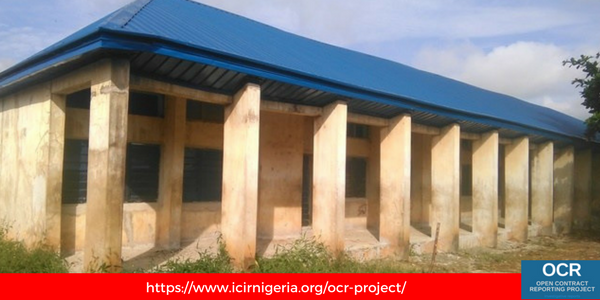
The building the teacher showed the students has a new blue aluminum roof. It is not painted. New iron doors and windows have been installed in a part of the block. The interior of the building is undone with cracks on some of the inner walls. There is no ceiling yet.
Before the rehabilitation started in April, the block contained the library and two classrooms. The books in the library were removed and packed into a store. Students vacated the classrooms for the renovation.
The block under renovation
Chioma Amuta, the principal of the junior section of the school, told the ICIR that she thought the renovation of the building would have been completed by the reopening of the new academic year after the long holiday.
The school has two principals for the junior and senior divisions.
When a contractor came earlier in the year, he told Amuta that he had been given contract by UBEC to renovate a building in the school and chosen this particular block.
The contractor asked Amuta to remove what was in the building to enable him start the renovation. But the principal protested that instead of asking them to vacate the block which they were still using as library and classrooms, he should rather renovate the dilapidated and abandoned school laboratory whose roof had caved in or the hostel where the windows and ceilings were in terrible conditions.
Amuta said the response of the contractor was that he had chosen the building and he was going ahead with the rehabilitation.
“They came and said they were doing UBEC project,” Amuta said. “We don’t know anything about it. I don’t know the arrangement they had with UBEC. They just came, looked around and picked the one they felt was okay for them.
“We were hoping that they would pick the lab that is very bad but they picked this one. The machines in the lab are gone. Rain damaged everything.”
Regina Anuta, the principal of the senior section, said she did not discuss with the contractor about the renovation. She said the man met her in the office and told her that he had chosen a building to renovate.
“This one was manageable,” Anuta said, pointing to the block that is still under rehabilitation. “We used to have two classrooms here. But in others, nobody stays there and everything is damaged.
“He chose the one he liked. I was begging him to do the lab that’s really bad but he said he came in my absence and chose this one.”
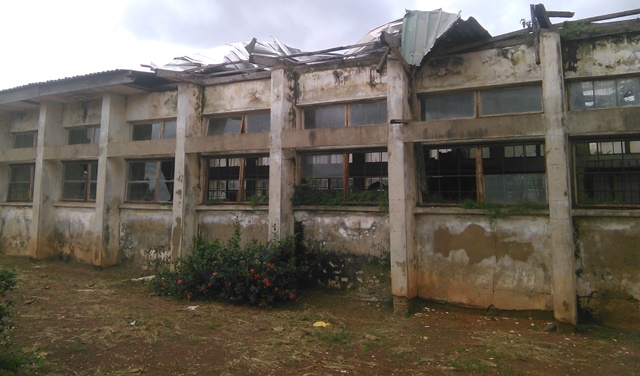
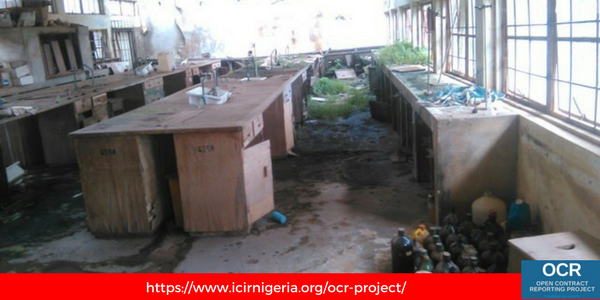
The laboratory’s roof had collapsed. The students had not been making use of the laboratory for their science practical for the past three years. The science equipment and laboratory furniture were damaged by rain. Grass has grown around the dark and stagnant water inside the laboratory building.
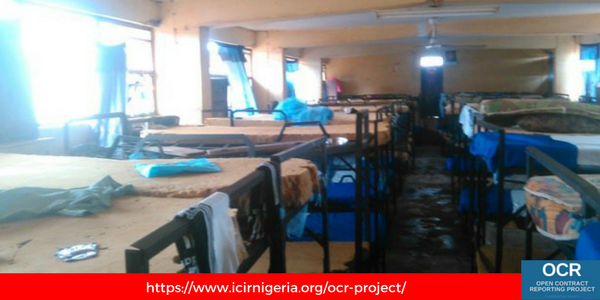
The student hostel is in a terrible condition. Many of the windows of the hostel are missing. The staircase on the one-storeyed hostel has no rail. Portions of the ceilings in the hostel have caved in and faeces from bats drop on the students from the damaged ceilings. A teacher told the ICIR that many bats live inside the ceiling and she had tried to use chemicals to chase them away without success.
The roof of the hostel leaks. When it rains, the students use their buckets to collect the rain from the leaky roof to avoid soaking their tattered mattresses. But violent wind during rain, according to the students, blows water inside the hostel from the missing widows despite their effort in covering the openings with wrappers and cottons.
Rachel Umahi, the first lady of Ebonyi state graduated from the school. It is a boarding school and it is one of the seven comprehensive model secondary schools in the state. Ebonyi is adjudged educationally disadvantaged and has the lowest proportion of school enrolment in the south-eastern part of the country.
The principals and the teachers faulted the claim that the contract for the renovation cost N20 million. They wondered why the contractor refused to renovate the laboratory or the hostel which require urgent intervention but instead opted for the building they were using for library and classroom.
Inside the laboratory building
While the Ugwuachara Girls project has partially been done with the changing of the roof, doors and windows, the project for the rehabilitation of the Urban Junior Secondary School, Abakaliki was yet to start.
Philip Egwu, the principal of the Urban Junior Secondary School, told the ICIR that nobody had come to carry out renovation in the school. The last renovation in the school was done by the Ebonyi State Universal Basic Education Board more than a year ago.
He said he had no idea of a contract being awarded for any renovation in the school. He, however, said he had never been consulted for any past projects in the school.
Another project awarded for the rehabilitation of Government Primary School, Afikpo in Ebonyi State in 2016 has not been executed.
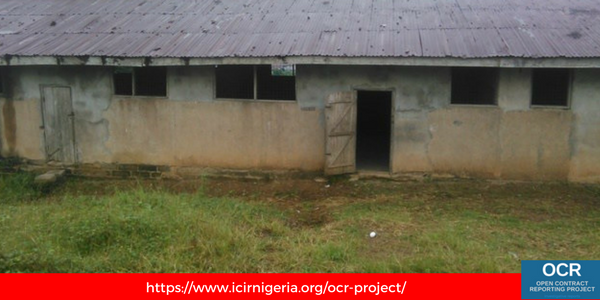
Theresa Eze, the headmistress of the school, told the ICIR that she has not seen any contractor and was not aware of the renovation project. Two classroom blocks for Primary 4 and 6 have been abandoned because they were in bad condition.
Eze said the pupils in the dilapidated buildings have been moved to the other two buildings that contain the rest of the classes. She said the school established in 1924 can also be fenced to provide them with a measure of security.
BRIEFCASE COMPANIES
Hostel, Girls Model Comprehensive Secondary School, Ugwuachara, Ebonyi State
The two companies awarded the contracts for the rehabilitation of the secondary schools are Centre Energy Services Limited and Wellness Energy Result Limited. Both companies were registered on the same day with the same address as a law firm that has occupied the same office at Willand Plaza, Zone 4 in Abuja long before the registration of the companies.They were registered on July 7, 2011, by the Corporate Affairs Commission (CAC).
Centre Energy Services Limited got the contract for the rehabilitation of Girls Model Comprehensive Secondary, Ugwuachara while Wellness Energy Result Limited secured the contract for the renovation of Urban Junior Secondary School, Abakaliki.
Vision Global Synergy Limited got the contract of N20, 094,000 for the rehabilitation of Government Primary School, Afikpo. The company has an obscure address at Anafara Plaza in Gwarimpa, Abuja.The amounts of the contracts were almost at the same price respectively based on information obtained from the Public and Private Development Centre (PPDC), an organisation that is advocating for open contracting in Nigeria.
UBEC was established in 2004 to eradicate illiteracy, ignorance, and poverty in Nigeria through a nine-year basic education. UBEC, which is funded by 2 percent of Consolidated Revenue Fund, is meant to support states and local governments in financing the basic education in the country.
THE BIG SCAM?
N184 million Almajiri school in Ebonyi State
In 2014, UBEC awarded a contract of N184 million for the construction of Almajiri school in Ebonyi State. The contract was awarded during the time that Goodluck Jonathan, the former president, approved the construction of hundreds of Almajiri School, mostly in the northern part of the country.
Almajiri system is prevalent in the northern part of the country where children are sent to Islamic teachers to learn the Koran. In the process of this informal arrangement of religious education under “Malams”, the children roam the streets, begging for alms. To curtail the menace of Almajiri, the schools were constructed to integrate them into Western education.
John Nweze, the focal person for Islamic education in the Ebonyi State Universal Basic Education Board (ESUBEB), told the ICIR that the state does not have Almajiri children, adding that there was no such project in the state.
The only Islamic centre in the state is a private school in Afikpo.
Nweze, however, said UBEC awarded a project for the construction of a block of two classrooms at an Islamic centre in Afikpo.
He said they only got to know about the project when UBEC officials wrote a letter to ESUBEB that they were coming to supervise the project and needed someone to take them to the place.
He said he accompanied the UBEC officials to the school and explained that the project was for the construction of a block of two classrooms, but the school decided to reinforce the building to have a hall on top of the building. The cost of the additional hall was paid by the school.
Eze said the project could not have been awarded at N184 million because it was just a block of two classrooms and the school was paying for the hall. The file containing information about project when the UBEC officials visited the Islamic school in 2015 showed that the first tranche of money released to the contractor was just N2.6 million.
The School of Arabic and Islamic Studies Centre, Enohia, Afikpo was founded in 1963 by Ibrahim N’ass Nwagui and is funded by Muslim World League Makkah AlMukarraawah in Saudi Arabia.
Yakubu Ibrahim, a teacher in the Islamic Centre, corroborated what Eze said that the UBEC only awarded the contract for the construction of a block of two classrooms but the school management decided to add an exam hall on top of the building.
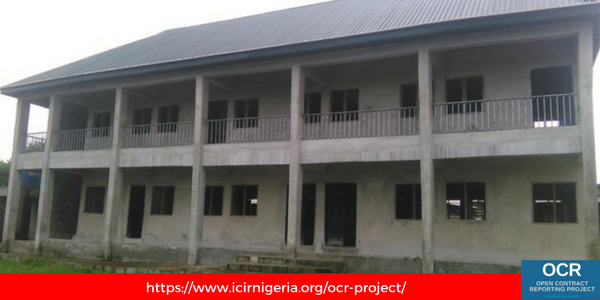
The building has been roofed but it has no doors and windows. No furniture has been provided and it is yet to be painted. The private secondary school was still on holiday when our reporter visited in September.
The project was awarded to Papacy Ventures Limited, a company whose address is located at a private residence in EFAB Estate, Mbora, Abuja.
ESUBEB NOT AWARE OF THE PROJECTS
Dilapidated classrooms block at Government Primary School, Afikpo, Ebonyi State
Hyacinth Ikpo, the chairman of ESUBEB told the ICIR that he was not aware of the projects awarded by UBEC and could not monitor or provide any information about them.
“He said he is a journalist from Abuja,” Ikpo complained to the visitors who were in the waiting room in his office. “And he is coming to ask me about the project given by UBEC in Abuja. Am I the one to tell them how to do their job?
“I can’t tell you what I don’t know. We don’t supervise their projects. The one that involves me they bring money and we bring money that is the one I know. I’m not going to ask them. They are my bosses. They award a contract, they supervise the contact and they pay the contractors.”
When Ikpo was reminded that primary and secondary education is the responsibility of the state, not the federal government, he said UBEC could decide to have interventions in the schools without consulting the state.
“Yes, we own the basic education to the extent that we are given projects and we do it. They do their own projects. They can decide to intervene in each state. They decide to build a block of the classroom. They send their contractor. The contractor will do the job and they will supervise and pay the contractor.”
Ikpo said the last time UBEC officials came to his office, they told him to supervise their projects but he replied them that he could not supervise a project without the bill of quantity.
Chukwu Nwazunku, the UBEC focal person in Ebonyi State, also said he was not aware of the four projects by UBEC in the state.
He explained that execution of projects in schools by UBEC is done through direct intervention or counterpart funding with the state, adding that the direct interventions were usually new construction, not renovation.
Nwazunku insisted that he had no idea of the four projects but pointed out that UBEC usually sent officials from Abuja to monitor projects.
NO PROJECTS DONE IN IMO STATE
Ekubga Home Primary School, Egbema, Imo State
Last year, UBEC awarded two contracts for the construction of classrooms at Ekubga Home Primary School, Egbema and Central School, Amucha, Njaba, Imo State. The contracts included the provision of desks and tables to both schools.
Both projects for the two schools have not been carried out when ICIR visited.
Chinyere Oji, a teacher at Ekugba Home Primary School told the ICIR that a contractor came to the school last year to inquire where he could construct classrooms. It was agreed that the classrooms should be constructed on a space behind the old structure but the man never came back.
The school has just one hall where all the pupils are taught. The hall is not plastered. Teachers interchange two blackboards to teach different classes.
“Sometimes, we ask some teachers to stop teaching to allow others to teach because of the noise when we are all teaching at the same time,” Oji said.
The school, located at the oil producing community, has only five teachers but three have stopped coming because they have not been paid three months’ salary.
Oji said the headmaster had been sick for almost two years. She has been the only teacher coming to school since it reopened four days earlier for the new academic session. She said she had to go to the villages to ask the pupils to start coming to school.
According to her, the school used to have up to 300 pupils but the majority of them have stopped coming because there are no classrooms. She said the pupils reduced to 105 last term, but she was not sure if up to 50 of them would return for the new term.
At Central School, Amucha, Njaba, the contractor has not shown up and the school management was not aware of the contact.
Elizabeth Okpara, the headmistress of the school, said she paid with her money to renovate some parts of the buildings to make it comfortable for the pupils.
“You can see how bad the buildings are,” Okpara said. “The steps you see here, I used my personal money to do it. Nothing is new here”
“The teachers don’t even have tables and chairs. There is nothing in this school. I have been praying to God to do something for this school.”
She said she has more than 200 pupils in the school.
Okpara invited Donatus Agukwe, the chief of the community to inquire if he has heard of any project for the school.
“We haven’t seen anything,” Agukwe told the ICIR. “The only modern building was done by an individual from the community. Since civilian regime, nothing has come to this school. Ask the people in Abuja to show where they did the project.”
ABUJA DID NOT SHOW THE PROJECT
The ICIR first approached Osom Osom, the public relations officer of UBEC to get the commission to provide the status of payment for these projects in Ebonyi and Imo states. He asked our reporter to write the name of the projects and he would get the appropriate department of the commission to provide the information.
Osom later said they would not respond without a letter addressed to UBEC. Subsequently, the ICIR wrote a Freedom of Information (FOI) request to the executive secretary of UBEC on October 9, 2017, to provide the details of payment for the projects. UBEC did not respond to the request.
The FOI provides that all information relating to the receipt or expenditure of public or other funds of public institutions to be widely disseminated and more readily available. The Act also requires public institution to provide the requested information within seven days that the request is received.
However, a source said the companies that got the contracts could mostly have been owned by UBEC officials, their relatives or friends. According to the source, UBEC will be reluctant in releasing the details of the projects because its staff will be indicted.
This investigation is supported by the John D. and Catherine T. MacArthur Foundation and the International Center for Investigative Reporting, ICIR.
Anytime Nigeria is portrayed negatively by the western media, some of us — die-hard pro-Nigeria citizens who are unrepentant Nigerians by birth and blood — feel our pride has been injured.
We don’t always want to hear or read about the ills of our country being told or spread by foreigners, not because we support those ills — not at all, far from condoning bad behavior or indiscipline — but we know the effects of such negative portrayal on all of us.
But one is always constraint by the limit to which Nigeria can be defended and many times promoted when the indices are pointing the other way.
When in November 2017 Portharcourt and Murtala Mohammed airports were rated among the 20 worst airports in the world, some of us felt our image was being unduly maligned by the Sleep in Airport website that carried out the survey. Those who know what obtains at these airports and others could not be bothered by such rating – the airports never measured up to the international standards.
In that survey, Lagos was ranked the fifth worst airport in the world while Port Harcourt was placed the third worst globally. The two are within the world’s worst five.
The website explained that the airports that appeared on the list of worst airports in the world were those that had the capacity to truly offend travelers.
“Within these terminals, there appears to be a general disinterest in a positive traveller experience. In some cases, passengers are made to stand or sit on the floor as they await their flights. In others, the bathrooms don’t have water, toilet paper, or any semblance of cleanliness,” sleepinairpport.net, which is recognized globally, said.
“In some cases, the physical structure of the airport is fine, but the personnel are the problem. Got a problem? Don’t expect much in terms of customer service at these airports.
“If you find yourself travelling through one of these 20 terminals, brace yourself. You’ll want to give yourself just enough time to get in and get out. A minute more and you’ll be unhappy and uncomfortable – a minute less and you risk missing your flight,”
The indices are clear and our airports can be judged through this lens view, even by Nigerians.
NO MEDICAL UNIT AT MMA…AN INFANT CONVULSED?
This happened just exactly one month after MMA was rated fifth worst airport in the world — nothing has changed and is not likely going to change, although there are ministers who oversee the sector and billions of tax payers’ money has been spent to upgrade the airports.
It was a Thursday morning, December 14, 2017. I was rushing to catch an 8 O’clock flight to Abuja from a hotel in Ikeja GRA, Lagos, after attending a three-day training.
Lulu Bangkok of ITV, Ruth Olurounbi, Tola Bademosi both of the Nigerian Tribune plus two other colleagues and I entered the departure lounge of Terminal 1 of MMA.
Despite all the millions claimed to have been spent to renovate the airport, the departure lounge, in terms of space and other accessories, is still below standard. A true reflection of what was considered in the ranking.
But that’s not my real headache. As soon as I passed my stuff through the scanner and I was cleared to enter the departure lounge, a scene caught my attention immediately — a terribly scary experience. There, to the left corner of the scanner, was an Indian couple struggling to revive their baby who was having convulsion. The baby was jerking on the floor, his eyes were dilating.
While a woman I first thought was the mother but later turned out to be a good ‘Samaritan’ was massaging the boy’s hands, the father was doing same to his legs, the real mother was just as confused as the rest of us. Other passengers minded their own business – I don’t blame them, though.
Where are the medics here? I asked almost out of reflex when it looked the boy wouldn’t come back despite efforts by this ‘good lady’ and the father, and ironically, his twin brother was playing around quite unaware of the fate befalling his brother.
At this point, I had expected some level of emergency response from the airport officials. There was none, except for what was a casual call by one of the Airforce personnel who said “please call the medicals”. She left her duty post briefly to where the boy was lying and almost immediately she returned without any real concern for the little boy.
More than 10 minutes after she made this call, there was neither a first aid box in sight nor any medical personnel. In fact, no airport official came close to this dying boy.
Someone among us standing said facing the father, “please take this boy to a hospital”. There and then, the boy, having been stabilized a bit, was lifted by his father on his shoulder. The man exited the departure lounge.
Though I didn’t know where he went and what happened thereafter because it was almost the boarding time for me and others. I hoped the boy survived.
But this is not a good image for Nigeria despite the huge money the government claimed to have spent on the airport. In 2015, Aviation budget was N12.2billion, N36.07billion in 2016 and N70.4billion still running for 2017.
That was not all that happened at the airport just within 30 minutes. Like one of the songs of late Fela Anikulapo Kuti, the Abami Eda himself, ‘e no finishing, no finishing, no finishing’. When the announcement was made for the boarding of Arik plane W3722 to Abuja, Ruth Olurounbi, Business Correspondent with the Nigerian Tribune, couldn’t find her hand luggage.
She was sitting at the lounge just adjacent my seat with her colleague from the same office, Tola Bademosi with her bag under the seat. “Who picked it, where did you keep it,” were the questions we asked a visibly troubled Ruth. No answer and the bag was nowhere. Thus, she boarded the Abuja bound airplane without suitcase which she said contained her clothes and other personal items.
This was also almost a month that Fisayo Soyombo, Editor of the International Centre for Investigative Reporting (ICIR) lost his Nikkon Camera to checked-luggage thieves at Nnamdi Azikwe International Aiport, Abuja while returning from Johannesburg via Addis Ababa aboard Ethiopia Airline.
“Theft of travellers’ belongings is common at Nigerian airports; the airlines know about it, and NAHCO officials are a big part of it,” one airport official had told Fisayo after he discovered that his camera was missing. “Once they see it in the scanner that there are valuables in your checked-in luggage, they find a way to pilfer it. However, if you mount serious pressure on them, they will bring out your property.”
So could it be that someone saw what was inside Ruth’s bag among those manning the scanner? Could it be that one of them had come for the bag later? But she would be told that ‘she was on her own’ by an official she complained to. Grudgingly and very upset too, Ruth boarded the plane to Abuja without her bag.
One thing is clear, Nigerian airports are increasingly becoming unsafe and embarrassing to all of us. Despite the huge amount – N707billion spent to renovate and expand MMA in 2016, it is doubtful if the airport is equipped with Closed Circuit Cameras (CCTV). If there are CCTVs, they are definitely not working like what you have within and around Abuja.
One wonders if the ‘thieving culture’ at Nigerian airports is spreading; Olose Michael, Retail Sales Executive with one of the companies in Nigeria’s downstream sector, had to create a scene early this week at the Abuja airport when his mobile phone disappeared under the scanner.
“I had missed the fly and I was passing my stuff through the scanner,” he said. “I just observed my phone was missing just after I passed it through the scanner,” said Michael who by now had started making trouble before an official said he was the one who picked it when he didn’t see or know who the owner was.
According to him, a senior airport personnel apologized on behalf of the kleptomaniac officer, claiming he was new on the job. What’s obvious; this nauseating thieving by Nigerians at the airports is perpetrated by the so-called airport workers. So there are no CCTV cameras at the airports?
With touting by same officials at the airport, poor state of facilities and pilfering of passengers’ luggage, many Nigerian airports will, for a long time to come, be source of embarrassment to us while the Federal Government keeps budgeting huge sums for airports without corresponding effects.