Home Blog Page 2662

Soyombo, editor of ICIR, short-listed for Wole Soyinka award again

‘Fisayo Soyombo, Editor of the International Centre for Investigative Reporting (ICIR), is one 10 journalists short-listed for the 2017 edition of the prestigious Wole Soyinka Award for Investigative Reporting.

Soyombo, former Editor of TheCable and two-time winner of the award, claimed the overall prize last year with Forgotten Soldiers,  a hard-won exploration of what it means for a soldier to suffer life-threatening injuries while defending his country’s territorial and existential integrity, and then watch helplessly as he is ignored and forgotten by the army, government and people he defended.

The contest allows journalists to win a maximum of three times, after which they become ineligible to apply.

Also included in the 2017 shortlist are: Ayodele Ojo of Daily Sun, Adekunle Yusuf of The Nation, Kemi Busari of Premium Times, Ebere Ndukwu of Ripples, Ayodele Adeniran of The Guardian, Kolawole Aliu of Leadership, Chinwe Agbeze of Business Day, Ujorha Tadaferua of Daily Trust and Mojeed Alabi of New Telegraph.

Also, Obiageli Ezekwesili, former minister of education, and Edetaen Ojo, executive director of the Media Rights Agenda, will receive the anti-corruption defender award and lifetime award for journalistic excellence respectively.

“Ezekwesili is to be recognised for her untiring efforts to promote transparency and accountability as well as her unstinting commitment to the values of justice within and outside Nigeria,” Motunrayo Alaka, Coordinator of the Wole Soyinka Centre for Investigative Journalism (WSCIJ), said in a statement.

Ojo’s recognition, on the other hand, will be as a result of his efforts to “enshrine freedom of expression, including his dogged trailblazing effort at ensuring the passage and implementation of the Freedom of Information Act in Nigeria”.

The award ceremony will hold in Lagos on its customary date, December 9, the World Anti-Corruption Day.

According to Alaka, this year’s edition of the award has six categories – print, online, television, radio, photo, and editorial cartoon, as well a special prize for Food Security and Agriculture.

Before winning the overall prize in 2016, Soyombo was first named second runner-up in the Online category, for his story, UNDERCOVER INVESTIGATION: Nigeria’s ‘Customs of corruption, bribery and forgery’.

Moments later, he then won the first prize in the same category, for Forgotten Soldiers, which then went on to clinch the overall prize.

Also in 2016, Soyombo won the Maritime Economy category of the Zimeo Excellence in Journalism Awards organised by the African Media Initiative, in Nairobi, Kenya, for the same undercover investigation on the Customs.

Four days earlier, he had been second runner-up in the Investigative Journalist of the Year category of the 25th Diamond Awards for Media Excellence (DAME) — again for the same Customs investigation.

In November 2016, he won the Newcomer of the Year — Hans Verploeg Award at the 2016 Free Press awards, which held in The Hague, Netherlands — an award he dedicated to Enenche Akogwu, the Channels TV journalist killed by Boko Haram in 2012.

That award came a month  after he was named Journalist of the Year (Business and Economy Reporting) in the PricewaterhouseCoopers Awards, and three months after his short-listing for the 2016 Kurt Schork Awards in International Journalism.

He was first short-listed for the Kurt Schork awards in 2014, for ‘Blood on the Plateau’ — a five-part investigative series on the ethnocentric killings in Plateau state, published in December 2013. That year’s finalists were chosen from “almost 300 stories entered by 93 journalists from 41 countries”

Soyombo, a 2013 recipient of the Deutsche Welle/Orange Magazine Global Fellowship for Young Journalists, contributes opinions to Doha, Qatar-headquartered Al Jazeera and Germany-based TAZ.

finalist for the 2015 Thomson Foundation Young Journalist from the Developing World FPA Award, his works have been translated into French, German and Arabic.

Lai: You may not like Buhari, but you cannot say he is corrupt


Lai Mohammed, Minister of Information and Culture, says President Muhammadu Buhari is the best man to lead the anti-corruption campaign, as nobody can contest his integrity.

“You may not like him, but nobody can say Mr President is corrupt. His impeccable integrity puts him in a good stead to lead the war against corruption,” Mohammed said  at the 68th General Assembly of the Broadcasting Organisations of Nigeria (BON) in Abuja on Monday.

Mohammed urged the media to stop mocking the efforts of the Federal Government, adding that more could have been achieved if all stakeholders joined hands with the government in the fight against corruption.

“This fight must not be seen as Buhari’s fight alone; it must not be seen as the federal government’s fight. It is our fight,” Mohammed said.

“If we fail to defeat corruption, it will simply overwhelm us as a nation.

“This appeal to the media to join us in the fight against corruption is borne out of  the fact that the fourth estate of the realm cannot afford to sit on the fence as far as this fight is concerned.

“We are not saying that the media should not criticise us over our strategies, but they should stop mocking us.

“In recent times, it is not unusual to read such headlines as ‘Buhari’s Government losing anti-corruption war’, ‘Buhari’s anti-corruption war is failing’, ‘Arewa youth knocks Buhari over failing anti-corruption war’.

“This is sheer mockery, nothing but mockery. And this war is not Buhari’s war, it is our war.”

Mohammed said that of all the three major pillars of the Buhari administration, namely fighting corruption, tackling insecurity and revamping the economy, “the toughest is fighting corruption”.

“Why? Because fighting corruption anywhere in the world is like walking a lone road. While many will join hands with you to tackle insecurity or to revamp the economy, you are on your own when you take on corruption,” he said.

“Most Nigerians were direct beneficiaries of corruption, hence the resistance. Many were subsidised by corruption.

“That is the origin of the bring-back-corruption campaign being carried out by certain elements in the society.”

Mohammed urged the media not to fall for the “distraction tactics” of those who are mortally afraid of the anti-corruption war.

“How many newspapers, for instance, have written strong editorials in support of this war? How many BON members have donated airtime or news reports in support of this war?” he asked.

EXCLUSIVE: Maimuna Aliyu goes into hiding

Maimuna Aliyu, the rejected nominee to the board of the Independent Corrupt Practices and other related offences Commission (ICPC), has gone into hiding.

This is not the best of times for Maimuna, whose daughter is currently remanded at Suleja Prisons, for allegedly stabbing her husband, Bilyamin Bello, to death.

Maimuna was one of 14 persons nominated on August 1 by then Acting President Yemi Osinbajo to the ICPC board, but she was dropped after an exclusive report by the ICIR detailing how the ICPC was investigating her — as well as Sa’ad Alanamu — for multimillion-naira corruption.

She is due to be arraigned in court on Tuesday November 27 at an Abuja High Court, but there is now no trace of her anywhere around the Federal Capital territory (FCT) or elsewhere in the country.

“Maimuna Aliyu has gone into hiding. We have completely lost track of her,” a security source closely involved in the monitoring of her movements, ahead of the arraignment, told the ICIR on Monday evening.

“We have no trace of her, which is a big surprise, given the current travails of her daughter. With her daughter facing the law for alleged murder, no one would have thought this to happen. But I can tell you that she has gone underground.”

MARKED OUT FOR CORRUPTION

The Economic and Financial Crimes Commission (EFCC), the Nigerian Police and the ICPC were already investigating several corruption cases against Maimuna, a former Executive Director of the Aso Savings and Loans, when her board nomination was announced.

In fact, in May, a police investigative report indicted her and recommended her for prosecution. The investigative report dated May 31, 2017, and signed by Taiwo Oyewale, a Superintendent of Police, for the Deputy Commissioner of Police, IGP Monitoring Unit, said that Aliyu illegally converted to personal use a total of N58 million being proceeds of three plots of land belonging to her employers, Aso Savings and Loans.

Police investigations showed that as Executive Director, Marketing, Aliyu got approval to sell three of the bank’s landed properties in Abuja. The plots were offered for N19 million each. Aliyu is said to have sold the lands for N58 million but refused to hand over the money to the bank.

The police investigations commenced after Aso Savings and Loans wrote a petition in November 2016 alleging that Aliyu, who had by then retired from the bank for three years, had refused to hand over the proceeds of the land sale.

The same month, the bank also wrote a petition against her to the Governor of the Central Bank of Nigeria, the EFCC and the ICPC

In one of the investigations, it was discovered that Aliyu actually sold the three plots of land entrusted to her by the bank at N40 million each (instead of N19 million) totaling N120 million and held on to every penny.

Apart from the N120 million allegedly misappropriated by her, the bank also lodged several complaints of abuse of office and conversion or diversion of its funds, totaling nearly N1 billion.

The bank alleged that in 2012, Aliyu sought and got a mortgage facility of N40 million to purchase five houses – four-bedroom detached mansionettes. However, after she resigned her appointment in September 2013, the former Executive Director said she could no longer bear the burden of the payments and requested the bank to cancel the mortgage on four units and take them over. She said she would continue to maintain the mortgage contract on just one unit.

However, since 2013 when she left the bank, Aliyu has refused to hand over the four houses and has not serviced the mortgage on them. In fact, investigators believe that she has since sold the units and pocketed the money.

The bank also alleged that Aliyu abused her office by illegally allocating a house at Aso Groove Estate to her son, Sand Aliyu. According to the bank, Aliyu had showed interest in buying the house for her son in the name of a company in which he is a director. However, because she had all the keys of the houses put up for sale by the bank since she was in charge of marketing and sales, Aliyu handed over the key to the house to her son without paying a dime for the house worth N210 million. She still has not paid for the house till date and her son continues to live there.

THE CHARGES

The charges against her, according to court documents, read:

“That you Mimuna Aliyu (f); on the 7th of December, 2012 or thereabout in Abuja, being the Executive Director [Retail] of Aso Savings and Loans Plc, Abuja at the time, used your said position to confer corrupt advantage upon yourself when you received the sum of about $360,000 (Three Hundred & Sixty Thousand Dollars) the equivalent of N57,000,000.00 (Fifty – Seven Million Naira) at the time being the amount for the sale of Plots Nos 2432; 2433; and 2434 all in Cadastral Zone B08, Jahi District, Abuja, property of Aso Savings and Loans Plc; from one Banagana Bashir on behalf of Vincent Mshelia and you failed to remit the said amount to Aso Savings and Loans Plc as required; and you thereby committed an offence contrary to and punishable  under section 19 of the Corrupt Practices and Other Related Offences Act 2000.

“That you Maimuna Aliyu (f); a former Executive Director [Retail] of Aso Savings and Loans Plc, Abuja; on the 10th of January, 2017 or thereabout in Abuja, made false statements to the operative of the Independent Corrupt Practices and Other Related Offences Commission (ICPC), in the course of their official duties that Plots Nos 2432; 2433; and 2434 all in Cadastral Zone B08, Jahi District, Abuja, properties of ASo Savings & Loans PLc were sold to Banagana Bashir acting as agent for Vincent Mshelia of Subwang Global Integrated Limited, and that you handed over the sum of about $360,000 (Three Hundred & Sixty Thousand Dollars) the equivalent of N57,000,000.00 (Fifty – Seven Million Naira) being the amount for the sale of the said plots at the time, to one Bilkisu Rimi ( Company Secretary, Aso Savings & Loans Pls), statements you know to be false; and you thereby committed an offence contrary to and punishable under section 25 (1) (a) & (b) of the Corrupt Practices And Other Related Offences Act 2000.

“That you Maimuna Aliyu (f); between the 7th of December, 2012 or thereabout in Abuja, being the Executive Director [Retail] of Aso Savings and Loans Plc, Abuja at the time, entrusted with the original copies of the offer in respect of Plots Nos 2432; 2433; and 2434 all in Cadastral Zone B08, Jahi District, Abuja, for purposes of selling same on behalf of Aso Savings and Loans Plc, did commit criminal breach of trust when you disposed of the said plots of land to Banagana Bashir acting as agent for Vincent Mshelia of Subwang Global Integrated limited and you dishonestly misappropriated the total sum of about $360,000 (Three Hundred & Sixty Thousand Dollars) the equivalent of N57,000,000.00 (Fifty – Seven Million Naira) at the time as you thereby committed an offence contrary to section 311 and punishable under section 312 of the Penal Code Act, Cap 532, Laws of Northern Nigeria 1990.”

He disappearance notwithstanding, the ICPC is expected to show up in court on Tuesday to get a new arraignment date.

Physically challenged protesters lay siege to NNPC headquarters


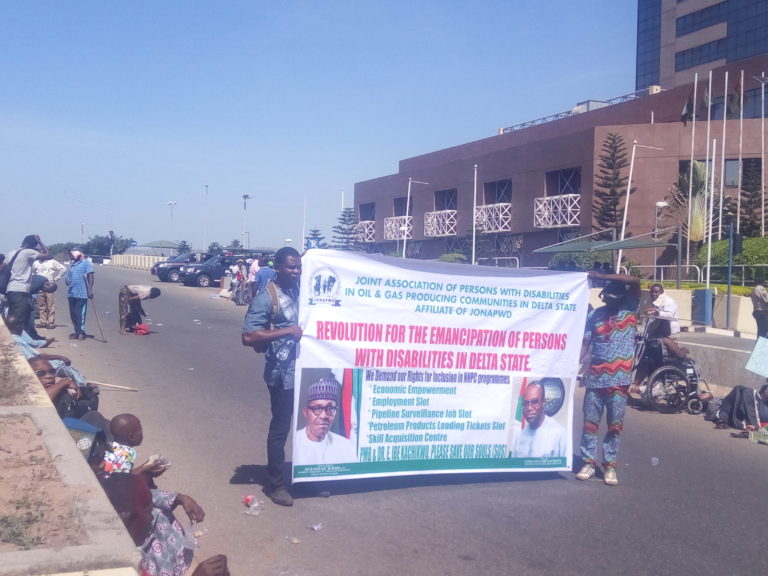
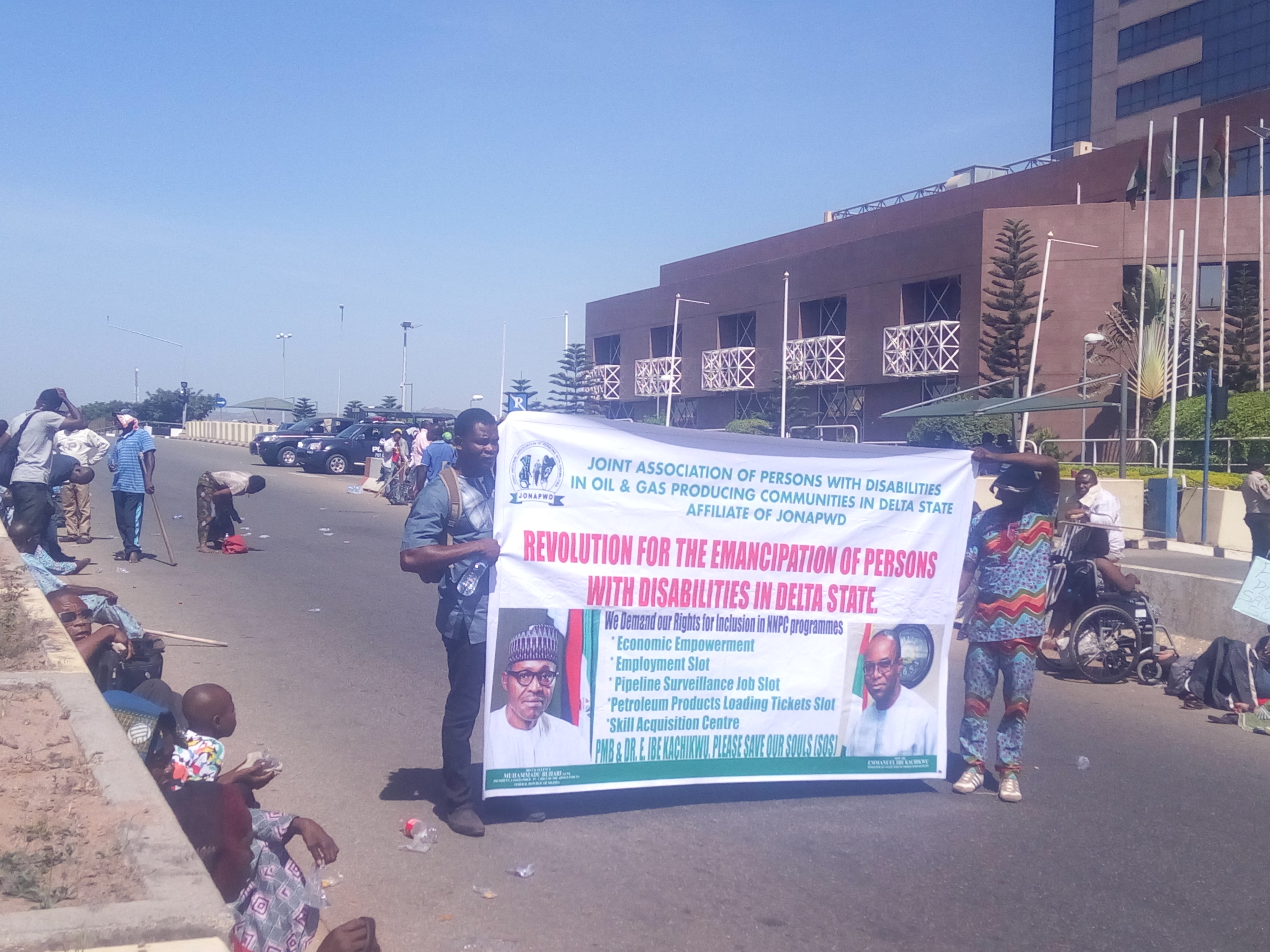
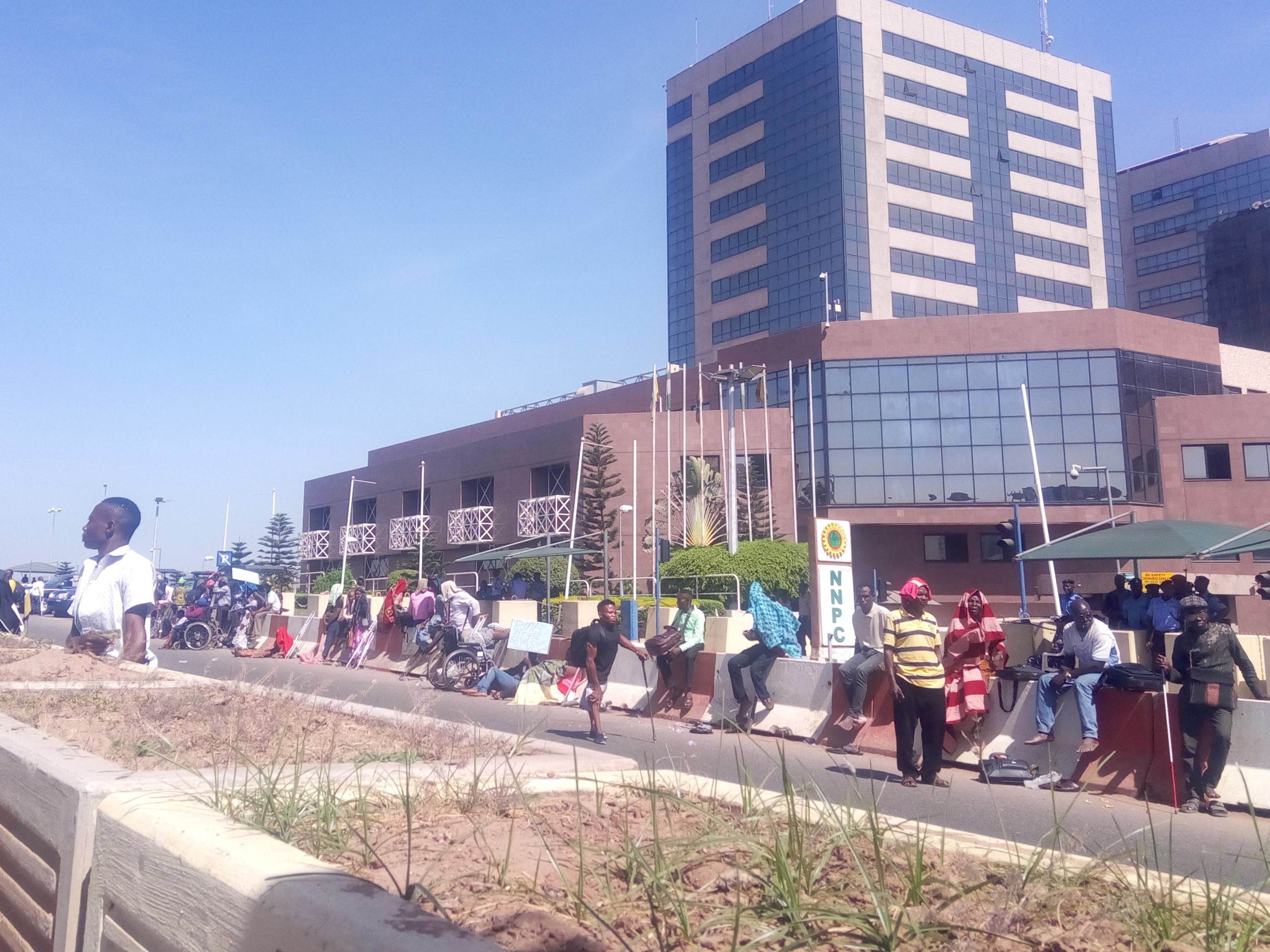
The Joint Association of Persons with Disabilities (JONAPWD) in oil-and-gas-producing communities in Delta State on Monday picketed the headquarters of the Nigerian National Petroleum Corporation (NNPC) to demand “the emancipation of persons with disabilities in Delta State”.

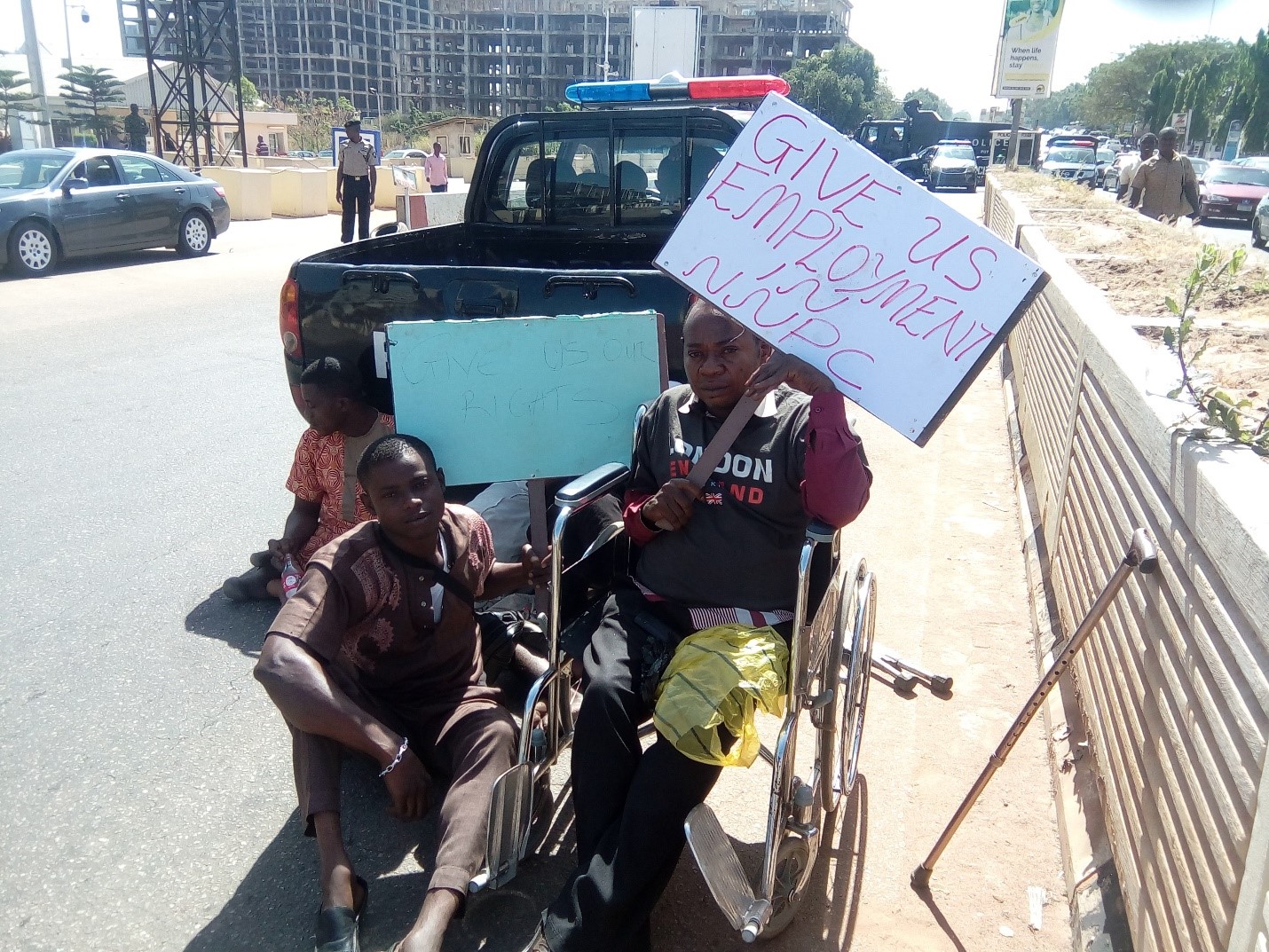
The scorching sun didn’t stop the group from raising placards, sitting on the floor and angrily stopping motorists from driving in and out of the building, thereby causing traffic gridlock in the area.

Comprising the blind, deaf and crippled, members of the group all wore worried looks. Some of their inscriptions read: “PMB save our souls”, “Give us our right”, “Give us products loading tickets”.

Speaking with the ICIR on behalf of the association, Comrade Njoarinma Raees said their action was all about marginalization.

“The government in general and NNPC in particular is not carrying the physically challenged along,” he said.

“They are not giving us what belongs to us; they’re always telling us that physically challenged will not be given slots because we are not capable.

“There are so many able people, some directors in their offices who don’t do their jobs but just sit at their tables, yet they call other people to do the work they are supposed to be doing. Is the person not physically challenged?

“That we are physically challenged doesn’t mean we are mentally challenged. There are certain things I don’t need to do with my legs; I can do them with my voice and hands.

“According to the constitution, whatever employment or empowerment done in the country, the physically challenged should be given 5%. Presently, we are not getting anything.”


A second protester who asked to remain anonymous said they submitted to the Nigerian National petroleum Corporation (NNPC), a proposal to undertake pipeline surveillance for the government.

“We no get work, even hospital care for our community, nothing wey dem do for us; we even tell them say make dem give us ticket to load tankers to go and sell, they refuse,” he said.

“In April we came here and met with Ibe Kachikwu, Minister of State for Petroleum Resources. They (NNPC) promised to do it and till now nothing has been done and now they are depriving us of our right.”

Another protester added that there demands were three: pipeline surveillance job slots, to be taken into skills acquisition centres and to be given petroleum product loading tickets.

When ICIR got to the scene of the protest, Ogbuche Isaac Omoh, Chairman of the association, alongside other representatives, were holding a meeting with the NNPC management while the rest of the protesters remained outside.


READ ALSO:

LUCKY ESCAPE: It’s 7 years in jail for Oyo lawyer who stabbed husband to death

Justice Munta Abimbola of the Oyo State High Court, Ibadan has sentenced Yewande Oyediran, a female lawyer, to seven years imprisonment after she was found guilty of stabbing her husband to death.

This is coming just days after Maryam Sanda, daughter of rejected ICPC board nominee, Maimuna Aliyu, was remanded in Suleja prison for allegedly stabbing her husband, Bilyamin Bello, to death in their home in Abuja.

Oyediran, a staff of the Directorate of Public Prosecution (DPP) in the Oyo State Ministry of Justice, stabbed her husband to death on February 2, 2016, at Akobo area of Ibadan.

She was arraigned on a single charge of murder, to which she pleaded not guilty.

Delivering the judgement on Monday, Justice Abimbola held that the prosecution was able to prove beyond reasonable doubt that the defendant caused the death of the deceased, but it failed to prove that she did it intentionally.

Abimbola said the evidence before him shows that the convict and her late husband had frequently engaged in domestic violence, and that the defendant had admitted to once stabbing her husband with a pair of scissors.

He also adjudged the evidence of the couple’s landlord and wife, Mr and Mrs Akinpelu, as credible.

The landlord and his wife had told the court that they saw the convict holding a knife, while the deceased was in a pool of blood.

File: Prison officials leading Oyediran to the courtroom during one the hearings

“Having seen the defendant holding a knife and the defendant had earlier confirmed that she had earlier stabbed her husband with a pair of scissors a day before, I hold that it was the defendant that stabbed the deceased,” Abimbola said.

The court also took into consideration the autopsy report written by Abideen Oluwashola, a consultant from the University College Hospital (UCH), Ibadan.

“According to the autopsy report, the deceased died as a result of shock from a deep wound caused by a sharp object,” Abimbola said.

The court said that the evidence of the convict could not be relied upon, because her statement with the police was different from her statement before the court.

Magu asks journalists: What are you doing to fight corruption?


Ibrahim Magu, Acting Chairman of the Economic and Financial Crimes Commission (EFCC), wants Nigerian journalists to step up their role in the fight against corruption.

Speaking on Monday at the 68th General Assembly of the Broadcasting Organisations of Nigeria (BON), themed ‘The Nigerian Media and The War Against Corruption’, Magu described corruption as cancerous, saying it has defied every effort at eradicating it while making the country a laughing stock in the committee of nations.

Noting that poverty in the midst of wealth is the paradox of our existence, and corruption is the culprit, he blamed corruption for majority of the country’s problems.

“We have never been in doubt that checking corruption is the fast way to escape from poverty and squalor. This is the reason why successive administrations make the fight against corruption a priority programme. But success in the endeavour has been mixed,” he said.

While noting that some Nigerians are content with blaming successive regimes for lacking the will to tackle corruption, Magu argued that the majority of citizens share in the blame.

“As citizens and professionals, we have roles to play. The question is: how effectively have we played our roles of helping to fight corruption in Nigeria?

Magu, in his appraisal, of the theme of the event, said it was as apt, timely and the evidence that “the media appreciates the fact that the anti-graft war is arguably the most urgent issue in our national agenda”.

He said, “As media practitioners, for instance, how effective have we been in helping to fight corruption? Unlike other professions, the media occupies a unique place in the fight against corruption and impunity in Nigeria.

“As the fourth estate of the realm, the media is the only profession that is constitutionally mandated to hold the nation’s leaders to account. How has the media fared in the discharge of this mandate?

“The roles which the founding fathers of the modern journalism played in the anti-colonial struggles are very well documented. The media was also at the vanguard of the struggle for the liberation of the country from the shackles of military dictatorship.

“But since the return to constitutional democracy in 1999, what has been the experience? As an observer, I will say the experience has been mixed. We have seen flashes of courageous reporting that have strengthened our public accountability architecture even as we also continue to be assailed by pedestrian performance by renegade section of the media involved in cronyism, sycophancy, and outright graft.”

QUESTION: Did slain Bilyamin Bello marry three wives?

There are many mysteries in life that may never be unlocked. When death sets in for one or more of the key actors, it gets worse.

One of such mysteries is the precise marital life of Bilyamin Bello, who was allegedly murdered by his wife Maryam Sanda over claims of infidelity.

One wife is known already: Sanda. Who wouldn’t know her when she is the one alleged to have inflicted multiple stab wounds on Bilyamin? But also in the background are two other women.

MARYAM SANDA

She is the only known current wife of the late Bilyamin. No controversies about that. They have a six-month-old daughter together.

Sanda, daughter of rejected ICPC board member Maimuna Aliyu, allegedly stabbed her husband in the neck, chest and genitals last week at their home in Maitama, Abuja. She was said to have rushed him to a hospital, where he gave up the ghost.

She was denied bail and remanded at Suleja at Suleja prison after her arraignment in court, where she was spotted studying the Quran.

FAKHRIYYA BEN-UMAR

Fakhriyya Ben-Umar is widely accepted as Bilyamin’s first wife. She was studying in the United Kingdom at the time, but the union was short-lived.

They lasted only a few months before a divorce still believed to have been instigated by Maryam Sanda.

Fakhriyya, who holds a first degree in Chemical Engineering and a second degree in Sustainability Engineering, has since re-married.

AMINA SHAGARI

This is the controversy. Amina’s status as a “wife” of the deceased began gaining traction on Friday after her viral tribute to Bilyamin, during which she said they “decided to get married”.

“We decided to get married out of pure friendship,” she had specifically written. “How strong was that bond, and when we couldn’t we still found our way back to being friends.”

Amina, whom the ICIR confirmed to be Shehu Shahagri’s granddaughter, has since deleted the Facebook post, which in a way suggests the marriage never held. Perhaps they “decided” to get married but never quite implemented the decision.

So, did Bilyamin marry her or not? Maybe he didn’t; which would mean he only had two wives.

But they could well have been married. As some say, the heart is the first place where a marriage takes place. Maybe she is his main love; and even though he never married her, his two other marriages couldn’t have separated him from her.

It is even possible that they got married secretly, only to the knowledge of only the duo. The mysteries around love are numerous. This particular one may never be resolved.

Checked-in luggage thieves at Ethiopian Airlines and Nigerian airports

3

The world will not be destroyed by those who do evil, but by those who watch them without doing anything — Albert Einstein.

In life, never say never. Nothing, really, is finite. On Tuesday November 14, I was discussing with a very senior journalist about why opinion writing space should be strictly devoted to public matters, how the columnist should focus on public issues rather than himself, how, after writing every piece, I deliberately re-read to rephrase all expressions bearing the First Person Singular Pronoun “I”.

That conversation held during an Ethiopian Airlines flight from Abuja to Johannesburg via Addis Ababa; little did I know that the return trip would be laced with an incident that would make me break this rule. What would you do if you were wronged and the offender looked you in the eye and said there was nothing you could do about it? Use all possible avenues to seek retribution!

WHEN ‘SECURITY GUARDS’ ARE THE THIEVES

The return Ethiopian Airlines Flight ET911 arrived Nnamdi Azikiwe International Airport, Abuja — via Flight ET 858 from Johannesburg to Addis Ababa — around noon on Monday November 20. Tired after a journey — counting from the hotel — that lasted 18hours, I dragged my checked-in luggage straight home. Next morning when I opened it, I discovered that my expensive Nikon AF-S DX Nikkor 18-105mm f/3.5-5.6G ED VR camera had been stolen. The thief stole the camera and left the pouch, battery and manual for me! Straightaway, I embarked on some Formula One driving to the Abuja Airport and promptly located the Ethiopian Airlines office. I still haven’t got over the nightmare that followed.

When I told the Nigerian Aviation Handling Company (NAHCO) official in that office that I needed to speak with an Ethiopian Airlines official to complain about my stolen property, his reply was curt: “They are at the tarmac; go there if you want to see them.” By the time I started reminding him that I couldn’t be allowed anywhere near the tarmac since I wasn’t travelling, it was his back I was seeing, hands on the door, ready to abandon me in that office.

Luckily — no, unluckily, — a tall, dark and well-built Ethiopian Airlines official walked in just as the NAHCO official was exiting. When I narrated to him how I discovered that my property had been stolen, and my decision to lodge a formal complaint about it, he muttered some imperceptible words and said he had work to do. Before I could say Jack Robinson, Mr. Ethiopian Airlines Official was on his way out as well, leaving the door ajar and me inside. Never ever had I seen such blithe insouciance by a service renderer to a customer. At that point, I remembered the words of a NAHCO official in Lagos whom I phoned the moment I discovered the theft. “Theft of travellers’ belongings is common at Nigerian airports; the airlines know about it, and NAHCO officials are a big part of it,” he had said. “Once they see it in the scanner that there are valuables in your checked-in luggage, they find a way to pilfer it. However, if you mount serious pressure on them, they will bring out your property.”

At that point, I became agitated and opted to launch a one-man protest. Within five minutes of my creating a scene at the airport lobby, a second NAHCO official fished out a complaint form, and it was handed over to me by the first NAHCO official. I was shocked to see this first NAHCO official calmly ask me questions about my travel and fill the answers on a separate form of his.

Then there was trouble. I filled the form and was already leaving when I realised I had no proof of ever filing a complaint. I asked to make a photocopy but the official said it was impossible. Then I asked to take shots of the form with my phone; this angered him. As I was taking a shot of it, he looked sternly at me and said: “You’re just stressing yourself. You see all these things you’re doing, filling form and snapping photos, nothing will come out of it. And there is nothing you can do about it!” That was after the Ethiopian Airlines staff had told me: “We’re just trying to help you.”

ETHIOPIAN AIRLINES’ LONG-RUNNING HISTORY OF LUGGAGE THEFT

I was so distraught by the airport experience that I put up a Facebook post to vent my frustrations. Within 24 hours, five victims of property theft by Ethiopian Airlines showed up. The reaction from the airline has been the same: make them fill complaint forms, then cover the matter up. The examples are all similar. Apparently, Ethiopian Airlines has been stealing from its customers for years and getting away with it.

Seun Oduloye arrived Lagos on June 6, 2017, via an Ethiopian Airlines flight that connected Nigeria from Dublin via Addis Ababa, to the discovery that an entire luggage had vanished. In that big bag were, among others, three pairs of suit, 13 pieces of shoes, perfumes, wristwatches, ladies’ handbags, dresses and packs of chocolate. In the six months that have followed, what Ethiopian Airlines has done is to dribble her like Lionel Messi from one office to another. The airline also failed to reply all three letters from her lawyer.

In December 2014, when Temitayo Odusolu travelled from Bangui, Central African Republic (CAR), to Douala, Cameroon, with Asky Airlines, and then flew Ethiopian Airlines from Douala to Addis Ababa and also the same airline to Lagos, one of her three bags went missing. In that bag were close to 10 books, clothes, camera, and an expensive cloth gift from Ecobank CAR. In a few days, it will be exactly three years since the incident occurred; and despite filling a claims form and following up with different Ethiopian Airlines officials for many months, Odusolu has received neither a formal apology nor compensation from the airline.

On December 17, 2016, Oluwaseun Adepoju arrived Lagos from Hong Kong on an Ethiopian Airlines flight to the discovery that his bag had been opened and baby wears removed from it. Thinking that he encouraged the thieves by trusting Ethiopian Airlines enough not to padlock his bags, Adepoju decided to start padlocking his bags from then on.

However, when he flew Ethiopian Airlines (Flight No ET 901) again on November 5, 2017, from Hong Kong to Lagos, having been collected from a Cathay Pacific plane arriving Hong Kong from South Korea, the thieves struck again. He had two brown bags — one big, the other medium-size — both locked with a mini blue-coloured code. The code locks were forced out of the zipper handles, while the trolley handle of the small bag was forced out beyond repairs. Three shirts were missing from a stack of nine new shirts arranged in a white mall gift cellophane in the big luggage.

On July 17, 2017, a Nigerian who asked not to be named — because it was a business trip and his company policy forbids talking to the media — connected Nairobi via an Ethiopian Airlines flight from Addis Ababa. Upon landing, he discovered that his locked checked-in bag had been broken, and $750 stolen from it. He promptly lodged a complaint, but six months after Ethiopian Airlines has not refunded the money to him.

THE DAMAGE, THE DEMAND
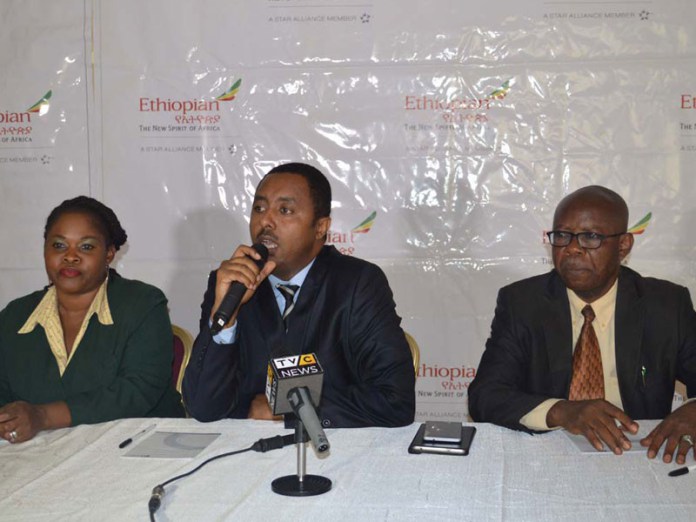
Incidentally, as I was complaining at the Abuja airport, aviation stakeholders were holding an ICAO World Aviation Forum (IWAF) meeting in Abuja, where five obstacles slowing down aviation and air transport in Africa were listed as: safety, market access, high fares and costs, infrastructure, and availability of finance. A sixth needs to be added: poor customer service. And for all the government’s noise about ease of doing business, nobody wants to travel to a country where checked-in luggage is unsafe or where, due to human errors/failings, theft or damage to luggage cannot be punished and the victim compensated.

This is a public call to the Consumer Protection Council (CPC) and the Nigerian Civil Aviation Authority (NCAA) to pay more attention to widespread customer dissatisfaction with the aviation industry. It is not just the manner of delay and cancellation of flights that is worrisome, it is the I-don’t-give-a-hoot attitude to passengers. In 2015, I lodged a complaint with the NCAA over a premeditated six-hour postponement of a trip, without even a text notification, by Aero Airlines. Maybe tomorrow, after more than two years, someone at NCAA will call just to acknowledge it!

Finally, this is a public appeal to Ethiopian Airlines to return my stolen property, and also compensate Seun Oduloye, Temitayo Odusolu, Oluwaseun Adepoju and the anonymous passenger for their stolen items/luggage. It is not enough for my matter to be treated; all four others must be compensated.


Soyombo, Editor of the International Centre for Investigative Reporting (ICIR), tweets @fisayosoyombo

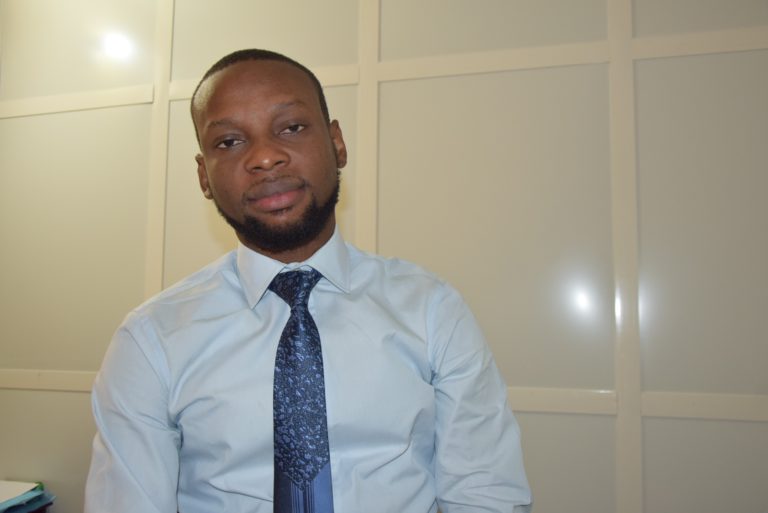
Olu Falae: Nigeria out of recession? It’s pure statistical deception!


Olu Falae, former Finance Minister, says the performance of  the President Muhammadu Buhari government so far has been unimpressive.

Falae, who is also a one-time presidential aspirant, faulted the Federal Government’s claim that Nigeria has exited recession, stressing that nothing has been working under the current government.

He insisted  that the claim is “statistical deception”.

“That is statistical deception. If we are out of recession, the man on the streets should feel it. Changes in oil price can account for the higher income they are talking about,” Falae said  in an interview with The Sun.

Urging Buhari to roll up his sleeves and stop talking about meeting an empty treasury, he said: “Be that as it may, he hasn’t been sterling. I live in Akure, Ondo State. I don’t see what the Federal Government is doing here. The roads are bad, I don’t see anything being done about it. I know the economy, they say we are out of recession.

“Do I know what they are spending money on? I will look at what I am doing, order my own priorities. My priorities will be in the area of ensuring that power is available and affordable. In one, two, three years, 100 thousand industries will spring back to life. Tens of millions of people will go back to work.”

He maintained that the situation in the country today is not different from that of the Ibrahim Babangida military regime which, according equally battled low earnings from oil sales but left huge signature projects.

“That, to me, is more important than anything. After all, when Babangida was in charge, I had the privilege of serving in that government, the government inherited external debt of $28 billion from the Shagari government through to the Buhari government.

“We were the ones who hired Chase Manhattan Bank to even find out how much we were owing these foreigners, because nobody knew. We were just being harassed that we were owing money, they would not open letters of credit for us again. So, we hired Chase, which said the total that they accepted was $28 billion. The rejected claims were over $10 billion. And the price of oil dropped to $10 per barrel.

“With $38 billion debt overhang, that government still managed to run the economy. Yet a few things were still done. Egbin Thermal Plant in Lagos, Ugborode Generation Plant, the Third Mainland Bridge. Despite oil falling to $10 a barrel.

“And we had $38 billion debt overhang inherited from the previous administrations. So, when they say there is no money, it’s a relative term. My father told me, he didn’t have much education.

“Before, there was a small unit in the Ministry of Economic Development, which handled the disbursement of grants to agriculture-related research institutes, but they built it up into a ministry and that was when wastes started. River Basin Authorities, all over.

“Where are they today? Moribund. Extension service could only be done effectively at the local level, ideally by local governments. It is dead all over the country, but they still give a lot of money to the Federal Ministry of Agriculture. In those days, agriculture meant fertilizer importation. Huge areas of waste.”

Stop blaming Grace Mugabe

0

By Panashe Chigumadzi

As former President Robert Mugabe and his second wife, Grace Mugabe, prepare to make their exit from Zimbabwe’s State House, Zimbabweans have hankered for “Amai” (Mother) Sally, his late first wife, who is fondly remembered as a “very sensitive and intelligent woman” who may have been a “restraining influence” on her husband.

On the day of the military intervention earlier this month, the veteran South Africa-based Zimbabwean journalist Peter Ndoro tweeted the following:

“As developments continue to unfold in #Zimbabwe #RobertMugabe might be looking back and wondering if … his rule wasn’t a tale of two wives. One that died too soon and the other that ended up being his Achilles heel. #ThisFlag #SaveZim”

With almost 2,000 retweets, it is the kind of misogynist narrative that has found an easy resonance in many quarters of a country that has been ruled by the heavy hand of a patriarchal nationalist tradition for nearly four decades.

Across the many rallies and marches in Zimbabwe, many people sang “Hatidi kutongwa nehure” [We do not want to be ruled by a whore]. Zimbabwe National Liberation War Veterans Association Chairman Chris Mutsvangwa described Grace Mugabe as “clinically mad,” and Temba Mliswa, a member of parliament from the ruling Zanu-PF party, has claimed that “Robert Mugabe’s legacy has been destroyed by his wife. He’s old, he’s aging, and they’ve taken advantage of him.”

As Mugabe’s party rebrands itself, it is using a simplistic narrative that absolves both Mugabe and Zanu-PF of their political blunders, sweeping all that went wrong into a Grace Mugabe-sized hole.

Is it really “a tale of two wives”? Let’s start with “Amai” Sally Mugabe and whether she was a “restraining force” on her husband.

Having met Mugabe at a teacher training college in her native Ghana, Sally Mugabe, nee Hayfron, married Mugabe in 1961. She became increasingly involved in nationalist political trenches in the ’60s, leading campaigns for the release of Zimbabwean political prisoners, including her husband, while in exile in London. Once her husband was released, she campaigned for the safety and well-being of refugees of the Second Chimurenga (liberation war) while in Mozambique.

In 1980, she joined her husband, Zimbabwe’s first black prime minister, at the helm of the country and officially became first lady seven years later, when he assumed the presidency. By 1989, she was elected secretary general of the Zanu-PF Women’s League. Outside of politics, Sally continued to be popular for her involvement in welfare programs through organizations such as the Zimbabwe Child Survival Movement and Zimbabwe Women’s Co-operative.

A popular leader at home and abroad at the time, Mugabe was meanwhile consolidating and centralizing his post-independence power through constitutional and forceful means. In 1984, Zanu-PF’s congress gave Mugabe extensive powers to appoint the executive members of the party and passed constitutional amendments that created the executive presidency.

Most importantly the early ’80s, Sally was by his side during the “Gukurahundi” (Shona for “the first rains, which wash away the chaff before the spring rains”), the genocide of more than 20,000 Ndebele people. The violent campaign was aimed at quelling the threat of political dissidents; incoming President Emmerson Mnangagwa was a key figure in the massacres.

As Sally Mugabe became increasingly ill with kidney failure in the late ’80s, Robert Mugabe began his affair with Grace Ntombizodwa Marufu, a young married mother and a typist in the president’s office at the time. In 1992, Sally Mugabe died in Harare at the age of 60. As Zimbabwean academic Alex Magaisa points out, for Mugabe, the loss of Sally represented a loss of a close companion and, importantly, a peer. Mugabe married Grace in a spectacular ceremony four years later.

Compared with Sally, who was loved for her apparent sense of modesty and public work, Grace Mugabe became increasingly unpopular for her lavish lifestyle in the midst the economic fallout of the 2000s. She largely stayed out of politics.

This changed by 2014, when she began her foray into politics through her election as president of Zanu-PF’s Women’s League. Though unpopular, Grace Mugabe continued to consolidate power through the support of the “G40 faction,” made up mostly of a younger generation of Zanu-PF members who did not participate in the Second Chimurenga.

Invoking the fist often associated with her husband, Grace Mugabe included in her acceptance speech for the Zanu-PF post threats to those who opposed her: “I might have a small fist, but when it comes to fighting I will put stones inside to enlarge it, or even put on gloves to make it bigger. Do not doubt my capabilities.”

Grace Mugabe’s unpopularity has only kept pace with the kind of hostile language she has increasingly used in her fiery speeches, rhetoric she clearly learned from the man who mentored her over the years.

If we were to hazard that it was “a tale of two Mugabes” instead of “two wives,” that still would be misleading. As Percy Zvomuya points out, Mugabe has been fairly consistent, famously stating in 1976 that “Our votes must go together with our guns. After all, any vote we shall have shall have been the product of the gun. The gun which produces the vote should remain its security officer, its guarantor. The people’s votes and the people’s guns are always inseparable twins.”

However popular or unpopular Mugabe may have been with general populace, the real guarantor of his power has always been the gun, as represented by the military and the war veterans. Over the past 37 years, the relationship between Mugabe and his “guns” has not been entirely smooth, but the relationship has largely remained intact as he gave in to their various demands and safeguarded their interests.

In turn, he has relied on their force to guard him against dissent from organized labor and civic groups. What has been Mugabe’s undoing over the past few years is that at the height of popular dissent with his rule, he increasingly undermined the interests of his “guns” in favor of Grace Mugabe’s G40 faction. The final straw was to remove his longtime ally (and now successor) Mnangagwa.

Grace Mugabe is no saint. But she has also done nothing without Robert Mugabe’s endorsement (and indeed that of many others in the party). The political fallout cannot be put down to an aging leader’s being led astray by an overbearing or too ambitious wife. Given the evidence of Mugabe’s career trajectory, the extent to which first ladies Grace or “Amai” Sally could have restrained their husband is unclear, but even more importantly, it is neither here nor there.

The common denominator in both marriages has been Robert Mugabe, a man who has more than proved himself a skilled and shrewd politician. It was his political mistake to undermine the “guns” that guaranteed his power for so long. It is at best simplistic and at worst misogynistic to hold Sally or Grace Mugabe accountable for their husband’s political missteps.

This article is culled from The Washington Post. The author, Panashe Chigumadzi is an essayist and novelist who was born in Zimbabwe and is based in South Africa.