Home Blog Page 2674

 Six farmers injured in fresh suicide  attack in Maiduguri

Six persons working on their farms were injured on Tuesday when four suicide bombers attacked Mairi-Kwait, a suburb community located close to the University of Maiduguri.

Witnesses say multiple blasts were heard across the city at about 8.20 am to about 9.51 am on Tuesday.

Danbatta Bello, an official of the Civilian Joint Task Force, told newsmen that the attackers were trying to make their way through some barricades constructed around the University to ward off the numerous attacks that the school had witnessed since January this year.

According to him, one of the four female suicide bombers blew herself up in the bush not far away from the fortification, while three others came closer before detonating the explosives to their bodies.

The six farmers who were injured in the attacks were said to have been harvesting their crops at their nearby farm when the bombs went off.

“We have just returned from the scene of the blast which was near Mairi-Kwait,” Bello said.

“They were four female suicide bombers, and all of them got themselves killed in the blasts.

“One died in the bush, and three others died near the parapet after they detonated on a farmland where six farmers who were harvesting their crops got injured.”

The attacks come less than 24 hours after soldiers, supported by members of a local vigilante group and hunters, repelled an attack by Boko Haram insurgents in Gulak, headquarters of Madagali Local Government Area of Adamawa State.

The incident was confirmed by Muhammadu Jibrilla, Governor of Adamawa.

“Nigerian Army supported by local hunters have rolled back the invading terrorists in Gulak,” Jibrilla told journalists via a phone interview.

“Though the areas are under Chibok Brigade, but I do call for minute by minute report on what is happening over there. God is giving victory to our security and hunters.”

So far there has been no word on the number of casualties in the attack except for one woman who was said to have died after she was hit by stray bullet.

Court orders Concord Newspaper to pay Samuel Ortom N5 million

Justice Adam Onum, of the Makurdi High Court, has ordered Ab’iodun Oluwarotimi, Editor-in-Chief of Nigerian Concord Newspaper, to pay Samuel Ortom, Governor of Benue State, the sum of N5 million as damages for libel.

Ortom had approached the court asking it to grant the sum of N10 billion against Oluwarotimi for publishing an article which the Governor claimed defamed his character and reputation.

Throughout the trial, Oluwarotimi, the accused person, refused to appear in court, even when the presiding Judge directed that he be served the writ of summons through substituted means in two National Dailies and through his Facebook handle.

At an earlier hearing in October, the prosecution presented evidences, including Oluwarotimi’s comment on the writ of summons that was posted on his facebook timeline, to prove that he actually read the summons but deliberately refused to show up in court.

Justice Onum also ordered Oluwarotimi to retract all the libelous publications in national newspapers, television, radio and social media platforms as well as tender apologies which must be published in the national dailies within 14 days of the judgement.

Andrew Wombo, counsel to the Benue State government, expressed satisfaction with the judgement and said that he would take every legal step to ensure that the judgement will be enforced.

“Although the motive for instituting the case was not for financial benefit, we will make sure the defendant pays the money as a deterrent against those bent on publishing falsehood against others,” Wombo said.

For ‘a man of the people,’ Dapo Olorunyomi, at 60

0

By Chido Onumah

Dapo, ‘Daps,’ ‘Dapsy’ Olorunyomi who turns 60 on Wednesday, November 8, 2017, is your quintessential humanist. It is impossible to spend an hour with Dapo without being smitten by his humility, compassion, sense of humour and deep appreciation and concern for his environment, including its human challenges and foibles 

Since Dapo is not one to talk about himself, much less celebrate a milestone, it is only fitting to do this tribute—for the sake of the younger generation of Nigerian journalists—in a country where true heroes and heroines are in short supply and charlatans and scoundrels, whether as lawmakers or chief executives, have taken over our political and social spheres.

I met Dapo about a quarter of a century ago through another revolutionary humanist, journalist, and mathematician, Edwin Madunagu. Dapo had just left the African Guardian magazine and he and his friends had set up the The News magazine, an experiment that would define the future of journalism in Nigeria. Our paths would cross many times after that.

It was Dapo who “forced” me to return to Nigeria in September 2006 to join the Economic and Financial Crimes Commission (EFCC) as head of the civil society crime prevention unit tagged Fix Nigeria Initiative (FNI).

As Policy Director and Chief of Staff to then Executive Chairman of the Commission, Mallam Nuhu Ribadu, Dapo brought order and clarity to the work we did during those turbulent days at the Commission. But he did more than that. He provided a philosophical élan that refined the work of fighting corruption, part of which was to engage Nigerians, to reduce the dependence on traditional anti-corruption agencies, and create a public ownership of the fight through the engagement of trade and labour unions, media, civil society, women groups, youth, students, faith-based organizations, professional associations like the Nigerian Bar Association (NBA), Chartered Institute of Bankers of Nigeria (CIBN), Institute of Chartered Accountants of Nigeria (ICAN), Nollywood, Kannywood, Performing Musicians Association of Nigeria (PMAN), etc.

Dapo also made it possible to strengthen relationship with international anti-corruption agencies and development partners, providing guidance on global best practices, strategies and policy issues regarding anti-corruption. Of course, much credit would go to Mallam Ribadu who not only gave Dapo the opportunity but also the freedom to experiment with these ideas and to engage passionate and committed individuals dedicated to developing a professionally run anti-corruption agency.

Dapo’s idea was to enlist public participation and support in a way that would ensure not just a coherent philosophy and strategy but a community ownership of the anti-corruption war. This belief in community power—every group bringing its ideas and strength—is what our country so desperately needs to get it out of the doldrums. It is this obvious lack of belief and ownership of what some people call the Nigerian Project that explains the mindless pillage of public resources orchestrated by our rulers. For no sane person will steal from him or herself the way public officers do in Nigeria.

Unfortunately, that experiment didn’t last long. Dapo was sent on indefinite leave after Ribadu was suddenly removed—in a move inspired by reactionary politicians and enablers of corruption many of whom are still around—and Farida Waziri took over as chairman of the EFCC. Dapo resigned and would later come back to his first love, journalism, at 234Next.com, a journalistic experiment, though short-lived, that would define another phase of journalism in Nigeria. As Enterprise Editor, he set up and headed the Investigative Reporting Team of the newspaper.

Educated at the University of Ife (now Obafemi Awolowo University) where he earned a B.A in English and M.A in Literature, Dapo has attended several courses around the world and received many awards, including the Freedom to Write Award, Hellman Hemmett Grant, Press Freedom Award, and International Editor of the Year Award.

Your archetypal restless soul, Dapo is constantly innovating and experimenting with new areas of interest, from photography to human rights to management of natural resources. Even in the midst of his hectic schedule leading or managing different concerns, he has found time to  receive a Certificate in Human Rights Law from the Washington College of Law of the American University in Washington, DC, a Certificate in Natural Resource Management from the University of Oxford, and is currently completing an MBA from the Business School, Netherlands and is also registered for the graduate program in Futures Studies at the University of Stellenbosch Business School in South Africa.

Dapo is currently the Chief Judge for the Zimeo Award of the African Media Initiative (AMI), and a board member of the Norbert Zongo Cell for Investigative Journalism, an initiative of the UNODC to promote investigative journalism in West Africa.

A journalist and administrator per excellence, Dapo has been involved in setting up and managing several successful projects. He is part of the founding team of The News magazine that was launched in 1993. He served as deputy editor-in-chief of the magazine and groomed a generation of Nigerian journalists many of whom have made giant strides in journalism, academia and other areas.

Dapo was the heartbeat of the magazine and one of chief instigators of the samizdat press, or “guerilla journalism” in Nigerian media parlance, that defined that era of our political history. It was when the murderous dictator, Sani Abacha, held sway and closure of media houses, arrest, detention and disappearance of journalists was the directive principle of state policy. Dapo was caught in the web of violent persecution of perceived enemies perpetrated by the psychopathic Abacha and his goons and was forced into exile in 1995.

While in the US, Dapo would continue his passion for investigative journalism and deep concern for ethics and professionalism in the media. That passion found expression when he joined Panos Institute, Washington, DC, USA, as Director of Africa Programs in 1996, helping journalists in Nigeria and across West Africa deal with ethical and diversity issues. I was honoured when Dapo recommended that I replace him in 2002. He had moved to a bigger assignment with the Open Society Initiative (OSI) in Budapest, Hungary. Dapo and his family—Ladi, his wife, also a journalist, and children, Ifekitan, Aramide and Segun—opened their home to me and gave me all the support I needed.

Dapo returned to Nigeria in 2004 to work as Project Director of Freedom House, an independent organization that supports the expansion of freedom in the world. In 2005, he founded the Wole Soyinka Centre for Investigative Journalism (WSCIJ). Named after Africa’s first Noble laureate in literature, Professor Wole Soyinka, WSCIJ’s objective is “to mainstream the practice of investigative journalism as mechanism for exposing corruption, regulatory failures and human rights abuses in the Nigerian media as well as provide training, developing resources, and forming partnerships that encourage journalists to build a transparent and accountable Nigerian community via investigative reporting.”

When Nuhu Ribadu ran for president in 2011, Dapo was the lead strategist for the campaign. Though Ribadu lost the presidential election, thanks to Dapo’s creative ideas and supervision, the campaign built an unprecedented national youth volunteer initiative, Team Ribadu, that brought a refreshing perspective to volunteerism and youth involvement in politics in Nigeria.

After the campaign, Dapo, always in tune with the evolution of the press, founded Premium Times, undoubtedly Nigeria’s leading online investigative news platform. Shortly after, he would go on to launch another initiative, the Premium Times Centre for Investigative Journalism (PTCIJ), “to promote a truly independent media landscape that advances fundamental human rights, good governance and accountability in West Africa through investigative journalism, open data and civic technology.”

Dapo’s simplicity is infectious. He is kind and generous to a fault and many who have experienced his kindness and generosity know what I am talking about.

I salute this media icon, benefactor, selfless patriot, and exemplary humanist.

Onumah is Coordinator of the African Centre for Media & Information Literacy, Abuja.

‘Militants’ kill British missionary kidnapped in October

The British High Commission in Nigeria has confirmed that one of the four missionaries kidnapped in Delta State in October, by suspected militants, has been killed.

BBC reports that Ian Squire was an optician who, before his abduction and subsequent murder, was participating in a charity programme where the local residents were being administerd free medical.

The charity – New Foundations – is run by David and Shirley Donovan, husband and wife who have spent 14 years in Nigeria.

Both David and Shirley have been freed, alongside the other captive, Alanna Carson. They have since returned to the UK.

It was not clear whether any ransom was paid to secure their release.

“The British High Commission and Nigerian authorities negotiated the release of Alanna Carson, David Donovan and Shirley Donovan,” the report said, adding that it had been a “traumatic time” for the people involved.

Relatives of the four said they were “delighted and relieved” that Ms Carson and Dr and Mrs Donovan had returned safely.

“Our thoughts are now with the family and friends of Ian as we come to terms with his sad death,” they said in a statement issued on their behalf.

The UK Foreign Office advises against all but essential travel to much of Delta state, saying there is a “high threat of criminal kidnap”.

On October 19, six days after the missionaries were kidnapped, the Delta State Police Command told newsmen that four people had been arrested in connection to the crime.

“We are following up on a lead with the arrest of four persons in connection with the incident,” said Andrew Animaka, spokesman of the Police in the State.


Buratai assures soldiers will get outstanding allowances this week

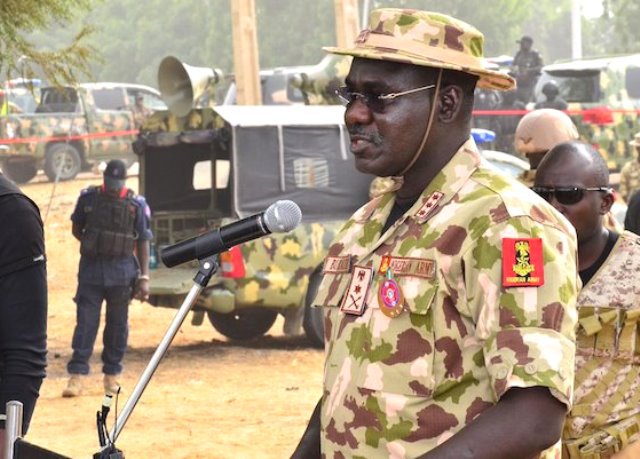
Tukur Buratai, Chief of Army Staff, says the two-month outstanding operational allowance of soldiers who are taking part in Operation Lafiya Dole will be cleared this week.

Buratai’s announcement is coming only a day after an undisclosed soldier wrote an open letter to President Muhammadu Buhari, alleging that there is massive corruption in the military’s prosecution of the war against Boko Haram.

Sani Usman, Director of Army Public Relations, issued a statement on Monday quoting Buratai as saying that the Ministry of Defence had released funds for the payment of the troops’ outstanding logistics and operational allowances for the third quarter of 2017.

Usman also said Buratai commended the troops for their unflinching loyalty, perseverance, courage and dedication to duty.

“The COAS has also assured troops especially those on Operation LAFIYA DOLE of their welfare. This is coming from the good news of the release of funds for the payment of operational allowances and logistics for the Third Quarter 2017 from the Ministry of Defence,” Usman stated

“He further stated that this would facilitate the payment of operational allowances owed to them for the last 2 months this week accordingly.

“The COAS while thanking them for their patriotism, patience and understanding, further reiterated that he will ensure that as usual, all funds meant for the troops and the Operation LAFIYA DOLE will always be paid promptly when received from the appropriate Ministries.”

On Sunday, several media organizations published an open letter purportedly written to President Buhari by an undisclosed soldier.

In the letter, the soldier alleged that he and his colleagues were being owed three months in operations allowances and have had to rely only on their “meager” salaries for all their expenses.

“Your Excellency, this is the third month in a row that we have been denied of our operations allowance. We have to rely ONLY on our meagre salary for everything,” the letter read.

“From battalion commanders, to Company and Sectors leaders, we are all in debt, because our salaries are not enough to sustain us at the battlefront while feeding our families back at home.

“It is a big shame that we have joined the Army to defend the civilians, yet we have to go to the civilians in town to borrow money to fend for ourselves at the battlefront.

“Take for instance the food that we are fed, most of the times it is not fit for human consumption.

“The taste of the food is so bad that we have to add surplus salt to be able to eat it. This is also dangerous for our health. A plate of our food per soldier is probably about two hundred Naira.

“It is said that the Federal Government spends about fourteen thousand Naira (N14,000) on each prisoner in Nigeria. Here, at the battlefront in Operation LAFIYA DOLE, the Army spends about six hundred Naira (N600) per day per soldier on feeding us, while in reality billions of Naira is appropriated per year for this purpose.

“We are treated like animals. Most of us are afraid to talk because of the dire consequence.

“Your Excellency, corruption in the Army is REAL, and it is killing us.

“Every man and woman who decided to join the Army knows the risks (but) while we expect to die in the hands of the enemy, we don’t expect to die in the hands of the Nigerian Army, due to corruption and criminal negligence.”

Italy probes death of 26 Nigerian female migrants


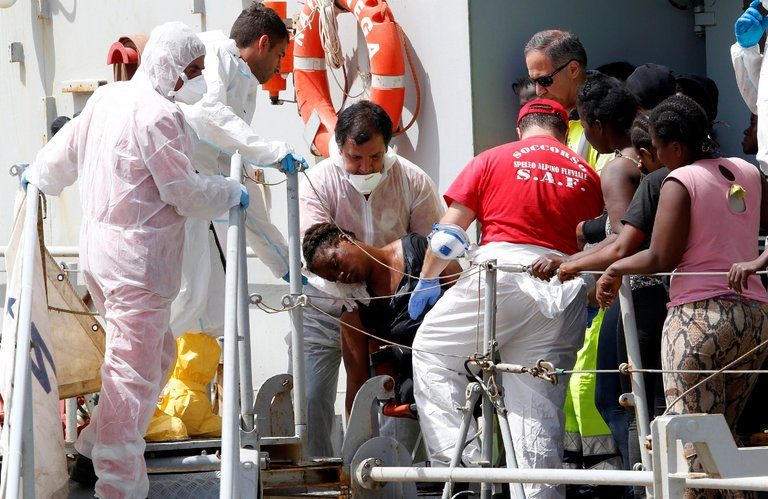
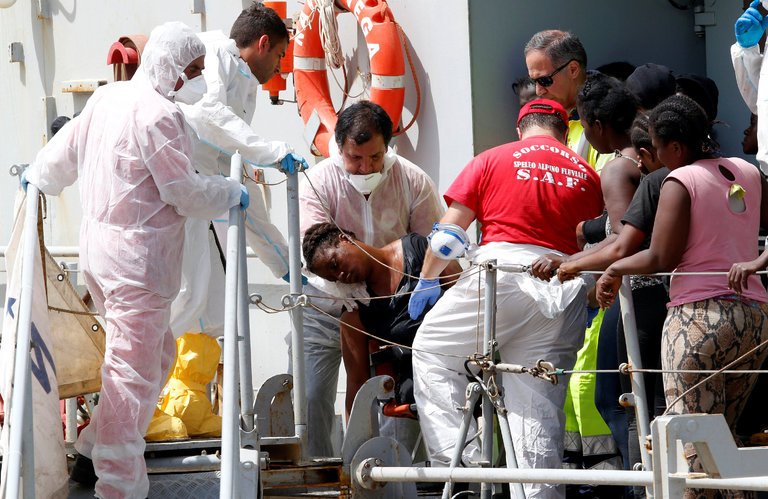
Italian prosecutors are investigating the deaths of 26 Nigerian women – most of them teenagers – whose bodies were recovered at sea.

According to BBC, the investigators suspect that the women, aged 14-18 years old, were sexually abused and subsequently murdered while trying to cross the Mediterranean.

The investigation has led to the detention of five migrants who are being questioned in the southern port of Salerno.

The report said 23 of the dead women had been aboard a rubber boat with 64 people.

Their remains are being kept in a refrigerated section of a Spanish warship, Cantabria, docked on the Salerno port, carrying 375 migrants after other rescue operations.

Amongt the survivors were 90 other women, eight of whom are pregnant – and 52 children.

An Itallian aid group alleges that people-smuggling gangs charge migrants about $6,000 (N1.8 million) to get to Italy, travelling through the Sahara Desert to Libya and then through the Mediterranean Sea to Europe.

Many migrants have reported violence, including torture and sexual abuse, by the gangs while on voyage.

Federal Mortgage Bank defies Fashola’s directive to reinstate sacked whistle blower

The Federal Mortgage Bank of Nigeria (FMBN) has refused to comply with the directive of Babatunde Fashola, Minister of Power, Works and Housing, ordering the immediate reinstatement of two officers who were sacked for blowing the whistle on corruption at the bank.

Murtala Ibrahim, Head of Special Investigation/ICT in the Audit Department was sacked on May 8, 2017, while his boss, Taslim Anibaba, Head of Internal Audit department, was placed on indefinite suspension on August 25, 2017.

Africa Centre for Media and Information Literacy, AFRICMIL, a Non-Governmental Organisation based in Abuja, has been fighting for the reinstatement of the sacked workers.

Chido Onumah, Coordinator of AFRICMIL, described the bank’s refusal to obey Fashola’s directive as unfortunate and an act of gross insubordination.

“These gentlemen committed no crime other than refusing to be coerced to cover up a doctored 2016 half-year financial report and other mind-boggling acts of corruption in the bank, including the N2.2billion contract for the renovation of Mamman Kontagora building,” Onumah said in a statement on Monday.

“The bank used the manipulated 2016 financial report to fraudulently earn the commendation of Mr. Fashola, the supervising minister of the institution who was misled into believing that the bank recorded profits in the stated period when in fact it recorded a loss.”

Fashola had ordered an investigation of the case and issued an order of immediate reinstatement of Messers Murtala Ibrahim and Taslim Anibaba but the management of FMBN has brazenly flouted the minister’s directives, refusing to reinstate the sacked and suspended staff while offering no explanation.

“It is unfortunate that the bank has refused to obey the minister’s directive. We view this as an act of gross insubordination and grave insult to the person and office of the Honourable Minister of Power, Works and Housing,” Onumah said.

He added that the bank’s attitude constitutes serious threat not only to the successful implementation of the whistleblower policy, but also endangers the anti-corruption campaign of the President Muhammadu Buhari administration.

Onumah reiterated the need to ensure the safety and protection of whistleblowers, adding that if people do not get protection they are not likely to report wrongdoings. This, he said, would render the whistleblower policy ineffective.

ICIR announces names of successful applicants for investigative journalism training

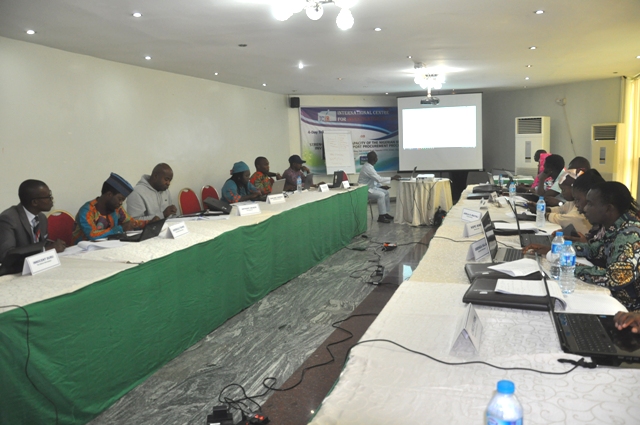
The International Center for Investigative Reporting, ICIR, is glad to announce names of successful applicants for its investigative reporting capacity building project for Nigerian journalists.

The project is aimed at building the capacity of journalists in investigative reporting and data journalism and also develop their skills in reporting issues like illicit international financial flows and tax matters to promote transparency, accountability and good governance in Nigeria.

The successful qualified journalists are drawn from the online, print and electronic (Television & Radio) media across the country.

The training programme is part of a project initiated by the ICIR and supported by the Ford Foundation aimed at bringing the media and civil society together to work on social accountability, equality and governance issues. The two-year project will see both journalists and civil society organisations collaborating and complementing each other’s work in promoting good governance.

The qualified journalists will participate in two intensive training programmes over a two-year period that will be delivered by professionals from within and outside the shores of Nigeria.

In addition, the successful candidates will partake in a mentoring program and will receive financial support to work with civil society organisations to undertake incisive reporting and investigations in critical sectors of the economy.

Successful candidates will soon be contacted for the next stage on the project. They are:

S/N Name Organisation Gender State
1 Ada Igboanugo The Cable Newspaper F Imo
2 Adedayo Adejobi ThisDay Newspaper M Osun
3 Aderemi Alex Ojekunle Nigeria Bulletin M Oyo
4 Adetola Bademosi Nigerian Tribune F Ondo
5 Bayo Akinloye The Punch M Oyo
6 Daniel Adugbo Daily Trust Newspaper M Imo
7 Etebong Akpan Pioneer Newspaper M Akwa Ibom
8 Shamsiyya Haruna Freedom Radio F Jigawa
9 Isaac Anyaogu Business Day Media M Abia
10 Lulu Bankong Independent Television F Cross River
11 Joseph Olaoluwa The Nation Newspaper M Ondo
12 Kelechukwu Iruoma Vanguard Newspapers M Imo
13 Mustapha Kaita Liberty Television & Radio M Katsina
14 Olu Phillips Channels TV M Imo
15 Oluwadare Taiwo The Sun Newspaper M Osun
16 Opeoluwani Akintayo Sweet Crude Reports F Oyo
17 Ruth Olurounbi Nigerian Tribune F Oyo
18 Ukamaka Owo NTA F Enugu
19 Wilfred Okiche YNaija M Anambra
20 Yekeen Akinwale ICIR M Oyo

ABOUT THE CENTER

The International Centre for Investigative Reporting is an independent, nonprofit investigative news organisation which aims to use watchdog reporting to promote transparency and accountability in Nigeria.

Principally, its mission is to popularize a culture of investigative reporting across newsrooms by building the capacity of journalists to do incisive, critical reporting. Last year the Centre concluded the Nigerian Investigative Reporting Project, NIRP, a two -year project supported by Ford Foundation which helped to train more than eighty (80) journalists in Investigative and Data Journalism.

It is currently implementing another big capacity building project for journalists in the area of open contracting and procurement. The Centre runs its own news website @ www.icirnigeria.org.

Buhari should recall Maina, says Ngozika Ihuoma

Ngozika Ihuoma, a former member of the House of Representative and Executive Director of Legislative Watch, says President Muhammadu Buhari should recall and reinstate Abdulrasheed Maina, wanted former Chairman of the Pension Reforms Task Team (PRTT).

Ihuoma, who spoke during AIT’s Focus Nigeria on Monday, said he worked with the PRTT as a consultant and was privy to all the activities of the team.

According to him, Maina is “innocent” and “a saint” who is being haunted by persons who have enriched themselves illegally from pension funds.

He also said it was wrong for the EFCC to claim that it invited Maina for questioning in 2015, when it only sent a letter through a former colleague of Maina’s who last saw him in 2012.

“The EFCC, in trying to be funny, sent invitation to him (Maina) through somebody who used to be his staff. This is what they are parading that they invited him,” Ihuoma said.

“Is this the proper way of inviting somebody? Ann (the person the letter was given to) saw Maina last in 2012, then in 2015 you gave Ann a letter under duress to go and give to Maina.

“Meanwhile, the EFCC Chairman from Larmode to Magu visits Maina in Dubai when he was in Dubai. They go there to collect instrument to get pension fund thieves.”

He said that the PRTT had recovered N282 billion in looted pension funds and more than N1 trillion in property, from only four of the over 90 agencies of government before the team was scrapped.

“The PRTT had only gone round four offices, and there are ninety-something offices where the pension racketeering is still ongoing,” Ihuoma said.

“No sooner than we were driven away, there was another N35 billion that got missing from the (office of) the Head of Service. I blew the whistle.

“ICPC was investigating till today. Ekpo Nta (former Chairman of ICPC) just left, he should tell Nigerians what he found out.

“It’s a goldmine, a goldmine that is bigger than the NNPC, people are wasting time. Funds are trapped here.

“Let the President bring back Maina. He is not on the run. (Shows a picture) This is that car he was in when he was shot severally. Is it when Maina is killed that we would sacrifice him?”

Asked when Maina will come out and face his probe, Ihuoma said “if the Senate and the House of Representatives invites him tomorrow, I will be there with him”.

“Let them send the invitation through me. We are expecting the Senate to reconvene and invite us between now and next week. Maina will be there live, I assure you.”

If you picked Buhari over Jonathan in 2015, you did no wrong

0

There are numerous disgruntled Muhammadu Buhari supporters straddling the social media space. Worried by a series of controversies in a government they placed high hopes in, many of Buhari’s supporters are penitent.

“Throwback to when I used my bike to campaign for Buhari preaching change. God forgive me,” one named ‘Hur’ recently wrote on social networking site Twitter, accompanied by teary emoticons.

Did people like Hur really have a choice in 2015?

THE JONATHAN YEARS

It was always clear to the neutrals that Buhari was not Nigeria’s best-possible presidential proposition in 2015. But weighing him against Goodluck Jonathan, he was the perceptibly better choice. Two disappointing Buhari years are not enough to exorcise the ghost of the Jonathan years. A quick rundown, for those who have forgotten.

What collective progress would Nigeria have made under a man who personalized and institutionalized corruption? This was a man, who, speaking of his aversion to assets declaration for public officials, as mandated by the Code of Conduct Bureau, said: “The issue of public asset declaration is a matter of personal principle. That is the way I see it, and I don’t give a damn about it, even if you criticise me from heaven.” That was in 2012.

Two years lateR, at a presidential media chat, he made a woeful attempt to separate corruption from stealing, saying: “Over 70 percent of what are called corruption, even by EFCC and other anti-corruption agencies, is not corruption but common stealing.”

Under Jonathan, common stealing was the norm — left, right and centre. It was so bad that a returning minister, seeing the scale of looting all over the place, would say in private circles: “I have not come to Abuja this time around to count the bridges; I must get my share.”

Of the numerous corruption cases under his watch, one was particularly problematic for Jonathan. Stella Oduah, his Aviation Minister, was found guilty of procedural breaches in the purchase of two bulletproof cars for $1.6m — about $1.2m more than the market price. Still, Oduah prospered under Jonathan and in fact played a big role in his 2015 campaign; he only dispensed with her when he sensed her baggage could hurt his reelection bid.

Let’s not even talk about Diepreye Alamieyeseigha, the Bayelsa ex-governor convicted for multi-million-pound corruption who disguised as a woman to jump bail in the UK but was eventually granted state pardon by Jonathan. In that administration, the nation’s treasury was national cake and anyone bold enough to approach it with a knife was free to have his cut! That is why there is nothing to show for the periods in his reign when crude oil prices were favourable; Buhari nevertheless ended up inheriting an economy in tatters, many states unable to pay workers’ salary.

How can we forget Jonathan’s handling of the Boko Haram insurgency? For so long, he viewed it as a plot of the opposition to hunt him down. And the Chibok girls’ abduction? As former President Olusegun Obasanjo would eventually reveal, Jonathan, for 18 days after the kidnap, insisted that no abduction took place. By the time he finally accepted he had the largest-scale abduction since the start of the insurgency on his hands, the girls’ captors were well and truly beyond overhauling.

That wasn’t just an odd error of judgement; it was the archetypal Jonathan. Remember when more than 80 people were bombed to death in Nyanya, Abuja, in April 2014? Two days later, the President was dancing away at a PDP rally in Kano. And only a day after at least 48 were killed in a blast in Potiskum in November 2014, Jonathan organised a colourful ceremony to announce his reelection ambition. What about parents of the abducted Chibok girls? The President refused to meet with them — until Malala Yousafzai, a 17-year-old, came here to beg him. Security of lives is one of the simplest responsibilities of a government. And when a government cannot guarantee this (and its head literally rubs it in), thereby leaving the people in a perpetual state of panic, such President deserves to be shown the exit door.

IT WILL BE DÉJÀ VU IN 2019

Why is it so important to harp on the talking points of an election that was staged two years ago? Because we’re inevitably going to find ourselves in a similar situation in 2019.

Like the litany of unfulfilled promises under Jonathan, Buhari has underwhelmed in that office. He promised to fight corruption but he didn’t tell us he would only fight it in the camp of his personal and political enemies; he didn’t tell us his cabinet members were immune from the much-vaunted anti-corruption campaign, that the war would be restricted to the PDP and the Jonathan regime. We didn’t expect that the economy would regress under his watch or that the administration would be so disjointed that government agencies would overtly and covertly antagonise one another. We didn’t expect that the regime of Buhari, a former military strongman, would be hijacked by a cabal.

Buhari has brought a new dimension to the people’s dissatisfaction with governance. To his credit, Jonathan assembled a fairly technocratic cabinet but Buhari’s is inferior by a distance. Buhari made enormous progress with limiting the Boko Haram damage but cronyism and ethnocentrism are some of the hallmarks of his reign. We chased Jonathan away and got rid of his problems; with Buhari, it’s fresh man, fresh problems.

The rising disillusionment with the current administration means Buhari’s long-time and newfound haters will likely be fixated on getting rid of him in 2019 — not necessarily finding the best possible replacement. That would mean we haven’t learnt a thing from the desperation to eject Jonathan and the disappointment of electing Buhari. It would also mean that rather than upgrade our political leadership from one election cycle to another, we’re only stuck in the vicious cycle of unseating one underwhelming government to make room for another.

LOOKING AHEAD TO 2023

For all the attention that the 2019 election has been recently generating, I’m struggling to see how it can become a watershed in Nigeria’s political history. Any serious challenge to Buhari’s reign will likely come from the PDP — a party still in tatters more than two years after losing power.

All those who have so far showed interest in the PDP ticket are the usual suspects — regular faces that have graced the political scene for years or sometimes decade; same old, same old! As it stands, none of the other registered parties is strong enough to gatecrash the PDP-APC hegemony. In 2019, the options will be either returning to messy way of old or sticking with the sticky patch of now. Neither is attractive prospect. We’ll be torn between the devil and the deep blue sea, like we were in 2015.

This is why, ahead of 2023, the electorate need to gravitate towards selection rather than election. There is an urgent need for a non-partisan movement to identify a genuine presidential material among us, and subsequently raise a partisan platform with which the selected material can challenge the PDP or APC. It is a long-term project, and it is far more difficult to achieve in reality than it looks on paper. But something is no longer difficult to see: we can no longer be satisfied with picking one of the two candidates thrown at us by the APC and PDP. It’s time we picked our candidate and threw it at them!

Soyombo, Editor of the International Centre for Investigative Reporting (ICIR), tweets @fisayosoyombo