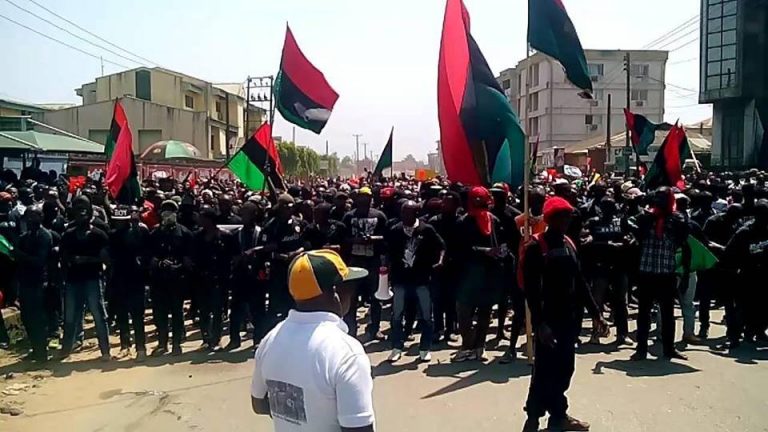
The Nigerian military says the Indigenous People of Biafra (IPOB) will henceforth be treated as a “militant terrorist organisation”.
In a statement issued on Friday, John Enenche, Director of Defence Information, said claims by the group that it does not bear arms are false.
Enenche said that IPOB had been metamorphosing from one stage to another but that the military is resolved to confront any security threat anywhere in the country in order to ensure the safety of lives and property of the citizenry.
“After due professional analysis and recent developments, it has become expedient to notify the general public that the claim by IPOB actors that the organisation is non-violent is not true. Hence, the need to bring to public awareness the true and current state of IPOB,” he stated.
“In this regard, some of their actions, clandestinely and actively, that have been terrorising the general public include: The formation of a Biafra Secret Service, claimed formation of Biafra National Guard, unauthorised blocking of public access roads and extortion of money from innocent civilians at illegal road blocks.”
Enenche listed the kinds of arms wielded by the IPOB to include “stones, molotov cocktails, machetes and broken bottles, among others”.
He also cited an incident on September 11 where Nnamdi Kanu, the leader of IPOB, and his men attacked soldiers at a checkpoint and attempted to “snatch their rifles”.
There was another alleged “attack by IPOB members on a military checkpoint on Sept. 12, 2017, at Isialangwa, where one IPOB actor attempted to snatch a female soldier’s rifle”.
“From the foregoing, the Armed Forces of Nigeria wish to confirm to the general public that IPOB from all intent, plan and purpose as analysed, is a militant terrorist organisation,” Eneche said.
Earlier on Friday, army authorities had insisted that its scheduled operation in the South East, code-named “Operation Python Deance II” will take off on Saturday as initially planned.
This was contrary to the announcement by Okezie Ikpeazu, the Governor of Abia State, that soldiers would start withdrawing from the streets of Aba from Friday.
Tension has been high in the south-east since heavy military machinery started moving into the region early this week.
There have been reports of confrontation between soldiers and members of the IPOB, leading to deaths and injuries.
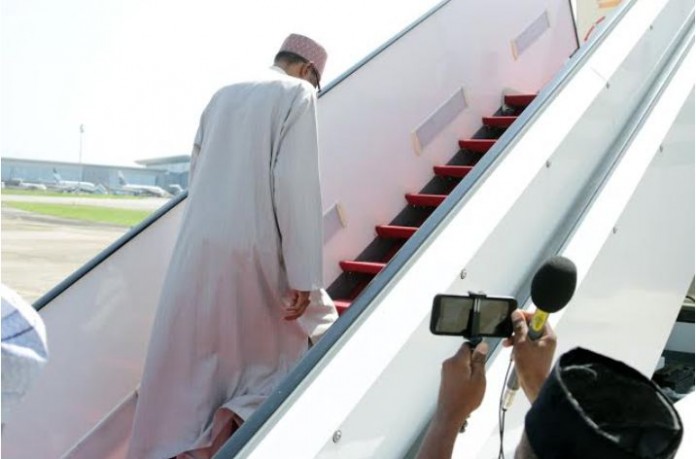
President Muhammadu Buhari will travel to the United States of America on Sunday to attend the 72nd session of the United Nations General Assembly (UNGA 72) but will “transit through London” during his return.
Femi Adesina, Special Adviser to the President on Media and Publicity, said this in a statement issued on Friday.
Buhari returned from a 103-day vacation in London on August 19 after receiving treatment for an undisclosed ailment.
According to Adesina, “the high point of the President’s visit will be his participation in the General Debate during which he will deliver the country’s National Statement”.
“President Buhari will join other world leaders at the welcoming reception to be hosted by the UN Secretary General, Antonio Guterres, and also hold a bilateral meeting with the UN scribe,” he said.
“Equally, the Nigerian leader will hold a lunch meeting with President Donald Trump of the United States of America, along with other world leaders.
“During the General Assembly, Nigeria will participate in high-level meetings on ‘Prevention of Sexual Exploitation and Abuse: Building Momentum for Change,’ the Commonwealth Heads of Government Meeting, a High Level Event organized by the African Union under its Theme of the Year: ‘Roadmap on the Demographic Dividend: from Commitment to Action,’ among others.”
Buhari is also expected to project Nigeria as a strong moral force and responsible member of the international community during the event.
“Other priorities for the Nigerian delegation at UNGA 72 include strengthening human rights institutions; the rule of law; support for Internally Displaced Persons (IDPs) as a result of terrorist acts and recent flooding, and mitigating the effects of Climate Change,” Adesina stated.
“The Nigerian delegation will also canvass the support of UN member states for the Buhari Administration’s efforts towards combating illicit financial flows in order to foster sustainable development.
“President Buhari will transit through London on his way back to the country.”
Governors Abdulazeez Yari of Zamfara, Dave Umahi of Ebonyi and Rotimi Akeredolu of Ondo States, as well as some “key cabinet ministers” will be on Buhari’s entourage.
The statement did not include when the President is expected to return to Nigeria.
Adesina had said after Buhari’s return from the UK that he would travel out again should the need arise.
“What Nigerians should hope for is that our President should remain whole. That is what we should hope for, but if there is any reason to go out, why not?” he had said.
“You need to first stay alive before you can lead a country. So whatever it takes for our President to remain healthy should be done. But we want to hope and believe that the worst is over.”
Itse Sagay, Chairman of the Presidential Advisory Committee Against Corruption (PACAC), is not relenting in his criticism of legislators and their humongous allowances.
At a reunion symposium organised by the Hallmarks of Labour Foundation in Lagos State, on Thursday, Sagay described the Senate as “a merciless and ruthless organisation” with members, who, just like “locusts”, are only interested in “finishing everything within their environment”.
“They have no mercy, they have no conscience; they simply want to behave like locust just to finish everything within their environment for themselves. That’s totally unacceptable and I’m not going to relent on this thing [criticism],” he said.
“Look at the allowance they take, forget the amount. Why would a whole senator collect money for his wardrobe? Is he naked?
“Does a labourer, who is taking just N18,000 a month, get it? He’s the one who needs the money for wardrobe allowance.
“But these opulent, rich, super-rich people are still collecting from you and me to clothe themselves; they’re collecting money from you and me to buy newspapers; they said they’re suffering hardship by working inside chambers that are fully air-conditioned with luxurious cushions, with people serving them left, right and centre, with food and drinks available.
“If you ask them what is their income they will tell you they’re earning a salary which is taxable, which is very little – about one to two million (Naira) a month.
“They will never talk about those allowances which bring their income into tens of millions. We haven’t come near what senators and House of Representatives people are really taking.
“We are talking about allowances; there are many other secret things that they are taking that have not been exposed.”
Sagay said Abdulmumin Jibrin, “the gentleman who was suspended from the House of Representatives last year… has a huge story to tell of the billions that nobody knows about that they’re collecting”.
He insists that “there will be no rest until there is justice”.
Last week, Aliyu Sabi Abdullahi, Chairman of the Senate Committee on Media and Public Affairs, criticised Sagay for his earlier comments against legislators.
He described Sagay as a “senile, outdated professor of law” who talks like a man who is constantly under the influence of some substance.
“This man talks like a man who is constantly under the influence of some substance and perhaps possessed as he employs the language of a tout with no civility,” Sabi said.
“He is probably constantly excited and incensed by the fact of having his first opportunity to find himself in the corridors of power.”
It is not pessimism neither is it doomsday prophecy, but we hardly need any seer at the moment. Everybody, without crystal ball, except those in power, can see the tearing apart of our country. But when an individual or a group of people continuously follow a path and expect a result different from the standard outcome of such exertion, such a situation can only be described as insanity at worst or idiocy at best.
Since time immemorial, Nigeria has been seen as a potential giant in Africa that will also find her place in the world. But again, there is a whole world of difference between potentiality and reality. Even the regional champion Nigeria considers her birthright by virtue of her population and remarkable natural endowments is fast slipping off her fingers. So, in essence, Nigeria has continued to disappoint both her internal and external admirers who are expecting greatness from her. Yet again, Nigeria is anything but great except in potentials and things that make sane people query the intelligence of her people.
The line that Nigeria is hanging on a cliff or standing on the precipice seems to be a jaded one that has always been sung to successive governments that have had the fortune to preside over her affairs. Still, none of these administrations has deemed it fit to move Nigeria away from that often cited precipice.
Though, it all started on a wrong foundation when the British for their pecuniary interests and imperialistic agenda set foot on this vast land and forcibly bring together different people and nationalities that are disparate in almost all particulars. That was in 1914. Nigeria has since celebrated a century of that amalgamation without unity, even though the conceptualisation and the form of the celebration were subjects of contention.
A hundred and three year old man could be wizened but sagacity birthed of years of accumulated experiences should not be absent in his virtues just as a fifty seven year old should be a grandfather, if the normal ordering of human life prevails. In the case of Nigeria, the country has continued to crawl and act like a toddler. Everything about her appears infantile.
Between 1967 and 1970, the country fought a vicious civil war that claimed about three million lives between both sides of the war and yet the country learnt nothing. Perhaps, our lack of empathy for fellow human beings and utter lack of respect for the sanctity of life emanated from that unholy kiss with war and cruelty.
Today, a python is dancing in the Southeast and there are strong signals that if care is not taken, the country may again blow up the fragile fraternity among her component units and shamelessly descend into another brutal civil war. And I have heard severally that no nation can survive two civil wars. Why Nigeria is intent on treading that path is unfathomable.
The tense situation in the country today is not strange as those who are reflective enough have spoken loudly enough and written copiously on the critical issues that will invariably imperil the country if not addressed.
The greatest misfortune of Nigeria as a nation is the ignorance and outright blindness of her leaders. Agitations, impunity and lawlessness are rampant all over the country. While some of the perpetrators of these felony and affray are treated with kid gloves, pythons are set after the others. Before the Northern Youth Coalition retracted their threat and quit notice to Igbo living in the North, the government found it difficult to arrest and prosecute those purveyors of hate speeches.
The government has also found herself helpless in dealing decisively with the felonious herdsmen threatening the peace of the nation. Sending pythons to the East without sending the monarch of the reptiles after the murderous herders and those who spewed hate in the North to counter Nnamdi Kanu’s hate rhetoric amounts to injustice and a leader must be fair to his people.
Underlining these ricocheting hate speeches is the disenchantment of the components units with the country. In this 21st century hallmarked by the liberalisation of access and production of knowledge, I don’t understand why Nigerian leaders are still stuck with the sentiment that our unity is non-negotiable. If to them, that represents patriotism, such patriotism is what Samuel Johnson referred to as the last refuge of the scoundrel. There is no better time than now to quickly restructure this country before it goes up in flame. True federalism will no doubt turn the potentiality of the country into reality.
The elites are no less culpable in the gathering armaggedon all over the country. In the North, the elites deliberately pauperised their people to maintain their hegemony. It is plain feudalism in action there and the system has bred Boko Haram as the monster that will continue to give the country sleeplessness. When the complete degradation and defeat of the insurgency will be achieved is uncertain.
In the East, the elites have succeeded in turning justifiable grievances to criminality and we have on our hands dangerous cases of militancy and secession. The West too is not exempted as the systematic pauperization of her people has turned them to ritual killers and armed robbers who can go to any length just to live the good life. All over the country, noble values have been debased and the worst among men are presiding while the best are gaping like spectators.
If there is a competition to determine the gullibility of nationalities, Nigerians will likely come first in the world. Their lives have been so bastardized that they will grovel and praise -sing their leaders for doing nothing at all. And they so love their tormentors as they always exhibit the familiar Stockholm syndrome of falling in love with their chains and oppressors. Rather than hold the dregs of leaders to account and strongly demand good governance, they will herd themselves to prayer houses where again, they are fleeced by ‘supposed’ men of God, who in reality, are entrepreneurs thriving on the gullibility of unwary compatriots.
From the North to the South, the cannon fodder bearing the brunt of wickedness in high places and cataract-infected leadership is the youth. Today, a python is dancing in the East, majority of the victim of that misadventure will be young men who are recruited into the mob of IPOB because of idleness just as those that are detonating bombs and planting caliphate in the Northeast are young men and girls who the society have neglected and who are now clamouring for alternative society. What a heedless nation!
Since the critical soft infrastructures mentioned above are absent, we cannot possibly talk about societal institutions. Sometimes, when a society is struck with the misfortune of selfish, ignorant and blind leaders, the institutions in the society may temporarily fill the gap and rapidly make the necessary adjustment to remove the distortion, but in our case, there are no institutions. In any case, where are the men to build the institutions? So sad!
This predicament, though gloomy, is not without exceptions. There are still men of honour either in the government or outside of the government but their numbers are too little and too few to make any appreciable impact. No doubt, there are great Nigerians in the country and all over the world, who are the exact materials to effect the necessary changes that will jumpstart our journey to greatness. But are they within the power centres?
The python that is dancing in Southeast should be recalled from the dancing floor. Though, it is sad that the Igbo nation has ceded her representation and advocacy to the mob and a man who is clearly intellectually incapable of dealing with the grave challenges of nationalism and nation building. Kanu calls Nigeria a zoo and revels in incendiary rhetorics, calling for open enmity and disaffection between Igbo and the other nationalities in the country. But apple does not fall far away from its tree as they say just as a man can only give what he has.
If Nigeria is a zoo and his compatriots are animals as he insinuates, definitely an irrational animal must be living within him, with him providing the hide and mouth for the beast in him. This is the man leading the Igbo today. This calls for sober reflections. Where were the Igbo Intelligentsia when Nnamdi Kanu seized the narrative on behalf of their people. Where were the political class when the rabble were being roused?
In spite of the glaring failure of the cream of the Igbo nation to provide the necessary leadership for their people, President Muhammadu Buhari cannot win this vociferous demand for restructuring through strong-arm tactics or by rolling out tanks as he just did in the southeast. When a state responds always with threat, intimidation and suppression of the genuine grievances of her citizens in order to subjugate them, such a state is loosing the narratives and initiatives and it is heading towards failure. The demand to tinker with the federation as presently structured is becoming a din and if hearkened to, the Igbo may after all find secession less attractive. Is the President there?
In a pure democracy, elected leaders simply carry out the wishes of the voters, while securing the absolute sovereignty of its territories from outside forces.
Since its independence from colonialists on October 1, 1960, Nigeria has gone through different political transitions. It has witnessed the birth and death of three republics. It’s progress has been thwarted by violent military takeovers, ethnic and religious violence, corruption and other social unrest. Recently, it was battered by the cold whips of recession.
With calls for restructuring emanating from different indigenous groups, and considering the fate of a nation that many would say is hanging precariously on the edge of a cliff, not forgetting the neglect of equal representation as stipulated by the Federal Character Commission (FCC) Act promulgated in 1995, and later fused into the 1999 Constitution of the Federal Republic of Nigeria (CFRN), it seems there is cause to raise questions concerning Nigeria’s practice of true democracy.
The Act stipulates in its Part 1 that (1) “Each state of the federation and the Federal Capital Territory shall be equitably represented in all public enterprises and organization”.
(2) “The best and the most competent person shall be recruited from each state of the federation to fill positions reserved for the indigenes of the FCT”.
Today, September 15, being the World International Day of Democracy, is a significant day to examine Nigeria’s progress in its 19 years as a democratic nation.
Paul Francis, a 73-year-old trader at Wuse Market, believes democracy, as a system of government, has come of age in Nigeria but cannot spread its tentacles due to the evil claws of corruption.
“Democracy has come of age in Nigeria because there is no more military interruption, though one thing that keeps pulling Nigeria down is corruption,” he said.
“Everybody wants to get to the helm, get what they can, and leave. There is crisis here and there, but it is certain that democracy has definitely reached its maturity phase in this nation.
“If we are being frank with ourselves, we need to put some certain things together. We have to avoid sentiments, religion and ethnic differences, this is the best way to combat the bad blood flowing.
“Projects left by predecessors should be completed. Let’s curb the craving to award new contracts when previous ones are still underway or not finished. Only then and then alone will the widespread national agitations be nipped in the bud.”
Also, Celestine Onuorah, an Abuja resident, said there are lot of things amiss in the country but rather than make amends, we imitate other established nations like America in our system of governance while overlooking the things we need to do.
“In a country that your freedom of expression could be threatened so easily, who is to say that your right to existence cannot be equally snatched from you?” he asked, visibly getting emotional.
“We need to address the issue of geopolitical neglect. We need to start listening to those who feel they are being marginalized, sit down and negotiate properly.”
However, Danjuma a 45-year-old merchant, said the country’s democracy is still immature.
“Democracy in Nigeria cannot be said to have come of age, when what we have is just rulers and not leaders,” he said.
“Nigeria is not a parade ground; democracy should not be substituted for autocracy. We are past the era of dictators. But in a nation where we have majority of top officials as retired generals, what then is our fate?
“Since they are retired, they ought to be the ones directing younger troops on the different drills in the army to safeguard the nation; the affairs of the state should be the affairs of the state and not otherwise. Our rulers are taking the judiciary as child’s’ play, the same people that swore you in, you have turned into slaves.”
In addition, he urged the ruling class to work according to the purpose of democracy — for the people by the people.
“In a democratic nation were the teachers are neglected, where do you think we are headed for? Where rage and bitterness for the polity is what fuel their determination?” he asked.
He said that democracy could not have possibly come of age with only old and tired people controlling the affairs of the state.
“When you have a son whose level of productivity is way above yours, then it is time to write a will and step down for him instead of butting heads with him,” he added.
“Our leaders need to own up to their level of productivity in this country, else kidnapping, armed robbery and other social vices are just the beginning of our problems.”
Usoro Favour, an importer, also told the ICIR that although Nigeria has not attained an ultimate position to be compared to most developed countries in terms of infrastructure, the Muhammadu Buhari administration deserves some plaudit.
“Nigeria’s democratic rule has done a lot. Compared to other democracies, I would say Nigeria is still a babe,” he said.
“But we’re coming up. I don’t think the youths have been marginalized either, especially in the current administration.”
While some say Nigeria’s disintegration of Nigeria is but a hair’s breadth away, it still does not negate the fact that today, the World International Democracy Day, Nigeria pat itself on the back for the baby steps it has taken through the decades.
The Catholic Bishops’ Conference of Nigeria (CBCN) says the ongoing tension and agitation across various parts of the country are the result of injustice and inequity being propagated by the President Muhammadu Buhari’s government.
This was contained in a communique issued at the end of second plenary meeting of the CBCN held in Jalingo, Taraba State, from September 7 to 15.
The Bishops noted that Buhari has failed to live up to his promise that he will cater to all Nigerians and that he would not pursue old scores.
“In his inaugural speech as civilian President of Nigeria on 29 May 2015, the President sent out a message of hope and of his commitment to national integration and cohesion,” the Bishops stated.
“He said: ‘Having just a few minutes ago sworn on the Holy Book, I intend to keep my oath and serve as President to all Nigerians. I belong to everybody and I belong to nobody. A few people have privately voiced fears that on coming back to office I shall go after them. These fears are groundless. There will be no paying off old scores.’
“More than two years later, the reality on ground and the verdict of most of our people across the nation – irrespective of religious affiliation, ethnic group or social status – points to the contrary.
“The inability of the government to address the inequitable situation in the country has provided breeding ground for violent reactions, protests and agitations, which exploit the grievances of different segments of the country.”
The CBCN said the surest way to achieve lasting peace in the country is for the government to “remove everything that smacks of injustice, and give everybody and every part of our country a sense of belonging”.
“We insist that merit and ability should be the primary criteria in making appointments and genuine needs the criteria for the distribution of amenities,” the group said.
“We also urge the government to be always sensitive to the multi-religious and multi-ethnic configuration of the nation.
“As Catholic Bishops, we affirm that the legitimacy of every government derives from its ability to listen to the legitimate yearnings and genuine cries of the people and honestly seek to address them.”
The CBCN stressed that “the deployment of soldiers in the midst of already restive youths could increase the nervousness among the populace with the potential of igniting a fire that could turn into an uncontrollable conflagration”.
It however advised all aggrieved persons and groups to employ peaceful means within the framework of the existing laws of the land to express their grievances.
“Care must be taken by all to avoid actions and utterances capable of causing yet another armed conflict in the nation or any of its parts,” the group said.
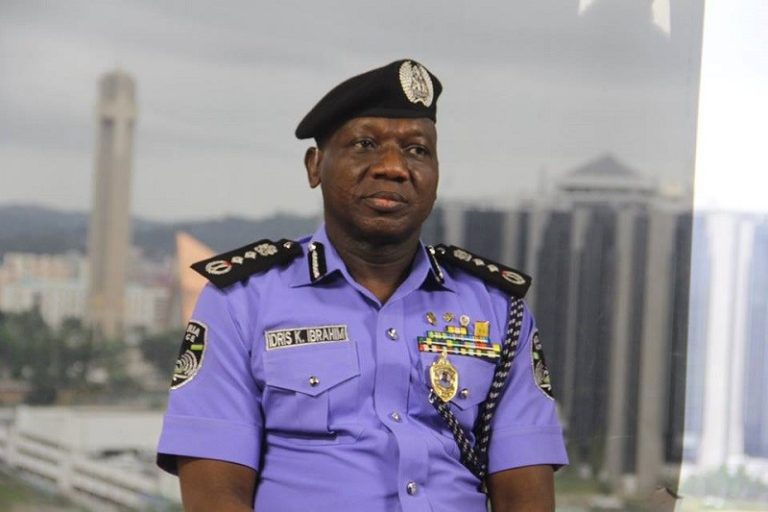
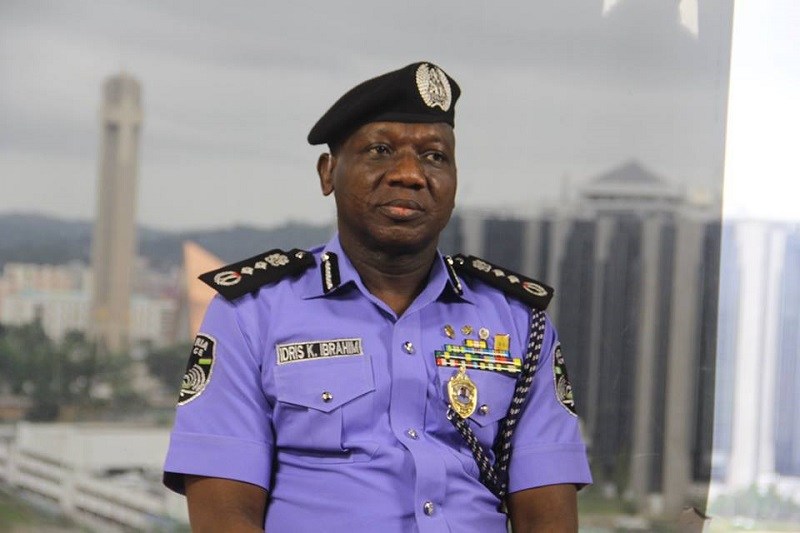
Ibrahim Idris, Inspector-General of Police, has described as “nonsense” the allegations by Nyesom Wike, Governor of Rivers State, that the police are behind incidents of armed robbery and kidnapping in the state.
After a meeting with Vice President Yemi Osinbajo at the State House on Thursday, Idris told newsmen that the allegations were baseless but that Wike has a right to express himself.
“He (Wike) has the right to express himself,” Idris said. “You know he is a governor… of course I have to deny that; it is nonsense. I have to deny that.
“If a policeman was killed, will you say he was involved in crime? I think you are mixing two different issues.
“A policeman was killed in Rivers in connection with this IPOB issue… it’s different from saying policemen are involved in crime. You cannot say someone that was attacked and killed is the one involved in crime.
“I just want you to read between the lines. If you have leaders making sweeping allegations obviously it does not make sense.”
The meeting between Osinbajo and Idris was to discuss the security situation in the south-east, which has resulted to the deployment of soldiers to curtail the activities of members of the Indigenous People of Biafra.
Idris said critical stakeholders, including governors of states in the south-east, are currently being engaged, even though more policemen would be deployed to the region to contain the situation.
“Obviously, one, is to deploy policemen across the country,” he said. “Two, we are in touch with the state governments, trying to mobilize the political leadership to be able to intervene where necessary on how to lessen the tension in the South-East.”
A three-day dusk-to-dawn curfew was declared in Abia State on Tuesday by Okezie Ikpeazu, the State Governor. The curfew, which was expected to end on Thursday, has been extended to Friday.
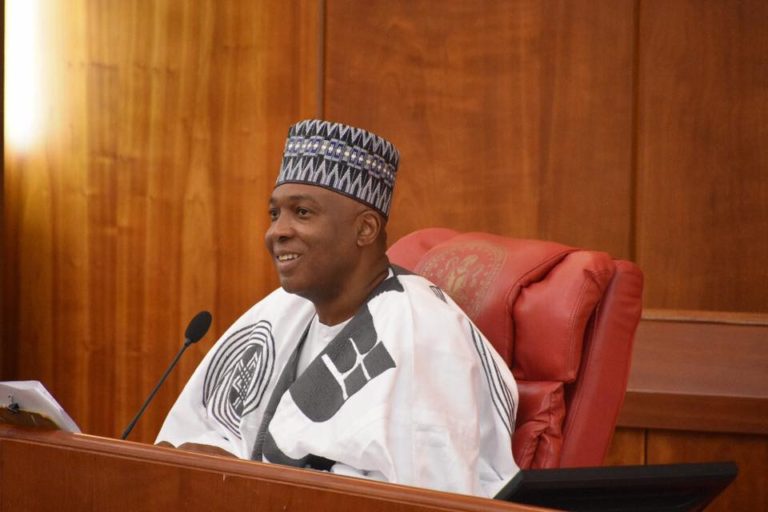
The Socio-Economic Rights and Accountability Project (SERAP) has asked Bukola Sakari, the Senate President, to “urgently explain to Nigerians if it is true that a Nigerian senator gets N29 million in monthly pay, and over N3 billion a year”.
This followed allegations by Itse Sagay, Chairman, Presidential Advisory Committee against Corruption (PACAC), that a Nigerian senator gets N29 million in monthly pay.
The Senate has, however, refused to clarify this or disclose the details of salaries and allowances of its members.
In a statement released on Thursday by Timothy Adewale, SERAP Deputy Director, the organisation said: “The ‘sky will not fall’ if details of a Nigerian senator’s salaries and allowances are published on a dedicated website.
“For the Senate, practising transparency should start with the leadership being open to Nigerians on the salaries and allowances of members.
“SERAP believes that releasing the information on salaries and allowances of members of the Senate would encourage a nuanced, evidence-based public debate on what would or should be a fair salary for a member of the Senate.”
It argued that “It is by making transparency a guiding principle of the National Assembly that the Senate can regain the support of their constituents and public trust, and contribute to ending the country’s damaging reputation for corruption.”
SERAP further noted that transparency is a fundamental attribute of democracy, a norm of human rights, a tool to promote political and economic prosperity and to curb corruption.
It added that “it is by knowing exactly how much their lawmakers earn as salaries and allowances that members of the National Assembly can remain accountable to Nigerians and our citizens can be assured that neither fraud nor government waste is concealed”.
“If the Senate under your leadership is committed to serving the public interest, it should reaffirm its commitment to openness by urgently publishing details of salaries and allowances of members.
“But when the Senate leadership routinely denies access to information on matters as basic as salaries and allowances of our lawmakers because some exceptions or other privileges override a constitutional and statutory disclosure requirement, open government would seem more like a distant, deferred ideal than an existing practice.
“The continuing refusal by the Senate to reveal concrete information about the salaries and allowances of their leadership and members could ultimately endanger the healthy development of a rule-of-law state.
“SERAP is concerned that the Senate seems to consider releasing concrete information about salaries and allowances of members to be at best a burden and, at worst, a threat to their legislative functions. Releasing information on your salaries and allowances would not interfere with your law-making functions. In fact, doing so would improve public confidence in the ability and legitimacy of the Senate to perform those functions and make laws for the peace, order and good governance of the Federation.
“By permitting access to information on your members’ salaries and allowances long shielded unnecessarily from public view, the Senate would be moving towards securing the confidence of Nigerians in the legislature. The Senate would also be establishing a more solid political base from which to perform its legislative duties and to fulfill its role in the balance of power within the Nigerian constitutional order.
“Transparency is necessary for accountability, and helps to promote impartiality by suppressing self-interested official behavior. It also enables the free flow of information among public agencies and private individuals, allowing input, review, and criticism of government action, and thereby increases the quality of governance.”
The details of the salaries and allowances as provided by Sagay are as follows: basic salary N2,484,245.50, hardship allowance 1,242, 122.70, constituency allowance N4, 968, 509.00, furniture allowance N7, 452, 736.50, newspaper allowance N1, 242, 122.70. Others are: Wardrobe allowance N621,061.37, recess allowance N248, 424.55, accommodation 4,968,509.00, utilities N828,081.83, domestic staff N1,863,184.12, entertainment N828,081.83, personal assistant N621,061.37, vehicle maintenance allowance N1,863,184.12, leave allowance N248,424.55, severance gratuity N7, 425,736.50 and motor vehicle allowance N9, 936,982.00.
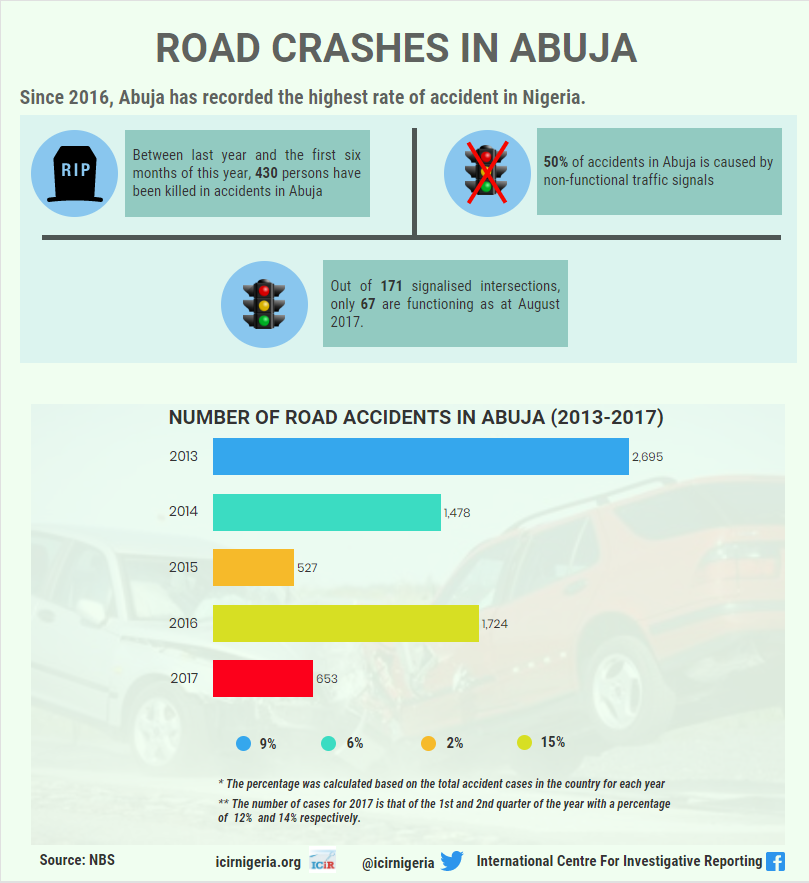
In 18 months, between January 2016 and June 2017, 430 persons have been killed in road accidents in Abuja, the nation’s capital. Investigation by the ICIR, however, reveals that at least 50 percent of the crashes were caused by non-functional traffic signals.
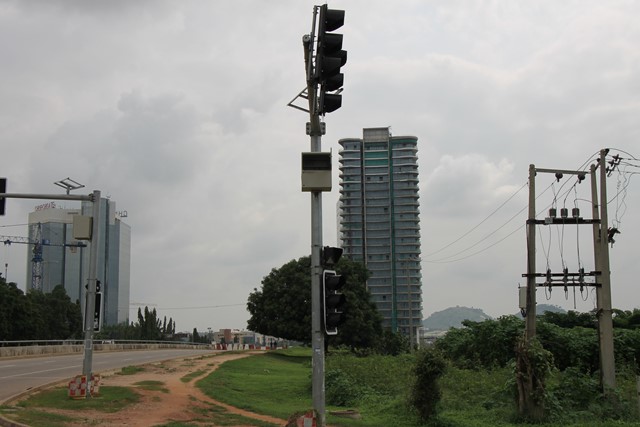
Abuja has 171 signalised intersections but only 67 are functioning after checks by the ICIR. Although 50 traffic signals in the City Centre, nine in Kubwa and eight in Gwarimpa are working as of the last week of August, official record obtained by the ICIR indicates that 74 are still operating.
An official document obtained by ICIR shows that 98 strategic intersections are yet to be signalised, while many of those that have been signalised are not functioning.
For the first time since accident records started to be kept, Abuja had the highest rate of accidents in 2016, beating Lagos, Kano and other states with higher populations.
This year, Abuja has maintained this lead as the accident-prone city. In the first three months of 2017, Abuja recorded 307 cases of road crashes, representing 12 percent of the total crashes that occurred across the country within this period. From April to June this year, Abuja also had 346 cases of accident, representing 14 percent of the total accidents in the country during the period.
This rate of accidents is odd in an administrative city like Abuja, where the President, members of the National Assembly, top civil servants and diplomats live.
While examining the road accident data published by the National Bureau of Statistics (NBS), the ICIR discovered unusual spikes in the rate of accidents in the city.
In 2013, Abuja recorded 2,695 cases of road accident, the second highest in the country, representing 9 percent of the total accidents in the country that year. By 2014, Abuja had an improvement on the previous year, registering 1,478 accidents, representing 6 percent of the total road crashes. The city also gained positively, placing third in number of accidents after Lagos and Ogun states.
But something unusual happened in 2015: road accidents reduced drastically to 527 cases. Abuja accounted for only 2 percent of total accident cases in the country in 2015, and rose from the usual first three to 26th position among the 36 states of the federation.
However, in 2016, Abuja recorded very unusual figures. From 26th position in the country in 2015, it declined to the worst position. There were 1,724 cases of accident in 2016, representing 15 percent of the total accidents in the country that year.
The city has since maintained this lead in the cases of accident till date.
WHAT HAPPENED IN 2015?
The only plausible factor that led to the magical improvement in the rate of accidents in Abuja in 2015 was the functional traffic signals.
A bilateral assistance from the Chinese government facilitated the installation of 76 new solar-powered traffic signals in 2015 at the cost of about N830 million. In March 2015, Poly Solar Technologies Beijing Limited began to install the new traffic lights in parts of the city. The other moribund traffic lights were also revived.
By the end of May 2015 when there was a change of government, about 168 signalised intersections in Abuja were functioning. The rate of accidents nosedived as all the signalised intersections were working.
About 10 months later when most of the traffic signals stopped indicating any light, accidents returned at the extremely high rate.
DEADLY INTERSECTIONS
Junction by the Church Gate, along Olusegun Obasanjo Way
The Herbert Macaulay Way has 14 signalised intersections but none of them is working. The road runs from the Julius Berger Roundabout through Wuse Market, NNPC Towers to end at the International Conference Centre and Radio House where it intercepts with Tafawa Balewa Way.
Similarly, only two out of nine traffic signals along the Tafawa Balewa Way are working. The two signals are situated by the Nicon Luxury Hotel. The road begins from Area 3 junction through the Defence Headquarters, Central Bank of Nigeria, and Ceddi Plaza to the Central Mosque area.
The Ahmadu Bello Way has the most signalised intersections in the city, with 22 traffic signals, but only three are working. Starting from the Bannex Junction in Wuse 2 through the Federal Secretariat, Area 11 to Apo, the only functional traffic signals are the interception with Capital Street by the Federal Capital Territory Administration headquarters and the two at Apo by the Legislative Quarters.
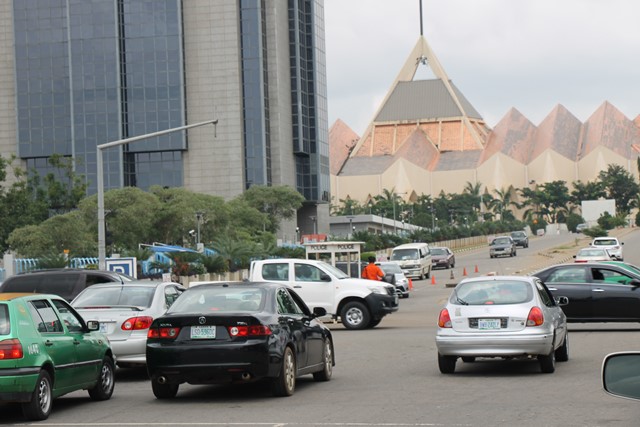
All around the city, traffic signals in the busiest crossroads in Abuja do not function. Coming to the Central Business District from the airport, the first signalised interception is the junction at Olusegun Obasanjo Way by the Church Gate and the World Trade Centre that is still under construction. The traffic signal is not working.
Only one signalised intersection out of the seven in Olusegun Obasanjo Way is working. The functional one is situated at the Bolingo Hotel Junction close to the Ministry of Defence.
Also coming from Keffi-Nyanya axis towards the Central Area after the A.Y.A junction, the first signalised intersection is moribund at the very busy junction between Nnamdi Azikiwe Way and Yakubu Gowon Crescent. Moreover, coming from this axis into the Central Area, the first functional traffic signal is situated after the police headquarters, towards the Federal Secretariat.
Driving through other busy roads, such as Shehu Shagari, Muhammadu Ribadu and Obafemi Awolowo, show moribund traffic signals.
WHEN HUMANS BECOME TRAFFIC SIGNALS
Junction by the Central Bank of Nigeria
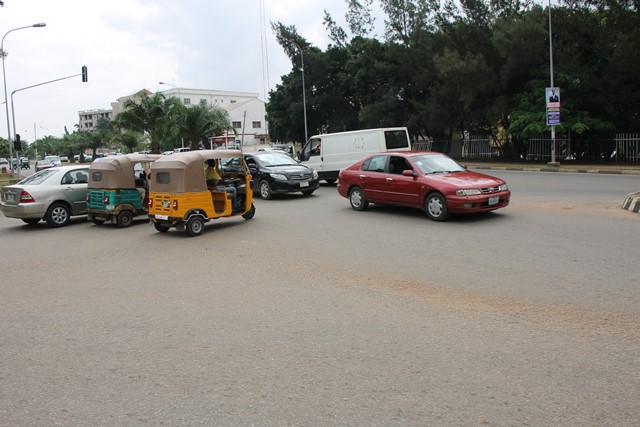
A man in a yellow shirt and black trousers stands in the middle of the junction by the CBN edifice. He puts up a high five with his left hand to cars coming from the Defence College, while waving on a stream of heavy traffic from the Nicon Luxury Hotel axis. When the traffic from this axis empties, he waves to the traffic coming from the Ceddi Plaza to pass.
This man, who is directing traffic in the middle of this strategic junction, is one of the traffic wardens to have replaced the dead traffic signals.
A police post is erected in the middle of the junction to provide him with a little shade from sun and rain but he is standing outside the shade, under the blazing sun. While the electronic signals indicate red, yellow and green light to control traffic, the warden uses his two bare hands to wave at traffic for stop and pass.
As most of the traffic signals are not working, traffic wardens are posted to the busiest junctions to control traffic. But unlike the traffic signals, the wardens do not work for 24 hours a day or seven days a week. They resume in the morning and close in the evening. And on weekends, a very few of them are at their duty post.
The ICIR observes that when the wardens desert their posts at the junctions, accident picks up in the evening and on weekends.
YOUR ASSUMPTIONS MAY NOT BE AUTHENTIC– FRSC
In a chat with the ICIR, Gora Wobin, FCT Sector Commander of Federal Road Safety Corps (FRSC), admits that accidents in Abuja happen more on weekends and evenings, but says it may not be authentic to conclude that most of the accidents are caused by non-functional traffic signals.
“The main causes of the accident in Abuja are impatience and lack of concentration,” Wobin says. “Even where the traffic lights are working, you see drivers beating traffic lights.”
He adds that over-speeding because of the good network of roads in the city is also a major factor why Abuja has a high level of road accidents.
Wobin points out that the location of Abuja also makes it prone to accident. “Abuja is a thoroughfare between the north and south. By the time they get to Abuja, they are tired. Fatigue is one of the major causes of the accidents in Abuja.”
He also suggests that using the rate of the accidents to compare Abuja with other states may not be a good measure, adding that the comparison should rather look at the fatality figures.
He says FRSC has put in place adequate measures to collect accident data, including minor contacts that contribute to making Abuja’s accident rate appear so high above that of other states.
But contrary to Wobin’s claim that the fatality figure of road accidents in Abuja may not be as high as other states, examination of the data shows that Abuja is second to Kaduna State in the number of people that have been killed in road accidents since last year.
WHERE DO ACCIDENTS OCCUR MOSTLY?
In a Twitter poll conducted by the ICIR, 64 percent of the respondents said accidents occur mostly at the junctions in Abuja while 36 percent said accidents happen more on the straight roads.
When motorists were asked where they had witnessed accident mostly in Abuja – junctions or straight roads – most of them agreed that most accidents in the city occur at the intersections. Some drivers, however, said that accidents also occur frequently at the U-turns along the expressways, especially the Murtala Mohammed Way.
Ibrahim Mohammed, a taxi driver, told the ICIR that accidents usually happen at the intersections where the traffic signals are not functioning or do not exist.
“You see, when you get to junctions, some drivers don’t look. They are kings of the road. They don’t stop. They will just hit you when you put head,” Mohammed says.
“If the traffic light is working, the kings of the road will be forced to stop. The lights are not working. They keep hitting at the junctions. People wound themselves and die like that”.
Simon Odey (popularly known as ‘Ogoja Pikin’), presenter of a 30-minute daily programme, ‘Oga Driver’, on Aso Radio, says accidents happen mostly at the junctions.
“Some motorists forget that there is a junction, especially where the traffic light is not working or there is no traffic light,” Odey says.
“The problem is that a driver will be thinking another driver will give way but the other is also thinking the other will give way and this often results in collision that is very fatal”
Odey recalls that in 2007, there used to be speed bumps at the junctions to make motorists slow down but these bumps were eventually removed.
He suggests that if the traffic light cannot work, the speed bumps should be reconstructed to reduce the level of accidents in the city.
IT IS VANDALISM – FCDA
Vandalised traffic light by Church Gate, along Olusegun Obasanjo Way
Vincent Igberase, Director, Department of Traffic Management in the Transportation Secretariat of Federal Capital Territory Administration, told the ICIR that all the non-functional traffic signals were vandalised by hoodlums.
He says the vandals removed the vital components of the traffic signals, leaving only the carcass. He listed the removed parts to include the batteries, slim controllers and the solar panels.
“We have done all that is humanly possible,” Igberase says, referring to the effort to stop the vandalism. “We have written to the Police. We have contacted the Civil Defence, even to the SSS. They have been on it, trying to apprehend those behind it. But no serious arrest has been made.”
He says the traffic signals that are still functioning were part of the 76 installed by the Chinese firm in 2015, adding that the older ones have all been vandalised. The older traffic signals have the locks and the batteries close to the ground but the new ones donated by the Chinese government have the vital components fixed above on the poles, beyond the reach of anyone without a lift.
Despite this improvement to prevent vandalism, Igberase says, the new ones are now being vandalised by still-unidentified hoodlums.
“We are surprised that recently after they have vandalised all the old ones, they are attacking the new ones. We don’t know how they do it,” he laments.
The ICIR observes that the signalised intersection at Olusegun Obasanjo Way by the Church Gate is actually vandalised. The traffic light is among the ones brought by the Chinese but the lock, which is suspended above, is open with nothing inside. The battery and the controller device have been removed.
Despite the moribund traffic signals, Igberase believes that the accidents in Abuja are caused by impatience of the motorists.
“We are not patient,” Igberase says. “Even when the traffic light is working, people still beat the traffic lights. I have gone to places even where there are no traffic lights in the four-way junction. You know what they do. First come first serve. You must give way to the person that comes first. If we follow this, where will the accident occur? The problem is impatience.”
IMPATIENCE OR NON-FUNCTIONAL TRAFFIC SIGNALS
One of the junctions along Tafawa Balewa Way without a warden to control traffic
The dominant narrative is that the high rate of accidents in Abuja is caused by impatience. FRSC officials, traffic light managers and most of the motorists interviewed say the accidents occur because the drivers are impatient when they get to junctions.
However, findings by the ICIR show that the accidents are caused mainly by non-functional traffic signals. In 2015 when the traffic lights were all working, the rate of accident reduced drastically by 64 percent. But in 2016 when most of the traffic signals stopped working, the rate rose by 69 percent.
Again in the evening when the traffic wardens are no longer at the junctions to control traffic, accident increases. Likewise on weekends when most of the traffic wardens do not work at the junctions, accident rate rises.
Contrary to the belief that accidents occur mostly in the evenings and weekends, because that is when the drivers get drunk, the reason major is that the traffic wardens do not work at night and most of them do not work during weekends.
By the ICIR’s checks, only two out of the 76 fixed by the Chinese in 2015 have been vandalised. This means that the new technology can withstand vandalism. If the old technology of the traffic signals is replaced by the new technology where the vital components are suspended at the uppermost part of the poles, beyond the reach of the vandals, the problem of vandalism will be solved to a reasonable extent.
When the signalised intersections start blinking green, yellow, and red again, the rate of accidents will be reduced drastically just as it happened in 2015.
The Nigerian Association of Resident Doctors (NARD) has temporarily suspended its indefinite strike for two weeks, in order to hold further discussions with the federal government.
The decision was taken at the National Executive Council (NEC) meeting of the association, which held on Wednesday night.
The strike will resume if, at the expiration of two weeks, the government has still not acceded to the doctors’ demands.
Segun Olaopa, Chairman of University College Hospital, UCH, Ibadan, chapter of NARD, explained that the suspension was influenced by outcry from the public and pleas that they should give the government more time.
Some of the demands being made by the striking doctors include: recalling of some of their sacked colleagues, payment of ‘skipping’ entitlements, inclusion in the Integrated Payroll and Personnel Information System (IPPIS) and payment of outstanding salary arrears.
So far, the federal government has agreed to pay the salary arrears and also begin the process of including resident doctors on the IPPIS platform.
According to Arikawe Adeolu, a member of the national executive council of NARD, members of the association are yet to receive their arrears.