Home Blog Page 2737

Nigeria’s cybersecurity: FBI, Kaspersky halt this nonsense and make some sense

0


By Timil Olagunju

This week, I had the privilege of making a presentation on Cybersecurity and Trust as a resource person in the area of cyberspace law at the recently concluded Nigeria Internet Governance Forum (NIGF) in Kaduna. You could check up discussions and action-plans on www.nigf.org.ng.

Afterward, I travelled for a speaking engagement at Ahmadu Bello University, and in my hotel room at the Senior Staff club, I remember stumbling on an article published by the Nigeria Communications Week (https://goo.gl/2irvPe), about Kaspersky suggesting that Nigerians have massively carried out successful attacks on the cyberspace of global corporations (not individuals this time); and the Federal Bureau of Investigation (FBI) estimates such at $3,000,000,000 (three billion dollars). Kaspersky further stated that the number of affected companies exceeds 22,143, in at least 50 countries.

But the question is, how did Kaspersky arrive at tracing it to Nigeria? In my finding, I discovered that it was through tracing Internet Protocol (IP) address. Now, the question is, could it be foreign nationals with advanced knowledge, that used the accommodating, faintly regulated, and porous Nigerian cyberspace to perpetuate this act? Of a truth, these days, even hackers use the dark web, to hack as children, family members, talk-less of advanced hacking of global corporations? Or is the usual blame game, since Nigeria has been identified as the ‘yahoo yahoo’ zone, using the cyberspace to dupe individuals? Making it is easier to pin this huge ‘cyber-heist’ of corporations on Nigeria.

In the words of Basil Udotai, a former Director of Cybersecurity, office of the National Security Adviser and Managing Partner, Technology Advisors, “kaspersky as an outstanding internet security company should remember always that attribution often goes beyond the first origination the tools pick up. $3b stolen by Nigerian hackers? Or international hackers bouncing off Nigerian networks! But who is to authoritatively challenge this incident statistics as WRONGLY attributed to Nigeria?”

Of a truth, I perfectly share same position, necessitating the need for me to address these accusations from a solution stand-point.

Well, some have argued that Kaspersky is trying to do business, no one can fault them on that, but leveraging on the reputation of our country is wrong, especially if the statistics are debatable. Kaspersky can say what it likes, but my question is “who is countering their facts with internally and locally generated evidence to the contrary? Who is driving our cyber-narrative as a nation? If you say well, our cyber-narrative is not important, then learn from the experience of an honest and hardworking Nigerian who was stigmatized in another country for being a Nigerian, only because such foreign national hears of Nigeria as home to “cyber-fraudsters”.

In these circumstances, Karsperky better check their facts right! How can a country, with hardly or no free anonymous proxy server, and pathetic electricity supply pull such global heist (beyond mere individual fraud) at the level of three billion dollars (approximately N6, 300, 000, 000, 000). With the state of electricity shortage (and outage) in Nigeria, isn’t it impossible for individual servers to be up and running 24 hours in 7 days for such heist? Again, I ask Kasperky, how can a Nigerian hacker maintain the consistent connectivity that is required to perform time demanding and rigorous hack activities at that level on such scale of six trillion and three hundred billion naira?

Maybe Kasperky needs be reminded, that there are hardly broadband internet connectivity available anywhere in Nigeria. Internet connectivity is mostly via mobile operator’s wireless GPRS data transfers, which has usually very slow data transfer ability. And to add fire to the coal, how many advanced hackers at that level can Nigerians boast of, for such organized and consistent large scale online hacking of corporations to be successful? If kaspersky had said, “Nigerians ‘tried’ hacking global corporations in 50 countries, then we might put the matter to rest, but to further claim, Nigerians did not only ‘try’ but succeeded, sounds more like a convenient way of ‘calling kettle black’.

Someone once argued that the so called “Nigerian hackers” are actually North Korean hackers – and its part of how they fund the North Korean economy, because Nigerian cyberspace is porous and we are a populous nation with a track record of cyberfraud; real or imagined. Well, whether Nigerian or North Korean (or even Chinese or Indian) hackers are involved, it is a known fact that Nigerian hackers lack the connectivity capabilities to operate the shady dark web. Even if broadband internet connectivity is sufficiently available for Nigeria, the dark web clearing house would be impossible for potential hackers.

These are key issues kaspersky needs to look, because such wide and untamed assumptions based on shallow testing, are ethically unacceptable. But also, it’s important for Nigeria to put her house in order – as a Nigerian proverb says “the way you call your calabash is what others will call it for you”.

Therefore, instead of agonizing over the problem of possibly false labeling of my beloved country, her people and cyberspace, I will proffer a simple solution.  In addition to securing our cyberspace, I recommend a concrete “Cybersecurity Media Team” (not committee — I regularly joke that committees mostly commit to drinking Nigeria’s national tea). The Presidency’s “Cybersecurity Media Team (CMT)” should be made up of cybersecurity advocates and media practitioners, working closely with the office of the National Security Adviser (NSA) and the National Orientation Agency (NOA), as well as a various ministries; a multi-stakeholder approach to verifying and sharing information about facts and figures on the Nigerian cyberspace, and helping produce what I refer to as a “Nigerian Cybersecurity Index (CSI)”, involving copious research on locally generated facts and figures about the Nigerian cyberspace. The “Nigerian Cybersecurity Index (CSI)” will help shape policy and technical direction to meet localized cybersecurity needs based on evidence, (and not assumptions or imported data), as well as tackle presumptuously exaggerated positions, which smear the image of our beloved Nigeria, and undermines efforts towards re-branding and attracting foreign investment.


READ ALSO:

Olagunju is a cyberspace lawyer, with specialization in providing training, legal, and business support for start-ups, institutions, and policy makers.

Twitter: @timithelaw                                                             Email: timithelaw@gmail.com

It is either a restructured Nigeria or no Nigeria

0


By Ogbaegbe Michael

“The sight of a united Nigeria’s light lifts Africa, and with it, the world.”

Those were the words of Stuart Symington, the US ambassador to Nigeria, on Thursday 29th June in a speech to celebrate the 241st anniversary of American independence.

Symington went further to say that “just like the United States, Nigeria is a wonderfully diverse nation whose differences and diversity are sources of strength and reason for pride”.

This heartwarming compliment of Stuart Symington might have come exactly two years one month late, considering what I consider our last chance at achieving a one united Nigeria. Muhammadu Buhari ‘was’ our last trial at a united, unrestructured, undivided Nigeria. So, the Buhari presidency might mark the end of history for Nigeria.

NIGERIA NO LONGER ONE

Take it or leave it, Nigeria is no longer one. This might sound pessimistic to those passionate about a one united Nigeria. I also have love for our diversity. I know that diversity can be a source of great strength. But sadly things have gone terribly out of hand the center can no longer hold.

I am an Igbo, from Imo state, but I live in Abuja. Last month I travelled home for a wedding and I spent time briefly in Onitsha and Awka in Anambra State before heading to my village. The first surprise package I got was that majority of Igbo people in the East are now interested in what is happening in government at the centre. Thanks to the incarceration of Nnamdi Kanu.

The second package is that the feeling there is very bad. Majority of Igbo in the East, old and young alike, no longer feel they belong to Nigeria. For them, their life is their hustle; there is completely no government at the federal level. This is not the usual feeling we have as Nigerians of how our government is not performing. This is bitterness. This is great anger that they have been deceived for so long with the idea of one Nigeria. But they are now certain that there is nothing like that.

I spent few days with some of my colleagues as a post graduate student of Nnamdi Azikiwe University. And the story is the same. For them Nigeria was structured to benefit the North and marginalize the South East. That it is time to call it a quit.

Even more revealing was the hot argument we had, relatives and friends, a night before my brother’s wedding. This people travelled home from different states in Nigeria, mainly the South Eastern States. Some of them came from Port-Harcourt, some Aba, some Onitsha, others Benin.

And they are not, as commonly assumed, individuals who are hopeless about their present life and feel the advent of Biafra will bring miraculous packages. These are people who are doing well in their businesses. Chidi, my cousin, who does business in Ariaria International market Aba came back with his newly bought car, which was part of the celebration.

For these my relatives in the South East, Nigeria makes one suffer so much to get very little. The belief in a United Nigeria is completely lost in them. And the idea that something good will come from Abuja politics is perceived as evil.

A lot of factors contributed to this horribly state of affairs. But I will highlight just three I think constitute the bitterness in the heart of many.

  • The Presidency of Goodluck Ebele Jonathan
  • The Detention of Nnamdi Kanu
  • The Presidency of Muhammadu Buhari

THE PRESIDENCY OF GOODLUCK JONATHAN

I was in Awka, the Anambra state capital, when Jonathan was the president of Nigeria. So I felt the groaning of Igbos in the South East then. What is playing out now in the name of Biafra was the animosity built up then.

This is because the common people in the South East did not feel any good impact of Jonathan’s presidency. We were only bombarded with stories of fraud from Abuja. Though then we never envisaged that things, as bad as they were, could get even worst.

Then the road network in the South East was terrible. Power supply was extremely poor, and there was no pipe borne water anywhere. The story is still the same to date, but what made it very painful during Jonathan’s tenure was that he claims to be ‘one of us’.  One singular project that would have been on record in his favour was the Second Niger Bridge. But that was yet another political scam.

To be blunt, Jonathan sowed the seed of what we have today as a divided Nigeria. He saw this whirl wind blowing today, but he neglected it, probably with the thought that the people can always be bought with ninth-hour palliatives.

During Jonathan’s presidency some Igbos were part of the government. Abuja connection trended in the South East then. But selfishness and greed couldn’t let them advise the president right. These Elites attracted no significant infrastructure back home. For them it was just an opportunity to flaunt power and money; that which the Hausas have enjoyed since independence.

No wonder Jonathan was helpless during the 2015 election. Majority of Igbos in Abia and Anambra states refused to vote for him. It appeared as if there was an agreement to boycott voting during the presidential election. The statistics are there for clarification.

THE DETENTION OF NNAMDI KANU

It has to be noted that the first wind of ‘Change’ felt in the South East was the arrest and detention of Nnamdi Kanu. As if Kanu intentionally showed up to be arrested to prove his statements on how brutish Buhari’s presidency will be.

Kanu was arrested just five months into Buhari’s administration. And he was detained for 19 months; what many Nigerians and non-Nigerians have rightfully described as an illegal detention. The detention and the drama that played out during Kanu’s case made majority of Igbo people in the South East interested in happenings in Abuja. These people came to better appreciate the enormous power that government at the center wields, and their comparative haplessness.

The obvious manipulation of our justice system and the disrespect to court rulings by the federal government made many Igbos in the South East feel completely voiceless in the midst of the present administration.

For majority of them, the arrest and unjust detention of Nnamdi Kanu drew the war line between the South East and the Nigeria Government. It completely became a thing of “us against them.”

Nigeria became for many Igbos in the South East a term that represents marginalization and brutish use of might. While the word Biafra became a symbol of brotherliness and common purpose. This is the feeling you get in the South Eastern Nigeria right now. Even those who have never participated in the struggle for seccession now wish for the devolution of Nigeria.

MUHAMMADU BUHARI’S PRESIDENCY

Buhari’s presidency has proved right the anxiety and fear Igbos in the South East nursed about it. The popular perception about Buhari is that he is that Northern Leader that neither respects, nor understands Igbo people. And Buhari’s style of leadership has further buttressed these points.

It is glaring that the present government headed by Muhammadu Buhari has no kind words for the Igbo. Buhari, it appears, had no memory of love from the South East and has no plan of showing the region any love. Just a look at the heads of various government parastatals and agencies as appointed by Buhari tells the story better.

Buhari’s presidency has only bred feelings of marginalization and division in the South East. With his lopsided appointments and harsh economic policies, Buhari has made Nigeria inhabitable for some people. No wonder they are opting out.

MY TAKE

The successive government we have had at the center has failed serially to deliver on the dividends of democracy, and the people are fed up. We cannot keep doing the same thing the same way and still expect different results.

For how long will people be fed with the talk that the coming president will be a father to all Nigerians and will fix the country? I think campaign on such basis is over in Nigeria, Buhari was the last experiment.

People in the South East, majority of Igbos there, are fed up with Nigeria and her promises of better life. The demand of greater number of people Igbos in the South East is outright secession: the emergence of the sovereign state of Biafra.

But I am sure the idea of restructuring into independent states may appeal to many, and so douse the present tension.

I agree with the US Ambassador to Nigeria on his remarks that a united Nigeria is strength; not just to Nigeria, but to Africa and the world. But unfortunately the idea of united Nigeria no longer appeal to many Nigerians, especially Igbo’s living in the South Eastern part of Nigeria.  This people feel excessively marginalized and dejected.

After the history of June 12, 1993, and how the people and God-given mandate of Chief MKO Abiola was brutally denied by Ibrahim Babangida, I dare say that no Nigerian individual can ever again enjoy the consensus of citizens from the six geopolitical zones.

According to the American Political Scientist, Francis Fukuyama, the three component pillars of a stable state are Strong and Modern, Rule of Law, Accountability. A united un-restructured Nigeria can never be perceived by its citizens as being led on this tripod. And if these values that make a liberal democratic state stable are not achievable in Nigeria where then lies the strength of a united Nigeria?

It has to be known to all friends of Nigeria that the continual stability of the Nigerian nation lies on how the present government handles this very important idea of devolution of power.

Unless government at the center takes this call seriously and finds modalities to implement it peacefully, secession will be the ultimate end of the present rancor in Nigeria. And who knows how that will play out?

Ogbaegbe, an author and Philosopher, writes from Abuja. He can be reached via: mchineduo1@gmail.com

Osun perm sec ‘murdered by kidnappers’ along Okene-Abuja highway


The Osun State government says Olufunke Kolawole, Permanent Secretary, Bureau of General Services, in the Office of the Osun State Governor, has been murdered by suspected kidnappers who “brutally attacked her” as she was travelling to Abuja.

Kolawole was travelling to attend the inauguration of Abiola Adewemimo, a former Permanent Secretary at the Ministry of Justice, who was recently appointed as a judge of the National Industrial Court (NIC).

She was initially thought to have been kidnapped but her body was later recovered along the Okene-Abuja highway.

Sunday Owoeye, Osun State Head of Service, confirmed the incident in a statement issued on Friday to condole with the family and colleagues of the deceased.

“On behalf of the Forum of Head of Service and Permanent Secretaries, Tutors-General, Accountant-General, Auditors-General and Surveyor-General, and with rude shock and a deep sense of loss, I hereby painfully announce the untimely death of Mrs. OLUFUNKE OLUWAKEMI KOLAWOLE who was brutally attacked by kidnappers while travelling along Okene-Abuja highway on her way to Abuja on Thursday, 12th July, 2017 for an official assignment,” read the statement.

“Until her death, Mrs. Kolawole was the Permanent Secretary, Bureau of General Services, Office of the Governor, State of Osun.

“The Forum commiserates with the families of the deceased, the entire public service and the State Government of Osun on this irreparable loss.”

Ex-Enugu chief judge in court for ‘collecting N10m’ from accused


The Economic and Financial Crime Commission, EFCC, has arraigned Innocent Umezulike, former Chief Judge of Enugu State for allegedly accepting donations from someone whose case was before him.

Umezuluike was arraigned before Justice Anthony Onovo on a one-count charge of using his office to secure corrupt and unfair advantage.

He was alleged to have received the sum of N10 million donation from Arthur Eze, a billionaire businessman, in February 2014, while Eze’s case was pending in his court.

Eze, the Chief Executive Officer of Oranto Petroleum LTD, made the donation during the launch of Umezuluike’s book, ‘ABC of Contemporary Land Law in Nigeria’.

Wahab Shittu, counsel to the EFCC, told the court that the action contravenes Section 19 of the Independent and Corrupt Practices and Other Related (offence) Act (Laws of the Federation) 2000.

However, Umezulike pleaded not guilty to the charge.

Agu Gab-Agu, counsel to the accused person asked the court to grant his client bail on self-recognizance, while also asking the court to address him as “Honourable Justice”.

Gab-Agu noted that Umezulike was granted bail on self-recognizance in a similar case brought against him before the Federal High Court in Port Harcourt.

The prosecuting counsel did not object to the bail request, but only pleaded with the presiding judge to grant the case accelerated hearing.

Justice Onovo granted the accused person bail in the sum of N1 million and ordered that he be addressed as Justice Umezulike during the trial.

He subsequently adjourned the case till October 26-27, and November 2-3, 2017 for definite hearing.

It’s a fallacy to say Nigeria’s unity is not negotiable, says Soyinka


Wole Soyinka, Nigeria’s first and only Nobel Laureate, says he believes in the country’s unity but citizens have the right to determine what becomes of their future.

He made the remarks on Friday in Kaiama, Bayelsa State, during the commissioning of the Ijaw National Academy, an ultra-modern secondary school built by Seriake Dickson, Governor of the state Government.

Soyinka noted that the unity of Nigeria as a nation is a topic that should be brought to the dialogue table so as to address lingering issues of marginalisation and injustice.

“The claim that the unity of Nigeria is non-negotiable is a false statement. The right of the people to determine their future is what is non-negotiable,” he said.

“Don’t tell me that Nigeria, as it is, is non-negotiable. To me, that’s a fallacy.

“Negotiation involves ensuring that there’s no marginalisation. Negotiation involves ensuring that the major components of the country are not feeding on the centre.”

Soyinka stressed that he believes in the unity of Nigeria, but said that those who are against restructuring were being “dogmatic and dictatorial”.

Earlier, Dickson had expressed similar opinions, pledging support for Nigeria’s indissolubility but adding that federating states must be allowed to manage their resources.

Dickson noted that Bayelsa State has only eight local government areas whereas there are states that have as many as 44 local governments.

He argued that a system where the wealth gotten from Bayelsa is used to finance other states and local government areas is not sustainable.

Only few weeks ago, Acting President Yemi Osinbajo had chided those calling for a renegotiation of the Nigerian state or for part of the country to secede.

“Our unity is not negotiable,” Osinbajo told a group of Muslim leaders at the Aso Rock Presidential Villa on June 25.

“We should make sure that we remain united in order to enjoy the resources God has blessed Nigeria with. So many nations envy what we have as a nation.”

Court grants seven Badoo suspects N1.4m bail

0


The Ebute Meta Magistrate Court in Lagos State has granted a N1.4 million bail to seven suspected members of the Badoo cult group after their arraignment on Friday.

The suspects were charged with conspiracy and membership of an unlawful society, contrary to Section 42(a) of the Criminal Law of Lagos State, 2015.

The suspects — Afolabi Kessington, Ismaila Shaibu, Mutiu Nurudeen, Ibrahim Bello, Lukman Mohammed, Gift Itafa, and Sheriff Adewunmi — all  pleaded not guilty.

Fidelis Dike, an Assistant Superintendent of Police who also served as the prosecutor, told the court that the accused persons committed the offences between July 3 and 5 at Powerline, Agbala area of Ikorodu, and also at Irawo Estate, Owode Onirin.

According to Dike, the accused persons were arrested when they gathered to have their illegal meeting.

Kofo Ariyo, the presiding Magistrate, admitted the accused each to a bail of N200,000 with two sureties in like sum, one of whom must be a relative.

She thereafter adjourned the case until August 9 for continuation of hearing.

A teacher’s reward is in heaven? One just received N500,000 from Obaseki

0


It’s not all the time that a teacher’s reward is in heaven — one, Birgitta Okodugha, a mathematics teacher at Asoro Grammar School, Edo State — just got a sum of N500,000 from Godwin Obaseki, Governor of the state.

Three others — mathematics teachers at Edokpolo, Deeper Life and University Preparatory schools — also received N250,000 each from the Governor.

Obaseki also donated N100,000 each to 16 students of different schools for doing the state proud in various local and international mathematics competitions.

The competitions were organised by the Mathematical Association of Nigeria (MAN) and the National Mathematical Centre (NMC).

Obaseki made the donation when he received executive council members of MAN, Edo Chapter, in Benin on Thursday, saying it was a way to encourage teaching and learning of mathematics.

He expressed appreciation to the association for simplifying the learning of the subject and demystifying the feared subject among students.

He said that he would encourage the association to continue, as meaningful development in the sciences could only be achieved with sound mathematics foundation.

He promised to redeem all pledges made by his predecessor, Adams Oshiomhole, to the association, within two weeks, and provide them transportation whenever they are travelling for competitions.

He expressed pleasure that majority of the benefiting students are from government-owned Asoro Grammar School.

He promised to find out the secret behind the success of the students, so that he could replicate it in other schools across the state.

Earlier, Lawrence Aguele, a Professor and Chairman of the association, said the association was promoting the learning of mathematics among students and sponsoring teachers for conferences.

He appealed for support from the state government through the provision of a secretariat building and vehicle for movement of pupils to competitions.

Some of the students, Favour Kenya, Victory Ojo and Wise Oghogho, thanked the governor for the donation saying it would help them buy more mathematics books and encourage them to perform better in future competitions.

For senate president’s wife, a bracelet can stop Nigerian children from dying

A bracelet worn on a new-born baby’s wrist or ankle until the baby is nine months old is believed by Toyin Saraki, wife of the Senate President Bukola Saraki, to have the potential to protect children from preventable death.

Whenever a child receives immunisation, a hole in the bracelet will be punctured. The number of the punctured holes will indicate the doses of a vaccine a child has received. It means that at glance, anyone will know whether a child has received the complete doses of immunisation.

The bracelet is an innovation by Alma Sana, an international non-governmental organisation. In South American countries of Peru and Ecuador, where the bracelet was first used on children, it has been shown to increase uptake and demand for immunisation.

“The fantastic thing about this bracelet is that it is a visual reminder to educate mothers on whether their children have had the right immunisation at the right time,” Saraki told the ICIR.

A baby born in Nigeria has five immunisation schedules — taken within 24 hours of birth, six weeks, 10 weeks, 14 weeks and nine months.  Most mothers, especially those in the rural communities, forget to keep tab of these immunisation schedules.

Complete immunisation of children in Nigeria is less than 30 percent, and Nigeria is one of the 10 countries where most incompletely immunised children in the world live. The 2013 Nigeria Demographic and Health Survey indicates that only 25.3 percent of children of immunisation age are completely vaccinated.

Based on the Nigeria Expanded Programme on Immunisation, a child is considered fully vaccinated if at the age of nine months, the child has received:  BCG against tuberculosis; three doses of vaccine to prevent diphtheria, pertussis, and tetanus; at least three doses of polio vaccine; one dose of measles vaccine; and three doses of vaccine against pneumonia.

Rotavirus vaccine against diarrhoea has not been introduced into the national immunisation schedule but the vaccine is available in private health facilities.

THE BRACELET

Bracelet

“Not immunising a child is a crime against humanity,” Saraki says. “Immunisation is probably the most sensible investment you can make to promote and protect a child’s health.

“I think anything that reminds us to get the right vaccinations for our children at the right time is a programme that should be supported. It is a great initiative and I hope it reaches every single Nigerian child of immunisation age.”

But reminding mothers about their babies’ immunisation is not enough as many health centres in the rural communities either do not have these vaccines or not functional. A report by the ICIR shows that health centres do not have the means to store the vaccines, and nursing mothers rarely get the vaccines when they take their babies to the health centres.

Alma Sana, the organisation that invented the bracelet, recently won $100,000 from the $1 million GlaxoSmithKline (GSK) Healthcare Innovation Award.

The bracelet, which is fashionable to be worn as a baby’s jewellery, will act as vaccination reminder through symbols embedded in it to remind both the literate and illiterate mothers of their babies’ immunisation schedules.

Although mothers in Nigeria are given immunisation cards by health facilities to keep records of their babies’ vaccination, many of them often forget to come along with the cards to the hospitals.

MORE THAN JUST A VACCINATION REMINDER

Vaccination

Saraki believes that the bracelet will be critical in fighting the high level of malnutrition among children. “You know that this bracelet is to be worn by a child between zero to nine months. So if you see an 11-month-old child and the bracelet is swimming around his wrist, you know that there is a nutrition deficiency that we need to address,” she told the ICIR.

Saraki is confident that the bracelet will not only remind mothers and health workers about the babies’ immunisation schedules but will also indicate how a child is being nourished.

According to Ministry of Health, malnutrition accounts for more than a half of under-five deaths. Apart from death, those who survive malnutrition face a lifelong challenge of physical and cognitive deficiencies. One-third of children under the age of five in Nigeria are stunted (too short for their age) due to nutritional deficiencies.

Scientific evidence shows that stunted children are more likely to have cognitive deficiencies and poor learning outcomes. A report by the Save the Children shows that malnourished children score 7% lower in mathematics tests, are 19% less likely to be able to read at age 8 and are 13% less likely to be in the appropriate grade for their age than those who are well nourished.

This month, Alma Sana in collaboration with the National Primary Health Care Development Agency, is expected to start rolling out 100,000 bracelets to newborn babies in rural communities in a pilot phase.

The bracelet has been applauded by stakeholders in the health sector as a means of reducing the high level of vaccine-preventable death among children.

However, some health experts point out the possibility of this bracelet causing allergic reactions on the babies. The concern is that putting the bracelet on a new-born baby can cause contact dermatitis.

Since the bracelet will be worn by the babies of mostly poor and illiterate mothers with a low level of sanitation, there is a concern that it will accumulate dirt on the babies’ wrists which can be a potential source of transmitting certain infectious agents.

Shola Dele-Owo, Nigeria implementing partner of Alma Sana, says the bracelet has been tested and it is safe. She says the bracelet, which is waterproof and durable to last a whole nine months in a baby’s wrist, was designed by mothers and nurses.

Polytechnic and university graduates to now earn equal pay


The Federal Government has approved equal salaries for civil servants with Higher National Diploma (HND) and Degree certificates, thereby bringing to an end the age-long dichotomy between university and HND degree holders in all the para-military services.

This was made known in a statement issued by Abubakar Magaji, Permanent Secretary of the Ministry of Interior.

Magaji said the decision was reached at a board meeting of the ministry, chaired by Abdulrahman  Dambazau, the Interior Minister, on Tuesday.

The recent development affects personnel of the Nigeria Security and Civil Defence Corps (NSCDC), the Nigeria Fire Service, the Nigeria Immigration Service (NIS) and the Nigerian Prisons Board.

“The board directed that all officers with HND should be upgraded to COMPASS 08, which is the salary grade level for holders of degree certificates at entry point,” the statement read.

“While the nomenclature for the HND holders will start with the rank of Senior Inspector, the degree holders are with the rank of Assistant Superintendent II.”

Ambode suspends Lagos monarch for faking his own abduction

0

Akinwunmi Ambode, Governor of Lagos State, has approved the immediate suspension of Yusuf Ogundare, a chief and the Baale of Shangisha, Magodo, Lagos, for faking his kidnap on July 5.

In a memo with reference number OLGAS.83/S./Vol.1 dated July 13, 2017, addressed to the Sole Administrator of Ikosi-Isheri LCDA and signed by Teslim Folami, Commissioner for Local Government and Community Affairs, Ambode directed Ogundare to stop parading himself henceforth as the Baale of the community till further notice.

“I am directed to convey the approval of His Excellency, Governor Akinwunmi Ambode of the suspension of Chief Yusuf Ogundare, Baale of Shangisha, with immediate effect in accordance with Section 38 subsection 1 of the Obas and Chiefs Laws of Lagos State which states that ‘the Governor may suspend or depose any Oba or chief whether appointed or after commencement of this law, if he is satisfied that such suspension of disposition is required according to customary law or is necessary in the interest of peace and good government,'” Folami said.

“You are to communicate the decision to the chieftain to stop parading himself as Baale of Shangisha with immediate effect.”

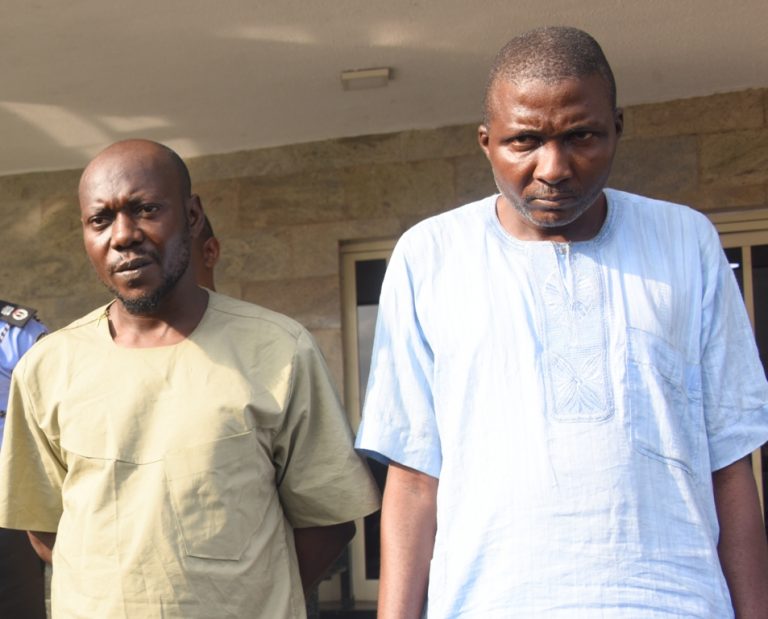
Ogundare’s suspension was approved by the Governor moments after the Lagos State Police Command paraded him alongside his younger brother, Mohammed Adams, for conspiring to fake the alleged kidnap.

On the fateful day, Adams had reported the alleged kidnap incident to the police.

????????????????????????????????????

Speaking while parading the two suspects, Fatai Owoseni, Commissioner of Police, said the Command received the report of Ogundare’s alleged kidnap on July 5, and immediately swung into action in collaboration with other security agencies, especially the Department of State Service (DSS).

Owoseni said luck however ran out on Ogundare when he was apprehended by men of the Rapid Response Squad (RRS) in Alausa area of the State on July 11 after he was dropped in a suspicious manner by a car which sped off immediately.

“On July 11 at about 10pm, a team of RRS patrol officers working around Alausa had sighted a vehicle drop a male adult in a suspicious manner close by Shoprite along the Secretariat road. The speed with which that car drove off attracted them to that spot and fortunately before they got to the spot, the car had taken off and a quick enquiry revealed that it was the Baale that was allegedly kidnapped,” Owoseni said.

“Immediately after, while Ogundare was being debriefed, he sold a dummy that the kidnappers dropped him off but unknowingly to him, it had been found out that on the 5th of July, the day he was allegedly kidnapped in Lagos, investigation had revealed that he was driving around in Ibadan around Ashi; he went to Ilorin, he went to Iwo, he was just on a frolic.

“And unknowingly to him as well that because of information that had gotten to security services that his younger brother and his wife were being questioned and were actually in custody because of some discrepancies that were noticed in the interaction they had with security agencies, and in furtherance of the synergy existing between the Police and DSS, we jointly compared notes and our findings were such that the act of the chief was despicable and amounted to crying wolf where there is none.”

Owoseni added that after the suspects were confronted with the indisputable facts, they had no choice than to confess faking the kidnap.