back to top
Home Blog Page 285

Nigeria, others face price hike as Trump slashes prescription drug costs

0

UNITED States President Donald Trump has announced his intention to sign an executive order aimed at significantly reducing the prices of prescription drugs in the United States. 

In a statement on Sunday, May 11, via its TruthSocial handle, Trump said the move would lower drug prices between 30 per cent and 80 per cent, addressing what he described as a long-standing disparity in global medication costs.

Trump criticised the high cost of prescription drugs in the United States compared to other countries, noting that medications produced in the same laboratories and by the same companies are often five to ten times more expensive for Americans.

“For many years, the world has wondered why prescription drugs and pharmaceuticals in the United States States of America were so much higher in price than they were in any other nation, sometimes being five to ten times more expensive than the same drug manufactured in the exact same laboratory or plant, by the same company??? It was always difficult to explain and very embarrassing because, in fact, there was no correct or rightful answer. 

“The pharmaceutical/drug companies would say, for years, that it was research and development costs, and that all of these costs were, and would be, for no reason whatsoever, borne by the ‘suckers’ of America, ALONE. Campaign contributions can do wonders, but not with me, and not with the Republican Party. We are going to do the right thing, something that the Democrats have fought for many years,” Trump added.

The executive order, according to Trump, will be signed at the White House at 9:00 A.M. (around 2 PM West Africa Time) on Monday, May 12. 

He promised that the price reduction would take effect “almost immediately,” adding that drug prices might rise globally as part of the equalisation process. 

“I will be instituting a most-favoured-nation policy whereby the United States will pay the same price as the nation that pays the lowest price anywhere in the world. Our country will finally be treated fairly, and our citizens’ healthcare costs will be reduced by numbers never even thought of before. Additionally, on top of everything else, the United States will save trillions of dollars. Thank you for your attention to this matter. Make America great again!,” he added.

The executive order came after Trump had previously signed an order that rescinded former President Joe Biden’s executive order that lowered the cost of prescription drugs. 

In April, the US president also signed another order directing the Department of Health and Human Services (HHS) to reduce drug costs through competition and market mechanisms rather than presidential directives.

The directive followed the Trump administration’s plan to impose tariffs on pharmaceutical imports, which were previously exempt from such levies introduced during the president’s first term. 

These tariffs could worsen shortages of certain drugs, especially generic medications, and potentially drive up prices.

ASUU elects new president

THE Academic Staff Union of Universities (ASUU) has elected a professor, Chris Piwuna, as its new national president. 

A consultant psychiatrist at the University of Jos Teaching Hospital and Dean of Student Affairs at the University of Jos, Piwuna succeeds Emmanuel Osodeke, another Professor of Soil Science from Michael Okpara University of Agriculture, Umudike, whose tenure began in 2021.

The election took place during ASUU’s 23rd National Delegates Congress, held at the University of Benin, Edo State, on Sunday, May 11. 

Piwuna, who previously served as ASUU’s vice president, won the presidency after defeating Adamu Babayo, a professor at Abubakar Tafawa Balewa University, Bauchi.

Confirming the news to The ICIR, Osodeke stressed that the new president had resumed office immediately.

The election was amid unresolved issues between the Nigerian government and ASUU, which has consistently identified poor funding as a major contributor to Nigeria’s educational challenges.  

In September 2024, the union noted that the government used “delay tactics” to deal with its members. 

The ICIR reported ASUU’s demands to include renegotiating the 2009 Federal Government and ASUU agreement, providing revitalisation funds for public universities, paying all earned academic allowances and withheld salaries, and addressing promotion arrears.

Underfunding public universities has been a recurring issue, sparking prolonged ASUU strikes, including an eight-month industrial action in 2022.

Kogi takes lead in prison breaks amid recurring incidents in Nigeria correctional system

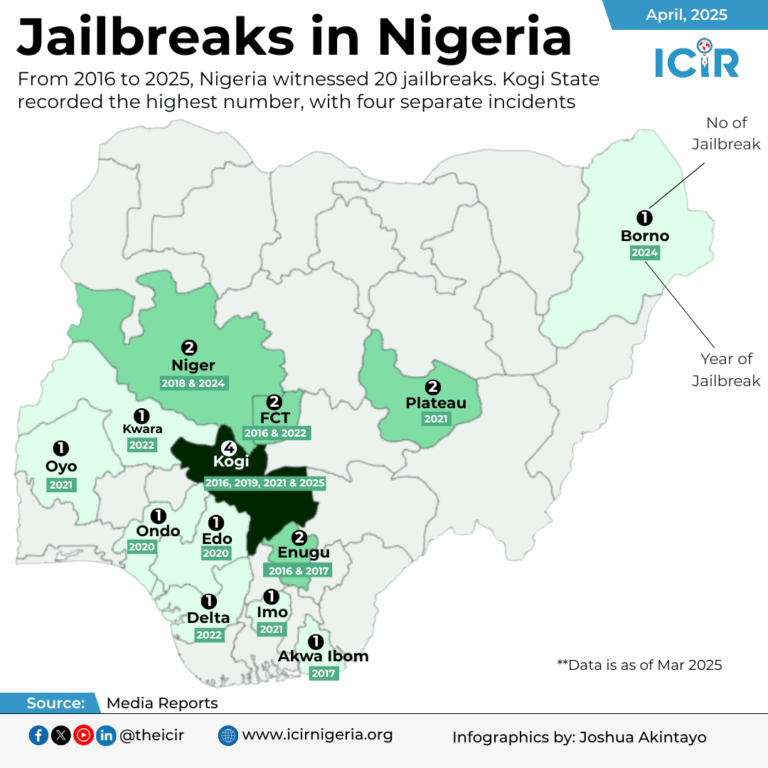
Following the most recent jailbreak in Kogi State, which shows the persistent challenges in Nigeria’s Correctional system, The ICIR documents the timeline of similar incidents in Nigeria from 2016 till date as well as the patterns at which they have unfolded.

The ICIR reported that in the early hours of March 24, 2025, twelve inmates escaped from the Medium Security Custodial Centre in Koton Karfe, Kogi State, marking another incident in Nigeria’s series of prison breaks.

The escapees manipulated padlocks in a section of the facility, leading to their breakout. Tragically, one correctional officer died during the incident. Security experts attribute these recurring incidents to systemic issues within Nigeria’s correctional system.

A report by Premium Times highlights factors such as infrastructural deficits, overcrowding, and prolonged trials as contributing to the frequency of prison breaks in the country. Also, a study published on ResearchGate emphasises the need for improved prison intelligence and dynamic security strategies to manage correctional facilities effectively. ​

In response to the Kogi jailbreak, the Acting Controller General of Corrections of the Nigeria Correctional Service (NCS), Sylvester Ndidi Nwakuche, ordered a comprehensive investigation into the circumstances surrounding the incident and mandated a security audit across all correctional facilities nationwide. ​

Timelines of jailbreaks 

2016: FCT, Kogi & Enugu

The year witnessed multiple jailbreaks. On June 24, of that year two inmates awaiting trial for murder escaped from the Kuje Medium Correctional Centre in Abuja by scaling the fence. This led to the removal of the officer-in-charge, Musa Tanko.

Just over a month later, on July 29, 13 inmates escaped from Koton-Karfe Correctional Centre in Kogi State during a coordinated breach.

Then on August 9, at least 15 inmates broke out of the Nsukka Correctional Centre in Enugu State.

2017: Enugu & Akwa Ibom

On October 7, two convicted inmates, Lucky Sama and Balogun Idiom Joseph fled through the ceiling of a Catholic Church within the Enugu Maximum Security Prison.

Similarly, on December 27, 36 inmates escaped from Ikot Ekpene Prison in Akwa Ibom State. The escapees attacked kitchen staff, even as four inmates were killed in the process.

2018: Niger 

On June 3, gunmen stormed the Minna Medium Security Prison in Niger State, killing a prison official and a motorcyclist. The attack enabled the escape of 210 inmates.

2019: Kogi

On October 28, floodwaters overran part of the Koton Karfe Correctional Centre in Kogi State. The breach allowed 122 inmates to flee, although 25 were later re-arrested.

Infographic showing timeline of jailbreak in Nigeria from 2016-2025
2020: Edo & Ondo 

The #EndSARS protests triggered widespread unrest, including in correctional facilities. On October 19, hoodlums attacked Benin and Oko prisons, enabling 1,993 inmates to escape.

Three days later, on October 22, another 58 inmates were freed after protesters broke into the Okitipupa Correctional Centre in Ondo State, bringing down its fence.

2021: Imo, Plateau & Kogi

On April 5, in one of the most brazen attacks, gunmen ambushed the Owerri Correctional Centre in Imo State. 1,844 inmates were set free. The attack was allegedly linked to the Eastern Security Network (ESN), affiliated with the outlawed Indigenous Peoples ofb Biafra (IPOB).

On July 8, four detainees escaped the Jos Custodial Centre in Plateau State. Officials blamed staff negligence.

On September 13, gunmen attacked the Kabba Correctional Centre in Kogi State, killing two security operatives and freeing 240 inmates. About 114 were later recaptured.

On October 22, heavily armed assailants raided the Abolongo Medium Security Custodial Centre in Oyo State, using grenades to breach the gates. 837 inmates escaped, out of which 262 were recaptured.

On November 28, gunmen stormed the Jos Correctional Centre again. 262 inmates escaped, nine were killed and ten re-arrested, while 252 remained at large.

2022: Kwara & FCT

The year began with another breach on January 2, when three inmates escaped from the Mandala Custodial Centre in Ilorin, Kwara State.

On May 13, after a perimeter wall collapsed due to heavy rain, three inmates escaped from the Agbor Prison in Delta State. In July, Nigeria witnessed one of its most high-profile breaches as the Kuje Medium Security Prison in Abuja was attacked by ISWAP terrorists. 879 inmates, including 64 Boko Haram fighters, escaped after explosives and firearms were used. A security officer was killed, and several others were injured.

2024: Niger & Borno

A heavy overnight rainstorm severely had damaged the Medium Security Custodial Centre in Suleja, near Abuja. The downpour destroyed parts of the prison’s infrastructure, including the perimeter fence, leading to the escape of 118 inmates. Authorities swiftly activated recapture protocols, and by the following day, 14 escapees had been re-arrested.

On September 9, 2024 severe flooding caused by the collapse of the Alau Dam led to catastrophic damage in Maiduguri, Borno State, including the breach of the Medium Security Custodial Centre’s walls. This disaster resulted in the escape of 281 inmates. Only seven were reportedy recaptured.

As Nigeria continues to grapple with these challenges, experts advocate for urgent reforms to address the root causes of prison breaks and to strengthen the country’s correctional infrastructure.

NERC orders 9 DisCos to compensate band A customers over power supply failures

THE Nigerian Electricity Regulatory Commission (NERC) has directed nine electricity Distribution Companies (DisCos) to compensate Band A customers residing on 557 streets within their franchise areas for failing to meet the minimum power supply requirements set under the new electricity tariff structure.

Affected DisCos must provide compensation for the inadequate power supply in April across 152 electricity feeders, NERC said.

The regulatory agency made the order in its April 2025 Multi-Year Tariff Order, noting that the compensation should be carried out either through electricity credit or by improving power supply.

The ICIR reports that Band A customers are those getting a minimum of 20 hours of electricity supply daily and pay the highest electricity tariffs.

The order showed that the DisCos affected include Abuja Electricity Distribution Company, Eko Electricity Distribution Company, Port Harcourt Electricity Distribution Company, Kano Electricity Distribution Company, Kaduna Electricity Distribution Company, Ikeja Electric, Ibadan Electricity Distribution Company, and Benin Electricity Distribution Company.

The AEDC is required to compensate consumers on 74 streets served by 20 electricity feeders.

“AEDC shall make appropriate compensation to the affected customers in Band A feeders listed in Appendix 3 for failure to deliver up to 20 hours of average supply, but more than 18 hours of average supply, in line with the provisions of the Order on Migration, while the feeders shall remain as Band A.

“AEDC shall downgrade the Band A feeder listed in Appendix 2 to the commensurate level of supply and make appropriate compensation to the affected customers in line with the provisions of the Order on Migration.”

The ICIR reported on Friday, May 10, that residents in Jabi District of Abuja and parts of Life Camp, Kado District, and areas along Kaduna Road expressed concern over a prolonged power outage affecting the areas. 

The NERC’s latest disaggregated data revealed that AEDC planned to downgrade 26 streets across three feeders, a move that may lead to potential revenue losses.

The order indicates that EKEDC has the highest number of affected streets, with compensation to be provided to customers on 155 streets served by 57 feeders.

The ICIR reports that this development comes exactly one year after NERC approved a contentious tariff increase of over 300 per cent for Band A customers, along with a mandate for a minimum daily power supply of 20 hours.

Despite the tariff hike and the significant expansion of the Band A customer base, consumers continue to decry poor service delivery, as many households and businesses grapple with unstable power supply, rising production costs, and shrinking disposable income.

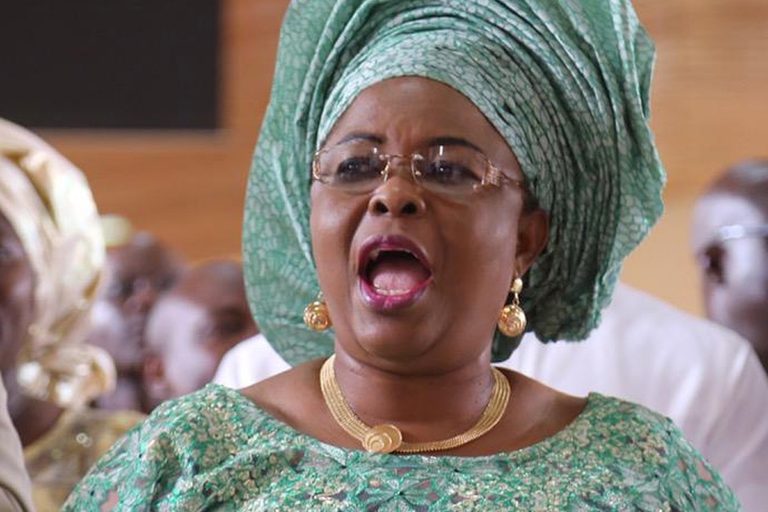
2027: I have no business in Aso Rock, will support Tinubu – Patience Jonathan

AMID speculations that powerful interests are encouraging former President Goodluck Jonathan to declare interest in the Nigerian presidency come 2027, his wife and former First Lady, Dame Patience, has dismissed any possibility of her family returning to the Aso Rock.

While receiving the Women Icon Leader of the Year 2025 award from Accolade Dynamics Limited at an event in Abuja Saturday night, Patience Jonathan pledged her full support for First Lady Oluremi Tinubu, whose husband is widely believed to be warming up to declare for a re-election.

The former First Lady expressed firm support for rotational presidency, emphasising that the “turn-by-turn” approach is crucial for maintaining national cohesion.

“We are groups. We worked when I was a deputy governor’s wife. We worked when I was a governor’s wife. I know her. I talked with Oluremi. Even when my husband was the vice president, Oluremi stood with her husband and supported us during our first election. They supported us. So, for me, I have a conscience. I cannot abandon my friend, whether you like it or not,” she said.

She stressed that instead of seeking a return to Aso Rock, she would stand firmly behind the First Lady and her husband.

“Because, you see, this is turn by turn. Today is my turn, I will go. Tomorrow, it will be another person’s turn. I stand by my friend. My friend is great. I told her I would campaign with her. I’m not denying her. I’m not running. I’m not going back to the Villa. If you call me, I will not go,” she said.

The former First Lady, attributing her youthful appearance to the peace of staying away from Aso Rock, said, “ Don’t you like how young I look? It is because I have the rest of mind.”

She described the award as a recognition of the collective efforts made toward promoting women’s health and economic empowerment.

She also expressed strong support for the 35 per cent affirmative action for women in governance, while lamenting the National Assembly’s repeated rejection of gender equality bills.

“During Obasanjo’s time, we worked for it, and the executive approved 35 per cent. My husband also maintained it. But when it comes to elective positions, the men dominate and shut us out. May God touch their hearts to understand that we are their mothers, sisters, and friends. We are not trying to take power from them; we are trying to support them.”

The ICIR reported that last week, the president of the Nigeria Rescue Mission Organisation and former president of Buhari Youth Organisation (BYO), Jibril Mustapha, called on Jonathan to contest the 2027 presidential election “to save Nigerians from hunger and other economic hardship.”

He said Jonathan, who lost his re-election to former President Muhammadu Buhari in 2015, should heed the call to contest for the second and final term.

He stressed that as the nation prepares for the 2027 elections, his organisation believed that it was time for all stakeholders to come together and support a candidate who could genuinely represent the interests of all Nigerians.


Lagos APC council primaries hit by protests as candidates emerge

THE Lagos State chapter of the All Progressives Congress (APC) has concluded its local government chairmanship primaries for the upcoming June 12 elections, but the process was marred by controversies.

Some of the aspirants and their agents staged protests over the outcome of the exercise in some areas.

The Electoral Committee Chairman, Babatunde Ogala, acknowledged the protests and attributed them to possible human errors during the process.

Ogala encouraged dissatisfied aspirants to seek redress through the party’s Appeal Committee, which can overturn decisions with valid evidence.

“Despite the protests, the APC has successfully produced 55 chairmanship candidates for the upcoming local government elections, covering most of the state’s 20 local governments and 37 local council development areas (LCDAs).

The APC chairmanship primaries produced four consensus candidates for the local government chairmanship elections: Isa Abiola Jibril (Iba), Azeez Karim (Oto Awori), Motunrayo Alogba (Ijede), and Rasaq Bamidele Kasali (Lekki). Their candidatures were affirmed by local party officers in the presence of INEC officials.

The full list of elected candidates includes:

Azeez Kareem (Otto Awori LCDA)
Usman Hamzat (Ifako-Ijaiye LG)
Motunrayo Gbadebo (Ijede LCDA)
Rasaq Kasali (Lekki LCDA)
Olamilekan Akindipe (Ajeromi-Ifelodun LG)

Hameed Aroyehun (Igbogbo/Bayeku LCDA)
Oluyemisi Rosiji (Ojokoro LCDA)
Moyosore Ogunlewe (Kosofe LG)
Isa Jubril (Iba LCDA)
Olufemi Okeowo (Ifelodun LCDA)

Taoreed Taiwo (Ejigbo LCDA)
Muibi Alade (Lagos Island East)
Suleiman Yusuf (Surulere LG)
Azeez Ogidan (Coker Aguda LCDA)
Tola Oyedele (Agboyi-Ketu LCDA)

Sanusi Ismail (Amuwo-Odofin LG)
Muibat Rufia (Ojo LG)
Samsudeen Agunbiade (Eti-Osa East LG
Abiodun Akinola (Orile Agege LCDA)
Lateef Ashimi (Somolu)

Humpey Babatunde (Badagry)
Sura Animashaun (Epe LG)
Adebayo Olasoju (Isolo LCDA)
Sesan Olowa (Ibeju-Lekki LCDA)
Wale Alomo (Ikosi-Ejinrin LCDA)

Rauf Ibrahim (Badagry West LCDA)
Adedayo Ladega (Ikorodu LG)
Rasak Oloyede (Oriade LCDA)
Taiwo Oyekan (Lagos Island LG)
Wale Hameed (Ikorodu North LG

Bolanle Bada (Ikosi-Isheri LCDA)
Kehinde Oloyede (Oshodi-Isolo LG)
Sunday Benson (Imota LCDA)
Kazeem Sulaiman (Ikorodu West LCDA)
Shobanjo Idowu (Apapa LG)

Peter Ajose (Olorunda LCDA)
Monsuru Ismail (Eredo LCDA)
Opeyemi Akindele (Mosan-Okunola LCDA)
Abiodun Agbaje (Ayobo-Ipaja LCDA)
Ibrahim Akinpelu (Alimosho LG)

Jimoh Olawale (Apapa-Iganmu LCDA)
Bukola Omofe (Bariga LCDA)
Tunbosun Aruwe (Mushin LG)
Olusegun Odunmbaku (Ojodu LCDA)
Idris Balogun (Egbe-Idimu LCDA)

Bola Oladunjoye (Ikoyi-Obalende LCDA)
Moyo Adebanjo (Onigbongbo LCDA)
Lasisi Akinsanya (Ikotun-Igando LCDA)
Akeem Dauda (Ikeja LG)
Lawal Jakande (Odi-Olowo/Ojuwoye LCDA)

Daniel Olufemi (Itire-Ikate LCDA)
Jimoh Ishola (Agbado-Oke Odo LCDA)
Adeola Sheriff (Eti-Osa LCDA)
Babatunde Azeez (Agege LG)
Aminat Alabi (Iru/Victoria Island LCDA)

The election into local government and LCDAs in Lagos will take place on July 12, 2025.

India, Pakistan have agreed to immediate ceasefire,  Trump says

THE President of the United States Donald Trump has announced that India and Pakistan have agreed to a full and immediate ceasefire, following hours of overnight fighting between the two nuclear-armed neighbours.

Trump announced this on his X handle Saturday night, stating that the ceasefire, set to take effect on Sunday, May 11, followed a lengthy conversation he had with leaders of both countries.

The ICIR reported that the arch-rivals engaged in intense fighting for four days, the worst escalation in nearly three decades.

They exchanged missiles and drones targeting each other’s military installations, resulting in dozens of casualties.

A ceasefire agreement was reached following US diplomatic efforts and pressure, but within hours, artillery fire was reported in Indian-administered Kashmir, the epicentre of much of the recent conflict.

Late Saturday, May 10, India accused Pakistan of violating the ceasefire agreement and stated that its armed forces had been directed to “respond firmly” to any further breaches.

In response, Pakistan affirmed its commitment to the ceasefire and accused India of being responsible for the violations.

By dawn, the overnight fighting and explosions had subsided on both sides of the border, according to Reuters.

Power was restored in most areas along India’s border towns after a blackout the previous night.

Trump commended the leaders of both nations for their decision to put an end to the hostilities.

“While not even discussed, I am going to increase trade, substantially, with both of these great nations. Additionally, I will work with you both to see if… a solution can be arrived at concerning Kashmir,” Trump said.

The clashes began on Wednesday, two weeks after an attack in Pahalgam, Indian Kashmir, claimed the lives of 26 men, all of whom were Hindu.

The ICIR reports that the two countries, created from British colonial rule in 1947, have fought three wars, two of them over the Kashmir region. 

Hindu-majority India and Muslim-majority Pakistan both control parts of Kashmir but claim the entire region. 

India accuses Pakistan of supporting an insurgency, which began in 1989 and has claimed tens of thousands of lives in its portion of the Kashmir.

India also holds Pakistani Islamist militant groups responsible for attacks in other parts of the country.

AMVCA 11: Femi Adebayo, Chioma Chukwuka claim Best Actor awards for roles in ‘Seven Doors’

FEMI Adebayo and Chioma Chukwuka won the Best Actor and Actress Awards at the eleventh edition of the African Magic Viewers’ Choice Awards (AMVCA) held on Saturday, May 10, in Lagos State.

They won the awards for their roles in the movie ‘Seven Doors’.

 The movies Lisabi: The Uprising and Seven Doors both won three awards each at the event.

The annual award, which recognises outstanding performances in television, film, and entertainment, was hosted by IK Osakioduwa and David Oke.

It featured the Chief Executive Officer (CEO) of Multichoice, John Ugbe, who gave a welcome address.

There were also musical performances by Johnny Drille, Kunmie, and Fido.

Full list of winners

Best Costume Design 

Adedamola Adeyemi – Christmas In Lagos — WINNER

Bolanle Austen-Peters, Yolanda Okereke, Juliana Dede, Gloria Oyu – House Of Ga’a

Toyin Ogundeji – Anikulapo: Rise of the Spectre

Oluwatoyin Balogun, Oyeade Adebimpe Adedimeji – Lisabi: The Uprising

Adedamola Adeyemi – Christmas In Lagos

Opeyemi Sogeke – Phoenix Fury

Best Makeup

Lisabi: The Uprising — Hakeem Onilogbo (Hakeem Effect) — WINNER

Clarence Peters’ Inside Life— Kpoudosu Winifred

Suspicion— Tracy Izogie and Adeleke Toluwulashe Maigari

Farmer’s Bride — Abejide Oluwatosin Mercy

Anikulapo: Rise of the Spectre — Hakeem Onilogbo (Hakeem Effect)

Seven Doors— Hakeem Onilogbo (Hakeem Effect)

Best Art Direction 

Lisabi: The Uprising — WINNER

Seven Doors

The Man Died

Anikulapo: Rise of the Spectre

Farmer’s Bride

Christmas In Lagos

Best Sound/Sound Design

Suspicion — WINNER

Seven Doors

Lisabi: The Uprising

Freedom Way

Inkabi

Ajakaju: Beast Of Two Worlds

Best Editing

Inkabi — Tongai Furusa — WINNER

Soft Love — Holmes Awa and Paballo Modingoane

Lisabi: The Uprising — Anthill Studios

Princess on A Hill — Laughter Ephraim and Peter Ugbede

Christmas in Lagos — Martini Akande

Skeleton Coast— Jordan Koen

Best Writing TV Series 

Untying Kantai — Abel Mutua Musyoka — WINNER

Anikulapo: Rise of the Spectre— Shola Dada

Tuki? — Louise Kamwangi

Cheta’M— Ifeanyi Chidi Barbara

Seven Doors — Adebayo Tijani, Yinka Laoye, and Soyombo-Oluyombo Oluwagbemiga

Roses and Ivy — Biodun Stephen and Abimbola Akinrinbola

Princess on A Hill — Bibi Ukpo, Niyi Adeniji, and Sonia Nwosu

Best Writing in a Movie

Freedom Way— Blessing Uzzi — WINNER

The Weekend — Egbemawei Dimiyei Sammy, and Vanessa Kanu, and Frederick O. Anyaebunam Jnr

House of Ga’a— Tunde Babalola

Christmas In Lagos — Jadesola Osiberu

Skeleton Coast— Omolola Lamikanra

Phoenix Fury— Ifeoma N. Chukwuogo

A Ghetto Love Story — Victoria Eze

Best Indigenous Language Film (South Africa)

Mwizukanji — WINNER

Walvis Tale

The Vow

Man of Gold

Lukas

Best Indigenous Language Film (East Africa)

Makosa Di Tangu — WINNER

The Caller

Wa Milele? (Forever)

Sabotage

Best Indigenous Language Film (West Africa)

Lisabi: The Uprising — WINNER

Seven Doors

Anikulapo: Rise of the Spectre

Mai Martaba

Kaka

Best Cinematography

The Legend of the Vagabond Queen of Lagos— Leo Purman — WINNER

Soft Love — Ebrahim Hajee

Lisabi: The Uprising — Barnabas Emordi and Nora Awolowo

Yen Ara Asaase Ni (This Is Our Land) — Onasis Gaisie, Michael Sefa, and Apagnawen Annankra

Agemo — Papama Tangela

Inkabi — Chuanne Blofield

Skeleton Coast— Wesley Johnston

Best Digital Content Creator

Iyo Prosper — WINNER

Dorcas Ariyiike Owolagba (Ariyi ike Dimples)

Elozonam

Jide ‘Pounds’ Ibitoye (Jide Pounds)

Maryam Apaokagi (Taaooma)

Best Indigenous M-Net Original

Onye Agbata Obim — WINNER

Mai Shayi

The Caller

Subterranea

Ebighi Ebi

Amoanimaa’s Era

Show Me The Way

Best Scripted M-Net Original

My Fairytale Wedding — WINNER

Italo

The Caller

Uriri

All Mine

Kam U Stay

Best Short Film

Brukaci — WINNER

The Incredible Sensational Fiancée of Seyi Ajayi

What Are You Really Afraid Of?

Sukari

In Bloom: ‘Afefe’

Best Unscripted M-Net Original

Nigerian Idol— WINNER

Husband Material

The Queens of Kopala

Pastor Wants A Wife (Zambia)

Overall Best

Best Score/Music

Seven Doors — Tolu Obanro — WINNER

Freedom Way — Ahuurra Andrew, Kehinde “Louddaaa” Alabi, and Cobhams Asuquo

Soft Love — Kolade Morakinyo (MPSE) and Efa Iwara (Love and Hate)

Inkabi — Seoli Bongani Mashaba

Skeleton Coast — Chris Letcher

Best Supporting Actress

Mercy Aigbe – Farmer’s Bride — WINNER

Ireti Doyle – All’s Fair in Love

Ini Dima-Okojie – Skeleton Coast

Meg Otanwa – side LifeIn

Tina Mba – Suspicion

Omoni Oboli – The Uprising: Wives on Strike 3

Darasimi Nnadi – Aburo

Best Supporting Actor 

Gabriel Afolayan – Inside Life — WINNER

Richard Mofe-Damijo – Christmas In Lagos

Uzor Arukwe – Suspicion

Adedayo Adebowale Macaroni – Lisabi: The Uprising

Aliu Gafar – Seven Doors

Femi Jacobs – Freedom Way

Mike Afolarin – House of Ga’a

Efa Iwara – Princess on a Hill

Trailblazer Award

Kayode Kasum

Industry Merit Award

Nkem Owoh
Sani Mu’azu

Best Lead Actress 

Chioma Chukwuka – Seven Doors — WINNER

GbugbemI Ejeye – Farmer’s Bride
Uzoamaka Onuoha – Agemo
Uche Montana – Thinline
Uzoamaka Aniunoh – Phoenix Fury
Hilda Dokudo – The Uprising: Wives On Strike 3
Bimbo Ademoye – Anikulapo: Rise of the Spectre

Best Lead Actor 

Femi Adebayo – Seven Doors — WINNER

Bimbo Manuel – Princess On A Hill
Stan Nze – Suspicion
Gideon Okeke – Tokunbo
Bucci Franklin – The Weekend
Femi Branch – House of Ga’a
Thapelo Makoena – Skeleton Coast
Adedimeji Lateef – Lisabi: The Uprising

Best Multichoice Talent Factory Movie

Everything Light Touches (West Africa) — WINNER

Deadbeat (East Africa)
The Immersive Alarm (East Africa)
Mwananga (Southern Africa)
Gone (West Africa)
Rivals in Time (Southern Africa)

Best Unscripted Series

Wa Milele? (Forever) — WINNER

Ebuka Turns Up Africa
Uzoamaka Tries Palmwine
Style Magnate
Skillers (The Builders Show)

Best Scripted Series 

Clarence Peters’ Inside Life — WINNER

Cheta’M
Roses & Ivy
Seven Doors
Princess On A Hill

Best Director

Awam Amkpa – The Man Died — WINNER

Robert O Peters – Skeleton Coast
Norman Maake – Inkabi
Bolanle Austen-Peters – House of Ga’a
Daniel Emeka Oriahi – The Weekend
Femi Adebayo, Adebayo Tijani, Tope Adebayo – Seven Doors

Best Movie

Freedom Way — WINNER

Inkabi
House of Ga’a
Christmas in Lagos
Farmer’s Bride
Lisabi: The Uprising
Skeleton Coast
Suspicion


How to tell if a photo is fake? You probably can’t. That’s why new rules are needed

0

By Martin Bekker, University of the Witwatersrand

THE problem is simple: it’s hard to know whether a photo’s real or not anymore. Photo manipulation tools are so good, so common and easy to use, that a picture’s truthfulness is no longer guaranteed.

The situation got trickier with the uptake of generative artificial intelligence. Anyone with an internet connection can cook up just about any image, plausible or fantasy, with photorealistic quality, and present it as real. This affects our ability to discern truth in a world increasingly influenced by images.

I teach and research the ethics of artificial intelligence (AI), including how we use and understand digital images.

Many people ask how we can tell if an image has been changed, but that’s fast becoming too difficult. Instead, here I suggest a system where creators and users of images openly state what changes they’ve made. Any similar system will do, but new rules are needed if AI images are to be deployed ethically – at least among those who want to be trusted, especially media.

Doing nothing isn’t an option, because what we believe about media affects how much we trust each other and our institutions. There are several ways forward. Clear labelling of photos is one of them.

An Africanised Mona Lisa generated by AI, using Meta AI.

Deepfakes and fake news

Photo manipulation was once the preserve of government propaganda teams, and later, expert users of Photoshop, the popular software for editing, altering or creating digital images.

Today, digital photos are automatically subjected to colour-correcting filters on phones and cameras. Some social media tools automatically “prettify” users’ pictures of faces. Is a photo taken of oneself by oneself even real anymore?

The basis of shared social understanding and consensus – trust regarding what one sees – is being eroded. This is accompanied by the apparent rise of untrustworthy (and often malicious) news reporting. We have new language for the situation: fake news (false reporting in general) and deepfakes (deliberately manipulated images, whether for waging war or garnering more social media followers).

Misinformation campaigns using manipulated images can sway elections, deepen divisions, even incite violence. Scepticism towards trustworthy media has untethered ordinary people from fact-based accounting of events, and has fuelled conspiracy theories and fringe groups.

Ethical questions

A further problem for producers of images (personal or professional) is the difficulty of knowing what’s permissible. In a world of doctored images, is it acceptable to prettify yourself? How about editing an ex-partner out of a picture and posting it online?

Would it matter if a well-respected western newspaper published a photo of Russian president Vladimir Putin pulling his face in disgust (an expression that he surely has made at some point, but of which no actual image has been captured, say) using AI?

The ethical boundaries blur further in highly charged contexts. Does it matter if opposition political ads against then-presidential candidate Barack Obama in the US deliberately darkened his skin?

Would generated images of dead bodies in Gaza be more palatable, perhaps more moral, than actual photographs of dead humans? Is a magazine cover showing a model digitally altered to unattainable beauty standards, while not declaring the level of photo manipulation, unethical?

Different versions of an Africanised The girl with the pearl earrings painting generated by AI, using ChatGPT.

A fix

Part of the solution to this social problem demands two simple and clear actions. First, declare that photo manipulation has taken place. Second, disclose what kind of photo manipulation was carried out.

The first step is straightforward: in the same way pictures are published with author credits, a clear and unobtrusive “enhancement acknowledgement” or EA should be added to caption lines.

The second is about how an image has been altered. Here I call for five “categories of manipulation” (not unlike a film rating). Accountability and clarity create an ethical foundation.

The five categories could be:

C – Corrected

Edits that preserve the essence of the original photo while refining its overall clarity or aesthetic appeal – like colour balance (such as contrast) or lens distortion. Such corrections are often automated (for instance by smartphone cameras) but can be performed manually.

E – Enhanced

Alterations that are mainly about colour or tone adjustments. This extends to slight cosmetic retouching, like the removal of minor blemishes (such as acne) or the artificial addition of makeup, provided the edits don’t reshape physical features or objects. This includes all filters involving colour changes.

B – Body manipulated

This is flagged when a physical feature is altered. Changes in body shape, like slimming arms or enlarging shoulders, or the altering of skin or hair colour, fall under this category.

O – Object manipulated

This declares that the physical position of an object has been changed. A finger or limb moved, a vase added, a person edited out, a background element added or removed.

G – Generated

Entirely fabricated yet photorealistic depictions, such as a scene that never existed, must be flagged here. So, all images created digitally, including by generative AI, but limited to photographic depictions. (An AI-generated cartoon of the pope would be excluded, but a photo-like picture of the pontiff in a puffer jacket is rated G.)

The suggested categories are value-blind: they are (or ought to be) triggered simply by the occurrence of any manipulation. So, colour filters applied to an image of a politician trigger an E category, whether the alteration makes the person appear friendlier or scarier. A critical feature for accepting a rating system like this is that it is transparent and unbiased.

The CEBOG categories above aren’t fixed, there may be overlap: B (Body manipulated) might often imply E (Enhanced), for example.

Feasibility

Responsible photo manipulation software may automatically indicate to users the class of photo manipulation carried out. If needed it could watermark it, or it could simply capture it in the picture’s metadata (as with data about the source, owner or photographer). Automation could very well ensure ease of use, and perhaps reduce human error, encouraging consistent application across platforms.

Of course, displaying the rating will ultimately be an editorial decision, and good users, like good editors, will do this responsibly, hopefully maintaining or improving the reputation of their images and publications. While one would hope that social media would buy into this kind of editorial ideal and encourage labelled images, much room for ambiguity and deception remains.

The success of an initiative like this hinges on technology developers, media organisations and policymakers collaborating to create a shared commitment to transparency in digital media.The Conversation

Martin Bekker, Computational Social Scientist, University of the Witwatersrand

This article is republished from The Conversation under a Creative Commons license. Read the original article.

Video does not show snow in Jos

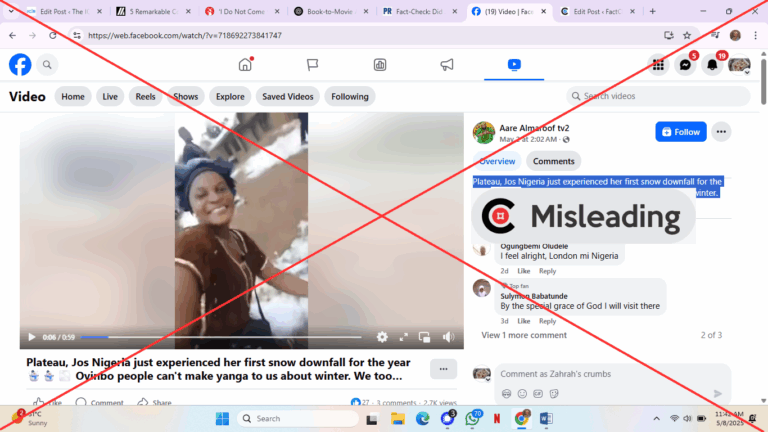
A viral video showing a woman gathering ice from ground and surrounded by what looks like a snowfall following a heavy rain has been circulating on social media.

A Facebook user, Aare Almaroof tv2, posted the video which was allegedly recorded in Jos, the capital of Plateau State, Nigeria.

In the video, the woman excitedly referred to the scene as a winter experience while scooping what appears to be snow. Several onlookers, including passing motorists, can be seen around the area as witnesses.

In the 59-second video, the woman could be heard saying:

See winter, tis is ice, see ice, this is ice the rain that fall here today, did you guys see look at this, do you see, see, it is coll,(Cold) so coll (Cold) look at ice, my goodness (sic).

The post was also accompanied with a caption that read:

Plateau, Jos Nigeria just experienced her first snow downfall for the year Oyinbo people can’t make yanga to us about winter. We too have snow, not in December, but in April.

The post has garnered over 2,000 views as of May 9, 2025. The claim was also found here and here on Instagram.

CLAIM

Video shows snow in Jos, Plateau State.

THE FINDINGS

Findings by The FactCheckHub show that the claim is MISLEADING, as the incident happened in Cameroon and not Jos.

Screenshot of an appearance of the claim on Facebook ; Insert : MISLEADING verdict
Screenshot of the claim retrieved from Facebook. Insert: MISLEADING verdict.

Snow forms when water vapor turns to ice and makes crystals that form familiar six-sided snowflakes. On the other hand, hail develops when updrafts send ice pellets up into cold air aloft.

“Initially there’s a small ice pellet,” said Jeff Lorber, a meteorologist with the National Weather Service’s Bay Area office in California, U.S. “Strong updrafts cause this ball of ice to expand as more supercooled water freezes onto it.”

When few keyframes from the video were subjected to a Google Reverse Image search, the results showed that the footage had previously appeared on Facebook. It was uploaded two weeks earlier by NexDim Empire, a Facebook user.

The video was accompanied with a caption that read:

All we need for fall bush for Babanki Tungoh, North West region 🇨🇲 Some say na hailstones while others say na snow . This lady say na ice.

The FactCheckHub observed that the Facebook user posts content related to Cameroonian entertainment, and has amassed over 234,000 followers on Facebook.

In the comments section on his post, most users were worried about the damage it would do to crops.

Multiple similar videos were also posted by some other Cameroonian accounts on social media as seen here and here.

A Google search of Babanki Tungoh shows that it is a community located in the North-West region of Cameroon. Also known as Kedjom Ketinguh, the village is situated in a breathtaking volcanic landscape, surrounded by three prominent rock outcrops.

Further checks by The FactCheckHub show that snowfall is not a typical meteorological incident in Cameroon. Although the country lies near the equator, occasional snowfall can occur at the summit of Mount Cameroon, but such events are rare.

In most parts of the country, snow is not a normal occurrence. For instance, reports of snow in Bana, located in Cameroon’s Western region in 2021 were later confirmed to be hail, not actual snow.

Also, recent weather reports from the Nigerian Metrological Agency (NIMET) show that there has not been any thunderstorms in Plateau State recently for there to be snow or hailstones as the weather is currently humid; also there would have been prior warnings from the weather agency.

THE VERDICT

The claim that the video shows snow in Jos is MISLEADING, as the video is likely from Babanki Tungoh in the North-Western region of Cameroon.

This report is republished from the Factcheckhub.