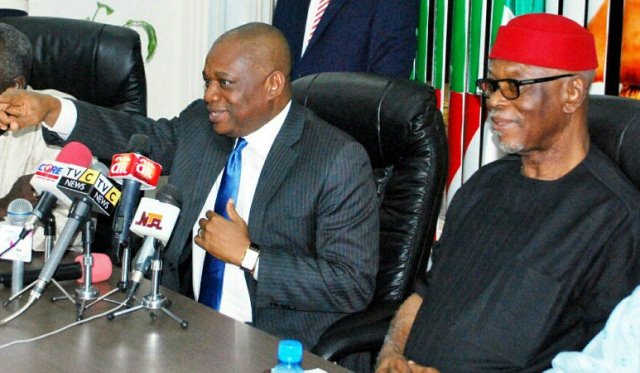
Former governor of Abia State, Orji Uzor Kalu, has formally dumped the Peoples Democratic Party, PDP, and has joined the ruling All Progressives Congress, APC.
He was received by the APC National Working Committee, NWC, at the National Secretariat on Wednesday.
The former governor, who had run for Abia North Senatorial Seat in the 2015 general election, said that he had to succumb to the pressure from his friends and well-wishers who want him to contribute his quota to building the party in Nigeria especially in the South East.
Kalu served as governor of Abia state between 1999 and 2007 and was succeeded by his former Chief of Staff, Theodore Orji, with whom he later fell out.
The former governor is still undergoing corruption charges having been accused of embezzling funds belonging to the Abia State government during his time as governor of the State.
The Islamic Movement in Nigeria, IMN, has said that it lost over 100 members in Monday’s clash with the Nigerian Police contrary to the reports by the Police that only 9 people, including a police officer, lost their lives in the violence.
In a statement released on Wednesday, the Shiite Islamic sect claimed that security agents dumped 40 corpses of its members at the Murtala Muhammad Specialist Hospital in Kano.
The group said that the police clampdown on its activities were unwarranted and unprovoked.
The statement read in part: “the police simply clamped down on a peaceful symbolic trek embarked upon by IMN from Kano to Zaria, Kaduna State, with teargas and live bullets.
“Several IMN members were injured in the unprovoked attack. The police fabricated lies to justify their action, claiming that the IMN engaged them in a shootout whereas there are no evidences of any IMN member carrying any weapon as depicted by pictures and videos of the attack.
“Nigerian Police in Kano Murdered 100+ IMN members with a bullet hitting one of them. Over 40 bodies of those killed by the Nigeria Security forces were dumped at Murtala Hospital alone in Kano.
“The whereabouts of other bodies ferried away by the police in Kano still remains unknown.”
The IMN also stated that “the government has remained silent since the incident as several tens of the injured are with police without medical attention.”
Inspector General of Police, Ibrahim Idris, while reacting to the incident, defended his men, saying they acted in self defence.
Speaking with State House correspondents on Tuesday after attending the inauguration of the 2017 Armed Forces Remembrance Emblem and Appeal Fund at the Presidential Villa, Abuja, Idris said that rather than condemning the police, Nigerians should sympathise with them.
He said: “I think, as Nigerians, we have to appreciate a dangerous situation, and be sympathetic with the policemen that are being killed by some of these miscreants.
“I agree with what you said (that Nigerians should not be killed while quelling riot) but when you have Nigerians armed to the teeth, killing police officers, I don’t think it happens anywhere.”
The IGP reiterated that the police have the responsibility to ensure law and order which is why they moved against the group which is notorious for trouble making.
He added that it was unlawful for the sect members to block a major road.
“Obviously from time to time, we have been experiencing upheavals from this set of people.
“As police officers, we have a responsibility to ensure there is law and order and when you have people taking over the whole country, dominating streets and buildings, we have to come in to maintain sanity in those areas,” Idris said.
In spite of strong opposition from the Minister of Transportation, Rotimi Amaechi, a bill for the establishment of the Nigerian Maritime University has scaled second reading at the Senate.
The bill which was sponsored by Delta State lawmaker, James Manager, was unanimously supported by the members of the senators after the lead debate by the sponsor.
Recall that former President Goodluck Jonathan had in 2014 performed the groundbreaking ceremony of the university at its proposed site in Okerenkoko, Warri south-West local government area of Delta State.
Also, the current Minister of State for Petroleum Resources, Ibe Kachikwu, had also acknowledged that physical asset were on site; but there has been no law backing the establishment of the university.
However, Nigeria’s Transportation Minister has vehemently opposed the creation of the university and had on January 19, before the senate committee on maritime, announced that the project has been scrapped.
The Nigerian Maritime University was supposed to be financed by the Nigerian Maritime Administration and Safety Agency, NIMASA, which is a parastatal under the transport ministry.
Amaechi cited insecurity in the Niger Delta region as among the reasons why the project was scrapped, describing it as “misplacement of priority” as according to him, there were already transport institutes in Zaria and Oron in Kaduna and Akwa Ibom states respectively.
“Who will attend the university?” he queried, “How many parents will allow their children to go to such a place where it proposes to site the university? I do not think we are proceeding with the university proposed by NIMASA because it is a waste of resources.’’
“We are not going ahead with the Maritime University project … because we have an institution (The National Martime Academy) in Oron, we have Nigeria Institute of Transport Technology, Zaria and we have the Nigerian College of Aviation in Zaria, which we could be upgraded to a university status,: Amaechi had said.
Again, in June, the Minister said that the university project had taken more than enough money, adding that government lacked the funds to continue with the school.
He said: “Okerenkoko (Maritime University), I am not against.
“My argument about Okerenkoko is that land alone is N13 billion. If you give me 13 billion, I will buy the half of Lagos. That 13 billion has built the university already,” he said.
Amaechi insisted that unless the N13 billion spent on the procurement of the land for the project was retrieved, the project stood scrapped.
Minster of Power, Works and Housing, Babtunde Fashola, has said that the federal government is ready to invest up to $150 million in rural electrification projects.
He was speaking in Abuja at a business forum on ‘’Financing Opportunities in the Nigerian Power Sector’’
Fashola disclosed that government plans to use 44 tertiary institutions and small hydro dams in the rural areas as anchors for the electrification Programme.
He explained that the money would be deployed towards providing Independent Power Plants, IPPs, to supply electricity to tertiary institutions and rural communities.
The minister also said that 37 out of the 44 tertiary institutions to be used for the project were universities, while the other seven were teaching hospitals.
According to him, government would deploy 37 IPPs consisting of nine gas plants and 28 solar plants with a combined generation capacity of 120 Megawatts to power the institutions.
The IPPs will replace more than 1,000 generating sets that have been serving the institutions, generating 210 Megawatts of inefficient and unclean energy.
Fashola said that the $150 million would cover capital expenditure, operations and maintenance cost of the IPPs.
The former Lagos State governor also stressed the need for financing and liquidity stability in the power sector.
He said that electricity Distribution Companies, DisCos, “need a lot of operating capital to buy meters, to change transformers that are old, to extend access to their customers, to replace transformers and so on and so forth.”
“They need operational capital and they need it in the mix of foreign exchange because some of the things they want to buy are not made in Nigeria and there are some made in Nigeria,” the minister said
For the Generating Companies, GenCos, Fashola said adequate liquidity was need for the procurement of turbines, parts and accessories which were largely imported.
He added however that investment in the GenCos was profitable, as the returns would be marvelous by the time the market is settles and stabilises.
“There exists a list of endless possibilities and opportunities for investment in the nation’s power sector,” he said.
Fashola also stated that the Nigeria Buck Electricity Trader, NBET, a government-owned company, was planning to raise a bond for investors to buy into it.
One of Nigeria’s major airline operators, Arik Air, has announced that it is reducing its flight operations due to the lingering scarcity of aviation fuel, known as JET A1.
Ola Adebanji, the airline’s Communications Manager, made the announcement in a statement issued on Wednesday in Lagos.
Adebanji said that the scarcity started manifesting last week when major oil marketers began to ration supply of the product to airlines.
He said that Arik Air is the worst affected by the current strike which he said was occurring for the fourth time this year alone.
According to him, the airline operates an average of “over 100 daily flights” and has “a daily fuel need of about 500,000 litres.”
He said: “One of the airline’s flights to Johannesburg on Tuesday had to be routed via Port Harcourt to pick up fuel.
“As a result of the worsening supply situation of aviation fuel, Arik Air has announced further reduction in flights from Nov. 16 to cope with the fresh scarcity.”
The airline spokesman said that the adjustment will reduce unpleasant flight delays and cancellations which passengers have experienced in recent times.
Adebanji disclosed that an oil marketer had on Saturday issued a Notice to Airmen, alerting them of non-availability of the product in Lagos.
Another marketer also said his company was running out of the product in Lagos with limited supplies in Port Harcourt and Abuja.
“This development has started taking its toll on Arik Air due to the airline’s large scale operations, with flights being delayed across the country and, in some cases, cancelled especially for airports without airfield lighting,” Adebanji said.
He also appealed for the understanding of its customers whose flights were likely to be affected by the scarcity and scaling down of operations.
The Arik Air spokesman assured that the airline “would notify passengers through SMS or email messages in situation where flights would be delayed or cancelled due to the scarcity.”
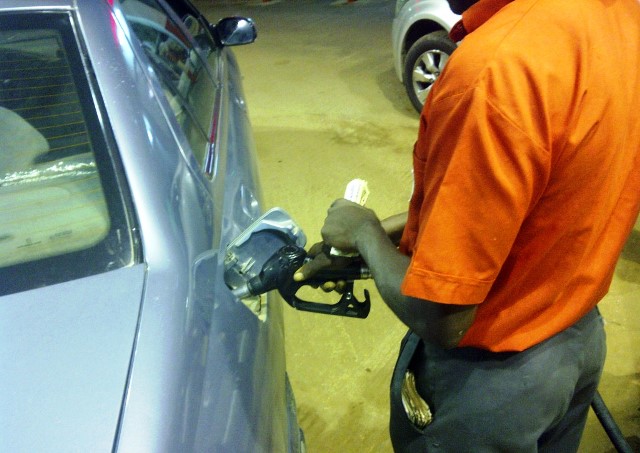
There had been fears recently that the country may be headed for another scarcity of Premium Motor Spirit, PMS, commonly known as Petrol, but the NNPC allayed those fears, saying that it has more than 1.6 billion litres of petroleum in its stock.
The recent scarcity of aviation fuel, experts say, may not be unconnected with the renewed destruction of petroleum pipelines by militants in the Niger Delta region.
The mayor of a town in the US state of West Virginia has resigned after she was caught up in a controversy over racist comments about First Lady Michelle Obama.
Beverly Whaling had appeared to applaud a Facebook post referring to the first lady as an “ape in heels”.
She wrote that the post had made her day, but later said she was referring to the election outcome.
A petition calling for the mayor’s resignation had gathered over 170,000 signatures.
Whaling was the mayor of the town of Clay, which has a population of just 491.
The town has no African American residents, according to the 2010 census.
In Clay County as a whole, more than 98% of its 9,000 residents are white.
Whaling had responded to a Facebook post by Pamela Ramsey Taylor, a local resident who runs a non-profit group in Clay County, which referred to the first lady as an “ape”.
“It will be refreshing to have a classy, beautiful, dignified first lady in the White House. I’m tired of seeing a Ape in heels,” Taylor wrote, to which Whaling responded, “just made my day Pam”.
While Clay County has a small population, the furore over the Facebook post spread far and wide.
Taylor, the originator of the facebook post, had already been dismissed from her post.
Whaling had already issued a written apology to news media outlets saying that her comment wasn’t intended to be racist.
“I was referring to my day being made for change in the White House! I am truly sorry for any hard feeling this may have caused! Those who know me know that I’m not in any way racist!”
Donald Trump’s victory in the just concluded US election has been celebrated by mainly by white supremacists including the Ku Klux Khan, KKK, group.
There has also been an increase in incidents of racial and religious intolerance since the Republican candidate was declared winner of the election.
Trump in his first televised sit-down interview since becoming President-elect told his supporters to stop harassing minorities.
“I am so saddened to hear that,” Trump said when he was told that his supporters were harassing Latinos and Muslims.
“And I say, Stop it… I will say this, and I will say it right to the cameras, Stop it,” he said.
“I would say, don’t do it, that’s terrible, because I’m going to bring this country together,” he added.
The billionaire hotelier however said that the situation was being exaggerated by the media, adding that he has seen “a very small amount” including “one or two instances” of racial slurs being directed at minorities, particularly in largely white schools, since his election.
Richard Cohen, President of the Southern Poverty Law Canter told journalists on Monday that there have been more that 300 incidents that their organization has recorded.
“He (Trump) needs to take a little bit more responsibility for what’s happening,” Cohen said.
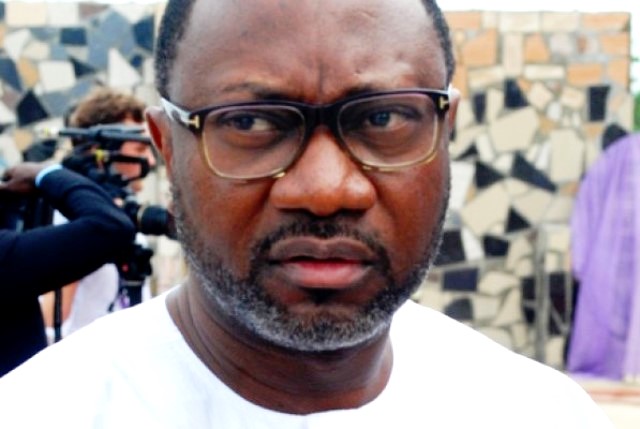
The Nigerian Police said it had foiled an attempt to kidnap one of Nigeria’s oil magnate, Femi Otedola
This was revealed in a statement issued on Wednesday by the Force Public Relations Officer, FPRO, Don Awunah.
He stated that the task was accomplished by the Inspector General of Police’s Intelligence Response Team, IRT, with the arrest of “a three man notorious kidnap gang on the 23rd June, 2016.”
According to Awunah, “the arrest was achieved through coordinated intelligence gathering and deployment of technical investigative tools that spanned several weeks.”
The FPRO stated: “The Principal suspect, one Ikechukwu Daniel, a 28 year old indigene of Imo State, who is the mastermind of the gang, was rusticated from Ahmadu Bello University Zaria due to his cult related activities on campus in 2009/2010.
“He also doubles as the IT guru of the kidnap gang with mastery of Computer applications. He made damning revelations of their criminal exploits in the South West of the Country.”
Awunah said that a serving officer of the Nigeria Security and Civil Defence Corps, NSCDC, was also part of the three-man gang.
He is 29-year old Adeyemi Kayode, a native of Ojoo in Ibadan, Oyo State, who serves as a Personal Assistant to the Oyo State Commandant of the NSCDC.
“The suspect took undue advantage of his office to obtain the GSM number and location of their would-be victim.
“He hatched the plan on how to kidnap the business magnate to make a demand of one billion naira ransom,” the police spokesman stated.
He further stated that “the third suspect, Ayodele Temitayo, a native of Oyo in Ibadan, Oyo State who is the marksman and armourer of the gang, claimed to have been dismissed from 213 Battalion Maiduguri of Nigeria Army as a Private in 2015.”
Awunah pointed out that the suspects have made “confessional statements revealing that they had successfully carried out several high profile kidnappings and two AK47 rifles loaded with live ammunition were recovered from them.”
He said that efforts are being intensified to apprehend other members of the gang and extend investigation to their other criminal enterprise.
He also reiterated the IGP’s commitment and the entire Police Force to clamp down on all criminal activities across the country and bring them to justice.
“The IGP urges Nigerians to avail the Police with relevant information that will help in the crusade against crime; as such information would be treated with utmost confidentiality,” Awunah stated.
In an apparent reaction to the economic crunch being experienced in Nigeria, petrol consumption as well as vehicle importation has drastically dropped
This development can be seen from the figures released by the Nigerian National Petroleum Corporation, NNPC, and the National Automotive Council.
According to the state-owned oil company, importation of petrol into the country is done using a system called Offshore Processing Arrangements, OPA, and Direct Sales Direct Purchase, DSDP, and statistics show that the quantity of fuel imported in the month of September shrank to 427 million litres, more than half of the 901 million litres in August.
The report showed that 427 million litres was the lowest product import volume made by the NNPC since October 2015, given that the NNPC normally imports at levels close to 1 billion litres a month.
According to the report, the September analysis revealed Nigeria’s local refineries contributed 108 million litres of fuel to the daily needs of the country, a significant drop from the 220 million litres it contributed in August.
Recently, the NNPC has had to reduce its petroleum product importation due to the drop in product sales as well as increase in distribution costs.
The report showed that the NNPC remained the major importer of petroleum products in the country since the partial deregulation of the market, as imports by independent marketers has dropped no thanks to the scarcity of foreign exchange that is currently plaguing almost all critical sectors of the Nigerian economy.
The NNPC has said it has over 1.6 billion litres of fuel available, calling on Nigerians not to panic about fuel scarcity.
Similarly, the automobile market has seen the importation of cars into Nigeria, dip from 400, 000 during the period of economic boom, to between 250, 000 and 300, 000 vehicles per annum.
Director-General of the National Automotive Design and Development Council, NADDC, Aminu Jalal, said that the decline in the market size is as a result of the scarcity in foreign exchange for vehicle importation as well as the declining purchasing power of Nigerians due to economic recession.
Jalal said that the volume of the vehicles comprised estimates of both new and used vehicles imported into the country during the recession.
He noted however that the situation was not peculiar to Nigeria, saying that it was a natural phenomenon for the auto market to bubble when the economy of a nation is booming and decline during recession.
He added that N13 billion has been disbursed as loans from the auto development fund, out of which N7 billion has been repaid.
Jalal said further that applications for N8 billion loan were received and fresh loans would be given after the initial ones had been repaid by the beneficiaries.
A groundbreaking investigation into the challenges of access to drinking water in Nigeria, done by Kolawole Talabi and published on the www.icirnigeria.org website has been selected as one of the winning stories of the water and sanitation round of the impactAFRICA data journalism initiative.
This category saw journalists in Ghana, Nigeria, Kenya, Tanzania, South Africa and Zambia investigate water and sanitation issues between March 30 and June 30, 2016.
The investigation details how dwindling revenues from crude oil sales have led to reduced public expenditure on water supply in Ibadan, Nigeria’s third largest city, with its attendant consequence of rapidly worsening health and hygiene for over three million people.
Talabi’s report sparked intense online public debate, followed by a wave of calls for government to either immediately improve funding or to privatise water infrastructure and services in Ibadan.
“At the time of application, this story was the most read on the iCIR website and the website continues to track follow up reports,” an information on the impactAFRICA website read.
Talabi, and the two other winning journalists will receive an all-expenses paid study tour to major newsrooms in the United States, as part of the impactAFRICA data journalism initiative.
The other winning stories include: Dam Data: Water Data for Nigeria by Abiri Oluwatosin Niyi writing for CMapIT which won recognition for Best Use of Data. This tool tracks data related to the supply and consumption of drinking water in Nigeria.
The report was an attempt to bring to the fore the challenges posed by the difficulty to access official data sources about Nigeria’s challenge to provide citizens with water.
Niyi’s project uses real-time data gathering and sharing system from both dam operators and citizens to monitor water distribution and produce journalistic reports on the trends by making use of a mobile app.
With the help of the app, citizens are able to report on the quality of water supplied to them, whether the service providers are meeting promises and whether they are experiencing water scarcity, and the data is made available for free download and reuse by other media and citizen groups.
Citizens are also able to monitor government expenditure of taxpayers’ money and transparency in order to collaborate with regulators to ensure equal access to water.
Also among the winning stories, is an investigation by South African journalist Sipho Kings for the Mail & Guardian titled: South Africa All At Sea.
The report which won recognition for Best Community Impact, focused on illegal fishing activities along South Africa’s coast.
Kings’ reportage helped dispel public confusion around South Africa and the protection of its maritime assets, and for the first time offered citizens compelling explanations about how illegal fishing in these communities affects their livelihood and the industry.
As a result of the report, South Africa’s Department of Agriculture, Forestry and Fisheries, DAFF, in collaboration with the country’s Navy has increased security patrols along the coast which has led to a string of arrests of illegal fishing trawlers and their operators.
impactAFRICA is the continent’s largest fund for data-driven investigative storytelling, offering $500,000 in cash grants and technology support, along with editorial mentorship, across a series of funding rounds for pioneering journalism that uses data or digital tools to tackle development issues such as public healthcare, water, sanitation, the effects of air and water pollution on African communities, climate change and its effects on farming communities and food baskets, and other development issues related to the Sustainable Development Goals, SDG.
The trial of former Chief of Naval Staff, Usman Jibrin, on corruption charges began on Tuesday, before Justice A. S. Umar of the FCT High Court, Maitama, Abuja.
Usman was arraigned by the Economic and Financial Crimes Commission, EFCC, alongside two other retired officers of the Nigerian Navy, Bala Mshelia and Shehu Ahmadu, on allegations of misappropriation of funds and money laundering.
At the resumption of trial, the prosecution presented its first witness, Shehu Ala, an operative of the EFCC, who narrated to the court how the former Naval Chief diverted the sum of N600 million belonging to the Navy treasury to a company’s account managed by his wife.
Led in evidence by the prosecuting counsel, Joseph Uzor, the witness told the court that the EFCC received a petition on a fixed sum of money in Petrus Ogu Nigeria Limited domiciled with Diamond Bank Plc.
According to Ala, investigations revealed that “the sum of N600 million was on March 13, 2014 transferred to the Diamond Bank account by the Nigerian Naval Engineering Services Limited which was done by the second and third defendant – Mshelia and Ahmadu – who were then the signatories to the account.”
The witness said: “We invited the second and third defendant for questioning (and) in the course of our interaction with them, they told us that, the ex-naval chief – Jibrin – told them to do so.
“We then wrote to Petrus Ogu Nigeria Limited where the money was deposited. Mr. Peter Ogu, who was the signatory to the account at Diamond Bank said that, the money in the account was used by the first defendant to purchase the property at No.7, Colorado Close, Maitama, Abuja.”
The prosecuting counsel produced supporting documents including power of attorney, statement of account and proof of evidence which were admitted as exhibits A1, A2 and A3.
Ala explained further how investigation was conducted on Habour Bay International Limited, a company he said was linked to Jibrin.
He said that “Habour Bay International Limited has Mrs. Lami Jibrin (wife of the first defendant) as the director and his (Jibrin) son, a top member of company,” and the same company was used “to purchase of the property at No.7, Colorado Close, Maitama, Abuja.”
Under cross-examination by the defence counsel, Ala maintained that the ex-Naval Chief ordered the transfer of N600million to Petrus Ogu account which he used to purchase the alleged property at No.7 Colorado close Maitama, Abuja.
The case was adjourned to December 6 for continuation of trial.