Home Blog Page 2900

Lt. Col Muhammad Abu Ali: Tribute To A Gallant Hero

0
Col. Mohammed Abu aLI

By Mustapha Anka

An officer and a gentleman

Cherished, admired and adored

By officers, soldiers and civilians

As angels adore God in heaven

Your transition, a shocking transition

Was like a candlelight blown out by the wind

An evil wind in an evil world

Though your memories remain

Forever in our hearts

A great hero of our time

The scourge of the enemies

A commander, a lion and a desert fox

Feared by cowards, revered by adversaries

Whenever your name echoed in the battlefield

We have lost a conqueror, a brave officer

Whose name was engraved with diamond

For diamonds are forever

We are in pain, an enormous pain

As your blood flows in our veins

We will never be the same

Your death will never be in vain.

We part to meet, this I’m sure of

We will regroup to part no more, this I know

Because from Him we come, and to Him we return.

Rest in peace ‘ma men’

* Mustapha Anka, a Colonel, is Deputy Director, Department of Army Public Relations, and spokesperson, 7 Division Nigerian Army, Borno State.

One Soldier Killed, As General Leads Battle Against Boko Haram

0


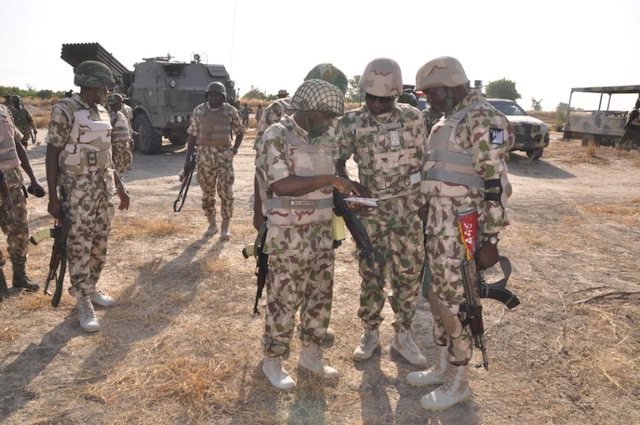
Nigerian soldiers
Nigerian soldiers

By Musdapha Ilo, Maiduguri

As the military tries to rally its troops back to battle, following the shocking death over the weekend of Muhammad Abu Ali, a Lieutenant Colonel, who was killed on Friday in an ambush, some cheering news has come in about a major success against the insurgents.

According to the army, troops carried out some clearance operations in Chukungudu, a major, strategic location used by the insurgents around the Lake Chad Basin in the northern part of Borno State.

Significantly, the operation, which lasted from Friday to Saturday, was led by the General Officer Commanding 7 Division, Victor Ezugwu, a Brigadier General, with troops from 3 Battalion under 22 Brigade.

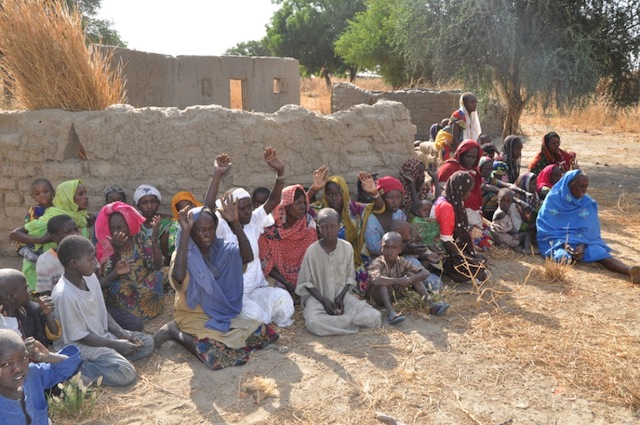
Geram, Bulankassa and Chukungudu were all cleared, leading to the deaths of five insurgents and rescue of 85 people, mostly women and children.

Rescued Boko Haram captives

Unfortunately, a soldier was killed during the exchange of fire.

“The troops recovered 4 rounds of Rocket Propelled Grenade (RPG) bombs, 1 Double Barrel Gun, 349 packets containing various rounds of ammunitions, 3 Magazines, a link belt of machine gun ammunition and 1 AK-47 rifle magazine,” a statement by army spokesperson, Sani Usman, a Colonel, said.

The troops also uncovered a bomb making factory at Geram, with several ready-made suicide vests. At Chukungudu, they discovered a spare part shop and a well equipped workshop where vehicles and motorcycles were repaired.

During the clearance operations, the troops made spectacular discovery of an Improvised Explosive Device, IED, making factory at Geram.

In the factory, they found several already primed suicide bombers’ vests.

They also discovered a well-equipped motor vehicles and motorcycles’ workshop and spare parts where house at Chukungudu village.

“The troops recovered 3 vehicles and several newly acquired motorcycles,” the army added.


Military Discovers Another Chibok Girl

0
military-discovers-another-chibok-girl
Photo of the rescued girl, Maryam Ali, as released by the Nigerian Army

The Nigerian Army says it has rescued another of the schoolgirls abducted by the Boko Haram Terrorists in Chibok, Borno State.

Army spokesman, Sani Usman, said the girl, Maryam Ali, was found with a 10-month-old son, at Pulka in northern Borno.

The development came nearly a month after another 21 of the Chibok girls were freed following negotiations with the insurgents.

Another round of negotiations is believed to be ongoing for the release of the remaining girls in captivity.

Usman said the latest girl to be found was discovered by soldiers who were screening escapees from Boko Haram’s base in the Sambisa forest.

More than 270 schoolgirls were seized from the north-eastern town in April 2014, sparking international outrage.

Boko Haram has been fighting a long insurgency in its quest for an Islamic state in northern Nigeria and the conflict is estimated to have killed more than 30,000 people.

The terrorist group has kidnapped thousands of other people during its seven-year insurgency in the North east and many people have been made homeless.

The freeing of 21 girls in October came after talks mediated by the International Committee of the Red Cross and the Swiss government.

Until then, there had only been one confirmed release of a student kidnapped from Chibok – a 19-year-old girl found by an army-backed vigilante group.

The Bring-Back-Our-Girls campaigners also confirmed the rescue of the chibok girl.

A message posted of the group’s social media handle read: “The cheering news of the return a missing #ChibokGirl is confirmed.

“Maryam Ali is #198 on our list. 196 MORE TO GO!”

Buhari Promises More Development Under His Watch

0

President Buhari, flanked by Governor Aminu Tambuwal of Sokoto State, Senate President Bukola Saraki, and House of Reps. Speaker, Yakubu Dogara, during the commissioning of the 500 housing units constructed by the Sokoto State govt.

President Muhammadu Buhari has pledged that Nigeria will see tremendous development during his presidency.

The President was speaking in Sokoto on Saturday, where he commissioned a 500-unit housing estate built by the Governor Aminu Tambuwal administration.

The commissioning coincided with activities to mark the tenth anniversary of the Sultan of Sokoto, Sa’ad Abubakar III.

Buhari also expressed optimism that in spite of the current challenges facing the country at the moment, it was well poised on the path to greatness.

“The administration will continue to bring development to Nigerians, improve security and welfare of Nigerians,” the President said.

He praised the Sultan of Sokoto for being a courageous and tireless peacemaker and bridge builder within and outside Nigeria.

He also hailed the continued support and loyalty of various traditional rulers and state governments to the federal government.

President Buhari called on all Nigerians to continue to work for sustainable peace, unity and socioeconomic progress of the country.

He also commended Governor Tambuwal for the housing project and urged the beneficiaries to make good use of the facilities.

Tambuwal in his reply said that the houses were built in fulfillment of his campaign promises to the people of the Sokoto State.

The governor hailed the president for his support to the states, noting that the modest achievements were attributable to this gesture.

Sokoto state Commissioner for Lands and Housing, Bello Gwiwa, said that the estate was provided with road networks, water facilities and school networks, among others.

Senate President, Bukola Saraki, and Speaker of the House of Representatives, Yakubu Dogara, were among the dignitaries that attended the event.

Nigerian Editor, Fisayo Soyombo Wins Free Press Award   

0
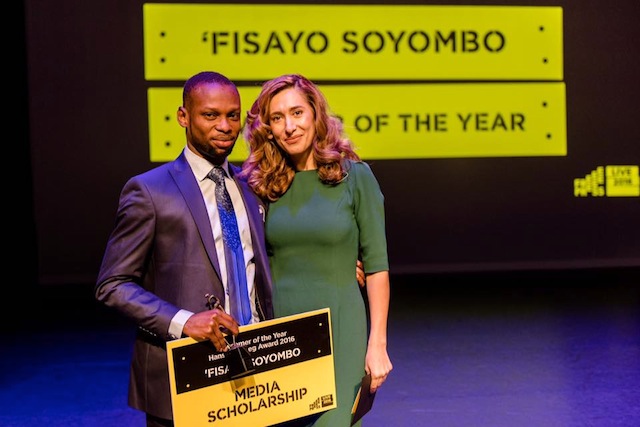
Fisayo Soyombo at the Free Press Award

The editor of TheCable, Fisayo Soyombo, has emerged winner of the Newcomer of the Year category of the 2016 Free Press awards, which held in The Hague, Netherlands, last Wednesday.

At the awards, held annually on November 2 — the International Day to End Impunity for Crimes against Journalists — Soyombo was named winner, ahead of Zimbabwean Tafadzwa Ufumeli and Albanian Mechman Huseynov, for ‘Forgotten Soldiers’ — a five-part series exploring the agony of soldiers shattered by Boko Haram’s bullets and mines, and what their pains mean for their loved ones.

After the story was published, the Nigerian army had accused Soyombo, TheCable, as well as the International Centre for Investigative Reporting, ICIR, which collaborated with TheCable on the project, of committing “subversion” — a treasonable offence punishable with death under military regimes.

The jury also praised Soyombo for his other two entries: ‘Undercover Investigation: Nigeria’s Customs of Corruption, Bribery and Forgery’, and a three-part investigation into Liberia’s post-Ebola recovery and the embezzlement of funds meant to fight the virus.

“He travelled to Liberia to cover its post-Ebola recovery at the great personal risk of possibly contracting the virus himself,” Fidan Ekiz, Dutch journalist and documentary filmmaker, said while handing the award over to him.

In a brief speech after receiving the award, Soyombo said: “In Nigeria, there are two types of investigative journalists: the ones who are viewed by the people as foolish because they died while chasing investigative stories; and the ones who are described as brave because they have managed to stay alive.

“But I know that I’m not brave; it is God who has kept me alive to witness a day like this.”

He thanked his mentor, Jahman Anikulapo, former editor of TheGuardian on Sunday; his boss, Simon Kolawole, chief executive officer of TheCable; and Dayo Aiyetan, executive director of the International Centre for Investigative Reporting.

“I studied Animal Science in the university and I probably would be on the farm by now, tending to cattle, sheep and goat,” he said.

“But after I opted to become a journalist, a certain editor denied me a place in his newsroom just because of my science background. But Mr. Anikulapo gave me a chance. I am forever grateful to him, and I’ll never pick up any award without mentioning his name.

“I am also grateful to Mr. Aiyetan, who looked at the ‘Forgotten Soldiers’ proposal and decided within 24 hours to fund it.”

About his boss, he said: “I have enjoyed tremendous support from Mr Kolawole, my boss. He gave me four weeks off my editing responsibilities in May so I could travel to the north-east. That is a massive sacrifice; If he didn’t make it, I wouldn’t be here today.”

Soyombo dedicated the award to the memory of Enenche Akogwu, the Channels TV reporter killed by Boko Haram in 2012. He said: “A day like this is important to keep alive the memory of journalists such as Akogwu, who have paid the supreme price for journalism.”

In the other two awards handed out, Hamid Mir, a Pakistani journalist, was named Most Resilient Journalist of the Year, while Klaas van Dijken won the Best Report award, which is meant for Dutch journalists.

Wednesday’s award came a month  after Soyombo was named Journalist of the Year (Business and Economy Reporting) in the PricewaterhouseCoopers Awards, and three months after his short-listing for the 2016 Kurt Schork Awards in International Journalism.

He was first short-listed for the Kurt Schork awards in 2014, for ‘Blood on the Plateau’ — a five-part investigative series on the ethnocentric killings in Plateau state, published in December 2013. That year’s finalists were chosen from “almost 300 stories entered by 93 journalists from 41 countries”

Soyombo, a 2013 recipient of the Deutsche Welle/Orange Magazine Global Fellowship for Young Journalists, contributes opinions to Doha, Qatar-headquartered Al Jazeera and Germany-based TAZ.

A finalist for the 2015 Thomson Foundation Young Journalist from the Developing World FPA Award, his works have been translated into French, German and Arabic.

New Navy Ship Arrives Nigeria

0
The Newly Acquired Navy Ship, NNS Unity

The newly-acquired Nigerian Navy Ship, named UNITY, which was constructed by the China Shipbuilding and Offshore International Limited, CSOIL, has finally arrived in the country.

Direct of Navy Information, Cor Ezekobe, said in a statement that the ship which departed from China on 15 September, “berthed at the Nigerian Naval Dockyard Jetty, in Lagos on Friday at about 2:10 pm and was escorted into harbour by two locally constructed Seaward Defence Boats, SDBs, NNS ANDONI and NNS KARADUWA.”

Chief of the Naval Staff, Ibok-Ete Ibas, officials of the Chinese Embassy in Lagos, as well as a representative of CSOIL in Nigeria, Dapo Oguntayo, were on hand to receive the massive war ship.

Also present at the event were former Chiefs of Naval Staff, Micheal Adelanwa, Victor Ombu and Dele Ezeoba.

Other dignitaries that graced the reception ceremony include a former Chief of General Staff, Ebitu Ukiwe, General Officer Commanding 81 Division of the Nigerian Army, Flag Officers Commanding Western Naval Command and Naval Training Command, senior military officers as well as officials of security agencies.

Ezekobe also stated that the new Ship on its way to Nigeria, “paid port calls at the ports of five countries in Asia and Africa namely Port of Klang in Malaysia, Port of Colombo in Sri Lanka, Port Lious in Mauritius, Simons Town Port in South Africa and finally Port of Luanda in Angola.

He also pointed out that “NNS CENTENARY, a sister ship of the same class was the first to be constructed by CSOIL.

“NNS UNITY being the second is built for high endurance capability at sea which makes her an ideal platform for naval operations.”

Rejection Of Executive Proposals: Saraki, Buhari In Closed Door Meeting

0
President Muhammadu Buhari in a handshake with Senate President Bukola Saraki on Friday

Following the recent misunderstanding between the Executive and the Legislative arms of government, which has seen the Senate reject two important documents forwarded to it by President Muhammadu Buhari, Senate President Bukola Saraki on Friday visited the Aso Rock Presidential to have a chat with the President.

The meeting was held behind closed-doors inside the president’s office, after both leaders had observed the Friday Jumaat prayers at the State House mosque.

Saraki was accompanied to the Villa by the chairman of the Senate Committee on Appropriation, Danjuma Goje.

In a chat with State House correspondents after the meeting, Saraki said that the President’s $29.9 billion foreign loan request which the Senate turned down on Tuesday was still a work in process.

He however cautioned Nigerians against politicizing what he called “very important issues”.

The Senate President also refused to acknowledge that he had visited the president to discuss the loan proposal, adding that the rejection of the loan request as well as the Medium Term Expenditure Framework, MTEF, document, was not a reflection of the relationship between the executive and the legislature.

“I came here to pray,” he said, “I have finished praying and I just had a general felicitation with the president. It did not go beyond that.”

“We should not look at that (Senate’s rejection of executive documents) as a reflection of the relationship between the Executive and the Legislature.

“Don’t let us politicize very important issues. As we said, this is work in progress,” he added.

Nigerian Troops Foil Another Suicide Attack

0
Some of the items recovered from the terrorists

Nigerian Soldiers in the ongoing clearance operations in the Northeast have averted what would have been a suicide bomb attack in Yamtake, Gwoza Local Government of Borno State.

Acting Director, Army Public Relations, Sani Usman, made this known in a statement released on Friday.

Usman stated that a female Suicide bomber tried to enter the military location in the area at about 9.45 pm on Thursday “but a vigilant sentry on duty gunned her down and she died instantly.”

The statement added that “the failed suicide bombing attack was followed up with futile probing attack by terrorists which was decisively dealt with by the troops.”

He added that all the four attackers including 2 suicide bombers were killed and various arms and ammunition recovered.

They include: “2 AK-47, 3 Magazines, 109 rounds of 7.62mm (Special), 1 Torchlight, 1 Water bottle, 3 Magazine carrier, 1 Illuminator pyrotecnic and some quantity of drugs.”

Usman also said that one soldier died in the attack.

There have been consistent attacks by the Boko Haram terrorist group in recent weeks.

Earlier in the week, two suicide bomb attacks killed nine people and injured 24 others, and a day after, the army revealed it foiled another suicide attack.

Just two days ago, nine people died when a pick-up vehicle laden with IEDs exploded along a road leading to Maiduguri, the Borno state capital.

Initial reports said it was an attack by the insurgents, but the army later clarified that all occupants of the vehicle were terrorists who had planned to attack a military position, but had detonated their devices following stiff resistance from the troops.

Nigeria Is 12th Most Unfriendly Country For Journalists

1

nigeria-is-12th-most-unfriendly-country-for-journalists


By Chikezie Omeje

A new global impunity index has revealed that Nigeria is the 12th out of 13 countries where journalists are murdered without their killers being brought to justice.

This is the second year in succession that Nigeria featured in the global impunity index compiled by the Committee to Protect Journalists, CPJ, just as the country joined the rest of the world on Wednesday to mark the International Day to End Impunity for Crimes against Journalists.

Since 2014, the UN has commemorated November 2 as a day to highlight the glaring number of unresolved journalists’ murders and the lack of punishment for their perpetrators around the world.

The United Nations Education, Scientific, and Cultural Organization, UNESCO, has recorded 827 killings of journalists around the world in past 10 years, from 2006 to 2016.

Last year alone, which is the second worst year for journalists in the past 10 years, 115 journalists were murdered. In 2014, UNESCO recorded 98 cases of killing of journalists.

The global impunity index by CPJ revealed that Islamic terror groups have been responsible for killing a large number of journalists without fear of being punished.

Somalia has maintained the first position as the worst country where journalists have been murdered with impunity and the Islamic terror group Al-Shabaab is alleged to be responsible for most of the murders.

Other countries that featured prominently in the global impunity index are Iraq, Syria, Philippines, South Sudan, Mexico, Afghanistan,  Pakistan, Brazil, Russia, Bangladeshi, Nigeria, and India.

According to CPJ, five journalists were killed in Nigeria in the past decade with the perpetrators getting away with the murders.

The murders have been attributed to the Islamic Boko Haram and other unknown assailants.

CPJ noted that Nigeria has failed to identify or prosecute not only the culprits in any of the murders of the past 10 years but also the perpetrators of assaults, some of which allegedly involved police and security forces.

The murdered journalists in Nigeria were local journalists, covering crisis, politics, and human rights. Those documented as killed in the last 10 years by the CPJ are: Enenche Akogwu, Channels TV.

January 20, 2012, in Kano, Nigeria; Zakariya Isa, Nigeria Television Authority October 22, 2011, in Maiduguri, Nigeria; Sunday Gyang Bwede, The Light Bearer April 24, 2010, in Jos, Plateau State, Nigeria; Nathan S. Dabak, The Light Bearer April 24, 2010, in Jos, Plateau State, Nigeria and Bayo Ohu, The Guardian September 20, 2009, in Lagos, Nigeria.

Others are Okezie Amaruben, News service September 2, 1998, in Enugu, Nigeria; Tunde Oladepo, The Guardian, February 26, 1998, in Abeokuta, Nigeria and Fidelis Ikwuebe, Freelancer April 18, 1999, in Anambra, Nigeria.

A breakdown of the 827 killings of journalists in the past decade as recorded by UNESCO, showed that 95% of killed journalists are local and only 5% are foreign correspondents, only 8% of the 827 cases are reported to be resolved, male journalists account for 94% of journalists killed, and 38% of killed journalists worked in print media.

Impunity is widely recognised as one of the greatest threats to press freedom, and international pressure to address it led the UN General Assembly to pass a resolution in 2013, recognising November 2 as the International Day to End Impunity for Crimes against Journalists. The date was chosen in commemoration of the assassination of two French journalists in Mali on 2 November 2013.

UNESCO Assistant Director-General for Communication and Information, Frank La Rue said in a message to mark International Day to End Impunity for Crimes against Journalists that UNESCO is concerned that impunity damages whole societies by covering up serious human rights abuses, corruption, and crime.

He called on Governments, civil society, the media, and everyone concerned to uphold the rule of law and join in the global efforts to end impunity.

Nigeria has made progress by responding for the first time in the UNESCO’s impunity accountability mechanism, which requests information on the status of investigations into killed journalists.

Findings in the CPJ global index showed that in the past 10 years, around 30% of murdered journalists were first taken captive and the majority of them were tortured. In at least 40% of cases, the victims reported receiving threats before they were killed.

Also, Political groups, including ISIS and other extremist organisations, were the suspected perpetrators in more than 40% of all murder cases.

Some of the key findings of the UNESCO DG’s Biennial Report on the Safety of Journalists and the Danger of Impunity showed that 213 journalists were killed between 2014 and 2015. 36.5% of these murders occurred in the Arab states, that is 78 killings.

Reflecting the extreme vulnerability of journalists working in conflict zones, UNESCO’s statistics on journalists killed in 2014-2015 showed that most of the killings took place in countries where there has been armed conflict, with 126 cases, or 59% of all cases.

According to UNESCO, 2015 witnessed a sharp increase in the number of online journalists killed, with 21 documented cases of killings, or 18% of all cases, compared to just two in 2014.  Almost half of these were Syrian journalists and bloggers covering the conflict in Syria.  The majority of journalists killed in 2014-2015 were television journalists, whereas in almost every previous year of the last decade print media journalists constituted the largest group affected by fatal attacks.

UNESCO pointed out that confirming a trend that could be noted throughout the decade, the vast majority of victims – representing almost 90% – were local journalists. In 2014, there was, however, a significant increase in the number of foreign journalists killed, with 17 such cases compared to an average of four in previous years.

A gender-based analysis of the victims of journalists’ killings in 2014-2015 revealed that, as in previous years, men have been the target of a far greater number of killings than women, with 195 fatalities among male journalists against 18 among female journalists. This difference, according to UNESCO, goes beyond the imbalanced representation of women in news media organizations and may partially be explained by the fact that fewer women journalists cover conflict zones.

A particular case of impunity in Nigeria was the murder of Eneche Akogwu in 2012, a 31-year-old cameraman with the Channels TV who was interviewing witnesses of a series of Boko Haram terrorist attacks when unidentified gunmen killed him. The Nigerian authorities have failed to bring those who killed Eneche to justice.

FG Employs First Batch Of 200,000 Teachers, Agric. Workers

0

fg-employs-first-batch-of-200000-teachers-agric-workers


The federal government said it has employed 200,000 graduates as teachers and agricultural extension workers across the country.

This was made known by Laolu Akande, the senior special assistant to Vice President Yemi Osinbajo on media, during the second presidential economic communication workshop in Abuja on Friday.

According to Akande, the newly employed graduates would work only for two years.

“We have selected 200,000 graduates out of 500,000. This is the first batch,” the vice presidential spokesman said.

“One hundred and fifty thousand will work as teachers while 50, 000 will work as extension workers.

“Their pay which is 30, 000 per month, will go directly into their account.‎”

He added that the selection process was completed “a couple of weeks back,” but that BVN‎ screening for the candidates had delayed the exercise.

Akande further stated that the new employees would work in their states of residence, and would be supervised by their local governments‎.

He added that another aspect of the social intervention programme, which is conditional cash transfer to the poor, would commence soon.

The present administration had announced the rolling out of series of employment and empowerment strategies in a scheme termed “N-Power”.

This comprises of three major areas: the N-Power Teacher Corps, which would see the federal government employ 500,000 graduate teachers to boost the education sector.

N-Power Knowledge (N-Power Creative, N-Power Tech: hardware and N-Power Tech: software), is aimed at enhancing the ICT know-how of Nigerian youths.

The third step, N-Power Build, is aimed at training 75,000 Nigerian youths to become skilled technicians, artisans and service professionals.