Home Blog Page 2911

Senate Okays Reintroduction Of Toll Gates

0

senate-okays-reintroduction-of-toll-gates


The Senate has passed a motion seeking to reintroduction of toll gates on all federal roads in the country.

Suleiman Nazif, a senator from Bauchi north, sponsored the motion, describing the state of federal roads in Nigeria as a “national shame and embarrassment”.

He said the reintroduction of toll‎ gates would go a long way in rehabilitating the country’s  dilapidated roads, adding that apart from generating revenue, “the presence of toll gates, which are normally managed by armed security agents, provides a level of safety for road users.”

‎Nazif called on the Senate leadership to “constitute an ad-hoc committee to carefully study the toll-gate policy together with other relevant stakeholders on effective and efficient ways to carry out the policy aimed at producing a holistic package to generate adequate funds for road construction and maintenance, and the money realised should be judiciously utilised in order to restore confidence in the masses”.

After a brief debate on the motion, Ike Ekweremadu, deputy senate president, who presided over the session, called for a voice vote, and the senate voted overwhelmingly for it.

Buhari Pledges To End Violence Against Children by 2030

0

buhari-pledges-to-end-violence-against-children-by-20301


President Muhammadu Buhari has launched what has been described as an ambitious campaign to end violence against children by 2030.

The event took place at the State House Conference Centre, Abuja, on Tuesday

Represented by the Secretary to the Government of the Federation, SGF, Babachir Lawal, president Buhari pledged to protect every Nigerian Child from abuse and violence.

“I say to children in Nigeria – on this historic day, we make a pledge. We commit to protecting each and every one of you from violence,” he said.

The campaign, which is being supported by the United Nations Children’s Fund, UNICEF and the United States Agency for International Development, USAID, is aimed at building and expanding on the success of just-ended Year of Action to End Violence Against Children, which was launched by the President in September 2015.

UNICEF’s chief of communication in Nigeria, Doune Porter, in a statement shortly after the launch, explained that during the just concluded Year of Action to End Violence Against Children, “Lagos, Cross River, Benue and Plateau States all heeded the President’s call to launch their own State campaigns; Bayelsa became the 23rd State in Nigeria to domesticate the Child’s Rights Act and nine States joined hands to develop a model child protection system to put the Child’s Rights Act into practice.”

Porter noted that millions of children suffer some form of physical, emotional or sexual violence every year in Nigeria.

“A survey carried out last year by the National Population Commission, with support from UNICEF and the US Centers for Disease Control and Prevention revealed that approximately 6 out of 10 Nigerian children experience one of these forms of violence before they reach 18,” he stated.

President Buhari, in his speech acknowledged that “the Year of Action has created a wonderful momentum to end violence against children.”

“We have a clear moral, legal and economic imperative and a global obligation to take action to end the suffering of children who live under the shadow of violence,” he added.

Also speaking at the event, Manuel Fontaine, UNICEF’s West and Central Africa Regional Director, reiterated that “Ending violence against children is everybody’s business.”

“With this campaign, Nigeria has shown it is determined to mobilize political will and resources to tackle all forms of violence against children wherever it happens”.

The Sustainable Development Goals, SDGs – which was accented to by all members of the United Nations, including Nigeria – require every country of the world to formulate policies aimed at ending all forms of violence against children by 2030.

To achieve this goal, the federal ministry of women affairs and social development announced that it will convene representatives from key Government Ministries, Departments and Agencies, as well as Civil Society and Faith Based Organisations to develop a National Plan of Action.

Dozens Killed At Pakistani Police College

0

dozens-killed-at-pakistani-police-college


At least 59 cadets and guards have been killed in an attack by militants on a police college in the Pakistani city of Quetta between Monday night and Tuesday morning.

Officials say three militants wearing suicide vests entered the college in the middle of the night and opened fire on the cadets who were fast asleep.

The Pakistani military forces later responded and after a major security operation that lasted for hours, one of the attackers was shot dead, while the two others were said to have blown themselves up.

So-called Islamic State, IS, claimed responsibility for the attack, although officials have blamed another militant group, Lashkar-e-Jhangvi.

Quetta, the capital of Balochistan province, has seen similar attacks by both separatists and various Islamist militant factions in recent years.

Hundreds of trainees were evacuated from Balochistan Police College as troops arrived to repel the militants. Local media reported at least three explosions at the scene.

“I saw three men in camouflage whose faces were hidden carrying Kalashnikovs,” one cadet said according to newsmen.

“They started firing and entered the dormitory but I managed to escape over a wall.”

The exact sequence of events is unclear but there was intermittent exchange of fire between the attackers and security forces for several hours, according to some reports.

There were also reports of a hostage situation.

More than 100 people, mostly trainees, were injured.

Pakistani media highlighted the nation’s poor security situation after the attack, with leading TV channels changing their logos to black in a mark of respect for the victims.

Officials blamed a faction of the Lashkar-e-Jhangvi militant group and said the attackers “were in communication with operatives in Afghanistan”.

However, IS said on its Amaq news agency that its fighters had carried out the attack, releasing an image purported to be of the three gunmen.

IS formed a branch for Afghanistan and Pakistan in January 2015 under Hafiz Saeed Khan, who was killed in a US drone strike in July this year.

The first suspected IS attack in Pakistan was in April 2015, when three soldiers were killed.

ISIS also claimed an attack on a bus in Karachi that killed 45 people, although the Pakistani Taliban splinter group Jundullah also said it was responsible.

FCT Minister Bans Cattle Grazing In Abuja

0

fct-minister-bans-cattle-grazing-in-abuja


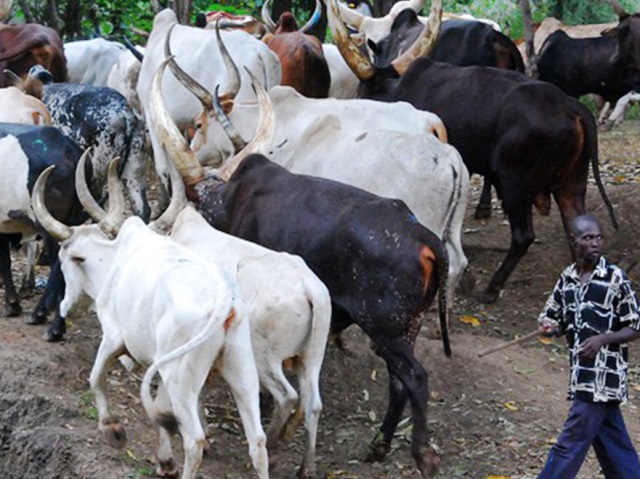
Minister of the Federal Capital Territory, FCT, Muhammad Bello, has announced a total ban on cattle grazing within the Abuja city centre.

A Ministerial Task Force headed by Abdullahi Monjel, was also inaugurated to ensure enforcement of the ban.

This is following series of complaints by residents of the FCT that the animals constitute nuisance and threat to lives.

In a meeting with members of the Miyetti Allah Cattle Breeders Association of Nigeria, FCT Chapter, the minister asked the association to nominate some of its educated young men to be part of the enforcement committee.

He reiterated that herdsmen must move their cattle out of the Federal Capital City because there is no way such animals can co-habit with the residents.

“You have to understand that when Abuja Environmental Protection Board says cattle should not roam the city, it is not because they want to prevent cattle breeders from raring cattle in the FCT. Basically, it is just for safety. It is for safety of your cattle and above all, safety of the citizens,” Bello said.

“In a modern city, it’s not possible for animals and vehicles to move together on the roads because this could cause accidents which in some cases could be fatal, and it is our duty to protect lives and property”.

The FCT minister said that new grazing reserves have been created for herdsmen to conveniently carry out their activities.

He said: “A total of 33,485 hectares have already been earmarked for grazing reserves to cater for about 7 million herds of cattle comprising of Paikon Kore 8,500 hectares; Karshi 6,000 hectares; Kawu in Bwari 9,000 hectares and Rubochi in Kuje which is 9,985 hectares.”

Bello said that his administration will work together with the National Assembly to amicably resolve the issue of compensation for the owners of the grazing reserves.

Chairman of the Cattle Breeders Association, Yahaya Isah, promised that the group will continue to cooperate with the government in order to promote peaceful co-existence.

Afenifere Accuses Cattle Breeders’ Association Of Terrorism

0


afenifere-accuses-cattle-breeders-association-of-corruption


The Yoruba socio-political association, commonly referred to as the ‘Afenifere Renewal Group’, has condemned the statements attributed to the Miyetti Allah Cattle Breeders Association of Nigeria, over the recently-inaugurated Anti-Grazing Enforcement Marshals in Ekiti State.

In a statement issued by the group’s publicity secretary, Kunle Famoriyo, the Afenifere said the cattle breeders group’s reaction to the creation of the Marshals is an assault on the Yoruba people and “will be treated as a terror threat until an apology is tendered”.

“Such open threat against the people and government that accommodate your business interest is terrorism,” the statement added.

Famoriyo said that the Miyetti Allah association “should be happy for the enactment of such law that will ensure genuine cattle breeders are not stigmatized by these criminals from other countries.”

He added that Governor Fayose, as the chief Executive Officer of Ekiti State, has the responsibility to protect the lives and property of his people, just as any governor in any state of the federation has the same obligation.

He said: “We recall that in 2013, the Hisbah Police in Kano reportedly destroyed more than 20,000 crates of beer bottles.

“Despite the freedom of movement and trade guaranteed by the Constitution, what mattered then was that Kano does not want beer within its jurisdiction – even though it hypocritically shares from the VAT generated from sales of alcohol in other states.”

“Why should governors of northern states have the freewill to protect their people and religious disposition, while their southern counterparts are subjected to intimidation?” Famoriyo asked.

“Nigeria is not a slave camp of any ethnic nationality and MACBAN’s statement is therefore considered an assault on Yoruba people and will be treated as a terror threat until an apology is tendered,” he added.

Recall that Governor Fayose, last week, inaugurated a team that would enforce the new  Anti-Grazing law in Ekiti State.

The law restricts animal grazing to designated ranches within the state and between 7:00 am and 6:00 pm.

But the Miyetti Allah group accused the governor of using the Marshals to harass their members and to seize their cattle.

“We have been reliably alerted (by) an impeccable source in Ado-Ekiti that the Anti-Malu vigilante group (as the Marshalls are referred to in the state) shot five cows and carted away with the meat but the herdsmen (sic) was able to flee with the rest of his cattle,” the group’s spokesan, Othman Ngelzarma, said in a statement.

“We are hereby constrained to implore the federal government through its security agencies to wade into this unprovoked and primitive aggression against our members, before this macabre incident develops into unquenchable inferno involving our members and Ekiti State government,” he threatened.

‎Former President Jonathan Doubts Allegations Against Dasuki

0
Former President Goodluck Jonathan

Former President Goodluck Jonathan has expressed misgivings over the $2.1  billion arms fraud allegation against former National Security Adviser, NSA, Sambo Dasuki.

Jonathan made his opinion known during a presentation at the Oxford Union in the United Kingdom on Monday.

When questioned about the allegations of corruption during his administration, Jonathan said: “They said the national security adviser stole $2.2 billion. I don’t believe somebody can just steal $2.2 billion.

“We bought warships, we bought aircraft, we bought lots of weapons for the army and so on and so forth, and you are still saying $2.2 billion (was stolen)? So where did we get the money to buy all those things?” he asked.

The ex-president acknowledged that there were cases of corruption during his tenure as president, but added that most of the cases were being exaggerated.

“Yes, there were some issues; yes, there are still corruption issues; but some of it were blown, I’d say exaggerated, and they give a very bad impression about our nation. You cannot say the national security adviser stole $2.2billion; It is not just possible,” he said‎.

“I don’t want to be seen as a former president challenging what the sitting government is doing so I have decided to keep quiet for the court to look into them. You will see that it has become a major topic whenever there is a change of government.

“I am not saying there is no corruption in Nigeria, there is corruption. If you look at corruption there is almost no country that is free, the degree varies, the perception varies.

Dasuki, who has been in detention for months, is being prosecuted by the Economic and Financial Crimes Commission, EFCC, for corruption.

In the last one week, several former aides to ex-president Jonathan have been invited and detained by the anti-graft agency on allegations of corruption and misappropriation of funds.

The latest arrests took place on Monday night as former Presidential spokesman, Reuben Abati, as well as former FCT Minister, Bala Mohammed, were arrested by the EFCC.

Former FCT Minister, Bala Mohammed, Arrested

0
Former FCT Minister, Bala Mohammed

Just as news of the arrest of former presidential spokesman Reuben Abati’s arrest filtered into the newsroom, came indications that former Minister of the Federal Capital Territory, FCT, Bala Mohammed, has also been arrested by the Economic and Financial Crimes Commission, EFCC.

Details of Mohammed’s arrest were not clear as at the time of filing this report, but sources confirmed that he was in detention at the EFCC headquarters, Abuja.

The spokesman of EFCC, Wilson Uwujaren, could not be reached for comments late Minday as his phone was switched off.

Mohammed, a former senator from Bauchi State, was the FCT Minister under President Goodluck Jonathan between 2010 and 2015.

The list of arrested former government officials who served under the Goodluck Jonathan administration is getting longer by the day as Mohammed and Abati now join former Minister of State for Defence, Musiliu Obanikoro and former presidential campaign spokesman, Femi Fani-Kayode who were arrested at different times last week.


EFCC Arrests Reuben Abati

0
Reuben Abati
Reuben Abati

Reuben Abati, Former Special Adviser to ex-president Goodluck Jonathan on Media and Publicity, has been arrested by the EFCC.

Abati was arrested on Monday and it is unlikely he will be let go until at least TuesdayMorning.

It was gathered that his arrest was on allegations of having received money from former National Security Adviser, Sambo Dasuki, who is currently being tried by the EFCC for alleged mismanagement of funds meant for the purchase of arms for the Nigeria Armed Forces.

Abati joins the long list of former aides to former president Jonathan who has so far been arrested by the EFCC.

Recall that former minister of state for defence, Musiliu Obanikoro is still in EFCC custody since last week Monday, having voluntarily surrendered himself for investigation.

Femi Fani-Kayode, former Jonathan campaign spokesperson, was also re-arrested by the anti-graft agency on Friday and is still in cutody.

Also, another of ex-president Jonathan’s aide, Waripamowei Dudafa is also undergoing trial for his connections to an account containing about $15 million.

However, former First Lady, Patience Jonathan had claimed ownership of the said amount.

Admit Responsibility For Nigeria’s Woes, Okorocha Tells APC

0

admit-responsibility-for-nigerias-woes-okorocha-tells-apc


Chairman of the Progressives Governors Forum and governor of Imo State, Rochas Okorocha, has said that the All Progressives Congress, APC, must accept responsibility for the current woes bedeviling the country.

Okorocha was speaking to State House correspondents shortly after leading the APC governors to a closed door meeting with President Muhammadu Buhari at the Presidential Villa, Abuja.

He said although some of the problems predated the present administration, the party must take responsibility without shifting blame.

“As APC, we are responsible for everything happening in Nigeria. We are responsible for the good, the bad, the ugly but we are promising Nigerians that we shall fix it,” he said.

The governor admitted that the masses were passing through difficult times, but added that there was no surgery that is not painful.

He said Nigerians were experiencing pains because the country was going through what he called “a very serious economic surgery.”

He said: “We share the pains of Nigerians, every human being must feel it. We also feel what they are going through but we are asking for a little patience.

“Let us do things the right way and do it once and for all. I am sure that by next year, you will begin to see changes, the price of rice will drop, price of dollars will begin to stabilise and we will see a lot of challenges.

“But at this painful moment, nobody likes it. It is like a woman in the labour room, when she is in the labour room there is no joy but she has to pass through that moment and that moment, she does not wear her high heel shoes, no makeup, no champagne, no party.

“She is going through a process but shortly after that process, joy cometh once she sees the child. So, Nigerians should bear with us as a government,” Okorocha appealed.

He said the meeting with President Buhari was to discuss a number of issues including the released Chibok girls, agriculture, the ongoing anti-corruption war as well as the forthcoming governorship election in Ondo State.

Sokoto Moves To Combat Malaria Outbreak

0

sokoto-moves-to-combat-malaria-outbreak


The Sokoto State government says it will administer 3.6 million doses of anti-malaria drugs on the people of the state within the next four weeks as part of efforts to combat the recent malaria outbreak in the state, which has claimed at least five lives in just one month.

The state Commissioner of Health, Balarabe Kakale, alongside other government functionaries visited the affected areas and assured residents that the needed number of drugs have been procured and kept at various medical stores across the state.

He said the drugs would be administered in four phases, with 900,000 doses given in each round.

The commissioner appealed to the people, especially those within the metropolis, to cooperate with the government to end the outbreak as adequate arrangements have been made to ensure success of the exercise.

He said: “As you are aware, we recently undertook massive fumigation of mosquitoes’ breeding areas across the state.

“We recorded successes on that front but we are appealing to people to help us by keeping their environments clean.

“In close collaboration with other ministries, we are working to deploy sanitary inspectors that will move to nooks and crannies of the state to ensure compliance to environmental laws.

“This will help our efforts in ensuring all areas are kept clean, thereby mitigating the effects of the deadly disease,” he added.

Kakale also said that the state government had conducted sensitisation exercises at various health facilities to enlighten residents on the need to adopt preventative measures while tackling diseases such as malaria.

It was gathered that the state government also sent a delegation, headed by Secretary to State Government, Bashar Garba, to condole with families of the five persons who lost their lives in the outbreak in Sokoto town.

However, some patients in the state-owned Specialist Hospital and other government owned health centers across the state have called for proper monitoring of the healthcare practitioners in the state.

Some of the patients who spoke on conditions of anonymity said that doctors in the specialist hospital were not always available to treat patients.