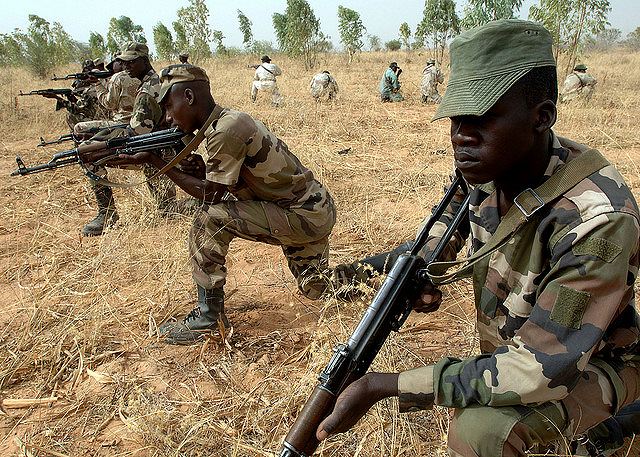
At least 83 Nigerian soldiers, including a Commanding Officer, are still missing days after they came under a Boko Haram attack.
Top level military sources monitoring the development told the newspaper that the soldiers were still missing in action as of Friday morning, four days after the attack.
The Army confirmed the attack in a statement on Tuesday, but has not given further updates. It did not also admit 83 soldiers were missing.
The latest update from several military personnel, follows an earlier report on how Nigerian troops drowned in a river as they scampered for safety in the face of a superior firepower from the terrorists.
While about 22 of the fleeing soldiers were later rescued by their Nigerien counterparts and dispatched to a hospital in Diffa, southern Niger, several others were fatally wounded after Boko Haram opened fire on them when they jumped into the River Yobe.
The Army leadership has established contact with the 22 soldiers —including two that sustained serious gunshot wounds— recuperating in the Niger hospital, PREMIUM TIMES was told.
The missing Commanding Officer of 223 Tank Battalion in Gashigar, was identified as K. Yusuf, a lieutenant colonel.
Military sources said the troops could not withstand Boko Haram because they had only two light armour tanks to work with.
Even the two tanks were withdrawn from the battlefront in Damasak to Gashigar, leaving soldiers in Damasak and other small units nearby with no tank.
“May God touch the heart of our dear president to equip the Army,” the source said. “How have we offended him that has made him not to equip us as promised?” one source said. “May God touch his heart to forgive. Our men are dying daily here.”
Besides the poor equipment, the renewed show of strength by Boko Haram has frightened many, coming after months of relative success by Nigerian troops.
Since the beginning of this year, the Army had maintained that troops were clearing the sect’s remnants across the troubled Northeast as a precursor to a new phase of winding down combat operations.
The Buhari administration claimed credits for the “improved morale” of the troops which had made it possible for previously displaced residents to return to their communities and commence rebuilding efforts.
Corruption returns
But high-ranking sources on the ground told PREMIUM TIMES the latest setback was because poor morale had returned to the battlefield.
“On the day they were dislodged, troop’s morale was at the lowest ebb and troops were not ready to face the terrorists,” security sources said.
The sources said the soldiers have had to endure months of unpaid salaries and their allowances also being held by their superiors.
All military sources who spoke to PREMIUM TIMES asked that their identities be protected because of the sensitivity of the issue.
This turn of event had compelled some commanders on the battlefield to go out of their way in search of financial support to keep their men fed — albeit poorly.
“The cause of the low morale was due to their being fed once a day and the insensitivity of the authorities to pay them their allowances,” the source said. “Only part payment of their allowance for August has been paid to date.”
“The commanders on the ground go out of their ways to incur debt in order to feed their troops.
“The ration cash allowance meant for feeding was last paid for the month of August. So the Commanding Officers on the ground are the worst hit,” the sources said.
The sources blamed alleged greed of a few brigade commanders for the situation the troops now find themselves.
“Some brigade commanders reduce the official feeding ration of N500 per day to a meagre N300 just to make money. Our findings reveal that most locations outside Maiduguri only feed their troops once a day with mostly beans,” the sources said.
The sources said this “insatiable craze for quick money” bears a stark similarity with what obtained under the Goodluck Jonathan administration.
“The last administration doled out a lot of money to the theatre of operations which was mismanaged,” the source said.
Other sources said the current pain is part of the consequences of a new distribution policy put in place by the Chief of Army Staff, Tukur Buratai, who came in a little over a year ago.
“The present Chief of Army Staff, in his good effort to minimise waste, decided to check these excesses by reducing maintenance allowance for the various units by half.
“So the commands are not too happy with the development and have resorted to looking into troops feeding money,” one source said.
They, nonetheless, described the policy as “a patriotic one” which was put in place to check the commanders’ use of allowances by “to settle political godfathers and patronise women”.
Army spokesman, Sani Usman, did not respond to PREMIUM TIMES’ requests for comments.
Nigerian troops are fighting alongside their counterparts from Cameroon and the Republic of Niger.
Monday’s development marked the first time in more than two years that Nigerian troops would come under superior firepower that required foreign military personnel to come to their rescue.
A similar incident last occurred in August 2014 when about 480 troops crossed the border into Cameroon while fleeing Boko Haram.
The insurgency, which began in 2009, has left approximately 20,000 people dead and displacement of millions.
Boko Haram leaders recently engaged in negotiation with the Nigerian government which led to last week’s release of 21 of the over 200 girls kidnapped from Chibok, Borno State, in April 2014.
Abdulmumin Jibrin, the suspended former Chairman of the House of Representatives Committee on Appropriation, has filed a fresh suit against the leadership of the House,asking for N1 billion in damages.
Jibrin filed the suit at the Federal High Abuja on Friday shortly after withdrawing the one he filed on August 9 asking the court to stop the House from suspending him.
The Kano State lawmaker is asking the court to declare his eventual suspension from the House of Representatives as a violation of his fundamental human rights to freedom of expression.
He prayed the court to declare that the resolution passed by the House of Representatives suspending him was in breach of Section 68 of the 1999 Constitution as amended.
Jibrin also wants the court to restrain the House of Representatives from preventing him from participating in the committees of the House or accessing the legislative chambers to perform his legislative duties.
He also wants the House to pay him N1 billion in damages.
Justice John Tsoho fixed November 22 for hearing of the suit.
Earlier, Justice Tosho had struck out a suit filed by Jibrin, challenging his suspension from the House after his counsel Chukuma Nwachukwu asked for discontinuance.
Kalu Onuoha, Counsel to the defendants, did not oppose the application, but asked that the court order Jibrin to pay a fine of N200,000 as the cost for the processes filed by the defendants.
Justice Tsoho, however, declined the request of the defendants for a N200,000 cost, saying that the defendants were “strong institution and personality”.
Recalled that Jibrin, a lawmaker from Kano State, was suspended by the House of Representatives for 180 legislative days, following what the lawmakers described as Jibrin’s attempt to drag the integrity of the House of Representatives in the mud.
Jibrin had, shortly after he was removed as House chairman on appropriation, made damning allegations against some principal officers of the House, claiming that Speaker Yakubu Dogara had made illegal insertions into the 2016 budget to the tune of over N4 billion.
The Economic and Financial Crimes Commission, EFCC, has re-arrested former Minister of Aviation, Femi Fani-Kayode.
Fani-Kayode was on Friday arrested by EFCC operatives as he left the Federal High Court premises in Lagos.
On Thursday, the former Aviation Minister released a statement alleging that the EFCC was planning to re-arrest and detain him.
He said the information was leaked to him by his sources within the anti-graft agency.
“I have been reliably informed by my sources within the EFCC that they are planning to re-arrest and detain me for as long as possible once again even though I have been granted bail by the Federal High Court in Lagos,” Fani-Kayode stated.
He said that fresh charges were filed against him by the EFCC at the Federal High Court in Abuja on July 7, accusing him of collecting N26 million naira from the NSA’s office in 2014.
“These are politically-motivated charges and there is no truth in or substance to them whatsoever,” he stated.
Fani-Kayode added that the case had been assigned to Justice John Tsoho and the date for arraignment was initially fixed for October 14, but on that day, the EFCC did not show up.
“The matter was therefore adjourned till November 10 and my lawyers have given an undertaking to the Judge to ensure that I am in court on that day.
“They have also written to the EFCC to that effect and our letter was acknowledged by them,” Fani-Kayode said.
He accused the EFCC of being a willing tool in the hands of those he described as hawks and hardliners in the Buhari administration, who he said might be acting on superior orders as well.
He said the commission was desperate to keep him out of circulation and off the streets, adding that he had been reliably informed of what the anti-graft agency was asked to do by the Presidency.
Apart from him, he said that the EFCC was also planning to arrest his wife and his eight- month old son just to hurt and spite him even though they had done nothing wrong.
The former minister was earlier arrested on May 9 by the anti-graft agency, and charged to court, and was later granted a N250 million bail.
He was eventually released from EFCC custody On July 15, after he met his bail conditions.
Shortly after his release, he described his incarceration as the “the worst experience of my life”, adding that “I am innocent of all charges and I look forward to defending myself vigorously in court.”
Borno State Government said it is set to discharge more than 2000 children who are being treated for severe acute malnutrition at the Borno State Nursery Village.
Chairman of the State Emergency Management Agency, SEMA, Satomi Ahmed, made this known in a chat with newsmen in Maiduguri, adding that the children had been stabilized and their parents were yearning to return to their homes, which is why government was considering discharging them.
“There are about 2,011 children that were admitted at the Borno State Nursery Village which was established to take care of cases of malnutrition crisis that broke up in the State,” Ahmed said.
“Today, there is a drastic recovery in the conditions of the children. Most of them have been stabilized and are fully recovered and we don’t intend to keep them any longer at the facility because their parents are eager to go back to Bama, their community.
“We will discharge them very soon,” he said.
The SEMA chairman also disclosed that another set of malnourished children were being treated at the Gwange and Maimusari malnutrition centers courtesy of the International Non-Governmental Organisation, Medicines San Frontier, MSF, in collaboration with the Borno State Government through the state ministry of health.
He pointed out that the SEMA under his leadership was able to introduce some reforms into the agency including the introduction of household feeding which according to him is more dignified that the central kitchen cooking system in the past where food were cooked with shovels etc.
“We felt there were too many complaints about food, feeding and sharing among the IDPs in the camp. Because of the several complaints, I decided that food should be shared based on household instead of the central kitchen cooking system. Food was being cooked with shovels and you see people lining up to collect food which was very undignified.
“With the introduction of the household feeding and food sharing, cooking in the camps has become more dignified and respectful. Apart from that, families cook and eat what they want any time unlike in the past,” Ahmed explained.
He however said that there was poor communication and coordination among the I-NGOs working in the state, a situation that continues to pose a challenge for SEMA.
He urged such organizations to liaise with SEMA in carrying out their activities so as to avoid duplication of efforts.
The SEMA boss also commended Governor Kashim Shettima for setting up the Humanitarian Response Committee which is headed by the Secretary to the State Government, Usman Shua, adding that the birth of the Committee has brought more rapid response to the needs of the IDPs in the state.
Information by the Federation Accounts Allocations Committee, FAAC, shows that the total amount of money shared between the three tiers of government for the month of September stood at N420 billion; a N90.27 billion decline from the N510.27 billion that was distributed in August.
The amount was also way below the N509.11 billion which was projected for the month of September.
The N420 billion shared among the three tiers of government accrued from the following sources: statutory revenue, N250.95 billion; Value Added Tax, N64.27 billion; exchange gain, N41.4 billion; and excess Petroleum Profit Tax, N63.39 billion.
Permanent Secretary of the Ministry of Finance, Mamudu Dutse, who chaired the FAAC meeting explained that the decline in revenue was due to lower volume of oil exports.
He said, “The gross statutory revenue of N279.75 billion received for the month was lower than the N319.05 billion received in the previous month by N35.29 billion.
“Crude oil export volume decreased by 1.15 million barrels in June. The decrease caused a revenue decline of $46.52 million in federation export sales despite the increase in the average price of crude oil from $46.06 per barrel in May to $48.43 per barrel in June.
“Force majeure was declared at the Bonny Terminal and there was a subsisting force majeure at the Forcados Terminal. Shut-in and shutdown of pipeline for repairs and maintenance also contributed to the drop in revenue.”
Dutse also said that “There were decreases in volume of dutiable imports receipts from Joint Venture Cash Call, Foreign Companies Income and Value Added Tax.
“The distributable statutory revenue for the month is N250.95 billion. There is a proposed distribution of N63.39 billion from the excess PPT Account. Also, exchange gain of N41.4 billion is proposed for distribution. The total revenue distributable for the month is N420 billion.”
He added that the Nigerian National Petroleum Corporation refunded a total of N6.33 billion to the Federal Government.
Seven communities in Jigawa State did not take part in the just concluded polio immunization exercise in Jigawa State.
This was made known by the state Executive Secretary Primary Health Care Board, Kabiru Ibrahim while briefing newsmen on the conduct of the exercise.
Ibrahim said that activities of kidnappers and bandits around Gwaram Local Government Area of the state made it difficult for immunization teams to conduct the exercise in six villages with a total target of 2,000 children.
He noted that, the board is now strategizing in collaboration with security agencies, traditional leaders and all stake holders to organise a special “Hit and Run” exercise for the left out village to immunize the remaining children in 24 hrs.
“Hit and run approach is a situation where a large number of vaccinators will be mobilised to carry out the usual four days vaccination exercise in three hours.”
“The communities we prefer to conduct the “hit and run” vaccination exercise and number of targeted children are: 341 from Matsongo, 345 from Funtua, 228 from Riminbabba, 322 from Lafia, 100 Ruwankari Gari and 180 Ruwankari Fulani communities.”
Ibrahim noted that 1.7 million children were targeted in the immunization exercise which was carried out successfully as a result of the effective plan that was put in place.
Tajudeen Suleiman takes a look at scholarship programmes in Nigeria and how states and federal governments waste billions of naira by awarding scholarships to students who end up in the unemployment market.
Ibrahim Ahmad, 28, came back from India last year after obtaining a Master’s Degree in Power Electronics and Drives from the SRM University. He was one of 501 students given foreign scholarships by the Kano State government in 2012 to study various courses at the Masters level. The scholarships cover courses in social sciences, arts, environmental sciences, computer studies, medicine and engineering.
Although, the Bayero University and the Kano State University of Technology offer some of these courses, the state government thought studying abroad would broaden the knowledge and outlook of the students.
Ahmad, as well as many of the other beneficiaries, had graduated either from Bayero University or Kano State University of Technology with Second Class Upper degrees.
While studying in India, Ahmad was paid 7,800 dollars about per year as allowances for accommodation and pocket money by the state government. In two years of his study, that amounted to 15,600 dollars. The government also paid 14,000 dollars as tuition fees for the two years he spent in India. If this had been the cost, the state government spent 29,600 dollars on each of the 501 students. That is a total of $14.8 million. At today’s exchange rate, that is nearly N10 billion. And, it could be higher as those who studied medicine and other medical courses even got higher funding.
Kano State scholarships
Before they travelled out to different countries in 2012, the government promised to give them jobs on their return. So the beneficiaries happily returned to Kano after their programmes to give back to the state that had invested so much in them.
But alas! Soon after their return, the story changed, and a new reality began to unveil itself. Government recanted and said there were no ready jobs. They were advised to watch out for employment opportunities in the future. Not satisfied, new graduates came together and formed a union last year to champion their cause.
After consistent pressure on the state government, about 60 of them or 12 per cent have managed to get jobs as lecturers in some of the tertiary institutions in the state. The remaining 88 per cent are now on their own, searching fruitlessly for jobs more than one year after their graduation.
By the grace of an uncle who is a politician, Ahmad managed to secure a job as a primary school teacher at LEA Bichi, in Bichi local government area of the state.
“When we came back the government told us there was no job. I went to all the higher institutions in the state but none could offer employment. I am now working as a primary school teacher because I couldn’t find any other job where my qualifications would be very useful,” he told www.icirnigeria.org as he mounted his motorcycle.
But compared to the situation of some of his colleagues, Ahmad appears lucky. Sani Hassan Garba also acquired an MSC in Information Security and Computer Forensic from SRM University in India. After searching fruitlessly for a decent job, his father convinced him to join him to hawk artefacts at the popular Kantin Kwori market. He told the reporter he hoped to start an Internet café business in the future if he is able to raise funds.
“Government sent us abroad to different countries paying so much money. Now we’re back and walking the streets of Kano. I don’t have money to start a business and no bank will give you loan to start a business without collateral. So what can I do?” he asked in resignation.
Another indigene of the state who was sent abroad by the state government to train as a pilot, but who refused to give his name, told our reporter that he got a teaching job at a government secondary school to teach Geography.
“I am managing in the school. At least it is better than roaming the streets without doing anything. But it is actually a waste of resources on the part of government if a pilot is forced to teach Geography in a rural school,” he lamented.
There are many who share the view that committing such huge resources to training youths without any plan to engage them is not only a waste of public resources but also betrays a glaring lack of vision of leaders in the state and, by extension, the country.
Kano, for instance, has no bond with beneficiaries of its scholarship programmes to make them serve the state after coming back home. The state started awarding scholarship since 1968. It currently has a total number of 445 students in various countries abroad studying for their Masters degrees. The countries include Cyprus, Egypt, China and Sudan.
Thus, while being unable to provide jobs for those who enjoyed scholarships in the past but have returned home and have no jobs, the state government is still spending enormous resources on sending students abroad without a thought to what they would do upon completion of their courses.
The Governor Abdulahi Ganduje administration has paid N2.1 billion in arrears on foreign scholarship since it came into office in May last year to avoid the students being sent out of school. Although the Kano State Scholarship Board said it could not give any data on what it has spent on foreign scholarship in the last 10 years, sources within the board said the state spends an average of N1.5 billion on scholarships annually. If the figure is to be believed, Kano State has spent not less than N15 billion on scholarships in the last 10 years.
But despite the funds committed to their education abroad, many of them would not be engaged by the state and are not bonded to serve the state after graduation.
Fatima Umar, a professor and Executive Secretary of the Kano State Scholarship Board, declined to comment on the issue and instead referred the reporter to the commissioner for Information, Mohammed Garba.
Garba agreed that it was a waste of resources to spend so much on a student and not have any plan to engage them.
He said: “This is something we inherited. There is no any bond with them. Even if we have a bond with them, where are we going to put them? Those who went to study piloting, do we have aircrafts in Kano? Even Nigeria does not have aircraft. So you cannot have any bond with such students. That is why I said there was no planning, we just send our students abroad to do anything.”
“May be it was politically motivated. If there was planning, the government must have considered the manpower need of the state before sending people abroad. Do you really need pilots in Nigeria today? You have to look at our manpower needs. May be if those students were sent to do medicine or computer, something that is needed, that would have been better.”
The commissioner said that the Ganduje administration was poised to review the state scholarship scheme to reflect current financial position of the state and its manpower need.
Same story in Jigawa
In Jigawa State, as well as many of the states in the North, every student studying in a tertiary institution is entitled to bursary award of not less than N10,000 per annum. There has been a gradual increase in the number of indigenes of the state studying in tertiary institutions across the country.
From a total of 10,826 in 2007, the state now awards bursary to 21,264 students in the current year. That means that the state governor is spending N212,6 million on bursaries in 2016.
But local and foreign scholarships are limited and are awarded for only courses that could help address the manpower needs of the state in the health sector and engineering. Apart from these fields, the state has also taken it upon itself to give foreign scholarships to students interested in Islamic education. The state borrowed the template of Kano State and pays as high as its richer neighbour.
Between 2007 and 2012, the state spent a total amount of N2.1 billion on local and foreign scholarships alone. This news website could not obtain data for current scholarship expenses.
Facts about scholarship in Jigawa State
But out of all those who get the foreign or local scholarships, only medical students are bonded. According to Babandi Gumel, Executive Secretary of the Jigawa State Scholarship Board, this is because the state requires manpower in the health sector, especially in the rural areas.
Medical students on state scholarship are enrolled on the state civil service payroll and place on level “0” 7 once they get to 300 levels. After their graduation from medical college, they are given permanent employment.
Giving reasons for the bond, he said many of the beneficiaries in the past secured jobs in other state after their graduation thereby denying the state of needed manpower. He said now it is impossible for any medical student who signed the bond to work elsewhere after graduation without consequences.
He said a beneficiary who got a job with the National Hospital, Abuja after graduation was compelled to relinquish the appointment when the state under former governor Sule Lamido, protested to the authorities at the hospital.
Hassan Takai, who studied Geography on the state scholarship and graduated in 2014, told our reporter that when he could not get a job, he went into “Okada business”. In essence, he became a commercial motorcycle operator.
Takai said there are many of them who have been jobless for years after graduation. He however declined to allow the reporter take his picture for fear that he may embarrass the state government.
“I still have to be grateful that the state made it possible for me to have a university degree, something my parents were not able to afford,” he said.
In Lagos, Beneficiaries Sign Bond To Serve State For A Year
Tope Ogunyemi, one of the indigent students who got Lagos State government scholarship to get their degrees, studied Civil Engineering at the Lagos State University, Ojoo. He graduated in 2013 but is yet to find suitable employment. He has tried the state civil service but to no avail.
After taking his CV around for more than a year, he finally got employed by a local contractor who now uses him as a personal assistant.
Ogunyemi is one of about 400 students who get Lagos state scholarship every year to study for degree programmes in local universities and polytechnics. These categories of beneficiaries are not bonded to serve the state after their education, the aim only being to give education to indigent youths in the state.
Apart from scholarships, the state government also gives bursaries to students from the state. Student on bursary get between N25,000 (for arts students) to N50,000 while scholarships range from N200, 000 to about N1.5 million, depending on if it is local or foreign.
It was learnt that only those granted foreign scholarships are bonded to serve the state when they finish their programme. According to Kehinde Fashola, Public Affairs Officer at the State Ministry of Education, this is so because foreign scholarships are targeted at the areas of need of the state and involve huge financial commitments.
Foreign scholarships are given for postgraduate studies in medical sciences and some engineering courses, although this has been suspended for now due to paucity of funds. After their studies, “they will serve the state for at least one year before they are allowed to go elsewhere, and usually while they are serving the state they are put on certain allowances.”
Lanre Ogunyemi, chairman of the Lagos State House of Assembly Committee on Education, told www.icirnigeria.org that government sees scholarship award more “as social responsibility to the people instead of investment in manpower development.
Even then he agrees that there is no sense in awarding scholarships without planning for how to employ the graduates.
“I really think it’s not a good thing for our system to give scholarship to people and not employ them, because it defeats the very purpose of investing in them.”
This is why, according to Fashola, the state has come up with an entrepreneurship programme for all final year students in the state’s tertiary institutions. The programme, which was started in June last year, is designed to address graduate unemployment in the state.
“We have just started a programme called Ready-Set-To-Work-Initiative. It is a 13-month programme to prepare graduate students for jobs. It is supported by the private sector and we have started with 500 students.
At the end of the programme, our private sector partners will give them six months’ internship after which some of them may get full employment. Some of them may even become entrepreneurs after the programme,” she stated.
Ogunyemi said the programme is a way of addressing the shortcoming of the scholarship programme: “It is not possible for government to employ every unemployed graduate. I think we should also ask that all the graduates being churned out of the tertiary institutions in the country, are we providing employment for them? The answer is No. But they can still be useful to the state if they are engaged by the private sector or self-employed. And that is why the Lagos state government is trying to diversify,
“The government is now advocating for vocational training. In our institutions here, there is a programme for final year students on self- employment. I think government wants to ensure that for those who would not be employed in the civil service, there is an alternative, which is what Lagos state is doing-preparing graduates for life outside the civil service.”
States Reviewing Scholarship Schemes
Many states, especially in the south where there is relatively higher rate of university educated youths, are now reviewing their scholarship schemes to reflect changing times and reduce financial wastages.
Lagos state has suspended foreign scholarships and may not sponsor any student in the years to come. Rivers State Government has also stopped the Governor’s Special Overseas Undergraduate Scholarship.
Need For A Review Of FG Scholarship Programme
The federal government has not fared better in terms of utilising investments in scholarship education. Even though many awardees of federal government scholarships studied courses that are badly needed in critical sectors such as health, maritime and engineering, many of them are not bonded and have returned to the country to roam the streets.
The Nigerian government through the Federal Scholarship Board, FSB, offers three categories of scholarship – the Bilateral Education Agreement, BEA, Award, the Commonwealth Award and the National Award for universities and other tertiary institutions in Nigerian.
The National Award had been stopped since 2014 and only the Commonwealth and the BEA are still offered. Even the commonwealth scholarship has run into hitches as a result of the Boko Haram crisis. Many of the commonwealth countries no longer send their students on exchange programme to Nigeria due to fears about their security. So, only the BEA is really fully operational.
Not less than 1,000 Nigerian students are currently in 16 BEA countries on scholarships in different disciplines including medicine and engineering courses. The countries include Japan, Romania, Hungary, China, Egypt, Algeria and Cuba. Others are Greece, Macedonia, Mexico, Morocco, Russia, Serbia, Tunisia, Turkey and Ukraine. The host countries pay for only tuition for the awardees while Nigeria picks the bill for their accommodation, upkeep and other things.
A student on BEA scholarship for post graduate studies is paid a minimum of N880,000 every year, but in most cases they don’t get the money until a year later.
Federal Scholarships are not better
Information about the activities of the FSB, particularly regarding the number of students on local and foreign scholarships as well as amounts spent on them is hard to find. Section 2, sub sections 3,4 and 5 of the Freedom of Information act, FOIA, 2011 require that public institutions proactively provide information in their custody to the public.
The scholarship board has not made public information in its hands available anywhere, not even on its website and when this news website requested for such information, it was denied.
The website did a Freedom of Information Act request to the Federal Scholarship Board, for data on the number of beneficiaries and amount spent on foreign scholarships in the last five years. The request letter dated August 9, 2016, was addressed to the agency’s Director.
When the www.icirnigeria.org went to the FSB office to enquire about the request, a secretary said the board was still working on it and promised to get back to the reporter when it was ready.
But on September 26 when the reporter went back, it was still the same story. “Don’t you know the information you request is much, and it will take time to get all the data,” the secretary told the reporter.
A deputy director at the federal scholarship board who spoke on condition of anonymity told www.icirnigeria.org that many of the overseas scholarship beneficiaries have been coming to the board for job placement.
“The board sees a lot of benefit in getting government jobs for the beneficiaries of our scholarship programme but we cannot do it on our own. The ministry of Education says it is not our job to find employment for beneficiaries, rather they should go to the federal civil service commission.”
Joel Oruche, Deputy Director, Public Relations at the Federal Civil Service Commission, insisted that all overseas scholarship graduands must have signed a bond that they would return to work for the country. “If they return and come to the civil service commission for job placement, it is usually automatic employment for them. But if anyone does not come to the commission there is nothing we can do,” he said.
But sources within the commission confirm to www.icirnigeria.org that Oruche was only protecting the image of the government and that there was nothing like automatic employment for scholarship beneficiaries. In fact, the experience of some of the beneficiaries also put a lie to Oruche’s statement.
Vowa Marigold, from Delta state, told our reporter she had gone to the Civil Service Commission and other government agencies many times without success. She was one of the Nigerians who got the BEA postgraduate studies scholarship to study Public Health in Serbia after graduating from medical college. She returned to the country in 2014 and is yet to get employment.
“I went to the scholarship board to help look for job placement in any of the agencies under the ministry of Health but they told me they don’t employ, and that I should go and look for employment by myself,” she said.
Marigold said she went to all the relevant government agencies, including the National Agency for the Control of Aids, NACA, to no avail. She eventually returned to Asaba to work in a small private hospital.
“I am not the only one that is still unemployed. The government did not give anyone of us automatic employment. Those who secured employment did so on their own,” she declared.
Chucks Nwagwugwu, another beneficiary of the BEA post graduate studies scholarship, studied Civil Engineering and Construction in Hungary. He, like Marigold, graduated in 2014. After roaming the streets for nearly a year, he finally got a teaching job in a state university in the Southeast.
Nwagwugwu told www.icirnigeria.org that he thought he would be posted straight to the Federal Ministry of Works on his return to the country.
“It was a shock to me that I have to start searching for job on my own even when I know that the government needs professionals like me in the Federal Civil Service,” he stated.
The Petroleum Development Trust Fund, Another Drainpipe
The federal government, through the Petroleum Technology Development Fund, PTDF, has also been making investments in educational scholarships that are becoming increasingly counter-productive.
The PTDF was set up to develop indigenous manpower for the petroleum sector – a mandate it has dutifully executed. It has sponsored not less than 870 Nigerians for bachelors and master’s degrees in foreign countries in Petroleum Engineering, Geology, Geo-physics and so on.
It has also sponsored 700 PhD students in different countries. In the area of technical skills such as welding and fabrication, PTDF has trained 1,600 Nigerians, and many are still in training.
PTDF scholarship is the most generous in the country, covering tuition, feeding, accommodation and other allowances for the beneficiaries and their immediate families. Some beneficiaries get as much as N3.5 million per year.
As with the FSB, Information about scholarships awarded by the PTDF is also hard to come by. Efforts to obtain data from the agency proved abortive as nobody was ready to avail our reporter with any.
Even a Freedom of Information request seeking information on the subject matter failed to yield results. In the letter dated August 8, 2016 and addressed to the acting Executive secretary the www.icirnigeria.org demanded information on the number of scholarship awards given to Nigerians from 2011 to 2016, the total costs of all local and foreign scholarships, including a breakdown of beneficiaries and how much each got and the current state of on going scholarship awards. Repeated trips by our reporter to the PTDF headquarters in Abuja also did yield results.
Surprisingly, on October 18 more than two months after the request was made (the law specifies a 7 – day timeline), the fund in a letter signed by B. Z Ahmed, GM, Legal and Secretarial services department, for the Executive Secretary said that it could not provide the requested information as it was already in the public domain.
“We wish to state that the information you requested is within the public domain and can be accessed on our website www.ptdf.gov.ng,” the Fund stated.
Observing that the Fund had discharged its responsibilities “in a transparent, effective and efficient manner and in accordance with the law establishing it,” the Executive Secretary stated: “By virtue of section 26 (a) of the Freedom of Information Act, 2011 which states that “this Act does not apply to published material or material available for purchase by the public.”
However, the Executive Director lied as none of the requested information is on the Fund’s website. The only information relating to scholarships on the website concern only the courses for which scholarships are awarded, types of scholarships and who is qualified.
The specific information requested by the news website relates to the “number of scholarship awards given to Nigerians between 2011 and 2016, including name of beneficiaries, course of study and duration as well as schools attended.”
The request also included “the total cost in local and foreign currencies of the scholarships awarded in the said period (2011 -2016), including a breakdown of how much each beneficiary got.” No such information is available on the PTDF website.
The Act quoted by the executive Secretary also provided for a N500,000 fine, upon conviction, for any public official who wrongfully denies information to citizens.
Even as the PTDF continues to sponsor young Nigerians abroad ostensibly for courses relevant to the petroleum industry, the problem is that when they return home, Nigeria and many of the International oil companies do not employ them.
According to Femi Ajayi, immediate past Executive Secretary of the PTDF, part of the problem is that multinational oil companies prefer to ship in their staff from abroad instead of employing qualified local hands.
“The challenge is that even where Nigerians have the expertise to work in the oil sector, you find out that some of the international oil companies still prefer to bring people from their parent countries rather than employ our people,” he observed.
He said Nigeria would be wasting huge resources if those it trained are not employed to take ownership of the sector.
“That’s why we call on government every day that the issue of expatriate quotas and local content need to be enforced. If you don’t make it compulsory for them to employ qualified Nigerians, they will not do it.”
Lack of employment opportunities has forced many of the beneficiaries to other countries. According to Ajayi, many of them have found employment opportunities in Aberdeen Scotland in the United Kingdom, Houston Texas and in Canada.
Another Supreme Court Judge, Sylvester Ngwuta, has accused Rotimi Amaechi of attempting to compromise him to rule in favour of the ruling All Progressives Congress, APC, in the Ekiti and Rivers states election disputes.
This is coming just few days after another justice of the supreme court, Inyang Okoro, made similar accusations against the former Rivers State governor.
Okoro and Ngwuta, are the two most senior of the seven judges whose houses were raided before they were later arrested by the Department of State Security, DSS, in the early hours of Saturday, October 8.
In a letter to the Chief Justice of Nigeria, dated October 18, Justice Ngwuta said he believes he was being haunted by Amaechi, who had threatened him after he refused to do his bidding in the Ekiti election case between Ayodele Fayose and “Amechi’s friend”, Kayode Fayemi.
Ngwuta also pointed fingers at the current minister of Science and Technology, Ogbonnaya Onu, whom he said tried to “destroy” him when he was in the Ebonyi appeal court in 2000.
Again, Amaechi denies
Amaechi, however, described the allegations made against him by Justice Ngwuta, as concocted lies by a “drowning man” which should be ignored.
Amaechi, in a statement by his media office said Ngwuta’s claims were “nothing but pure fiction, a dubious diversionary tale concocted to muddle the very serious issues of his arrest and investigation by the Department of State Services, DSS.”
The statement claimed “that Amaechi did not and has never lobbied, approached or attempted to make the CJN or any other Justice of the apex court to influence the Supreme Court judgment on the Rivers State and Ekiti State Governorship Elections petition appeals or any other matter before the apex court or any other court.
It read further: “Within a space of 48 hours, we have observed a carefully planned and coordinated political attempt to drag Amaechi into the DSS arrest and investigation of judges in Nigeria.
The aim of the plot is two-fold: to smear and politically destroy the image and reputation of Amaechi, and deceitfully portray him as the person behind the arrest of judges. This is indeed most ridiculous and callous.
“We are aware of a well-timed, heavily funded plot to “take out” Amaechi politically, and it appears that Justice Ngwuta and Justice Inyang Okoro (of the Supreme Court, who had also made similar made-up allegations against Amaechi), have wittingly or unwittingly been conscripted into this devious politics of “destroy Amaechi by all means.”
While the statement urged Justice Ngwuta to “kindly leave Amaechi alone and face the issues he has with the DSS” it added that the minister was “talking with his lawyers and will explore lawful channels to seek redress for this gross defamation against his character and person.”
The Senate has passed a bill to establish the North-East Development Commission, NEDC.
The commission, which according to the bill, will be partly funded by 3 percent of Value Added Taxes, VAT, accruable to the Federal Government, will be saddled with the responsibility of reconstructing the North-East region after years of destruction by the Boko Haram insurgency.
Also the senate included Kano and Plateau states as beneficiaries from the commission, saying that the two states had also been heavily affected by terrorism
This followed a protest by Rabiu Kwankwaso, former Kano State governor, now a member of the Senate, who argued that the Kano and Plateau states were several times attacked by the insurgents
The states that will benefit from the NEDC are: Yobe, Borno, Adamawa, Bauchi, Gombe and Taraba.
According to the bill, the commission should be located in Maiduguri, capital of Borno State and funded partly by 3 percent of the federation’s VAT for a period of 10 years.
Other sources of funding include 15 per cent of allocation to the states as well as a 50 per cent deduction of the ecological fund due to the six North Eastern states.
However, the passage of the bill and the inclusion of the two new states was strongly protested by Lagos State senators.
They expressed dissatisfaction that the Senate had turned down a bill for an act to allocate to Lagos State, one percent of the VAT accruable to the federal Government.
The bill was introduced by Oluremi Tinubu, wife of former Lagos State governor, who argued that since almost 80 percent of VAT in the country was generated from Lagos state, it would not be too much if only one percent was allocated to Lagos.
The bill was however roundly rejected by other members of the senate, but the Lagos senators had vowed to re-introduce it.
Billionaire and philanthropist, Aliko Dangote, has urged government to “loosen some of its tight regulations” in other that small businesses can thrive, especially in the face of harsh economic realities facing the country presently.
Dangote was of the opinion that the small and medium enterprises would perform better if given tax holidays or seasonal exceptions.
He said: “With the way the economy is going now, we are in a time when the government should loosen some of its tight regulations so that businesses can grow.
“Small and medium enterprises are at the risk of taxes from Local, State and Federal Governments, and other regular taxes that agencies demand from them.
“This is not to say that taxes are not part of running a business. Of course, business owners should pay taxes, but the channels should not be too much in such a way that will discourage them.”
Dangote also urged government to “look into the area of concessions for businesses at this time, in order to boost their capacities” while also urging upcoming businesses “not to spend all their profits and avoid over projection.”
Dangote, Africa’s wealthiest man, pointed out that one of the greatest challenges with Nigerian-owned businesses was that they spent their profits too early.
He also urged entrepreneurs to run their businesses with bankable proposals in mind to attract investors.