Three of the 19 candidates nominated by President Muhammadu Buhari to be on the board of the Niger Delta Development Commission, NDDC, were rejected by the Senate on Tuesday.
They are: Olatokunbo Ajasin from Ondo State, Donatus Enyinnah of Abia State and Osita Izunaso of Imo State.
Ajasin and Enyinnah were rejected on the grounds that their nominations did not adhere to the NDDC act, as both are not from the oil-producing areas of the respective states.
Osita Izunaso, a former senator and currently the National Organising Secretary of the APC, was not confirmed because he had earlier declined the offer due to opposition to his nomination, and had absented himself from the screening exercise.
It is expected that the President will name a replacement for the Imo State member of the board.
Recall that President Buhari had in July this year sent a list of 19 nominees to the Senate for confirmation as members of the Board of NDDC.
A United States’ company, General Electric, GE, has expressed “keen interest” in acquiring a Nigeria railway concession project worth around $2 billion.
This was contained in a statement the company mailed to the Reuters News Agency on Monday.
President Muhammadu Buhari, in his October 1 anniversary speech, had hinted that GE would be investing $2.2 billion in a concession to revamp, provide rolling stock, and manage some of the country’s railways.
The statement read in part: “Given the size and scope of the proposed project, it is likely that the debt and equity commitments required from lenders, consortium partners and other co-developers will be in the range of $2 billion or more.”
It added that the concession was already undergoing formal procurement processes.
Nigeria has been looking for partners to overhaul its ageing railway system, which was mainly built by British colonial rulers before the country’s independence in 1960.
The ministry of transport revealed in September that Nigeria had also signed two deals worth around $5 billion with China Civil Engineering Construction Corp, CCECC, to modernise and build railways in the north and south of the country.
Jay Ireland, a senior executive of General Electric was quoted as saying that aside the railway concession project, the company is currently spending around $150 million on capital expenditures in Nigeria.
President Muhammadu Buhari has sent the names of two judges to the Senate for confirmation as Justices of the Supreme Court.
Senate President, Bukola Saraki, read the president’s letter on the floor of the senate on Tuesday.
The judges are Sidi Bage from Nasarawa State, North-Central and Paul Jauro, Taraba State, North East.
The president noted that his request was in keeping with Section 231(2) of the Constitution of Nigeria, as amended, while also seeking for expedited action from the Senate
60-year-old Bage was born on June 22, 1956 and became a Federal High Court Judge in 1992 before he was elevated to the Court of Appeal in 2000.
The other nominee, Jauro, was born on June 26, 1954; got appointed as a High Court Judge in 1998, and ten years after, was appointed Justice of the Court Appeal.
The two Judges had been recommended for appointment as Justices of the Supreme Court by the National Judicial Council.
Recall that two Justices of the Supreme Court – Sylvester Ngwuta and John Okoro – were among the seven senior judges arrested by the Department of State Security on Saturday over alleged corruption.
Three members of the House of Representatives accused of sexual misconduct during a visit to the United States have been cleared of any wrongdoing.
The decision to acquit the lawmakers followed the recommendations by the joint committee of ethics and privileges and foreign affairs who had investigated the matter.
The United States’ Ambassador to Nigeria, James Entwistle, had written to Speaker Yakubu Dogara, on June 9, alleging that the lawmakers made inappropriate advances towards hotel attendants in the US where they had gone to participate in a US-sponsored leadership training.
The investigative panel recommended that the three lawmakers are cleared “for want of evidence.”
It also recommended that “the Hon Minister of Foreign Affairs do engage with the United States Ambassador to Nigeria, with a view to finding a seamless resolution of the domestic fallout of this unfortunate incident.”
The committee further urged the foreign affairs ministry to “write to remind the United States Embassy of the need to always adopt the official channel of communications in its dealings with any organ or institution of government.”
The recommendation was put to a voice vote by Deputy Speaker, Yusuf Lasun, and was unanimously accepted.
The three affected House members, Mohammed Gololo, Mark Gbillah and Samuel Ikon, had denied the allegations and threatened to take legal actions against the US embassy.
The Speaker later referred the matter to a joint committee of Ethics and Privileges, as well as that of foreign affairs, and a hearing was fixed, but the US ambassador failed to attend the hearings to provide evidence of his allegations.
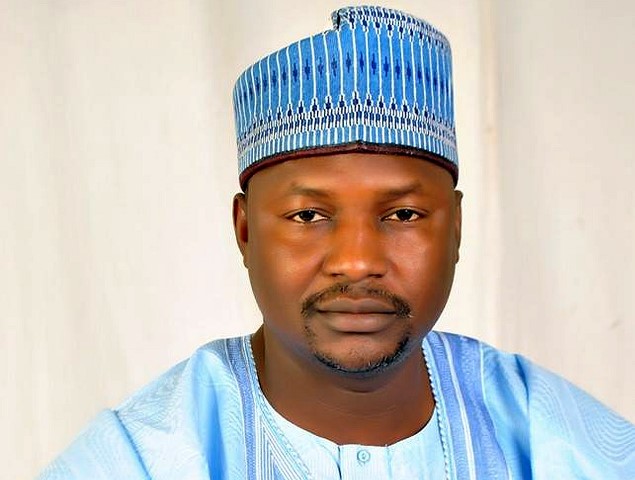
Attorney-General of the Federation, Abubakar Malami
The Attorney General of the Federation, AGF, and Minister of Justice, Abubakar Malami, has justified the arrest and detention of judges by operatives of the Department of State Service, DSS.
The AGF had on Monday, failed to attend the valedictory court session of retired Supreme judge, Suleiman Galadima.
He however spoke Tuesday after the inauguration of an Expert Review Committee on implementation of the United Nations Convention Against Corruption, UNCAC, saying “no one is or should be above the law”.
Malami said: “Was there an allegation of crime? Was there relevant provision of criminal procedure responsible for investigation? “Is there an allegation of corruption? If there is, no body, no matter how highly placed will be spared.
“The right to investigate has not been taken away from the constitution. The allegation borders on criminality and no one is or should be above the law.
“Neither the judiciary or the executive will be exempted from investigation”, the AGF stated.
Meanwhile, in a keynote address at the inauguration of the Committee, Malami stated that the federal government would put adequate measures in place to ensure that recovered loots are profitably managed.
He said: “No doubt, the extant review focusing on Chapter II and V of UNCAC relating to preventive measures against corruption in public and private sectors and assets recovery, is both necessary and timely at this time of the annals of country when endemic can systemic corruption has created a great disconnect between our nation’s wealth and the quality of life of ordinary citizens.
“As we are all aware, Nigeria is a state-party to UNCAC which is the first global legally binding international anti-corruption instrument.
“Your contributions will no doubt translate into massive political goodwill and will snowball into successes in pace setting as it relates to the fight against corruption. “Let me emphasise that the guiding principles of the review is non-adversarial, non-punitive and not aimed at ranking state parties”.
Members of the Committee were drawn from the Economic and Financial Crimes Commission, the Independent Corrupt Practices and other related offences Commission, Bureau of Public Service Reforms, Bureau of Public Procurement, Code of Conduct Bureau, Corporate Affairs Commission, Federal Ministry of Finance, National Drug Law Enforcement Agency, National Human Rights Commission, Nigeria Financial Intelligence Unit, among other agencies.
The Nigerian Senate and the House of Representatives have come down heavily on the Department of State Security, DSS, for the arrest of some of the countries senior Judges in the early hours of Saturday, October 8. The judges were however released on bail on Sunday.
The lawmakers say such moves go against the principle of separation of powers and did not fall within the mandate of the DSS.
At the commencement of plenary on the floor of the Senate on Tuesday, Joshua Lidani, raised a point of order, saying that the arrest of the Judges were unlawful.
Lidani said that he was in full support of the fight against corruption but stressed that “The fight against corruption should be done within the confines of the Law.”
“The Senate supports the fight against corruption but with strict observance to the principles of separation of power,”
Seconding the motion, the Senate committee Chairman on the FCT, Dino Melaye said: “It is a misnomer. It is absurd for the directorate of the SSS to operate outside their mandate.
“These are not allegations of rape, terrorism or crime; they are allegations of professional misconduct.
“I acknowledge the existence of corruption in the judiciary but the DSS overstepped and abused their boundaries,” he said
Another lawmaker, Suleiman Hunkuyi urged the national assembly to call relevant agencies to carry out their activities within the ambits of the law.
“National Assembly cannot provide the rule with one hand and collect it with the other hand,” he said, “every agency must operate within the confines of the law.”
Also contributing to the motion, Chukwuka Utazi, said government cannot claim to be protecting democracy by throwing all caution to the wind and engaging in extra-constitutional actions.
“What will the International Community think of us with our gestapo approach?” he asked.
“The act cannot be rationalized, the world is watching the senate, we must rise and stand for Justice,” Utazi stated.
However, the Senate Minority Leader, Godswill Akpabio, was a little cautious in his analysis.
He said: “The way we handle this matter will determine how the public view this senate.
“The senate is made up of erudite people. Nigerians believe in us (so) we must see things from both sides.
“The senate supports President Buhari in his corruption fight but we must look at the image of the country and do things right.”
The Senate President, Bukola Saraki also acknowledged that the judiciary needs to be sanitized but he condemned the unlawful mode of arrest.
“Any anti-corruption action that goes against the rule of law does not help the fight against corruption,” he said.
Saraki added that “The National Assembly has been playing its role to support other arms of government in its fight against corruption.
He subsequently moved for the adoption of the recommendations and refered the matter to Committee on Judiciary and Human Rights and Legal Matters.
The committee will report back to the senate in four weeks.
The House of Representatives on its part, passed a resolution to constitute an ad-hoc committee to probe all the invasions by DSS from last year to this year.
The decision followed the adoption of a motion by Kingsley Chinda, an APC lawmaker, who described the invasion of the Judges’ residences by the DSS as “almost a civilian coup”.
“There’s no doubt that we condemn corruption, but the method must follow the rule of law. Our people are waiting to see what we’ll do on this affront to democracy,” he argued.
However, another APC member of the House, Mojeed Alabi, raised a point of order, citing sections 4, 5 and 6 of the constitution, and saying that the House could not go into such matters because of the principle of separation of powers.
But he was booed by almost all the members and shouts of “sit down! sit down!” rented the air.
Speaker Yakubu Dogara ruled him out of order and the motion was consequently adopted by the majority of lawmakers.
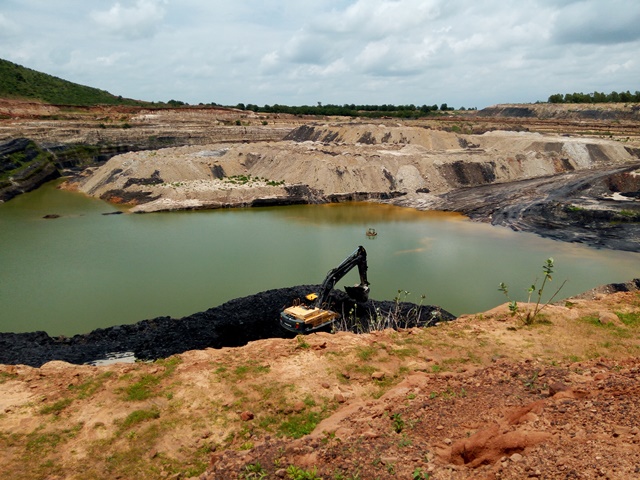
An excavator collects mined coal at the Maiganga coal mine
Coal, a natural resource, becomes a curse for several communities in Gombe State, as man and the environment suffer from its exploration
By Samuel Malik
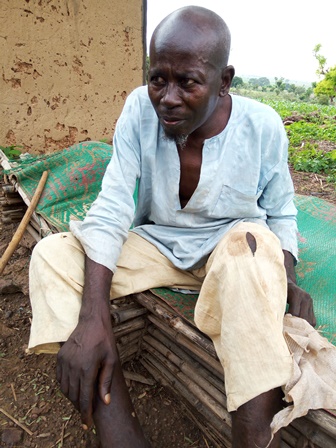
For three years, 70-year-old Musa Cindo has not known peace. He has been in and out of hospital in a bid to stay alive but with each passing day, he feels he is closer to the grave. With virtually nothing else to sell, his family has had to put up for sale its livestock and foodstuff to buy the drugs that get him through each day.
Cindo was visibly in excruciating pain when the reporter met him. In spite of this, he agreed to talk but not until he was helped to a sitting position on the raft bed he was lying on. His relatives said he was even better in the sorry state in which the reporter met him because he had just taken his drug, Levodopa-Carbidopa tablet, which is used for treating Parkinson’s disease, but which Cindo says relieves him of stomach pain.
The old man underwent surgery in 2013 following complaints of severe stomach pain but, a year later, the pain returned and he now depends on the Levodopa-Carbidopa tablet to get through each day.
Musa Cindo is suffering from the effects of coal mining in his community
For the past two years, he has been unable to sit straight or lie down without help and does not drink water unless it is lukewarm.
Also, he cannot empty his bowels without taking Liquid Paraffin, a laxative meant to soften his stool and lubricate the bowel to help it pass, and when there is no money to buy this, he stays for days without going to the toilet because of the difficulty in stooling
“It is not just our animals that are affected, we are also in pains, I am in serious pains,” he said. “The pain is worse at night and it is unbearable if I drink cold water.”
The septuagenarian and others in the village blame their health woes on the coal mining activities of AshakaCem, a cement manufacturing company at its coal mine in maiganga, just three kilometres away.
As if to amplify this accusation, as he spoke, Cindo paused intermittently to spit, pointing repeatedly towards the nearby village.
AshakaCem is owned by French construction giant, Lafarge, and has been mining coal in Maiganga since 2007, a year after it was granted a mining lease by the Ministry of Solid Minerals Development.
Located in Akko local government area of Gombe State, Maiganga host the coal mine whose waste has caused the ill health now plaguing many homes in Fngo. Aside Maiganga, there are two other host communities to the coal mine – Kwilapandi and Kwibah Alatai.
These two are under Komta, a town in Billiri local government area.
With a proven 4.5 million tons of lignite coal and an additional two million tons in prospects, the Maiganga coal mine has in the last nine years oiled the wheels of the operations of AshakaCem headquartered in Bajoga local government area, about 175 kilometres away from the coal mine.
Daily, several trucks loaded with coal make the journey from the mine to the factory.
Deaths, pain and aborted dreams
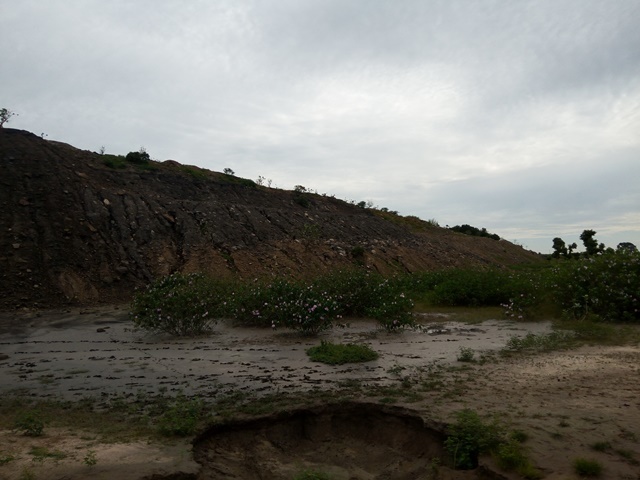
The environment around the coal mine does not look too good
To effectively mine the coal, the company has to constantly drain the water that is inside the mine and this water finds its way to Fongo, Cindo’s village, where it mixes with the only source of water the people and their livestock depend on, and sometimes floods farmlands as far as Kwilapandi and Kwibah Alatai-two neighbouring communities to Fongo.
The people started noticing changes in the taste of the water from their only source of drinking water, a brook, in 2009, two years after AshakaCem started mining operations.
When the taste of the water changed, they did not think it was anything serious, not even when they noticed that sometimes the water turned black and oily. They thought it was a fleeting fancy that would soon disappear. But they were wrong.
“You know, a Fulani man hardly falls sick and rarely goes to the hospital,” one of the villagers, who gave his name as Zubairu, said. “But we noticed more and more people were falling sick and they all complained of stomach pain.”
It took the intervention of the leaders of Komta, headed by the chief, Mela Kilang, to unravel the cause of the problem. In 2014, a doctor advised them to change their source of drinking water.
By then, the losses were shocking as seven people had died, four people operated upon and 10 women had suffered miscarriages, some more than once. The animals were not spared. Sixteen people lost 134 cows.
Even now, 13 people are left with severe stomach pains, among them Cindo.
According to 38-year-old Jauro Goma, whose wife also suffered miscarriages, the village had only known one source of drinking water, a brook, its whole life. “I was born here and I grew up here. This is the water everyone depended on and we never had problem with it.”
After the doctor’s warning, the people decided to slaughter some of their sick cows and they were shocked at what they saw.
“Inside the cows we found coal residues while some parts had become black,” Goma said, so they cut out these parts and took them to the company as proof that their water was contaminated.
“They came here and assessed the place and promised that they would provide us solar-powered borehole and other things,” he added. Nothing has been heard from the company since, according to the villagers.
When the www.icirnigeria.org visited the community, there were clear traces and coal residues both within and around the brook. Also, it was discovered that the channel created by AshakaCem to drain the water from the coal mine leads straight to the brook.
The plants on farmlands close to the area also had yellow leaves.
Our findings showed that Kwilapandi and Kwibah Alatai and the hamlets around them, are not the only communities feeling cheated by AshakaCem.
Maiganga, the host community where the coal is mined, has had running battles with the company for the nine years that mining has been going on.
They promised us heaven on earth but did nothing
The environment around the coal mine does not look too good
In 2006 when the company got its mining lease, it had to convince the people that relocating them away from the coal mining site was for their own benefit. As a result, the people were assured of several benefits, including employment, houses and other infrastructure.
“They told us we should prepare for enjoyment, as they would build us good houses and roads. They also promised us 60 per cent employment opportunity,” Gibar Tsabta, a teacher and head of the Maiganga Community Development Association, said.
As a sweetener, they were told that they would be compensated for the farmlands they were losing.
But trouble began with the payment of compensation for the lands, as the people felt they were short-changed.
It is obvious that the villagers were not educated and as a result could not tell the sizes of their lands. To describe the size of a piece of land, they use different methods, including counting the number of ridges it contains.
“I was paid N99,000 for my land that contained 200 long ridges, while my father was paid N40,000 for a land he bought for N60,000,” Tsabta said.
Uba Garba, the 73-year-old village head, staunchly refused to speak to our reporter after learning the subject matter was AshakaCem.
“When it comes to the issue of Ashaka, I would rather pretend to be deaf and dumb, as I don’t want to hear anything about the company,” he said. “I am tired of talking about them with no progress in our condition.
“Right now, I don’t have a farm and our youths are becoming thieves, which is the most painful part of all this. In the past, they were industrious but since our farmlands were taken, they have become jobless. I am so angry that I don’t want to hear about Ashaka, I am just waiting to die,” Garba said.
He does not know the size of his land but describes it in a way that one understands it was massive. He got the highest compensation of N800,000, but said he would not have sold it for 10 times the amount.
“It took a tractor two days to finish working on my farmland, just one farmland. These people just came and collected my land and gave me peanuts, N800,000. Even if they had wanted to give me N10 million, I would not collect. I have never had peace since they collected the land. That was a land I made at least 1,000 bags of grain every year,” the village head said.
According to documents seen by the www.icirnigeria.org, the total amount paid as compensation to 65 farm owners was N6.7 million.
If we don’t protest, nothing is done for us
The residents of Maiganda, a village of 500 people are seething with anger. They don’t understand why they should be sitting on a rich natural resource and still remain poor. Daily, they see several trucks leaving the village with coal and feel they should be getting a bigger slice of the pie than they currently do.
Tsabta said there are only 34 youths from the village employed by the company despite the promise that 60 per cent of the workforce would come from the village. Out of the 34, only five are permanent staff.
Now left with no lands to farm and no job at the mining site, survival has become a struggle for the men of the village.
Maiganga was relocated less than two kilometres away from the mine site and houses built for the people. However, our reporter observed that the rooms are only slightly bigger than cubicles. People’s properties hardly fit in and it is common to see furniture and other household items outside because there is no space for them.
“Go in and see the kind of houses they built for us. Over there is my mattress. It stays outside because it cannot fit into my room. Some white men from the company came to see me and promised that a befitting palace would be built and a car bought for me. You can see for yourself that none of those is true,” Garba said.
The company also built a small clinic, a block of two classrooms and hand pump boreholes.
Every other thing the company subsequently did in the community has been after the people protested, the said.
The people said that when they protest, the company uses the police to teargas and arrest them, with some spending several days at the police station in Gombe, the state capital.
In 2014, the people staged a massive protest that paralysed mining activities for more than two weeks. The police was called in to dispel the protesters but in spite of their efforts, including mass arrests, it took the intervention of the Gombe State government and the Federal Ministry of Solid Minerals Development to resolve the problem.
A company source told our reporter that for the two weeks that the protest lasted, AshakaCem spent over N300 million on diesel to power its operations.
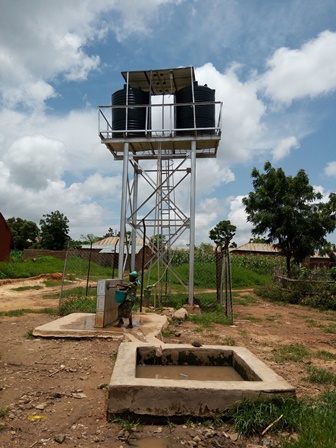
A little girl fetches water from the only functional source of water in Maiganga
The protest worked. The hand pump boreholes have given way to a solar-powered borehole, another block of two classrooms and a skill acquisition centre have been built while three people, who did not benefit from the houses built in 2006, had houses built for them.
Newly painted palace of the Maiganga chief
Garba’s palace was painted and the company claimed in its 2014 financial statement that it spent N1,000,000 on the renovation.
The lesson the community learnt from that experience is that it has to fight for rights to get them.
“You have to fight them before they would do anything for you. Why should it be so? We were living peacefully before they came. We never bargained for this,” Garba said. “This coal has become a curse we never wished for.”
While Maiganda may not be grappling with serious health challenges as Fongo and surrounding villages, it is facing its own peculiar problems. During dry season, the community grapples with dusty air coming from the mine and the trucks that transport the coal, and people have to go to Kumo, the headquarters of Akko local government area, to see a doctor because the clinic in the community is usually closed.. A peep through the windows showed that it had not been used for some time, as dust covered the floor and furniture.
Don’t blame us – AshakaCem
Water from the Maiganga coal mine and finds its way to Fongo village
The public relations officer of the company, Sarki Bajoga, exonerated his company from blame. He said that compensation was paid by Gombe State government through the ministry of Land and Survey, even though the money was provided by the company.
He added that each landowner received double the value for their land because the company paid as bonus whatever they were paid.
“The ministry assessed the land, the owner and the worth. They came up with the total amount that the lands were worth and wrote us a letter. We then replied with a check of the amount they said. The ministry liaised with the local government, Akko, and the money was paid to the people. I remember that during the payment, the then governor, Danjuma Goje was there physically. What we did again was to match the amount paid as compensation. In other words, the people got double the amount their lands were worth,” Bajoga said.
According to Bajoga, AshakaCem was aware that members of the community faced health risks by living very close to the mine and said the company was advised to relocate them far from the mine, advice that it took lightly.
“That place is an oily area, a coal deposit area. Therefore, the water there, if you don’t dig deep down, you must tap the coal water. That is one big problem we have there. During the compensation, the Gombe state ministry of land and survey advised them to be relocated far away from the site (and) cited the implication of them staying close to the mine but they refused,” he said. “It was not long that we began mining that the implications started manifesting, the problem of dust and water.”
AshakaCem, surprisingly, dismissed the health and other challenges faced by Kwilapandi and Kwibah Alatai and their surrounding communities. It accused them of lying about these cases.
“I saw a document they sent to us telling us that the water we are draining from the mine is killing their cows. They sent a picture but do you know what I saw in the picture? I saw two people forcing a cow to drink the water, and they are saying we are killing their cows. They should have left the cow to drink the water, may be fall down and then they could take the picture. We saw the picture and knew it was a total lie but we decided to send our officials to go and see things for themselves and they came back with a report,” Bajoga said.
He promised to get back to the reporter concerning the report of the officers who visited the communities, how much compensation was paid to the people of Maiganga for relocation, and AshakaCem’s contribution to the environmental fund.
However, when the reporter called Bajoga days later, he promised to call back. When he did, he told the reporter that he had the information requested but said the company would only give the reporter the information in person and not on phone.
Danjuma Goje, the former governor of Gombe state and now senator, who was in power when AshakaCem began mining coal in the state, was not available for comments. A call to his mobile phone line kept going to voicemail while a text message sent was not replied as at the time of filing this report.
Nigerian coal one of the best in the world
Nigerian coal
Nigeria’s quest to diversify its economy in the face of dwindling revenues from the oil sector has seen a focused attention on the mining sector, with coal expected to be at the centre of power generation.
With a proven coal reserve of more than 639 million metric tonnes and inferred reserves sum of up to 2.75 billion metric tonnes, Nigerian coal has been described as one of the finest in the world.
“Nigerian coal has the highest calorific value, meaning the amount of poison in the coal is minimal. Coal is in massive proven reserve in 26 states of the federation, which can sustain power generation for years,” Ibe Okpokwu, former spokesperson for the defunct Nigerian Coal Corporation, said.
Coal forms from decomposed waste materials from plants such as trees and leaves over a long period of time, sometimes millions of years. There are four major types of coals namely anthracite, bituminous, sub-bituminous, and lignite.
It accounts for about half of the US electricity generation while 39 per cent of global electricity generation comes from coal. Also important is the fact that coal accounts for about 70 per cent of steel production globally.
When in use, coal produces several dangerous pollutants like nitrogen compounds, silicon, aluminium, sulphur. Consequently, both human lives and the environment are at risk. The emissions from coal affect forests, water, air, and contributes to global warming.
Nigeria’s neglect of the coal industry in the past, however, suggests that there is a long way to go to fully harness the resource.
In 2005, less than five years after the federal government said it was investing in coal briquette, carbonised and smokeless coal for domestic use, the Nigerian Coal Corporation closed shop and its assets sold, including the coal washery plant in Enugu state. This washery was used to be the biggest in Africa and Asia, according to Reuben Ozonnadi, the founder and former head of briquetting in Nigeria.
Ozonnadi recollected how a lack of seriousness and commitment deprived the country the opportunity to develop the industry, particularly with regards to protecting the environment.
According to him, former President, Olusegun Obasanjo, was impressed by the exhibition done by the briquette department during an energy summit in Abuja around 2001, which showed that with briquette, government could discourage felling of trees and deforestation. After the exhibition, then First Lady, the late Stella Obasanjo, was interested in taking briquette to the rural women.
“A block of coal briquette was enough to cook you beans and you could be cooking in your room using briquette and there would be no smoke, much heat and your pot will remain as neat as it is for almost six weeks. It is very friendly environmentally,” Ozonnadi explained.
The government promised to immediately put in N550 million into the project. After the summit, N10 million was released and Ozonnadi said his team was able to set up a plant and produce three tonnes of briquette, which was bought by state governors and some exported to Ghana.
“Bayelsa, Gombe, Jos, Kaduna, and other states bought the briquette. It was widely accepted,” he noted, adding that at an even in Canada, the briquette was adjudge second in the world in terms of quality and environmental safety.
However, that was the end of the project. Rather than invest further, government decided to import machineries from China. The imported machineries never worked and were later sold with the entire coalmine as scraps.
Government must be careful with how it mines coal
Notwithstanding, the government has continued to invite investors and open up coalfields to them. So far, not enough is being done to monitor or oversee how these companies are using their licenses.
In Okobo and Itobe communities in Kogi state, a nongovernmental organisation, NGO, Global Rights, discovered that coal-mining operations threaten both the environment and the people.
It stated in a recent report: “In its short existence at Okobo, mining operations by the Zuma 828 Mines have resulted in considerable alteration of the topography and environmental pollution, including the pollution of the only potable and easily accessible communal water sources. In the water bodies sampled, anomalies were identified in the topography. The disproportionate metallic elements in the waters have potentially dangerous effects on the human body, animals, micro-organisms, and, overtime, plant life. Its high turbidity levels are associated with high level of disease causing microbes.”
At Itobe, Global Rights discovered also from the well water used by a majority of the people, that it had a pH level that was lower than the World Health Organisation, WHO, accepted limit and, therefore, “highly acidic and unfit for human consumption”.
An environmental activist cautioned that the government must be careful in its quest to shore up its revenue so that it actions do not destroy the environment.
Nnimmo Bassey, Director, Health of Mother Earth Foundation, HOMEF, pointed out that the country has a poor record of maintaining the environment.
“We have a history of abandoned mines in Nigeria: the coal mines of Enugu and the tin mines of Jos. These are danger zones crying for remediation and doing just that should be the starting point of any quest towards renewed mining activities,” he warned.
Bassey said the impact of coal mining on the environment is enormous far reaching, including “the scarification of the land, deforestation and pollution”.
According to him: “The pollution includes the pollution of the entire environment: air, land and water. Pollution of water can be particularly damaging from what is termed acid mine drainage. This makes water sources in communities toxic and unsuitable for any use.
“Underground coal mining also has the propensity of fire outbreaks due to the combustible gas in them. There are literal caves of fire in the Witbank area of South Africa, for example, where coal mines fires continue to rage for years. Coupled with the unpredictable occurrence of sinkholes, these can be extremely treacherous and dangerous to both humans and livestock. Mines have lifespans. What happens when they are no longer productive? We should mention here that there are over 6000 abandoned coal mines in South Africa alone.”
Failure to enforce regulations leaves host communities open to exploitation
The Nigerian Minerals and Mining Act, which came into effect in 2007, has been hailed as a great law that does not only seek to protect the environment but also communities where mineral resources are found.
From protecting the rights of host communities and environmental protection and rehabilitation to penalties for defaulters, the Act, Bassey said, is better than current petroleum laws in the area of impacted communities.
Despite this, individuals and corporations have left the environment open to degradation while host communities are left to bear the consequences.
A key component of the Act that ensures host communities are not short-changed is Section 116, which deals with Community Development Agreement, CDA.
Section 116 (1) of the Act states that: “Subject to the provisions of this section, the Holder of a Mining Lease, Small and Scale Mining Lease or Quarry Lease shall prior to the commencement of any development activity within the lease area, conclude with the host community where the operations are to be conducted an agreement referred to as a Community Development Agreement or other such agreement that will ensure the transfer of social and economic benefits to the Community.”
The section goes further to add that the CDA will take care of the educational scholarship, apprenticeship, technical training and employment opportunities for the indigenes of the communities.
On the environment, Section 118 is very clear about the expectation from leaseholders.
“Every holder of a mineral title under this Act shall as far as it is reasonably practicable – (a) minimise, manage and mitigate any environmental impact resulting from activities carried out under this Act; and (b) rehabilitate and reclaim, where applicable, the land disturbed, excavated, explored, mined or covered with tailings arising from mining operations to its natural or predetermined state or to such state as may be specified in this Act, its regulations and other partition laws in force, and in accordance with established best practices.”
Regarding water pollution, not only host communities are protected but also surrounding communities near and far.
“No person shall in the course of mining or exploration for minerals pollute or cause to be polluted any water or watercourse in the area within mining lease or beyond that area,” Section 123 states.
These and other provisions notwithstanding, mining lease holders have continued to exploit members of host communities and the environment.
In addition to polluting the water beyond its mining lease area, there is yet to be a Community Development Agreement, CDA, between AshakaCem and the people of Maiganga. This is in spite of the community’s eagerness to have the agreement signed.
At Okobo, Global Rights reported also that there was no CDA between ETA Zuma Coal Company and the community while the company had already started mining coal.
At Okpella in Edo state, BUA Group, owners of Edo Cement Company Limited, is yet to facilitate the signing of a CDA between it and the community.
To ensure that mining lease holders do not abscond after the expiration of their lease, section 121 of the Act requires a form of guarantee in the form of money paid into the Environmental Protection and Rehabilitation Fund.
“The minister shall establish an Environmental Protection and Rehabilitation Fund for the purpose of guaranteeing the environmental obligations of holders of mineral titles under this Act… Every holder of a mineral title shall commence contributions to the Environmental Protection and Rehabilitation Fund in accordance with the amounts specified in the approved Environmental Protection and Rehabilitation Programme not later than one year from such approval,” the Act says.
However, a source in the ministry of solid minerals development said the Fund is yet to take off, meaning mineral title holders are yet to start making contributions nine years after the Act came into force.
The government and AshakaCem must share the blame
Bassey said both the government and the companies must share the blame for the flagrant abuse of the Mining Act, adding that the requirement for CDA in the Act is not an act of charity.
“It is one of the key provisions of the law that tries to soften the social impact of mining on communities. It is a clear mechanism for avoiding, or stemming, conflicts with stakeholders. To ignore it is crass exploitation of poor communities and a flagrant abuse of the law,” he pointed out.
“To say that people refused to move from their communities so that mining can be carried out on their land is a classic example of heaping blames on victims and using that as a way of avoiding responsibility. Where health impacts are identified, there must be an agreement on ways of mitigating such impacts as well as responsibilities of parties concerned.
“The Nigerian Mining and Minerals Act 2007 does not in any way permit the forceful eviction or displacement of individuals or communities for the sake of mineral extraction. The law requires full consultation with owners of areas where minerals are found. It also requires negotiations with such owners, agreement on rents to be paid for the land to be exploited,” Bassey said.
Government says it is no longer business as usual
The Ministry of Solid Minerals Development said it is prepared to rein in companies that violate the mining Act, as government opens its doors to investors in the mining sector.
According to Gabriel Yakudu, a deputy director in the department of Mines Environmental Compliance, the renewed focus brought by the minister, Kayode Fayemi, means it can no longer be business as usual for companies, particularly with regards to the environment and agreements between host communities and mining companies.
Our findings showed that the ministry wrote a letter to both Maiganga community and AshakaCem in 2014, urging them to fast-track the signing of the CDA but nothing has been done, with the community blaming the company for the delay.
“The problem was that the ministry was not given much attention in the past. But with this new administration, things are changing and we are taking everything serious, especially with regards to CDA.” Yakubu told the www.icirnigeria.org.
One example of how the ministry is getting tough with companies is by insisting that BUA and Okpella sign a CDA and the www.icirnigeria.org learnt both parties are close to an agreement.
With regards to AshakaCem and Maiganga, Yakubu assured that the ministry will compel the company to accelerate the process.
Bassey called for a strict compliance with the mining Act as the best way to mitigate the problems associated with the environment while also ensuring that host communities are not exploited.
“First, the provisions of the Mining and Minerals Act must be strictly enforced. Secondly, there has to be total adherence to the stipulations of the EIA Act, including the preparation of clear environmental management plans before commencement of operations. If these are enforced, and careful attention paid to ways to mitigating social impacts, the interest of communities and the environment will be secured to a reasonable extent,” he said, pointing out that in bid to shore up its revenues, government must be careful with how it goes about opening up the mining sector to investors.
“Care must be taken not to rush into mining as a way of getting out of the current economic quagmire. As the saying goes, you don’t get out of a hole by digging deeper into it. We dug our way into trouble by over dependence on oil and gas and a shift of focus should not be to mine pits. With reported cases of earth tremors in Nigeria we should be cautious about how we dig, blast and exploit Mother Earth.”
AshakaCem recently signed a deal worth N11 billion with a Chinese firm for the establishment of a coal power plant, meaning unless something is done, the company will continue with its coal mining activities in Maiganga.
As it seems, helpless people like Cindo can only hope that government steps in to prevent the company sending more people to the hospital, and at worst, their early graves.
The Department of State Security, DSS, has released the seven judges who were arrested over the weekend on corruption allegation.
A top security source told journalists that they were released on Sunday night on personal recognition.
They were all released on bail yesterday(Sunday) on self recognition,” one of our sources said.
“They reported this morning (Monday) and they have all gone back home. They will be coming back tomorrow,” the source said.
“They were released on bail on self recognition based on the fact that given their standing in the society, they cannot run away. They were instructed that they should come back today by 10am.
“They did report for investigation this morning and they have gone back home. And the investigation continues and preparation to charge them to court continued.”
The seven judges were part of the 15 senior judges under investigation by the security agency over corrupt practices.
The DSS source added that the judges “were allowed access to their families and they are cooperating with us. We still respect them. They are not being treated like common criminals.”
He said that there would not have been any need to arrest the judges in the manner they were arrested if the National Judicial Council had cooperated with the DSS.
The raid was “sequel to lack of cooperation by the National Judicial Council; such as refusal by the NJC to allow the affected persons to be questioned by the DSS,” the source said.
He also revealed that investigations against the judges “started some seven months ago, precisely in April 2016.”
The Nigerian Police Force on Monday paraded nine suspected kidnappers of the wife of the Governor of the Central Bank of Nigeria, CBN, Margret Emiefele.
Force spokesman, Don Awunah, said the suspects, who included two policemen, have confessed to their various roles in the crime.
He however clarified that the Police do not encourage payment of ransom to kidnappers; rather, as was the case with the kidnap of the CBN’s Governor’s wife, ransom was sometimes used as bait or bargain to save the lives of victims of crime.
Awunah said: “It is also absolutely important to mention that the police do not and will not encourage payment of ransom.
“Relatives of victims of kidnap for ransom are strongly advised to exercise considerable caution in succumbing to payment of ransom.
“The I-G, Mr Ibrahim Idris, is determined in making sure that all those who are engaged in kidnappings and armed criminal activities do not escape justice,” he said.
Items recovered from the suspects include: N14, 725,000, three cars, one AK 47 magazine and two cartridges.
Awunah stated that the suspects also received various sums of money as part of their share of the ransom paid.
According to him, the police have recovered from the suspects part of the money and cars bought with the ransom.
The CBN governor’s wife was kidnapped with her three aides on September 29 along the Benin – Agbor road in Delta and were rescued less than 24 hours later.
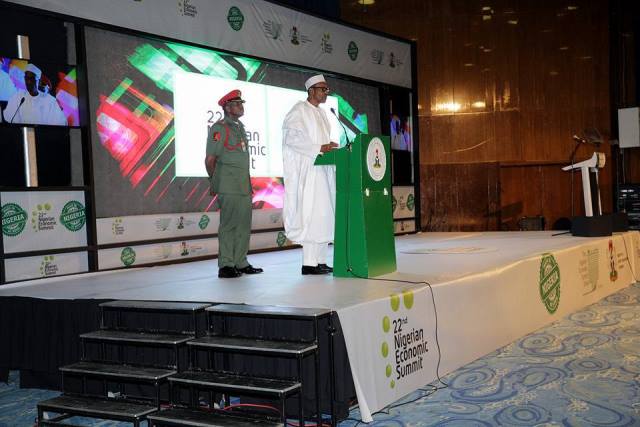
The 22nd edition of the Nigeria Economic Summit kicked off in Abuja on Monday with a focus on Made-In-Nigeria goods.
The theme for this year’s summit, ‘Made-In-Nigeria’, according to the Nigeria Economic Summit Group, NESG, was to highlight the importance of relying less on importation of commodities that could be produced locally and by so doing, growing the country’s economy.
Declaring the summit open, President Muhammadu Buhari said: “Made in Nigeria lies at the heart of so many efforts we are making to lead us through this trouble times and lay a firm foundation for the future.”
“We need to diversify the economy so that we will never again have to rely on one commodity to survive as a country; so that we can produce the food we eat, make our own textiles, produce most of the things we use and create the right environment for our young to be able to benefit and create jobs through technology.
Chairman of the NESG board committee, Adedoyin Salami, said the made-in Nigeria campaign must be driven by all states of the federation if the targeted objectives are to be met.
“If made-in-Nigeria must succeed, it should not be the challenge of the federal government alone. All the 36 states of the federation and the Federal Capital territory (FCT) must have a role to play,” Salami said.
He said that priority must be placed on locally-produced goods during public procurements in other to ensure that Nigeria’s economy become globally competitive.
He noted that at present, the nation’s economic indices were far from ideal.
“The country’s economic situation is worse than stagflation. What we have is an economy that is shrinking in size,” he said.
“So far, this year it has shrunk by about 1.5 per cent, with combination of stagnant growth and rising costs,” he noted.
Salami said the seeming setback should be utilized as an opportunity to restrategise and re-engineer the economy.
On the international scene, he pointed out that only diaspora transfers to Nigeria was in favour of the economy, with about $23 billion sent into the country every year.
However, other indices like global economic policy, global trade, and capital flows have worsened and are likely to remain unfavourable to Nigeria throughout the life time of the President Muhammadu Buhari administration.
He said that Nigeria realized more than $90 billion from oil revenue and $6.7 billion from non-oil export revenues in 2013, but expressed pessimism that the country would realise up to $40 billion this year, as a result of dwindling global oil prices.
“The dynamics of oil has changed, with the production of shale oil. The cost of producing shale oil imposes a cap on oil prices, with 72 countries in the world potentially capable of producing shale oil, with Nigeria’s key customers, United States and China already producing shale oil or looking for alternatives to our oil,” he said.
Salami said the more efforts should be channeled to the diversification of the economy by developing other promising sectors of the economy such as agriculture, ICT, Real estate, trade, among others.
He advised leaders at all levels to put in their best in this regard, saying that “your success is not going to be measured by what you have done. You will always be judged by what remains to be done.”
“We cannot continue to depend on imports. If we continue to export so much of our values through imports, we are leaving so little for ourselves,” he said.
Minister of Budget and National Planning, Udoma Udo-Udoma, in his speech noted that the present administration would continue to encourage and support the private sector as the anchor of the country’s economic growth.