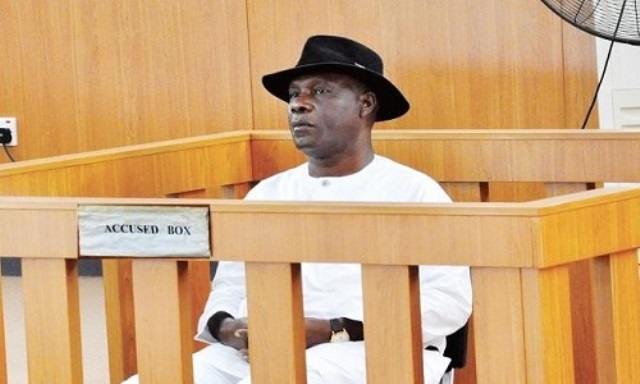
The Abuja High Court on Wednesday granted former Niger Delta minister, Godsday Orubebe, a N10 million bail, which is half of the amount placed on his co-accused, for allegedly diverting N2.3 billion.
Oludare Alaba and Ephraim Zeri were granted bail in the sum of N20 million each.
According to the bail conditions, Orubebe is expected to provide a surety in like sum, who must also provide evidence of tax payment in the last three years and own a land property in the Federal Capital Territory.
For the other accused, they were ordered to provide a surety each in like sum, who must be an assistant director in the civil service and also own a land in the FCT.
Before adjourning the case to November 10, Justice Olukayode Adeniyi ruled that Orubebe would remain in the custody of the Independent Corrupt Practices and Other Related Offences Commission, ICPC, until he meets the bail conditions.
The case against the former minister, a six-count corruption charge for diverting money meant for the payment of compensation of people affected by the dualisation of Section IV of the East-West Road, suffered two postponement before now.
The case was first postponed on August 18 when the prosecution sought permission to serve the accused with the charge. The judge then adjourned the case to August 30.
But when the case was called on that day, the former minister was absent due to illness, leading to the adjournment to September 7.
Also charged alongside the three is Gitto Costruzioni Generali Nigeria Limited, the company that owns the account into which the money meant for beneficiaries was paid.
In spite of budgetary provisions of over N3 billion in the last five years, Nigerian soldiers still have to buy the uniforms they wear.
Army boots for sale at the Central Market, Kaduna
By Samuel Malik
Nigerian soldiers have to pay for essential items of kit out of their own money, an investigation has revealed.
Over the last five years, the Nigerian government has budgeted a total of N3.456 billion for equipping its soldiers.
However, many soldiers, including those involved in the fight against Boko Haram insurgency in the North east, say that they have been forced to spend their own money on buying uniforms, boots and other items of equipment.
The scale of the problem became apparent during an investigation lasting several weeks that involved visits to army barracks across the country.
In Kaduna, Abuja and Lagos, the reporter witnessed first-hand how soldiers bought uniforms and boots both in the black market and in shops owned by the army.
Many soldiers said they had been issued uniforms only once in three years and so had had to buy their own uniforms on several occasions throughout their service.
Very few soldiers said they were ever given footwear.
“You have to buy boots with your money,” said one soldier who asked to remain anonymous for fear of punishment.
Serving in Maiduguri since 2013, he said he and his comrades had received extra uniforms as on one occasion they had been forced to retreat “with only the uniforms we had on”.
“We were issued one each early last year when we advanced to recapture Monguno. Also, the army gave us uniforms this year,” he said.
The Nigerian army has in recent years dismissed about 5,000 soldiers for various offences including refusing to fight Boko Haram militants. In turn, many of the soldiers accused the army of sending them to fight the insurgents without adequate equipment.
As many as 3,000 of these soldiers were later reinstated.
Meanwhile, a look at the army’s budget over the last five years shows that an average of N622 million was budgeted yearly for the provision of uniforms and kits.
A detailed breakdown of the allocations for uniforms and kits between 2012 and 2016 showed that N3.456 was appropriated for the purpose. In 2012, N370 million was allocated; 2013 in N742 million; N487 million each in 2014 and 2015; and in 2016, the army budgeted N1 billion.
Ways and Means
A retired sergeant, who spent 35 years in the army and worked with Ordinance, the division of the army responsible for everything from weapons and ammunition to uniforms and kits, said that the sale of military kits was uncommon in the past.
“What we had was ordinance store where kits and other equipment were kept, not sold. However, there was officers’ shop, where only officers went to buy some of their accoutrements but not boots and uniforms, which they were expected to be issued by the army.”
The retired soldier explained to the www.icirnigeria.org on condition of anonymity what made up a soldier’s kit.
“When a soldier leaves the depot after enlisting into the army, he is supposed to be given uniforms, belts, singlet, cap, boots, socks, blanket, sport wears, first aid kit – iodine, plaster, cotton wool, shoe powder, bandage,” he said.
The first aid kit, the sergeant explained, was supposed to be issued to soldiers on active duty.
However, in recent times, they had become luxury items only sold in army stores. Even the thousands of soldiers deployed in the northeast to confront Boko Haram were not given these kits.
Rather than depend on the army, soldiers buy their kit either from tailors, their colleagues, army stores or on the open market.
Tailors come to the rescue
Getting uniforms from the tailors who put together military outfits – usually in markets near the barracks – is easy. These tailors are either civilians or retired soldiers.
In Kaduna, this reporter witnessed a transaction in a tailor’s shop. A soldier who needed a camouflage uniform had called ahead and was informed that one was available. Once in the shop, the haggling started.
“But you know that camouflage is expensive. In some places it sold for N15,000 but mine is not that quality and also because it is not sewn, I will give it to you for N12,000,” the tailor said.
Eventually, the two men agreed on the sum of N11,000.
After leaving the tailor’s shop, the soldier met a colleague who said that he was about to sell a uniform that was of much higher quality.
“The one I have is number one [grade]. You know this one you have is not even number two. It is inferior to the one I am putting on, which is not number one,” he said.
“This uniform here is the same type issued to officers,” he continued, explaining how he had managed to obtain an outfit only meant for a superior rank.
“You know I’m in Jaji [where the army has its School of Infantry and its Command and Staff College), the home of officers,” he answered. Jaji has a reputation for being a hub for acquiring military accoutrements.
Official Roots
Although soldiers are rarely issued uniforms and other items, they are readily available in army shops.
Everything from uniforms, boots, and raincoats to camp beds, bags, first aid kits and ceremonial swords can be bought at ordinance shops or the Nigerian Army Post Exchange (NAPEX).
Soldier’s uniform on sale in an Army shop
There is no bargaining in these shops and each soldier has to show his ID card, with all purchases recorded. The price has to be paid outright, although when a soldier buys from a tailor or his colleagues, he can pay in instalments.
At the Mogadishu Cantonment, also known as Abacha Barracks in Abuja, camouflage is available for N15,000 at the ordinance shop operated by Lodoni Company Nigeria Limited.
The price of boots ranges from N10,000 to N15,000.
At the Ikeja Army Cantonment in Lagos, soldiers can buy kits from the NAPEX store inside the barracks, although some prefer to buy from their colleagues because they can bargain over prices.
Boots are harder to obtain than uniforms. Some of those fortunate enough to be issued with boots invariably received the incorrect size and had to look for colleagues to exchange with, or sell them and add their own money to buy suitable footwear.
Soldiers on peacekeeping missions tend to buy them when abroad.
Boots of a decent quality cost N9,000 at the Central Market in Kaduna. One trader said that he shipped them in from Togo.
The Soldier As A Uniform Merchant
All army divisions get their military kits from the Central Ordinance Depot in Yaba, CODY, Lagos State, a huge, tightly-secured storage facility headed by a Quartermaster General, who can be as high in rank as a Major General.
All visitors have to sign in and out while civilians have very limited access.
A battalion passes an order for kit to its brigade headquarters, which in turn forwards it to the division headquarters. The division checks its store to see if the requested items are available.
“Whatever is available is given, while the ones that are unavailable would be marked down for whenever they become available,” the retired sergeant explained.
Back at the battalion, goods are taken to a store under the care of the quartermaster, who in turn has store men working for him.
Nothing leaves the store without the knowledge of these men. From CODY down to the battalion level, store men are the conduits for contraband kit.
This is in spite of the frequent auditing.
“Auditors come to all ordinance stores three to four times a year. Before they come, the ordinance personnel are notified one week ahead to prepare their books, so the commanding officer arranges with his store man to make sure that their book is up to date,” the sergeant said.
He added that this advance notice was long enough time for the store man to arrange his books because “all the auditors do is to look at the inventories for items that come in and go out to see what is supplied, what is given out to soldiers and what is remaining”.
However, not all uniforms sold in the black market are obtained illegally. The sergeant said that ordinance personnel usually got double their share of everything issued by the army, even though they rarely went out on active duty.
“Are we not the ones in charge of the store?” he asked. “Ordinance personnel get uniforms at least once in 12 months.”
Domestic staff working with senior military officers, most of who do not need the uniforms they receive, also sell theirs for extra money.
Many soldiers explained that at one time or the other they had been issued with substandard uniforms by the army. “There are fake and original uniforms. The moment you insert the original in water, you see the Nigerian coat of arms. I had to buy an original when the army issued me a fake one,” a soldier involved in the fight against Boko Haram in Maiduguri said.
“Any soldier you see looking good, they must have spent about N30,000 of their money,” he continued. “The army wants us to look good, yet it is not giving us the kits to do so.”
The Nigerian Police Force and the Department of State Security, DSS, have advised the Independent National Electoral Commission, INEC, to consider postponing the Edo State governorship election scheduled for Saturday.
The call was made at a joint press briefing at the DSS Headquarters in Abuja on Wednesday.
According to the spokesman of the police, DCP Don Awunah and his DSS counterpart, Tony Okeowo represented by Garba Abdullahi, credible intelligence available to the security agencies indicate possible terror attack during Sallah celebration, especially in Edo State.
Sallah celebration is expected to hold on Monday, September 12.
A group of students also protested against holding the election on Saturday, a day they said students would be writing the GCE.
INEC Chairman, Mahmood Yakubu speaking at the stakeholders’ meeting in Benin City
A stakeholders’ forum was held in Benin City, the Edo State capital in preparation for Saturday’s governorship election.
The forum was organized by the Independent National Electoral Commission, INEC, as part of activities geared towards a free, fair and credible exercise.
It was gathered that all the 19 candidates of the various political parties taking part in the election are attending the meeting.
In his remarks, Mahmood Yakubu, the INEC chairman said commission had taken every necessary step to ensure the success of the election as 18,511 electoral officers have been trained & deployed for the exercise.
He added that there will be simultaneous accreditation and voting, reiterating that the Permanent Voter Card, PVC, remains the only means for voting.
With respect to the frequent cases of malfunctioning card readers, the INEC boss explained that the “SCRs (Smart Card Readers) have been reconfigured and re-charged” and should work optimally on Election Day.
Yakubu also cautioned “High profile voters” to “exercise their franchise in their designated polling units and thereafter respect themselves and return home.”
“No voter entitled to security protection shall be accompanied by armed security personnel to the polling unit.
“Armed escorts would not be allowed at any Polling Unit during the election. This is against the provisions of the Electoral Act,” he said.
The INEC chairman added that “All election duty personnel are expected to work within the confines of the law” as “any violator would be adequately dealt with.”
He said: “We appeal to those involved in the election to assist INEC in ensuring the safety of all election officials.
“We appeal to political parties to eschew violence and avoid intimidation of voters on Election Day.
“So far, the atmosphere in Edo state has been peaceful since the campaign began. We hope it remains same on Election Day.
“It is my hope that the election in Edo State would be a shining example of our democratic system,” Mahmood concluded.
The stakeholders’ meeting also witnessed the signing of a peace pact by the governorship aspirants, pledging to work for peace before, during and after the election process.
Representatives of both the Director-General of the National Youth Service Corps, NYSC, and the Inspector-General of Police, also spoke at the forum.
It was gathered that One governorship candidate as well as 8 deputy governorship candidates for the Edo State election are women.
The Nigerian journalist declared wanted by the army alongside two others, for alleged links to Boko Haram, has been released from custody.
BBC reports that Ahmed Salkida sent a text message to its Hausa service on Wednesday, saying he was “released in less than 24 hours without any conditions”.
Salkida also said he was not arrested at the airport, explaining that he was merely given a “pre-arranged lift” by the authorities.
The media reported that Salkida was arrested when he arrived in Abuja on a flight from the United Arab Emirates on Monday.
Military authorities had alleged that Salkida has something to hide with regards to the Boko Haram terrorist group and the whereabouts of the kidnapped Chibok schoolgirls after it appeared the journalist had been in possession of a video clip which the terrorist group later published online.
Army spokesman Sani Usman said at the time that there was “no doubt” the reporter and the two other individuals “have links with Boko Haram terrorists and have contacts with them”.
Salkida has extensively covered the activities of the Boko Haram in the Northeast over the last 10 years and is believed to have high-level contacts within the group.
He has maintained he has done nothing wrong and that he was prepared to return to Nigeria to speak to the authorities.
Mr. Lee Kuan Yew (1923-2015) was the first Prime Minister of Singapore and he governed Singapore from 1959-1990. In January 1966, he visited Nigeria as part of the Commonwealth delegation to discuss Rhodesia’s unilateral declarations of independence. Rhodesia is now called Zimbabwe. He stayed in Lagos like all the Commonwealth leaders for three days. It was after their departure that Nigeria’s Prime Minister, Alhaji Tafawa Balewa, was assassinated.
His views on Nigeria was published in 2000 in a 729 page book titled ‘FROM THIRD WORLD TO FIRST’ which I am sure many Nigerians have read. On page 352 of that book, he described Nigerians as ‘different people playing to a different set of rules’. On page 357 of that same book, he said Nigeria’s ‘tribal loyalties were stronger than their sense of common nationhood’.
To most of us Mr. Yew’s verdict on Nigeria is nothing new. This month is fifty years of the anniversary of the ad-hoc constitutional conference in Nigeria. The Conference was summoned by the then Lt-Col. Yakubu Gowon less than sixty-five days after he took over power. The Conference met between September 12 and 28 and again between October 28 and November 4, 1966. At that time there were four regions in Nigeria mainly North, Mid-Western, West and Eastern Region.
No delegation from the east attended the second session of the conference because of the political situation at that time. Sixteen major issues were discussed at that conference. They were – Form of government and component units, Head of state, Central government, Central legislature, Judiciary, Central civil service, Finance(power to raise revenue, the allocation of revenue and national debt), Defence, Police, External affairs, Immigration and emigration, Banking, currency, monetary policy, external loans, Transport and communications, Higher Education, Concurrent powers and Planning(including the equitable distributions of capital investment).
The Northern delegation included Sir Kashim Ibrahim, Alhaji Inua Wada, Mallam Aminu Kano, Chief Joseph Sawuan Tarka, Alhaji Abdul Razak and Chief Josiah Sunday Olawoyin. The Lagos delegation included Alhaji Femi Okunnu and Alhaji Lateef Jakande.
The Eastern delegation was led by Professor Eni Njoku. Other members from the east include Chief C.C. Mojekwu, Chief E. Eyo and Chief Matthew Mbu. The Midwest Delegation was led by Chief Anthony Enahoro, Dr. Mudiaga Oge was part of the Midwest delegation. The Western delegation was led by Chief Obafemi Awolowo and it included Professor Hezekiah Oluwasannmi assisted by Professors Ayo Ogunseye,Sam Aluko and Akin Mabogunje.
The following were proposals of each region as it affects the form of government and component unit –
EAST: An Association of the existing Regions, with a right to secede. Opposed to the creation of new states on three grounds:
(a) inadequate time:’ will involve a long-drawn-out process of inquiries, commissions and plebiscites, taking up many months or even some years which we cannot afford under the present crises’.
(b) entails a strong central government: ’not in the interest of harmony and peace of the country to have a strong central government. The splitting up of the country into new states will automatically have the effect of transferring functions which the smaller states cannot be expected to execute with their limited resources. This would, once again, engender inter-regional rivalry and political warfare to control the Centre.
(c) fails to satisfy all minorities: it is impossible to devise any political arrangement which will be devoid of minority problems….these problems can best be contained and satisfied within larger regional units’. The points raised above notwithstanding, it should be provided in the future constitution of the country that any Region can agree to split into more States which may be accepted into the future Nigerian association on equal terms as the existing Region if the people of such an existing Region and the areas concerned so desire…the initiative for the creation must come from the Region within which the State is to be created.
MID-WEST: A Federation of the existing Region, Lagos continuing as Federal Territory or becoming a Region. N.B. The Memorandum considered a redrawing of the constituent units desirable and set out the following criteria: ethnic, linguistic, and cultural affinity or homogeneity, historical association (e.g. Hausa/Fulani, Efik/Ibibio), viability of states both absolutely and relatively, geographical contiguity, comparability in size, reciprocal self-determination (i.e. not only should each minority group be given the opportunity to determine its future but also a majority group must be given the opportunity to determine whether it is willing to associate with a minority seeking such association.
On the basis of these criteria, twelve states might be created (4 in the North, 2 in the West, 4 in the East, the Mid-West, and Lagos). Although desirable, such a rearrangement was considered impracticable in the prevailing circumstances.
NORTH: (i) Original proposal. A Union or Association of the existing Regions, ‘and such other States as may be formed subsequently’, with a ‘right to secede completely and unilateral’.
The ‘right of self-determination of all people in the country must be accepted and a referendum or plebiscite shall be the method through which the wishes of the people concerned shall be ascertained. These rights include the right of any State within the country to secede. But the implementation of these principles shall not delay the determination of the future of Nigeria. All necessary guarantees shall, however, be written in the future constitution to establish the right of self-determination by any section.’
(ii) Revised proposal. A Federation with an ‘effective Federal government’. The above-mentioned method of creating new states was to be ‘discussed and formally adopted’.’ Grave doubts about the wisdom of creating states based on “ethnic and linguistic affinities”. In any arrangement based on this principle, there are bound to be large numbers of small pockets of minor ethnic and linguistic groups who will necessarily find themselves grouped uncomfortably with the larger and dominant ethnic groups.
Whilst in the past, such tiny tribes were undisturbed within larger units not based on tongues, they are most likely to develop genuine fears of tribal domination in any political arrangement based on the principle of language. Most of the smaller ethnic and linguistic communities have coexisted peacefully without any ill-feelings towards their bigger neighbor only because they and their neighbours belong to a larger political entity’.
‘In the exercise of ascertaining the wishes of the people for the creation of States as well as the actual creation of States, no Region except the Mid-West should be left out of the operation.’
WEST: (i) Original proposal.
First alternative: A Federation with ‘the immediate creation of more States (including a Lagos State) based on ethnic and linguistic affinities, account being taken also of territorial contiguity and economic viability’. Also ‘clear-cut and less cumbersome provision for the creation of additional states in the future under conditions which should be clearly set out in the Constitution’.
Second alternative: A ‘Commonwealth comprising the existing Regions and such other Regions as may be consequently created, with Lagos forming part of the present Western Nigeria’. Each State should have a right unilaterally to secede… at any time of its own choice.’
(ii) Revised proposal. A Federation; ’the creation of more States (including a Lagos State) based on ethnic and linguistic affinities, account being taken also of territorial contiguity and economic viability’ was’ strongly recommended’. ’In the event of states not being created, Lagos shall form part of the Western Region.’
On November 30, 1966, Lt. Col. Gowon adjourned the conference and disclosed that ’they had run into difficulties which made it impossible for them to meet.’
It was the failure of the conference that led to the Aburi meeting in Ghana.
Dr. Mudiaga Oje told me in 1977 that if the ad-hoc conference had succeeded, the Civil war could have been avoided. Suffice it to say that the issues raised at that conference are still relevant till today.
Eric Teniola, a former director at The Presidency, stays in Lagos.
File: President Muhammadu Buhari and Ex – President Goodluck Jonathan
Former President Goodluck Jonathan, ex-Head of State General Abdulsalami Abubakar and former Head of the Interim National Government, Chief Ernest Shonekan, are currently attending the Council of State meeting at the Aso Rock Presidential Villa in Abuja.
They are the only past leaders attending the meeting at the time of filing this report.
The meeting commenced at exactly 11.10am, and is also being attended by Vice President Yemi Osinbajo and Secretary to the Government of the Federation, Babachir Lawal.
This is the second meeting of the Council of State convened by President Muhammadu Buhari, and the first to be attended by Jonathan since leavng office.
Senate President Bukola Saraki and House of Representatives Speaker Yakubu Dogara who are also members of the council are absent.
The meeting is expected to consider names of nominees to fill vacant positions of National and Resident Electoral Commissioners, RECs, at the Independent National Electoral Commission, INEC.
The INEC currently has six national commissioners out of 12, while 21 out of 37 Resident Electoral Commissioners are yet to be appointed.
President Buhari is also expected to brief the council on the nomination of Ibrahim Idris as acting Inspector-General of Police. The Nigerian Police Council, NPC, is expected to ratify the appointment thereafter.
The Nigerian Council of State is an organ of the Nigerian government whose functions include advising the executive on policy making.
It comprises the president as chairman; vice president (deputy chairman); all former presidents and all former heads of the government of the federation; all former Chief Justices of Nigeria; President of the Senate; Speaker of the House of Representatives; state governors and Attorney-General of the Federation.
The responsibilities of the council include advising the president in the exercise of his powers with respect to the appointments of INEC commissioners, members of the National Population Commission, the National Judicial Council, prerogative of mercy and award of national honours.
The council also advises the president whenever requested to do so on the maintenance of public order and on such other matters as the president may direct.
The Nigerian Army on Tuesday arrested a suspected Boko Haram member who was on the list of 200 fighters declared wanted months ago by the military.
Muhammad Bulama, whose photograph is number 105, according to army spokesperson, Sani Usman, a Colonel, was arrested alongside two others as they headed to a market on horseback in Gujba local government area of Yobe State.
“Bulama was arrested along side with 2 other suspected Boko Haram terrorists; Ardo Abba Muhammed (elder brother to Bulama as claimed) and Muhammadu Kaigama, in Azare community, Gujba Local Government Area of Yobe State, with the help of the local vigilantes in the town.
“They were arrested riding on horseback and bicycle shepherding some sheep towards market,” Usman said in a statement.
The army spokesperson said Bulama personally identified his photograph on the list and revealed that his role in the terrorist organisation was rearing animals.
“He further confessed that they came to the village to sell the animals as they had ran out of cash in their hideout and would also get some food items back to for the upcoming Sallah festivity,” the statement read.
Minister of Defence, Mansur Dan-Ali, has recommended a total review of the nation’s defence policy to enable it tackle the many domestic security challenges in Nigeria.
The minister said this when he received the 2015 National Defence Policy Committee’s report in Abuja on Tuesday, adding that the existing National Defence Policy had not been reviewed in the last 10 years.
He is of the opinion that the lack of review over the years had made it difficult for the armed forces to effectively tackle emerging threats to national security.
Dan-Ali also explained that his ministry was already restructuring the armed forces to enable civilian staff undergo military training in other to build their capacity.
The call for a review of the defence policy is coming amidst security challenges in the oil-rich nation that have affected the nation’s crude oil output.
The so called Niger Delta Avengers has claimed responsibility for most of the attacks on oil installations in the region, which has adversely affected the Nation’s crude oil production.
In the northeast, Nigeria is yet to completely deal with the Boko Haram terrorist group, which is pushing for the establishment of an Islamic State and an end to Western education in the region.
Other splinter groups, like the Indigenous People of Biafra, IPOB, in the Southeast, are springing up and seeking secession from Nigeria.
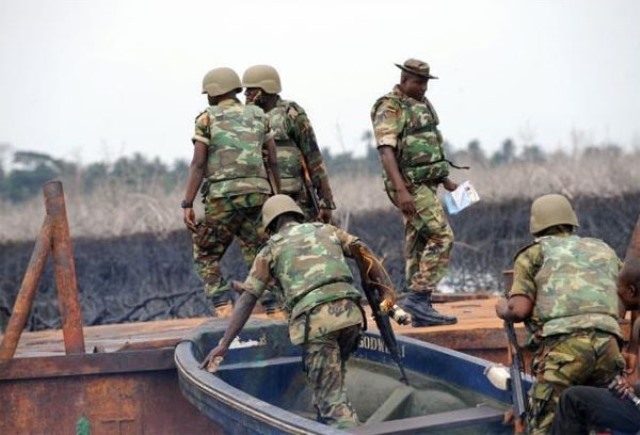
The Nigerian Army has confirmed the death of four soldiers in a boat mishap within Bayelsa waterways saying that the remains of the soldiers were yet to be found, but residents say two bodies have so far been salvaged.
The soldiers drowned during the ongoing military training exercise codenamed “Operation Crocodile Smile” after their boat capsized along Brass Water Front, Brass Local Government Area of the state.
Spokesman of the Nigerian Army, Sani Usman, a colonel, confirmed on Tuesday in Yenagoa that four Soldiers died in the incident, but added their remains were yet to be seen.
Usman said that search is underway.
“I can confirm to you that there was a mishap yesterday involving death of four soldiers; on whether their bodies have been recovered, search is underway and we are yet to get detail on that,” he said on phone.
A resident in the area, Jonah Kennedy however said that two out of the four bodies have been recovered as at Tuesday evening by local divers.
“I learnt that the community youths, soldiers and other local divers are on search to see that those bodies are recovered; this evening, we heard that two of them have been found,” Kennedy said
Lloyd Sese, Chairman of the Maritime Workers Union in Bayelsa, described the incident as unfortunate, urging the federal and state governments to improve emergency response along waterways in the state.