Finance Minister, Kemi Adeosun at the Opening of the IDB office in Abuja
Minister of Finance, Kemi Adeosun has called on the Islamic Development Bank, IDB, to support Nigeria in the rebuilding of the Northeast region which has been ravaged by terrorism.
Adeosun made the appeal on Monday in Abuja at the inauguration of the IDB Country Gateway office.
She said that Nigeria was making efforts to meet the Sustainable Development Goals, SDGs, and would require the support of the IDB in that regard.
She said: “I call on the IDB Group to work with development partners in operationalising the recovery and peace building assessment and implementation of the recently constituted June 2016 Buhari plan for the revitalisation of the North-East.
“This entails addressing aspects of interventions relating to peace building, stability and social cohesion.
The finance minister said that the new IDB office would go a long way to ensure speedy completion of projects and better impact of development intervention in the country.
Ahmad Ali, the IDB president, said that the bank is inspired by Nigeria’s exemplary leadership, drive for national development and zero tolerance for corruption, promising that the bank would give Nigeria its utmost support in alignment with the nation’s development priorities.
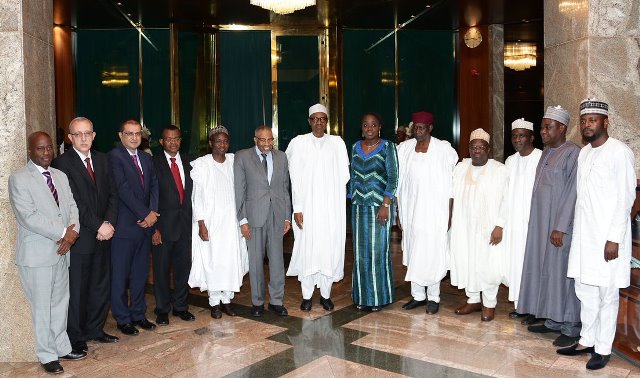
President Buhari in a group Photograph with the IDB team
He added that “The IDB group considers the education sector and particularly bilingual education among its priority areas in Nigeria and a key tool to counter extremism.”
Ali said that the bank would also focus on agriculture, health, infrastructure, small and medium enterprises and regional integration.
He noted that the establishment of the country gateway office would enable the group to be more service-centric and closer to the Nigerian clients in both public and private sectors.
Ali and his team later paid a visit to President Muhammadu Buhari at the Aso Rock Presidential Villa.
The IDB is a multilateral development financing institution established in 1975 in Saudi Arabia and Nigeria became its 56th member country in 2005.
Boko Haram insurgents under military fire in the Northeast planned to carry out suicide attacks in some states in the country, the Department of State Services,DSS, has disclosed.
This disclosure was made in a statement signed by Tony Opuiyo issued on Monday by the service.
The DSS however said the plan had been foiled as the service has arrested many members of the group involved in the plot, including a spiritual leader of the group, Mudaisiru Jinrin, in a Boko Haram cell in Kano.
The spiritual leader is believed to be the mastermind of the shooting of some students at Government Secondary School, Mamudo village near Potiskum, Yobe State, in 2013.
The statement also said that agents of the service rounded up some members of kidnapping gangs in Benue, Akwa Ibom and Calabar states.
The DSS said: “Following threat messages against some members of the diplomatic corps in Abuja and Lagos, this service responded and subsequently apprehended one Aikhoje Moses, on 19 August 2016, at Azagha by-pass off the Benin-Asaba expressway in Edo state. Before his arrest, Moses had threatened the diplomatic community in Nigeria, particularly the consular-generals of Switzerland and Denmark and their embassies in Nigeria, warning them to leave the country.
“The service also arrested one Mudaisiru Jibrin aka Namakele/Alarama on 17 July, 2016, at Sauna quarters, Yankaba area in Kano. Jibrin was the spiritual leader to a newly uncovered Boko Haram cell in Kano. Preliminary investigation so far conducted revealed that he was also the mastermind of the shooting of some students at Government Secondary School (GSS), Mamudo village near Potiskum, Yobe State, in 2013.
“Similarly, on 8 July, 2016, at Kinkinau area in Unguwar Mu’azu of Kaduna metropolis, the service arrested one Mukhtar Tijani, a notorious Boko Haram fighter and three of his accomplices namely, Isiaku Salihu, Abdullahi Isah and Hindu Isah. The four suspects were apprehended while perfecting arrangements for major coordinated attacks on selected targets and locations in Kaduna state.
“In a related development, on 12 August 2016, at Auchi in Edo state, three members of the Ansaru terrorist group hibernating in Kogi state were apprehended by the service. Usman Abdullahi, Abdulmumuni Sadio and Ahmad Salihu were arrested while making arrangements to launch attacks on some selected targets in Edo and Kogi states, before escaping to join ISIS in Libya.”
The DSS said it has also responded to recurring attacks by cattle rustlers in Zamfara state by arresting members of a gang which specialised in cattle rustling and kidnapping in Zamfara and Katsina states.
The DSS “conducted series of operations in collaboration with the military to degrade the criminal network of one ‘Buhari General’ in the state. Sequel to these operations, this service arrested one Abdullahi Haruna aka Douglas, a bread seller on 13 August, 2016, at Hayin Buba area in Gusau LGA of Zamfara state. Haruna was intercepted while using the cover of his petty business, to monitor security bases and movement of security agents in the state, in a bid to facilitate counter-attacks against security personnel deployed to the state.
“Also, on 12 August, 2016, at Aliero town in Aliero LGA of Kebbi state, one Hussaini Alhaji Sule aka Yellow, was apprehended by the service. His arrest was facilitated by an earlier operation of 29 July, 2016, when one Hafizu Sani, a spy and criminal associate of ‘Buhari General’, was apprehended by this service. Prior to his arrest, Sani was also spying on the movements of security agents in Zamfara state. Sani, in concert with other elements, has been terrorising local communities in Kaduna, Katsina and Zamfara states respectively, engaging in cattle rustling and kidnap activities.
“Meanwhile, following the spate of gruesome killing and kidnap incidents in Benue state, on 8 August, 2016, the service arrested one Terfa Jirgba and two of his accomplices, namely Terzungee Kwaghaondo and Mathias Aende, at Badagry street off Esther Aka road in Makurdi, Benue state. Jirgba is an active ally and gang member of Terwase Agwaza aka Ghana, a notorious kidnapper who runs a kidnapping and criminal network in Benue state.
“In a follow-up operation, one Terungwa Abur was trailed to Port-Harcourt City in Rivers state. He was eventually picked up on 16August, 2016. Abur is the second in command to Agwaza and a key member of the kidnapping gang of Terwase Agwaza aka Ghana which operates from Benue state. He acts as a courier for the underworld gang and was the negotiator of the N4m ransom paid to the gang for the release of two Indian national staff of Dangote Cement Company, Yander-Gboko, who were kidnapped on 29July, 2016, in Markudi city. He also participated in the killing of one Ortin in Gboko township on 1August, 2016.
“To address the activities of various criminal syndicates that have in recent months terrorised residents of Calabar and parts of Akwa Ibom state, on 15 August, 2016, along Ukpong street in Oron LGA, one Benjamin Emomotemi and his accomplices namely Gabriel Ambrose, Godbless Taliboth Mattias, Blessing Sunday, Simeon BlessingSunday, Edet Effiong Asanagasi And Rose Williams, were all apprehended by the service tactical team. The suspects were part of a kidnap ring which masterminded the abduction of one Mr Rufus AKV on 31 May, 2016 and Senator Patrick Ani on 6 July, 2016 in Cross River state.”
Former President Olusegun Obasanjo has expressed doubts in the ability of the opposition Peoples Democratic Party, PDP, to come out stronger from the current leadership crisis that is threatening to tear the party apart.
The elder statesman made this known while in a chat with journalists during a tour of some projects in Jalingo, the Taraba State Capital, over the weekend.
Obasanjo said: “In the part of the country where I come from, there is a saying that you cannot say ‘good night’ and come to say ‘good evening’ in the same place.
“So for me, it is good night for the Peoples Democratic Party, PDP, and that’s all.”
Obasanjo, a one-time Chairman, Board of Trustees of the PDP, had torn his membership certificate before the 2015 election, stating that he has retired from partisan politics.
However, recently, the former president was sighted at the Shehu Musa Yar’Adua Centre, venue of an event organized by the PDP, triggering rumuors that he may have returned to the party on which platform he won the presidential election for two tenures.
But Obasanjo released a statement describing the rumuors as baseless and insisted that he was done with party politics.
He explained that it was just mere coincidence that he also had a function to attend at the venue, that had nothing to do with PDP’s event.
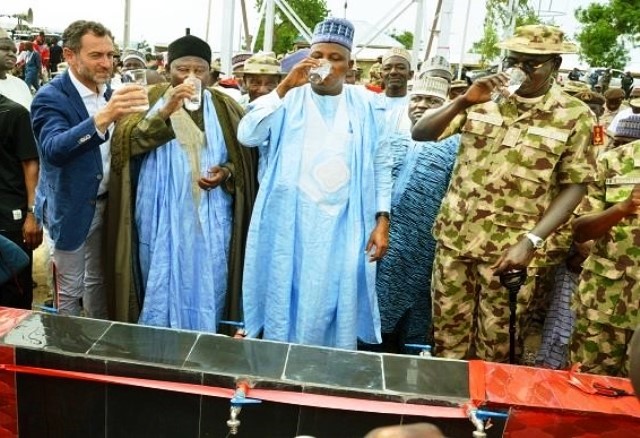
Toby Lanzer (far left) pictured with Governor Kashim Shettima and the Chief of Army Staff, Tukur Buratai, during the commissioning of a bore hole for the IDPs
By Samuel Malik
The United Nations has applauded the improvement in the conditions of internally displaced persons, IDPs, in Bama, Borno State, saying 15,000 people are provided with food by the World Food Programme while a clinic has been opened to provide care for the sick. Also classes have been set up for school children.
This was made known today in Abuja by the United Nations Assistant Secretary-General and Regional Humanitarian Coordinator for the Sahel, Toby Lanzer, who was accompanied by Governor Kashim Shettima to get first-hand information in Bama, one of the worst hit towns, where more than 20,000 displaced persons are camped.
Lanzer, who said his last visit to Bama was in April, said the current security situation is better than before, as Nigerian troops are firmly in control.
“Aid agencies have stepped up their engagement. For example, the World Food Programme is providing rations for more than 15,000 people and the International Organization for Migration and the UN’s Refugee Agency have supported families to build hundreds of all-weather shelters. I was particularly heartened to see young people of Bama, who had been displaced to Maidguri, returning to Bama to help the aid agencies with our work,” Lanzer noted.
In spite of these improvements, the UN chief called for more efforts, especially across the Lake Chad Basin, where he said millions are still at risk of starvation.
“The scale of the crisis in the region is staggering: 9 million people need emergency relief; 4.5 million people are severely food insecure; 2.5 million people have been forced from their homes,” he pointed out, adding that he expects more positive results in the coming weeks from both non-governmental organisations and UN agencies, including UNICEF.
He expressed concern about the new cases of polio in Borno State, which he described as a blow.
“Our stated purpose is to meet people’s needs and I have no doubt that, together with an increasingly engaged donor community, much more good work must and can take place,” he said.
The Bring Back Our Girls group was on Monday prevented from marching to the Aso Villa, where they had planned to demand an update from President Muhammadu Buhari on efforts to rescue the Chibok school girls kidnapped by Boko Haram 800 days ago.
The group had taken off from the Unity Fountain in Abuja but was halted at the Independence avenue by a combined team of policemen and men of the Department of State Services, numbering about 60.
Co-convener of the group and former Minister of Education, Oby Ezekwesili, told the police that they had come to see the President, insisting that he should be answerable to Nigerians who elected him into office.
But the team of security agents, led by Chuks Obasi, a Chief Superintendent of Police, said they were acting under strict orders not to allow the protesting group beyond the independence avenue.
Obasi said, “Well, I have my mandate and my mandate is to ensure that the protest does not assume a violent dimension.”
The protesters therefore resorted to sitting on the road and playing protest music.
Last week, the Boko Haram terrorist group released a video showing some of the abducted girls, and demanding that the federal government released their fighters that are being held by the country’s security agents in exchange.
The video also showed the dead bodies of some people whom the terrorists claimed were some of the abducted chibok girls that were killed when the military attacked the terrorists with a fighter jet.
One of the girls, who gave her name as Maida Yakubu, also begged the government to accede to the terrorists demands so that they would regain their freedom.
Since the video was released, the BBOG group has intensified their daily sit-outs at the Unity Fountain, urging the government to do everything possible to rescue the girls.
The Kaduna State Government has said that it intends to ban the sale of high energy consuming bulbs, as part of efforts at increasing energy supply in the state.
Muhammad Abdullahi, Kaduna state’s Commissioner for Budget and Planning, said this during an interview with the News Agency of Nigeria, NAN, in Kaduna on Monday.
Abdullahi said that government would embark on a state-wide campaign aimed at urging electricity consumers in the state to move to energy saving bulbs, before the ban would commence.
He added that ministries, departments and agencies of the state had already started implementing the energy-saving-bulbs policy.
The commissioner said the initiative is expected to save the state the sum of N360 million, which is about 30 per cent of the amount spent on light bills and fueling of generators annually by electricity consumers in the state.
Abdullahi explained that the strategy was the brainchild of Abdulkarim Mayere, who came third in the “My Great Kaduna Competition” organised by the state government in 2015.
The competition, according to the commissioner, was organised to source for ideas from members of the public on how to move the state forward and make Kaduna great again.
Abdullahi pointed out that the state governor, Nasiru El-Rufa’i had since appointed Mayere as the General Manger of Kaduna Power Supply Company, a new company set up to ensure energy efficiency in the state.
He also said that the state will soon commence the generation of electricity from domestic waste; another idea by Lwahas Adoniram, who was the best contestant in the “My Great Kaduna Competition.
According to the commissioner, “Adoniram suggested that waste could be converted into huge employment opportunities with the local construction of turbines powered by domestic waste.
“We have already entered into discussion with the Federal Ministry of Environment and it has shown interest to partner with us to make the project a reality.
“The people of the state have as much contribution to make, so we opened up the competition last year and received about 500 entries out of which 15 were selected and integrated into the state development plan.
“As you can see, we have already started implementing some of the ideas.
“The state government would continue to engage citizens in policy formulation and implementation processes in order to run a holistic people-oriented government,” the commissioner concluded.
Kano state governor, Abdullahi Ganduje, on Monday stirred the hornets’ nest when he joined the debate on whether or not Nigeria should take another look at its federalism.
The governor, who spoke during a social event organized in honour of delegates to a pre-election meeting of the National Youth Council of Nigeria, in Kano, observed that geo-political restructuring is not the panacea to the nation’s current socio-economic woes, stressing that Nigerians need to restructure their mindsets to return the country to the path of progress.
To buttress his point, Ganduje said the United States of America, the world’s strongest economy, is a more geo-politically fragmented and heterogeneous society than Nigeria, but it has remained the strongest nation in the world.
He stressed that the US attained its present status because of the ability of its leaders to harness the positive thoughts and actions of its heterogeneous population and not by restructuring the country along geo-political divides as being advocated by some groups and individuals in the country.
Lamenting the high prevalence of corruption in Nigeria, he argued that youths are the best segment of the society to lead in the crusade against it in view of their physical and intellectual capacity as well as their leadership potential.
He called on the youths to lead attitudinal change and urged the government to devote more attention to tapping from the potentials of its youths for national integration and development.
Ganduje’s view against restructuring is widely shared by many, especially in the North where calls for restructuring are viewed as decoy to fragment the country.
But his view sharply collides with that of Atiku Abubakar, a fellow party man and former Vice President of the country.
Abubakar had used various public fora to advocate for restructuring as the panacea for the country’s political survival.
Last month in Kaduna, at the late General Usman Katsina Memorial Conference, he again repeated his call for restructuring of the country.
Atiku said: “The north and Nigeria have not been served well by the status quo and there is need for change.
“Who among us who went to primary and secondary school in the 1960s had much to do with the federal government? Did the northern regional government wait to collect monthly revenue allocations from Lagos before paying salaries to its civil servants and teachers or fixing its bridges and roads?”
Many of his critics in the North had described his advocacy as political gimmick to help him realise his ambition to be president in 2019.
However, calls for restructuring have become more strindent since Muhammadu Buhari became president last year. The calls have come more from groups that opposed his election such as the Ohanaeze Ndigbo and the Yoruba socio-cultural group-Afenifere.
Afenifere recently rebuked Vice President Yemi Osinbajo for saying at a function that what Nigeria needed was economic diversification and not restructuring.
Afenifere said Osinbajo was “under pressure” from the “upholders of the status quo”, and stressed that the central plank of the restructuring they advocate was for Nigeria to go back to true practice of federalism wherein, mineral resources that abound in all states would be freed from the exclusive list so that states would move into prosperity.
Chukwuemeka Ezeife, a chieftain of Ohanaeze Ndigbo and a former governor of Anambra State, in a reply to Osinbajo, also said: “Restructuring is what will keep us together in view of the prevailing economic challenges. It will reduce the cost of governance. It makes our diversity to be positive. It is either we return to the six(three) regional structures or 12 regional units.”
The government of Osun State did not receive any money from the federation account in April 2016 due to deductions by the federal government.
A report by PREMIUM TIMES said that the deduction was part of the N32 billion deducted by the federal government from states as repayment for bailout funds and other loans extended to the affected states and the federal government.
According to the report, Osun state’s April allocation from the federation account totaled N2.03 billion, but the sum was insufficient to offset the state’s total debt of about N2.391 billion.
The state still owes the federal government N361 million which will be deducted from subsequent months.
PREMIUM TIMES also reported that some other states saw their monthly share from the Federation account hugely reduced as a result of the deductions
Bayelsa State, for instance, had N3.207 billion deducted from the N4.812 billion allocated to it in April. The sum represents 66.7 percent of the State’s allocation.
Other deductions included Cross River State, N1.405 billion (63.46 per cent); Ogun, N1.185 billion (57.2 percent); Plateau, N1.248 billion (56.52 per cent); and Ekiti, N1.067 billion (55.33 per cent).
Seven states – Akwa Ibom, Anambra, Jigawa, Kogi, Lagos, Rivers, and Yobe – along with the Federal Capital Territory did not have deductions, as they did not collect the bail-out funds used for the deduction.
It was reported that apart from bail-out funds, which took about N3.078 billion from the affected states, loans the states are now repaying to the federal government include debts on Asset Management Corporation of Nigeria,AMCON, loans, commercial agricultural credit scheme, bond issuance programme, obligations to contractors, and deduction from excess crude account.
Other deductions include refund/payment arrears of derivation, foreign loans, special intervention/flood management projects, the national FADAMA project and reconstruction of commercial bank loans into FGN bonds.
President Macky Sall of Senegal is one African leader after my heart. Few weeks into his presidency, the man took one look at the balance sheet and decided the interest of the country would be better served by a single-chamber parliament and simply abrogated the upper house.
He was convinced and, the people of Senegal agreed with him, that the unwieldy two-chamber parliament he inherited was a drain on the economy. His action must have conserved much-needed funds for the country.
The call for a review of Nigeria’s National Assembly assumed a new dimension in the last few years following the realization that the parliament has become a drain on the economy. It all started when former Governor of the Central bank of Nigeria and now Emir of Kano, Muhammadu Sanusi II revealed that nearly a quarter of the federal budget goes into servicing the false lifestyle of federal lawmakers.
The lawmakers did not help the situation by involving themselves in unwholesome practices such as bribe-taking, extortion and forging or falsifying official documents and budget proposals for the purpose of corrupt enrichment.
Unlikely voices have joined the call of late. Worried by the unacceptable level of corruption among lawmakers and as part of events to mark his 75th birthday, former president Ibrahim Babangida proposed an arrangement where legislative duties will be conducted on part-time basis as a cost-cutting measure and a way to break the cycle of corruption at the National Assembly.
The former president revealed that the idea was high on the agenda of his government in 1989. His views echoed similar ones by Chief Joe-Kyari Gadzama, SAN, in a recent cerebral presentation on the issue.
Chief Gadzama had argued that aside saving cost, part-time legislative work will enrich the democracy project at much lower cost because it is the only way to encourage professionals who do not wish to abandon their primary callings to the National Assembly.
The Nigerian Senate (upper chamber)
He even suggested the idea of reserving seats in the National Assembly for professionals, as practised in some developing democracies, who will also operate on part-time basis as other members.
Still as part of cost-cutting measures, there are those who believe Nigeria should operate a single-chamber National Assembly.
In one of his major contributions to constitution making some three decades ago, President Olusegun Obasanjo made a robust case for a unicameral or, single-chamber legislature for Nigeria which he said best suited developing countries.
In his words, bi-cameral or, double-chamber parliaments are generally unwieldy and wasteful for developing countries. Problem is that on two different occasions, President Obasanjo had the opportunity to grab the front-page and twice he demurred!
Honestly, it is still puzzling that Obasanjo passed up the glory of the revolutionary idea. Who knows?
Had he pushed for a single-chamber parliament instead of busying himself with wasting precious time and tax payers’ money on the plan to stretch his tenure, Obasanjo’s aspiration to the fatherhood of the nation would probably have been adequately vented. But, that is as far as it could get!
Aside its unadvertised role as job-placement agency, the best-known benefit of double-chamber parliament, which is suitable for and, desirable in comparatively rich and literate democracies, is that it allows for checks and balances!
Here, the impression one gets is that the upper house, supposedly made up of ‘level headed’ people is capable of checking the supposed excesses of their supposedly ‘hot headed’ juniors in the lower house. It is devoid of commonsense to even imagine that this perceived benefit applies to Nigeria.
Developing democracies have no need for double-chamber parliaments. Aside being financial sink holes, double-chamber parliaments are mere duplication of roles and functions.
With two unwieldy, often-bickering and scandal-prone houses, Nigeria’s National Assembly with some four hundred and fifty mostly half-educated and mostly-lazy federal legislators is a major drawback.
And, mind you, the grouse here is not with representation in terms of numbers. With a population estimated at one hundred and sixty million, the National Assembly may not be overpopulated.
Trouble has always been the unreasonable and unrealistic chunk of the federal budget that services the false life style of a disingenuous few in a vast plain of poor, struggling people.
If self-regulation, a synonym for checks and balances is the main attraction of a double-chamber legislature, it could be better achieved through a less-costly, result-oriented and effective single-chamber assembly with a good mix of supposed cool headed and supposed hot headed members.
The Nigerian House of Representatives (lower chamber)
To achieve this is to retain the present 350 federal constituencies with legislators working on part time basis. In any case, the present arrangement of observing a 181-day legislative year is part-time, anyway!
Aside baiting professionals to bring their expertise to the table, part-time legislative work will eliminate the do-or-die approach to election to the National Assembly which many see as an instant route to wealth.
This is misplacement of priorities which in turn shuts out serious-minded people and thereby robbing the National Assembly of the services of the best minds.
Nigerians cannot continue to be represented by or, subsidize the false style, of poor quality lawmakers some of whom are stark illiterates anyway!
But, if for the loss of meal ticket many see part-time legislative duties as self-destructive, we can try the Ghana experiment which has a single-chamber legislature where cabinet positions are occupied by elected members of parliament.
The attraction with the Ghana arrangement is that it creates a healthy political arrangement where ministers take matters relating to their constituencies to parliament, update their constituencies as to happenings in the parliament as well as press the case of their constituencies at cabinet meetings.
This clearly eliminates a situation where people who cannot win elections in their backyards are rewarded with cabinet positions.
The problem here is not with members of the National Assembly who see their presence as a call to duty. As usual, problem is those who are so unimaginative to the point of not being able to survive outside politics.
They are the ones who have lost all sense of creativity and who will naturally resist any change to the present order with the proverbial last blood. And this is where patriotic and progressive minded members in the National Assembly have a historic duty to rise to the occasion.
History beckons! As the Buhari/Osinbajo administration steadies itself, it may not be a bad idea to look toward progressive lawmakers in seeking ways to jiggle the National Assembly.
Salkida fled Nigeria after he was threatened by Boko Haram. Photograph: Premium Times
By Samuel Malik
The Nigerian journalist declared wanted by the Nigerian Army in connection with Boko Haram has said he has no control over the group despite having contacts with some of its leaders.
“I neither decide for the government nor for Boko Haram,” he said.
Self-exiled Ahmed Salkida, who lives in the United Arab Emirates, UAE, with his family, was reacting to calls by some Nigerians for the Bring Back Our Girls campaigners to direct their planned protest today towards him instead of the government.
“Beyond what I report as news, I have no authority over those I report. Neither in government nor those of the terrorists fold,” he declared.
The BBOG plans to match to the Presidential Villa to demand the release of the Chibok girls following proof of some of them being alive in a video released by the insurgents recently.
Salkida, the only Nigerian journalist known to have contacts within the group and who has reported extensively and exclusively on its activities, said he is helpless in securing their release because he wields no influence over the sect.
Beyond what I report as news, I have no authority over those I report. Neither in government nor those of the terrorists fold
While admitting that he had in the past tried to use his contacts to secure the release of the girls, the Borno State-born journalist said such efforts brought him enemies rather than appreciation.
“I have written extensively on the issues that undermine the sanctity of our humanity as a nation such as the abducted Chibok school girls. I have even at the government’s request sought to use my professional access to affect possible release of the girls.
“This ground of sacrifice has sadly and repeatedly harvested the most unjustifiable professional hostility towards me,” he posted on his blog.
Salkida noted that his reporting on Boko Haram has made him stand out like a sore thumb both among government and its supporters but said other journalists in the past had suffered worse.
He, however, pointed out that government is capable of securing the release of the abducted school girls.
“I know that both the previous and current government in Nigeria publicly declared a commitment to get the girls released. I believe that any government that takes this as an obligation can achieve the set objective,” he said.