The Presidency will install plagiarism detection software in the computers of its speechwriters to prevent a recurrence of plagiarism in presidential speeches, sources in the State House disclosed.
President Muhammadu Buhari had in his “Change begins with me” speech this month lifted a paragraph from US President Barack Obama’s 2008 victory speech.
The Presidency had apologized for the incident – which it blamed on an overzealous aide – and said it wouldn’t happen again.
Sources said officials in the Presidency have now resolved to take a range of measures to guard against any further embarrassment.
“One of the measures will be to install plagiarism detection software to check speeches before they are delivered by the president,” an official involved in the plan told Daily Trust.
He said they all felt embarrassed by the plagiarism case, even though it was essentially the stupidity of one individual who didn’t envisage the gravity of his action.
When contacted over the planned installation of plagiarism detector, presidential spokesman Garba Shehu confirmed the plan.
He said the Presidency is determined to ensure that a case of plagiarism will never happen again.
He had earlier issued a statement in which the Presidency blamed a deputy director “for the insertion of the contentious paragraph”.
It said: “This serious oversight will be investigated thoroughly and appropriate sanction meted.
“The Presidency wishes to state in the clearest possible terms that it regrets this unfortunate incident and will ensure that this does not happen again.
“President Buhari urges Nigerians to look beyond this incident and focus on the message of change,” the statement added.
Sources told Daily Trust that the deputy director responsible for the incident would be removed from the Presidency.
The case was particularly embarrassing to the Presidency, especially as it came at the time US officials scheduled a meeting between President Obama and President Buhari.
The two presidents are expected to meet on Tuesday on the sidelines of the United Nations General Assembly session.
President Buhari is already in New York to attend the UN session and conduct several other international engagements.
The economic recession in the country has claimed its first set of causalities in the ivory towers as the Federal University, Lafia, has sacked 35 non-teaching staff in what may be the first batch of retrenchment.
The Vice Chancellor of the university, Mohammed Sanusi, a professor, who disclosed this to journalists in Lafia, said the sacking of the affected staff was due to lackof funds to pay their salaries.
The affected staff were among those engaged by the university earlier this year comprising of 11 corps members, who were retained after their service year in the school, and 24 others.
Liman said the council had directed the management to source for money and pay off the affected staff since they had worked for over five months without pay.
“It would be inhuman to keep the staff working when we cannot pay them given our poor budget, and that is why the council decided that we should pay them off,” he said.
According to him, the university consistently has a shortfall of over N38 million in her allocation for several months, which has adversely affected the running of the institution.
The VC said the management had uncovered a job racketeering syndicate in the university, which had given illegal employment to some persons.
“When we got wind of the matter, the management set up an investigative committee, which turned in a report that was submitted to the council.
“The university council referred the matter to its disciplinary committee for investigation and appropriate action,” he said.
Abdulmumin Jibrin and Speaker Yakubu Dogara when the going was good
Embattled Kano member of the House of Representatives, Abdulmumin Jibrin, has denied allegations that he owns and operates a bank account in the United Kingdom.
A group, the National Youth Council of Nigeria, NYCN, had alleged that it traced £1.558 million to an account in the United Kingdom, allegedly owned by the former chairman, House of Representatives’ Committee on Appropriations.
The allegation was contained in an e-mail sent to journalists by Ifeanyi Okonkwo, the Head of the Anti-corruption unit of the NYCN.
Jibrin however, denied owning any account in the UK or having anything to do with the address in the e-mail sent by the NYCN.
In a series of tweets on Monday, the lawmaker said the report was just the handwork of mischief makers who are bent on foiling the anti-corruption campaign he had initiated against speaker Yakubu Dogara and three other principal officers of the house.
He stated: “My attention has been drawn to a widely circulated report that I own an account with ING bank UK with Essex address and balance of £1.3m.
“The document is FAKE; I DO NOT own such account or balance neither do I have anything what so ever to do with the said address at Essex.”
The Kano state lawmaker said the report was “part of a wider propaganda arranged by the desperate Speaker Dogara through his Deputy Chief of Staff Hon CID Maduebum.”
He also alleged that Maduebum recruited and paid N20 million to one Okonkwo and Ugochinyere “to do the hatched jobs.”
“Ahead of resumption of the House, they are back at work to divert attention from allegations of budget fraud and corruption against Mr Speaker.
“The plan is to create credibility problem for me as I release more revelations on Mr Speaker that will send shock down the spines of Nigerians,” Jibrin said.
He vowed to ensure that the allegations were investigated, saying that “my lawyers are taking the necessary legal actions. ENOUGH IS ENOUGH.”
The NYCN had claimed that documents obtained from the UK revealed that Jibrin allegedly “owns and operates the said account domiciled in ING Bank Channels Island, United Kingdom.”
Part of the letter sent by the NYCN read: “The bank is located at Forum House, Grenville Street, St-Heller, Jersey JE2 4UF, Channels Island United Kingdom.
“Jibrin opened the account with his address at 453 Crank brook Road, Ilford Essex IG2 6EW.
“Details of the account statement obtained by some lawyers in the UK show that Jibrin has a total £1.558m (approximately N825m) in the account between June 1, 2016 and June 30, 2016.”
Okonkwo in the letter claimed that Jibrin had withdrawn £623.44 pounds within the one month period bringing the balance in the account to £1.376, 193.84 British pounds.
“Jibrin’s ownership of foreign account contravenes the provisions of the 1999 Constitution which bars public officers from owning and operating foreign account,” he added.
Paragraph 3, Part one of the Fifth Schedule of the Constitution of the Federal Republic of Nigeria 1999, states:
“The President, Vice-President … members of the National Assembly and Houses of Assembly of states and such other public officers or persons shall not maintain or operate a bank account in any country outside Nigeria.”
Several punishments were recommended in Paragraph 18 of same Schedule of the constitution for any public officer that defaults on the above provision.
They include: vacation of office or seat; disqualification from membership of a legislative house; seizure or forfeiture of assets or property being proceeds of such corruption; and prosecution in addition to the above sanctions; where the conduct constitutes a crime.
The deputy director, who reportedly was responsible for the controversial ‘Change begins with me’ speech delivered by President Muhammadu Buhari, will this week be transferred out of the State House.
Presidential spokesman, Garba Shehu, had on Friday said that the presidency was greatly embarrassed by the development and promised that sanctions would be meted out on whoever was responsible.
“The Presidency wishes to state in the clearest possible terms that it regrets this unfortunate incident and will ensure that this does not happen again.
“Already, a Deputy Director in the Presidency has accepted responsibility for the insertion of the contentious paragraph.
“This serious oversight will be investigated thoroughly and appropriate sanction meted,” the statement read.
Sources at the presidency hinted that the official will start facing disciplinary proceedings according to civil service rules on Monday.
But he will first be directed to vacate his seat at the president’s office, officials said.
The deputy director is expected to be queried by the Permanent Secretary of the State House, Jalal Arabi, before the case will be referred to the Head of Service for further actions.
The plagiarism was first detected by a Newspaper columnist and President Buhari has since apologised for the incident.
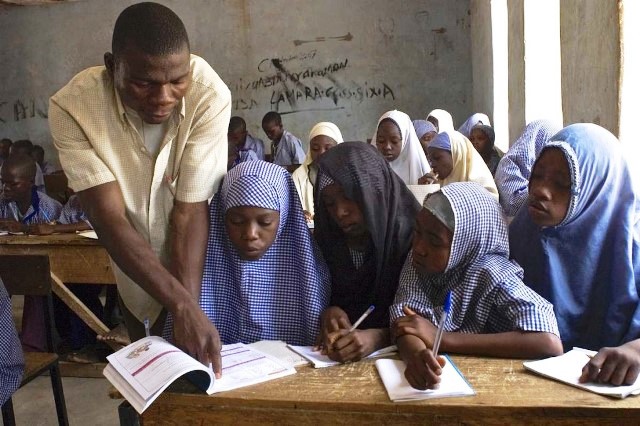
Public secondary schools in Borno State will reopen on Monday, September 26, more than two years after they were closed due to Boko Haram insurgency.
Borno State Commissioner for Education, Inuwa Kubo, told the News Agency of Nigeria, NAN, in Maiduguri that Internally Displayed Persons, IDPs, who were camped at the schools, had been relocated so that academic activities could resume.
He said that repair works had been carried out on the structures in the schools to provide conducive atmosphere for teaching and learning.
The statement read: “I wish to announce that on September 26, all public schools are going to be re-opened.
“I want to state that government has repaired all the structures damaged by the Internally Displaced Persons (IDPs) in the schools, to ensure comfort for the returning students.
“Parents and guardians should please make sure that they send their children back to school,” he said.
The commissioner said it was unfortunate that proprietors of private schools in the state had taken advantage of the closure of public schools to arbitrarily hike their school fees.
“We understand that some of them have taken undue advantage of the closure to hike school fees; we will not allow the situation to continue,” he said.
“We are going to visit the schools to find out how much they are charging and how much they are paying their teachers.”
It would be recalled that public schools in Borno State were forced to close in March, 2014, after suspected terrorists attacked a school in neighbouring Yobe.
The government reopened the primary schools in 2015 but could not do so with the secondary schools as they had been taken over by IDPs.
President Buhari on his arrival at the JFK international airport was received by the Chief of the Nigerian mission to the US
President Muhammadu Buhari is expected to address the United Nations General Assembly on the condition of the millions of people residing in the Lake Chad Basin on Monday.
The president is one of the five speakers scheduled to address the assembly during its plenry session.
Among other things, president Buhari is also expected to sign the Climate Change agreement reached in 2015 at Paris, France.
Top Nigerian government officials who accompanied the president on the trip include Minister of Solid Minerals, Kayode Fayemi, Minister of the Interior, Abdulrahman Danbazzau and Minister of Environment, Amina Mohammed.
Others are the Senior Special Assistant to the President on Diaspora Matters, Abike Dabiri Erewa and the National Security Adviser, Babagana Munguno.
President Buhari arrived in New York on Saturday evening and was received by the Nigerian Charge De Affairs in the city, Anthony Bosa.
Over 190 world leaders would be attending the UN general assembly for a high level opening meeting where many challenges facing different nations of the world would be discussed, including the issue of refugees and migrants.
Also on Monday, the President is expected to attend the AU Peace and Security Council meeting at the AU Observer Mission Office, before meeting with the British Permanent Representative to the United Nations, Matthew Rycroft.
Executive Chairman of the Federal Inland Revenue Services, FIRS, Tunde Fowler
Executive Chairman of Nigeria’s Federal Inland Revenue Service, FIRS, Tunde Fowler, says that Africa has huge revenue generation potentials which could only be realized if African leaders would grant autonomy to their countries’ Revenue Authorities.
The former head of the Lagos Internal Revenue Service, LIRS, shared the experience of the autonomous FIRS and LIRS, in his presentation titled: “Establishment of An Autonomous Revenue Authority With An Independent Board-The Nigerian Experience”.
Fowler said this at the African Tax Administration Forum and International Monetary Fund, ATAF-IMF, seminar in Cape Town, South Africa.
He pointed out that the autonomy of the Nigeria’s Tax Authorities has brought about a huge increase in collection by tax authorities in Nigeria.
Fowler said “Clearly, Revenue Authorities across Africa have the potentials to generate funding for their respective governments and they will perform better if they are allowed to fully be in charge of their day to day operations and empowered to hire staff, pay competitive salaries and provide regular training for staff.
“The compelling evidence from Nigeria’s experience is that wherever Revenue Authorities have been granted operational, administrative and financial autonomy and allowed to operate with minimal civil service bureaucratic encumbrances, revenue administration has been enhanced and tax collection performance has gone up significantly.”
The tax boss maintained that the independence of revenue boards has proven to be beneficial for revenue generation agencies in meeting up with their responsibility of generating funds for government to carry out its projects and programmes.
For instance, Fowler noted that revenue generation increased “from N1.846 trillion in 2007 when FIRS was granted autonomy to an average of over N4.5 trillion in 2015.
“In the LIRS, tax revenue grew from N50 billion in 2007 to N270 billion in 2015.”
The FIRS chairman said that Nigeria had neglected revenue generation from taxes due to more focus on income from oil but following declines in oil proceeds in the 1990s, government was forced to adopt series of tax reforms and initiatives.
He recalled that at that time, the FIRS was under the Finance Ministry and was faced with many hitches characterizing the civil service, including absence of financial and administrative autonomy, existence of leakages in revenue collection due to lack of transparency and corrupt practices by some tax officials and taxpayers, etc.
Fowler noted that various reports and recommendations by experts in revenue generation, eventually led to the promulgation of the Federal Inland Revenue Service (Establishment) Act, No. 13, 2007).
“It was the second time a tax agency would enjoy autonomy in Nigeria with an Act of Parliament.
“The first being the enactment of the Lagos State Internal Revenue Service Law in 2006 by the Lagos State House of Assembly,” he said.
He explained that the FIRS, under the supervision of its independent Board, has been able to initiate and implement various revenue collection in the country.
The FIRS chief executive listed the initiatives of the service which lead to the increase of revenue generation in the country to include amongst others: the VAT Auto-Collect project; the Integrated Tax Administration System (ITAS) project; the National Taxpayer Identification Number (TIN) project; Massive Taxpayers Registration activities, etc.
Fowler acknowledged that “there is no ‘one size fits all’ way” to achieve an improved tax regime, but “a good way to start is to put in place requisite legal and administrative framework to ensure that the Revenue Authority can function with less public service bottlenecks…”
He added that political support and general policy direction from the supervisory Ministries of Finance, will also be critical to the success of Revenue Authorities.
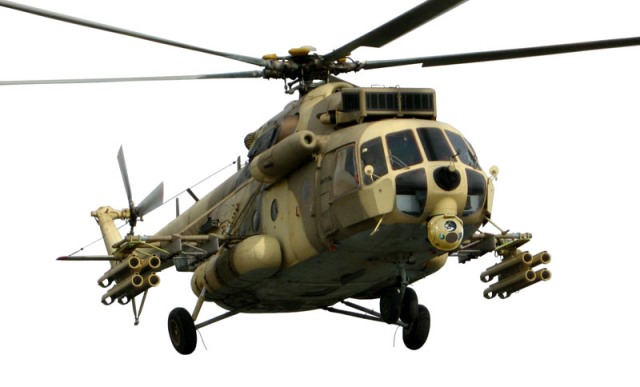
The Nigerian Air Force, NAF, says it carried out several air strikes on suspected Boko Haram terrorists’ locations on the outskirts of Tumbin Gini and Tumbin Kayewa, Northeastern Borno State, on Friday 16 September 2016.
A statement posted on the force’s social media page on Sunday said that the air strikes were in continuation of NAF’s efforts at finishing the remnants of the Boko Haram terrorists in the North East.
The statement added that “the air strikes were as a result of ground based intelligence and successive Intelligence Surveillance Reconnaissance reports obtained from several missions flown by NAF platforms.”
“A post-strike battle damage assessment of the the strikes revealed that the rendezvous was badly damaged with many casualties while those far from the vicinity could be seen scrambling to safety.”
The NAF said that the aircrafts involved in the operations were the NAF F-7Ni and the Alpha jets.
It added that the air operations have continued to make life difficult for the terrorists.
“This has enabled unhindered advance by the surface forces as part of the ongoing Operation GAMA AIKI,” the statement added.
Recall that the NAF had, in an earlier operation successfully conducted air strikes on Boko Haram camps at Tumbin Rego on 26 August which led to the death of many high ranking members of the group.
Below is the link to the video of the airstrikes as released by NAF.
After losing three children and her 40-year-old husband to a bomb blast at Saint Teresa’s Catholic Church Madala, Niger State, 33-year-old Chioma Dike says her only prayer is that her two surviving children be strong enough to forge ahead with her.
The whole family was in the church vicinity on Christmas day in 2011 when the explosion by the Boko Haram struck.
When she was told by medical practitioners that her only surviving son had a secondary missile, more like a nail, inside his head, Mrs. Dike hoped for help from government and well-meaning Nigerians to end the sufferings of the 11-year-old.
“Government gave us hope. They said they would treat us fully and in good hospitals,” she said.
However, five years after the blast, Mrs. Dike’s son still lives with the nail in his head.
“Most times he suffers headaches and becomes dizzy as a result of the problem,” she told PREMIUM TIMES.
“Even in July this year I took him from Suleja to the National Hospital in Abuja for a treatment which I had to pay for from the meagre income I receive through the trading business I am managing.
“One of the drugs cost N2, 800 for its singular purchase,” said Mrs. Dike in a telephone conversation with PREMIUM TIMES.
The sad story shared countless times by Mrs. Dike is similar to that of other victims of bomb explosion in Nigeria.
However, it was not meant to be so as the Federal Government established a fund to support the victims; or so it seems.
THE VICTIMS SUPPORT FUND
In its bid to assist victims of the Boko Haram insurgency and rebuild destroyed communities, the administration of ex-President Goodluck Jonathan put in place a Victim’s Support Fund, VSF.
The committee supervising the VSF, led by Theophilus Danjuma, a retired Army General, organised a fund raising in 2015 to address the challenges of those directly affected by the insurgency.
Over N54 billion was pledged as donations to the VSF.
According to the Executive Director of the Fund, Solomon Ochoche, about half of the pledge has so far been redeemed.
“N28 billion has been redeemed out of N54 billion which was pledged,” he told PREMIUM TIMES.
While recounting the expenditure, Mr. Ochoche said N3.8 billion has been spent on projects for the welfare of various victims of terror in Nigeria since the establishment of the VSF in 2015.
Of that sum, N227 million was shared among 14 hospitals across North-East Nigeria for the care of civilians affected by bomb explosions, he said.
Another N35 million was given to two military hospitals for the same purpose.
When asked about treatment of victims of the various bomb explosions that happened in the Nigerian capital, Abuja, and neighbouring states, the director said their treatment was not initially part of the Fund’s mandate.
“At the beginning; the Victims Support Fund identified three areas of intervention; women economic empowerment, educational support for children and psycho-social support,” he said.
“Those were the areas identified and the needs in these areas are very broad. When we later identified the enormity of the needs of bomb blast victims; VSF decided to step in to help support the health challenges of the victims,” he added while explaining that the funds largest expenditure was a N2 billion donation to the Safe School Initiative in the North East.
Mr. Ochoche’s explanation appears to contradict the aim of setting up the fund as espoused by ex-President Jonathan while inaugurating the committee.
“Our gathering here today is to kick-start the process of providing succour to our people who have been directly affected one way or the other by acts of terrorism in the country,” Mr. Jonathan had said.
VICTIMS UNIONISE
To ensure a more cohesive push for government attention, some of the victims of the various explosions formed the Bomb Blast Victims Association of Nigeria, BVAN.
The Chairman of the association, Kayode Olatunji, said the most fortunate of those affected by the bomb blasts were only assisted by government during the early stages of the incidents.
“Every member of the BVAN will tell you, like it was the case with me, that they only got help for a while at the hospital,” said Mr. Olatunji.
Mr. Olatunji who was affected by the April 8, 2011 bomb explosion at the Independent National Electoral Commission, INEC, office in Suleja explained that he still has some treatments pending for his eyes, ears and bones.
Scene of bomb blast in Nyanya, Abuja, in 2014
“I was treated with assistance from government at the University Teaching Hospital (UTH) in Gwagwalada, Abuja for four months and two weeks, after which I was made to fully continue the treatment, since help no longer came from government,” he said.
“One of my ears is still down; my left eye requires a cornea transplant while my right eye has been affected with cataract; all as a result of the incident,” Mr. Olatunji told PREMIUM TIMES.
He said he still goes for treatment at the UTH in Gwagwalada and another hospital managed by the Evangelical Church of west Africa (ECWA), in Kano, with whatever funds he is personally able to come up with.
Mr. Olatunji also told PREMIUM TIMES that Mr. Ochoche had stated that money under the care of the fund was not meant for them.
“All efforts to get funds from the VSF to help our members have failed,” he said. “Professor Ochoche asked us to find ways of getting government to listen to our problems, as funds under his care was not meant for us.”
MORE VICTIMS LAMENT
Like Mrs. Dike, other victims of bomb explosions also lament their situation.
Favour Duke, whose husband was killed in the June 25, 2014 bomb blast at Emab plaza, said she joined BVAN so that she might be assisted with a job to feed her seven-year-old daughter.
“My husband was the bread winner of the family. We were practically comfortable with what he provided,” the Banking and Finance graduate told PREMIUM TIMES.
“However since he died it has been one problem or the other. A couple of months back my daughter took ill and almost died. It took the grace of God with the assistance of the church I attend to provide over N200, 000 needed for her medication.”
“Even the house we live in has been due for the renewal of its rent, for almost two years now. The only reason we are still able to remain here is that the house currently has legal issues. Any time they demand that it should be demolished or sealed, I don’t know where to go to,” she said.
Mrs. Dike said her effort to start a day-care business was frustrated by the construction of a bridge around their house, which made it impossible for people to take their children to her home.
“I live from day to day, anxious about what the next challenge might be,” she told PREMIUM TIMES.
Another victim, Monica Solomon, narrated her experience after surviving the May 1, 2014 explosion in Nyanya, Abuja.
Mrs. Solomon, 38, sustained severe burns which affected both her hands and legs.
After initial reluctance, she narrated her ordeal.
“I had gotten off that morning to go to work as usual. I boarded a bike from my house to the bus stop at Nyanya. After getting there I stood under the bridge, awaiting a taxi to take me to work.
“There was a vehicle in front of me, but I never knew that the vehicle was loaded with a bomb. I had turned and decided to move to a different spot after I saw a man, whose appearance I didn’t like.
“Suddenly I heard a loud sound and lost consciousness. When I woke up, I was covered with the heat of fire.
“They brought a police van that carried us to the Asokoro District Hospital, from where we were transferred to Garki, because the authorities at Asokoro said there was no bed.
“The same complaint was made, also at Garki District Hospital and we were taken to that of Wuse, where I was kept for two weeks before I was taken to Teaching Hospital at Gwagwalada.”
At Gwagwalada Teaching Hospital, Mrs. Solomon said she was faced with an entirely new policy, from that which obtained at Wuse hospital, where her medical bills were fully paid for.
At that point of her narration, her husband, Adebosun Solomon, who was present during the interview, interjected.
Mr. Solomon said even at the Wuse hospital, he had to foot some of the bills.
“A day after the visit of the Minister, Bala Mohammed, I was made to pay for a cream that was to be applied on my wife’s hand. The Hospital authorities at Wuse actually said they had the cream, but added that the person holding the keys to the place where the cream was kept, was not around.
“The cream was N2,500. They also asked me to pay for an injection whose single dosage cost N3,500 and my wife had six of that injection at the time,” he said.
“Even the promise of feeding my wife for free was practically impossible, as we had to buy the kind of food that was good for my wife.”
According to Mr. Solomon they began to fully foot the bills for every treatment when they arrived Gwagwalada Hospital.
He added that the situation got so bad that his wife’s hands started stinking before he was advised to take her home and apply alternative or traditional methods of treatment which were more affordable.
“Even now though the wounds have practically healed from the outside, the problem is still not over. Every evening from 7 p.m., we will not sleep. Her hand will become very itchy,” he said.
According to Mrs. Solomon, all she has prayed for, since the incident is that some help will come to put her hands back in good shape, so that she can find another job and help her civil servant husband.
She explained that months after the explosion, her employer, Dumo Casino, a transport agency where she had worked for 21 years, laid her off with a severance pay of only N150, 000.
Her husband stated that he had to visit the company’s office several times, before they released the money in two instalments of N50,000 and N100,000 respectively.
WE CAN’T EXTEND MANDATE
While many bomb victims continue to live in pain and helplessness, the VSF, which still has over N24 billion of unspent funds said it cannot do more.
“It is not possible for the VSF to cater for all the people affected by these terror,” Mr. Ochoche told PREMIUM TIMES.
The official said his agency had identified and provided funds for 14 hospitals to treat the victims.
When told that the identified hospitals often referred the victims to other hospitals not among the 14, Mr. Ochoche said his agency could no longer assist such victims.
“If they go to hospitals that we have asked them to go to and they are referred to other hospitals, I am sorry but we cannot take responsibility for that. It is the hospitals that will know how to sort themselves out.”
When asked how his agency planned to spend its remaining N24.2 billion, the VSF official said the funds are spent based on the determination of the committee’s short, medium and long term budgeting objectives.
“You cannot just spend the money like that,” he said. “The expenses have to be determined by the committee and then after I have drafted the budget based on the short medium and long term needs, they will have to approve it before any expenses are made.”
FirstNation Airways has resumed flight operations in Nigeria on Sunday evening, one month after it suspended flights to enable the aircraft fleet undergo engine maintenance.
NAN reports the airline made the announcement through its Twitter account which stated that it would resume flights by 4 p.m. on Sunday 18th September 2016.
The airline announced the suspension of its flights on August 17 few days after another airline, Aero contractors made a similar announcement.
The development created panic in the aviation sector as there were speculations that the companies were closing shop due to the current economic challenges facing the country.
However, Chimara Imediegwu, the Director of Flight Operations, dispelled the rumuor that the airline was folding up, explaining that it voluntarily grounded the aircraft to await the arrival of a team to carry out routine maintenance on some of its aircraft.
He said “the FirstNation management planned well ahead and kept the Nigerian Civil Aviation Authority ,NCAA, informed of the progress of the maintenance of its aircraft.
“The airline planned this maintenance action well ahead. We notified passengers and flights are currently loaded online, effective Sept. 15.
“This will ensure that passengers continue to enjoy safe and reliable services that the airline is reputed for.”
Recall that another airline, Arik Air, resumed operations on Sept. 14, after suspending its flight operations for 24 hours over issues relating to aircraft insurance renewal.