It is not very often that I find myself writing a tribute considering that ours is a country where heroes and heroines are in short supply. But I couldn’t allow this particular occasion to pass without reflecting on what Edwin Madunagu, popularly called Eddie by friends and comrades, means to me, to Nigeria and the international socialist movement. Eddie has been described by one of his contemporaries and closest comrades, Biodun Jeyifo, Harvard University’s Professor of African and African American Studies and Comparative Literature, as “the greatest materialist historian and archivist of socialism and the Left in Nigeria’s political history”.
Edwin Ikechukwu Madunagu was born on May 15, 1946, in Ilesha, in present Osun State. He attended Obokun High School, Ilesha, and later studied mathematics at the universities of Ibadan and Lagos. He taught mathematics at the universities of Lagos and Calabar before he and other radical lecturers were sacked in the late 70s by the egotistic military dictator, Gen. Olusegun Obasanjo, for teaching what they were not paid to teach. Eddie has published many works, including The Philosophy of Violence (1976); The Tragedy of the Nigerian Socialist Movement (1980); Human Progress and Its Enemies (1982); Problems of Socialism: the Nigerian Challenge (1983); The Political Economy of State Robbery (1984); The Making and Unmaking of Nigeria (2001); and Understanding Nigeria and the New Imperialism (2006).
In The Nigerian Left: Introduction to History, Eddie says of himself: “I am a Marxist and a socialist and have been so since 1973. I am also strongly influenced by anti-sexism, humanism and revolutionary internationalism. I have remained committed to what Karl Marx called the categorical imperative, that is the struggle to overcome all circumstances in which the human being is humiliated, enslaved, abandoned and despised…As I have said publicly on several occasions, this commitment comes before everything else, including family, ethnic group and nationality.”
I wanted this tribute to coincide with Eddie’s 70th birthday on May 15, 2016, but the vicissitudes of life in Nigeria made that task practically impossible. Ever since, that responsibility has weighed on me. Last September, during a conference in Calabar, I made out time, as I always do anytime I am in Calabar, to visit Eddie and his spouse, Comrade Bene. Such visits, even if for an hour, are usually tutorials in radical politics, history, political economy and the struggles of the working class and the “wretched of the earth” in Nigeria.
During that visit, I had asked Eddie what he planned to do on his 70th birthday. The short answer he gave was, “Nothing”. And then he muttered something to the effect that he would be doing a lot of reflection. It occurred to me that I had posed the wrong question; and that instead of asking Eddie what he planned to do, I should have confronted him with what we planned to do in return for what he has done us, particularly those of us he worked with closely as students at the University of Calabar. I immediately made efforts to bring together some of our comrades in the radical student movement for whom Eddie was a towering source of inspiration and support to do something to honour him. Unfortunately, that effort did not yield the desired result. But it is not too late!
Twenty years ago, in 1996, when Eddie turned 50, I wrote a tribute and journeyed to Calabar to join friends and comrades in celebrating this iconic newspaper columnist, mathematician, author and socialist internationalist. I first met Eddie on the pages of The Guardian newspaper where he maintained a must-read Thursday column for almost three decades before I met him in person. Eddie was among those – others were Profs Biodun Jeyifo, Chinweizu, Godwin Sogolo, Femi Osofisan, Olatunji Dare and Onwuchekwa Jemie – whose writings in The Guardian shaped the thinking and writing of many of my generation. Humanist per excellence, Eddie brought panache and mathematical meticulousness in explaining even the most complex of historical, political and ideological issues. I not only read Eddie religiously, I made sure I preserved all his writings, first in hard copies, and subsequently in soft copies when The Guardian joined the Internet revolution.
Ten years ago when Eddie turned 60, I was away in the US. As his birthday approached, I contacted Comrade Bene, herself a radical socialist and feminist activist, a founding member of Women In Nigeria (WIN), Girls’ Power Initiative (GPI) and now a retired professor of botany, on the possibility of putting together Eddie’s articles into a book to mark his birthday. Comrade Bene jumped at the idea. But there was the little problem, considering the shortness of time, of how to compile and type Eddy’s articles in The Guardian spanning 21 years.
What I told Comrade Bene next was music to her ears. I informed her that I not only had copies of Eddy’s articles from when he joined The Guardian in 1985 but that I also kept soft copies from the moment The Guardian went online. That effort culminated in the publication of a 573-page book titled Understanding Nigeria and the New Imperialism: Essays 2000-2006, a collection of Eddie’s articles in The Guardian edited by Prof Biodun Jeyifo, Prof Bene Madunagu, Kayode Komolafe and myself. That intervention spurred my interest in documenting my own essays which appeared first in The Punch in 1991 and subsequently with Eddie’s encouragement in The Guardian and much later in other newspapers and online platforms. The result has been three published works of essays: Time to Reclaim Nigeria (2011); Nigeria is Negotiable (2013), and We Are All Biafrans (2016).
Understanding Nigeria and the New Imperialism is a book I find myself referring to each time I want to understand the many problems confronting our country and our world. On page 338 of the book is what I consider one of Eddie’s most endearing reflections on the Nigerian crisis – a tribute to Peter Ayodele Curtis Joseph – which was an essay in The Guardian of June 27, 2002, under the title, “To Remember and to Honour”. Eddie wrote, “Of all the contemporary social developments that currently sadden me, one of the most painful is the disconnection of Nigerians, especially the younger ones, from their own history, including the history of their own immediate environments. I can put my finger on a number of interconnected factors responsible for this historical connection. Our educational system pays little attention to our history. Most of the current generation of teachers are products and carriers of this deficiency, so what do you expect from the new products? Our media, print and electronic, from time to time, put out historical materials and programmes. But many of them are disgustingly eclectic, distorted and full of errors of fact and sequence. Our post dependence history is short, just 42 years. But you are asking for a heart if you dare ask any final year undergraduate or young politician to name, in historical sequence, the regimes that this country has had since independence.”
Thanks to social media and the rise of religious fundamentalism, among other factors, the condition Eddie described above has worsened in the last decade. Young Nigerians are not only disconnected, they are tragically disinterested in the history and future of the country as well as in socio-political events that shape their material conditions. And when they attempt to “confront” these issues, what you get is what Prof Biodun Jeyifo describes in the foreword to the book Understanding Nigeria and the New Imperialism, as “a dialogue of the deaf and the damned”. Of course, this attitude is not limited to our youth. As Prof Jeyifo notes, it finds expression “within the community of Nigerian radicals and leftists and the broader community of the national intelligentsia – of all shades of ideological opinion”.
Essentially, what Prof Jeyifo is saying in describing Eddie’s vast and complex body of work is that he (Eddie) shows us that “no meaningful conversation exists” among Nigerians about the future of the country. “What we have is a dialogue of the deaf and the damned. A dialogue of the ‘deaf’ because interlocutors and disputants in our national conversation don’t take the time to listen at all to one another, let alone hear one another as the same issues, the same ideas are repeated and recycled again and again. And a dialogue of the ‘damned’ because we seem headed for a catastrophe that we might not survive this time around as we survived – after a fashion, at least – our Civil War of 1967-70.”
“The eloquence, clarity and force with which he advances (his) theses mark Eddie out as perhaps the revolutionary conscience of our generation,” notes Prof Jeyifo. In a country in crisis like ours, it is the likes of Eddie that we should turn to for guidance. Sixteen years ago (May 4, 2000), in an essay in The Guardian on the Biafra agitation titled “Settling accounts with Biafra”, Eddie wrote, “The young Nigerians now threatening to actualise Biafra should forget or shelve the plan. In place of ‘actualisation’ they should, through research and study, reconstruct the Biafran story in its fullness and complexity and try to answer the unanswered questions and supply the missing links in the story. This is a primary responsibility you owe yourselves: you should at least understand what you want to actualise. If 30 years after Biafra, you want to produce its second edition, you need to benefit from the criticism of the first. History teaches that a second edition of a tragic event could easily become a farce – in spite of the heroism of its human agencies. On the other hand, those who enjoy ridiculing Biafra – instead of studying it – are politically short-sighted. My own attitude to Biafra is neither ‘actualisation’ nor ridicule. I propose that accounts should be settled with Biafra.”
In another essay titled “Sovereign conference or civil war?” (March 16, 2000), Eddie observed: “Nigeria has been reprieved from civil war several times in the past decade. The point is that this reprieve cannot continue indefinitely. Sooner or later history may give Nigeria what the powers-that-be have been reckoning.” If Eddy were still active as a columnist, I wonder what he will make of the depressing news that in a country where the minimum wage is N18,000 ($50) a month, a career soldier, a serving general, in the country, could save enough money to buy not one but two houses in Dubai, one of the swankiest real estate markets in the world.
There are many today, even in the midst of mounting despair and alienation, grinding poverty, hopelessness, terrorism and violence, inextricably linked to the renewed onslaught of capitalism, who still have doubts that a post-capitalist world is possible. To such people, I recommend this extract from a tribute to Eddie by Prof Biodun Jeyifo (The Nation, May 15, 2016): “Let us put away the fears, the worries of the faint-hearted among us that socialism is dead in our country and our world. Indeed, without being in the least complacent about the challenges ahead of us, let us rest assured that prospects for a post-capitalist era of political, economic and social justice for the vast majority of our people in Nigeria and the peoples of our planet are as good now as they were more than forty years ago when, in the Anti-Poverty Movement of Nigeria (APMON), we first became, instantly and forever, lifelong comrades in working class activism.”
Apart from my father, perhaps no other person has had as much influence on my life as Comrade Edwin Madunagu and I am proud not only to be associated with him for three decades but to be his protégé. At 70, Eddie spends his “retirement” running the Calabar International Institute for Research, Information and Documentation (CIINSTRID), a free research institution and public library of the Left, which he set up in 1994 in collaboration with other comrades.
I conclude this homage to Eddie by returning to Prof Jeyifo’s tribute. “It so happens that the prospects for a post-capitalist future are indeed much brighter in many other parts of the world than in our country at the present time,” he wrote. “But we are part of the world at large, thanks in part to global capitalism. No comrade that I know understands and appreciates this contradiction better and keener than Edwin Madunagu.”
There is nothing more to add other than to say that the mission of the generation of Nigerians under 40 is to renew the progressive, radical and popular-democratic traditions of struggle in Nigeria which Comrades Eddie and Biodun Jeyifo (who turned 70 on January 5, 2016) exemplify. You betray that mission at your own peril!
Onumah’s latest book is We Are All Biafrans – A Participant-Observer’s Interventions in a Country Sleepwalking to Disaster. He can be reached through: conumah@hotmail.com; Twitter: @conumah
File: President Buhari meets with leaders of NUPENG, PENGASSAN
Nigerian oil workers under the umbrella body of the Nigeria Union of Petroleum and Natural Gas Workers, NUPENG and the Petroleum and Natural Gas Senior Staff Association of Nigeria, PENGASSAN, have postponed their proposed strike until Monday when negotiations will be opened with the federal government.
Leaders of the oil workers union say the action is being put on hold until they are able to meet with the government delegation to table their grievances.
That meeting was originally scheduled for Thursday but was moved to Monday because of the three day public holiday this week to celebrate Eid El Fitri.
The Ministers of Labour and Employment, Chris Ngige and Petroleum Resources counterpart, Ibe Kachikwu, will represent the federal government at the meeting which is expected to hold at the NNPC Towers in Abuja.
The unions had earlier on Wednesday declared that it would halt the supply of premium motor spirit, PMS, popularly called petrol, across the country from Thursday.
It also threatened to ground activities at the NNPC, all PMS depots, refineries and International Oil Companies, IOCs, where it had members.
The public relations officer of PENGASSAN, Emmanuel Ojugbana, said the union was not happy at government’s seeming inability to address the lingering industry issues despite the notice given by the union.
“The strike will hold,” he said, “It is going to be a total shutdown and, of course, will cause fuel scarcity. Our members at the depots have all shut down and nothing will work once we start the strike in full; you will see.”
Among the issues PENGASSAN wants government to sort out is the settlement of cash call indebtedness by the federal government to the IOCs, which has grown to about $7 billion.
Ojugbana said the huge debt had made it impossible for some of the IOCs to pay the salaries of their workers, and many had told PENGASSAN that the option before them was to sack their Nigerian employees.
“We are tired of the level of redundancy in the sector. In fact, our major work in the last two to three months has been to fight against redundancy from one company to the other. And the cause of this is that the government is not keeping to its part of the joint venture funding and cash call obligations with the IOCs,” he said.
A huge protest broke out in Ado Ekiti, the Ekiti State capital on Thursday, as excited crowds of residents shut down business and commercial activities, declaring their support for the Economic and Financial Crimes Commission, EFCC’s probe of Governor Ayodele Fayose.
The protesters, comprising of youths, market women, members of the civil society and the organized labour, brandished placards with anti-Fayose inscriptions and demanded the resignation of the governor.
The protesters gathered at the Fajuyi Park area, near the Governor’s Office and went round major streets in Ado Ekiti, before converging at the popular Ijigbo junction where they held a rally and were addressed by many activists who echoed support for the anti-corruption drive of the President Mohammadu Buhari’s administration.
Omotunde Fajuyi, a leader of the All Progressives Congress, APC, in EKiti State, supported the efforts of the EFCC to probe Fayose, saying that the embattled Governor must forfeit the funds in his already frozen Zenith Bank Account to the State Government.
Gboyega Adeoye, an indigene and one of the protesters said, “I saw all these coming long ago. There is a limit to grandstanding, particularly when one is with little or no reputation. It is a case of over stretched luck. And it is sad that one can have two undue chances and squandered them.”
Fayose’s headache began when the EFCC froze his bank accounts with Zenith Bank Plc, alleging that it contained proceeds of crime.
He immediately went to court seeking for an order to unfreeze the accounts and claiming that he was protected from any prosecution as provided for in the 1999 Nigerian Constitution as amended.
The court then asked the EFCC and Zenith Bank to provide reasons why it should not grant Fayose’s plea.
The EFCC promptly filed documents showing details of how governor Fayose, received N1.2 billion from former National Security Adviser, Sambo Dasuki, a retired Colonel, through former Minister of State for Defence, Musiliu Obanikoro.
Recall that Dasuki is currently facing trial for alleged misappropriation of $2 billion meant for the purchase of weapons for the country’s Armed Forces.
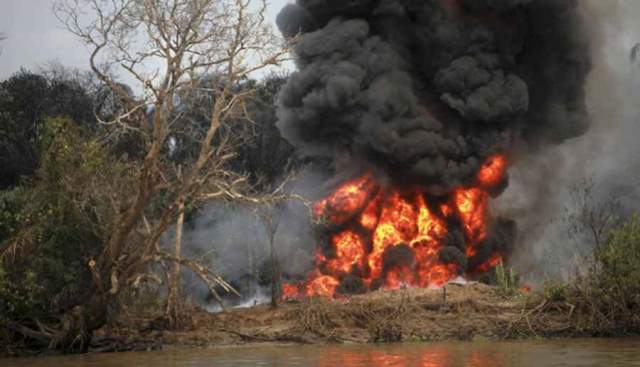
The Niger Delta Avengers has yet again blown up oil pipelines belonging to Chevron and the Nigerian National Petroleum Corporation, NNPC in Rivers State.
The attacks were carried out between Wednesday night and the wee hours of Thursday.
The group revealed this through its website and Facebook accounts as Twitter had suspended the militant groups’ account on Monday, July 4.
The statement by the group’s purported spokesman, Mudoch Agbinibo read: “Between the hours of 10.50pm to 11.10pm our (Niger Delta Avengers) strike team blew up Chevron Manifolds. The manifolds are RMP 22, 23 and 24,”
“By 3.00 am, yesterday, strike team 2, carried out a major strike, bombing NNPC pipeline at Eleme leading to NLNG. You won’t stop us,” another post on the group’s facebook page read, before wishing their Muslim brothers Eid Mubarak.
There have been renewed attacks by militants on the country’s oil installations despite pleas from the federal government for an amicable resolution of whatever the grouse the militants have with the government.
On Wednesday, President Muhammadu Buhari called on leaders and stakeholders in the Niger Delta to work for cessation of hostilities in the region, as well as strive for the unity of Nigeria, insisting that the unity and oneness of the country is not negotiable.
The U.S. National Institutes of Health said it will fund a study to monitor U.S. athletes, coaches and members of the Olympic Committee staff for exposure to Zika virus while in Brazil, with the hope of gaining better understanding of how it persists in the body and the potential risks it poses.
The study, announced on Tuesday, seeks to determine the incidence of Zika virus infection, identify potential risk factors for infection, evaluate how long the virus remains in bodily fluids, and study reproductive outcomes of Zika-infected participants.
Brazil, which has been hardest hit by the mosquito-borne virus spreading across the Americas, will host the Summer Olympics in Rio de Janeiro next month.
The virus has caused concern because it causes potentially severe birth defects in babies whose mothers were infected during pregnancy, including microcephaly – a birth defect marked by small head size that can lead to developmental problems.
The study, which hopes to enroll at least 1,000 subjects, is being led by Carrie Byington, a Doctor at the University of Utah.
“We will follow individuals who have exposure to Zika virus for up to two years,” Byington said, “Because the cohort is anticipated to include primarily individuals in their reproductive years, we will be able to study reproductive health outcomes, including pregnancy outcomes.”
“We hope to identify risk factors and protective measures that may help other travelers avoid infection,” Byington said.
The connection between Zika and microcephaly first came to light last fall in Brazil, which has now confirmed more than 1,600 cases of microcephaly that it considers to be related to Zika infections in the mothers.
Zika is the first known mosquito-borne virus that can also be transmitted via unprotected sex with an infected male partner, leading to imprecise recommendations of how long couples should abstain or refrain from unprotected sex if the woman is pregnant or hoping to become pregnant.
The U.S. Olympic study could help answer some of the big questions surrounding Zika, particularly how long the virus remains present and transmittable in semen.
The Central Bank of Nigeria, CBN, has urged Nigerians to ignore speculations and rumuors that some banks in the country have gone or may be going into distress.
This was contained in a statement by the apex bank’s Acting Director, Corporate Communication, Isaac Okorafor, describing the rumuors as malicious and unfounded.
Okorafor reiterated the CBN’s position do that the speculations do not reflect the actual health of the individual banks and, indeed, the entire banking industry.
He stated that the infusion of a new Board and Management for Skye Bank Plc is a proactive regulatory action meant to ensure that the bank does not continue to fail in its relevant prudential ratios, insisting that neither Skye Bank nor any other bank in the industry is in distress.
“The CBN would like to request the general public to ignore speculations or rumours to the contrary as they could only be the handiwork of mischief makers who do not mean well for the Nigerian banking system and its economy,” Okorafor stated.
“As the regulator of the industry, the CBN hereby reassures the banking and general public that their deposits remain safe in any Nigerian bank.”
Okorafor advised that there is no need for panic withdrawals from any bank as “going by both the CBN’s Examination Reports as well as analysis from market watchers, International Credit Rating Agencies, and Development Finance Institutions, the Nigerian banking industry remains strong in spite of the global economic challenges emanating from the collapse of global commodity prices.”
He urged the banking public to remain calm and not panic as there was no cause for alarm.
Tukur Buratai and Governor Shettima at the Eid prayer ground in Maiduguri
Borno State, North-East Nigeria, for the first time since 2011, witnessed a very peaceful Sallah celebration following the decision by the state government and security agencies not to restrict movement as security situation in the region improves.
The state, which is worst hit by the Boko Haram insurgency, had been closed to vehicular movements and out-door celebration during all festivities, be it Islamic and Christian, due to fear of terror attacks.
Residents were compelled to celebrate religious festivals under curfew or restriction of movement following incessant bomb attacks and other violent acts by the Boko Haram.
Governor Kashim Shettima had made the announcement Monday July 4, allowing all citizens of the state to have a fresh breath of air during the festival.
“After extensive deliberations, the key actors in security in the state unanimously resolved that we want to give our people dignity. We want them to have a feel of what it was to celebrate and we have resolved not to restrict movement during this year’s Eid-el-Fitri,” he announced.
Shettima disclosed that the decision to allow people roam freely on the streets this year was due to an improvement in the security situation in the state in recent times.
He added that security would be intensified as security agencies and the Civilian JTF had been directed to conduct thorough search and checks on the people.
In a similar development, the Nigerian Army has reopened the Maiduguri-Mafa-Dikwa-Gamboru/Ngala road; a key road that links Borno with Central African countries.
The 138-kilometer road is of great economic importance to Borno State and the nation but has been closed for three years by the military, no thanks to the activities of the Boko Haram terrorists.
The reopening of the road was witnessed by Chief of Army Staff, Tukur Buratai and Governor Shettima as part of activities to mark the 2016 Army day celebration in Borno State.
The embattled chairman of the Peoples Democratic Party, PDP, Ali Modu-Sheriff, has issued a Certificate of Return to Matthew Aighuhuenze for the forthcoming governorship election in Edo state despite a Federal High Court judgement in Port Harcourt on Monday, July 4 that sacked his faction of the party.
Ali Modu Sheriff presented the certificate to Aighuhuenze as the party’s flag bearer, after the chairman of his delegates congress committee, Ahmed Gulak, presented the reports of his primaries to the group in Abuja.
The Ahmed Makarfi-led caretaker committee of the PDP had on Monday, July 4, flagged off the campaign of its own candidate, Osagie Ize-Iyamu, for the same election in Benin City with almost all party notables in the state lining up behind him.
Modu-Sheriff says his faction will, in the coming days, flag off campaign for their own candidate in the same state.
A Federal High Court in Port Harcourt, the Rivers State capital, presided over by Justice Abdullahi Liman had ruled that the PDP national convention held on May 21, 2016 in the state capital which removed Sheriff as chairman, was legal and did not go contrary to any law.
The judge also held that the dissolution of the National Executive Committee, the National Working Committee and the constitution of a caretaker committee to oversee the affairs of the party by that convention was valid.
However, another Federal high court sitting in Abuja had earlier ruled that the removal of Modu-Sheriff and the formation of a caretaker committee was illegal, ordering the Independent National Electoral Commission, INEC, not to recognize any other faction of the PDP except Sheriff’s.
Modu-Sheriff told journalists in Abuja shortly after the Port-Harcourt judgment that the both the Abuja and the Port-Harcourt courts are of coordinate jurisdiction, insisting that he remains the national chairman of the PDP until the Court of Appeal sets aside the earlier ruling which was in his favour.
Over a period of several months, our reporter, SAMUEL MALIK, interacted with many Nigerian soldiers in the North east fighting in the war against Boko Haram. In this report, he tells the story of the war against terror from the soldier’s viewpoint. Except where indicated, the names of the soldiers in the story have been changed
Ahmed Yusuf is a member of the AHQ Task Force Battalion that was first deployed to Lokoja, the Kogi State capital, in 2012 to deal with the Boko Haram cell believed to be operating there.
In 2013, his battalion was deployed to Borno State, where it has since been. In that period, he has spent less than three weeks with his family back home in Ilorin, Kwara State, and his two year old daughter could not recognise him the last time he was home.
“The last time I went home, she saw me lying in the bed next to her mother and she started crying and hitting me, trying to push me away from her mother. She thought I was a stranger. It was after two days that she became used to me,” he explained.
Another soldier, John Musa, was not so lucky. The home he left so he could fight for his country had been put asunder by the time he returned. He was informed in 2015 that his wife had left with another man, leaving their two children with a neighbour.
“He was first in Maiduguri in 2011 but in 2013 he was deployed again here. He suspected that his wife was cheating but he never expected her to abandon their children. He was called last year that she had left the barracks, apparently with a civilian, who people said was always coming to the house,” one of his friends recalled.
Musa was shattered and decided to leave the army to take care of his children.
“He told us he would use the money he saved to buy a car for transport business,” his friend said.
These are some of the indignities that Nigerian soldiers who are deployed to the North east to fight Boko Haram have to suffer away from their homes and families. The insurgency has broken many homes with some wives abandoning their husbands and soldiers abandoning their wives and children to marry women in their areas of deployment, fathering many children along the way.
Some women who could not cheat on their husbands or abandon them have had to join them in their places of deployment despite the risk involved. And, the risk is as much to the woman as to her husband. Our reporter was told the sad story of a soldier in Yobe State who was killed because he refused to leave his wife behind when insurgents attacked a village where he was stationed.
“Usually, the soldiers’ wives were hidden by the villagers but on that occasion, the man decided to go back for her. That was how he was killed and the woman almost went mad,” a colleague said.
Between 2013 and 2015, like Yusuf and Musa, many soldiers deployed to the North east spent more than the standard two years allowed for deployment and spent less than three weeks with their families in that period. This is understandable as this was a time when the Boko Haram insurgency was at its peak.
It was a low period both for Nigeria and the army as Boko Haram took control of territory after territory, leaving a trail of destruction, carnage, blood and death. As the terrorist group dealt with civilians, it also dislodged soldiers at will and overran their formations easily.
In some cases soldiers abandoned their posts before the invading insurgents arrived. It was a period Nigerians got used to the phrase “tactical manoeuvre”, which the army used to describe troops withdrawing from confronting Boko Haram.
It got to a head when 480 Nigerian soldiers escaped into Cameroon, having been overpowered by the insurgents on August 25, 2014.
Three months earlier, soldiers of 7 Division Nigerian Army in Maiduguri had shot at their then General Officer Commanding, Ahmadu Abubakar, a Major General, over the death of 12 of their colleagues in an ambush by Boko Haram.
According to soldiers, while their commanders sent them to confront an enemy rated ahead of ISIS as the deadliest terrorist group in the world by the Global Terrorism Index, they were not provided with the necessary firepower to do so. All they were given are just AK-47 and few rounds.
Ill equipped soldiers confront well kitted terrorists
Many soldiers who spoke to our reporter confessed that, in the past, the biggest problem they faced confronting Boko Haram fighters were weapons. The insurgents always appeared to be better equipped and, many times, far outnumbered our troops.
The main weapon available to a Nigerian soldier is the AK-47, which is one of the most trusted assault rifles in the world due to its effectiveness and durability, including the ability to withstand all weathers.
However, despite the prowess of this rifle, soldiers took to their heels when they came face-to-face with the insurgents who had superior weapons.
It turned out that the AK-47 was no match for Boko Haram’s Anti-Aircraft guns, popularly called AA, Rocket-Propelled Grenades, RPGs, General Purpose Machine Guns, GPMGs and the Armoured Personnel Carriers, APC.
“There was no way a soldier with only AK-47 could withstand insurgents coming with AA and APCs. When we fought and exhausted our ammunition, we were left with no choice than to withdraw,” Ado Ghali, a Warrant Officer and Regimental Sergeant Major, RSM, for 21 Brigade in Bama, explained.
The lack of support weapons such as AA artillery, GPMG, RPGs and so on proved fatal when soldiers came in contact with the enemy.
Now soldiers have support weapons
“When we deployed to Gombe in 2015, there was no single support weapon. It was just we and our rifles and when Boko Haram came, they came with trucks mounted with AA. Mind you, the effective range of AA is more than double that of AK-47,” a soldier, who deserted the army following the attack and did not want to be mentioned, said.
By the time reinforcement came, including air support, more than 20 soldiers had been killed, according to him.
In addition to its superior fire power, Boko Haram also did not have regard for the rules of engagement, the soldiers said. They could use an RPG on a single soldier.
“(For instance) you may see 30 of them all carrying RPGs and they are willing to use an RPG on one person. RPG is an area target weapon. It is not meant to target an individual but these guys do not care. So, if a soldier comes in contact with such a situation, what does he do? And going by the way they operate, they prefer capturing a soldier alive in order to slaughter him,” Hamza Usman, a Major, noted.
Boko Haram, a well-trained, sophisticated army
According to the troops, they were surprised at the level of coordination and sophistication Boko Haram fighters displayed. Besides being able to operate different kinds of weapons, they engaged in tactical intelligence gathering and carried out reconnaissance and laid ambush.
“We thought these guys were the normal almajiris (child beggars) until they came out and we saw that they were so sophisticated. I believe other forces are behind them because the way they carry out attacks, you know it is beyond the talent of an ordinary almajiri. We thought it was an issue the police could tackle until the government had to deploy soldiers because of their sophistication and mode of operation,” Usman said.
“From my encounter with Boko Haram, I saw that they were well trained and coordinated, suggesting they were given military training,” another member of the AHQ Task Force Battalion said, adding that the insurgents had a penchant for launching night attacks.
Explaining a situation where the insurgents displayed their tactical knowhow, he cited how Nigerian troops were dislodged from New Marte on April 5, 2015.
Apart from their MOAB (Massive Ordinance Air Blast) and Sergei (a Soviet 23 mm anti-aircraft twin-barrelled autocannon, also known as ZU-23), the soldiers depended on their rifles.
“The bastards came around 6:35pm through some quarters shouting Allahu Akbar, Allahu Akbar. We engaged them and killed many of them. When it became dark, they sent their first suicide bomber, which demolished our MOAB. The second one was later sent to target our Sergei because that was where the highest volume of fire was reaching them from.
“Meanwhile, we had suspected they might target it after the MOAB. So, we moved the Sergei to another location and replaced it with some scrap metal. Before we knew it, the suicide bomber had rammed into the irons and exploded, killing two soldiers instantly. A staff sergeant had his both legs blown off and the soldiers with him could not carry him due to the intensity of gunshots. He was killed there while two other soldiers could not be accounted for,” the soldier narrated.
He added that they had to withdraw when it was obvious that the insurgents were getting reinforcement in droves.
A soldier who was part of the battalion dislodged from Bama on September 1, 2014, explained that the insurgents made sure to block the major roads leading into or out of the town.
He who fights and runs away, lives to fight another day
Within these two years, soldiers got so used to attacks like this that they mastered the sounds of all weapons used by Boko Haram. They used this knowledge to stay alive. In the war front, one wisdom nugget that kept many soldiers alive was to tactically withdraw when the enemy’s firepower is superior.
“When you are in a battlefield, it is important to read the battle. If the firepower from the enemy supersedes what you have, you have to manoeuvre and during the manoeuvring, you all cannot escape. Someone must pay the price either with their life or injuries,” a member of the AHQ Task Force Battalion said.
“From the sounds of firepower, you know the type of weapons your enemy has, whether it is AK-47, Anti-Aircraft, MG 4, MG 3, RPG, etc. If you don’t have what it takes to match or counter what your enemy has, it is foolhardy to remain or continue to engage them.”
Soldiers in the war front lived by the day, knowing that the day’s battle might be their last, with many constantly staring death in the face. Some went to battle wearing civilian clothes under their uniforms to aid their escape.
“Most of us would wear mufti inside our uniforms and when the attack became too severe, we would remove the uniforms and bury them with our riffles and blend in with civilians to find our ways out of town,” a soldier who eventually deserted the army said.
Soldiers and the trauma and stress of battle
Living in the frontline is a hard life
The constant fighting, daily near death experiences, killing of the enemies and losing of colleagues all take a toll on the soldiers, with many suffering from post-traumatic stress. Some lose their minds and have to be hospitalised
Earlier this year, Mohammed Ibrahim, popularly called Danfulani, a member of AHQ Task Force Battalion stationed at Gajiram in Monguno, shocked his colleagues when without provocation he opened fire on them, killing one and wounding another.
“The soldier killed by Danfulani is Lance Corporal Onate Emmanuel while Lance Corporal Etim was shot in the head and is now in the hospital,” a colleague disclosed.
The saving grace for others is that there was a jammed round in Danfulani’s rifle chamber which stopped it from firing and made it easy for him to be subdued.
Instead of getting angry, his colleagues had pity on him because, according to them, they understood his frustration.
“He was a calm guy who suffered some misfortune. He had not been able to spend time with his new wife and claimed that he was denied promotion by the army. He got into drugs while here,” a colleague said, adding that if attention was paid, Danfulani, who is now in detention, would have been saved.
What Danfulani’s colleagues did not know is that he might have been suffering from post-traumatic stress disorder. In fact, many of them might have been unknowingly battling the same mental and emotional disorder.
Post-traumatic stress is a mental health disorder that is triggered by either a tragic occurrence or a shocking experience such as the ones which soldiers constantly have in the battlefield.
When the battle gets too tough, some just ‘up and go’
Desertion, hardly heard of in the army in the past, was rife at the height of the Boko Haram insurgency. Some soldiers claimed they left due to inferior weapons they were given to confront well-armed insurgents. One soldier said that they were virtually sent to the war front to commit suicide daily as they never had the weapons to deal with Boko Haram fighters. Thus, they watched daily as the insurgents massacred their friends and colleagues.
But for others, the pressure from loved ones was just too much to ignore.
Musa, mentioned earlier, was said to have left the army to take care of his children after his wife eloped with her lover.
A soldier from 121 Battalion left the army after learning that his unit was heading to Gwoza after capturing Bama in March 2015.
He said he started having doubts about the sincerity of the army when initially they were each given seven rounds and sent to capture Bama under terrible conditions.
Even though they had support weapons, particularly one he called 50-barrel launcher, soldiers were exposed to danger. They were later given 50 rounds before advancing to Bama.
“We were detailed with 122 Battalion for the operation. In my unit, there were about 180 of us, out of about 300, that did not have fragmental jackets,” he explained.
“We camped in a Federal Road Safety Quarters along Konduga road and were there for three days. Those three days was hell. Getting drinking water was difficult and three people were required to share a sachet of water (also known as ‘pure water’).”
In spite of the 57 rounds the soldiers had, they were able to capture Bama with the help of support weapons after several hours of battle that lasted all through the night. Many soldiers lost their lives, most of whom were those that had no fragmental jackets, the soldier explained.
After this victory, the troops were to deploy to Gwoza but some of them left the army because of the Bama experience.
“My parents had said I should come home but I refused. After Bama and seeing some of my friends leaving, I changed my mind and joined them.”
Fear? The bullet that will bring you down, you don’t hear the sound
Fear is a constant companion to be brushed aside
Speaking to some of the soldiers, it was obvious that they knew what they were getting into when they joined the army, including the likelihood of death.
For this set of troops, colleagues’ deaths can serve as galvanising force. For them, there was no going back.
“In such unfortunate situation, there is no point tearing yourself up. All you need to do is pray for the repose of the fallen colleague’s soul,” George Nwamana, a Staff Sergeant, said.
For Usman, every soldier is trained to fight, even though the thought creeps in that any deployment could be one’s last.
“Going by our training, we are ready for these kinds of things but the fact that we are human beings and blood runs through our body, there is that fear. The only thing one may battle with is the thought of what happens to their wife and children if they are killed in action,” he said.
Another soldier, Austin Karfe, a Staff Sergeant in Bama, said it is normal for a soldier to be afraid of dying but the first sound of gunshot helps to dispel any fears.
“When we are asked to deploy or go for an attack, it is normal for one to have that fear but there is a secret, the moment you hear the first gunshot, the fear disappears. The shot you hear is not yours and it means you are alive. The bullet that will bring you down, you don’t hear the sound because it is not meant for you,” he explained.
Another soldier likened the feeling of losing a colleague to being drunk.
“At that moment, I am usually not myself and it is like I am drunk. All I care about is to sight the enemy and rain bullets on them. I am usually hypersensitive during this time,” the soldier noted.
Allegations of extrajudicial killings
At such moments, is it possible that emotions can becloud a soldier’s judgement so much so that he can get reckless and go beyond the bounds of rules of engagement? Can such emotional crisis, these moments of mental and psychological torture, explain or justify accusations of extra judicial killings levelled against Nigerian soldiers?
International human rights organisations such as Amnesty International and Human Right Watch in recent reports have accused security agencies in Nigeria, including the army, of extra judicial killings.
Many soldiers question such reports and refute allegations of extra judicial killings by Nigerian troops. According to Nwamana, who frowned at such accusations, the only way human rights organisations can get the true picture of events is by going to the frontline to get their information first-hand.
He narrated an instance where a soldier shot a Boko Haram suspect who tried to disarm him. In such a situation, Nwamana said, sympathisers relaying the incidence may paint it in such a way that puts the soldier in bad light.
“As a trained soldier, what do you do in such a situation? You have to defend yourself and your weapon. If that insurgent succeeded in taking the gun from the soldier, what do you think would have happened to the soldier and others there? Now, in a situation where sympathisers saw this and wanted to report it, they will paint it in such a way that tells that the soldier committed human rights abuse,” he explained.
But Usman is realistic and concedes that that a number of factors are responsible for soldiers’ behaviours regarding human rights issues. He said in the past soldiers were not grounded in rules governing warfare when dealing with civilians and unarmed enemies.
Another reason, which soldiers agree with, is as a result of the trauma resulting from their experiences with the insurgents.
“Going by the havoc wrecked by Boko Haram on soldiers, most soldiers saw how the insurgents slaughtered their colleagues. So, while not trying to excuse the soldiers’ actions, you cannot rule out that pain and misdirection of anger from some of these soldiers,” he explained.
Goodluck Jonathan laid the foundation for the success against Boko Haram
The shape of the war against terror changed sometime in early 2015. When former President Goodluck Jonathan postponed the 2015 general election by six weeks citing insecurity, many saw it as a political gimmick. But results would prove it was not a wrong move after all.
The six weeks window proved decisive in the fight against Boko Haram, even though it came a little too late for Jonathan, who lost to President Muhammadu Buhari.
Supported by 72 Mobile Strike Group, which was a team made up of South African mercenaries and Nigerian soldiers, and Belarus-trained soldiers of Special Fighting Forces Battalion, the military went after Boko Haram with so much force that in no time, the insurgents were losing territories far more easier than they captured them.
As our findings showed, majority of the towns in the North east hitherto controlled by the insurgents were recaptured before Jonathan left office on May 29, 2015.
Monguno, Bama, Pulka, Gwoza, Madagali, Gulak, Michika, Askira-Uba, Bita and others were all liberated before May 29 2015.
The routing of Boko Haram
Upon assumption of office, one of the first actions President Buhari took was to order the relocation of the command and control centre of the counterinsurgency operation to Maiduguri, the epicentre of the battle. He followed that with the sacking of the service chiefs and appointment of new ones in July, 2015.
With the appointment of Tukur Buratai, a Lieutenant General, from the Multinational Joint Task Force, MNJTF, the army aggressively moved to consolidate on the gains recorded by his predecessor, Kenneth Minimah, now a retired Lieutenant General.
One strategic move was the renaming of the operational slogan from Operation Zaman Lafiya to Operation Lafiya Dole.
“Under Operation Zaman Lafiya, Boko Haram was dislodging us in some areas and having upper hand against us. But, by the grace of God, since we changed to Operation Lafiya Dole we have been the ones seeking out Boko Haram from wherever they are to destroy them. The hunter is now the hunted,” Victor Ezugwu, a Brigadier General and General Officer Commanding 7 Division, said.
This tactics has worked in the favour of the military, as Boko Haram’s ability has been seriously degraded.
What happened in the past was that when soldiers captured a town from the insurgents, they remained contented with such victory instead of going after the insurgents. As a result, the insurgents regrouped, came back and dislodged the troops.
An example was New Marte in Monguno, where AHQ Task Force Battalion was deployed. When Kirinua, Gamboru-Ngala and Dikwa fell to Boko Haram around August 2014, the battalion retreated to 5 Brigade in Monguno to fortify the town.
However, the insurgents stormed Monguno on January 25, 2015 and captured it, with several soldiers only escaping with the uniforms on them. After three weeks, Monguno was recaptured by government forces and the battalion returned back to New Marte on March 4 only to be dislodged again on April 5.
Under Operation Lafiya Dole, the strategy is not only to capture and defend a territory but to take the battle to the insurgents.
“Don’t hold any territory for me. Take the fight to them wherever they are because the best form of defence is attack. I want you to attack them till they are forced to embrace peace,” Ezugwu, told soldiers of 251 Task Force Battalion and 81 Battalion at Bulabulin.
Brig. Gen. Victor Ezugwu on the field
Bulabulin is key in the fight against Boko Haram because it separates Sambisa Forest, which is the insurgents’ camp and Alagarno, their spiritual and logistics headquarters.
This tactics was used in capturing Bita, a former Boko Haram stronghold. The insurgents captured it when it overran 81 Battalion on May 6, 2015, forcing the soldiers to abandon their weapons and protective gears. So, the army sent 114 Task Force Battalion, which recaptured the town nine days later.
The battalion has since been able to foil over 30 attacks, as Boko Haram tries to retake it. Rather than just hold Bita, the battalion made sure that the surrounding villages were cleared of the insurgents to prevent them from regrouping.
“While we held Bita, it was necessary for us to conduct other offensive operations to clear all camps at least within 15 kilometres radius. So, we have cleared Manawashi, Bulajilin, Bulagaji, Sasawa, Tikunbere, there are a lot of them,” Emure, a Captain and operations officer for 114 TFB, told the www.icirnigeria.org.
This tactics has worked, as the insurgents find it difficult to come near troops.
“For four months now, we have not had any attack. When we go on patrol, we only see few of them and the moment they see us, they scamper away but we chase after them,” Monday Daniel, a Corporal, said with a smile.
Unlike in the past, soldiers now conduct patrols, including laying ambushes. The results have been impressive, as improvised explosive devices making factories, training camps, hideouts, etc. are destroyed. This has also led to a near-stop in suicide attacks, as the insurgents are now on the run. As a result, no single territory captured from Boko Haram within the last one year, has been retaken by the insurgents.
Also important to troops’ morale is the operational tours conducted once in a while by military commanders, something they learned from Buratai, who visits soldiers in the frontline whenever he is in the northeast.
The recent tour of over 10 locations by Ezugwu, and his decision to go by road had a major impact on the troops.
“It is visits like this that boost troops’ morale. Seeing the GOC face-to-face gives the soldiers the encouragement that they are being thought of,” Adedamola, a Warrant Officer and crew commander at Banki Junction, a strategic crossing point used by Boko Haram to reach Pulka and Gwoza, said.
Boko Haram pinned to a corner
The courage and daring the Nigerian soldier was noted for seemed to have returned. This was no doubt what Ezugwu had in mind when he visited troops in the frontline.
“I can assure you that when we finish with Boko Haram and Nigeria becomes free and regains its place as one of the most powerful nations in the world and history is being written about those who defeated terrorism, defeated insurgency, especially with Boko Haram tagged the most deadly terrorist group in the world, you will be remembered and regarded as some of the greatest soldiers on earth,” he told them.
The soldiers also showed their appreciation by roaring their commander’s nick name “Zuma, Zuma”.
This camaraderie between the army leadership and soldiers is one of the two reasons soldiers said are responsible for the victory against Boko Haram.
“The motivation has been that sometimes you see the brigade commander in front of you leading an attack with his riffle. What motivation is better than that? This is one of the main things that have motivated troops,” Nwamana told the reporter.
Aside the commanding officers leading from the front, soldiers have also been motivated by the provision of support weapons.
With the capture and deployment of troops and patrol operations in Bama, Banki, Banki Junction, Gwoza, Askira-Uba, Damboa, and Bulabulin, the military has succeeded in caging the insurgents within the dreaded 80 square kilometre Sambisa Forest by forming some sort of circle round it.
In addition to these, the capture of Alagarno, Kumshe and Kala Balge proved a fatal blow to the insurgents while the recently conducted Operation Crackdown around the Sambisa general area involving 21 Brigade, 25 Brigade, 26 Brigade, 28 Brigade, and 7 Division Garrison further confined them to the forest.
The Motorcycle Battalion launched in February this year has also played a key role in securing major highways, especially the Maiduguri-Damboa-Biu road, which was opened four months ago. In the past, travellers had to go through Damaturu, Yobe State, sometimes spending about eight hours for a journey of three hours.
No regrets running away from Boko Haram
Soldiers are now happy to confront the insurgents knowing they have the right equipment that answers at the right time and the results are what Nigerians are seeing now, as Boko Haram has been rendered a spent force.
Do they regret turning their back on the enemy? They said they would do it again.
“People say as soldiers we have signed to die at any time but they fail to add that all human beings have signed to die at any moment once they are born. In the case of soldiers, you cannot say it is their destiny when they die at the hands of Boko Haram as a result of their leaders looting money meant for the purchase of weapons to help them confront a better equipped enemy,” a soldier explained.
According to the soldier, it is for a reason that the saying, “he who fights and runs away lives to fight another day”, exists.
But as it would now seem, Nigerian soldiers have not only lived to fight another day, but they are now taking the battle to the insurgents who are now the ones fleeing.
Problems persist on the home front
Far away from home
Even though many of the soldiers who spoke to us were in high spirit, many of them still worry about their families back home, sometimes to the point of distraction.
In addition to dealing with the stress of fighting insurgents, soldiers deployed in areas where there are no network services find it difficult to communicate with their loved ones. They sometimes rely on friends who are going to town to call their family members.
“Sometimes it was an amazing experience because the woman you are telling that her husband was fine does not believe you. She would ask why you got the chance to go to town and not her husband. Sometimes you hear her crying on the phone and do everything to assure her that all was fine. Some other times, it was a funny experience because the woman did not speak English and you did not speak Hausa but still you found a way of conveying the message,” a soldier explained.
Other times, the family members would just have to endure.
But now, army commanders have made it easier for soldiers to keep in touch with loved ones by providing Wi-Fi in military bases. In addition to chatting, they are allowed to make calls at least twice a week using social networks like Facebook, WhatsApp and IMO.
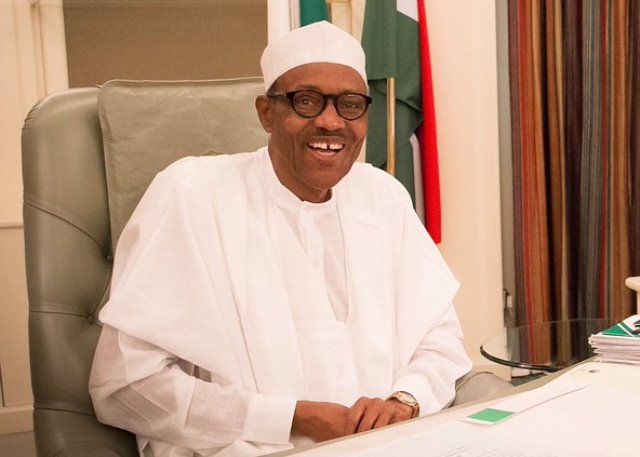
President Muhammadu Buhari has called on the Niger Delta Militants and all those calling for the break-up of the country to work for peace in the country as the unity of Nigeria is not negotiable and to keep Nigeria one is a task that must be done.
The President made the call at the Presidential Villa when residents of the Federal Capital Territory led by Vice President, Yemi Osinbajo paid him a Sallah visit after the Eid prayers in Abuja on Wednesday.
The President called on well-meaning Nigerians to persuade the militants to give peace a chance, saying that his administration would continue to ensure justice and fairness in the country.
The President vowed that his administration would ensure that Nigeria continued to exist as a geo-political entity.
He said a lot of success has been recorded in checking the activities of Boko Haram.
“We are now concentrating on the militants to know how many of them are there in terms of groupings, leadership and to plead with them to try and give Nigeria a chance, Buhari said.
“So, please pass this message to the militants, that `one Nigeria’ is not negotiable and they had better accept it.” The president assured the militants that they will get what is stated clearly for them in the Nigerian constitution and that justice will be done.
The President also called on those in possession of Nigeria’s stolen funds to return them peacefully and negotiate with the government.
According to him, Nigeria is seriously in need of the stolen funds to uplift the quality of life of its citizens.
“And please tell those with plenty of money, which does not belong to them to try and negotiate and return it in peace so that both they and us will be in peace, otherwise, we will continue to look for it,’’ he said.
Speaking earlier, Vice-President Yemi Osinbajo, noted that the past one year had been tough for the government and Nigerians because the administration had been doing a lot of “land clearing”.
He, however, reiterated the administration’s commitment to delivering on its promise of a positive change in the country adding that “things are already looking up.’’
He prayed that the President would continue to get the wisdom and strength to overcome all challenges facing the country.
President Buhari had performed the Eid prayers at the Mogadishu Mosque in Abuja.