The trial of a former governor of Nasarawa State, Aliyu Akwe Doma, and two others continued on Wednesday, June 22, 2016 before Justice Agatha A. Okeke, with a prosecution witness, Ego Abashe, the Clerk of the Nasarawa State House of Assembly, revealing how the former governor had allegedly diverted the sum of N350m from the state funds.
Doma alongside Timothy Anjide, a former Secretary to the State Government, and Dauda Egwa, a former Accountant-General, are being prosecuted by the Economic and Financial Crimes Commission, EFCC, on a 10-count charge bordering on money laundering and financial crimes.
The accused persons between January, 2007 and December, 2009 allegedly conspired and fraudulently laundered state funds to the tune of N8bn, an offence contrary to Section 14(1)(a) of the Money Laundering (Prohibition) Act 2004 and punishable under section 14(1) of the same Act.
At the resumed hearing today, Abashe told the court there was no approval or record by the House of Assembly for the sum of N350 million allegedly disbursed under the title of ‘‘special releases’’.
Abashe, who was led in evidence by Kemi Phinheiro, SAN, also told the court that the State House of Assembly did not initiate the disbursement of N70 million as shown to him in exhibit 23aa-cc.
He added: ‘‘I can’t recall the disbursements of N80 million as shown in exhibit 23ca; N150 million as shown in exhibit 23ab and N120 million as shown in exhibit 23ba, as there was no record or memo initiated for such releases; and there was no cheque raised for special releases in the office of the House of Assembly.’’
Abashe, who stated that he was familiar with the records of the House of Assembly even before becoming the Clerk, added that ‘‘ for additional funding, which is not captured by the budget, the Clerk will put out a memo endorsed by the Speaker of the House of Assembly and addressed to the State Executive (Governor). The Governor would approve the memo, which would be conveyed to the House of Assembly and then taken to the Office of the Accountant- General for a cheque to be released.’’
According to him, funding of the House of Assembly is initiated by a memo and not by any other means.
While under cross-examination by A. F. Yusuf regarding the disbursements, he said that he was not the Clerk as at the time the disbursements were carried out.
He, however, said the procedures for disbursement were the same and were all in the files.
Still testifying, he said: ‘‘Monies meant for security matters are not addressed to the Clerk or channeled to the Clerk, as security matters are not discussed in the House of Assembly.’’
Another prosecution witness, Abubakar Ishaq, Permanent Secretary, Bureau for Cabinet Affairs and Special Services, presented two documents titled: Expenditure Needs for the Nasarawa State Public Services and Part of Nasarawa State Executive Council Convention, which were tendered and admitted as exhibit P30 and P31, respectively.
He told the court that the documents were to guide government officials, ministries, departments and agencies particularly in areas of finances.
Ishaq, who was formerly a director in the same office, said: “It was proposed that the governor could not make expenditure above N50m. However, the Governor can expend any amount and later make ratification provided that the expenditure was done in the interest of the state and in accordance with due process.’’
When Ishaq was presented with exhibit P20, which was an approval for N496 million initiated by the Office of the Secretary to the State government, he told the court that there was no ratification by State executive council for it.
Also, going through exhibit P23 (cc), which was the approval granted by Doma for N150 million and P23 (ba) for N120 million , he told the court there was no directive to the State executive for ratification and he did not receive any ratification for it either.
The case has been adjourned to June 23, 2016 for continuation of trial.
President Muhammadu Buhari has warned staff in the presidential villa to avoid dipping their hands into the treasury to avoid going to jail and causing embarrassment to their loved ones.
The president gave the warning on Wednesday during his first meeting with the staff. He urged them to learn from the government’s ongoing anti-corruption drive, adding that only those who have helped themselves to public funds are prosecuted.
“You and your family will earn respect. But, if you short-change the treasury, you will be caught and I pity your family, because people will be abusing them. People will be calling you big thieves; that how did you raise money to build all the houses in Abuja and Europe with your meagre salary.
“I think personal integrity is something to be encouraged. I assure you that I am absolutely dedicated to serve Nigeria. Those who behave themselves will never regret. But, those who don’t behave themselves, is their problem,” the President said, adding that there is no going back on the fight against corruption.
He also assured that government is preparing to ensure that next year the country feeds itself.
“We have to quickly go back to the farm. It is too late for this year. But, next year, we will make a better arrangement to make sure next year, we can feed ourselves,” he said.
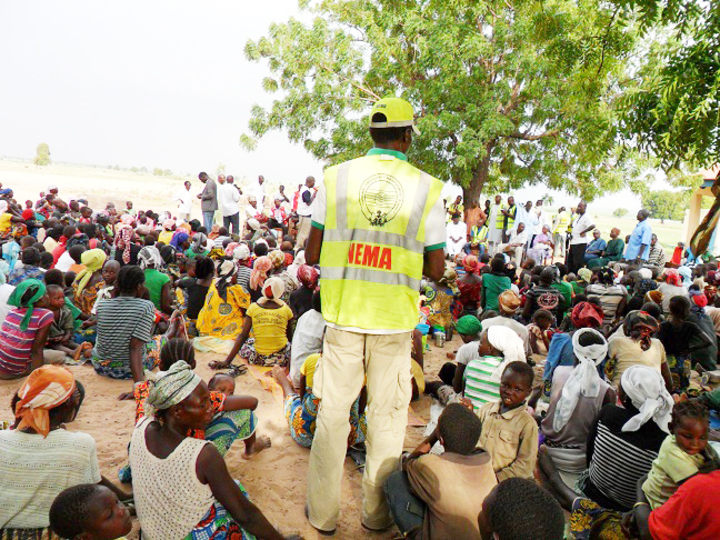
National Emergency Management Agency, NEMA, on Wednesday began the screening of hundreds of refugees that fled Boko Haram attack in Bosso, Niger Republic.
National Emergency Management Agency, NEMA, on Wednesday began the screening of hundreds of refugees that fled Boko Haram attack in Bosso, Niger Republic.
Some Nigeriens and Nigerians living in the Nigerien border town with Nigeria, had fled the insurgency attack on the town about a week ago to villages in Geidam Local Government Area of Yobe State.
Speaking to journalists, the field coordinator of NEMA in Yobe State, Mohammed Abubakar said the screening and profiling of the refugees and the displaced people will last three days.
He revealed to journalists in Geidam that the agency has so far registered over 5000 refugees including IDPs. He added that about 100 malnourished children were also captured in the exercise.
When our correspondent visited Geidam thousands of displaced persons were seen sleeping in the open including motor parks and primary schools under extreme difficult situation.
It was gathered that the attack on Bosso created panic along the Niger/Nigeria border in the Northeast with many people displaced from Kannama, Abadam, Demasak, Kareto areas of Yobe and Borno states.
Also discovered were refugees from Diffa and Bosso in the Republic of Niger.
Speaking to journalists, the NEMA field coordinator said “we were sent down to assess the exact number of people displaced by Boko Haram in Bosso, Diffa in Niger Republic, and Kanamma town in Yunusari local government area of Yobe state.
“We are here base on the directives of Mr. President to assess their exact number, and forward recommendation for relief assistance and succour to the displaced persons.”
He however said that in the interim, immediate palliative of food items were brought and would be distributed to ease the fasting difficulties, while the main intervention is on the way.
Items distributed includes 25 bags of rice, 25 bags of sugar, 20 cartons of milk, 20 cartons of beverage, 20 cartons of noodles and Nylon mats.
Speaking on the number of people screened, Abubakar said, “we have so far registered up to 5000 people including women, children and adult. There is the possibility that the number will go up because today is just our second day in Geidam and we are carrying out this exercise for three days.
One significant thing I have observed is the high number of malnourished children. Their conditions are critically and intervention has to be timely for this people,” he said
The screening of 47 ambassadorial nominees by the Senate has been put on hold following what federal lawmakers called irregularities in the nomination process.
The exercise was suspended on Wednesday after Joshua Dariye raised a motion under matters of urgent national importance, alleging the non-inclusion of the names of competent career diplomats from among his constituents.
This was supported by Sola Adeyeye and Fauster Ogolar who also believe the nomination process was faulty.
After deliberations, the Senate summoned the minister of Foreign Affairs, Geoffrey Onyema, to appear before its committee on Foreign Affairs to explain the nomination process.
Senate President, Bukola Saraki also joined in criticizing the nomination process while announcing the Senate’s resolution to suspend the screening.
The Senate Committee on Foreign Affairs is expected to meet with the minister and report to the Senate in one week.
A Primary Healthcare Centre in Zuma, Bwari Local Council of FCT, built at the cost of N21,986, 983.95 as an MDG project has not received a single patient since it was completed in 2014.
The reason is not that people in the farming community of Zuma are immune to illness, but because government has refused to open it and residents of the community still have to travel on bicycle to Bwari to access medical treatment and to have their pregnant women put to bed.
“Even though the PHC is completed with all necessary amenities, including a borehole, government is yet to staff the clinic and open it for us,” says a resident of the area.
This discovery was made by Public and Private Development Centre, PPDC, a Non-Governmental Organisation that seeks to promote citizens’ participation in governance.
The PPDC visited the community recently to see how the health centre was contributing to the quality of life the people were living, but was shocked to find that the investment was actually wasting.
Seember Nyager, leader of the team, said they found an abandoned facility that was under lock and key when the community was “crying” for medical attention.
Nyager said in a report that residents of “ the Zuma community had been excited when the PHC was being built because they had believed that it would take away the hardship of having to access health services farther away – especially in emergency situations. Unfortunately, since the completion of the PHC, it had not been commissioned or used for its purpose. Two years after its construction, the existence of a PHC in Zuma community has made no difference to the lives of its inhabitants,”
Worried by such waste of national resources, the PPDC sought a meeting with the Senate Committee on Public Procurement and they were scheduled for June 20, to discuss the abandoned health facility and how it can be put to use for the benefit of the people.
Members of the PPDC team included Samuel Umejiaku, Ugochi Ekwueme, Gift Omoidedia and Nkem Ilo.
But when the team arrived National Assembly for the meeting, members of the committee were not on hand to meet them. Instead it was the clerk of the committee, Lawal Bugundu, that met with them.
Bugundu asked them why they had come, and after the explanations he told them what could have happened to the project.
“After explaining the duties of the committee, he went on to ask about the project, it’s location, the name of the contractor and the agency handling the project which Seember responded to. He also asked about the present status of the project and if we have confirmed from the National Primary Health Care Development Agency, NPHCDA, the liquidity of the project. He explained that some projects might have been implemented by the contractor without funds from the FG who will then release funds after implementation. If funds are not released by the FG, the contractor holds on to the project until funds have been paid by the FG.
“Furthermore, he revealed that about 11,000 projects have been abandoned across the country while in Niger Delta, contractors are paid mobilization fees as high as N200 million without mobilizing. He thanked the PPDC team for bringing this to his notice and promised to carry out an investigation on the matter.”
It’s about midday in mid-May at the 7 Division Medical Services and Hospital, Maiduguri, Borno state. Visitors to the ward for severely-injured soldiers are welcomed by the soothing lyrics of Max Lucado’s My Heart Will Trust.
Though I walk through valleys low
I’ll fear no evil
By the waters still my soul
My heart will trust in you
This is no routine song; it is a song for trying times, for seeking consolation during hardships, maybe also for battling depression.
It is no coincidence, too, that the music is buzzing from the HP laptop and portable woofer of a soldier shot in the thigh by Boko Haram. Recuperating in conditions utterly undermining the gravity of his sacrifice to fatherland, the soldier reckons his hospital stay is a “walk through the valleys low”; he is left with no choice but to let his “heart trust in God”.
Make no mistake: a soldier felled by the enemy’s bullets while defending his country’s territorial integrity has no business trusting in God alone; he should be trusting in his country — in the government, in the army and in the people in whose interest he headed to the battlefront. A cheery soldier, he has no qualms exchanging banters with a stranger, and even offers to transfer the song to him.
Bad combo: Gunshot wound plus heat stress
A few beds away, another soldier is fanning his gunshot wound with a handheld mat made of raffia fronds. Yes, with a local mat! There is power outage and the ward is fusty. There is also a standby generator; just that all it does in periods of power outage is to stand by… because it is hardly fuelled.
A soldier sits by the rechargeable fan he bought to beat power outages
While those soldiers who are slightly heat-tolerant are content with just furling the blinds to reduce airlessness in the ward, others have self-purchased rechargeable standing fans. One way or the other, each soldier has devised an ingenious way of keeping himself and his wound aerated, proving that this incident of power outage without the cushion of generator is anything but a one-off.
One soldier soon politely asks a visitor to switch on the television by the entrance. The visitor kindly obliges. As the air conditioner is also close by, the visitor asks if he should switch it on as well.
“That one?” the soldier replies. “No. It’s not working; it’s merely there for decoration.”
The ward itself is ordinary. Take away the patients’ beds and tiled floor, and what is left is a nondescript room only slightly better than a manger. It is doesn’t look a shade like a befitting recuperation centre where any serious country keeps its heroes.
At the 7 Division Hospital, no soldier exhibits the willingness to speak with a reporter; it is understandable. Located inside the Maimalari Barracks, Maiduguri, this hospital is the first drop-off zone for soldiers injured by Boko Haram. Most of the injuries here are fresh, ranging from a few days to a few months. Their frustrations are at their earliest stages, so it is logical that they are unwilling to talk just yet.
However, at the 44 Nigerian Army Reference Hospital, Kaduna, where injuries are stale, ranging from many months to a few years, it is much harder for the soldiers to hide their plight. Their sufferings, therefore, are noticeably easier for a fact-finding journalist to dig up.
Like 7 Div, like 44 Hospital
44 Div Hospital, Kaduna
It is a familiar welcome to the 44 hospital in Kaduna: electricity outage, poor ventilation, heat stress, furled blinds, hurting soldiers. Why, for heaven’s sake, should soldiers be nursing their injuries in this kind of heat?
“There is a big generator over there,” an annoyed soldier tells no one in particular. “See the kain heat wey person dey suffer. There is a “big generator”, he explains, but dem no go put fuel.”
It is not a particularly spic-and-span ward. Hanging loosely over the beds are dingy mosquito nets, held together by straps fastened to the supposedly butter-colour but pale walls. It will be a miracle if the ceilings aren’t leaking, as cracks in the asbestos are palpable from afar. Overall, it’s a far-from-dignifying setting.
Food sans protein
Soon, it is lunch time. A soldier jokes that this “good yam porridge” is what they feed on to “refresh and freshen up”. It is a banter the server is pleased to accept, remarking: “We want you to heal very well.”
Any wonder what kind of porridge Nigeria’s heroes are eating? It’s an all-starch affair — yam served without fish or meat, or any other protein supplement!
Disturbing as these discoveries are, they are purely superficial issues. At an adjoining ward, there is a one-eyed soldier who is at the mercy of the authorities. Blinded in the right eye by fragments of a Rocket-Propelled Grenade (RPG) fired by Boko Haram on the battlefield, the soldier (name unknown because it wasn’t an interview but a conversation obtained undercover) is awaiting referral to a better hospital abroad.
Blinded soldier awaiting referral
And while he awaits that referral, the problematic eye remains plastered while two Play Station keypads and his laptop (out of power again!) offer him escapism from his anguish and the anxious wait.
A soldier who had been discharged several weeks earlier and was only returning to the hospital for an appointment with the doctor asked the one with the eye injury why his case had still been unattended to.
“You’re still here?” the concerned, surprised soldier asks in pidgin. “When I travelled, I thought your case would have been sorted before my return.”
“For where?” the victim replied, also in pidgin. “They said my case cannot be handled here. They will have to refer me elsewhere, but I don’t know where.”
For more than one week, this soldier had been awaiting referral to another hospital. One-and-a-half weeks of awaiting transfer to a more competent hospital! That itself must have been a frustrating experience for him, but what is unbelievable is that this is an injury he has been carrying since April 2014.
At some point, he was referred to a hospital in Lagos; it didn’t work. Abuja has been mulled as well, but it hasn’t happened. As it is, he is currently wasting away in Kaduna, as one of the many victims of needless bureaucracy and corruption in the army.
A few soldiers also offered to speak on the deeper issues — anonymously, though.
Bone-setters better than military hospitals?
Corroborating soldiers’ complaint about their treatment, a member of the Armed Forces Special Force (AFSF) shares the story of an injured colleague who was forced to leave the military hospital to seek care from traditional bone-setters, following a mine explosion.
On May 30, 2015, nine AFSF guys were travelling along Banki, where they withdrew to after leaving Sambisa. But between Bama and Banki, they were caught by mines planted by Boko Haram. Six people died instantly; their bodies were shred into pieces. Two of the other three would die later; the third is “neither alive nor dead”, facing the grim possibility of losing his two legs.
The victims were listed as Adamu Dan Fulani, Jubril Livi, one Ita, one Bukar, “a certain Gabriel who joined the army back in 1996, and one dark guy who mounts their GPMG”.
“I would have died myself because I’m always in that Mohak,” recalls the soldier, one of a special breed of military men trained in Belarus to combat Boko Haram as a sniper. “It was just fate that made me jump down [before the mine explosion] that day.”
The only full-fledged survivor, “without any form of immediate injury”, was the driver. But he would die quietly in his sleep few days after, “due to internal bleeding”.
“The officer that escaped, U.B Gbasa, is not normal as I am talking to you because when he was flung out by the explosion, he landed on his head at a very far place,” he adds.
“The guy has only been trying to act normal, but he has been doing lots of abnormal things.”
U.B. Gbasa, a naval officer, is currently attending an engineering course in Sapele, Delta state, and is the only victim who is “completely alive”.
“The other person was hit in both legs,” he adds. “They almost cut his leg at the 7 Division Hospital but he was shouting that they should not cut his leg, until the navy evacuated him and took him to hospital.”
The victim, he explains, stayed a few months at one of the military hospitals in Abuja, where he was evacuated to, but he eventually sought better treatment with bone setters.
“There is no further indictment of care for injured soldiers than learning that a colleague left a military hospital for local, unqualified bone-setters. Need I add anything?”
Drugs’ scam
A second soldier speaks of how soldiers were being short-changed by the 44 Hospital through the hoarding of drugs that should ordinarily be available to them under the National Health Insurance Scheme (NHIS).
“As I speak to you now, when drug is above N200, soldiers are meant to buy with their money. When nurses go to DRS with your file and you are meant to have hard antibiotics that will facilitate you treatment, the pharmacists will say we have only Panadol or Vitamin C oh! No Augmentin, no Diclofenac, no Cataflam, so, bros, you will have to buy it yourself,” he says.
“But if you can give a civilian the money to go to the same Drug Revolving Scheme (DRS), he will come back with heavy packets of the drugs. Most of the soldiers buy their drugs themselves because they want to stay alive. We know that they have been feeding Buhari with lies, but he will come in one day to see for himself.”
These are allegations that Sani Usman, spokesman of the army, would have none of, insisting that the NHIS caters to the medication of every officer or soldier (including certain numbers of members of his family) during illness.
“Yes, I agree that sometimes our DRS may not have some of the prescribed drugs in stock,” he says.
“You can’t have a hundred per cent stock of drugs in the hospital and pharmacy at all times. But what they [the soldiers] do is to go outside, buy the drugs, tender the receipt and they will be repaid. It may take time but they will be repaid.”
Lone bright spot: Brigadier-General Okeke
Military Medics
ALL the soldiers who aired their complaints also had words of appreciation for Ikechukwu Okeke, a brigadier-general and director of the 44 Hospital. They all hailed his transfer from the 7 Division Hospital to the 44 Hospital, saying it had given hope to many soldiers who had been deprived of “minor” needs.
“About 50 to 100 soldiers got hearing aids after the arrival of Brigadier-General Okeke,” one soldier says.
“When former director was here, they were discharged without receiving the aids. For how long will soldiers be lacking something as basic as hearing aids? The hearing aids cost just about N180,000 to N200, 000.
“Mr. Man, that is not too much for soldiers who lost their hearing as a result of blasts. If Maiduguri is not calm, nobody will stay in Kaduna here. Thousands of soldiers have sacrificed their lives.”
There are similar words of encouragement for a certain Dr. Ken, who is “in charge of all orthopaedic cases at this hospital”, but also calls for reinforcement, to ease the burden on him.
“It’s too much work for one doctor to handle the scores of orthopaedic injuries referred to this hospital,” adds the soldier. “What does it cost the army to employ more experienced doctors to join him?”
No help for psychologically-traumatised soldiers
Soldiers training in the desert
For the nature of operations in the north-east, which often require soldiers to spend several weeks in the bush, soldiers are often in need of regeneration that transcends the physical realm. Two incidents in Maiduguri on May 9 proved that soldiers are in need of psychological management far more than the authorities think.
At about 2pm on the day, a soldier sauntered into the Soldiers’ Club inside the Maimalari Barracks, failing to maintain any form of coherence in gait, speech and looks. He wasn’t drunk at the time, but when he spoke it was though he blended English with Hausa. For the two hours he spent at the club, he struggled to string two clear sentences together back to back.
Much later in the evening, at about a quarter past 6, a Hilux van bearing some AFSF members turned in an injured soldier to the 7 Division Hospital. As the hospital ambulance met up with the van to receive the victim, someone mentioned that he had been shot in both legs by Boko Haram, in Sambisa.
All the AFSF members went into the hospital premises to witness the handover of the injured to the hospital, save one — a gracefully tall, remarkably dark fellow who pranced up and down one minute and then sat alone quietly the next. It was a strange sight to behold, watching him swing between fits of animation and stillness just in a matter of seconds.
In his animated mood, he did act like a Muhammed Ali preparing for ‘Rumble in the Jungle against George Foreman, or, when he chose to run around, like a Chioma Ajunwa training ahead of the Atlanta 1996 Olympics. When he sat still, he wore the aura of a devastated mourner, someone whose losses were far too weighty for words.
When the soldier’s actions were explained to another soldier the following day, he was unmistakeable in his analysis: “Look, those are the signs of a psychologically-traumatised soldier.
“That is a soldier who has seen lots of tragedy in the bush, who has lost his colleagues to blasts and mines, who has run into decomposing bodies of his friends that were not retrieved by the army, whose mental store house are filled with surreal images.
“Take a good look at me, I wasn’t drinking until I started going to the bush. But when five of us are in a group and in a second all four others are gone, why won’t I come here to drink my sorrows away?”
One week later, in Kaduna, another soldier re-echoes those words. “I left my parents pure; clean. All these things you see me do, I learnt them inside the bush.
“In fact, I was blessed before I left my parents; they prayed for me. Na inside this army I learn all these things.”
Strained love lives and ‘scattered’ marriages
AFSF soldiers ready for battle
A major complaint among the soldiers was failure of the army to fulfill its promise of rotating soldiers posted to the north-east. The tradition in the military is that soldiers get deployed for upwards of two years (maximum) after which they are rotated. In addition to subjecting soldiers to psychological trauma (caused by several consecutive months in the forest “without tasting the town”), the practice is also straining their love lives and “scattering” their families.
“I can count how many families have scattered; both mother and daughter impregnated at the barracks while the father is here fighting Boko Haram,” a soldier who was in Kareto during April’s high-casualty attack by Boko Haram, says.
“But before — during Minimah’s time — soldiers were rotated. You were here for six months and you left. But these days, the army drops somebody here for complete four years just because the boss can fly a jet to anywhere he likes. In fact, because of two much familiarity, some soldiers here have turned to Boko Haram members, selling army equipment.”
A 35-year-old civilian, who has spent his entire life in and around the Maimalari Barracks because his father was a soldier, speaks in similar vein: “I know some soldiers here, four GOCs have come and gone, and they’re still here because they’re ordinary soldiers.
“In this Maimalari, when you come for night parties, you will be dancing. You don’t know that all those people you’re dancing with are soldiers’ wives. I went to one party, I saw a fine woman and I was dancing with her. I was trying to hold her and she was saying no, no.
“When the dance was over, someone started pointing the women at the parties, saying, ‘You see this one, her husband is in Mali; this one, her husband is elsewhere.’ After that party sef, na only God know where those women go sleep.”
The soldier from Kareto cuts in, recalling the experience of a soldier whose wife was put in the family way while he was away on the battlefield.
“One young soldier slept at his colleague’s place and saw the neighbour’s wife whose husband is in the Niger-Delta. Today, he buys bread and says ‘Tolu take.’ She smiles, collects it and thanks him.
“Another day, he buys yoghurt. Before you knew it, this guy impregnated the woman. When the soldier came back and saw a pregnant wife, he had to end the marriage.
So, you marry now and you are sent on operation to Maiduguri or elsewhere. Before you return, the family you were working for has already scattered. Now, tell me, what’s your gain? Will you start from square one again? Is this what you planned with God? Those of us who are here and our family is still intact, it’s by God’s grace.”
Patience… but for how long?
To sum up the grievances of the injured soldiers, Joel Hamidu, whose limbs were chopped off by explosives in August 2015 but is still awaiting prosthesis, says the plan is to “calm down” and patiently wait for what the army and the government have to offer.
“They said all these while that they were waiting for Buhari to sign the budget, so I am trying to exercise patience and listen to the lyrics they are playing to me,” he says.
“We are all calming down because we don’t want to compromise discipline in the army. We are all patient to see if the army has anything to offer us, but as you can see, for how many years will it take the government of the day to make provision for us? That is the irony.”
NEXT: The intriguing love story of Joy Johnson, whose boyfriend joined the army and — after an attack by Boko Haram — suffered amputation of his left. Joy went ahead to marry him even though the tragedy had cruelly altered their love life.
The Nigerian Army has denied that it has neglected soldiers wounded in the fight against Boko Haram, saying reports on the contrary are only meant to demoralise troops and downplay recent successes against the terrorists’ group.
The army was reacting to an investigation by TheCable, an online newspaper, which exposed the terrible conditions wounded soldiers are facing in military hospitals in Maiduguri and Kahuna.
The investigation, done by TheCable’s editor, ‘Fisayo Soyombo, with support from the www.icirnigeria.org, exposes the corruption in the welfare of wounded soldiers, some of whom have had to wait for months, even years, without any hope in sight.
But the army has said the allegations are not true.
In a terse statement issued by army spokesperson, Sani Usman, a Colonel, the army said the report is “unacceptable” and “inaccurate”.
“Most of narrations were outright falsehood and calculated attempt to cause disaffection amongst personnel.
“It is therefore safe to conclude that ICIR and The Cable have embarked on yet another round of subversive activities in order to portray the Nigerian Army and the nation as uncaring. This is in an effort to score cheap popularity or create an aura of a professional investigative journalists for themselves. They are far from that, rather they are bunch of fifth columnists that enhance the work of crisis merchants and terrorists.”
However, as if to contradict itself, the army suggested that the allegations are true but said they did not happen under the current leadership.
“It is important to state that most of what they were alleging took place between 2012 and early 2015. This did not take into account the changes and progress recorded within the last one year especially with the coming on board of the present Chief of Army Staff, Lieutenant General TY Buratai in July 2015,” it said, adding that the current leadership of the army takes seriously the issue of welfare, including flying wounded soldiers abroad for treatment.
“Additionally, from July 2015 to date, no fewer than 71 officers and soldiers with medical issues were medically evacuated to various countries such as India, UAE, Scotland and Germany by the Nigerian Army. It is important to note that while some were treated abroad, others were treated here in Nigeria by specialists based on the severity of their cases. Those with prosthetic limbs made in India are 16 in number, while those with prosthetic limbs procured in Nigeria are 9 in number,” the statement added.
While saying it has nothing to hide, the army said it will not tolerate infractions from its personnel with regards to troops welfare.
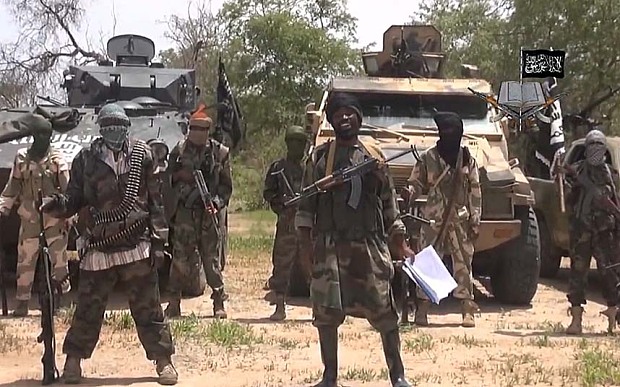
A senior US army general, Thomas Waldhauser, has said the Boko Haram terrorist group have fractured internally, with a big group splitting from its leader, Abubakar Shekau.
The general said the split is because of Shekau’s failure to adhere to directives from the Islamic State, IS.
General Waldhauser, who is the nominee to lead the US military’s Africa Command, suggested that the internal division was illustrative of the fact that there’s a limit to IS’s influence over Boko Haram despite the pledge of allegiance by Boko Haram last year.
Waldhauser revealed this during his nomination hearing before the US Senate Armed Forces Committee.
He said Shekau has not fallen in line with Islamic State’s instructions including ignoring calls for Boko Haram to stop using children as suicide bombers.
“He’s been told by ISIL to stop doing that, but he has not done so and that’s one of the reasons why this splinter group has broken off,” he said.
He added that the IS were trying to re-unite the two factions.
Waldhauser acknowledged that the IS has not been of much financial help to the Boko Haram but perhaps in tradecraft and trading, adding that he is more concerned with the splinter group which might act more in concert with the Islamic State.
“What concerns me is the breakoff group of Boko Haram who wants to be more IS-like, and consequently start, like the IS, to target western interests.
The Niger Delta Avengers have denied being part of a one-month ceasefire agreement with the federal government.
Sources at the Ministry of Petroleum had claimed that the federal government has brokered a one-month ceasefire with the various militant groups in the Niger Delta region, including the so-called Avengers.
“It was very difficult getting the Niger Delta Avengers to the negotiation table, but we eventually did through a proxy channel and achieved the truce,” the official had said.
Hours later, however, the militant group issued a statement via their twitter account, denying the purported ceasefire agreement.
The short statement read: “the NDA high command never remember having any agreement on ceasefire with the Nigerian government.
The group had reeled out a number of conditions to be met before it would agree to a negotiation.
The conditions included the involvement of the home countries of the various international oil companies operating in the Niger Delta region.
The Avengers are also demanding sincerity on the part of the government, saying it would be the major factor that would affect the possibility of a dialogue.
The group also warned the government and the oil companies to suspend further selling or buying of crude oil from the region, and not to carry any repair works on damaged oil facilities.
The renewed attacks on oil and gas infrastructure in the Niger Delta has brought Nigeria’s crude oil production to a 30-year low of just a little above one million barrels per day.
The federal government has asked heads of federal government tertiary health institutions to fill the vacancies created by Resident Doctors who have abandoned their training programme in protest of what they called poor welfare.
The directive by Isaac Adewole, Minister of Health, was contained in a circular by the Permanent Secretary of the ministry Amina Shamaki and addressed to Chief Medical Directors and Medical Directors of the tertiary health institutions.
The circular reads: “It has come to the notice of the Management of the Ministry that some Resident Doctors in your establishment have voluntarily withdrawn from the Residency Training Program by refusing to report for training without authorization.
“Public Service Rule, PSR 030402 (e) is relevant. This is in spite of the ongoing negotiations on their demands put forward by the representatives of the National Association of Resident Doctors under the auspices of the Nigerian Medical Association.
“In view of this development, you are hereby directed to replace all the doctors that have withdrawn their services, with others from the pool of applicants for the training programs in the various disciplines in order not to create ominous gap in training with attendant disruption of healthcare delivery in your facility”.
However, Oluwole Atoyebi, Registrar of the National Postgraduate Medical College, on Wednesday said the federal government has not sacked any doctor from Federal Tertiary Health Institutions in the country.
Atoyebi said following an intervention by the Speaker of the House of Representatives, Yakubu Dogara, all the parties involved has agreed that the directive by the Health Minister be rested for now.
“No doctor has been sacked. While the resident doctors have been told to suspend the strike, the Ministry has been told by the Speaker to rest the directive for now, and that has been agreed by all parties,” he said.
The ministry of health said it is working with the panel on the review of the Residency Training Program in Nigeria, to fast-track the development of a comprehensive blueprint for postgraduate training of doctors in the country.
Activities at most teaching hospitals and federal medical centres were paralysed as a result of the doctors’ strike.