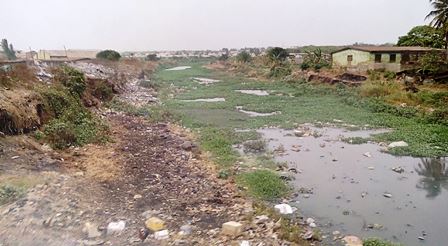
Home Blog Page 3034

MDGs In Anambra: The Good, The Bad And The Ugly

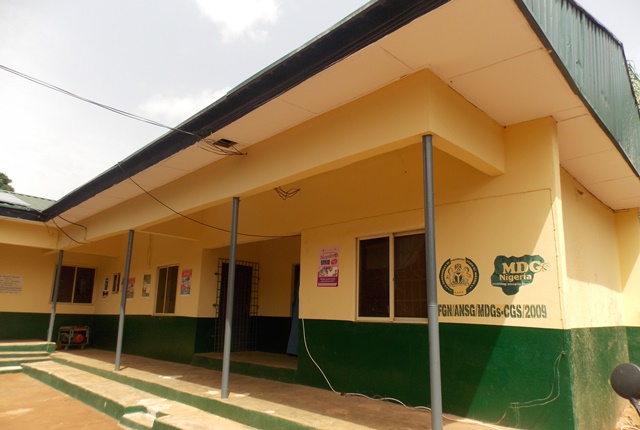
MDG renovated school

This report by Alfred Ajayi of Radio Nigeria Purity Fm, Awka, Anambra State, was done with support from Ford Foundation and the International Centre for Investigative Reporting.


When world leaders came together at the United Nations Headquarters in New York in September 2000 to adopt the United Nations Millennium Declaration, following decades of conferences and summits, the aim was to commit nations of the world to a new global partnership to reduce extreme poverty.

They set out eight time-bound targets with a deadline of 2015, which became known as the Millennium Development Goals, MDGs, which ended December 2015 and has since January 1, 2016 been succeeded by the Sustainable Development Goals, SDGs.

The final MDGs Global Report indicated that the 15-year programme was the most successful anti-poverty initiative in history, with over 50 per cent reduction in the number of people living in extreme poverty, almost 50 per cent reduction in the proportion of undernourished people in the developing regions. Primary school enrolment rate has reached 91 percent, and many more girls are now in school compared to 15 per cent a few years ago.

But in Anambra State, investigation revealed that MDGs implementation only started in 2007 under the administration of Governor Peter Obi.

Professor Stella Chinyere Okunna, former Commissioner for Economic Planning and Budget in the state, who also chaired the MDGs Implementation Committee, said Governor Obi pursued MDGs with uncommon commitment.

“The MDGs were also his vision because when he came in, he adopted what he called Anambra Integrated Development Strategy, ANIDS, because every sector needed attention, none was developed. He looked around for how to implement this all sector policy and he saw in the MDGs an instrument that could help him implement his own multi-sectoral programme and vision. So immediately we adopted MDGs as our own vision. So, to make sure we achieved our own vision, we had to achieve the MDGs. So whatever other states were doing, if they did ten per cent, we were always compelled by our own choice to do ninety per cent, because they were just doing MDGs as doing it, but we were doing it to achieve our own vision,” she stated.

She said further that for the Obi administration, achieving the MDGs was almost like a do or die affair as the administration devoted every effort to it. She stressed that Obi put in a lot of money into the MDGs because it tallied with his vision..

“Because it was Peter Obi’s vision, he put in a lot of money. MDGs would not have given you such huge sums. For every implementation circle, you put in like N500 million orN600 million. They give you another six hundred million. That is N1.2 million. But Peter Obi put in billions and billions of Anambra money.”

According to a document containing the MDGs Conditional Grant Scheme, between 2007 and 2013, 360 VIP toilets and 120 solar powered boreholes were provided in the 21 local government areas of the state in 2007.

The year 2008 saw the construction and equipping of 10 skills acquisition centres, drilling of 66 solar powered boreholes, supply of 21ambulance buses to all the local government areas, provision of water buses to riverine areas of Anambra East, Anambra West, Awka North and Onitsha North, as well as supply of medical equipment and drugs to 138 primary health centres, PHCs and 15 general hospitals in all local government areas.

In 2009, 42 primary health care centres were rehabilitated, 11skills acquisition centres constructed, medical equipment were supplied to 105 PHCs, while small town water schemes were executed in Awka South, Njikoka, Dunukofia, Nnewi South, Anaocha and Oyi Local Government Areas.

Medical equipment and drugs were supplied to PHCs in Awka North and Orumba South and Anambra West Local Government Areas in 2011, with massive renovation of school infrastructure, provision of boreholes, reactivation of solar powered boreholes and construction of VIP toilets.

Small town water schemes were provided in Achalla, Awka North;, Ozubulu in Ekwusigo;, Umuoji and Obosi in Idemili North;, Oba in Idemili South, as well as in Ogbaru, while hostel blocks were constructed at School of Nursing, Iyienu;, School of Midwifery Idemili North; Saint Charles Boromeo Hospital Onitsha;, Holy Rosary Nkpor;, Schools of Nursing, Midwifery and Medical Laboratory Science all in Ihiala;, School of Midwifery Adazi;, Heart Centre Adazi and General Hospital, Amaku, Awka.

Under the 2011 MDGs Conditional Grants Scheme, CGS, N600 million was disbursed to three local government areas, while 304 projects were delivered across water, health and education sectors.

In 2012, 2,250 persons from 25 communities of Anaocha, Anambra West, Ihiala, Ogbaru and Orumba South Local Government Areas benefitted from the MDGs Conditional Cash Transfer.

In 2013, it was construction and renovation of classroom blocks, provision of school black boards, instructional materials, financial grants to co-operative societies, purchase of medical drugs and equipment, provision of referral ambulances, provision of motorized boreholes, rehabilitation of water facilities, provision of waste management equipment in health facilities, in Anaocha, Ekwusigo, Idemili North, Ogbaru, Ihiala and Oyi.

The sum of N5 billion was provided for the execution of projects ahead of the 2015 MDGs deadline, for the execution of regional large water schemes, small town water projects, boreholes, abattoirs, Schools, Healthcare facilities and medical staff quarters amongst others.

In September 2013, cheques for another N1.2 billion were handed over to six other local government areas of Anaocha, Ihiala, Idemili North, Ekwusigo, Ogbaru and Oyi, with each receivingN200 million, to develop healthcare, renovate schools and sink boreholes, among others.

In February 2014, N10 billion naira was released to continue rehabilitation of public and mission schools and for accelerated execution of various projects, all in a bid to meet the MDGs.

MDGs – a blessing in Anambra State

With the knowledge of the implementation of MDGs in the state, visits were paid to selected communities to ascertain the gains of MDGs and how they impact on the lives of the people.

Residents submitted that MDGs was a mixed blessing in the state.

The chairman of the MDGs Implementation Committee during the last administration, Professor Chinyere Okunna, claimed the programme was a huge success.

“I don’t want to be immodest, but our performance in MDGs was quite good. I think we were about the first state to carry out poverty mapping in Nigeria, supported by DFID. We did that to identify where the extreme poor people live and we saw that they were in Ayamelum, Anambra West, Orumba South, Awka North and Ogbaru side without neglecting other local government areas, we concentrated on them,” Okunna stated.

“And again, one thing we found out was that their poverty was mainly because they were inaccessible, they had no road. So, the very first road we built as a government was to Ayamelum. We opened up those rural areas with good roads, so that they could evacuate their farm produce because they were all food producing areas. They began to have access to input for agriculture even for visit from government officials and the poverty level improves drastically.

“Other poverty reduction interventions were carried out. For instance we implemented the safety net under which people of 75 and above, who were indigent without pension and no one to take care of them, were paid N5,000 each every month. Also women of child bearing age, who had young children in school but couldn’t afford to maintain those children. If they were pregnant and were attending ante natal clinics with public health institutions, they also received this kind of MDGs intervention.”

The committee chairman said further that the government also trained women especially the poorest among them, in variety of handicrafts and gave out sewing machines, hair dressing and bakery equipment.

In the area of education, Professor Okunna said one of the biggest steps taken by the Peter Obi administration was the return of schools back to missions.

“There was opposition from his own government, NUT, everybody. But he defied everybody and returned them and that has really revolutionalised education here. The church came into a kind of unique partnership with the government. There was massive renovation of schools and construction of new classroom blocks in every community which gave them facelift. The money was given directly to the schools, which engendered honesty and competition. And it was cheaper so they could renovate hundreds of classrooms.

“If you had awarded contracts, may be one quarter of what was done would have been done. The morale of the teachers was boosted because secondary schools in the state whether public, mission or private received computers, library, laboratory equipment and buses. And the seed we sowed began to germinate even when Peter Obi was still there, our children began to lead in WAEC and NECO.”

The Permanent Secretary in the Ministry, Andrew Umeobi who just retired from service, also argued that MDGs changed the face of Anambra State in many respects.

“MDGs report has been produced and you find out that in the South-East, Anambra State is number one. Number doesn’t mean that we got everything right. It is relative. There is how they marked it, green, amber, red and so on and so forth. Anambra state had more green and amber than other states like Ebonyi which had a lot of red,” he said.

In the same vein, residents interviewed unanimously gave the MDGs a pass mark for the transformation it brought about especially in the health and education sectors.

The President General, Isuaniocha, Dr Alfred Nkwonta, said MDGs was a blessing to the community, with the provision of boreholes, generating set, fridge and tricycle for the Primary Health care centre, provision and renovation of school structure.

Sir Mike Opia who hails from Ogbaru agreed that MDGs succeeded in Anambra State.

“In education, there is success story. I remember the immediate past administration initiated this direct cash disbursement under the MDGs to schools whether public, private and missionary schools. Initially people were complaining and stood against the method, but the governor stood (firm) and today go to our public schools, you see structures. In fact now, we in the Civil Society have argued that one of the reasons Anambra State is performing well in public examinations – WAEC and NECO- is because the carrying capacity of our educational institutions at that level has improved and there is enabling environment for teaching and learning.”

“Talk of health, yes, there are also some successes. Some institutions that needed to be accredited were equipped and I think we succeeded there, even though is not yet uhuru. Just yesterday, we were talking about some medical equipment that were distributed to various hospitals that were not being enjoyed by the end users,” Opia observed.

Visits to communities across the state indicated that Ojoko Memorial Primary School, Nawfia had done well with MDGs with the provision of VIP toilet and a block of classrooms and offices.

In Anambra West Local Government Area, the water borehole provided at the community secondary school, Umueze-Anam, has been meeting the water needs of the school as attested to by the one of the Vice Principals, Dominic Okafor.

“Sincerely speaking, the MDGs programmes that the Anambra State government keyed into right from the time of Peter Obi and which has been accelerated by Governor Obiano has really reduced the plight of our people, especially potable water. Like in the school here, we have our VIP toilet given to us courtesy of MDGs and it is wonderful. Some toilet infections that we used to experience in the past, we no longer see them again. Not only that, before this toilet came, all around you see our students in the bush, going to defecate. But now, that one is a thing of the past. The environment is clean. The students had been given orientation on how to maintain that place. And then, the state of hygiene both within and outside the classrooms has been improved,” he said.

Some primary and secondary schools visited in Anaku, Omor and Igbakwu, all in Ayamelum Local Government Area and those in all the eight other selected local government areas of Awka North, Dunukofia, Njikoka, Orumba North, Nnewi South, Ekwusigo, Oyi and Anambra West, had their classroom blocks renovated, with some provided with VIP toilets and water boreholes.

In the area of health care delivery, MDGs intervened with renovation of Primary Health Centres, supply of drugs and equipment, provision of VIP toilets, placenta pits and tricycles especially to aid mobility during immunizations and emergencies.

Primary Health Centres in rural communities such as Anaku, Omor, Mgbakwu, Umueze-Anam, Mmiata Anam, Amichi, among others, benefited from the installation of solar panels to serve as alternative to power from the national grid.

There were also multi-billion naira investments in secondary and tertiary health care, which facilitated the accreditation of the state university, now known as Chukwuemeka Odimegwu Ojukwu University Teaching Hospital, Amaku Awka.

Water sector not so good

While the global report indicates that the target of halving the proportion of people who lack access to improved sources of water was also met, in Anambra State, it was the submission of some residents that MDGs implementation in the water sector was not such a big success..

For instance, Opia who lamented over the failure in the water sector implementation of MDGs, said:.

“Even though in South East Zone, Anambra State came first in MDGs implementation, there are a lot of failures in the water sector. That was basically because of the way MDGs was designed. It was designed in Abuja and in most cases they didn’t have the local environment situation in mind. They cost the provision of boreholes as a universal thing, but you find out that there are geological and geo-physical differences.

“If that is not taken into consideration in costing the boreholes, you find out that in most cases, the contractors will just carry the money, when they get to the sites and discover that the money cannot do what they were asked to do, some abandoned the projects and ran away. Some would play a fast one like pouring water into the overhead tanks and after inauguration, it dries off. The problem is from the design and I think the SDGs is taking care of that shortfall in MDGs by trying to be specific in the design of projects, so that we will outgrow this problem witnessed under the MDGs.”

Radio Nigeria during visits to some of the communities discovered that many boreholes and small town water schemes provided under the MDGs were not functioning, while some of those that still work at the moment were either reactivated by the government or the benefitting communities or institutions.

Non-functional or moribund water projects are found in Ifite- Awkuzu, Anaku, Amichi and Ozubulu.
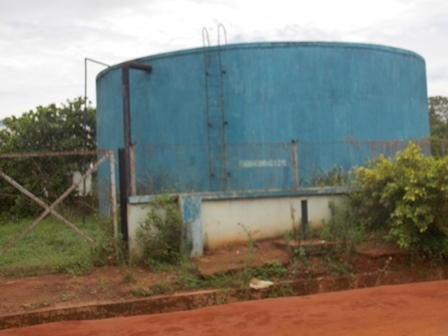
Non-functional Water scheme at Egbema Ozubulu

Obinna Edochie who resides in Ifite-Awkuzu, regretted that the water scheme which brought a big relief to the community after completion, worked only for short time and stopped.

The water scheme provided for the people of Anaku had also stopped giving water to the people as revealed by residents including, Peter Okoye.

“I can’t just tell when the water was provided. When I came back from Ghana, I met it. I came back 2010. It has not been working. They told me that it worked only few days and stopped. Since then, it has been covered with bush as you can see. We still get water from the streams and well. We are suffering here,” Okoye stated.

The administrative officer of Abba, Njikoka Local Government Area, Okpala Fabian, wondered why government would execute project that cannot serve the purpose intended, by not getting to the point they will strike water sustainably.

“Well, it is not encouraging at all. If a project like that is supposed to be sited here, it must be fully sunk, getting the real aquiver where the water rests, not when the water gushes out, you stop it and during the dry season, everything dries up. It was functioning before,” he said.

The Health Officer in charge of one of the Primary Health Centre in Ukpo, Florence Osakwe lamented that all efforts by MDGs to give them water failed.

“MDGs tried severally, they couldn’t get water. They just packed their equipment and left just like that, we didn’t see them again up till now. But the Rural Women Foundation, they came and gave us water here”.

One of the problems with the water sector implementation of MDGs is vandalisation and theft by residents of host communities.

It was gathered at the primary health care centres in Mgbakwu, Awka North Local Government Area, and Amichi, Nnewi South, that part of the boreholes provided by the MDGs were stolen by unscrupulous unidentified persons.

Another resident of Mgbakwu, Chijioke Iferike Oliver, condemned the shoddy job done by contractors, who handled some water projects in the community.

“The MDGs water project in the Community Secondary School is uncompleted because they couldn’t get water from that place. Then during the inauguration; they bought water and put inside the tank. Two or three weeks after inauguration, they couldn’t get water again up till this moment. The one at the Community Primary School was meant to serve both the school and Unity Primary School. It is not also functioning now. It was completed then, it functioned, they got water from the borehole, but I don’t know what actually is the cause.”

The borehole provided at the Primary Health Centre, Omor, did not work at all, while the one at St Mary’s High School Ifitedunu, was reactivated by the management of the school.

Concerning the low performance of MDGs in the water sector, Professor Okunna, the former MDGs implementation committee chairman and now Head of Department, Mass Communication, Nnamdi Azikiwe University, Awka, agreed that some of the boreholes failed but argued that MDGs water sector segment of MDGs was not a total failure as there are water projects which were successfully completed and are meeting the water needs of the people up to date.

“Borehole was not the solution. But when we came in, there was no water at all and we needed to provide something as soon as possible and the only option was sinking of boreholes, before we plan for big water scheme. Most of those boreholes that didn’t work are the solar ones because solar technology was new and many didn’t really understand it as at then. But the communities claimed that they could not afford the motorized boreholes, the fuel for the generator. So they began to convert to solar boreholes and many of the boreholes didn’t work, that is the honest truth.

“However, others that worked, communities are failing to take ownership. When we visited some of them following complaints that they were not working, we discovered that something as small as fuse could blow and they will leave it waiting for the government to come and replace them. Consequently, we began the campaign to make sure that people take ownership of those projects. Also some of the medium level water schemes at Ifitedunu, Ukpo, Ozubulu, and Atani to mention few, worked when they were commissioned and they began reticulation before we left.”

Investigations also revealed that some of the gains of MDGs are being eroded due to alleged shoddy execution, failure to take ownership of projects and sustain some of the lofty initiatives or lack of maintenance culture.

The Nursing Officer in charge of one of the Primary Health Centres in Ukpo, Florence Osakwe, lamented that the solar panel installed at the centre only worked for two months after installation and all efforts to call the contractor back to rectify the fault failed.
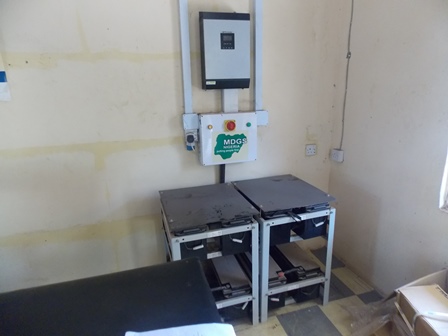
Solar power at a PHC in Ukpo, worked for only two months

Besides, some of the schools repainted in the past had lost their beauty and needed repainting, while supply of certain drugs to most primary health centres had since stopped.

 Obiano’s administration to the rescue

Governor Willie Obiano has at different fora lamented the failures and lapses in MDGs implementation under the previous administration and had pledged to reverse the trend.

The governor recently inaugurated small town and regional water schemes in various parts of the state including Abatete, Nanka, Igbariam, Ihiala and Umunze.

False claim of projects and reversal of MDGs gains

Visits to Comprehensive Secondary School and Community Secondary school, both in Nawfia, revealed that the VIP toilet and solar powered borehole claimed to have been provided by the MDGs were non-existent.

Radio Nigeria had a chat with one of the teachers in the school, Ezisu Linus.

“As for the solar power borehole, they did not install any borehole here. The borehole you see here was done by Nawfia indigenes residents in the USA as we were told when we came here because the school was operating from town hall before we came in January 2012.. In case of VIP toilet, we saw two burnt toilets here, I don’t know whether MDGs provided it or not. But recently, one Honourable decided to renovate the two toilets. He just put zinc on them. We didn’t see any name of MDGs as they normally inscribe on their projects,” he said.

Allegation of corruption and denial

One of the reasons people adduce for the failure particularly in the water sector is corruption and connivance between government officials and contractors.

A former member of the state House of Assembly, Val Ayika, shared his experience with MDGs during oversight visits to some of the projects.

“The target of course wasn’t met, no two ways about it. But human existence in developing world has been uplifted to some extent, because if you move around, you will see some subsisting projects boldly marked MDGs. However, it was such a regrettable and condemnable thing that when we visited Orumba, I must be specific, we saw a borehole project believed to have been an MDG project but finally turned out to be an individual borehole. And the individual, who happened not to be in town, we spoke with him on phone and he confirmed that it was his own personal borehole.

“We also visited a transformer put by the town union, which was claimed to be an MDG thing. The legislature is not completely carried along to know the full details of the projects,” the legislator said.

But, Okunna denied the allegation of corruption or connivance with contractors as according to her, everything t was done with transparency and accountability to the best of our knowledge.

“Really, the Ministry of Planning was doing the small boreholes. The big water schemes were handled by the Ministry of Water Resources under Emeka Nwankwu. And I don’t remember any shady deal, I don’t know, I won’t tell you I know. But as far as we were concerned, what we did was above board. The implementation of the MDGs was done through the communities. They gave the projects we implemented and we told them to also keep an eye on those projects even as we did a lot of monitoring ourselves. So, I don’t see where the fraud would have come in,” the Mass Communication Professor said

Opia, a member of the MDGs Steering Committee from the civil society, also believed the process was transparent to a large extent.

“To the best of my knowledge and what was made available in the steering committee, by the Desk Officer, who was in charge of day to day administration of those projects. I didn’t see really any manipulation. I was part of the process of contract awards. But you know we are in Nigeria and you cannot rule out some of these under hand deals. But particularly, failure was not due to manipulations and corruption among government officials because it would have affected other sectors”

In an interview, an official in the MDGs office, John Paul Onyekineso, denied the allegation from some citizens that the MDGs projects in their communities especially water projects, were not functioning at the time of inaugurating them.

“Quote me anywhere, there has never been any project constructed that never worked at the point of commissioning or after commissioning. The project failure will normally start due to mismanagement on the side of the community members. There is no how we will commission a project that is not functioning, it is not possible. Any community that is saying that their project is not functioning, let’s go there and you see that the problem is exactly from the community side because the project must have been completed and handed over.”

Onyekineso also disclosed that the Anambra State government is still waiting for the federal government to contribute its counterpart fund for the implementation of MDGs projects for 2014 and 2015, adding that the lessons from MDGs will help the state in executing the Sustainable Development Goals, SDGs, whenever the federal government flags off the implementation.

The final MDGs Global Report also states that despite the huge success recorded by MDGs around the world, the job is unfinished as there is urgent need to end hunger, achieve full gender equality, improve health services and get every child into school. The SDGs are expected to guide policy and funding for the next 15 years, beginning with the historic pledge on 25 September 2015 to end poverty everywhere permanently, including Anambra State.

In Anambra State, any development programme including Sustainable Development Goals, will have to focus on equipping primary health care centres for qualitative service delivery, recruitment of personnel, sustainable distribution of drugs to PHCs, making the school environment better and more conducive for teaching and learning with adequate security, provision of toilet facilities across communities and public places to enhance public sanitation, provision of water on a sustainable basis.

Several efforts made to speak with the Chairman, House of Assembly Committee on MDGs, Patrick Aniuno, on the role legislative oversight will play in ensuring value for money were not successful as he kept postponing appointments for an interview. Eventually, he failed to speak with the reporter before going to press.

However, respondents expressed the hope that the current administration of Willie Obiano and those after it would learn from the experiences of MDGs and adopt better strategies for implementing the Sustainable Development Goals.

They also suggested community ownership of all projects in their localities, diligent and regular monitoring, engendering of maintenance culture and above all sincerity on the part of those saddled with the responsibility of implementation.


Buhari Urges Speedy Passage Of Executive Bills

0

Buhari-Saraki-and-Dogara

President Muhammadu Buhari has called on the legislature to ensure speedy passage of the five executive bills before it in order to help his anti-corruption war.
The five executive bills now before the National Assembly include: the Money ‎Laundering and Prevention Bill of 2016‎, Mutual legal Assistance in Criminal Matters Bill, 2016, the Federal Capital Territory Appropriation Bill, 2016, the Statutory Budget of Niger Delta Development Commission (NDDC), and Bills for Acts for domestication of agreements for avoidance of double taxation between Nigeria and South Korea, Spain and Sweden respectively.
The President made the appeal during a dinner at the presidential villa, Abuja on Monday to mark the 2016 democracy day and his one year in office. The dinner had members of the federal legislature and some chieftains of the All Progressives Congress, APC, in attendance.
While pledging his administration’s commitment to the law of separation of powers, President Buhari expressed his gratitude to the lawmakers for the thorough but speedy scrutiny and passage of the 2016 budget.
“Let me again appreciate the work of the National Assembly for the painstaking and consensual work they did with the Executive to deliver the 2016 Appropriation Act. It is on record that this is one rare occasion where the Appropriation Act was assented to with the schedule( details). This is a good start in our journey of change.”
The president then drew the attention of the legislators to the five executive bills with particular emphasis on the FCT Appropriation Bill, 2016 and the Statutory Budget of Niger Delta Development Commission (NDDC)‎, 2016. He stated that if their budget was not passed, they would be unable to execute their project and run the affairs of their offices.
“I am conscious that on June 9, 2016, the National Assembly will complete one legislative year. May I appeal to you to consider and pass these submitted bills, particularly the statutory budget of the FCT, the NDDC Budget and the budget of statutory corporations. These bodies cannot execute their statutory mandate nor incur expenditure for the year unless their budgets are approved by the National Assembly.”
Speaking earlier at the dinner, Senate President and chairman of the National Assembly, Bukola Saraki, ‎thanked the President for the invitation and called for more interaction between the various arms of government in order to strengthen and solidify democracy in the country.
Speaker of the House of Representatives, Yakubu Dogara, ‎ former vice president, Atiku Abubakar, National Chairman of the party, John Oyegun, and leader of All Progressive Congress, APC, Bola Tinubu, were among the dignitaries that attended the dinner.

IGP Asks IPOB Members To Disarm

0
Inspector General of Police, Solomon Arase

IGP Asks IPOB Members To Disarm

Following the killing of some police officers by members of the Indigenous People of Biafra, IPOB, on May 30 in some states in the South East, the Inspector-General of Police, Solomon Arase, has ordered the group to immediately disarm or risk arrest.

The directive, contained in a statement released on Tuesday by the Force Public Relation officer Olabisi Kolawole, said the Police has performed its statutory functions in the most professional and civil manner since the latest Biafra agitation resurfaced, but warned that with the current attacks on its personnel, the IPOB activists had crossed the line.

The IPOB, MASSOB, and some other pro-Biafra groups in the five Southeastern states of Abia, Anambra, Ebonyi, Enugu and Imo had gathered on Monday to celebrate ‘Biafra Day’ in memory of Late Chukwuemeka Odumegwu Ojukwu, but the events turned sour in Anambra state, as the army, police and pro-Biafra activists clashed, resulting in the death of over 30 persons including some policemen, while several of the protesters were arrested.

The statement said: “ Following the manifestation of the disposition of the armed Indigenous People of Biafra (IPOB) activists to undertake premeditated attacks on Police officers engage in operations aimed at restoring public order in States in the South-East and South-South geopolitical zone of the country, the Inspector-General of Police, IGP Solomon E. Arase has directed the Assistant Inspectors General of Police and the Commissioners of Police in the affected area to disarm members of the group operating firearms immediately.”

The Inspector-General also directed that any member of the IPOB found in possession of firearm be arrested and brought to justice, while all the activists arrested in connection with the killing of the Policemen should be charged with murder.

He however assured Nigerians that the Police Force will remain committed to their safety and security and will continue to work diligently towards eliminating any threat to internal security in the country.

Military Takes On Pipeline Vandals, Kills Unspecified Number

0
Photograph: Premium Times

The Nigerian Army says its men on Sunday engaged suspected pipeline vandals, who it claims were on a mission to blow up oil installations, in Bayelsa State, killing some while others escaped with injuries.

Army spokesperson, Sani Usman, in a statement, said troops from 343 Artillery Regiment of Brigade, 82 Division, in the early hours of today encountered some of the vandals during a patrol exercise within Gulobokri and Eweleso, around Brass in Bayelsa State.

“During the exercise, the patrol team had an encounter with some armed militants in 2 Speed boats with intents to blow up Nigerian Agip Oil Company (NAOC) pipeline at Gulobokri. The suspected vandals opened fire on the patrol team. The troops responded with overwhelming superior firepower and as a result, the suspected criminals sped off from the area with many of them sustaining gunshot wounds. No casualty on the patrol team,” the army said.

He added that a member of the team from the Nigerian Security and Civil Defence Corps, NSCDC, sustained gunshot wound but was in a stable condition, having been evacuated for treatment.

In another development, the army said a separate team from the same 82 Division patrolling at Perigbene House Boat encountered three speed boats with suspected militants. The troops opened fire on the boats and killed several of the suspected vandals.

“However, the casualty on militants cannot be ascertained as it was raining heavily and the raging storm could not allow troops to go on pursuit of the escaping criminals.

“A mop up operation has been organized for those militants that escaped with gunshot wounds and injuries as they may be receiving treatment in the neighbouring communities,” the statement added.

The army said it would continue to intensify its surveillance in the area to prevent further attacks on the oil installations.


Bomb Explosion Kills Soldier, Four Civilians In Borno

0

Troops Soldiers Army

A soldier, who sustained injuries from a bomb explosion in Bui, Borno State, has died at the hospital, the Nigerian Army has announced.

Four civilians, including a woman and her child, died instantly while three persons were injured when the a tricycle, popularly called Keke NAPEP, accidentally stepped on the IED planted by roadside along Biu-Damaturu road near a military checkpoint.

The incident happened around 8:00am on Sunday.

“Unfortunately, the IED exploded instantly killing 4 persons comprising of a woman with her baby and 2 other male adults. Three other persons were injured including a soldier and they were immediately evacuated to Biu General Hospital. We regret to state that the injured soldier also died at the hospital.

“The general area has been cordoned off and Explosive Ordinance Device (EOD) team from Forward Operation Base (FOB) in Buratai have been mobilized to carryout further search of the area,” a statement issued by army spokesperson, Sani Usman, said.

The army said that investigation showed that the explosive device was planted a long time ago and had remained undetected.

“This unfortunate development has brought to the fore, the need for more security consciousness and vigilance among all.

“We would like to reiterate that the explosion would not deter us from seeing to the end of Boko Haram terrorists wherever they might be hiding through our ongoing clearance operations,” the army said in the statement.


The Life And Times Of The Woman On The Fifty Naira Note

69

The naira is the official currency of Nigeria and one of the symbols of its nationhood. First issued in 1973, this currency has seen several devaluations over the years but more importantly, it has been deployed to honour some of the Nigeria’s past heroes. However, this important national symbol has also been used to reinforce age-old patriarchy through the sheer proportion of male portraits that grace the naira especially the fifty naira banknote


By Kolawole Talabi

In 1991, the Central Bank of Nigeria (CBN) issued a new denomination of the naira, Nigeria’s official currency and legal tender for transactions within the country. Within months of its circulation, the newly minted denomination had humorously assumed a new denotation on the streets. Nigerians, surprisingly, dubbed the blue-hued banknote ‘Better Life’ in a period when the country had barely recovered from the economic woes of IMF’s Structural Adjustment Programme despite the estimated $12 billion oil windfall of the Gulf War.

Since average incomes and the accompanying standard of living had fallen due to the prolonged austerity, why then did struggling Nigerians dub the new banknote ‘Better Life’?

Although life was not better in Lagos or Asaba, the country’s first lady at that time – Maryam Babangida- had ceremoniously embarked on a financial jamboree purportedly towards uplifting Nigerian women out of poverty. Launched in 1987, two years after her husband seized power in a military coup, Mrs Babangida’s welfare project was called the Better Life Programme for Rural Women and amongst its noble objectives was “raising the consciousness of the rights of women, the availability of opportunities and facilities, their social, political and economic responsibilities.”

The ‘Better Life’ tag has since stuck to the fifty naira note. Even though the Central Bank of Nigeria has issued four higher denominations since 1991, no other banknote has had such metonymic appellation as the fifty naira banknote. Regardless of the sentiments of good fortune which it inspired, the fifty naira bill has a rather ugly side that most Nigerians, especially women, have not taken note of. Whether my accident or intention, the fifty naira banknote is an affront to the dignity of Nigerian women with which it supposedly shares a convoluted history.

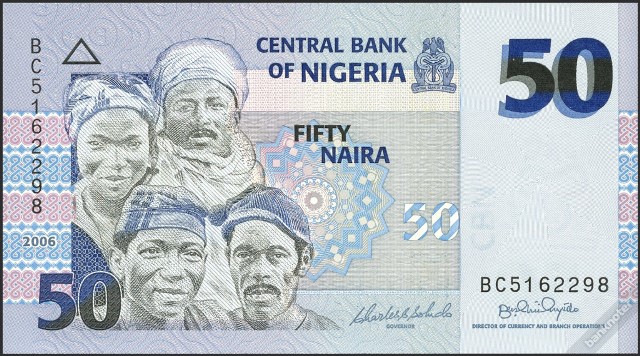
Designed to inspire feelings of nationalism that is rooted in the equality of Nigeria’s different ethnicities, four culturally relevant portraits which depict Nigeria’s diversity appear on the fifty naira. On the reverse side of the banknote, another set of portraits showcasing the industry of Nigerians appear with three men engaged in fishing, an economic activity that is predominant in rural areas. Both sides of this banknote seem to appeal to Nigerians to embrace diversity and industry as a means to peace and progress. Unfortunately, this is where the good story ends and the sad one begins.

Fifty Naira Note

At a closer look, the fifty naira note is very much a symbolic expression of the entrenched patriarchy in Nigeria’s postcolonial society. Out of the seven portraits on the fifty naira, only one is female. As a matter of fact, the fifty naira has been reissued once since its initial launch in the early 1990s. In the first design, the lone woman on the front occupies the central portion of the banknote. Despite being outnumbered by her male ‘counterparts’, she appeared as a key figure in the designer’s attempt to symbolise Nigeria’s unity in diversity.

By the time the fifty naira was redesigned in the 2000s, her portrait had been moved to the left margin of the note. Now, it seemed that she appears as a fixture on the margins of Nigerian society. This subtle change in the design of this particular banknote is an example of the inequality that the average woman faces in Africa’s most populous country and economic powerhouse.

Despite their contributions to Nigeria’s advancement, women are still assigned provincial roles in state affairs and they are overwhelmingly discriminated against in many facets of our national life.

National symbols such as currencies convey nuanced feelings of the significance a society places on its past and present icons. Globally, progressive nations have used women figures as portraits on their currency to commemorate the roles which they have played in history. Queen Elizabeth II graces the British pound and Evita Peron is an immanent feature on the Argentine peso. The recent decision by the US government to put Harriett Tubman on the twenty dollar bill is a testament of the political will that recognizes the contribution of a black woman to America’s greatness.

In Nigeria, this hasn’t been the case. In fact, just one of the nine currently used denominations of the naira bears the portrait of a woman on its front. The naira has thus been used to reinforce the inequality that exists between the genders. Mrs Babangida and her successors (about seven since her husband was forced to step down in 1993) have all missed an opportunity to use their status to campaign for redesigning the naira to drive the narrative for gender equality and also, call for a rethinking of issues that afflict women at the margins of society.

Despite being a signatory to the Maputo Protocol, Nigeria merely pays lip service to the rights of women to social and political equality with men. Since 2005 when Nigeria ratified the Protocol to the African Charter on Human and Peoples’ Rights on the Rights of Women in Africa, the Central Bank of Nigeria has issued another banknote—the thousand naira banknote and the naira’s highest denomination. Like its precedents, the thousand naira note is graced by men. In, fact the 1000-naira bill has the portraits of two men—former governors of the apex bank.

Even the roll call of past and present governors of CBN is overwhelmingly male. Out of the 12 chief executives who served the bank since its establishment 58 years ago, only one is a woman -Sarah Alade. And she merely served in an acting capacity. What is more, Alade served the shortest tenure of all her predecessors and eventual successor, Godwin Emefiele. Like the woman on the fifty naira banknote, her stint at the top was a footnote that was quickly turned to make room for a man. The story of the woman on the 50-naira bill is the story of most Nigerian women.

Despite the ‘good intentions’ enshrined in the lofty goals of the Better Life programme, the social conditions of rural women in Nigeria hasn’t really improved since its launch almost 30 years ago. Today, Nigeria ranks 125 on the gender equality index of the UNDP. Moreover, the successes of the welfare project have been overshadowed by the fact that the founder’s husband, General Ibrahim Babangida, the self-styled military president, institutionalized public sector corruption in all tiers of the governance in a country that was recently described as “fantastically corrupt”.

Instead of eliminating gender inequality in Nigeria’s political structure, we have created a cabinet-level women’s ministry that does nothing more than reinforce the superiority of men. Nigeria has not really made life any better for its rural women; rather, we have allowed them to become appendages of their husbands. Rural women engage in farming and produce food for the nation yet they own less land than men. The role of women as primary caregivers is unquestionably stamped into the national conscience but their contributions to national output are greatly downplayed.

As a state party to the Maputo Protocol, Nigeria has many obligations which the country must perform with regards to the rights of women. It is not enough to create quotas for women in the legislature or offer them executive appointments which only fill gaps when and where men are unavailable. We must engender a culture of equality right from birth. We must value our girls as much as we do the boys. Whilst this is a long journey, we can begin to take the first steps of feminizing our national symbols of which the naira is major.

President Buhari Promises To Fix Nigeria

0

President Buharii

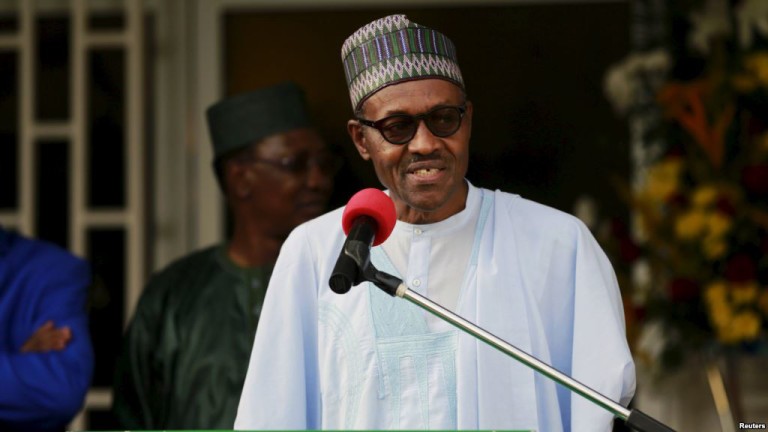
President Muhammadu Buhari on Sunday said he will use his age, instinct and experience in fixing Nigeria, as his administration looks forward, rather than backward, in finding the best way out of the economic challenges confronting the country.

He made this known in his Democracy Day speech to commemorate his one year in office.

The President said although the problems facing the nation were due to the mismanagement of past administrations, the world, including Nigeria, faces three major problems of a 70 percent drop in oil prices, slowdown in global growth and normalisation of monetary policy by the United State Federal Reserve.

Speaking on the achievement of his administration vis-à-vis the three campaign promises of tackling insecurity, corruption and fixing the economy, the President said progress was made in the first two areas.

“Huge debts owed to contractors and suppliers had accumulated. Twenty-seven states could not pay salaries for months. In the North-east, Boko Haram had captured 14 local governments, driven the local authorities out, hoisted their flags. Elsewhere, insecurity was palpable; corruption and impunity were the order of the day. In short, we inherited a state near collapse.

“We reinforced and galvanized our armed forces with new leadership and resources. We marshaled our neighbours in a joint task force to tackle and defeat Boko Haram. By the end of December 2015, all but pockets and remnants had been routed by our gallant armed forces. Our immediate focus is for a gradual and safe return of internally displaced persons in safety and dignity and for the resumption of normalcy in the lives of people living in these areas.

“EFCC was given the freedom to pursue corrupt officials and the judiciary was alerted on what Nigerians expect of them in the fight against corruption,” he noted, adding that the Ministry of Information will publish and periodically update information on the state of recoveries made from corrupt persons.

While admitting that there are genuine concerns about the state of the economy, the President enumerated measures taken and those to be taken to aid its recovery.

Government’s plan, he said, is to save as much foreign exchange as possible by first, fixing the refineries and ensuring that the country refines most of the fuel requirements and, second, growing most of our food products here to discourage importation.

He also pointed out that 43,000 ghost workers were identified using the Integrated Payroll and Personnel Information System, saving the government N4.2 billion monthly, while the implementation of the treasury single account has helped in blocking leakages.

Also, the President announced a N23 billion reduction in official travelling and sitting allowances per annum through the efficiency unit. He added that plans are underway to further reduce the number of government ministries, departments and agencies, all geared toward having a leaner government for effective service delivery.

The President further said: “As well as making savings, we have changed the way public money is spent. In all my years as a public servant, I have never come across the practice of padding budgets. I am glad to tell you now we not only have a budget, but, more importantly, we have a budget process that is more transparent, more inclusive and more closely tied to our development priorities than in the recent past. 30% of the expenditure in this budget is devoted to capital items.”

He also spoke about job creation and how the government intends to take people out of poverty, especially through the budgetary N500 billion social intervention fund.

“We are committed to providing job creation opportunities for five hundred thousand teachers and one hundred thousand artisans across the nation. 5.5 million children are to be provided with nutritious meals through our school feeding programme to improve learning outcomes, as well as enrolment and completion rates.

“The conditional cash transfer scheme will provide financial support for up to one million vulnerable beneficiaries, and complement the enterprise programme – which will target up to one million market women; four hundred and sixty thousand artisans; and two hundred thousand agricultural workers, nationwide. Finally, through the education grant scheme, we will encourage students studying sciences, technology, engineering and maths, and lay a foundation for human capital development for the next generation,” he noted.

President Buhari also announced a N1.6 loan scheme for women, especially in rural areas affected by insurgency and conflicts.

The government, the he explained, is not deterred by renewed attacks by militants in the Niger Delta and assured that those behind the attacks, particularly the sponsors, will be arrested and prosecuted.

“If the militants and vandals are testing our resolve, they are much mistaken. We shall apprehend the perpetrators and their sponsors and bring them to justice.

“The policy measures and actions taken so far are not to be seen as some experiment in governance. We are fully aware that those vested interests who have held Nigeria back for so long will not give up without a fight. They will sow divisions, sponsor vile press criticisms at home and abroad, incite the public in an effort to create chaos rather than relinquish the vice-like grip they have held on Nigeria,” he noted.

The President ended with the release of two of the abducted Chibok school girls, reiterating government’s resolve to secure the release of the rest.

“During the last one year, not a single day passed without my agonizing about these girls. Our efforts have centred around negotiations to free them safely from their mindless captors. We are still pursuing that course. Their safety is of paramount concern to me and I am sure to most Nigerians. I am very worried about the conditions those still captured might be in.

“Today I re-affirm our commitment to rescuing our girls. We will never stop until we bring them home safely. As I said before, no girl should be put through the brutality of forced marriage and every Nigerian girl has the right to an education and a life choice,” he concluded.


Skolombo Boys: How Parents Abuse, Abandon Children In Calabar

Street Kids in Calabar

The second and concluding part of IBANGA ISINE’s Skolombo Boys Investigation  in PREMIUM TIMES was done with the support of Ford Foundation and the International Centre for Investigative Reporting 


Sometime in April 2003, Arikpo Williams, a resident of Calabar, Cross River State, in Nigeria’s oil-rich South-south region, was to attend a rehearsal at the city’s Cultural Centre.

As he walked into the expansive compound, Williams spotted a boy lying lifelessly on the lawn.

“I thought he was dead,” he recalled. With his heartbeat thumping, Williams moved closer and poked the boy on the shoulder and he woke with a yawn.

“Why are you lying here as if you are dead?” he recalled asking the boy. “You scared me!”

When they got talking, the seven-year-old boy, who gave his name as Otop, recounted how his parents threw him out on the allegation that he was a wizard.

Otop is one of thousands of children dumped in the streets of Calabar over the years, by their families or guardians for every imaginable reason, from being a “witch or wizard”, to exhibiting the exuberance of adolescence.

In the mid-80s, hundreds of abused children were already living in abandoned public buildings, motor parks, markets and gutters in Calabar, residents, government officials and the police told PREMIUM TIMES.

According to Williams, it was his meeting with Otop that opened his eyes to the scourge of child neglect and abuse long before any serious step was taken to address it as a major social issue.

Instead of going for the rehearsal at the Cultural Centre, Williams said he attempted to reunite the boy with his parents, who at the time were living near Atekong Street in Calabar.

“When we got there, we met the boy’s uncle, who told me Otop is a wizard and would not be allowed into the compound,” said the Good Samaritan.

“He told me to wait for the father. And not long after, a man appeared from one of the rooms with a well-sharpened cutlass and charged at us. I ran as fast as my legs could carry me out of the running behind me.”

Not willing to let go, he took the boy to nearby Uwanse Police Station, less than a kilometre from where they first met.

At the police station, he recounted to two female police officers how he found Otop and the narrow escape from his angry father.

Rather than enter the complaint, the police officers asked him to look at Otop’s stomach.

Surprised, he looked down at the boy’s stomach. He hadn’t taken any special interest in Otop’s stomach since they met.

“This boy has eaten witchcraft and that is why his stomach is big,” one of the officers told him. “If you know what is good for you,” one of the female officers said, “take this boy back to where you found him and go your way.”

Angry and disappointed, Williams went away with Otop.

Street children of Calabar

Years before Williams found Otop, child abuse and abandonment had become a major social issue in Nigeria’s former capital city.

A former official of the social welfare unit of the state ministry of women affairs, who pleaded not to be named because she was no longer in a position to speak on the matter, told PREMIUM TIMES that as far back as 1998 hundreds of abandoned children were already roaming the streets of Calabar.

While a lot of them hawked food items for their parents and guardians, she said many others scavenged refuse heaps for recyclable plastics, metals and aluminium.

“As at the time, there was a five-year counterpart-funded programme between the state government and the United Nations International Children’s Educational Fund, UNICEF, on street children,” she said.

“The government was supposed to take ownership of the project afterwards but that never happened.”

While she would not speak on the nature of intervention the state government carried out with UNICEF, and PREMIUM TIMES was unable to get information regarding the project, but the number of street children found in Calabar years later was an indication that the project was not successful.

Williams said months after he met Otop – they became friends and started meeting frequently – he found out that more parents and guardians were wilfully sending their wards into the streets of Calabar.

“I was shocked to know that over 238 children lived on the streets within the metropolis,” Mr. Williams said. “I personally counted them as Otop took me from one location to the other, to show me where his colleagues lived.”

The children were found in Etim Edem Motor Park and along Bassey Duke Street by Nelson Mandela. Others lived in Bogobiri, Flour Mill, and Cultural Center and inside the gutter by the Zoological Garden.

Former street children, Abigail Orok and Essien Aye, confirmed that these areas were homes to hundreds of their colleagues until Obioma, the wife of the former governor of the state, Liyel Imoke, rescued them and many others.

Patricia Endeley, a former commissioner for social welfare during Imoke’s administration, said long before his principal was elected into office, the problem of street children had assumed a dangerous dimension in Calabar.

Endeley noted that hundreds of children were living in abandoned public buildings, markets and motor parks in various parts of the state capital, especially Calabar South Local Government Area.

“They were products of dysfunctional homes and most of them imbibed immoral and criminal tendencies while on the streets,” she told PREMIUM TIMES.

The Security Adviser to the state governor, Jude Ngaji, blamed “irresponsible parents” for the high volume of street children in Calabar.

Ngaji maintained that the increase in crime rate within the city was caused by some of the street children who were abused and abandoned after being branded witches and wizards.

When Child Right Act fails

Nigeria ratified the Convention on the Rights of the Child in 1989 and made its own version of the Child Rights Act in 2003.

The 1999 Constitution provides that children’s rights come under responsibility of the  state and for law to become operational, a state must pass it into law.

With more and more children being thrown out of homes and sometimes branded witches and wizards in Calabar, the state government took a decision to address the crisis when it passed into law the Child Rights Act on May 26, 2009, a day to Nigeria’s Children’s Day celebrations.

Cross River thus became the 23rd out of Nigeria’s 36 states to domesticate the law which specifies the responsibilities of children and the duties and obligations of the government, families and the authorities to uphold the rights of children.

After Imoke gave assent to the bill, the then head of the United Nations Children’s Emergency Fund, UNICEF, in Nigeria, Suomi Saakai, wrote to congratulate the state and Endeley said the international body declared the state safe for children.

Ironically, while the world body celebrated the state, its capital, Calabar, was at the time, far from being a haven for children.

The wife of the governor at the time inspected the locations the children lived and later initiated an arrangement where food was cooked and delivered to the children in their various hideouts.

“The initiative of the then first lady was largely to complement the effort of the state government to indeed make Cross River, a state fit for the child,” Endeley said.

Charity abused

Unable to cope with the daily logistics and sheer burden of cooking and feeding the children in their various locations, Mrs. Imoke was said to have sought and obtained her husband’s permission to house these street kids in an abandoned government-owned eye clinic.

With the help of her pet organisation, Mothers Against Child Abandonment, MACA, she  renovated, furnished and renamed the clinic located in Calabar South, Destiny Child Center, DCC.

The Executive Director of MACA, Ndodeye Obongha, said DCC was established to deal with cases of street children and child abandonment.

On October 11, 2009 when the home was opened, scores of children, both male and female were brought in. Later, others were rescued by residents and officials of the state government. The children were documented, some sent to schools and others to skill acquisition centres.

But there was another twist.

The success of the kids in Mrs. Imoke’s shelter became motivation for some parents to push their children out to the streets, hoping they would be rescued by the government.

“They thought by sending their children to the streets, the government would pick them up, feed and send them to good schools,” Henry Fadairo, the state Police Commissioner, told our reporter.

He noted that when DCC was overstretched and Mrs. Imoke was unable to take anymore child in, some of the children who were left on the streets formed a recruitment pool for gangs and street urchins popularly called, “area boys”.

Endeley also confirmed the police boss’ position, saying a lot of families sent their children into the streets to escape taking responsibility for their upkeep and education.

DCC had thus provided refuge for hundreds of abused and abandoned children in Calabar until it was shut down at the twilight of the Imoke administration.

“After reuniting many of the children with their families, we were left with 38 at the time we handed over the home to the state government in May 2015,” Obongha said.

She said her organisation fed, clothed and supported the education of the children weeks after it had signed a deed to hand over the facility to the state government.

“But as I speak to you that centre has been folded up,” she said.

Investigations revealed that Otop, unfortunately, was not one of the children who were admitted to DCC, having become a bigger street boy at the time the home was opened.

Attempts to locate him and his parents failed as residents of their last known address were unwilling to speak on their whereabouts.

Paying back in crime

In a previous report by this newspaper, the police, officials and residents narrated how hundreds of abused and abandoned children were recruited into a deadly criminal gang known as “Skolombo Boys”.

The gang is said to be responsible for the increasing spate of armed robbery, rape and sundry crimes that have turned the once peaceful Calabar, aptly known as Canaan City into a hot bed of crime.

You can read that report here


EFCC Sells Anti Graft War To Nigerians With Clean Hands Campaign

0
EFCC Chairman, Ibrahim Magu and other walking to the Eagle Square

The Economic and Financial Crimes Commission, EFCC, on Thursday kicked off a new campaign tagged: “Clean Hands”, aimed at stamping out corruption from the society and encouraging Nigerians to imbibe the culture of integrity and honesty.

Acting Chairman of the Commission, Ibrahim Magu, in an address at the launching of the new campaign at the Eagle Square, Abuja, stated that in the past 13 years, the EFCC has successfully confronted looters of the nation’s commonwealth, tackled impunity and kept faith with its mandate and the expectations of Nigerians.

Also giving an account of his six months tenure, Magu said the that EFCC had recovered billions from corrupt persons, including hitherto untouchable high profile criminals, in the period.

‘‘In just six months of this year, we have secured over 140 convictions, including some elusive ‘high profile’ criminals. We have recovered billions of dollars’ worth of stolen funds and blocked numerous avenues of money laundering,’’ he said.

He added that the new strategies being employed by EFCC had enabled Nigerians to take direct ownership of the war on corruption.

‘‘Citizens are now more disposed to pre-emptively act against corruption; and where the act has been committed, they are willing to work with EFCC to fish out the criminals,” he observed.

The EFCC boss also urged Nigerians not to relent in mounting pressure’ on the commission in order for it to carry out diligent investigation and prosecution and to inform the people of its activities.

Also present at the event was the co-founder of the Transparency International, co-convener of the #BringBackOurGirls campaign and former Minister of Education Dr. Oby Ezekwesili.

She praised Magu and his team for their commitment in the fight against corruption and called on everybody to join in the anti-corruption campaign.

‘‘If any Nigerian is serious at all about the necessity for the greatness of nation, then, he or she must take the fight against corruption seriously. This is because the consequence of not taking the fight against corruption seriously is that the nation will forever be mortgaged,” the former minister stated.

Chairman, House Committee on Financial Crimes and Anti-corruption, Kayode Oladele, was also present at the event said that it was important to start the fight against corruption from the grassroots.

The EFCC “Clean Hands” campaign, kicked off with a walk by staff and management ofcommission, National Youth Service Corps, NYSC, members and other interest groups. It also featured match past and choreography by a number of primary and secondary school students in Abuja.

The event was held simultaneously in all EFCC offices across the country, including Port Harcourt, Maiduguri, Ibadan, Enugu.


Ecological Funds: A Tale OF Corruption And Waste

This report, the second in our Ecological Funds Investigation series, was written by OLAJIDE ADELANA of NAIJ.com with support from Ford Foundation


When Sky Technical Construction Company (STCC) moved its equipment to Kambel in Anglo-Jos, Jos South Local Government Area (LGA) of Plateau State some nine years ago, Francis Hukuma and his late father, Samuel, were both full of joy.

To them and other residents, their prayers had finally been answered.

At the time the contractors came to their rescue, flood and gully erosion had become a menace that regularly harassed the residents during the rainy season.

For most residents of Anglo-Jos, a hilly settlement in Jos South LGA, the months of April to October – the rainy season – are reminiscent of death, obituaries, funerals and loss of properties.

In Francis’ case – it is a mixed memory of his dad’s funeral and the pain of how he lost his property.

Francis’ late father, was amongst the people whose houses had to make way for the erosion control measures by the contractor. At that time, the late Samuel had managed to raise his house to lintel level.

Pending the completion of his dream house, Samuel resided with his son in a makeshift tent on the same plot of land anticipating the joy of living in a befitting house.

The dream was however cut off when STCC came to site with its machinery and took a portion of his land and his dream house.

Unlike other neighbours who survived losing their properties without compensation, Francis’ dad, who had held unto the prospects that being a landlord brings, did not.

After series of consultations, begging and liaising with the construction company to no avail, Francis’ dad agreed to work with the company as a security officer.

“He couldn’t beat them so he joined them”, a neighbour who did not want to be mentioned because of the sensitivity of the issue said. Our reporter was informed that the remaining portion of the building was later razed down by irate youths during the religious crisis that engulfed Jos in 2010.

The year after, on August 28, 2011, Samuel died of stroke. And, Francis dropped out of school and later became a bricklayer. Now in his early 20s, Francis believes his father wouldn’t have died if government and the contractors had compensated them appropriately.

Francis, now four years experienced in brick-laying wants a recompense!

The story of Francis and other residents of Anglo-Jos is a common phenomenon associated with most projects executed by the Ecological Fund Office (EFO) especially in the North central states of Kwara, Kogi, Niger, Plateau and Benue when NAIJ.com visited.

How contractors leave residents worse than they met them

Nine years after the contract for the control of flood and gully erosion in Anglo-Jos was awarded, the miseries of the residents of the area has only worsened – no thanks to the contractor who has abandoned project.

Like Francis, the uncompleted project has cost most residents a fortune even as the problem of flooding and gully erosion in the area still persists.

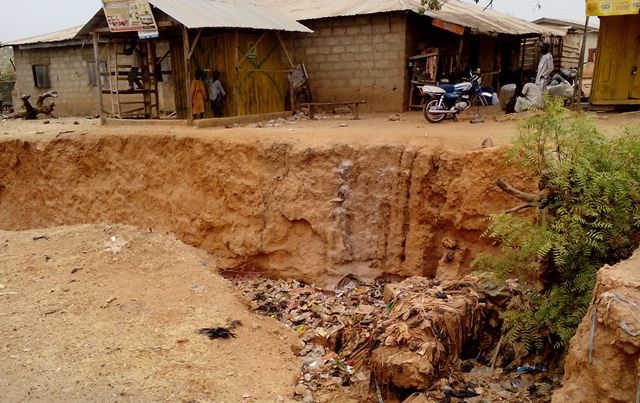
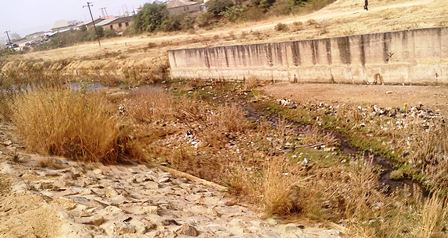
The bandoned erosion control project in Anglo - Jos
The abandoned erosion control project in Anglo – Jos

“When it rains you will pity us. We are at the mercy of the flood due to the sloping nature of this place. But that is not the thing that pains me. What pains me is the fact that government has already awarded this contract and yet more than five years that we thought that we have a solution we are still here counting losses,” the youth president of Anglo-Jos, Victor Gyang  lamented the ecological problem troubling the area.

The Chief of Anglo-Jos, Mr. Mancha and the youth president said they warned the contractor not to abandon the project when they noticed the slow-pace of work. The contractor assured them that the project will be completed as scheduled.

Not long after, the fears of Macha and other residents were confirmed – the contractors had abandoned work causing residents of the area more troubles.

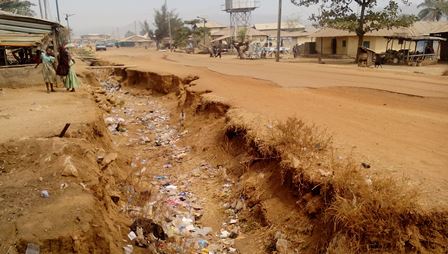
Shouting at our reporter from a cliff created by the gully erosion, a resident of the area, David who mistook the reporter as a project officer sent by the construction company, perhaps, to access the erosion problem in the area, asked if help would be coming soon.

“Hello. Please, stop there. Are you not one of the construction company’s workers? Please, when are you people coming back to site?” David probed.

“No, I am not. I am a journalist,” our reporter responded.

Apologizing to our reporter,  David whose house is near the path of the erosion went on to narrate his ordeal every rainy season, adding that some officials who didn’t disclose their identity had earlier visited the site raising hopes that help was  on the way.

“Oh, sorry. I thought you were one of those people that once came to inspect our area. We have been facing a lot in this place. Since when the government approved the contract up till this moment our situation has been worsening. People die, animals and our properties are carried away with the flood. We are not safe, we live in fear of the rainy season,” an apologetic David said.

Investigations revealed that the Anglo Jos contract was awarded to STCC on February 26, 2007 at the cost of ₦134, 557,153.50.

However, despite the fact that ₦94,190,007.45 (about 70 percent of the contract sum) has being paid to the company, the project has not been completed and residents of the area still live in fear of the unknown whenever it rains.

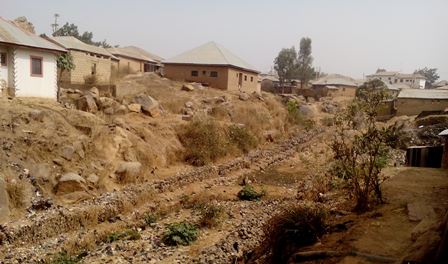
The best portion of the abandoned Anglo - Jos project
The best portion of the abandoned Anglo – Jos project

Why then is the project not completed?

To find an answer to this question, a Freedom of Information Act (FOIA) request was sent to the Ecological Funds Office, EFO, to give clarification on the scope of the contract. The agency failed to respond even after seven days as provided by the FOI Act.

However, a search at the Corporate Affairs Commission (CAC) showed that the company is headquartered in Kano with Sani Alhaji Kabiru, Kabir Aliyu Sani, Sani Umar, Kabiru Sani, and Kabiru Hadiza on the board of directors.

Efforts to get the company to address the issue proved abortive. The secretary of the company said the chairman who was out of town was the only one permitted to speak on the issue. She also declined to give out the phone contact of the chairman.

When it comes to contract abandonment, the Anglo-Jos situation is more of the norm than an exception.

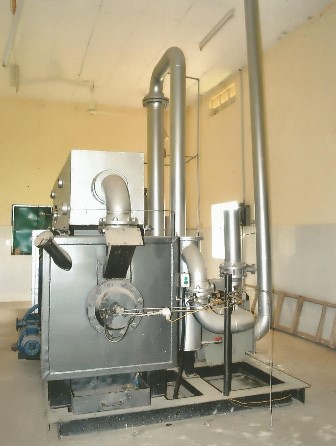
On May 16, 2007, a contract worth ₦82, 253, 500 was awarded to Hazardous Waste Management Engineering Limited for the procurement, supply and installation of 1 unit 150KG/Hr rotary kiln medical waste incinerators at the Federal Medical Centre (FMC), Makurdi, Benue State to the delight of the medical community.

What is however not delightful is that nine years after approval was given and 80 percent of the contract sum for the project paid to the contractor, the facility is far from being functional.

Access to the project site was restricted when our reporter sought to ascertain the present state of the project.

However, the head of the environmental department, FMC, Makurdi who has been delegated by the hospital to monitor the project, James Kimbir, confirmed that the incinerators cannot be used due to the low standard of the facility.

The contractor used sub-standard materials that might endanger people’s lives if put to use, said Mr Kimbir.

The non - functional medical waste incenerator
The non – functional medical waste incenerator

According to Kimbir, when the lapses were noticed the hospital management notified the contractor and also informed the Ecological Fund Office but no intervention was made. NAIJ.com later found out that notice was conveyed to the Ecological Fund Office through a letter with Ref no: FMH/FMC/FIR/291/Vol.1/4 on the 16th of June 2010.

NAIJ.com also obtained a recent letter written by the medical director/ chief executive officer of the hospital, Dr. Peter Inunduh to the permanent secretary of the Ecological Fund Office on the failure of the contractor to abide by the terms contained in the consultant’s terms of appointment among other requirements.

The letter which was made available to NAIJ.com by a top source in the Ecological Fund Office dated June 1, 2015 with Reference no FMH/FMC/FIR/29/Vol.1/17 also revealed that the executing agency, the contractor and consultant never met to review progress of work and draw up work plan as expected.

It was also pointed in the letter that the incinerator was solitarily test run by the contractor, Hazardous Waste Engineers and its cable got burnt.

Presently, the hospital spends about ₦120,000 monthly for its 35 tonnes of healthcare waste including general waste to be managed by a private waste management company.

More than 7 years after the expected date of project completion, the hospital still spends ₦1.4 million yearly and would have spent ₦11.2 million by the end of May, 2016 on the treatment of its medical waste.

Efforts to reach the contractor, Hazardous Waste Engineers Limited proved abortive. An online search at http://new.cac.gov.ng/, which is the website of the Corporate Affairs Commission also could not provide any useful clue.

A physical search at the Corporate Affairs Commission also showed that the company does not exist.

A similar trend was also observed in the execution of projects in Kogi state.

The people of Okaito in Okehi Local Government Area of Kogi State might look fearless but one of the things they dread most is the rainy season and the calamitous memories of the loss of lives and property akin to it.

In July, 2013, the government of former President, Goodluck Jonathan approved a sum of ₦105 million for erosion control in Okaito to Messers Total Unique Nigeria Limited.

However, three years after the contractor reported that it had achieved 100 percent completion, the problem of erosion still lingers.

The Amutu of Eko in Okaito, Chief Ayodele Abass was enraged when our reporter informed him that the erosion control contract has been certified completed by the Ecological Fund Office.

The Erosion Control Measures in Okaito didnt last long
The Erosion Control Measures in Okaito didn’t last long

Chief Abass hinted the likelihood of monitoring and evaluation officers from the government and the contractor conniving to give a misleading report that a good job was done.

The chief said he complained about the poor execution of the contract and also protested to one of the engineers handling the project.

Corroborating what the Amutu said in a separate chat, the former chairman of Okehi LGA from June 1999 to 2002, M.K Ibrahim chronicled the struggles and pains that went into getting government’s attention through the help of the former deputy chief of staff to former Vice President Atiku Abubakar, Prince Vincent Sola Akomode. He said that the erosion control measures didn’t last more than a few weeks.

The contractor only channelled the drainage a kilometre from Okaito to a major river in the area, Etegoza River and weeks after a heavy rain, the culverts were washed off”, the former chairman disclosed.

For the people of Okaito in Okehi LGA, it is now back to square one!

The same scenario was observed in Idah, the headquarters of Igala Kingdom where six years after a ₦150 million contract was awarded to ETA Associates Limited to control erosion in the area, residents still live in fear whenever it rains.

A cloudy sky might be a farmer’s delight but for most residents of Idah, it is a sign to brace up for the unknown as no one can tell whose turn it is to mourn.

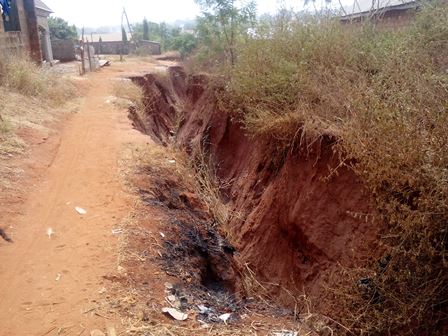
The residents of Inachalo, Angwa and Technical School area, in Idah, Kogi State, are in constant struggle with the menace caused by the gully erosion that is threatening their lives and livelihoods.

A supervisor, Williams Ayika, who claimed to have been engaged at some point by the contractor to monitor the construction of a 280 metre drainage at Accountant General Road in Idah said he was only provided funds to construct the drainage half-way.

Gully erosion IN Angwa, Idah, kogi state

Not all were lucky but the contractor’s “half-measure” was able to save some houses from being washed off by the gully erosion.

One of the lucky ones, a community leader in the area, Mr. Ibrahim Usman, said he was about vacating his house at that time because of the erosion that kept on “eating deep” into his building.

Mr. Usman who disclosed that he had spent about ₦ 3 million on erosion control measures prior to the intervention from the contractor boldly confirmed that six houses has so far been lost to gully erosion in the area.

“Thank God for the small wuruwuru work they (the contractor) did. It saved my house. Before then I had spent close to 3 million trying to save my house but all to no avail. There are some people who own houses in this GRA that are not as lucky as me,”Usman submitted.

The situation in Ilorin, Kwara state capital and hometown of Senate President Bukola Saraki is not indistinguishable from what holds sway in other places.

The pathetic situation in Amilengbe, Isale Koko and Aduralere axis of the state capital where residents have to vacate their houses whenever it rains give strong credence to this.

The lynchpin in this case is the Asa River.

Asa River suffers heavy pollution due to practices along the riverbed such as farming, industrial effluent discharges, and dumping of domestic and industrial solid and liquid waste which blocks its distributaries causing massive flooding whenever it rains.

A ₦1.2 billion contact awarded to Ambico Sendirian Nigeria Limited for the channelization of Asa River and its tributaries in 2013 has not done much. The 2.3km channelization is from Unity Bridge to Emir Bridge and then Amilengbe.

Amilegbe area in Ilorin

Residents say attempts made so far by the contractor has not ameliorated their sufferings, adding that the contract expected to be executed within nine dry months has lingered for far too long.

Our reporter observed that the project is far from being completed and residents of the area especially those in Amilegbe and Isale Koko might again witness massive flooding when it rains considering the snail speed of work by the contractor.

This was corroborated by a community leader in the area, Ahmed Abdulganiy, who said the contractor only began serious work on site because of the fear of Buhari administration.

When the contractor was contacted, the project director, Idowu Salau dispelled fears that the project would be abandoned, adding that he had offered a detailed explanation to the Department of Security Service (DSS) when he was invited by the security agency to clarify the reason for the delay.

He blamed challenges such as the denial of the right of way and weather problems as some of the reasons why the project has exceeded the scheduled timeline for completion.

“We have just been paid about three weeks ago. When their auditors came to site they were impressed with what they saw. The project was supposed to be for nine dry months but we had a lot of challenges. The people don’t want to give us the right-of-way and we also had challenges from the weather.”

When our reporter sought to know the status of work done on the site, Mr Salau sounded rather unsure disclosing that he was waiting for the final certificate of the project to be raised. He added that work has resumed at the site and the company is working hard to compensate for time lost.

“You know we raise certificates and they pay us. So we cannot get the exact percentage of the work done. Now we are waiting for our final certificate and retention. This money that was paid is just to be able to complete and raise the final certificate,” Mr Salau said.

Ecological Fund of Corruption and Misuse

Nigeria is said to be the 136 least corrupt nation out of 175 countries, according to a 2015 Corruption Perception Index report by Transparency International.

Corruption has eaten deep into nearly all sectors of the country’s economy and the Ecological Fund Office seems not to be an exception.

In 1981, the ecological fund was established through the Federation Account Act to address the multifarious ecological problems ravaging communities across the country. It received one percent of the federation account at some point before going through some modifications which increased its allocation to two percent.

Investigation of projects approved and funded by Ecological Fund Office from the year 2005 to 2015 reveals a pattern of misuse and misappropriation of funds.

Documents obtained from the Ecological Fund Office showed that 25 projects approved and funded by the EFO from 2005 to 2015 in the northcentral states of Niger, Nassarawa, Benue, Plateau, Kwara, Kogi and the Federal Capital Territory (FCT), Abuja gulped a sum of ₦3.7bn.

About 49.5 percent of the amount was used to cater for erosion control measures while 9.2 percent went into waste management-related projects. Others project areas that also got funds include development of tree nurseries and raising of seedlings, development of data bank for forestry management, and remediation of polluted sites in mining impacted areas.

It was observed that projects were approved for purposes irrelevant to the aims and objectives of the fund.

For example, money was approved by the Federal government on March 4, 2003 through the Ecological Fund account of the Secretary to the Government of the Federation (SGF) for the construction of an abattoir in Bida, Niger state with Lower Niger River Basic Development Authority (LNRBA) as the executing agency.

The contract was worth ₦10 million and the contractor, Sitbabs Engineering Limited reported 100 percent project completion on November 2007.

However, a physical inspection of the site paints a different picture. The facility has not been put to use since its supposed completion. It has since been converted to a store house and market by the local government.

“The project couldn’t be used as an abattoir as the contractor didn’t put in place the necessary equipment needed in a slaughterhouse,” Sabba Bala, a resident and indigene of the area said in justification of the conversion.

Efforts to reach the company proved abortive. A company search at the Corporate Affairs Commission showed that the company does not exist.

An FOI request bothering on the contract and other projects was sent to the Ecological Fund Office but the agency refused to respond.

From all indications, the Bida project seems to be a double scam.

The first being that it was a project not meant to be in the first place because of its irrelevance to the objectives of the ecological fund.

Second is the poor execution of the project without provision for slaughterhouse equipment, water and security.

The utilization of ecological fund especially since the return to civilian rule in 1999 has been enmeshed in one controversy or the other, says a 2015 study by a team of researchers headed by a Professor of Political Science, Ken Ifesinachi on the management of the ecological fund and natural resource conflicts in northern Nigeria from 2009 to 2013.

“When it rains you will pity us. We are at the mercy of the flood due to the sloping nature of this place. But that is not the thing that pains me. What pains me is the fact that government has already awarded this contract and yet more than five years that we thought that we have a solution we are still here counting losses,” the youth president of Anglo-Jos, Victor Gyang  lamented the ecological problem troubling the area.”

An audit report by the Auditor-general for the federation to the National Assembly on the accounts of the government of the federation in 2007 corroborates this.

The Auditor-general’s report lamented the lack of compliance on the part of the executing agencies “who often alter or reduce the scope of projects without putting into consideration the cost implication that had been prepared and sometimes approved by the Federal Executive Council.”

The audit revealed amongst other things the thoughtlessness associated with the approval and execution of ecological fund related projects.

The report revealed that two departments of the Ministry of Agriculture namely Agricultural Land Resources and Livestock and Pest Control Services benefitted a combined sum of ₦400 million from January, 2000 to December, 2005 to tackle the negative effect of sheet erosion and control qualia birds in frontline states but the fund was misapplied.

It was also observed that some of the projects that were funded by the EFO and said to be completed could not be traced by our reporter.

Considering the notorious tendencies of corrupt government officials and contractors to short-change Nigerians at the slightest opportunity, one might suspect foul-play.

One of such untraceable project is the procurement and installation of one multipurpose plastic waste recycling plant in Kwara, Niger and Benue states by Adul Essentials. The sum total worth of the contracts expected to help with the recycling of plastics so as to reduce its environmental menace is ₦36,213,778.2.

Efforts to speak with Abdul Essentials proved abortive. Information about the company was also not seen on the shelves of the Corporate Affairs Commission when a search was conducted.

How state governors squander ecological fund

Saying that the ecological fund is prone to political corruption in Nigeria amounts to stating the obvious.

The case of former governor of Plateau state, Joshua Dariye is still fresh. The former governor turned senator is being prosecuted by the Economic and Financial Crimes Commission (EFCC) for money laundering and diversion of funds meant for Plateau state totaling ₦1.2 billion.

Dariye was said to have taken advantage of his position as Governor of Plateau state between May 29, 1999 and May 2004 to unlawfully enrich himself through various transactions involving his office. Dariye also failed to fully declare his assets in accordance with the Code of Conduct Bureau and Tribunal Act.

In a statement obtained by EFCC in 2007, Dariye acknowledged sanctioning the disbursement of the said ₦1.2 billion ecological fund by the now defunct All States Trust Bank. The money was diverted to sponsor the 2003 Presidential election of the PDP and also paid to companies some of which were found to be owned by the former state governor.

A document confirming the disbursement of the cash was recently presented in court by the prosecution witness. The document showed that Dariye ordered ₦80 million to be paid to Union Savings and Loans; ₦250 million was given to Pinnacle Communications Limited; ₦550 million to the Plateau state government; ₦100 million to the People’s Democratic Party (PDP), South-west, and ₦176, 862, 900 was paid to Ebenezer Retnan Ventures ERV, a company said to be owned by him.

Dariye does not belong to this “club” alone.

Former governor of Benue state, Gabriel Suswam is also facing the same hurdle. According to the EFCC, Suswam diverted proceeds from the sale of shares owned by the Benue State government and Benue Investment and Property Company Limited and also illegally diverted ₦6 billion of ecological funds during his two terms as Benue state governor.

Suswam’s prosecution by the EFCC appears to substantiate allegations by Lawyers Alert, a Civil Society Organization in Makurdi that Suswam’s administration diverted funds donated by international and local intervention agencies during the 2012 flooding that affected the state for purposes other than they were meant for.

Francis Hukuma of Anglo-Jos will still face the next rainy season in fear, years after the sufferings of his community were supposed to have been addressed. He and others like him who depended on the Ecological Fund Office for their lives and livelihoods may well be justified in asking where the money has gone.