This report, the second in our Ecological Funds Investigation series, was written by OLAJIDE ADELANA of NAIJ.com with support from Ford Foundation
When Sky Technical Construction Company (STCC) moved its equipment to Kambel in Anglo-Jos, Jos South Local Government Area (LGA) of Plateau State some nine years ago, Francis Hukuma and his late father, Samuel, were both full of joy.
To them and other residents, their prayers had finally been answered.
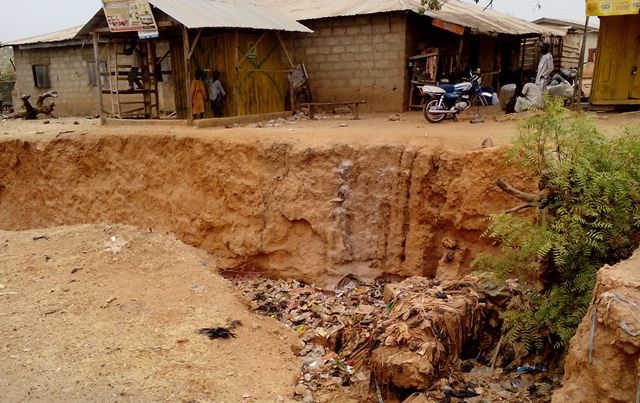
At the time the contractors came to their rescue, flood and gully erosion had become a menace that regularly harassed the residents during the rainy season.
For most residents of Anglo-Jos, a hilly settlement in Jos South LGA, the months of April to October – the rainy season – are reminiscent of death, obituaries, funerals and loss of properties.
In Francis’ case – it is a mixed memory of his dad’s funeral and the pain of how he lost his property.
Francis’ late father, was amongst the people whose houses had to make way for the erosion control measures by the contractor. At that time, the late Samuel had managed to raise his house to lintel level.
Pending the completion of his dream house, Samuel resided with his son in a makeshift tent on the same plot of land anticipating the joy of living in a befitting house.
The dream was however cut off when STCC came to site with its machinery and took a portion of his land and his dream house.
Unlike other neighbours who survived losing their properties without compensation, Francis’ dad, who had held unto the prospects that being a landlord brings, did not.
After series of consultations, begging and liaising with the construction company to no avail, Francis’ dad agreed to work with the company as a security officer.
“He couldn’t beat them so he joined them”, a neighbour who did not want to be mentioned because of the sensitivity of the issue said. Our reporter was informed that the remaining portion of the building was later razed down by irate youths during the religious crisis that engulfed Jos in 2010.
The year after, on August 28, 2011, Samuel died of stroke. And, Francis dropped out of school and later became a bricklayer. Now in his early 20s, Francis believes his father wouldn’t have died if government and the contractors had compensated them appropriately.
Francis, now four years experienced in brick-laying wants a recompense!
The story of Francis and other residents of Anglo-Jos is a common phenomenon associated with most projects executed by the Ecological Fund Office (EFO) especially in the North central states of Kwara, Kogi, Niger, Plateau and Benue when NAIJ.com visited.
How contractors leave residents worse than they met them
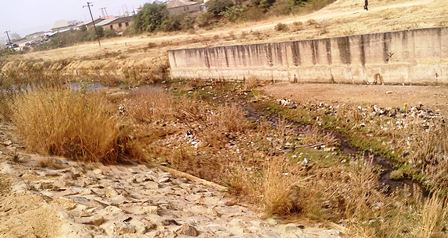
Nine years after the contract for the control of flood and gully erosion in Anglo-Jos was awarded, the miseries of the residents of the area has only worsened – no thanks to the contractor who has abandoned project.
Like Francis, the uncompleted project has cost most residents a fortune even as the problem of flooding and gully erosion in the area still persists.
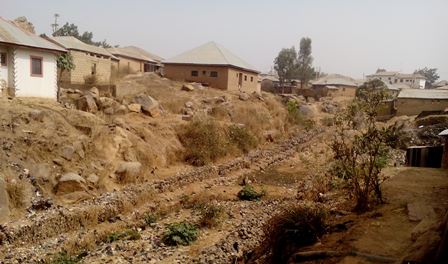
“When it rains you will pity us. We are at the mercy of the flood due to the sloping nature of this place. But that is not the thing that pains me. What pains me is the fact that government has already awarded this contract and yet more than five years that we thought that we have a solution we are still here counting losses,” the youth president of Anglo-Jos, Victor Gyang lamented the ecological problem troubling the area.
The Chief of Anglo-Jos, Mr. Mancha and the youth president said they warned the contractor not to abandon the project when they noticed the slow-pace of work. The contractor assured them that the project will be completed as scheduled.
Not long after, the fears of Macha and other residents were confirmed – the contractors had abandoned work causing residents of the area more troubles.
Shouting at our reporter from a cliff created by the gully erosion, a resident of the area, David who mistook the reporter as a project officer sent by the construction company, perhaps, to access the erosion problem in the area, asked if help would be coming soon.
“Hello. Please, stop there. Are you not one of the construction company’s workers? Please, when are you people coming back to site?” David probed.
“No, I am not. I am a journalist,” our reporter responded.
Apologizing to our reporter, David whose house is near the path of the erosion went on to narrate his ordeal every rainy season, adding that some officials who didn’t disclose their identity had earlier visited the site raising hopes that help was on the way.
“Oh, sorry. I thought you were one of those people that once came to inspect our area. We have been facing a lot in this place. Since when the government approved the contract up till this moment our situation has been worsening. People die, animals and our properties are carried away with the flood. We are not safe, we live in fear of the rainy season,” an apologetic David said.
Investigations revealed that the Anglo Jos contract was awarded to STCC on February 26, 2007 at the cost of ₦134, 557,153.50.
However, despite the fact that ₦94,190,007.45 (about 70 percent of the contract sum) has being paid to the company, the project has not been completed and residents of the area still live in fear of the unknown whenever it rains.
Why then is the project not completed?
To find an answer to this question, a Freedom of Information Act (FOIA) request was sent to the Ecological Funds Office, EFO, to give clarification on the scope of the contract. The agency failed to respond even after seven days as provided by the FOI Act.
However, a search at the Corporate Affairs Commission (CAC) showed that the company is headquartered in Kano with Sani Alhaji Kabiru, Kabir Aliyu Sani, Sani Umar, Kabiru Sani, and Kabiru Hadiza on the board of directors.
Efforts to get the company to address the issue proved abortive. The secretary of the company said the chairman who was out of town was the only one permitted to speak on the issue. She also declined to give out the phone contact of the chairman.
When it comes to contract abandonment, the Anglo-Jos situation is more of the norm than an exception.
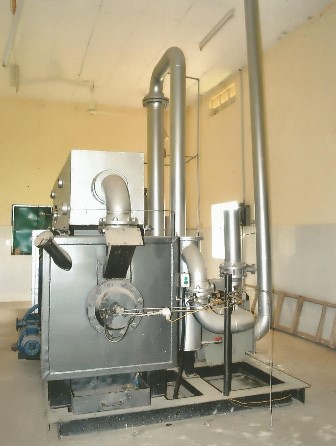
On May 16, 2007, a contract worth ₦82, 253, 500 was awarded to Hazardous Waste Management Engineering Limited for the procurement, supply and installation of 1 unit 150KG/Hr rotary kiln medical waste incinerators at the Federal Medical Centre (FMC), Makurdi, Benue State to the delight of the medical community.
What is however not delightful is that nine years after approval was given and 80 percent of the contract sum for the project paid to the contractor, the facility is far from being functional.
Access to the project site was restricted when our reporter sought to ascertain the present state of the project.
However, the head of the environmental department, FMC, Makurdi who has been delegated by the hospital to monitor the project, James Kimbir, confirmed that the incinerators cannot be used due to the low standard of the facility.
The contractor used sub-standard materials that might endanger people’s lives if put to use, said Mr Kimbir.
According to Kimbir, when the lapses were noticed the hospital management notified the contractor and also informed the Ecological Fund Office but no intervention was made. NAIJ.com later found out that notice was conveyed to the Ecological Fund Office through a letter with Ref no: FMH/FMC/FIR/291/Vol.1/4 on the 16th of June 2010.
NAIJ.com also obtained a recent letter written by the medical director/ chief executive officer of the hospital, Dr. Peter Inunduh to the permanent secretary of the Ecological Fund Office on the failure of the contractor to abide by the terms contained in the consultant’s terms of appointment among other requirements.
The letter which was made available to NAIJ.com by a top source in the Ecological Fund Office dated June 1, 2015 with Reference no FMH/FMC/FIR/29/Vol.1/17 also revealed that the executing agency, the contractor and consultant never met to review progress of work and draw up work plan as expected.
It was also pointed in the letter that the incinerator was solitarily test run by the contractor, Hazardous Waste Engineers and its cable got burnt.
Presently, the hospital spends about ₦120,000 monthly for its 35 tonnes of healthcare waste including general waste to be managed by a private waste management company.
More than 7 years after the expected date of project completion, the hospital still spends ₦1.4 million yearly and would have spent ₦11.2 million by the end of May, 2016 on the treatment of its medical waste.
Efforts to reach the contractor, Hazardous Waste Engineers Limited proved abortive. An online search at http://new.cac.gov.ng/, which is the website of the Corporate Affairs Commission also could not provide any useful clue.
A physical search at the Corporate Affairs Commission also showed that the company does not exist.
A similar trend was also observed in the execution of projects in Kogi state.
The people of Okaito in Okehi Local Government Area of Kogi State might look fearless but one of the things they dread most is the rainy season and the calamitous memories of the loss of lives and property akin to it.
In July, 2013, the government of former President, Goodluck Jonathan approved a sum of ₦105 million for erosion control in Okaito to Messers Total Unique Nigeria Limited.
However, three years after the contractor reported that it had achieved 100 percent completion, the problem of erosion still lingers.
The Amutu of Eko in Okaito, Chief Ayodele Abass was enraged when our reporter informed him that the erosion control contract has been certified completed by the Ecological Fund Office.
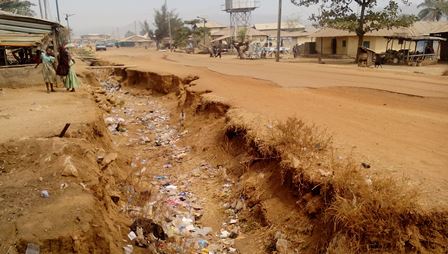
Chief Abass hinted the likelihood of monitoring and evaluation officers from the government and the contractor conniving to give a misleading report that a good job was done.
The chief said he complained about the poor execution of the contract and also protested to one of the engineers handling the project.
Corroborating what the Amutu said in a separate chat, the former chairman of Okehi LGA from June 1999 to 2002, M.K Ibrahim chronicled the struggles and pains that went into getting government’s attention through the help of the former deputy chief of staff to former Vice President Atiku Abubakar, Prince Vincent Sola Akomode. He said that the erosion control measures didn’t last more than a few weeks.
“The contractor only channelled the drainage a kilometre from Okaito to a major river in the area, Etegoza River and weeks after a heavy rain, the culverts were washed off”, the former chairman disclosed.
For the people of Okaito in Okehi LGA, it is now back to square one!
The same scenario was observed in Idah, the headquarters of Igala Kingdom where six years after a ₦150 million contract was awarded to ETA Associates Limited to control erosion in the area, residents still live in fear whenever it rains.
A cloudy sky might be a farmer’s delight but for most residents of Idah, it is a sign to brace up for the unknown as no one can tell whose turn it is to mourn.
The residents of Inachalo, Angwa and Technical School area, in Idah, Kogi State, are in constant struggle with the menace caused by the gully erosion that is threatening their lives and livelihoods.
A supervisor, Williams Ayika, who claimed to have been engaged at some point by the contractor to monitor the construction of a 280 metre drainage at Accountant General Road in Idah said he was only provided funds to construct the drainage half-way.
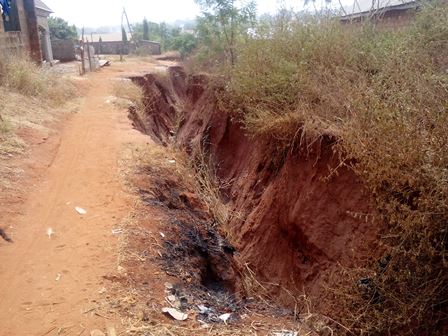
Not all were lucky but the contractor’s “half-measure” was able to save some houses from being washed off by the gully erosion.
One of the lucky ones, a community leader in the area, Mr. Ibrahim Usman, said he was about vacating his house at that time because of the erosion that kept on “eating deep” into his building.
Mr. Usman who disclosed that he had spent about ₦ 3 million on erosion control measures prior to the intervention from the contractor boldly confirmed that six houses has so far been lost to gully erosion in the area.
“Thank God for the small wuruwuru work they (the contractor) did. It saved my house. Before then I had spent close to 3 million trying to save my house but all to no avail. There are some people who own houses in this GRA that are not as lucky as me,”Usman submitted.
The situation in Ilorin, Kwara state capital and hometown of Senate President Bukola Saraki is not indistinguishable from what holds sway in other places.
The pathetic situation in Amilengbe, Isale Koko and Aduralere axis of the state capital where residents have to vacate their houses whenever it rains give strong credence to this.
The lynchpin in this case is the Asa River.
Asa River suffers heavy pollution due to practices along the riverbed such as farming, industrial effluent discharges, and dumping of domestic and industrial solid and liquid waste which blocks its distributaries causing massive flooding whenever it rains.
A ₦1.2 billion contact awarded to Ambico Sendirian Nigeria Limited for the channelization of Asa River and its tributaries in 2013 has not done much. The 2.3km channelization is from Unity Bridge to Emir Bridge and then Amilengbe.
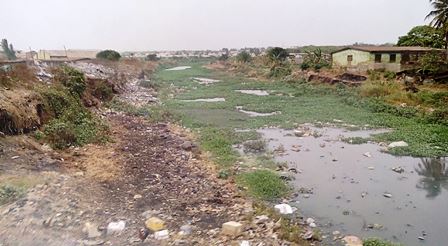
Residents say attempts made so far by the contractor has not ameliorated their sufferings, adding that the contract expected to be executed within nine dry months has lingered for far too long.
Our reporter observed that the project is far from being completed and residents of the area especially those in Amilegbe and Isale Koko might again witness massive flooding when it rains considering the snail speed of work by the contractor.
This was corroborated by a community leader in the area, Ahmed Abdulganiy, who said the contractor only began serious work on site because of the fear of Buhari administration.
When the contractor was contacted, the project director, Idowu Salau dispelled fears that the project would be abandoned, adding that he had offered a detailed explanation to the Department of Security Service (DSS) when he was invited by the security agency to clarify the reason for the delay.
He blamed challenges such as the denial of the right of way and weather problems as some of the reasons why the project has exceeded the scheduled timeline for completion.
“We have just been paid about three weeks ago. When their auditors came to site they were impressed with what they saw. The project was supposed to be for nine dry months but we had a lot of challenges. The people don’t want to give us the right-of-way and we also had challenges from the weather.”
When our reporter sought to know the status of work done on the site, Mr Salau sounded rather unsure disclosing that he was waiting for the final certificate of the project to be raised. He added that work has resumed at the site and the company is working hard to compensate for time lost.
“You know we raise certificates and they pay us. So we cannot get the exact percentage of the work done. Now we are waiting for our final certificate and retention. This money that was paid is just to be able to complete and raise the final certificate,” Mr Salau said.
Ecological Fund of Corruption and Misuse
Nigeria is said to be the 136 least corrupt nation out of 175 countries, according to a 2015 Corruption Perception Index report by Transparency International.
Corruption has eaten deep into nearly all sectors of the country’s economy and the Ecological Fund Office seems not to be an exception.
In 1981, the ecological fund was established through the Federation Account Act to address the multifarious ecological problems ravaging communities across the country. It received one percent of the federation account at some point before going through some modifications which increased its allocation to two percent.
Investigation of projects approved and funded by Ecological Fund Office from the year 2005 to 2015 reveals a pattern of misuse and misappropriation of funds.
Documents obtained from the Ecological Fund Office showed that 25 projects approved and funded by the EFO from 2005 to 2015 in the northcentral states of Niger, Nassarawa, Benue, Plateau, Kwara, Kogi and the Federal Capital Territory (FCT), Abuja gulped a sum of ₦3.7bn.
About 49.5 percent of the amount was used to cater for erosion control measures while 9.2 percent went into waste management-related projects. Others project areas that also got funds include development of tree nurseries and raising of seedlings, development of data bank for forestry management, and remediation of polluted sites in mining impacted areas.
It was observed that projects were approved for purposes irrelevant to the aims and objectives of the fund.
For example, money was approved by the Federal government on March 4, 2003 through the Ecological Fund account of the Secretary to the Government of the Federation (SGF) for the construction of an abattoir in Bida, Niger state with Lower Niger River Basic Development Authority (LNRBA) as the executing agency.
The contract was worth ₦10 million and the contractor, Sitbabs Engineering Limited reported 100 percent project completion on November 2007.
However, a physical inspection of the site paints a different picture. The facility has not been put to use since its supposed completion. It has since been converted to a store house and market by the local government.
“The project couldn’t be used as an abattoir as the contractor didn’t put in place the necessary equipment needed in a slaughterhouse,” Sabba Bala, a resident and indigene of the area said in justification of the conversion.
Efforts to reach the company proved abortive. A company search at the Corporate Affairs Commission showed that the company does not exist.
An FOI request bothering on the contract and other projects was sent to the Ecological Fund Office but the agency refused to respond.
From all indications, the Bida project seems to be a double scam.
The first being that it was a project not meant to be in the first place because of its irrelevance to the objectives of the ecological fund.
Second is the poor execution of the project without provision for slaughterhouse equipment, water and security.
The utilization of ecological fund especially since the return to civilian rule in 1999 has been enmeshed in one controversy or the other, says a 2015 study by a team of researchers headed by a Professor of Political Science, Ken Ifesinachi on the management of the ecological fund and natural resource conflicts in northern Nigeria from 2009 to 2013.
“When it rains you will pity us. We are at the mercy of the flood due to the sloping nature of this place. But that is not the thing that pains me. What pains me is the fact that government has already awarded this contract and yet more than five years that we thought that we have a solution we are still here counting losses,” the youth president of Anglo-Jos, Victor Gyang lamented the ecological problem troubling the area.”
An audit report by the Auditor-general for the federation to the National Assembly on the accounts of the government of the federation in 2007 corroborates this.
The Auditor-general’s report lamented the lack of compliance on the part of the executing agencies “who often alter or reduce the scope of projects without putting into consideration the cost implication that had been prepared and sometimes approved by the Federal Executive Council.”
The audit revealed amongst other things the thoughtlessness associated with the approval and execution of ecological fund related projects.
The report revealed that two departments of the Ministry of Agriculture namely Agricultural Land Resources and Livestock and Pest Control Services benefitted a combined sum of ₦400 million from January, 2000 to December, 2005 to tackle the negative effect of sheet erosion and control qualia birds in frontline states but the fund was misapplied.
It was also observed that some of the projects that were funded by the EFO and said to be completed could not be traced by our reporter.
Considering the notorious tendencies of corrupt government officials and contractors to short-change Nigerians at the slightest opportunity, one might suspect foul-play.
One of such untraceable project is the procurement and installation of one multipurpose plastic waste recycling plant in Kwara, Niger and Benue states by Adul Essentials. The sum total worth of the contracts expected to help with the recycling of plastics so as to reduce its environmental menace is ₦36,213,778.2.
Efforts to speak with Abdul Essentials proved abortive. Information about the company was also not seen on the shelves of the Corporate Affairs Commission when a search was conducted.
How state governors squander ecological fund
Saying that the ecological fund is prone to political corruption in Nigeria amounts to stating the obvious.
The case of former governor of Plateau state, Joshua Dariye is still fresh. The former governor turned senator is being prosecuted by the Economic and Financial Crimes Commission (EFCC) for money laundering and diversion of funds meant for Plateau state totaling ₦1.2 billion.
Dariye was said to have taken advantage of his position as Governor of Plateau state between May 29, 1999 and May 2004 to unlawfully enrich himself through various transactions involving his office. Dariye also failed to fully declare his assets in accordance with the Code of Conduct Bureau and Tribunal Act.
In a statement obtained by EFCC in 2007, Dariye acknowledged sanctioning the disbursement of the said ₦1.2 billion ecological fund by the now defunct All States Trust Bank. The money was diverted to sponsor the 2003 Presidential election of the PDP and also paid to companies some of which were found to be owned by the former state governor.
A document confirming the disbursement of the cash was recently presented in court by the prosecution witness. The document showed that Dariye ordered ₦80 million to be paid to Union Savings and Loans; ₦250 million was given to Pinnacle Communications Limited; ₦550 million to the Plateau state government; ₦100 million to the People’s Democratic Party (PDP), South-west, and ₦176, 862, 900 was paid to Ebenezer Retnan Ventures ERV, a company said to be owned by him.
Dariye does not belong to this “club” alone.
Former governor of Benue state, Gabriel Suswam is also facing the same hurdle. According to the EFCC, Suswam diverted proceeds from the sale of shares owned by the Benue State government and Benue Investment and Property Company Limited and also illegally diverted ₦6 billion of ecological funds during his two terms as Benue state governor.
Suswam’s prosecution by the EFCC appears to substantiate allegations by Lawyers Alert, a Civil Society Organization in Makurdi that Suswam’s administration diverted funds donated by international and local intervention agencies during the 2012 flooding that affected the state for purposes other than they were meant for.
Francis Hukuma of Anglo-Jos will still face the next rainy season in fear, years after the sufferings of his community were supposed to have been addressed. He and others like him who depended on the Ecological Fund Office for their lives and livelihoods may well be justified in asking where the money has gone.