An EgyptAir flight from Paris to Cairo has been declared missing shortly after leaving Greece air space and there are fears it may have crashed into the Mediterranean sea.
The Plane departed Charles de Gaulle Airport in Paris on Wednesday and was scheduled to arrive Cairo on Thursday.
It had a total of 66 people on board, comprising 56 passengers, seven crew members and three security personnel. Three of the passengers were children.
According to records obtained from Egyptair, 30 of the passengers were Egyptians, 15 were French Nationals, 2 Iraqis and 1 each from Britain, Canada, Belgium, Kuwait, Saudi Arabia, Algeria, Sudan, Chad and Portugal.
Greek aviation officials said its air traffic controllers had talked with the pilot a few minutes before the plane went off the radar and that everything had appeared normal.
Meanwhile, Egypt’s Prime Minister, Sherif Ismail, says search was underway for the missing plane, adding that it was too early to rule out any explanation, including terrorism.
“We cannot exclude anything at this time or confirm anything. All the search operations must be concluded so we can know the cause,” he said.
The search and rescue operation involves the Greek and Egyptian armed forces with France promising to send boats and planes to help in the effort.
This latest incident is coming less than two months after a flight from Alexandria to Cairo was hijacked in March, by a man wearing fake explosive belt, and was forced to land at Cyprus.
The man later gave himself up and has since been extradited to Egypt to face charges.
The rescued Chibok girl, Amina Ali, is expected to meet with President Muhammadu Buhari in Abuja on Thursday in company of her parents, the Defence Headquarters has announced.
This was contained in a statement posted on the official Defence Facebook page.
According to the statement, Ali and her four months old baby were yesterday handed over to Governor Kashim Shettima on behalf of Borno State after being medically examined at the Air Force medical facility and certified okay.
“After preliminary investigation, the rescued girl and her baby has been handed over to Borno State Governor, His Excellency, Honourable Kashim Shetima, at Government house, Maiduguri this evening (Wednesday) by the Acting General Officer Commanding 7 Division, Brigadier General Victor Ezugwu in a brief ceremony,” the statement read.
Ali’s supposed husband, Mohammed Hayatu, who was arrested on Wednesday, is still undergoing interrogation at the Joint Intelligence Centre and is treated in line with the counterinsurgency rules of engagement regarding members of Boko Haram who voluntarily give up their arms.
Former Senior Special Assistant to ex president Goodluck Jonathan, Doyin Okupe, on Wednesday told the Justice Okon Abang of the Federal High Court sitting in Abuja that the National Publicity Secretary of the Peoples Democratic Party, PDP, Olisa Metuh, was paid N400 million, apparently to boost the image of the president.
Metuh and his company, Destra Investment Limited, are being tried on a seven-count charge by Economic and Financial Crimes Commission, EFCC, for their involvement in the $2.1 billion arms deal.
He is accused of receiving N400 million from former National Security Adviser, NSA, Sambo Dasuki, a retired Colonel.
Earlier on Tuesday, May 17, 2016, Colex Ifeanyi Odenigbo, a consultant with Q-time Nigeria Limited, who was presented by the defence had told the court that the sum of N450 million was remitted to Destra Nig Limited from the Office of the NSA, but he doesn’t know the source of the money.
When the trial resumed on Wednesday, Doyin Okupe, who was led in evidence by Metu’s counsel, Onyechi Ikpeazu, SAN, explained that he was part of a meeting in which then President Jonathan said he would make funds available for Metuh to carry out a project to make him more acceptable to the people.
Okupe also explained how Metuh called him the next day to say his account had been credited with N400 million.
But while being cross examined by counsel to the EFCC, Sylvanus Tahir, Okupe said government institutions and agencies were not part of the organs of the party.
One of the exhibits, an e-payment mandate from the Office of the NSA, with details of a transfer of N400 million to Destra Investment Limited, was shown to Okupe but he said he did not understand the document.
Ikpeazu sought for an adjournment of the case, citing his client’s health challenge.
The Nigerian Army has said that the Chibok girl who was rescued near Sambisa Forest on Wednesday was found with her husband, suspected to be a Boko Haram terrorist.
A statement issued Wednesday evening by the acting Director of Army Public Relations, Sani Usman, a Colonel, gave the girl’s name as Amina Ali and her husband’s as Mohammed Hayatu.
Usman said that the two were rescued by a combined team of men of the 25 Brigade of the Nigerian Army in Damboa and Civilian JTF members in a military operation in Baale, near Damboa, Borno State.
Mohammed Hayatu, the resued girl’s husband
“Both were brought to Headquarters 25 Task Force Brigade Damboa at about 2.30pm today. Preliminary investigation shows that she is indeed one of the abducted Chibok School girls abducted by Boko Haram terrorists on 14th April 2014 in Chibok and her name is Amina Ali as against Falmata Mbalala that was earlier stated.”
According to the Army statement, Amina, a nursing mother with a four – month old baby, and her husband have both been taken to a hospital in Maiduguri for medical check up and screening.
There had been conflicting reports about who rescued the girl and if they were even rescued at all.
While the Army initially claimed that its men rescued the girl, other reports indicated that she was found at the edge of Sambisa Forest by vigilante youths of the Civilian JTF
Former Head of Service to the Federation, Stephen Oronsaye, was on Wednesday, May 18, 2016 re-arraigned before a Federal High Court, Abuja by the Economic and Financial Crimes Commission (EFCC) on an amended 35-count charge that borders on stealing and obtaining money by false pretence.
Included in the charges along with Mr Oronsaye are Osarenkhoe Afe, Fedrick Hamilton Global Services Limited, Cluster Logistic Limitd, Kangolo Dynamic Cleaning Limited, and Drew Investment & Construction Company Limited.
Oronsaye and Afe, who is the managing director of Fredrick Hamilton Global Services Limited, were present in court pleaded not guilty, but the other defendants were absent.
Prosecuting counsel, Leke Atolagbe urged the trial judge, Justice Gabriel Kolawole to enter a plea of “not guilty” for the defendants who are absent in court, so that the trial can proceed; a plea that Justice Kolawole agreed to.
Following the “not guilty” plea by the accused persons, the prosecuting counsel asked the court to fix a date for the trial to commencement, adding that the prosecution has 22 witnesses it intended to present in court.
The defence counsels did not object to this but rather made an oral application that the court allow their clients to continue with the earlier bail granted them on July 21, 2015.
The trial judge acceded to the request and adjourned to June 9, 2016 for commencement of trial.
The former Head of Service was initially arraigned before Justice Kolawole on July 13, 2015, on a 25-count charge, to which he and his co-accused pleaded not guilty.
The case file, was however, erroneously transferred to Justice J. T. Tsoho of a Federal High Court, Abuja, who later on realizing the error, passed it back to Justice Kolawole on March 1, 2016.
Justice Kolawole explained that the error occurred when the Chief Judge redistributed cases to new judges posted to the Federal High Court, in order to decongest the court.
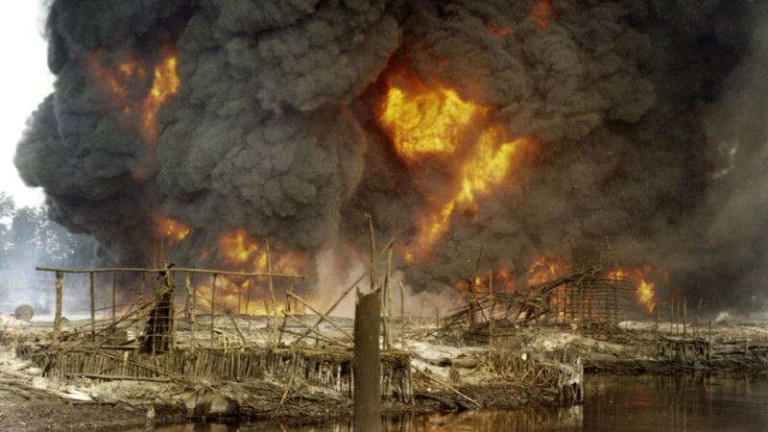
The Nigerian Agip Oil Company (NAOC) says there has been a pipeline attack at one of its oilfields in Ogbembiri in Southern Ijaw local government area of Bayelsa state, and this has compelled the oil firm to shut production on the line.
Consequently, the oil firm has deferred production of 1000 barrels of oil, its production share in the joint venture with the Nigerian Petroleum Corporation (NNPC)
According to a statement by the spokesperson of Eni, parent company of NAOC on Wednesday, the attack by unidentified gunmen reportedly occurred on Sunday night around 9 pm.
Sources at the outfield disclosed that the line has been blown up at least 13 times in the last one month.
The company said it could not estimate how long it will take to fix the damaged gas pipeline.
The pipeline is one of the major gas supply pipelines to power plants passing through Tumor community in Bomadi, Delta; Ogbuasiri in Ekeremor and Ogbembiri in Southern Ijaw, Bayelsa.
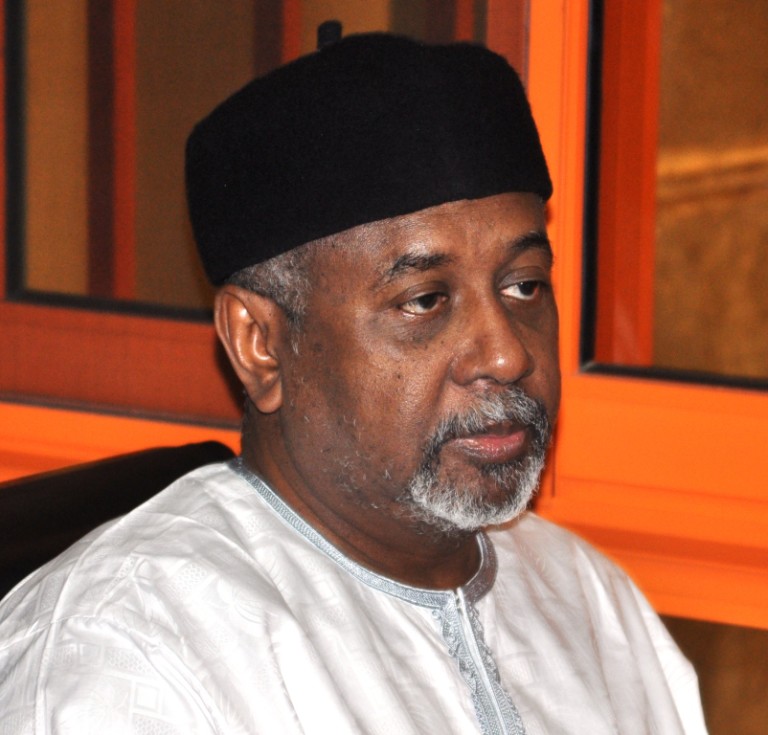
The Federal High Court in Abuja on Wednesday heard that the weapons found in the residence of former National Security Adviser, Sambo Dasuki, a retired Colonel, belonged to the Office of the National Security Adviser.
Dasuki is being tried for illegal possession of firearms.
The weapons were said to have been retired by Dasuki’s security details about 48 hours after he was relieved of his duties by President Muhammadu Buhari.
This information was contained in the ex-security chief’s statement made during his interrogation by men of the Department of State Security, DSS. The statement was admitted as exhibit by Justice Adeniyi Ademola.
A prosecution witness, Samuel Ogwu, who read the statement, confirmed it was made by Dasuki during his questioning after leaving office. He added that the ex-NSA in the statement said the weapons were to be returned to the ONSA by the end of the day when his house was searched.
The witness said the weapons, which he referred to as very sophisticated, were not issued by the DSS but was quick to add that he was not aware if any of the security agencies coordinated by the ONSA, including the military, made the issuance.
Ogwu also revealed that DSS questioned Dasuki due to the calibre of the weapons, which he said could not be imported by individuals. He gave examples of the weapons to include Tavor Assault Rifles and said they were imported by the Federal Government as part of efforts to equip the military against Boko Haram insurgency.
One of the more than 200 abducted Chibok school girls has been rescued, the Nigerian Army has confirmed.
Although there are conflicting reports concerning the name of the girl and how she was rescued, both the army and some activists said it was the same person.
According to reports, Amina Nkeki was rescued with a child by members of the youth vigilante group, Civilian JTF, near Sambisa forest and has already been identified by her parents.
The Nigerian Army, however, gave the rescued girl’s name as Falmata Mbalala and said she was rescued by soldiers at Baale near Damboa.
According to Bukky Shonibare, a member of the #BringBackOurGirls campaign group, the girl said six of her abducted colleagues have died, adding that they are heavily guarded by the insurgents to prevent their rescue by the Nigerian troops.
Reports also said the girl is now with the army, possibly being debriefed.
Civil Servants in many states of the federation, including the federal Capital Territory, on Wednesday, defied the call for a nationwide strike by the Nigeria Labour Congress (NLC), with many of them turning up at their work places, some as early as 8am.
Our correspondent in the federal capital territory who visited the federal secretariat in Abuja at about 10 am, observed that many workers, including junior workers were at their desks.
Gates to all the ministries, Departments and Agencies at the Federal Secretariat were open and workers and visitors were seen going about their normal businesses.
In Bayelsa, the Secretariat was open and workers went about their normal duties.
Many of them said they were not sure whether the strike action was holding or not as there hasn’t been any communication to that effect by the state NLC executives.
Tonye Ayama is a staff of the Bayelsa State Ministry of Women Affairs. He said his office was open for work “but just few people have reported, due to the NLC strike… Though, right now we are in the office, nothing serious is going on, we are just hanging on. The state NLC is yet to address us; so, we are still waiting to hear from them, if they say there is strike, then we will go back to our houses.”
Meanwhile, some of the workers expressed disappointment that the two major labour unions in the country, namely the Nigeria Labour Congress (NLC) and the Trade Union Congress (TUC), are not united on this issue of Petrol Price Hike.
But Chairman of the Bayelsa State chapter of TUC, Mr Tari Dounana, said the union was against the fuel price increase, adding however that the organised labour should show more unity and commitment in protecting the interests of Nigerian workers.
Mr Ndiomu John, Chairman of the State NLC chapter could not be reached as at the time of this report; as calls made to his phone did not go through
At the Federal Secretariat in Abuja, a staff of the ministry of power, Halima Mukhtar, asked why the NLC did not call for strike when there was no fuel at filling stations.
“Now that there is fuel at the filling stations, what is the point of going on strike?” She asked.
Secretary to the Government of the Federation, Babachir Lawal, had in a statement urged the Nigeria Labour Congress not to go ahead with the proposed nationwide strike, while assuring that government will guarantee the safety of workers and work places.
He added that acts of intimidation, harassment, including barricading of gates, locking up of offices and preventing workers from carrying out their lawful duties will be met with appropriate response by security operatives.
According to the statement, the federal government has directed all ministers, permanent secretaries and heads of government agencies to invoke the provision of “no work no pay” in respect of any staff who is absent.
The federal Government on Tuesday secured a court order from the National Industrial Court, stopping the NLC from calling out workers on strike.
It was late in the evening in August 2014 and most traders at the famous Makera iron fabrication market in Gombe State were hurriedly packing their wares into their shops as they closed for the day. It was about to rain and the sky had darkened. Just a few metres from the road and very close to a bridge, an elderly man sat in his shop perhaps waiting to go home after the rain, unaware of the danger ahead.
Usually, at that time of year, it rains nonstop and with the bridge and road completely flooded and the market overtaken by rain waters, the ground on which the shop stood began to give way. Unknown to the man, his shop was standing on mud soil.
When the contractor that built the drainage few months earlier dumped the excavated soil there, none of the people in the market knew it was mud soil.
With no one outside or nearby to come to his aid, the old man could not get out and in no time, he was washed away with his shop by the heavy flood.
His corpse was recovered a day later alongside that of a 17 year-old boy, who also drowned in the flood on the same day. He and two of his friends were said to be standing on a culvert watching the flood when he fell and was swept away.
In Herwa Gana, which extends to Kasuwan Makera, the shoddy work done has become a curse rather than blessing to residents
The N352,317,046 contract, awarded in 2008 to ZEF Nigeria Limited was to be completed in June 2009 but residents said it was only completed in 2014 after people had suffered so many losses, including collapsed buildings.
It was not surprising that after so much delay and abandonment, residents were filled with anger and chased the contractor when he returned in 2014 to continue work.
“So many houses were flooded year in year out and the contractor did not come to complete his work. So, when he eventually showed up, angry residents asked him to leave. It took the intervention of the state government to get the people to allow him resume work,” Mohammed Mamu Tella, a resident in the area, who said he lost a three bedroom house and a shop, said.
This is precisely what the Ecological Fund, established in 1981, was created for; to solve serious ecological problems such as soil erosion, flooding, drought, desertification, oil spillage, general environmental pollution, storms, tornadoes, bush fires, crop pests, landslides, earthquakes, as well as prevent suffering and possible death from these natural disasters.
In the beginning, 1 per cent of revenues into the Federation Account was set aside for solving ecological problems. Today, the EFO gets 2% of federal earnings. From inception, the Fund has been a first line charge and is only released with the approval of the president. The approval is gotten through the National Committee on Ecological Problems, NCEP, an inter-ministerial body set up in 1985 and headed by the minister of environment. It advises the president on the disbursement and management of the Fund, collates proposed projects through four sub-committees, and implements presidential approvals for the proposed projects.
In nine years, between 2007 and 2015, Nigeria set aside an average of N48,055,829,613 yearly as ecological fund. Thus, a total of N432,502,466,521 accrued to the Fund during this time. Out of this sum, 57 percent, N245,721,482,473, was realised in four years, 2011 – 2014, when the country earned a lot of money from the rise in global oil price.
These efforts, however, seem good only on paper, as investigations carried out across the six geo-political zones by reporters from six different news organisations show that the implementation of the ecological projects has been anything but effective.
Investigations across the country show that the funds released for projects are characterised by mismanagement, diversion of funds, substandard and abandoned projects fully paid for while the threats of ecological problems continue to wreak havoc, sometimes taking lives. In many cases, projects costing billions of naira were certified completed by government engineers and other officials when, as investigations showed, the projects had either been abandoned or left uncompleted. Yet, money had been fully paid to the contractor, indicating a possible collusion between greedy and unpatriotic officials and contractors.
Investigations also showed that money from the Fund was released for purposes other than the ecological problems it is meant to take care of.
In four Northeast states visited by the icirinigeria.org – Adamawa, Bauchi, Borno, and Gombe – several projects that were listed by the EFO as completed and fully paid for were in reality either uncompleted or shoddily done while some could not be located, meaning that they probably do not exist.
The www.icirnigeria.orguncovered at least eight projects, six of which were listed by the Ecological Fund Office as completed, that symbolized the wasteful utilization of money. With N2.2 billion paid for the projects, they were anything but completed.
Human cost of uncompleted and abandoned projects
Hopeful residents of some towns and villages, who had waited to see contractors return to site, were downcast when the reality hit them – that they had been duped by their own government and left waiting for years for contractors to return to site and finish their work until their fears, that they had been duped by the government, were confirmed by our reporter’s visit. They also know that the threat to their lives and livelihoods will remain with them or even get worse with each rainy season.
In Baraza and Kardam in Bauchi State, villagers were shocked to hear that their villages benefitted from over N400 million contract for the construction of erosion control projects in 2007. The contract, valued at N442,379,368, was awarded to Anbeez Services Limited and was expected to be completed in 2008. It was for four villages, Baraza, Kardam and Bazil in Dass Local Government Area and Rimin Zayam in Toro Local Government Area.
Even though the Ecological Fund Office listed the project as completed, the reporter could not locate Bazil, as no one in the two local governments remembered any village with that name. However, in the three other villages, residents, including farmers, are battling with erosion and flood.
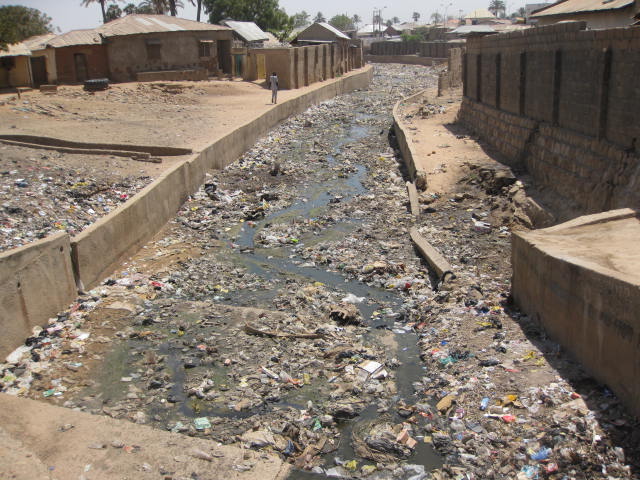
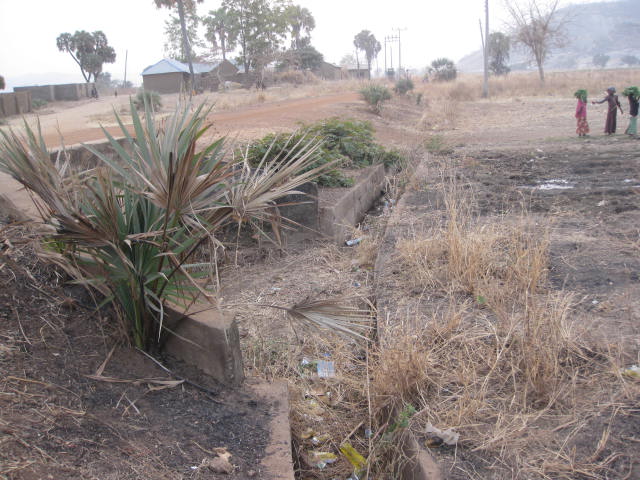
Baraza and Kardam are separated by a big river that overflows its banks during rainy season but dries up during dry season. When it rains heavily, farmlands, houses, schools and roads are submerged in water, with people opting to stay indoors.
The contractor abandoned the work after constructing the culverts, leaving the drainages undone. As a result, erosion has continued to wash farmlands and houses its way into people’s farms and houses, leaving the victims fearing for their lives. In one instance, erosion has washed inches close to an electricity pole and it is a question of when, rather than if, the nearby house gives way. The owner of the land, Garba Aminu, said this gives him sleepless nights.
Shallow drainage in Kardam
“When they (contractor) constructed this culvert, we told them they needed to extend the drainage a bit far and they said they would do it and when they were leaving they told us they would come back to complete the work. We have been waiting since. The erosion is eating into my land fast. You can see how close it is to the pole I put for electricity, now I have to remove and put it somewhere before rain starts. Despite the work they said they did, when it rains, we are not safe because of flood but we have nowhere else to go to,” Aminu explained.
Another villager, Danjuma Madaki, also said the contractor promised to return and complete the work but there was no sign that he would.
“They told us they are coming back to finish the work but they never did. Now I have to find a way of stopping water from washing away my land. I need to buy stones and cement to build a wall below the culvert to protect my land,” Madaki said.
In Kardam, it was the same promise about the contractor coming back but the village head, Musa Mohammed, said they made a mistake by taking him (contractor) for his word.
“They were supposed to construct drainages but only dug the ground and left it that way and it has been covered by sand and grass because it was very shallow. Even what they dug was not deep or wide enough for water to pass through without disturbing people. If we knew they would not come back, we would have stopped them from leaving or confiscated their equipment,” Mohammed said.
While Baraza and Kardam got culverts without drainages, Rimin Zayam got zero project. The reporter spent an hour in the vllage trying to locate any erosion control project built by EFO. He found none.
Residents of Zayam live in danger because when it rains heavily, houses, shops and other properties are flooded and washed away, including the market and motor park. With no drainages or gutters, residents have had to come together to find solutions to a common problems. They buy sand every year to refill some of the places washed away by the floods.
Adamu Umar, secretary to Rimin Zayam district head, denied that government, state or federal, constructed any erosion control project.
“There are no drainages in this town and there is no erosion control project done by the federal government. The only thing we know is that the state government bought lands from people to construct a road from the express into the village but nothing has happened since, as the owner of the land by the main road was not compensated,” Umar explained, adding that he rejected the N10, 000 compensation the state government gave victims of the deadly 2012 flood that affected several states.
“I lost my house to the deadly flood in 2012 and spent N600, 000 rebuilding it. Government gave me N10,000 compensation but I refused because it was an insult,” he said.
Still in Bauchi State, a vital ecological project that would have linked three villages was left unfinished. Angaz Nigeria Ltd was awarded a N319,708,462 contract, out of which N240 million was paid, to construct an erosion control project on a road linking three villages, Bundot, Dot and Bazali.
This project would have been of great benefit to commuters, including farmers, but the contractor only reconstructed or renovated existing culverts. In all, the reporter counted 41 culverts, including old ones. In many instances, the culverts are so narrow that they are easily flooded when it rains.
In spite of the culverts, erosion and flooding pose great danger to villagers, especially at Bazali, where farmlands and house are prone to flooding.
More than 100 houses and farmlands were washed away in 2012 with little or no compensation paid to victims.
“If you came during rainy season, you would understand the problem we face better because there would be no road for you to come here,” a villager, Dauda Gurama, told our reporter.
In Gombe State, it was a similar story. At Ashaka, which hosts Lafarge, one of the largest cement manufacturing companies in the country, the reporter could not locate a project said to be cited at a roundabout.
According to a document obtained from the Ecological Fund Office, the Ashaka roundabout erosion and flood control project was built from between October 2008 and August 2010 by Amtess Nigeria Ltd at a cost of N138,271,382.
However, after several hours of going round the town trying to locate it and speaking with residents and traditional rulers, no such project could be located.
The village head of Jalingo, one of the three villages that make up Ashaka, Haruna Jalingo, said not only was work never done, the town is facing serious ecological problems, including flooding.
“There has been no work done here by the Federal Government. The Ashaka roundabout you refer to is the one on your way to the town, where the military checkpoint is,” he explained.
The district head of Ashaka, Ibrahim Audu, also denied knowledge of work done and asked one of his staff, Sambo Jauro Galadima, to take the reporter round the town to see things for himself.
“Our town is gradually being washed away by erosion. We have resorted to planting flowers and small trees to stop it but it does not seem to be working,” Galadima said as he showed the reporter large openings in the earth caused by erosion and flood.
Flood and erosion leave communities fearing for their lives
Residents of Abujan Talakawa, a community in Nagada Bul in Maiduguri, Borno State, have a strange way of dealing with the erosion that is eating away their land rapidly.
The name ‘Abujan Talakawa’ is an oxymoron for an elitist area for the poor. It was named after Nigeria’s capital Abuja by a man who is believed to be its first inhabitant.
“The place was founded by my father but up to the late 1970s and early 1980s nobody wanted to live here because they did not see it as a good place to live,” Bulama Modu, who inherited the place from his father, said.
“Then you could get a plot of land for free but nobody wanted it. Since people opted for the GRAs (Government Reserved Areas) and other highbrow areas, we decided to call this place the Abuja of the poor and it is still populated by the poor.”
The area is one of the worst hit by flood and erosion in Maiduguri during rainy season. According to the head of the area, Bulama Babagana, who was installed by his father Modu, houses are destroyed every year by rain but the state government does nothing.
This has left the people to resort to self-help. They buy refuse from Borno State Environmental Protection Agency, BOSEPA, to refill their lands and openings caused by erosion.
Babagana showed the reporter a piece of land refilled by the community at the cost of N15,000, which saved surrounding houses from either collapsing or taking in water by diverting the flow of water away.
The community was also forced to acquire a piece of land from a member of the community to stop him from building on the land which is clearly a waterway.
“We cannot allow him to build a house there as it is a major waterway but we also recognise his right of ownership, as it was a family inheritance. Thus, we agreed to pay him the worth of the land, N600,000. So far, we have paid half that amount and are looking for money to pay the balance,” he noted.
The water that passes through Abujan Talakawa goes under the popular Nagada Bul Bridge and as a result it is also threatened by erosion and that is why the waste management agency was asked by the community to dump waste there to prevent more damage. But this is a temporary measure that only defers the inevitable if a permanent solution is not found.
While Babagana conducted the reporter round the area, a truck loaded of refuse arrived to empty its content beside the bridge. He noticed a gaping hole probably recently caused and asked the truck attendant if he could help refill it with the next round of refuse. The man said since their agreement did not extend to that place, it would cost N7,000.
Kululuri, another Nagada Bul community, grapples with flood that originates from behind the Nigerian National Petroleum Corporation, NNPC, depot and this, according to Bulama Modu, gets so bad that during rainy season, there is only one way that leads in and out of the community with a population of over 3,000 people.
“In 2014, one house collapsed killing one and injuring other members of the house,” Modu said, adding that the government is aware of the problem.
In Bajoga, a town near Ashaka in Gombe State, huge gorges are appearing in the earth crust in many places, leaving the people fearing for their safety.
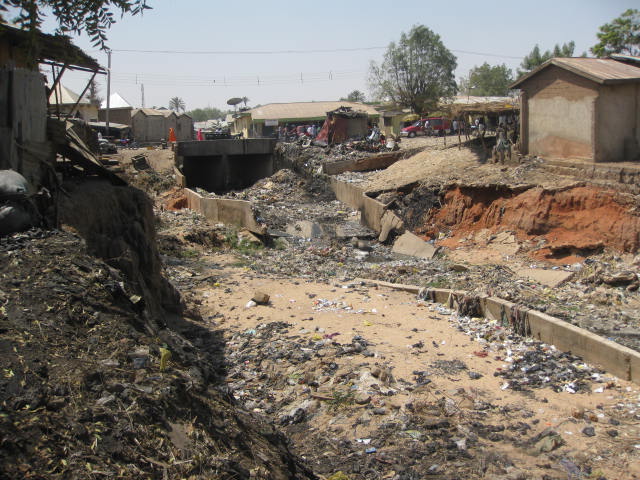
Gorges in Bajoga
In 2015, the town was thrown into mourning when one of its members lost his pregnant wife and two children.
“Only the woman and her children were inside the house when it rained. The house collapsed on them because it took in so much water,” the village head, Usman Garba, said, adding that their complaint to the Funakaye Local Government fell on deaf ears.
There is a particular gully, which residents said was not there in the past, eating its way into one of the worst hit neighbourhoods. This particular chasm was caused, villagers said, by erosion. It has become a death-trap with domestic animals falling to their death while parents do all they can to prevent children from wandering there.
In Adamawa State, despite the Ecological Fund Office spending N427,004,179 to construct flood and erosion control projects at Ganye, the town is still greatly affected by flood when it rains.
The work done by Matthews Man, the contractor, according to the people, has not solved their erosion and flood problem. The drainages are not deep or wide enough to allow for easy passage of water, making it easy for water to overflow onto the roads and into peoples’ compounds.
“Since the work was done, houses have been flooded while animals were drowned. Whenever it rains, the drainages are completely covered with water, making it dangerous to move on the roads, as someone may easily fall in and injure themselves,” Mohammed Saadu Gisilambe, a resident of Sangasumi 3, told our reporter, adding that they are not satisfied with the work done.
Community drags contractor before Ministry of Environment
Residents of Shagari Estate in Yola, Adamawa State, thought their prayer had been answered when Ecosystem Consultants Limited moved to site in 2013, two years after it was awarded the N224,189,130 contract, to commence work on the construction of flood and erosion control structures in the estate.
However, the contractor was far more in a hurry to leave the state than do a good job. By the end of 2014, the work had been declared 100 percent completed, leaving the residents peeved.
“We told the contractor that there was need for the drainages to be made in such a way to make flow of water easy but he refused,” Anthony Sawa, a resident of Shagari Estate since 1988, said.
“When it rains, the whole drainages are filled with stagnant water, which remains for days and thus attracts mosquitoes. The stench here is enormous,” another resident, Ibrahim Haruna, noted.
All effort to get the contractor to correct the anomalies yielded no result, so they wrote to the supervising agency, the Federal Ministry of Environment, through a law firm.
“The work is characterised by poor, shoddy and substandard quality; low depth of drainage; poor foundation and inadequate mixture of concrete; lack of consistency and continuation of drainage leading to blockage and over flooding; water retention from undispersed heaps of soil,” the letter, dated October 24, 2014, read in part.
They claimed they received no response from the ministry and that the contractor boasted that former Vice President Namadi Sambo was his brother, so he had the political backing to evade sanction.
They also claimed they heard the contractor telling his workers to do the work anyhow because he wanted to go home.
When the www.icirnigeria.org went round the estate, it discovered that most houses did not have access culverts, leaving people to jump over the gutters to gain entry into their homes.
“He asked us to construct culverts in front of our houses and that he would refund whatever money we spent. He only refunded one man’s money while the rest of us bore the cost of ours,” Linus Kwache, a lecture at the Federal University of Technology, Yola, said. Kwache claimed that he spent N26,650 to construct his own culvert. “I spent N26, 650 to build my culvert.”
In February 2015, the residents petitioned the minister of environment about what they called poor execution of the contract.
The letter was signed by 143 residents, who complained that some of their children were being treated for wounds sustained crossing the gutters.
When our reporter tried to clarify the issue with the ministry, Esther Agbarakwe, spokesperson for the Minister of Environment, Amina Mohammed, asked the www.icirnigeria.org to submit all enquiries in a letter. Nearly two weeks after a letter was submitted, the ministry has not replied.
Our reporter could not get Ecosystems Consult Ltd to comment as its registered address with the Corporate Affairs Commission, CAC, which is also the same with the registered address of the company’s shareholders, could not be located while there was no contact phone number in its file. Investigations at the CAC revealed that the company and shareholders’ address is Plot 17, Garki Village, Opposite Garki Primary School, Abuja, but when the reporter visited there, he could neither locate Plot 17 nor find anyone who knew a company by that name.
Ecological Fund Office became Father Christmas
According to a four-year audit of the Ecological Fund Office carried out by the Nigeria Extractive Industries Transparency Initiative, NEITI, between 2007 and 2011, the government diverted several billions of naira from the Fund to projects clearly not ecological in nature.
According to NEITI, in the period under review, a total of N217 billion was allocated to the Fund. The utilisation of the funds was, however, largely questionable.
Money was given out to government ministries, departments and agencies, including the military, for projects that were not ecologically related.
For instance, out of a total of about N33 billion that accrued to the Ecological Fund in 2007, the Olusegeun Obasanjo and Umaru Musa Yar-Adua-led governments between January and December that year gave N6.8 billion to the Federal Capital Development Authority, FCDA, for projects such as development of a mall and provision of engineering infrastructure to Kubwa and Karshi satellite towns.
According to the NEITI report, N4 billion was approved for the Kubwa and Karshi satellite towns engineering infrastructure but N6 billion was released.
It goes without saying that provision of engineering infrastructure and malls do not fall within the jurisdiction of the Ecological Fund.
So unmindful was the government of the essence of setting aside funds to deal with ecological problems that the state even borrowed money from the Ecological Funds Office to finance shortfalls in its appropriation. Between 2009 and 2011, the federal government withdrew about N94 billion from the N141.5 billion that accrued to the Fund to finance its budget deficit.
The Nigerian Air Force was in 2007 given N10 billion from the Fund as loan, although it completely repaid it in the same year, according to the report.
Consequently, NEITI called for a comprehensive audit of the Fund from inception to date.
The complicity of Ecological Fund Office
From all indications, the Ecological Fund Office has been a drainpipe to the national purse, frittering away billions on projects that are either shoddily executed or abandoned. The EFO primarily acts as a fund disbursing office and while it does not initiate projects, it monitors and approves them after completion.
All requests for funds to deal with ecological problems from states are sent to the EFO, which forwards them to the National Committee on Ecological Problems. NCEP reviews the problems, taking into cognizance the availability of funds, urgency of work to be done, severity of the problem, national spread, etc. and forwards them to the President for his approval.
After the President conveys his approval for a project, the EFO sends a request to the Ministry of Finance for payment processing, which is done by the Accountant General of the Federation, after which funds are paid into the Ecological Fund Office account domiciled in the Central Bank of Nigeria.
A contractor does not get paid, despite the issuance of Interim Payment Certificate, without the EFO sending its staff to inspect the work done.
Thus, it is curious that the EFO has several projects listed as completed and money fully paid when in reality they are abandoned or poorly executed.
In fact, visits to the EFO showed Hilux vehicles designated as project monitoring vehicles to sites, including the abandoned Bogo-BCG Gully Erosion Control Project in Gombe State awarded to Tabarakh Consolidate Ltd at the cost of N383,753,605.
This important project was awarded in 2011 and expected to be completed in 2012 but it was abandoned after N172,689,122 had been paid to the contractor.
When confronted with our findings, the EFO put up a wall. The Deputy Director Press, Tolu Makinde asked the www.icirnigeria.org to submit any enquiries in a letter.
A FOI Act request was written asking for contract details of some of the affected projects but the EFO has refused to respond.
Ironically, at the EFO, the first sign that welcomes one is the purported support for the implementation of the Freedom of Information Act.
Among others, the banner encourages staff to keep and make records available to the public.
In the course of this investigation, this website working in conjunction with the Public Private Development Centre, PPDC, sent several FOI requests to government agencies and ministries working on ecological problems in the country.
In addition to the Ecological Fund Office, FOI Act requests were sent to the ministries of environment and water resources, Central Bank of Nigeria, CBN, National Emergency Management Agency, NEMA, Office of the Accountant General of the Federation, and Office of the Secretary to the Government of the Federation, seeking information relating to ecological.
While NEMA only responded stating how much it had received as its constitutional share of Derivation and Ecological Fund, it did not provide information detailing the projects executed with the money.
The Ecological Fund Office replied with a 40-page document showing projects executed from 2005 to 2014. However, from the document, it was obvious that it was incomplete. The numbering showed that there were 80 pages instead of the 40 the EFO provided.
Another request for the release of the remaining 40 pages did not yield any results. Indications are that the unreleased information deals with the most recent ecological projects funded by the government and therein might lie the biggest scandals in the embarrassing tale of corruption that surrounds funds meant for solving ecological problems in the country.
Nnimmo Bassey, environmental activist and director, Health of Mother Earth Foundation/Friends of the Earth, expressed worry that ecological funds have been used by politicians as slush funds for political patronage and election campaigns, instead of combating ecological problems, adding that that has got to change.
“Nigeria’s ecological funds have for a long time been seen as political funds. This means that rather than deploying the funds to tackling ecological problems, the focus was rather on political patronage,” he observed.
He said further: “Lack of readiness to handle floods by not investing in drainage systems, for one, exposes vast populations to inundation. Lack of sufficient investment to tackle soil erosion leads to expansion of gullies across sections of the South East and South South leading to damage of extreme geological dimensions.”
Bassey is particularly concerned about poor shoreline protection in coastal Nigeria which he said had led to destruction of infrastructure in coastal communities and overall loss of land due to coastal erosion.
He added that “If ecological funds had been utilised to protect the Lake Chad environment, the rate of shrinkage occasioned by climate change and mismanagement of water usage, could have been reduced.”
One way forward, he suggests, is for the responsibility to manage ecological funds to be taken from the presidency and given to the environment ministry.
Bassey also advocates the involvement of the communities in the identification of ecological projects that would be executed in their areas.
“What we mean is that communities must be involved in the process of identifying ecological challenges.”