Home Blog Page 3123

Panic Grips Residents As Insurgents Attempt To Invade Maiduguri

0

Boko-Haram-insurgents
By Musdapha Ilo, Maiduguri

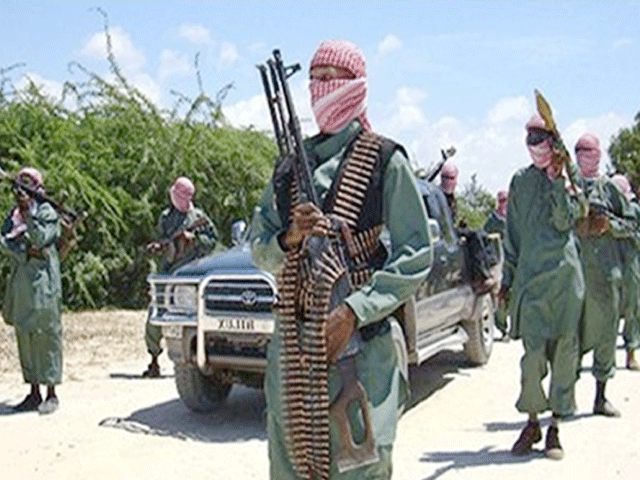
The Nigerian army on Wednesday repelled an attempt by Boko Haram insurgents to invade Maiduguri, the Borno State capital.

A source said that the militants killed six persons and abducted three women at Bale Mammanti, on the outskirts of the city.

A resident said sporadic gunshots were heard around the Maimalari Barracks as the soldiers battled insurgents, who attempted to take control of the military facility.

A resident said the gunshots which sounded for about 30 minutes sent residents running for cover.

It was gathered that the soldiers who noticed the militants prowling around the barracks released shots to prevent them from entering.

Modu Kakami, a member of a youth vigilante group said militants stormed the village of Bale Mammanti, in Jere local government area of Borno state, killings six civilians as well as abducting some women.

Another resident said that the Insurgents might have been after food and cattle.

“We fled into bushes last night because we knew that we are the target but this morning we discovered that all our cattle, rams and foodstuffs were carted away,” he said.

He explained that among the six persons killed by the insurgents were two children.

Activists Vow To Fight Water Privatisation In Lagos

1

aboise 2
By Abiose Adelaja Adams

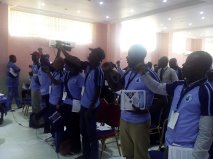
It was a mass rallying point on Tuesday at the Lagos Water Summit, as members of both local and international civil society groups, the Nigeria Labour Congress, NLC, and human right groups across the country gathered to protest the water privatization plans of the Lagos State government.

The campaign, which was organized by Environmental Rights Action, ERA,/Friends of the Earth, Corporate Accountability International, USA and Public Service International, Ghana, began in October 2014 with the theme, “Our Water, Our Rights, Say No to Privatization”.

It, however, has not got a satisfactory response and so the promoters decided to harness all forces at the summit in order to galvanize people to action that would stop the Lagos government in its insistence that privatization is the solution to the problems of water access and delivery in the state.

“Water is a human right and free gift of nature therefore no one should be denied or cut out of this basic human right because he cannot afford the cost,” said Godwin Ojo, the executive director of ERA.

“The reason for this summit is that we are here to say no to privatization, we have started with this campaign last year but we are not satisfied because feelers from the Lagos State Water Corporation indicate that the Agency is pushing ahead with the public private partnership, PPP. Therefore we have come together to confront the menace of privatization in the water sector which is a force advancing on Lagos and other major cities across the world,” he stated.

Through this summit, he added, residents will be educated on their rights to water, while myths behind public private partnerships, PPP, will be debunked.

In his good will message, Solomon Adelegan, the National President of Amalgamated Union of Public Corporations, Technical and Recreational Services Employees, who also representing the Nigeria Labour Congress said, threatened that Labour would not condone the privatization of water in the state.

“If Lagos goes ahead with the privatization plan we will not only grind lagos, but the whole country, because it is Nigerian workers that will bear the brunt.”

“The NLC president is actively working on this and we will fight it to a halt,” he added.

Joe Odumakin, president, Women Arise, said a stop must be put to the privatization plan, adding “water is our right. If we do not stop them now from selling our water, one day, they will package the air we are breathing and sell it to us.”

ERA called to the world’s attention in October 2014 that the Lagos State had signed an MoU, memorandum of understanding with the World Bank’s Private arm , the International Finance Corporation, in a PPP, the content of which was not made public.

After much pressure from local and international NGOs, the managing director of the Lagos Water Corporation, Shayo Holloway, stated that “there is no plan to privatise Lagos water, rather its set to partner with the private sector in a bid to increase water supply and alleviate poverty.”

He called this public private partnership which is backed by the Lagos Water law of 2004.

Explaining the rationale, Holloway further stated that the total installed capacity of the Corporation as at today is 210 million gallons per day (water production), whereas the actual water demand is 540 million gallons per day.

By year 2020 water demand is expected to be 733 million gallons per day, while the water production will be 745 million gallons per day, leaving us with the excess of 12 million gallons per day.

However, Nnimo Bassey, director, Health of the Mother Earth Foundation, who gave the keynote speech at the Water Summit, observed that the World Bank was out to make profit from Lagosians through the PPP agreement rather than alleviate poverty.

Quoting Holloway, Bassey said “the total available water assets, even if run at 100 per cent efficiency, stands at 210 gallong per day, leaving a shortfall or deficit of 330 million gallons per day.

“Now that the installations are not working at 100 per cent and electricity is epileptic, how many Lagosians enjoy public water. The figure is a paltry 10 per cent. This is woeful for an upcoming Megacity ,” he said.

Similarly, Shayda Naficy, campaign director with Corporate Accountability International said provision of water is a social service which should not be for profit.

“The goal of any water system is to provide the water people need to survive, not earn profits for the corporate water industry. It’s time for the World Bank to end its dogmatic promotion of water for profit and support democratically controlled and publicly owned water systems, which is what the people of Lagos are demanding,” she added.

Nevertheless the Lagos State is going ahead with its plan. It says on it website that the estimated cost of the privatization scheme is $3.5 billion dollars and it cannot do it alone.

“This is an investment which the state government cannot solely undertake as this will take the State government 2 ½ years to fund; with every naira income going into the water sector only! With other equally demanding sectors (Health, Education, Security, Social services, etc), no State is able to undertake this financial burden.”

It says it has commenced the implementation of the Master Plan with the ongoing construction of Adiyan phase 2.

ERA argues that if the plan works out, it is believed that ordinary Lagosians who are already burdened with the cost of procuring water for drinking and other uses will be further levied while those who cannot pay will be excluded from a basic human right they are entitled to.

Even the rich who can afford borehole will also have their fair share of woes as the deal with World Bank’s IFC will result in the declaration of boreholes as illegal, thus forcing Lagosians who own boreholes to stop using them, relying only of government’s privatized water.

In addition, the state’s indebtedness to World Bank will continue to accumulate for generations to come to inherit.
Upon all this, it is not guaranteed to work as previous World Bank projects such as the examples from Manila in Philippines and Nagpur, India have failed, marred by poor services, hikes in water rates, other inconsistencies such as broken promises, as well as frustration of the plight of women and children.
abiose 1

Water As A Human Right

One of the points loudly reiterated by various speakers as they gave their good will message at the summit is the issue of safe and clean drinking water and sanitation as a human right as recognized by the general assembly of the United Nations in 2010.

Twenty three members of the Congress of the United States, sent for the purpose of the summit a letter that reads thus, “Thank you for bringing to our attention the situation in Lagos, Nigeria.”

The letter further reads further:

“Water is a fundamental building block upon which individuals and collective prosperity relies. We are deeply concerned that low income communities and people of colour are disproportionately affected when water is managed with greater attention to profit margins than to human rights. we share you’re your concerns that a move towards privatization of the water scheme could leave the city vulnerable to the negative impacts historically associated with various forms of water privatization including rate hikes, worker layoffs, service interruptions and failures to adequately invest in infrastructure.”

Sani Baba, of the Public Service International, Ghana, one of the organizers of the event said “there are some communities that it is a taboo to sell water, whether in sachet or bottle. Water is a free gift of nature,” he restated that his organization is ready to stand by this campaign till it wins.”

Privatization and its effects

Lagos has population of about 20 million people, 90 per cent of which takes it upon themselves to provide their own water using alternative sources such as boreholes, water vendors, wells, sachet water, bottled water, streams or even rain water for drinking, cooking and washing.

The concern of activists is that the city of Lagos and, by extension, the country will face immense hardship if water is privatized.

Concerns were raised about the issues of increasing water-borne diseases, increased unemployment as a result of laying-off of Lagos State Water Corporation staff, lack of affordability due to poverty levels, increased corruption and crime.

According to the WHO/UNESCO, 66 million Nigerians do not have access to potable water; Premature death from water related diseases cost the country $2.5 billion, while $191 million was spent on healthcare for diarrhea alone in 2012.

“Avoidable deaths and diseases will continue to rise in portions of the world where citizens do not have adequate and safe water and sanitation,” said Bassey.

Tunde Akanni, a lecturer of Journalism at the Department Of Communications, Lagos State University, believes that the exercise will make criminals out of otherwise innocent people.

“Our attitudes to standard will be compounded by water privatization. For instance, if water is privatized people will be forced to look for short cuts and the government can’t police everybody,” he said.

Given the state’s insistence, the activists vow to employ all the might of other countries which have succeeded in resisting World Bank’s water privatization for instance, in Ghana.

ERA’s director of corporate accountability, Akinbode Oluwafemi said the group had sought dialogue from both World Bank and the Lagos State government to no avail.

“Even during the campaign, we met both governorship aspirants, Jimi Agbaje and Akinwunmi Ambode, they both said very good things they will do. Now we wrote to Ambode, he is yet to reply us.”

“What we are doing here is connecting Lagos to the global audience, and we will match them science for science, figures for figures. We are going to commission a large study to look at investments in water, what has gone wrong since the 70s. We are going to the Lagos House of Assembly to recruit parliamentarians. We are going to emlarge this campaign,” he stated.

Oshiomhole Denies Planned Eviction Of Displaced Persons In Edo State

0

Adams-Oshiomhole-620x400

By Jefferson Ibiwale, Benin

Governor of Edo State, Adams Oshiomhole has assured internally displaced persons, IDPs, residing in the state that the threats issued by security operatives that they would be evacuated would not be carried out.

Security operatives in the state had threatened to evacuate the IDPs to Jigawa and Kano states, a move that had been stoutly resisted by the IDPs.

However, on Tuesday, Oshimhole said he was not aware of the threat.

He said no one would be moved out of the state against their will, adding that he had to travel to see President Muhammadu Buhari to allay the fears created by the controversy.

“I am not aware of attempt to relocate them. But I think this is as a result of communication gap. The recent issue was just because of the impression that some of the kids wanted to reunite with their parents, but we said it was better for their parents to come here and see their children. It is very touching seeing these kids, I think the good news is that the Edo state government will take over their welfare, we will treat them the same way we treat every other child in Edo state,” the governor said.

He promised that the state would build a school also employ teachers to train the children while also building more hostels to take accommodate them.

The governor said that he had already met with the commissioner of education on how educational facilities could be quickly constructed to aid the development of the children.

He said as long as the IDPs elect to remain in the state, no one would drive them out.

He also promised to provide the necessary facilities to make their stay comfortable at the camp.


READ ALSO:


He said the welfare of the kids was top priority for the state.

“Everybody is concerned that the kids should be saved. Nobody had any negative motive in moving the children. Having lived in the North all my life I believe any where any Nigerian finds himself should be his home. That is why we abolished the indigene policy in this state. What is important is that these children are no longer orphans. We will treat them like our children,” Oshiomhole said.

There was a brief period of excitement and laughter when the governor interacted with the IDPs in Hausa language.

During the interaction, lunch packs were distributed to the children by members of the governor’s team. This was in addition to 500 bags of rice and five cows given out to assist in the feeding of the IDPs.

Experts Caution On Nigeria’s Polio Eradication Drive

0

Polio immunization

The World Health Organization, WHO, has advised the Nigerian government to strengthen its routine immunisation in the North east in its stride to attain a polio-free status in 2017.

WHO director on Polio Eradication, Hamid Jafari, gave the advice at a meeting to review strategies toward eradicating polio in Nigeria on Tuesday.

Jafari said the number of children missed during immunisation in the north-east could be a big challenge standing in Nigeria’s way to attaining the polio-free status if left unchecked.

Last month, Nigeria marked one year of polio interruption, raising hope that it will soon be removed from the list of endemic countries by WHO.

The meeting had experts and government officials in attendance and it was targeted at reviewing strategies toward eradicating polio completely and attaining the WHO polio-free status by 2017.

In other to achieve this status, UNICEF Country Representative, Jean Gough, also urged the government to sustain the current momentum.

Over seven million children are targeted for immunisation against wild polio virus in 2015.

In a related development, the executive director of the National Primary Healthcare Development Agency, Ado Muhammad, and the chairman of the Expert Review Committee on Polio Eradication, Oyewale Tomori, havesaid the efforts were on to ensure that polio was completely eradicated and that Nigeria attained the polio free status from the WHO.

Nigeria, Pakistan and Afghanistan are the three countries that have not been certified polio-free by WHO.
Although Nigeria has interrupted polio transmission for one year, it will need to sustain it till 2017 before WHO would certify it polio-free.

NEMA Distributes Delivery Kits To 400 Displaced Persons

0

 nema-logo

By Samuel Malik

The National Emergency Management Agency, NEMA, has selected about 410 pregnant internally displaced persons in Maiduguri, Borno state capital, to be given delivery kits that would last them up to six months after they put to bed.

NEMA’s North east coordinator, Mohammed Kanar, disclosed this when he spoke to our correspondent on the condition of displaced persons in the region.

“The kits will contain mattresses, baby shower, blankets, mosquito nets, and everything a nursing mother needs,” Kanar said, adding that the agency was poised to distribute mosquito nets to the camps to help prevent cases of malaria, especially as rainfall increases.

The NEMA chief also said diabetic IDPs would now have their meals specially prepared since they cannot eat most of the general food prepared in the camps.

“When I heard of their problem, I decided to take over their feeding because they are not many; usually you find 100 here, 30 here and 30 there, so I told my staff that this time around food should be given directly to the kitchen to be cooked for them,” he explained.


Nigeria Lost N225bn To Gas Flaring In 2014

0

gas flaring 2030

By Tosin Omoniyi

A civil society organization, the Centre for Social Justice, CSJ, on Tuesday said that the nation lost about N225 billion ($1b) to gas flaring last year alone.

It said this was as a result of the country’s inability to exploit the approximately 295 billion standard cubic feet of natural gas that was flared within nine months of the past year.

The Lead Director, CSJ, Eze Onyekepere, said the volume of massive volume of flared gas could fuel about 7,000 mega watts of efficient thermal electricity plant if properly channeled.

Onyekepere, who spoke in Abuja at a press briefing lamented that the nation had yet to utilize fully the massive opportunities inherent in gas flaring.

“Nigeria flares about 1.2 billion cubic feet (bcf/d) of gas per day, which could fuel about 7,000 megawatts of efficient thermal electricity power, over 1,400 agro-processing facilities, 350 textile plants, 70 fertilizer plants with opportunities for creating over one million jobs. About 295 billion standard cubic feet of natural gas was flared in the nine-month period” he said.

He urged the government to quickly see to the passage of the Petroleum Industry Bill, PIB, so that the issue of gas flaring and its attendant challenges can be tackled effectively.

While calling on Nigerians to participate in funding of the gas master plan which is estimated to consume about $25 billion, the CSJ tasked the government and relevant stakeholders to fix a definite time frame to end gas flaring and also implement the Gas Re-injection Act which had rules to punish defaulting companies.

It would be recalled that Nigeria’s absence at a global forum held in April 2015 on the Zero Gas Flaring Treaty had raised questions about its commitment to ending gas flaring and its associated environmental challenges.

The forum was convened under the auspices of the Office of the United Nations Secretary-general, Ban Ki Moon, and World Bank Group President, Jim Yong Kim.

Four African countries, Angola, Cameroon, the Republic of Congo and Gabon were among the nine leading global crude oil producers that signed an agreement to end gas flaring at oil production fields by year 2030.

The participating countries and companies at the forum cumulatively account for over 30 per cent of flared gas around the world.

Nigeria, reputed as Africa’s largest crude oil and gas producer, was not listed among the signatories to the treaty.

Nigeria presently is faced with severe challenges arising from gas flaring at onshore/offshore production sites by international oil companies.

Experts say that flaring of gas contributes to climate change and impacts the environment negatively through emission of carbon monoxide, CO2, black carbon and other pollutants. It also wastes a valuable energy resource that could be used to advance the sustainable development of producing countries.

It is believed that the amount of gas flared was used for power generation; it could provide about 750 billion kWh of electricity which is more than the African continent’s current annual electricity consumption.

Presidency Pulls Back Support From Hajj Funding

0

Hajj-Pilgrims

President Muhammadu Buhari, on Monday announced that the current administration would not fund any delegation to this year’s hajj in Saudi Arabia.

He said this was a drastic measure to cut government expenditure.

By this move, the government is expected to save about $1 million in foreign expenses and about N30 million in local costs.

The Senior Special Assistant to the President on Media and Publicity, Garba Shehu, who stated this on behalf of the government, however, quoted the Buhari as saying that the decision was not targeted at any individual or group as may be construed in certain quarters.

Shehu equally said that financially buoyant states were free to sponsor their pilgrims, if they could spare the funds.

“The states can deal with that but this year at the center, we will not be involved” Shehu said.”
He added that the decision would not prevent the federal government from playing its statutory roles of providing consular, medical and security services to Nigerians on pilgrimage.

The country is presently undergoing a financial crunch that has seen the federal government providing bailout funds for states unable to meet monthly financial obligations.

The president had also promised to cut government spending in a desperate attempt to pull the nation back from imminent financial collapse.

Buhari Partners Ford Foundation, Others To Fight Graft

0

Buharii

By Tosin Omoniyi

In an added effort to battle corruption in the country, President Muhammadu Buhari, has set up a Presidential Advisory Committee against Corruption to advise him on effective avenues to deal with graft.

Three development partners, Ford Foundation, MacArthur Foundation and Open Society Foundation have also promised to provide about $5m to assist the committee tackle graft.

The seven-man committee among other things is expected to guide the president on how to effectively use the nation’s criminal justice system to tackle the high incidence of corruption marring different sectors of the nation’s faltering economy.

The committee is also to develop comprehensive intervention strategies aimed at achieving the recommended reforms.

The committee is headed by Itse Sagay, a professor of Law and a veteran civil rights activist.


READ ALSO:


Members of the committee include Femi Odekunle, a professor of Criminology at the the Ahmadu Bello University; Benedicta Daudu, an associate professor of International Law, University of Jos; E. Alemika, a professor of Sociology, University of Jos; Sadiq Radda, a professor of Criminology at the Bayero University, Kano and Hadiza Bala Usman, another civil rights advocate.

A member of the Nigerian Institute of Advanced Legal Studies, Bolaji Owasanoye, is to serve as executive secretary of the committee.

“The committee’s brief is to advise the present administration on the prosecution of the war against corruption and the implementation of required reforms in Nigeria’s criminal justice system,” a press statement from the State House said.

The statement also disclosed that the three global development partners had already earmarked $5m to assist Nigeria prosecute its anti-corruption war and criminal justice reforms.

The fund is to be managed by Trust Africa, an organization which assists global efforts aimed at strengthening initiatives targeting Africa’s biggest challenges and which has ongoing projects in 25 nations.

President Buhari has always identified corruption as the major challenge stalling Nigeria’s progress economically.

He had noted at several economic and political outings that except corruption was killed, it would kill the nation.

Many attribute his Spartan attributes and anti-corruption stance over the years as the principal reason why he received massive number of votes from the electorate during the polls to defeat an incumbent leader.

It would be recalled that the president recently vowed to launch an investigation aimed at unraveling how the nation was defrauded of about $150bn mainly through illegal crude oil deals.

The president has also sought the assistance of the United States and other western countries in the administration’s unrelenting efforts to recover billions of naira of funds looted from the nation’s treasury.

In July, this year, Buhari disbanded the entire board of the Nigerian National Petroleum Corporation, NNPC, an outfit generally regarded as a cesspool of corruption.

He equally banned 113 foreign vessels from lifting crude oil from ports on allegations that the vessels were involved in the illegal lifting of the nation’s crude oil.

Seven Displaced Persons Give Birth In Mubi, Seven Others Wed In Maiduguri

0

baby IDPs

By Musdapha Ilo

In spite of the horrible experiences of displaced persons in the North east, some good news to celebrate and cheer came over the weekend from Internally displaced Persons, IDP, camps in Mubi in Adamawa State and Maiduguri, the Borno State capital.

While seven women were successfully delivered of babies at the Mubi transit camp where Nigerian returnees from the Republic of Cameroun are being temporarily accommodated, seven other female IDPs, were on Sunday married off at an elaborate wedding in Maiduguri.

At the Mubi transit camp, Health workers assisted in the safe delivery of the seven pregnant women, who delivered four girls and three boys, who are said to be in stable condition.

The director general of the National Emergency Management Agency, NEMA, Muhammad Sani Sidi, who had earlier visited Mubi said 5,762 returnees have been transported by the agency to IDP camps in Yola, Adamawa State.

Sidi was accompanied by the deputy governor of Borno State, Zanna Umar Mustapha, who promised that the welfare of the returnees remained a top priority for the authorities.

The director, Search and Rescue of NEMA, Charles Otegbade, an Air Commodore, said that 4,641 of the returnees were transported at the weekend in addition to the 1, 121 earlier moved.

He disclosed that out of this number, 650 persons have been transported from the camps in Yola to Borno State.

He also said that more returnees were still being expected at the border post.

He disclosed that those transported to Yola have been taken to the IDP camps in Damare, NYSC camp, Malkohi and also a new location in Fufore.

He assured that all returnees arriving at the border would be duly assisted and taken to the camps for proper care.

In Maiduguri, the wedding of the women, all displaced from Bama, a town captured by the insurgents last year, was sponsored by the treasurer of the state chapter of the All Progressive Congress, APC, and attracted many from across the state and North east.

The event, which took place at the Government Reserved Area, GRA, residence of the APC chieftain witnessed the glamour of Kanuri tradition and was celebrated in accordance with the dictates of Islam.

Kolo said he decided to sponsor the wedding to give a sense of belonging to the IDPs who lacked the resources to marry. He said that his motivation was derived from the need to strengthen the institution of marriage in the community.

All the newly wedded brides took turns in expressing joy at the event and thanked Kolo for the gesture.

One of the beneficiaries, Amina Bukar, said she had wanted to formalize her marriage since 2014 but was constrained by lack of funds.

Military Debunk Death Of Soldiers In Nembe Attack

0

pirate

By Tosin Omoniyi

The Nigerian military on Monday said that no soldier was killed in the attack on the Joint Task Force, JTF, in Nembe Jetty in Bayelsa State as widely reported in the media.

Several newspapers, including the www.icirnigeria.org, reported over the weekend that four soldiers and a policeman were killed in the attack by sea pirates on Friday.

However, the director, Defence Information, Rabe Abubakar, a Colonel, told reporters that the figure was false adding that the military did not suffer any casualty in the incident.

He said that six persons had been arrested in connection with the crime adding that they were currently being interrogated by security operatives.

Abubakar also noted that to forestall similar attacks in the future, intensive condone and search exercises were ongoing in the Nembe region.

Contrary to the military’s position, however, the Bayelsa State police command had confirmed that four soldiers and a policeman were killed in the attack on the military formation.

Spokesman to the Bayelsa Police Command, Asinim Butswat, who confirmed the incident in a statement, clearly stated that four soldiers and a policeman were killed.

“On the 7 August, 2015, at about 11:30pm, four speedboats loaded with unknown gunmen, suspected to be sea pirates attacked the Joint Task Force (JTF) Base, at Nembe Water front, in Nembe LGA. They killed four soldiers and one policeman. The gunmen carted away two HP guns and other arms from the Base. A combined team of the JTF, Marine Police and the Navy are combing the creeks to recover the arms and arrest the culprits,” Butswat said.

The attack was also confirmed by the media coordinator of the JTF in the Niger Delta, Isa Ado, a Lieutenant Colonel, although he could not confirm the casualty figures.

Also, the Bayelsa government on Sunday condoled with the Chief of Army Staff. Maj.- Gen. Tukur Buratai and the families of the five security officers believed to have been killed in the Nembe attack.

In statement signed by Daniel Iworiso-Markson, spokesman to governor Seriake Dickson, the government assured the families of the slain officers that they did not die in vain.

Iworiso-Markson said that a letter personally signed by Governor Dickson had been dispatched to the Chief of Army Staff to express the heartfelt condolences of the government and people of the state.