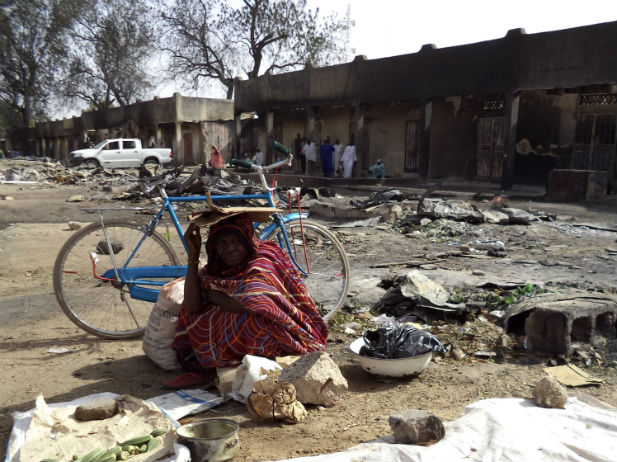
Governor Kashim Shettima of Borno State has said rebuilding of the communities destroyed by Boko Haram insurgency will begin after Ramadan in July.
The governor made this known when he received the director general of the National Emergency Management Agency, NEMA, Sani Sidi, who was on a visit of displaced persons camps in the state.
According to Shettima, the reconstruction will be a joint effort between the state government and NEMA, as government is determined to ensure that displaced persons return to their communities to resume their life.
Sidi said Borno state accounts for 70 per cent of displaced person in the three north-eastern states ravaged by the insurgency, Borno, Yobe and Adamawa, and that work is in progress for the resettlement of displaced persons in the 22 IDPs camps in the state. “We are working toward durable resettlement of displaced persons in the northeast.”
Borno state not long ago entered into partnership with the federal emergency agency to jointly feed the displaced persons. Thus, the NEMA boss donated 26, 000 bags of rice and other relief items, something the state governor said came timely because the state would have had to cough out N500 million, instead of the N48 million it just released.
The governor said the state will need building materials when the reconstruction starts and pleaded with NEMA to assist in this regard.
“We will need zinc, roofing planks, cement and other materials and I won’t mind coming to beg you again for the sake of my people,” Shettima said.
The Inspector-General of Police, IGP, Solomon Arase, has ordered policemen in Zone 6 Police Command to intensify their efforts in curtailing the increasing rate of kidnapping and violent crimes in the zone.
In a statement issued by the police spokesperson, Emmanuel Ojukwu, Arase expressed worry that despite several directives to stem the tide of violent crimes in the states that form the zone-Cross-River, Rivers, Ebonyi and Akwa-Ibom, there is no progress.
“With a view to further ensuring that the order is complied forthwith, the IGP has also put an embargo on all forms of leave, either casual or annual, for officers and men in these Commands,” the statement read.
While calling on the public to collaborate with the police in their fforts to rid the society of crime, Ojukwu added that the police force is determined to ensure that people go about their normal activities without fear
An unidentified army general with the Department of Military Intelligence has been accused of detaining a journalist as well as threatening to frame him up as a Boko Haram informant.
The journalist, Jide Abdulazeez, a staff of the Abuja-based Aso FM, told Leadership newspaper that he was arrested for daring to stand up to the general, who he said was driving against traffic on June 1, 2015.
“While I was driving along the Kubwa-Gwarinpa Expressway, there was traffic hold-up, which made some motorists drive against oncoming vehicles on the lane. As a special marshal, I put on my special marshal jacket, got out of my vehicle and went to restore normalcy.
“Suddenly, I saw a convoy of army vehicles on this same lane which I had managed to clear and took my iPad to take photos, just to have evidence if any accident occurred. Suddenly, the convoy stopped and a soldier hopped out. He took the iPad away forcefully, got back into the vehicle and drove off,” Abdulazeez said.
The journalist said he followed the convoy to the Directorate of Military Intelligence office, where he identified himself and said he was encouraged by President Muhammadu Buhari’s directive that no one should drive against traffic.
“Captains Ogunbunmi and Sanni made me write a statement. Thereafter, I was blindfolded and taken to an unknown destination, where I spent the night. I answered every question they asked and even informed them that I was a journalist, but they kept me. They deleted the pictures I took and even threatened that I would be sent to Maiduguri and labelled a Boko Haram informant”, he narrated.
The next day, Abdulazeez, said, he was taken to Department of State Services, DSS, where he wrote a lengthy statement and detained till 3:45pm when he was released on bail. His phones and other gadgets are still held by the general and he said his private and public life has been affected.
Abdulazeez is seeking justice and has written a letter to the President’s chief of staff, the director-general of the DSS, the country representative of Amnesty International, the executive secretary of the National Human Rights Commission and some individuals.
“I was accused of being a member of the Boko Haram; that was not only absurd, it is also capable of damaging my image and reputation as an on-air personality which I have built for years,” he stated.
When contacted, defence spokesperson, Maj. Gen. Chris Olukolade, declined comment while DSS spokesperson, Marilyn Ogar, did not answer her phone or reply a text message sent to her.
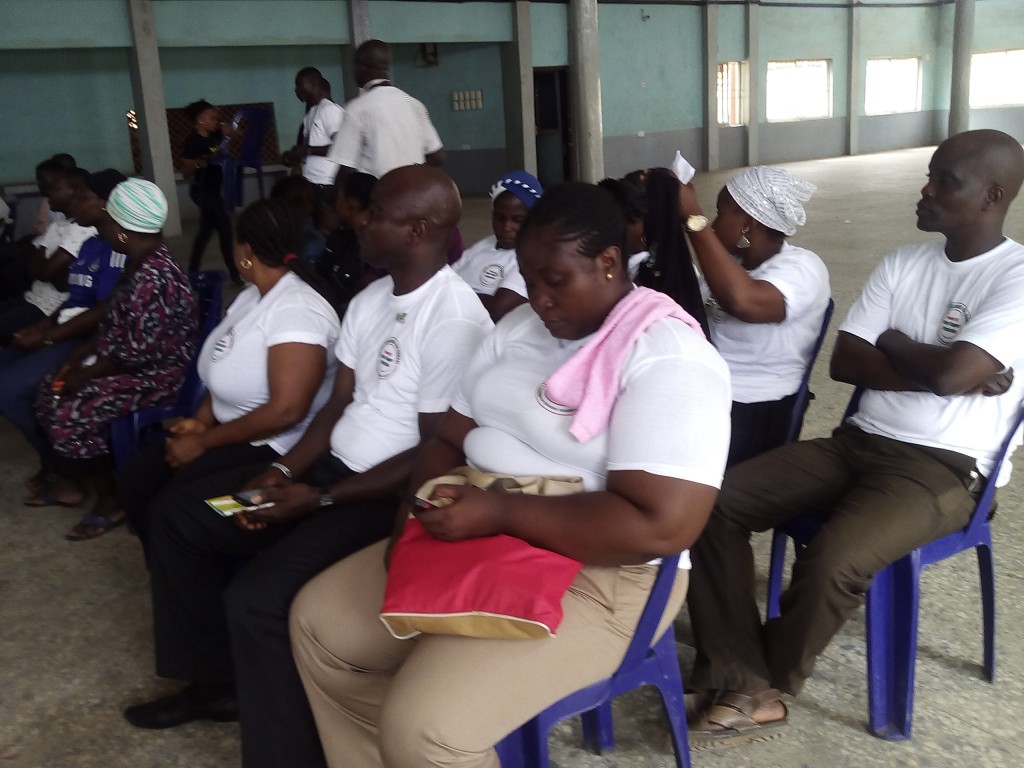
No fewer than 55 women in Oshodi Local Government Area of Lagos State were on Monday rewarded with items that will promote their various micro, small and medium enterprises (MSMEs).
At an event organized by the head of Women Affairs Programme of the local government area, the women were given items such as deep freezers, commercial cooking stoves, gas cookers, in tandem with the development objectives of the donor.
The sponsor, Adedayo Aduke-Thomas head of Women Affairs Department and member of the transition committee of council, said the beneficiaries were nominated based on their economic status. “We choose those who are needy. For instance those selling drinks, we are giving them deep freezers. Those into are into bakery, we are giving the gas cookers. We also have microwave ovens and gas cylinders,” he said.
According to him, women are key to national development and their empowerment is that of the society.
The last national census put Nigeria’s population at about 170 million, with women making up 49 percent of this figure. These women opt out of white collar jobs and are most often into small businesses, as most employers are less inclined to hire nursing mothers and pregnant women.
He added that since most are into small medium scale enterprises, (MSMEs) true empowerment begins with providing them with items that will serve as capital or enhance their businesses. The 2013 National MSMEs survey reported that MSMEs are the biggest employer of labour, having employed 60 million Nigerians and contributing to 48% GDP.
A middle- aged woman and beneficiary, Sade Kasali, said she is excited to receive her gifts as this will help her in bakery.
“I am indeed very grateful to him for doing this. He is using his own personal money but there are many people that after we elect them, they don’t remember us again. But this is very much appreciated. This deep freezer will help me in my trade a great deal,” she said.
Another beneficiary, Bimbo Malik, a fresh graduate from Fountain University Oshogbo, received a gas cooker and sees it as an investment in her future. “I am very glad to receive this. I am looking for a job now, but while I am waiting, this comes handy if I want to start a small business like frying chin chin, plantain chips, it is a good start for me,” she gushed.
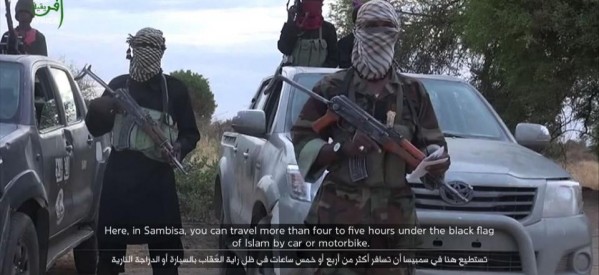
Eleven people were killed, while eight others sustained injuries when two suicide bombers on Monday morning hit Potiskum, the commercial nerve of Yobe state.
According to an eye witness, the first attack occurred at the Dorowa area office of the Civilian JTF, a local vigilante group. The witness said the bomber detonated the bomb when he entered the office, killing eight people, including the bomber.
”A young man came to our office and we insisted that anybody that we would allow to enter must be searched and when he pretended to be opening the bag, he detonated an explosive device,” the witness said, adding that one of the commanders of the vigilante group was among the dead.
Not long after and while people were still discussing the incident, another suicide bomber, pretending to be a customer, walked into a nearby building where people were drinking, and detonated a bomb, killing three people, including himself.
A source at the General Hospital in the town confirmed that eleven corpses were deposited at the morgue and that eight other persons were admitted at the Accident and Emergency Unit of the hospital.
Monday’s attack came just a day after Boko Haram militants attacked Babbangida, the headquarters of Tarmuwa Local Government Area in the state.
A South African non-governmental organisation, Institute for Security Studies, ISS, has described the role played by the country’s government in the al-Bashir saga as “sad for South Africa and a blow to the rule of law”.
Omar al-Bashir, Sudan President had been prevented from leaving the country by a Pretoria High Court pending a hearing into case file by Southern African Litigation Centre, a civil society organisation seeking to compel South Africa to comply with the International Criminal Court’s request for the Sudanese president to face charges of war crimes and crimes against humanity.
However, with the matter scheduled to be heard on Monday, al-Bashir was reported to have left the country, ostensibly aided by Jacob Zuma’s government.
“Until now, the country has been a champion of international justice and has done more than most in Africa to make sure victims get justice,” Anton du Plessis, ISS managing director, said in a statement released on Monday.
South Africa had claimed, through its ambassador to the Netherlands, Bruce Koloane, that Bashir was under immunity, just like other African leaders that attended the African Union Summit over the weekend, an argument the ICC dismissed.
“There exists no ambiguity or uncertainty with respect to the obligation of the Republic of South Africa to immediately arrest and surrender Omar Al Bashir to the Court, and that the competent authorities Republic of South Africa are already aware of this obligation,” Judge Cuno Tarfusser of the ICC clarified.
Du Plessis agreed with the Court, saying: “The UN Security Council decision in this case bars immunity to Bashir under international law and in relation to his position as head of state. Plus, South Africa’s own ICC implementation law removes immunity for individuals wanted by the ICC.”
According to ISS, for South Africa, one of the first African countries to ratify ICC’s Rome Statute, this was good opportunity for the country to help bring justice to victims of Bashir’s crimes, something it failed to do.
“Criminal justice, good governance and the rule of law in the country have been systematically eroded in recent years. We shouldn’t be surprised that this now extends to the international level,” du Plessis stated, referring to recent problems in South Africa.
The Rwandan Patriotic Front, the country’s ruling party, has said it is backing a constitutional change that will pave the way for President Paul Kagame to seek third term in office.
“Based on the wishes of Rwandans and party members that have been recently expressed, we support that the (constitution) should be amended,” a communiqué released by the party read.
It is reported that 3.6 million people out of the country’s 11.8 million people have signed a petition supporting the change, even though there are allegations that many were coerced into signing the petition. “If the allegations that some people have been forced are true, that’s a concern and you should also have that concern,” the president told members of his party, adding that no one should be forced to sign the petition.
Kagame is in his second and final tenue of seven years currently allowed by the constitution, having been re-elected by a landslide in 2010, and he has said he is open to the change, though he had in the past disagreed with calls for constitutional amendment.
With Burundi engulfed in violent protests following President Pierre Nkurunziza’s declaration that he would be seeking a third term in office, no such case is expected in Rwanda, where Kagame has been praised for restoring the country to good health after the genocide of 1994, which claimed about 800, 000 lives.
Sudanese President Omar al-Bashir looks on ahead of the 25th African Union summit in Johannesburg June 14, 2015. (REUTERS/Siphiwe Sibeko)
By Samuel Malik
Sudanese President, Omar al-Bashir, has left South Africa before a court ruling to determine whether to compel the country to arrest him, the BBC has reported.
Al-Bashir is wanted since 2009 for war crimes and crimes against humanity and when he decided to attend last week’s African Union’s meeting in South Africa, the International Criminal Court, ICC, requested for his arrest.
The Southern African Litigation Centre, a human rights group, approached the Pretoria High Court to stop al-Bashir from leaving the country and the court postponed ruling till Monday, asking the government to ensure that the president was in the country till the case was heard.
The BBC said the lawyer representing the South African government told the court that Bashir’s name was not on the list of passengers that left the country earlier.
However, a Sudanese minister has told Reuters, according to the BBC, that Bashir is expected in Khartoum later in the day, with a press conference expected to be held in the nation’s capital upon his arrival.
Following Sunday’s court order, the African National Congress, South Africa’s ruling party, issued a strongly-worded statement condemning ICC’s action, accusing it of selective justice against Africa.
“The ANC holds the view that the International Criminal Court is no longer useful for the purposes for which it was intended,” the statement read, adding that Africa and Eastern Europe “continue to unjustifiably bear the brunt of the decisions of the ICC, with Sudan being the latest example.”
Al-Bashir is understood to have sought assurances from the government of Jacob Zuma that he would not be arrested and the government is also understood to have given immunity to all visiting heads of government.
According to the United Nations, Sudan’s crisis, which began in 2003, has killed 300, 000 people, with a further two million displaced.
None of the offices of the Attorney-General of the Federation, National Security Adviser or the Economic and Financial Crimes Commission, EFCC, can account for the whereabouts of the money Nigeria has received from foreign countries as part of the money stolen from the treasury by former head of state, the late Gen. Sani Abacha.
The government agencies are in court because a non-governmental organisation, Legal Defence and Assistance Project, LEADP, is suing them for details of the repatriated fund.
The AGF and NSA were fingered by the EFCC as having knowledge of what happened to the money in its counter-suit against LEDAP in 2011, when the NGO dragged the anti-graft agency before Justice Ahmed Mohammed of a Federal High Court in Abuja for refusing to furnish it with the information it requested regarding the loot under the Freedom of Information Act, FoI.
Following their implication, LEDAP decided to join the AGF and NSA in its suit, but the two denied involvement in any deal that led to the recovery of the money.
Austin Emmumejakpor, a lawyer with the EFCC, in the counter-affidavit on March 5, 2012, said: “That I am informed that remittances relating to the estate of the late Gen. Abacha were co-ordinated by the offices of the National Security Adviser and the Attorney-General of the Federation and not the respondent (EFCC) as erroneously thought by the applicant.”
However, the AGF and NSA are refusing to be joined in the suit and their lawyer, Godwin Onwusi, said they knew nothing that transpired leading to the deal.
“That the 2nd party sought to be joined (NSA) did not coordinate the remittances relating to the estate of the late Gen. Sani Abacha.
“That the 2nd party sought to be joined is neither in custody nor in possession of information relating to the remittances referred to in paragraph five above.
“That the 2nd party sought to be joined is neither a necessary party nor an indispensable party in this suit,” Austin Nwaroh, a lawyer from Onwusi’s law firm, deposed on January 28, 2015.
On March 25, 2014, the two had opposed being joined as defendants in the case and deposed through another lawyer with Onwusi’s firm, Ifeanyi Umeji, that, “the 1st and 2nd parties sought to be joined (AGF and NSA) did not coordinate the remittances relating to the estate of late Abacha.”
However, LEDAP’s counsel, Chino Obiagwu, argued the both the AGF and NSA are necessarily part of the case because according to the Section 21 of the FoI Act, 2011, “the onus is on such body to prove that the information is not within its control.”
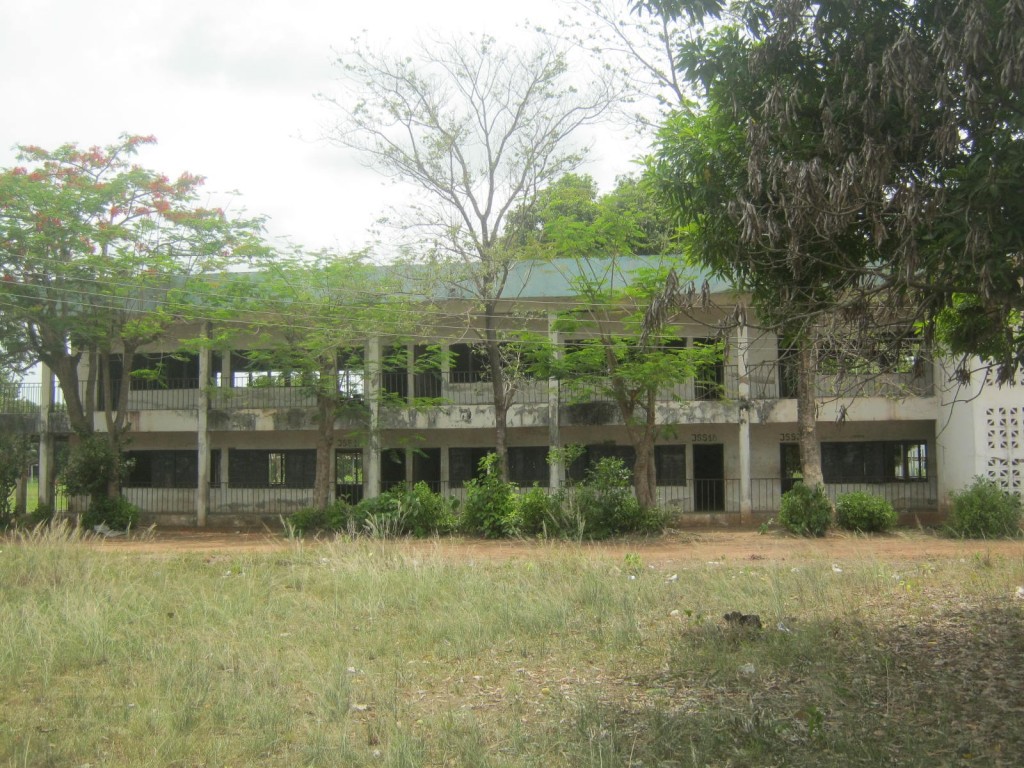
Government College, Utonkon, Benue State, where Apa University operated from
Assistant Editor SEUN AKIOYE and SAMUEL MALIK in this joint investigation, report on the activities of some self-acclaimed prívate universities whose legality has been questioned by the National Universities Commission (NUC).
In the prosecution dock at the Federal High Court, Akure, Ondo State, stood Dr. Martins Olurankise. Standing opposite him was Ayobami Blessing, witness-in-chief in a case Justice I.M. Sani heard on February 10, 2014. Olurankise and Blessing were fairly familiar with each other; the former as a vice-chancellor and the latter as a student. Now they found themselves at opposite ends of the law.
Eight years earlier, Olurankise was living in dreamland as the Vice-Chancellor of the Akure Campus of Open International University, Sri Lanka. The institution had more than 2,000 students registered for various courses.
Open International University Colombo Sri-Lanka, Akure Campus, was not any other university. Its admission process was not cumbersome. You did not need the Joint Admissions and Matriculation Board Examination (JAMB) to secure admission into it. All you needed was to pass the special entrance examination of the school, pay the required fees and you would become a student. What is more, you would be given a degree certificate from a foreign university. The prospects were simply too enticing to resist.
Blessing thought she had been blessed after passing the school’s entrance examination and meeting other entry requirements. She was admitted to study for a degree programme in Nursing and Midwifery.
Blessing told the court: “I met the requirements and admission was given. The admission letter showed the name of the school, the course offered and the signature of the Vice Chancellor, which helped to convince me that the school was authentic.”
Her conviction, she said, moved her to pay the various fees required to tie down a place at the institution. “I paid the sum of N5,000 for acceptance fee and a receipt was issued. I then paid the sum of N2,000 and N12, 500 as part of the tuition fees. I also paid the sum of N17, 500 for which a receipt was not issued. I later paid N5,000, making it a total sum of N22,000, for which a receipt was given,” Blessing told the court.
The fees, she explained to the court, were classified as tuition and miscellaneous fees for the 2006/2007 academic session.
The school opened and classes resumed, with students studying courses like Medicine, Pharmacy and Nursing.
The next session, Blessing paid N5,000 as part of the tuition fee and got a receipt. She paid another N15,000 which was also receipted.
In 2008, however, Blessing’s dream of continuing her studies in the school crashed. The institution was invaded by operatives of the Independent Corrupt Practices and other related offences Commission (ICPC), accompanied by officials of the National Universities Commission (NUC).
The agencies were acting on a petition addressed to the NUC by the Ondo State Ministry of Health, to which the institution had written that it was running academic programmes in Pharmacy, Medicine and Midwifery.
Olurankise had written to the Ondo State Ministry of Health, introducing his school and the courses it offered, including B.Sc in Medicine, Pharmacy, Nursing and others. It was in a bid to request that the ministry should offer students of his university opportunities for practical training in health facilities in local government areas in the state. Olurankise successfully placed some of his students at medical facilities operated by Akoko South West Local Government Area.
But that was as good as it got. He was arrested by operatives of EFCC and the institution was shut down. One year later, Olurankise appeared before the Federal High Court to face allegations related to fraudulently obtaining money from unsuspecting students.
A disturbing trend
A joint investigation by The Nation and ICIR would later show that there are many others in the country, running illegal tertiary institutions and fleecing hapless students. A major problem bedevilling admission into tertiary institutions in the country is acute shortage of places for qualified candidates.
In addition to this, many candidates are denied admission because they lack basic requirements, notable among which are earning a certain number of credit passes in the West African Examinations Council (WAEC) examination required for university admission and scoring the required marks in the highly competitive Joint Admissions and Matriculation Board (JAMB) examination.
But a disturbing, albeit recurring decimal, has been the number of students who are qualified for admission but are unable to get places because of shortfall in admission slots. Recent figures from the NUC indicate that the country has 142 universities. Of these, 41 are Federal Government-owned, 40 are owned by state governments, while 61 are privately-owned.
The total number of universities, many experts believe, is grossly inadequate for the number of eligible admission seekers, which has been rising yearly. For instance in 2009, a total of 911,653 candidates applied to sit for the JAMB examination. This number increased to 1,092,324 in 2010. In 2011, it was 1,493,604 and in 2013, it reached an all-time high of 1,735,729. Also between 2013 and 2014, there were roughly 1.67 million candidates who sat the JAMB examination.
Admission places are simply not available in the same proportion. For instance in 2013, the number of spaces in the universities was 520,000 (29.96 per cent) of the students seeking admission.
Most of the universities dealt with this issue by exceeding their permissible admission quotas. According to the NUC report of 2011/2012, University of Lagos’ (UNILAG) admission quota was 6,500, but it admitted 7,527; Ahmadu Bello University (ABU), Zaria, had 6,688 places but ended up with 7,397. University of Nigeria, Nsukka (UNN) had 5,970 places, but admitted 8,267.
Available statistics also show that only about 20 per cent of post-secondary school students seeking admission into higher institutions get admitted. The shortage of admission places in the federal and state universities makes the privately-owned institutions the only alternative.
However, it is not an alternative open to everyone, as the huge fees charged by the schools constitute an impediment. This, naturally, compels many applicants to keep hoping for places in government-owned universities and creates opportunities for proprietors of unapproved universities to mine applicants’ eagerness for degrees.
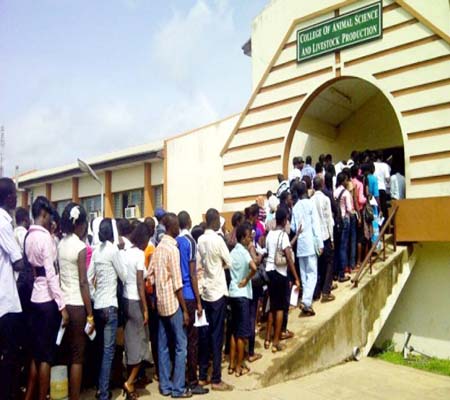
UTME students about to write exam at a centre… What hope of placement for them?
They simply establish universities and advertise them as being affiliated to foreign tertiary institutions. Most times, the overseas affiliates are in Asia, a continent where verification is difficult.
“The problem is with the system. Apart from the fact that we do not have enough universities, there is also this craze for a university degree. In Nigeria, you almost cannot make any headway if you do not have a university degree, and we have relegated technical certificates to the background. That is the gap fraudulent individuals seek to fill by establishing schools that would feed the desire of students that are left out,” said Oladele Olaleye, an educationist said.
Another educationist, Mrs. Funso Apoeso, believes that the lure of easy admission requirements is the main attraction to these universities.
“In such institutions, you discover that the admission requirements are always lower than the ones in approved universities. And if someone has tried to gain admission but was constrained due to these, such a person will easily fall prey to such scams,” she said.
In 2006, the NUC went after these ‘gap-filling’ institutions by establishing the Committee on Closure of Illegal Universities (CIU). The committee, which has since shut a number of illegal universities, publicly listed 64 universities as illegal and unapproved institutions in 2013. The NUC said the schools flouted the Educational Act, CAP E3, Laws of the Federation of Nigeria 2004.
Operating in the shadows
Adebola (surname protected), a staff of the Federal University of Technology, Akure (FUTA), remembers exactly where and when he met Olurankinse. “We heard the advertisement on the radio where he was calling for students and lecturers. There were posters all over Akure. I got in touch and he asked me to come for an interview,” Adebola said.
The ‘interview’ held at the Ondo State Library at St. Peters Junction, Oyemekun Road, Akure. It had a three-man panel that included Olurankise. In the end, Adebola was given the school’s posters and flyers and then a shocker: his employment would be based on how many students he brought into the new school.
“My marketing skills aren’t good so I did not bring any student and thus no employment for me,” Adebola said with a smile.
Blessing got Olurankise’s phone number from one of the posters and was admitted to the school after paying the N5,000 acceptance fee. About 2,000 other students also paid about N10,000 each into the coffers of Open International University, Sri Lanka, aside the tuition and other fees.
In the course of a two-month investigation into the operations of these illegal universities, most of the schools on the NUC list and visited had two things in common: they operated on the outskirts of town, possibly to avoid the attention of relevant authorities, and had no structures of their own. They operated from rented apartments or already existing schools.
For instance, Apa University, which reportedly folded up years ago, existed in Utonkon in Ado Local Government Area of Benue State. Getting to Utonkon and back from Otukpo, a major town, on a motorcycle cost about N1, 000, and the location makes it very difficult for relevant authorities, like the NUC, to regulate it.
Apa University had no structures of its own and operated from Government College, Utonkon, a school with decrepit facilities.
Akor Okpe, a victim of Apa University, told our reporter: “The hostel was not good and had small rooms. Students fixed the doors themselves. The sanitary condition was so terrible that students defecated in the bush, and there was no good library to suggest we were in a school, a private school. Even lectures were not regular.”
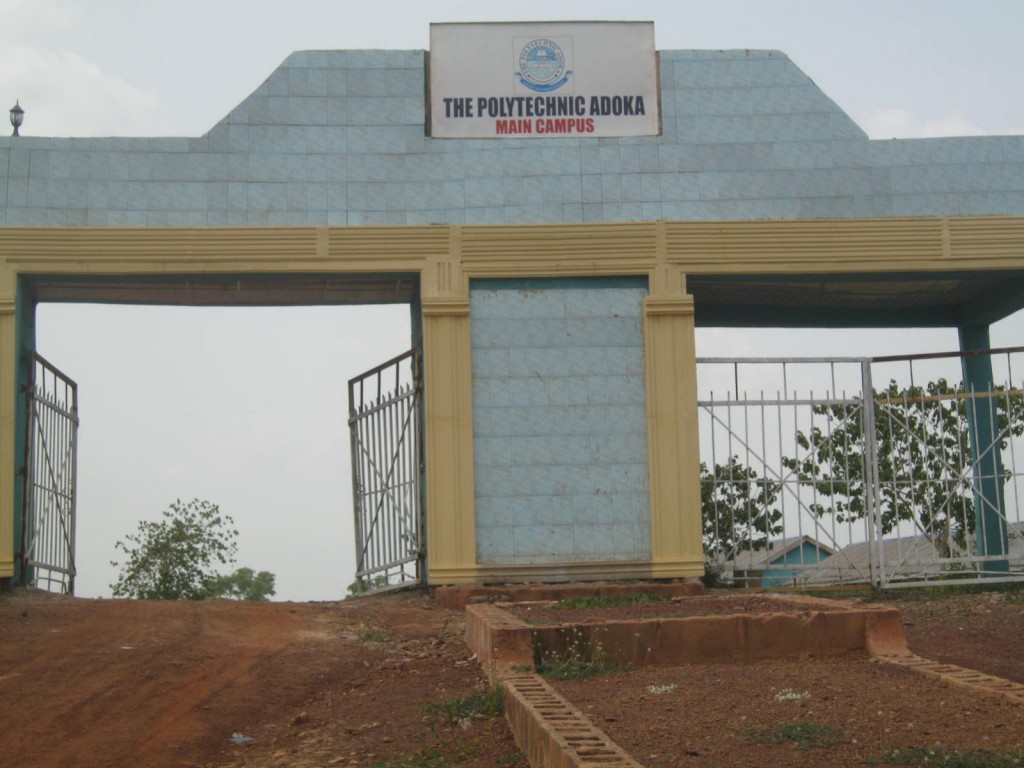
Also, it takes about two hours from Makurdi, the state capital, to get to Adoka, where Samuel Adokpela University allegedly existed. On arrival in Adoka, the only school seen with the name Adokpela was a secondary school, with residents saying there was never a university there. The university had simply ‘vanished’.
Another ploy of the operators of unaccredited universities is to claim an affiliation with little known universities abroad. This way, they deceive students into believing that they are studying for internationally recognised degrees. It makes sense, therefore, that instead of the students spending millions to travel abroad and undergoing the stress of obtaining visa, the same international degree could be obtained here in Nigeria spending a fraction of the money.
In Ekiti, St. Clement University, Iyin Ekiti, seemed to have folded up and the operators disappeared into thin air. However, one Atinuke, who claimed to have been a victim of the school’s admission racket, said her dreams were shattered after they saw the name of the school among the ones listed by the NUC as illegal and confronted the management.
“The next day, no lecturer came to the lecture rooms. We saw only a few of the administrative officials and within the week, the campus was only filled with students that would mill around discussing their fate. Some would cry and we were unable to console one another. It was like that until one after the other, we dispersed from the institution, seeing that there was no one to hold by the collar,” she said.
In the eastern part of Nigeria, investigations also revealed that many of the universities on the NUC list have gone underground. In Mbaise, Imo State, nobody could recollect seeing Fifom University and the United Christian University, which are on the list of the NUC as illegal. In Abia State, nobody seemed to have heard about the Volta University, Aba. In Oyo State, Acada University in Akinlalu, near Ife, was also nowhere to be found. A resident of the village said he had heard of the school, but it had closed down.
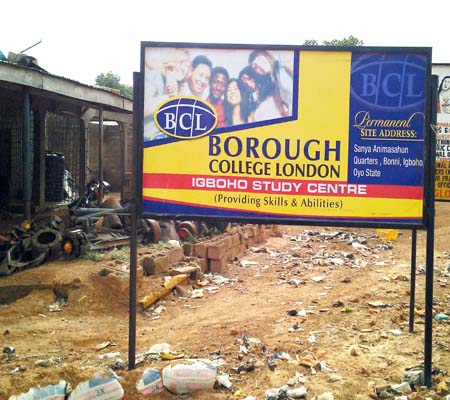
There is also the celebrated case of Borough College London, Igboho Study Centre, which has been attracting attention since The Nation did an exhaustive report on the activities of the school. Currently, the school is still shut while the NUC said the operators must return to follow the accreditation process before it could be re-opened.
According to Folu Olamiti, the resident consultant on Media for the ICPC, the operators of the school have two options: “They can either redress any defaults and thereafter resume operations or seek legal protection of their rights if they believe that they are executing their activities with the approval of applicable state and federal legislation. As a last resort, they can forcibly reopen the institution and face criminal charges.”
The site of the Borough College London, Igboho, Oyo State
However, the NUC has an explanation for some of the above scenarios, according to the Chairman of its Committee on Closure of Universities, Prof. Adebisi Balogun. He explained that the universities may have folded up due to the clampdown from his committee.
“The list of universities you found there are compilations over a period of time. Because of our activities, some of those schools have packed up and gone underground. You may not find them where they were listed. At the time we captured those lists, they were actually in operation,” Balogun said.
Impatience
According to investigators at the ICPC, some operators of these schools fell foul of the law for lack of patience. Once they applied to the NUC for permission, they did not wait for approval before beginning to run the schools.
Sunday Adokpela University, our investigation revealed, falls into this category. Having applied to the NUC for permission to operate a university, it went ahead and sold forms without waiting for NUC’s approval.
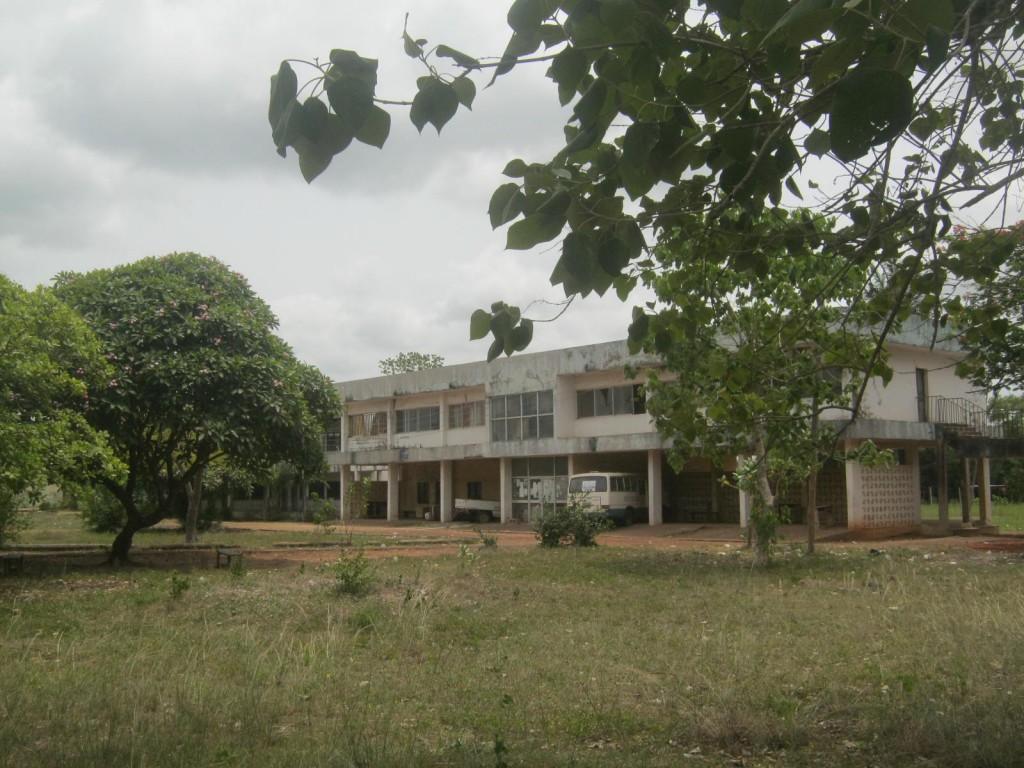
The school sold forms for pre-degree programmes and gave admissions to students, but then realised that the university was going to take time to start. So, it decided to convert the admissions to polytechnic programmes under the incorporated name of Sunday Adokpela Polytechnic. But since the polytechnic itself was not yet operational, the school approached Fide Polytechnic in the state for permission to administer its programmes to the students and after their graduation, they would be given certificates in the name of Fide Polytechnic.
Students were not happy and some of them decided not to continue because what they wanted was university education.
The Polytechnic, formerly Sunday Adokpela Polytechnic where illegal degree programmes were allegedly offered
The ICPC is currently prosecuting some individuals and institutions for operating illegal degree programmes and exploiting students. According to the commission, one Prof. David, operator of a university in Abuja allegedly collected over N100 million from students for the award of honorary doctoral degrees under the pretence that the school is based in Belize in the Americas.
Another operator falsely assumed authority to offer admission and in the process obtained more than N8 million from students by deceiving them that the school was affiliated to Ambrose Ali University, Ekpoma, to offer degree courses.
Barrister Moses Awe, deputy director, Legal Department, and secretary of the Committee on the Closure of Universities, said the motivation for the establishment of illegal universities is greed and the act an economic crime.
“It is an act of obtaining money under false pretence from gullible students,” Awe said.
This is the case that is hanging over Olurankinse. He has been charged with fraudulently obtaining money from unsuspecting students by false promise.
Legal encumberances
The ICPC and NUC operatives who shut down Evangel Christian University came unannounced. One Saturday, classes had begun and it seemed things would go on swimmingly.
Grace, a woman who witnessed the raid, said the school management was caught unawares. “Many of them were running everywhere looking for escape routes, with many fleeing through the window and leaving the hapless students to their fate,” she recalled.
According to the NUC, when operatives shut down any institution, they are always on the lookout for the proprietor or the vice-chancellor as the case may be. These men usually run away whenever they sight operatives of the ICPC.
But NUC and ICPC have been able to prosecute and get convictions in some cases. For instance, Francis Ada Agbo was convicted in Keffi and sentenced to three years imprisonment. Also, Mr & Mrs Nwachukwu of Temple University, Abuja, were convicted and sentenced to six months imprisonment.
But there are others who have either escaped justice or have been able to use the law to their advantage. For instance, the lead prosecutor in Olurankinse’s case, T.N Ndifon, had complained about deliberate tactics by the defence counsel to delay the prosecution of the case.
For Lawrence Kayode Dare, counsel to Olurankinse, his team has a solid defence against the allegations against his client. In a telephone interview, Dare said: “Our defence is that my client is just an employee of that institution. It is not his responsibility to register the school and he didn’t collect any money from the students. None of all the payment receipts tendered was signed by my client. He is not the owner of the institution; he was just employed as a regional Vice Chancellor.
“You work with The Nation. Is it your responsibility to ensure The Nation is registered with the appropriate bodies? And if certain adverts are carried and payment made to the cashier, can you be liable?
“We asked the prosecution if they knew that the parent body is in Colombo and they confirmed that the parent body exists. They should have enquired from the parent body if Martins is an employee of the school,” Dare concluded.
But the case may have hit a dead end. At the last adjourned date of April 11, 2015, the court did not sit on the case and there is currently no date for continuation of the trial. With the lull in the case, there are fears that it may die naturally.
Students’ gullibility
Unaccredited institutions offer the easiest route to a university degree for candidates who do not have the minimum entry requirements of five credits, including Mathematics and English Language; those who consider the JAMB examination an irritation or those who have attempted it without success.
The institutions lure candidates with the assurance that they have nothing to worry about, while the students follow without asking the necessary questions. Even if they do ask, the schools usually come up with convincing answers.
“Seven professors came to assure us that we had nothing to worry about and that the school would be accredited because they had been to the NUC and the process was already on,” Daniel Ojile, a victim of an unapproved university in Benue State, said.
Ojile had become desperate for admission, and when news went round that a university was coming to Idoma land, he was excited. He was offered admission into the school’s preliminary studies and after a year, got admission to study Medicine. Two years later, his world came crashing down.
Government College, Utonkon, Benue State
“We waited for the accreditation and after two years, when I was in 200 Level, we learnt that the school could not secure accreditation and that it would be scrapped,” Ojile, now a final year student of Microbiology in the University of Abuja, recalled.
Awe would also blame some of the students for not being diligent enough to seek information about the universities. He also believed the problem is not that of access to universities, with the Federal Government’s recent approval of specialised universities and over 150 schools students can choose from.
“Nobody has a reason to patronise them. But you would see students with two credits getting admission and a Third Class graduate teaching them. I would blame it on the students. We have a website where they can check for all the information they need. You would be shocked to find that some students even want it like that,” he said.
NUC and the law
As much as the NUC wants to fight the running of illegal universities, it is hampered by lack of prosecutorial powers. Even when arrested, there is no law with which the NUC can charge operators of illegal universities. Currently, there is no law that criminalises the running of an illegal school apart from the Educational Act, CAP E3, Laws of the Federation of Nigeria 2004, which stipulates the requirements for the establishment of private universities in the country.
“This is why we have partnered with the ICPC, which has the power to prosecute people who have committed economic fraud,” Awe said.
Implications of attending a degree mill
To many of the victims, the opportunity offered by the unaccredited universities might have been hard to resist, but the implications of attending and graduating from one of such universities are dire.
“The perpetrators of this evil act see themselves as the last hope of the masses. And before the students become aware that they were being fleeced, they would have been in the university for one or two years, with a lot of money already spent,” Ojile, a victim, said.
One easy way of attracting students by these fake universities is to offer them respite from JAMB which, unknown to many students, is the gatekeeper between schools and the National Youth Service Corps (NYSC) programme.
JAMB is the only body that is responsible for admission into tertiary institutions through the University and Tertiary Matriculation Examination (UTME), which qualifies a candidate for admission into a university, polytechnic or college of education.
According to JAMB, while a school may organise preliminary programmes for those seeking admission, such programmes are not substitutes for UTME.
“Some schools, which have their regulatory bodies’ accreditations, run preliminary programmes, remedial studies or whatever they want to do (and) we do not care,” Fabian Benjamin, JAMB’s head of public relations said.
“What we do (care about) is that when these candidates go through these programmes, they still have to write the JAMB exam. The point here is that whatever you are doing is like a coaching class for them.”
Benjamin said schools cannot impose candidates on the board simply because the candidates perform well in the preliminary programmes, and that if a defaulting school thinks it is smart and offers admission to students without its knowledge, repercussions await such students.
“If you have to participate in the National Youth Service Corps programme, you must have a JAMB admission letter. And for you to have that, you must have sat for and passed the JAMB exam. To have sat for JAMB and gained admission, you must have got the minimum entry requirements,” he said.
The proposed site for a university in Abuja
The way forward
According to some experts, the NUC should do more than just shutting down illegally operated universities but also address the roots of the problem. Prof. Olusegun Osinowo, chief operating officer of Sophie Academic Services, Abeokuta, said the government must address the issues of serious shortfall in the number and quality of university lecturers.
He said while there are about 150 universities in Nigeria, the high fees being charged by private universities put them beyond the reach of most admission seekers. Osinowo said the NUC must adopt a more liberal attitude towards part-time programmes and the operation of 24-hour campuses (night study).
“Virtually all Nigerian universities currently operate for between eight and 10 hours daily. The facilities remain idle for the rest of the day. The introduction of night study on these campuses has the potential of increasing enrolment by 50 to 100 per cent, with minimal additional investment in solar panels or diesel generators, pending improvement in power supply through the national grid,” he said.
This investigation was supported by Ford Foundation and the International Centre for Investigative Reporting (ICIR).