Home Blog Page 326

How to get a clean shave – tips from a skin expert

0

By Adebola Ogunbiyi, University of Ibadan

THE development of facial hair is a sexual characteristic that marks adulthood in men. In the past, facial hair was often frowned upon culturally in Nigeria, with some institutions even mandating a clean shave. Well-groomed facial hair has gradually become more acceptable globally, however.

Despite this shift, anecdotally, many men would prefer to have a clean shave. But they worry about razor burn, nicks, skin irritation and developing bumpy skin.

Pseudo-folliculitis barbae is a common disorder on the face and neck of individuals of African and Asian descent as a result of shaving. It happens when hairs grow back into the skin and cause inflammation and irritation. The result is papules (solid bumps), pustules (fluid-containing bumps) and post inflammatory hyperpigmentation (dark marks).

There is no precise figure for the number of people with this condition. It has been attributed to genetics, the structure of hair, and poor shaving techniques. Facial hairs are curved, which increases the likelihood of re-growing hair penetrating the skin or growing inward within the follicle.

Razor or shaving burn – pain, itching, redness and rashes – results from a sensitive skin, inadequate skin preparation before a shave, the use of dull blades, shaving against the direction of hair growth or irritating shaving products. Razor burn usually stops after a couple of weeks of continuous shaving.

As a dermatologist with research in shaving habits, my advice is: prepare the skin well; use the right shaving tools; use proper shaving techniques; and care for your skin after shaving. This applies whether you are using razors, clippers, depilatory creams or powders, plucking, waxing, electrolysis or laser hair removal.

Skin preparation

To ensure a comfortable shave and minimise skin irritation, wash your face with water and a gentle cleanser (soap) during or after a bath to reduce the oil, sweat and dirt on your skin. This softens facial hair, making it easier to cut with less pressure. It also produces blunt tips, reducing the chances of the hair penetrating the skin when it grows back. Before shaving, apply foam, gel or a soap and water mixture. This hydrates the hair and enables the blade to glide over the skin, reducing friction and skin irritation.

Shaving tools

The choice of a shaving instrument is dependent on skin sensitivity, beard texture, hair growth and the smoothness desired. Other considerations are cost and time availability.

Razors give the smoothest shave. If you have a sensitive skin or soft facial hairs, single razors are ideal. If you have thick and coarse hair, multiple blade razors may be more efficient. The multiple blade razors lift and cut the hair, allowing the tips to recede slightly into the follicle for a smoother shave.

An electric razor can be used without prior skin preparations (dry shave) and causes fewer cuts and nicks than manual razors.

Beard trimmers or hair clippers have guards that prevent them from coming into direct contact with the skin. That means less skin irritation and pseudo-folliculitis barbae.

In Nigeria, our research found that the most commonly used instrument among 1,003 men in Ibadan was the clipper (67.5%), followed by shaving stick (19.3%), razor blade (9.8%) and shaving powder (5.8%).

Shaving sticks (usually disposable) were used more by older respondents while clippers were preferred by younger men. Clipper users tended to shave less frequently and to have had shaving bumps in the past.

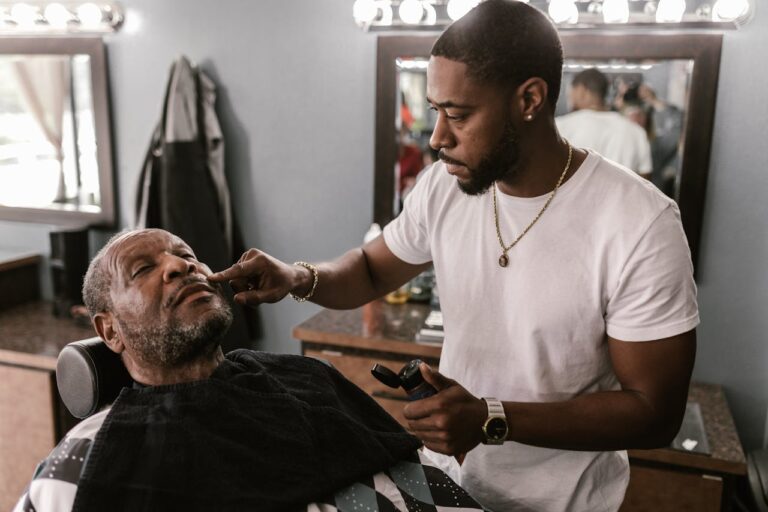
Keep the blades of your shaving instruments clean and sharp to prevent clogging. Dull blades require extra pressure, producing more friction and skin irritation. Change blades as required. Clean electric shaving heads with cotton tips or damp cloths, and then keep them dry. Use your own shaving instruments, especially at barber shops, markets or hair salons, to prevent the transmission of infections from inadequately sterilised instruments.

Shaving techniques

You should shave in the direction of the hair growth, except in the neck area, where direction of hair growth may not be obvious. Shave in one direction with mild pressure. This reduces the chance of irritating or cutting the skin. If you want a smoother shave after the first stroke, gently shave against the grain. Do not shave over irritated skin or other skin disorders such as acne (pimples) as this will lead to more irritation or ulcerated surfaces. Shave frequently to prevent pseudo-folliculitis barbae.

Post-shave care

Rinse the skin with cool water to clean off shave gels, soap and foam residues and hairs that may irritate the skin, then pat dry with a clean towel (rubbing may irritate the skin). Apply an aftershave preparation or a moisturiser.

Aftershave preparations moisturise and soothe the skin. They come as lotions, gels and balms and usually contain soothing substances such as aloe vera and chamomile. Some contain menthol, which gives a cooling effect. A few contain alcohol, which has antiseptic properties but may leave your skin too dry.

Non-conventional aftershave products include alum (potassium aluminum sulphate) stones because of its astringent and antiseptic effect. Alum blocks make for popular shaving products because they prevent bacterial growth and reduce inflammation. This may help reduce the risk of a shaving rash or infection.
However, it may lead to dryness, tingling and tightness and is better avoided. Other irritating substances to be avoided include lime, lemon, engine oil and medicated soap.The Conversation

Adebola Ogunbiyi, Professor of Medicine, University of Ibadan

This article is republished from The Conversation under a Creative Commons license. Read the original article.

Regulatory risks loom as Nigerian banks fail to meet CBN obligations


NIGERIAN banks’ aggregate Capital Adequacy Ratio, (CAR), remains below the regulatory threshold as of January this year, an official report from the Central Bank of Nigeria (CBN) has revealed.

Although many banks are intensifying efforts to meet the regulatory obligations as the banking recapitalisation deadline draws closer in March 2026, CAR indicates how well a bank can meet its obligations to the regulator to determine its risk of failure. In this case, Nigerian banks were below the threshold.

According to CBN’s Guidelines on Regulatory Capital issued in September 2021, “A minimum Pillar 1 regulatory Capital Adequacy Ratio (CAR) of 15 per cent will apply to all banks and banking groups with international authorisation and those that have been categorised by the CBN as being Domestic Systemically Important Banks (D-SIBs). A minimum CAR of 10 per cent will apply to all other banks.”

The report, released recently, contains the personal statements of its Monetary Policy Committee (MPC) members on the 299th MPC meeting held on February 19 and 20 this year.

The committee used the two-day bi-monthly MPC to make decisions on Nigeria’s macroeconomics and rein in inflation.

At its meeting last month, the committee held all key economic parameters, The ICIR reported.

Members of the committee observed that the CAR of banks was still below the regulatory threshold, raising concerns over banks’ financial stability.

The ICIR reports that CAR is a tool used by the CBN to measure the ability of banks to handle their financial risk exposures.

The apex bank regularly takes into account the relevant risk factors and the internal capital adequacy assessments of each bank to ensure that the capital held by a bank is commensurate with the bank’s overall risk profile.

The assessment includes, among others, the effectiveness of a bank’s risk management systems in identifying, assessing, measuring, monitoring, and managing various risks, including interest rate risk in the banking book, liquidity risk, concentration risk, and residual risk.

In Nigeria, the apex bank mandates a minimum CAR of 15 per cent for banks with international licenses and 10 per cent for those operating locally.

In his note for the last MPC meeting, a member of the committee, Mustapha Akinkunmi, expressed concern that banks’ CAR, which rose to 14.84 per cent at the end of January this year, up from 10.70 per cent in January last year, was still below the minimum regulatory threshold.

According to him, the increase reflects positive movement in the capital strength of Nigerian banks, indicating that banks have either raised more capital, improved profitability, or reduced risky assets, which enhances their ability to absorb shocks, but fell below the requirement.

“While this improvement is positive, 14.84 per cent remains below the regulatory threshold for many banks in the advanced economies, thus leaving room for further improvement to meet international standards and cope with external financial pressures.

“I therefore call for additional action to accelerate the recapitalisation process,” Akinkunmi said.

Another member of the MPC, Bandele Amoo, also expressed similar worries.

He said, “The Capital Adequacy Ratio (CAR) declined to 14.8 per cent in January 2025 from 15.2 per cent in December 2024, thereby exposing banks to more risk-weighted assets and undermining credit growth, even as interest margin to total operating income rose by 8 per cent.”

Amoo, however, noted that banks’ non­performing loans (NPLs), as a proxy of credit risk, stood at 4.2 per cent in January 2025.

When banks’ NPLs reach five per cent and above, it signals a danger that borrowers may not be meeting their loan obligations.

The NPLs declined to 4.22 per cent in January 2025 from previous months, since November 2024, when the ratio was at 4.87 per cent.

“This decline is generally a good sign, indicating that more borrowers are meeting their obligations, and banks may be addressing their non-performing loans more effectively.

“It could also reflect improved economic conditions and better risk management practices,” Akinkunmi added his voice.

But while this represents a positive trend, it is important to note that NPLs remained higher than the 4.15 per cent recorded in January 2024, leaving substantial room for improvement, he pointed out.

CBN’s mandates on CAR

According to CBN, banks are required to maintain the minimum regulatory threshold on an ongoing basis to ensure their financial stability and instill confidence in the banking sector.

Simply put, CAR is the proportion of a bank’s equity to its risk exposure.

It is an indicator of how well a bank can meet its obligations, and it is used to protect depositors and promote the stability and efficiency of financial systems around the world.

For instance, if a bank has N200 billion risk-weighted assets and has a qualifying capital of N60 billion, then its CAR is N60 billion divided by N200 billion, which equals 30 per cent.

CAR helps the apex bank to protect depositors from banks that lend aggressively and, in doing so, do not get back most of the money lent.

When a bank makes large loan losses that wipe out its total equity, it may lead to an immediate bankruptcy, which will result in depositors losing their money.

Concerns over individual deposits higher than corporate deposits

Another warning signal noted by MPC members was that individuals’ deposits in the banks were higher than deposits from corporate organisations.

According to Akinkunmi, as of January this year, individuals led the ownership of deposits with 45.20 per cent of the total bulk deposits in the banking system.

“This suggests that Nigerian consumers, whether through personal savings accounts, current accounts, or other forms of deposit, hold a significant portion of the liquidity in the banking system,” he said.

However, corporate organisations hold 42.07 per cent of total deposits, indicating a significant role in the banking system, especially considering their lower percentage compared to individual ownership.

“Therefore, I call for carefully balanced monetary policy decisions to maintain consumer confidence in the banking system,” Akinkunmi said.

IMF appoints Tony Elumelu, 8 others to new advisory council

0

THE International Monetary Fund (IMF) has appointed Tony Elumelu, the founder and chairman of Heirs Holdings, along with eight other prominent figures, to a new Advisory Council on Entrepreneurship and Growth.

IThe appointment was confirmed in a statement released by the IMF on Thursday, March 27, by the IMF’s managing director, Kristalina Georgieva.

The council members will be sharing their thoughts and experiences on how macroeconomic and financial policies can help boost entrepreneurship and productivity.

Their main aim is to identify policies that will improve how resources are used, encourage innovation, and drive economic growth led by the private sector.

According to the IMF in the statement released from Washington, DC, United States, the appointment is part of its efforts to help its 191 member countries create better macroeconomic and financial conditions for strong and durable economic growth driven by increased productivity.

Georgieva was stated to have convened an inaugural meeting with her new Advisory Council on Entrepreneurship and Growth on Thursday.

“The medium-term outlook for world economic growth is at its lowest in several decades. Much of the slowdown can be attributed to declining productivity growth.

“The Council brings together a group of leading thinkers and practitioners in business, finance, academia, and policymaking to share their views and experiences on how macroeconomic and financial policies can provide a supportive environment for innovation, entrepreneurship, and productivity—key ingredients for a thriving private sector and strong economic growth,” Georgieva said.

The council will meet approximately once every three months in structured discussions under Chatham House rules.

The discussions with the council will inform the IMF’s analytical agenda and policy research aimed at promoting macroeconomic and financial policies that are conducive to higher productivity growth and can support stronger medium-term economic prospects across its membership, the statement added.

The council members confirmed by the IMF are:

  • Professor Ufuk Akcigit, Arnold C. Harberger Professor of Economics, University of Chicago.
  • Reema Bandar Al-Saud, Ambassador of the Kingdom of Saudi Arabia to the United States of America.
  • Marc Benioff, Chair, CEO, and Co-Founder of Salesforce.
  • Ana Botín, Executive Chair, Banco Santander.
  • Natarajan Chandrasekaran, Chairman, Tata Group.
  • Margherita Della Valle, Chief Executive, Vodafone Group.
  • Tony O. Elumelu, Founder and Chairman, Heirs Holdings.
  • Robert Smith, Founder, Chairman and CEO, Vista Equity Partners.
  • Federico Sturzenegger, Argentine Minister of Deregulation and State Transformation.

Lawmakers to look into money lost to tax incentives, waivers

LAWMAKERS in Nigeria, specifically the House of Representatives, have decided to investigate claims that Nigeria has lost trillions of naira because of tax incentives, waivers, and exemptions given to companies.

The government agency responsible for handing out these tax breaks and incentives is the Federal Ministry of Finance, through the Nigeria Investment Promotion Commission (NIPC).

The motion was adopted at the plenary on Thursday, March 27.

It followed the adoption of a motion of urgent public importance moved by a member representing Oriade/Obokun Federal Constituency, Osun State, Oluwole Oke.

While moving the motion, Oke explained that the Federal Government has the sole right to tax income, profits, capital gains, exports, and imports. They use tax rules to try and keep the economy stable..

He pointed out that one way the government tries to boost the economy in certain areas is by giving tax waivers, breaks, exemptions, and incentives.

However, the the lawmaker also said that while these tax breaks are meant to be helpful, they have created a massive hole in the country’s finances.

He claimed that this is mainly because companies that benefit from these schemes are abusing the system.

Oke, however, pointed out  that successive administrations had issued fiscal policy measures and tax modification orders in line with national economic strategies, with some interventions yielding positive results.

Despite the good intentions, the lawmaker, however, lamented that tax incentives and waivers had created a “major black hole in the country’s finances.”

He asserted that this is mainly due to abuses by companies benefiting from the scheme.

Oke stressed that data suggest Nigeria loses an estimated N8 trillion every year due to tax waivers. Out of this, N6 trillion is lost because companies are taking advantage, and N2 trillion is down to badly managed waivers.

He highlighted specific tax areas that are often misused, such as capital allowances, investment allowances, pioneer status incentives, free trade zone exemptions, and VAT exemptions.

“These loopholes have significantly impacted Nigeria’s tax-to-GDP ratio, which currently stands at 10.6%—one of the lowest in Africa,” Oke maintained.

He believes that urgent steps need to be taken to curb the abuse of tax waivers so the country does not get plugged into severe fiscal crises.

“If this situation persists, Nigeria may not only be on the verge of a fiscal collapse but could suffer a fate similar to Venezuela, where a country with vast resources finds itself in deep economic turmoil, recession, and depression.”

To further look into the matter, the Green Chamber then mandated its Committees on Industry, Finance, and Commerce to investigate the issue and submit a report within four weeks for legislative action.

Nigeria’s losses to tax incentives and others have been a worry to many stakeholders and concerned groups.

In particular, the Civil Society Legislative Advocacy Centre (CISLAC) has repeatedly expressed worries that Nigeria faces a severe fiscal crisis marked by a consistent decline in government revenue over the past years.

The ICIR reported in April 2024 that CISLAC’s executive director, Auwal Ibrahim Musa, lamented that Nigeria’s fiscal woes were being compounded significantly by revenue losses attributed to tax expenditures, encompassing incentives, exemptions, credits, and waivers.

According to him, this substantial revenue leakage underscores the urgency of addressing tax expenditure and debt management issues with utmost priority.

He argued that there is a need for a comprehensive review of existing tax incentives to ensure their effectiveness, efficiency, and alignment with national development priorities.

NNPCL plans to sell shares to public

0

NEARLY  four years into the implementation of the Petroleum Industry Act (PIA), the Nigerian National Petroleum Company Limited (NNPCL) has said they are planning to offer shares to people to buy on the Nigerian stock market.

The move is a welcome development as people can now invest in the national oil company and share in profits.

Selling shares could also mean the government gets more money from taxes, dividends (which are like little payouts to shareholders), and royalties. Plus, it means Nigerians will really own a part of their national oil company.

The NNPCL announced this in a statement on Thursday, March 27 signed its chief corporate communications officer, Olufemi Soneye.

He said the NNPCL is at the final stage of getting listed in the capital market, in keeping with the provisions of the Petroleum Industry Act (PIA) 2021.

According to Soneye, the company’s finance boss, Olugbenga Oluwaniyi, mentioned this at a meeting with their partners in Abuja on the same Thursday.

Oluwaniyi said the NNPCL is currently talking to potential partners in what they’re calling an “IPO Beauty Parade”. This is basically where they chat with different companies to see how they can help with the share sale, which is called an Initial Public Offer (IPO).

The idea of the “IPO Beauty Parade” is to find out which companies can help them with things like talking to investors, getting ready for the IPO, and being their investment bank partners.

The areas of partnership required include investor relations, IPO readiness advisers, and investment bank partners, the company stated.

“The company with the best offer in terms of project partnership would be selected for each of the three categories,” the statement added.

The ICIR reports that the PIA provides for the NNPCL to list its shares in the capital market in line with the provisions of the Companies and Allied Matters Act (CAMA) 1990.

An IPO is a public offering in which shares of a company are sold to institutional investors.

There has been concern over the delay in listing the state-owned oil firm despite having transitioned into a Limited Liability Company on July 19, 2022, with the signing of the PIA. The ICIR earlier reported.

The NNPCL’s failure to enlist in Nigeria’s capital market came following the initial plan to list in the middle of 2023.

2027: Tinubu, Atiku, Obi’s presidential bid threatened as Reps pass bill limiting candidates age to 60

THE House of Representatives has passed for the second reading a bill seeking to bar individuals above 60 years from contesting for the offices of President and Governor in Nigeria.

The Green Chamber passed the bill, sponsored by one of its members, Ikeagwuonu Ugochinyere, on Thursday, March 27.

The bill proposes amendments to the 1999 Constitution to revise eligibility requirements for key political positions.

It spells out that presidential and gubernatorial candidates must not be older than 60 years at the time of contesting for the office.

It also requires that candidates must hold at least a Bachelor’s degree in their chosen field of study.

Specifically, it proposes an amendment to Section 131 of the 1999 Constitution to introduce an age limit for a presidential and Section 177 for governorship candidates.

If allowed to see the light of the day and passed into law, it will stop President Bola Tinubu from seeking re-election in 2027.

It will also kill the ambition of Atiku Abubakar and Peter Obi, among others, from seeking the highest political office in the country.

The ICIR reports that there have been calls for lawmakers to legislate on limiting the age of candidates aspiring to contest for political offices in the country.

In November 2024, two Labour Party (LP) chieftains, national youth leader Kennedy Ahanotu and the party’s lawmaker representing Okpe/Sapele/Uvwie Federal Constituency, Benedict Etanabene, made a similar call.

Their call was that any politician who is 70 years and above should be stopped from contesting elections just as the Federal Government placed an age restriction on civil servants, who are the most productive arm of the nation.

According to them, this is to free a lot of positions for the younger generations to take up important national responsibilities.

The ICIR had reported that the former governor of Ebonyi State and currently the Minister of Works, Dave Umahi, had suggested an age limit for the lawmakers.

He made the call while refuting an allegation that former governors had turned the Senate into a retirement home since the return of Nigeria to civil rule in 1999.

Northern Youth Council opposes proposed conversion of Lagos 37 LCDAs to LGAs

1

NORTHERN Youth Council of Nigeria (NYCN) has kicked against the bill seeking to convert 37 Local Council Development Areas (LCDAs) in Lagos State to Local Government Areas (LGAs)

In a statement on Thursday, March 27, the NYCN National President, Isah Abubakar, stated the bill was unfair and a threat to national unity.

The House of Representatives, on Wednesday, March 26, had passed the bill for a second reading.

The ICIR reports that if the bill scales through, Lagos State LGAs will increase from 20 to 57 and will raise Nigerian LGAs from 774 to 811.

The NYCN warned that the proposed change would unfairly favour Lagos State, undermining fairness and equality in governance.

Instead, the group advocated for a thorough review of local governance structures in the country to ensure fair representation and consideration of diverse needs.

It advised Nigerian governors, especially those from the Northern region, to oppose the bill.

The NYCN reaffirmed its dedication to advancing unity, fairness, and equal opportunities in governance, cautioning lawmakers to carefully weigh the potential consequences of the bill.

The bill is among dozens of bills currently before the House of Representatives as the National Assembly seeks to amend the Constitution of the Federal Republic of Nigeria (1999 as amended) and enact new laws for the country.

The ICIR reported on Thursday that a bill seeking to create the Office of the Prime Minister as the head of government and the Office of the President as head of state passed a second reading at the House of Representatives. 

 The bill proposed to alter the provisions of the constitution to provide a framework for the mode of election to the two offices.

The bill is among the 32 constitutional amendment bills that scaled second reading in the House of Representatives on Thursday.

Also among the bills is a bill for an Act to amend the constitution to provide for specific seats for women in the National Assembly and state houses of assembly.

Another bill proposes to amend the constitution to shorten the time for resolving pre-election disputes, establish pre-election tribunals, and regulate the suspension of National Assembly members.

A bill for an Act to amend the constitution to review the requirements that qualify persons to be elected as president and vice-president of the Federal Republic of Nigeria, governors and deputy governors also passed a second reading at Thursday’s session.

Three other bills that seek to alter Nigeria’s Constitution to review the Federal Capital Territory’s status in presidential elections and create two new states, Wan and Gobir, also passed a second reading.

This brings the total number of Constitution Amendment Bills to 113.

The ICIR also reported that the House reversed its decision on a bill that sought to strip the vice president, governors, and deputy governors of immunity from prosecution.

Bill to create Office of Prime Minister passes second reading at House of Reps

0

A BILL seeking to create the Office of the Prime Minister as the head of government and the Office of the President as head of state has passed a second reading at the House of Representatives.  

The bill proposed to alter the provisions of the Constitution of the Federal Republic of Nigeria, 1999 as amended, to provide a framework for the mode of election to the two offices.

The bill is among the 32 constitutional amendment bills that scaled second reading in the House of Representatives on Thursday, March 27.

Also among the bills is a bill for an Act to alter the provisions of the Constitution of the Federal Republic of Nigeria, 1999 as amended, to provide for specific seats for women in the National Assembly and state houses of assembly.

Another bill proposes to amend Nigeria’s 1999 Constitution to shorten the time for resolving pre-election disputes, establish pre-election tribunals, and regulate the suspension of National Assembly members.

A bill for an Act to alter the Constitution of the Federal Republic of Nigeria, 1999, to review the requirements that qualify persons to be elected as president and vice-president of the Federal Republic of Nigeria, governors and deputy governors also passed a second reading at Thursday’s session.

Three other bills that seek to alter Nigeria’s Constitution and review the Federal Capital Territory’s status in presidential elections and create two new states, Wan and Gobir, also passed second reading.

This brings the total number of Constitution Amendment Bills to 113.

The ICIR reported that the House reversed its decision on a bill that sought to strip the vice president, governors, and deputy governors of immunity from prosecution.

This change followed a motion moved by the Majority Leader, Julius Ihonvbere, during Thursday’s plenary.

The bill had passed its second reading on Wednesday but was revisited and rescinded the next day. 

The House also rescinded its decision to pass for a second reading the bill to amend the Constitution to review the death penalty for certain categories of offences. 

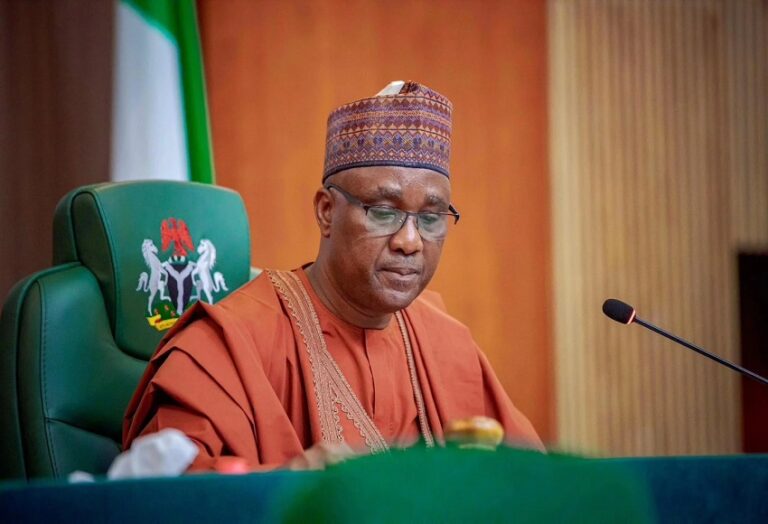
The Deputy Speaker, Benjamin Kalu, who presided over the plenary, said the House’s decision to pass the bills for second reading became necessary given the need to subject them to further debate

Kalu said the bills would be returned to the House for debate by members, given the sensitive nature of the issues involved. 

EU seeks framework for its €1.3bn trade, investment committment in Nigeria

THE European Union (EU) wants to set up a clear plan for its proposed €1.3 billion trade and investment in Nigeria’s economy. The EU says this will increase its commitments to infrastructure and sustainable development in Nigeria.

Because of this, the EU has suggested establishing a structured discussion framework with the Nigerian government about trade and investment. This would improve cooperation in important areas like infrastructure, green finance, and sustainable development.

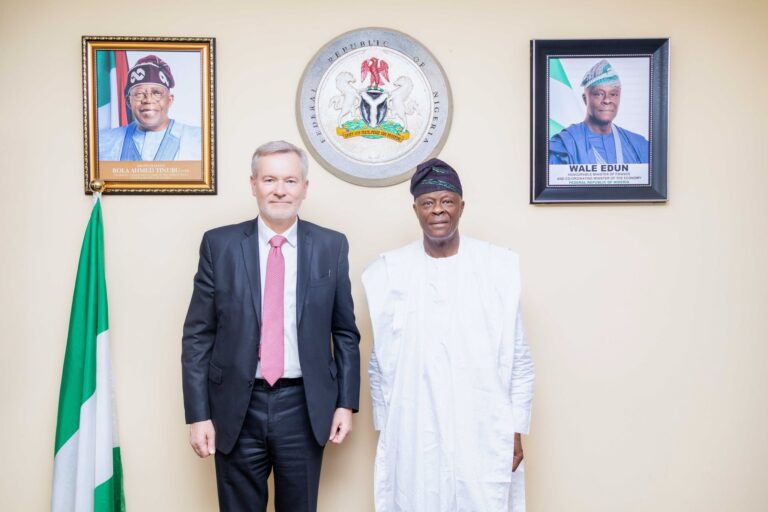
Nigeria’s Minister of Finance and the coordinating Minister of the Economy, Wale Edun, has confirmed that he has discussed this with the EU Ambassador to Nigeria, Gautier Mignot, in Abuja. The talks specifically focused on creating a structured investment plan for the Nigerian economy.

This was contained in a social media post by the Federal Ministry of Finance on Thursday, March 27.

The post quoted the EU Ambassador to Nigeria as highlighting the EU’s position as Nigeria’s biggest trading partner and a major source of foreign direct investment (FDI).  

The meeting emphasised the EU’s current €1.3 billion investment in Nigeria, along with recent involvement from the European Bank for Reconstruction and Development (EBRD). It also highlighted the EU’s Global Gateway Investment Strategy, which aims to boost infrastructure and sustainable development across Africa.

The post reads in part, “The meeting spotlighted the EU’s €1.3 billion investment portfolio in Nigeria, recent engagement by the European Bank for Reconstruction and Development (EBRD), and the Global Gateway Investment Strategy aimed at deepening Africa-Europe economic ties.”

Minister Edun welcomed the EU’s proposal while reaffirming Nigeria’s commitment to macroeconomic stability, investor-friendly policies, and fiscal consolidation.

He highlighted key reforms designed to make it easier to do business in Nigeria, including the National Single Window trade system, adjustments to tax policies, and efforts to attract private investment into crucial sectors.

Edun also pointed to Nigeria’s projected gross domestic product (GDP) growth of 4.6 per cent by 2025, driven by sustained reforms in the oil and non-oil sectors, as well as strategic investments in agriculture, technology, and manufacturing.

The ICIR has recently reported the EU’s call on the Nigerian government to allocate more resources to social protection programmes aiming to mitigate poverty and improve the welfare of vulnerable populations.

The head of cooperation of the EU delegation to Nigeria and the Economic Community of West African States (ECOWAS), Massimo De Luca, said this at the third edition of the Social Protection Cross-learning Summit (SPECS) held in Abuja on June 28, 2024.

De Luca said that social protection provided safety nets that ensured access to essential services for the country’s development, adding that investing in social protection would contribute meaningfully to society.

Nigeria condemns shooting of Immigration officer allegedly on Chinese firm’s order

0

THE Minister of Interior, Olubunmi Tunji-Ojo, has vowed to take tough actions against the shooting of an officer of the Nigeria Immigration Service (NIS), allegedly on the order of a Chinese company operating in Nigeria.

The minister, while condemning the incident at a stakeholders’ sensitisation workshop on the implementation of the Nigeria Visa Policy 2025 in Abuja on Thursday, March 27, described the action as an outright “attack on Nigeria.” 

He vowed to escalate the incident, which happened in Niger State, at the highest diplomatic level, adding that such action would not be tolerated.

He said, “I will not go to any country, open a company, and say the Immigration Service cannot come out. I will not do that.

“I don’t want to mention the company here, but they shot one of our Immigration officers. They told their security attaché to shoot our officer, and he did— a foreign company?

“That happened a couple of weeks ago in Niger (State), and we are going to take it up with the Chinese embassy because it’s a Chinese company. I won’t go to China as a Nigerian, enter a company, and tell my security to shoot a government official in uniform. It’s never done anywhere in the world. That alone is an attack on Nigeria.”

The officer, he explained, was simply carrying out his duty when he was shot.

“That is a diplomatic issue, and we will handle it. It will not happen again. So we are going to be very firm. We will not disturb your business or overburden your operations.

“But don’t make us inferior in our land. We are going to be very tough on this. I’m not just speaking with passion; I’m speaking with anger.”

Tunji-Ojo further warned that the government would not hesitate to revoke business licences and shut down companies operating with disregard for Nigerian laws.

“No company is above the law. We will not tolerate it. No agent, no company is above the law.

“We are doing our best to make things easier and to collaborate with businesses. But please, we beg you, do not insult us. We will not disrespect you. As long as the president remains in office, nobody will disrespect you in Nigeria. All we ask for is mutual respect,” he stated.