Home Blog Page 3363

World Leaders Honour Mandela At Memorial Service

Over 100 world leaders, including Nigeria’s President Goodluck Jonathan, are among tens of thousands of people gathered at the FNB Stadium in Soweto, the Johannesburg township that was a stronghold of the anti-apartheid struggle, to celebrate the life of Nelson Mandela and pay final tributes to him.

Prime Minister Stephen Harper and his wife Laureen were accompanied by four former Canadian prime ministers – Mulroney, Kim Campbell Jean Chretien and Joe Clark – to honour Mandela’s well lived life.

U.S. President Barack Obama who landed in South Africa early Tuesday, delivered a eulogy at the memorial, describing Nelson Mandela as a “giant of justice” and the last great liberator of the 20th Century.

Obama said too many leaders in the world claimed solidarity with his struggle for freedom “but do not tolerate dissent from their own people.”

“It is hard to eulogise any man… how much harder to do so for a giant of history, who moved a nation towards justice.”

The American President whose moving speech was repeatedly interrupted by applause from the crowd compared Mandela to Mahatma Ghandi,  Martin Luther King Jr and Abraham Lincoln.

Obama said that the great black leader taught the world the power of action and ideas and lamented that “We will never see the likes of Nelson Mandela again.”

Obama made the trip to honour Mandela’s memory with his wife, Michelle, former presidents Jimmy Carter, Bill Clinton, George W. Bush and his wife, Laura, and former Secretary of State Hillary Clinton.

Just before his compelling speech, Obama made news when he shook hands with Cuban President Raul Castro.

mandela's memorial-obama-castrThe U.S. and Castro have been enemies since the Cuban revolution led by Castro’s older brother, Fidel, in 1959.

After U.S. businesses in Cuba were nationalized without compensation, the U.S. broke off diplomatic relations and                                                                                                           imposed a trade embargo.

President Jacob Zuma, was booed by the crowd but still delivered a keynote address in which he said that Mandela was “one of a kind adding that he was a “fearless freedom fighter who refused to allow the brutality of the apartheid state to stand in way of the struggle for the liberation of his people”.

UN Secretary-General Ban Ki-Moon in his speech said that South Africa had lost “a hero, a father”.

Continuing, he said “The world has lost a beloved friend and mentor. Mandela was more than one of the greatest leaders of all time…This boxer fought throughout his life for each of us. It is the duty of all of us who loved him to keep his memory alive.”

ANC’s Deputy President, Cyril Ramaphosa, he apologises for the rain, but says this is a blessing for Africans. “We were not able to stop the rain,” he says. “These are blessings, and in our African tradition, when it rains when you are buried the gods are welcoming you.”

Other dignitaries present at the memorial which was still in progress as at press time included the British Prime Minister, David Cameron, Afghan President Hamid Kazai, President Goodluck Jonathan of Nigeria,Canadian Prime Minister, Stephen Harper, Brazilian President Dilma Rousseff, Cuban President Raul Castro, Zimbabwe’s President Robert Mugabe and Chinese Vice President Li Yuanchao.
mandela's memorial Former South African president Thabo Mbeki and his wife Zanelemandela's memorial Former Bishop Desmond Tutu (right) and former Irish President Mary Robinsonmandela-jonathan_2761104cmandela-brazil_2761068c

The ceremony will also welcome tributes from Mandela’s grandchildren.

Tuesday marked the 20th anniversary of the day when Mandela and South Africa’s last apartheid-era president, F.W. de Klerk, received the Nobel Peace Prize for their efforts to bring peace to their country.

The heavy rains that greeted the spectators did not appear to dampen the mood in the 95,000-seat stadium, as crowds sang and danced in the stands.

mandela's memorial 1

The stadium was only half-way full at the time the memorial commenced at 12 noon, an hour behind schedule owing to the downpour and other stadiums in the area equipped with giant video screens for anticipated overflow crowds were largely empty.


Subsidy Scam: EFCC Re-arraigns Tukur, Alao, Others

0

The Economic and Financial Crimes Commission, EFCC, on Monday, re-arraigned four suspects – Mahmud Tukur, Alex Ochonogor, Abdullahi Alao and Eternal Plc – before Justice Lawal Akapo of the Lagos High Court sitting in Ikeja on a nine- count charge of obtaining money by false pretence and forgery.

Mahmud, one of the suspects is the son of the chairman of the Peoples Democratic Party, PDP, Bamanga Tukur, while Abdullahi is the son of a prominent Ibadan-based businessman, Abdullazeez Arikesola-Alao.
The accused persons were first arraigned on July 26, 2012 before Justice Adeniyi Onigbanjo, who was later transferred to another division of the court.

The suspects are accused of unlawfully obtaining the sum of N1.8 billion from the federal government through the Petroleum Support Fund.

All the four accused had pleaded not guilty before Justice Onigbanjo to all the charges preferred against them and had requested for more time to discuss with the EFCC regarding the charges preferred against them.

The trial judge acceded to their request and also ordered the EFCC to release the international travelling documents of Tukur and Ochonogor to enable them travel to the United Kingdom and France for business purposes.

In view of their pleas, prosecuting counsel, Rotimi Jacobs, quickly called the attention of the court to the preliminary injunction filed by three of the accused persons -Mahmud Tukur, Ochonogor Alex and Eterna Plc- challenging the validity of the charges against them.

However, Justice Akapo urged the EFCC counsel to liaise with the court registrar to identify the processes previously filed and the arguments canvassed by both parties to enable the judge acquaint himself with the case and prepare for the next hearing.

He subsequently adjourned the case to February 24, 2014 for argument on the bail applications.

Subsidy Scam: EFCC Re-arraigns Tukur, Alao, Others
The Economic and Financial Crimes Commission, EFCC, on Monday, re-arraigned four suspects – Mahmud Tukur, Alex Ochonogor, Abdullahi Alao and Eternal Plc – before Justice Lawal Akapo of the Lagos High Court sitting in Ikeja on a nine- count charge of obtaining money by false pretence and forgery.
Mahmud, one of the suspects is the son of the chairman of the Peoples Democratic Party, PDP, Bamanga Tukur, while Abdullahi is the son of a prominent Ibadan-based businessman, Abdullazeez Arikesola-Alao.

The accused persons were first arraigned on July 26, 2012 before Justice Adeniyi Onigbanjo, who was later transferred to another division of the court.

The suspects are accused of unlawfully obtaining the sum of N1.8 billion from the federal government through the Petroleum Support Fund. 

All the four accused had pleaded not guilty before Justice Onigbanjo to all the charges preferred against them and had requested for more time to discuss with the EFCC regarding the charges preferred against them.

The trial judge acceded to their request and also ordered the EFCC to release the international travelling documents of Tukur and Ochonogor to enable them travel to the United Kingdom and France for business purposes.


READ ALSO:


In view of their pleas, prosecuting counsel, Rotimi Jacobs, quickly called the attention of the court to the preliminary injunction filed by three of the accused persons -Mahmud Tukur, Ochonogor Alex and Eterna Plc- challenging the validity of the charges against them.

However, Justice Akapo urged the EFCC counsel to liaise with the court registrar to identify the processes previously filed and the arguments canvassed by both parties to enable the judge acquaint himself with the case and prepare for the next hearing.

He subsequently adjourned the case to February 24, 2014 for argument on the bail applications

Tambuwal Blames Jonathan For Soaring Corruption In Nigeria

0

Assessing corruption trends in Nigeria at a roundtable to mark the International Anti-Corruption Day, the Speaker of the House of Representatives, Aminu Tambuwal, has accused President Goodluck Jonathan of encouraging corruption in the country.

Tambuwal who presented a paper titled the ‘role of the legislature in the fight against corruption in Nigeria,’ at the roundtable organised by the Nigerian Bar Association, NBA, lamented that the President has failed to act on corruption cases painstakingly probed and investigated by the House, adding that is most cases a new committee is set up to further duplicate what has already been done and prosecution is often slow or outrightly absent.

Under the legislative function, Section 4 of the Constitution of the Federal Republic of Nigeria 1999 provides that the National Assembly shall have the power to make laws for peace, order and good government of the country.

More specifically, under Section 15 (5) of the Fundamental Objectives and Directive Principles of State Policy, it provides, “The state shall abolish all corrupt practices and abuse of office”.

But citing examples of the fuel subsidy probe, the pension scam, the Securities and Exchange Commission, SEC, probe and recently the bullet proof car cases, Tambuwal concluded that Jonathan has failed to act on corruption cases unearthed by the National Assembly.

“The President’s body language’ seems to be encouraging corrupt practices in the country. In some cases, you have the government setting up new committees to duplicate the job already done by the parliament. Take the bullet proof cars case, the NSA, with all the security challenges confronting the country, should not be burdened with a job that can best be handled by the anti-corruption agencies,” he said.

He added: “By the action of setting up different committees for straightforward cases, the president’s body language doesn’t tend to support the fight against corruption.”

The speaker said a list of manifestation of corruption especially in the public sector of Nigeria ranges from direct diversion of public funds to private pockets, contract over-pricing, bribery, impunity, nepotism, general financial recklessness, fraudulent borrowing and debt management, public assets striping, electoral fraud, shielding of corrupt public officers among others.

He noted that corruption thrives well in any environment or society where there is community indifference or lack of enforcement policies, societies with a culture of ritualized gift giving where the line between acceptable and non-acceptable gifts is often hard to draw and societies in which values have been overthrown by materialism or where the laws are observed more in the breach.

According to him, corruption is Nigeria’s greatest problem and an impediment to any development efforts.

The Speaker added that if Nigeria is to witness true development, then corruption must be dealt with decisively and comprehensively.

“It is a duty requiring will, zeal and passion on the part of the three arms of government and indeed the entire citizenry,” Tambuwal stressed.

Speaker Tambuwal also called for the provision of adequate funding for anti corruption Agencies through appropriation.

“Unfortunately efforts to exercise this function by the legislature is often misconstrued by the executive arm and even some members of the public. Yet without adequate funding the anti corruption agencies cannot execute their functions satisfactorily,” he noted.

The lawmaker urged other arms of government and indeed the general public to complement the efforts of the legislature in ridding the country of its corruption tag.

Tambuwal reiterated that the Legislature will not abdicate its responsibilities on the account of inaction or negligence of another arm of government, adding: “If nothing else we will at least continue to name and shame.”

It would be recalled that in its 2012 Global Corruption Perception Index, CPI, the global corruption watchdog, Transparency International, ranked Nigeria as the 36th most corrupt country globally.

Nigeria placed 139th of the 176 countries assessed scoring 27%.

In its statistics, the African Development Bank, AfDB, says an estimated $2.6 trillion is stolen annually through high level corrupt practises in Africa.

AfDB’s President, Donald Kaberuka, said that the figure amounted to more than five per cent equivalence of the global GDP.

The theme of this year’s International corruption day is “Zero Corruption, 100 per cent Development”.

The day had been observed every December 9 since the passage of the UN Convention Against Corruption on Oct. 31, 2003.

The convention aims to promote and strengthen measures to prevent and combat corruption more efficiently and effectively.

Universities Remain Shut As ASUU Defies Govt’s Return To Work Order

0

Most public universities remained shut on Monday as lecturers defied the order by the federal government to return to work or be sacked.

The brawl between both parties escalated after several failed attempts at peace, with the government announcing a December 9 ultimatum for the lecturers to go back to work.

ASUU had described the threat and its corresponding ultimatum as a joke and set for the outcome of events, patiently did a countdown to Monday when it displayed doggedness in its struggle and proved to hold the keys to the lecture rooms even though it is only an employee of government.

Virtually all the schools monitored failed to succumb to the dictate of the federal government and although some lecturers were present at institutions visited, they would not sign the attendance register which they equated with signing a death warrant.

In institutions where a few lecturers showed up, they also refused to hold lectures or conduct examinations as was the case at the Enugu State University of Science and Technology, ESUT.

The second semester examination of ESUT could not hold on Monday due to the absence of lecturers, even though the institution had announced resumption with the commencement of examinations and students were seen in the lecture halls waiting for question papers which never arrived.

Some frustrated students called on both parties to reach a compromise and resume academic activities, stressing that the students are made to bear the brunt of the fight.

The dean of the Faculty of Management and Social Sciences, Joseph Aneke, said that there was no instruction from ASUU for academic activities to resume.

“That is why the examination could not start today. Due to the strike, academic activities have been postponed indefinitely until the strike is called off.”

Chairman of the University of Nigeria, Nsukka, UNN, ASUU chapter, Ifeanyinchukwu Abada, confirmed that the institution too had not resumed.

“Lecturers are ready to resume work as soon as the government meets their demands. We are waiting for the government’s sack letters as the deadline ends today,” he said.

At the Ahmadu Bello University, ABU, Zaria and Bayero University Kano, BUK, no attendance registers were opened by the authorities and the campuses remained mostly deserted.

Chairman of ASUU in BUK, Muhammad Kabir Aliyu, said the strike was a necessary evil and a price that must be paid at this time to salvage the system from total collapse.

“It is not that we are enjoying this strike, but it is something that becomes necessary in order to save the education sector from total collapse. This strike continues until our national executive decides otherwise,” he said

Like others, the University of Lagos, UNILAG; the Lagos State University, LASU; the Federal University of Technology, FUT Minna and the Ekiti State University, Ado-Ekiti, all failed to resume on Monday.

A visit to two campuses of the FUT, Minna, showed that none of the 730 showed up for lectures.

As at the close of work on Monday, none of the lecturers had appended their signature on the register which was opened on December 2.

Classrooms, lecture theatres, laboratories, workshops and studios at Bosso and Gidan Kwano remained under lock and key.

Efforts to get the school’s Registrar,  Victoria Kolo, for comments as press time proved unsuccessful as she was said to have been in a meeting but a source in her office confirmed that no lecturer has signed the register.

The branch chairperson of ASUU, Abdulfatai Jimoh, said that the union will not be intimidated and that lecturers in the school will neither sign the register nor return to work until the federal government implements the 2009 agreement.

“We at FUT Minna have resolved to stand by the decision of national ASUU. No amount of treat will make us sign any register or return to classroom. The strike is still in force. No retreat, no surrender,” Jimoh stated.

However, at the University of Benin, as many as 30 lecturers signed the attendance register, but with many more insisting that the strike must continue.

Those who appended their signatures on the register said they boycotted the strike not for fear of losing their jobs but as a result of the unsatisfactory way in which the union was handling the situation.

One of the lecturers who spoke on the condition of anonymity said they expected ASUU to call off the strike after the intervention by President Goodluck Jonathan.

However, the institution’s ASUU chairman, Tony Emina-Monye, said the strike continues and that lecturers were not moved by the sack threat.

“We are disregarding the ultimatum and threat of sack by the federal government. We are still on strike and none of our members has signed any register to resume work. We will continue with the strike until otherwise directed by the national secretariat of the Union,” he said.

Meanwhile, the Nigeria Labour Congress, NLC, has begun another move to intervene in the impasse between ASUU and the federal government.

The acting general secretary of the NLC, Chris Uyot, said it had written a letter to the Presidency seeking leave to intervene in the crisis which is now in its sixth month.

“We have sent a letter to the presidency today, December 9. We want to intervene in this matter. The turn of events is causing a lot of disaffection which can easily be resolved, that is if the government is willing to talk about it,” Uyot said.

Thai Prime Minister Dissolves Parliament, Calls For Fresh Election

Embattled Thai Prime Minister, Yingluck Shinawatra, on Monday dissolved the country’s lower House of Parliament and called for a snap election as part of desperate moves to defuse Thailand’s deepening political crisis.

“After listening to opinions from all sides, I have decided to request a royal decree to dissolve Parliament. There will be new elections according to the democratic system,” Shinawatra announced in a broadcast.

Her ruling party won the last vote two years ago in a landslide and is likely to be victorious in any new ballot.

Government spokesman, Teerat Ratanasevi, said the cabinet had proposed that a new vote be held February 2 and King Bhumibol Adulyadej formally endorsed both that date and the dissolution of the House of Representatives via a royal decree.

Shinawatra said she will remain in a caretaker capacity until a new prime minister is named.

As she spoke on Monday, long columns of marching protesters paralyzed traffic on major Bangkok boulevards, filling four-lane roads as they converged from nine locations on the prime minister’s  office at Government House.

The protesters, estimated at about 150,000, vow to oust Shinawatra from office and are pushing for a non-elected “people’s council” to replace her democratically elected government.

Analysts say the dissolution of the parliament may have come too late and is unlikely to satisfy opponents who want to rid Thailand of Shinawatra’s powerful family’s influence.

Leader of the protesters, Suthep Thaugsuban, a former deputy prime minister lashed out against the Prime minister, calling her administration “corrupt” and “illegitimate” as crowds of supporters cheered.

The protest movement does “not consent to allowing the dictatorial majority … to betray the people, to destroy the balance of democratic power,” Thaugsuban said adding that “the people must use “their rights as citizens to take back their power.”

He has repeatedly said that calling new elections and even Shinawatra’s resignation would not be enough to end the conflict.

Many feared the day could end violently and more than 60 Thai and international schools were closed as a precaution. But the marches were peaceful and no violence was reported.

Thailand has been plagued by major bouts of upheaval since Shinawatra’s brother, Thaksin Shinawatra, was toppled in a 2006 army coup that laid bare a deeper conflict between the elite and educated middle class against his power base in the countryside, which benefited from populist policies designed to win over the rural poor.

An attempt by Yingluck’s party last month to pass a bill through Parliament that would have granted amnesty to Thaksin and others triggered the latest round of unrest.

Impunity, Rule Of Law And The Budgeting Process

0

By Eze Onyekpere

A couple of days ago, the Federal Government announced that it had satisfied the conditions arising from its negotiations with the Academic Staff Union of Universities for the later to call off its nationwide strike action. Part of the conditions was the Federal Government’s disclosure that it had deposited N200bn in the Central Bank of Nigeria for distribution to universities to improve their funding. There were also earlier announcements of the offer of N30bn in support of University Councils to settle the earned allowances of university teachers. On the surface of it, these offers and deposit of money in the CBN look like steps in the right direction meant to solve the challenge of the now six months old strike. However, a deeper examination and analysis may prove that the Federal Government is merely compounding an existing problem.

As the title of this discourse suggests, three issues are at stake vis, impunity, neglect of the rule of law and abuse of the budgeting process. The first part of it is impunity. When the Federal Government signed and entered an agreement it had no intention of executing and believed itself to be above the law, this is impunity and this is the foundation of the crisis and prolonged industrial action in the education sector. Many may ask about the relevance of this analysis considering that we are now looking for solutions to the crisis. My honest answer is that if we do not understand the foundations of the crisis, we are bound to repeat mistakes and take actions which ridicule the nation whilst stagnating economic development due to the absence of a sense of history and learning from its teachings. That impunity led to the refusal of the Federal Government to ensure that the provisions of the agreement are made to reflect in the Medium Term Education Sector Strategies, Medium Term Expenditure Framework and the annual budget.

The rule of law is certain as there is no ambiguity that expenditure without appropriation is an unforgivable sin against the Constitution of the Federal Republic of Nigeria 1999. I am not aware that the N200bn deposited in the CBN for the use of the universities was approved in the 2013 Appropriation Act nor has there been any Supplementary Appropriation Bill presented and approved by the National Assembly. Permit my ignorance and accept my apologies if this money was surreptitiously approved by any authority unknown to me. The executive appears to lack the presence of mind to do the right thing as stated in the Constitution. For the members of the National Assembly, they are onlookers who do not ask the right questions or take the right decisions in such matters of urgent national importance. Did the executive vire money from one head of account to an illegal head of account not stated in the Appropriation Act or did the President simply tell the CBN to print new naira notes? Alternatively, did the President dip his hands into the Excess Crude Account or any other fund of the Federation meant for other purposes or did he simply ask the Debt Management Office to secretly raise bonds for this purpose?

Therefore, in trying to purportedly solve the ASUU challenge, the executive has commited a bigger constitutional fiscal felony. In times of national emergency, this kind of expenditure may make sense to save the Federation from a grave crisis affecting its sovereignty, integrity or to avert or ameliorate a physical catastrophe. But the ASUU strike bears no such semblance. It was a battle foretold which as an African proverb indicates does not consume a cripple because he was forewarned to move at his pace to escape the battle. For the past six months, the executive and legislature had ample time to intervene, discuss and approve appropriate sums of money. It was not supposed to be a unilateral action on the part of the executive.

In the budgeting process, the refusal to abide by the rule of law accounts for this industrial crisis and the stagnation of our national economy, which has failed to deliver concrete dividends to the majority of the population. Yes, the statisticians and the World Bank say our economy is growing in unimaginable proportions; but it is delivering the good things of life only for those in the corridors of power and their cronies. If the Ministry of Finance and the Budget Office of the Federation had done the right thing by following the rule of law as defined in the Fiscal Responsibility Act, we would have averted this crisis. The beginning of the MTEF process would have seen Ministries, Departments and Agencies convene a Medium Term Sector Strategies session which would have representation from not just the Ministry of Education and its parastatals but representatives of the legislative committees in the National Assembly which exercise oversight over the ministry, sectoral labour unions (ASUU should be there in education), organised private sector and civil society organisations. At this retreat, there would have been a review of sectoral high level policy documents, ongoing projects; objectives and goals would have been set for the medium term while prioritisation of projects and expenditure heads to fit into the envelope would have taken place.

Can you imagine ASUU at such a meeting on the determination of educational priorities without raising these issues that led to the strike? Can you imagine ASUU that has been complaining about poor funding of universities acceding to the establishment of new ones with the little vote allotted to education? For the education sector, the issues leading to this crisis would have been an in-house affair resolved at the stage of the MTSS before the approval of the MTEF. When some civil society activists queried the rationale for the abandonment of the MTSS process, we were told by the Budget Office of the Federation that it had been overtaken by the Transformation Agenda of the Jonathan Administration. Pray, what did the Transformation Agenda provide for the ASUU crisis or was it steeped in the same impunity of ignoring a signed agreement?

Therefore, the choice is clear on what the executive should do to avoid similar crisis in the future. Let the people have a say in their budget; let them determine their priorities as stated by the Fiscal Responsibility Act. Participation and consultation are fundamental issues. The days are gone when some “wise men and women” lock themselves up in a room pretending they know it all and that they can solve the problems of the country. Those days are gone and gone for good. If those days could deliver anything meaningful, why has the Federal Government failed to improve the living conditions of majority of Nigerians? If the Ministry of Finance had done the right thing by consulting with the National Assembly as indicated by the FRA at the stage of preparing the MTEF, why are we still having this unnecessary benchmark war?

Let no one spend a kobo of public money in the name of responding to the ASUU crisis without getting legislative approval. The year has virtually ended. The executive and legislature should put their houses in order and approve within the confines of the law, the necessary demands of ASUU. For the government, if it continues repeating the same mistakes, it will get the same poor results.

•Follow me @censoj

Niger Bans Motorcycle Operators In Minna

0

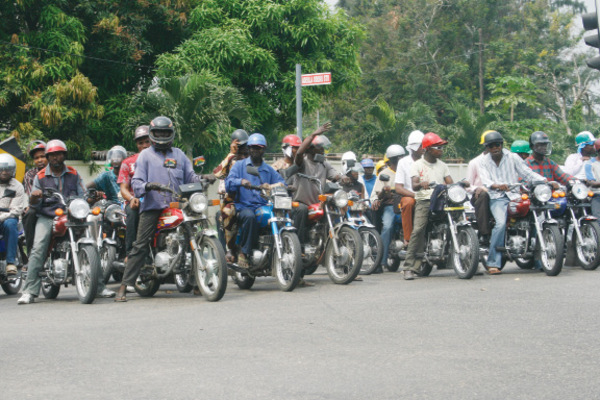
The Niger state government has announced the banning of the operations of commercial motorcyclists popularly called Okada in Minna, the state capital.

In a statement signed by the chief press secretary to the governor, Danladi Ndayebo, the government noted that adequate arrangements had been made to cushion the effect of the ban.

It also added that the state ministry of transportation had taken full delivery of 1000 units of Mahindra Tricycles in addition to 8 units of 18-seater buses and 12 units of 100 capacity Bus Rapid Transport, BRT, buses that have already been put on the roads to ease transportation problems in the state capital.


READ ALSO:


Enforcement of the law would commence from January 2, 2014.

Ndayebo dismissed concerns that motorcycle operators would be put out of job as a consequence of the ban, saying that the newly purchased tricycles would be distributed to okada operators through the Amalgamated Commercial Motorcycle Riders Association of Nigeria, ACOMORAN.

President Jonathan To Attend Mandela’s Funeral

President Goodluck Jonathan will leave Abuja on Monday evening to South Africa to pay last respect to late anti-apartheid fighter and former South African President, Nelson Mandela.

According to a statement issued by the President’s special adviser on media and publicity, Reuben Abati, Jonathan will attend the memorial service for Mandela on Tuesday at the FNB Stadium in Johannesburg and on Wednesday be present at the Union Building, Pretoria, for the lying in state.

The President would depart Pretoria on Wednesday at the end of the event to honour a long-standing invitation to be a guest of honour at Kenya’s 50th Independence Anniversary celebration, in Nairobi.

He will be accompanied on the visit by the supervising minister of foreign affairs, Viola Onwuliri, and is expected to return to Abuja on Thursday.

Meanwhile, prayers of remembrance have been held across South Africa for Mandela.

South African President Jacob Zuma, Mandel’s fomer wife, Winnie Madikizela-Mandela, a large number of family members, Mandela’s grandson, Mandla, dignitaries and friends attended church service at the Bryanston Methodist Church in Johannesburg.

Speaking to the congregation, President Zuma urged South Africans to unite around the ideals Mandela espoused.

Zuma said Mandela preached and practiced peace and reconciliation to make those who had been fighting to forgive one another and become one nation.

In Mvezo, Eastern Cape, where Mandela was born, villagers and well wishers attended prayers service wearing the African National Congress T- shirts.

“Though the village is sad, they are grateful for the changes the that the anti apartheid icon’s freedom had brought to them,’’ one of Madiba’s great grandson, Mayibuye Mandela said.

Mandela died on Thursday evening at his Houghton home in Johannesburg after a long illness. He was 95 years old.

His remains will be laid to rest next Sunday, at his home village of Qunu in the Eastern Cape.

Army Employs New Tactics To Fight Terrorism

0

Musdapha Ilo, Maiduguri

The military says it is evolving new strategies to combat terrorism in the country’s North-east region.

Members of the banned Boko Haram fundamentalist sect have continued to unleash violence on helpless citizens, accounting for the loss of thousands of lives and properties, but the army says it is more determined than ever before to put an end to the terror.

Muhammad Dole, who spoke on behalf of the 7 Division of the Nigerian Army in Borno State, said there are plans to immediately commence patrol of the towns and villages in the state, especially on market days.

He said the army had observed that increased violence is perpetrated on such days and is therefore taking the measure in order to prevent future attacks.

“The new strategy, that we will immediately adopt is the patrol of Borno towns and villages on their market days, including the 454-kilometre Maiduguri-Damaturu, Biu-Maiduguri, and Maiduguri-Gwoza roads of Central and Southern Borno state,” Dole said.

The spokesman urged residents of Bama, Konduga, Damboa, Chibok, Uba/Askira and Gwoza to supply the army with relevant information that will help curb the activities of the group.

“As the insurgents continue to change tactics of attacking our people in these border towns and villages, including the ones that are sighted on the peripheries of Sambisa Forest, our men have to change tactics with the adoption of new strategies to contain the incessant attacks and killing of innocent villagers,” he explained.

Clerk Bags 3 Months For Stealing N8.3 million

0

A Kogi state High Court in Koton-Karfe has sentenced one Modupe Adeyemi, an account clerk at the Federal Medical Centre, FMC, Lokoja, to three months imprisonment without an option of fine for stealing and forgery.

Adeyemi who was arraigned in November 2009 by Independent Corrupt Practices And Other Related Offences Commission, ICPC, on 30 counts charge, was accused of  defrauding the FMC of part of revenues accruing to it up to the tune of N8.3 million between October 2006 and April 2007.

She was said to have used her office to corruptly enrich herself, altering duplicate copies of various bank tellers with the intent to defraud and making false statements on returns contrary to sections 19, section 15 sub-sections (a) & (c) and section 16 of the Corrupt practices and Other Related Offences Act, 2000 respectively.

According to the ICPC prosecutor, Henry Emore, each time the accused person was sent to deposit some money in various banks belonging to the Centre, she would deposit only part of the money and keep part of it to herself.

“She did this successfully by altering duplicate copy of the bank tellers which she returned to the Centre,” he said.

Delivering  judgment, Justice Alaba Ajileye, lamented the delay associated with the case before the sentence and sentenced her to three months in jail.

The accused  person was is now serving her term in Okene Prisons.