Home Blog Page 3429

INEC Staff Not Excluded From Prosecution – Jega

0

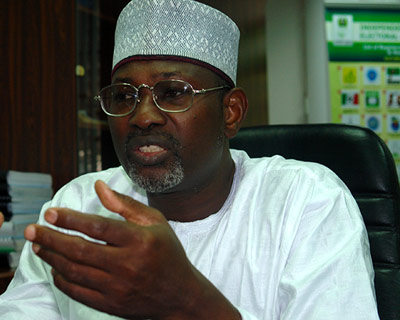
In a bid to ensure transparency, free and fair election in 2015, the chairman of the Independent National Electoral Commission, INEC Attahiru Muhammadu Jega, has stated that any of the staff of the commission found guilty of rigging and other electoral malpracticeswill be prosecuted.

Jega who admitted the presence corrupt officials and staff in the commission gave this assurance at the official unveiling/public presentation of  strategic programme of action of INEC from 2012 to 2016 to political parties and electoral stakeholders in Abuja.

He said that no INEC official or staff is immune from prosecution adding that his assessment of what has happened previously showcased that few bad eggs were in the commission and have been quietly dealt with accordingly but not captured in the media.

“INEC officials are not immune to prosecution. In fact, since we came here, as a commission we have prosecuted INEC officials, probably it was not well advertised but we prosecuted INEC officials who have been found guilty of breaching established laws, rules and regulations; we have also quietly shown people the way out.”

“There were many people who were indicted for activities incompatible with the objectives and responsibility they were expected to bring to this job. We have retired people. We have dismissed people and asked people to withdraw their services. We have done a lot quietly and it is not something that really should have been advertised in our view”, Said Jega.

The  assurance given by INEC boss was prompted by various knocks given by chairmen of some political parties including SamNkire of the Progressive Peoples Alliance, PPA, Chekwas Okorie of the United Progressive Party, UPP, and Victor Umeh of the All Progressive Grand Alliance, APGA.

Umeh had called for a review of  adhoc staff recruitment by INEC, noting that their activities  posed great threats to the success ofINEC’s efforts in conducting credible elections.

He said that there are bad soldiers/policemen who forcefully change results or make things untidy and have never been reported byINEC, adding that these attitude taints the electoral body’s image.

“I don’t know if INEC staffs are immune to prosecution. Before now, they are the ones who give result sheets before elections. There are bad eggs who help to doctor results”, he said.

Nkire also emphasised the need to checkmate corrupt INEC officials whom had given it a bad image, while Okorie stressed the need to expedite action on the Electronic Voting System EVS, saying it would limit the mistakes of the commission.

Keyamo Has Authority to Prosecute Fani-Kayode – EFCC

59

The Economic and Financial Crimes Commission, EFCC, has confirmed that Festus Keyamo Chambers has the authority of the Attorney General of the Federation to prosecute Femi Fani-Kayode, a former aviation minister, in relation to a money laundering charge.

In a letter dated June 27, 2013 and signed by Chile Okoroma, its acting director of legal and prosecution department, the Commission said Keyamo and his law firm have been instructed to handle the case since 2008 and that the firm has “diligently prosecuted the matter up to the supreme court and back to the Federal High Court”.

The letter titled “Legal Representation In Respect Of Charge No. Fhc/L/ 523c/2008: Between Federal Republic Of Nigeria Vs FemiFani-Kayode” was addressed to the chief registrar of the Federal High Court, Lagos, apparently in reply to questions raised over the matter by the court.

Justice Rita Ofili-Ajumogobia of the Federal High court, Lagos, Tuesday restrained Festus Keyamo from further prosecuting Fani-Kayode, until he is able to tenders a fiat from the Attorney General of the Federation authorizing him to do so.

The judge held that the prosecutor has shown no evidence of being delegated to prosecute the case, raising doubts as to whether or not Adoke had issued a fiat to the chambers of Keyamo.

The court’s ruling followed the contention raised by Ifedayo Adedipe, one of the counsels to the defendant, who on June 6 challenged the appearance of the prosecutor in the case.

Adedipe had argued that it was not clear whether Ahaotu, a lawyer from the Keyamo chambers was prosecuting on behalf of the federal government or the EFCC.

Going by the response of the EFCC, it is apparent that KeyamoChambers is prosecuting the accused on behalf of the commission and not the Attorney General and it is not clear if the judge who had insisted on a fiat from the Attorney-General will now consent to a continuation of trial.


READ ALSO:


Fani-Kayode is standing trial on a 47-count charge of money laundering. He was accused of making transactions with fundsexceedingN500,000 without going through a financial institution.

The former minister is also alleged to have accepted cash payments of about N230 million.

Below is a copy of the confirmation letter sent by the EFCC:

“EFCC/EC/FHC/100/13

June 27, 2013

The Chief Registrar,

Federal High Court,

Ikoyi,

Lagos.


Dear Sir,

LEGAL REPRESENTATION IN RESPECT OF CHARGE NO. FHC/L/523C/2008: BETWEEN FEDERAL REPUBLIC OF NIGERIA V. FEMIFANI-KAYODE

Kindly be informed that since 2008, Mr. Festus Keyamo and his firm, Festus Keyamo Chambers, have been instructed to prosecute the above mentioned Charge on behalf of Economic and Financial Crimes Commission. They have since diligently prosecuted the matter up to Supreme Court and back to the Federal High Court.

We hope this will clear any doubt as to the authority of the firm to prosecute this matter.

Accept the assurances of our highest regard.

Thank you.


Chile Okoroma

Ag. Director, Legal & Prosecution Department

For Executive Chairman


CC:

1.     The Attorney-General of the Federation,

Ministry of Justice,  Abuja.


2.     Festus Keyamo Chambers”

FG Recovers 22.5 million Pounds Abacha Loot

0

The federal government has recovered over £22.5 million allegedly stolen by the late  military head of state, Sani Abacha.


The Attorney General and Minister of Justice, Mohammed Adoke, said this on Thursday at the on-going ministerial platform in Abuja.


He said the money was recovered in 2011, from one Raj ArjandesBhojwani, an Indian national and associate of the late Abacha.


Adoke also said that the Principality of Liechtenstein recently confiscated the sum of €175 million from the Abacha family and associate companies iwhich his ministry ensure is equally repatriated.


“During the period under review, the ministry intensified its efforts to trace and repatriate Nigeria’s stolen assets abroad. In this connection, …our close liaison and negotiation with the Island of Jersey led to the recovery and repatriation of the sum of £22.5 million confiscated by the Royal Court of Jersey from Raj ArjandesBhojwani, an Indian national and associate of General Sani Abachaon account of his money laundering transactions from Nigeria,” the minister said.

Abuja Residents Groan Under New Transport Policy

0

Hardship. Pain. Agony Long faces. Curses. These, are the fallouts of the new transport policy recently introduced in Abuja by the Federal Capital Territory Administration, FCTA.


The Minister of the FCT, Bala Mohammed, had promised that the new policy would ease transportation and movement in and out of Nigeria’s capital city, but since June 3 when it took effect, the impact on social and economic life, including schooling and civil service work, has been substantially negative.


Speaking through his senior special assistant on political matters and National Assembly, Usman Jibril Wowo, the minister promised that that “will make people move from the satellite towns to the city with ease and at a cheaper rate as the highest fare is N150 for people from Gwagwalada, Kuje and Zuba and as low as N50 for movements within the business district.”
But the experience of residents has been different. Rather, not only have transportation costs increased, movement for students, civil servants, traders and all other residents has become a problem so much so that schooling and academic life in the Federal Capital Territory, FCT, faces a major setback.

A teacher at the Pilot Science Primary School, Wuse Zone 5, S Truman, is among those who come into town from Kubwa, a satellite town, every working day. Before now, by 7.30am she would have gotten to school, ready for the day’s business. But not anymore.


Since early June when the new transport system commenced she has been coming late to school because getting a bus to town has become such a hassle.


But even more worrying is the impact students. According to her, many of them get to school late, sometimes past 10.00 am, and thus miss part of the morning classes.


Even for those who come early, because many of them have to wake up much earlier now and also face a hell of a time getting to school, a great number of them sleep for the most part of the morning classes.

.

“In the past we used to punish students for late-coming but we find out now that if we are to punish them they may not be able to attend more than three lessons before the day is over and this will definitely affect performance,” she said.

The policy is also taking its toll on the parents as workers who have to commute from outside the city now report very late at work while some who cannot put up with the stress just stay at home.


For usually laid back civil servants, many have chosen to report at work only on specific days, sometimes only on Mondays or twice a week.

By 3:30pm-4:00pm in the afternoon, offices are nearly almost deserted as workers migrate to the parks to secure a good position on the queue and also to beat traffic, leaving their jobs to suffer.


The situation at designated terminals where the big buses are meant to move commuters in and out of the city is most pitiful during peak hours, usually early in the morning and between 3.00 pm and 4:00pm and is marked by long queues of commuters who are eager to secure a space in the limited buses provided by the government.


Commuters spend between 45 minutes and as much as two hours waiting at designated bus stop for these buses.

In spite of the queues which are meant to make the process of entering a bus orderly, there is still occasional pushing and struggling by the impatient or unruly, making the place rowdy and conducive for pickpockets.
Also, because of the huge numbers of passengers, the buses are overloaded with many standing in the aisles, thus leaving the journey prone to accidents. Some commuters have to stand all the way to their destinations.


At the Nyanyan Park, designated as terminus for moving commuters from the Karu/Nyanyan/Mararaba axis, passengers sometimes have to wait for two hours to get a bus. The scene is pitifully chaotic as thousands of commuters gather as early as 6.00 am in a bid to get a bus to town.


And the people are full of tales of woe and wonder how a representative government can foist such hardship on citizens.


Stanley Chukwu, a self – employee man, condemned the new system and believed that it is aimed at “punishing the masses”. He added that the cost implication of the policy is high as what he spends now on transportation has doubled.


He complained that the buses are restricted to particular routes and compelled to leave at a particular time.


Michael Chinonso, a civil servant and Mararaba resident lamented that the earliest time he has reached office since the commencement of the new policy is 9.00am. He noted that government has a lot to lose with the new policy as it has greatly affected productivity because workers resume to the office late and leave early.


Tony Oga, another civil servant who lives in Nyanyan said the policy is anti-people and complained of the high cost on commuters. For example, like many others, he now has to take two to three buses/cabs to work instead of one which means that he has to pay more.


He lamented that as things are now his salary would only be sufficient to pay for his transportation leaving him with nothing to cater for his other needs.


These are some of the realities of the two weeks old transportation policy in Abuja that has outlawed mini-buses from the city’s centre and inflicted greater hardship on residents.
Commuters are yet to adjust to the transportation plan and many do not see the plan working because it is defective and ill timed. The major criticism against the policy is that the FCT government has not provided enough big buses to move the huge population of workers who come into town daily from satellite towns that surround the capital city.

Abdullahi Baguda, a tailor who lives in Dutse Alhaji but who has a shop in Wuse area said that it was irresponsible of the government to rush into such a policy that would impact on many lives without adequately providing for alternatives.

“If you look at the queues and the number of the buses available, then you will see that this government is not serious. I do not think they planned the whole thing well or had the interest of commuters at hear when they came up with the idea,” he lamented.

Odiachi Josephine, a civil servant said the policy would have been a good policy if government had test ran its effectiveness and efficiency before its formal launch. This was a position amplified by Chinonso who suggested that government should have taken a cue from system in Lagos where privately owned buses are allowed to operate along with BRT.

Odiachi suggested that government should have a rethink on the policy and increase the number of the buses with effective logistics.

She observed that it has increased traffic jams as some commuters manage to go to office with their old moribund cars. Truly, traffic in and out of Abuja has worsened since the policy took effect. The traffic prone Abuja/Mararaba/Keffi road is worse off as commuters now spend up to two hours on the road, particularly after office hours.

Some commuters who are positive about the new transportation policy say with more high capacity buses available and an extension of the routes and terminals, the plan would prove more effective than it is now

Media Contest Opens for Best Reporting Of Infectious Diseases

0

Health reporters in Sub Saharan Africa, along with those from Europe and the United States, can win $10,000 worth of international reporting trips by sending in stories on infectious diseases in a contest launched by the International Center for Journalists, ICFJ.

Stories can be on diseases such as AIDS, tuberculosis and malaria, which are the leading causes of death in low-and middle-income countries, claiming nearly four million lives every year and costing billions of dollars in lost productivity.

Preference will be given to multimedia feature articles or documentaries; investigative reports or explanatory stories and reports that use data, mapping and other digital tools to engage audiences.

Deadline for submission is August 1, 2013 and stories must have been published or broadcast between May 20 and August 1, 2013

Along with the story submitted, which must be in English or French, participants must write a 300-word proposal for international reporting trip to expand their coverage of infectious diseases annually.

The ICFJ will select a winner each from Sub Saharan Africa, Europe and the United States and results will be announced on September 15, 2013.

The ICFJ says that “an editor or manager at each of the selected news organizations will also earn a trip to Washington, D.C., to attend ICFJ’s 2013 Awards Dinner on Nov. 7, 2013.”


For more information of the contest click here

Again, Civil Servants Loot Pension Funds

Impunity Reigns as civil servants continue the pillage of pension funds


In spite of the trial of many of their former bosses for stealing billions, senior civil servants in the office of the Head of the Civil Service of the Federation, HOCSF, have again started looting pension funds meant for the payment of pensioners.


Like before, the civil servants who manage pension funds at the office of the HOCSF have employed a number of ways by which they pilfer pension funds, including the use of ghost and fake pensioners, awards of dubious contracts and embarking on bogus training programmes.


The new onslaught of looting in the pension office has affected the payment of pensions and gratuities to tens of thousands of retirees since November when a new team took over the administration of the funds.


The national chairman of the Association of Federal Public Service Retirees, Emmanuel Akinola Omoyeni, alleged that “Up to now, 80% of pensioners have not received their payments for November and December, 2012.”


In a protest letter written by the retirees to President Goodluck Jonathan seeking his intervention, signed by Omoyeni, they also allege that the arrears of about 4,000 pensioners which was approved by the disbanded Pension Reform Task Team, PRTT, for payment in November 2012 has also not been paid although money had been made available for the exercise.


Investigations by the www.icirnigeria.org showed that since November when a new team took over the administration of the pension office from the PRTT, officials have reverted to the old system employed in looting pensioners’ funds, using the same brazen tactics.


The former director of the office, Sani Teidi Shuaibu, and his deputy, Phina Ukamaka Chidi along with 30 others are before a Federal High Court in Abuja facing a 23 – count charge of stealing over N30 billion of the pension funds.


The new lords of the HOCSF pension office allegedly directing the looting now are V.A. Zafi, director of pension, Charles Wali, assistant director, pension accounts and John Atume, an accountant and internal auditor.


The first thing the new team did was to dismantle the biometric system developed by the PRTT which exposed the monumental pilfering that Shuaibu and others had perpetrated in the old order.


Through the nationwide biometrics conducted by the task team, it had been discovered that over 71,000 fake of ghost pensioners had been on the pension payroll and that officials had been collecting nearly one billion naira illegally monthly and pocketing it.


The Wali – led team, in order to revert to the old system, abandoned the database generated from the biometrics exercise by the task team and with which pensioners had been paid for months.


Insiders told our reporter that the task team did not do any handing over to any member of the new team and so they did not have anything to work with. But that was okay by them as it fit exactly into their plans.


What they did was to approach the banks through which pensioners were paid to collect payment schedules for as far back as June 2012.  Thus, all the retirees brought into the payroll between then and November have been excluded from payment.


At the time that the Wali team took over, the database showed that there were 129,000 genuine pensioners on the payroll of the HOCSF pension office.


However, the payment schedule of June 2012 obtained from banks had far less than that.


Sources in the pension office who are miffed by the return of the old system of looting told www.icirnigeria.org that Wali and others have made up the shortfall with fake pensioners.


That is what accounts for the non-payment since November of pension to thousands of retirees who had been on the payroll before. Their names have been replaced by fake pensioners.


A source in the HOCSF’s pension office said that officials there had been allocated the number of fake pensioners to contribute to the payroll and that senior persons have thousands of such ghost pensioners on the list now.


Even then, it appears that they want to take the looting to another level, apparently not satisfied with the number of fake pensioners they can add to the payroll.


Our sources said that the strategy the pension office bosses have adopted is to arrange for yet more persons to claim that they are pensioners who have not been captured in the payroll.


One official said that some of the persons being used to make such claims are the same crooks who were previously used before as ghosts to pad up the list of pensioners but were discovered and yanked off by the PRTT.


The pension office has so far claimed that there are some 10,000 pensioners who have lodged complaints of not being captured in the payroll. This claim, it appears, has got the head of service, Bukar Abba Aji, hoodwinked as he last week set up a 25 – member pension complaint resolution committee.


A statement by the director of press in the office of the Head of service, Tope Ajakaiye, said the committee was set up to resolve more than 10,000 complaints on pension payments and related issues.


Interestingly, and ironically too, the committee is headed by Zafi, one of the men behind the attempt to load the payroll with fake pensioners.


However, taking a cue from other pension thieves before them, these new rogues have also devised other means of dipping their hands in funds meant solely for payments to pensioners. One such method is to award bogus contracts to themselves through proxies.


Because the contract awards are fraudulent, payments for them are fraught with irregularities. For example payments for such contracts are made without going through normal auditing processes.


Also, in many cases, although the contracts are awarded to companies, payments are made into private accounts and when they are made to the companies’ accounts, they find their way back into the pockets of officials of the pension office.


In one such alleged bogus contract payment, the pension office claimed that it employed the services of a consultant, Consult and Capital Ltd, to “verify, reconcile and recover all trapped funds belonging to the OHCSF in distressed City Bank Plc and AFEX Bank”.


In a memo written by Wali on March 19, 2013, the director observed that the job which was contracted out to the consultant in 2010 had been concluded as he had recovered the sum of N806,741,771 previously trapped in City Bank and recommended that Consult and Capital Ltd be paid  of N80, 669,177.10 , being 10%  of the funds recouped.


However, it is alleged that the original agreement with the consultant was that he would be paid 5% of any funds recovered or N30 million or whichever of the two options is lower.


However, after finishing the job, it is alleged that the consultant was asked by Wali to jerk up his claim to 10%.


Ordinarily, in the civil service, when a contractor seeks upward review of the cost of a job, a committee is set up to review the request and make appropriate recommendation. But in this case no such committee was set up and no recommendation was made or followed.


All that the pension director did to effect the review was write a memo recommending that 10 % of the total sum recovered be paid to the consultant.


When our reporter spoke to the consultant, Olumuyiwa Yemi OyeniyI, he said he did legitimate business and only got paid for services he rendered. According to him, he never bargained or agreed to be paid 5% for the job, in fact, maintaining that he charged 15 % initially but was finally paid 10%.


” I never bargained for 5%. How could i? The money had been there for seven to eight years and they did not even know about it until I told them. So they could not have dictated terms to me,” he said.


However, contrary to Wali’s claim in his memo that the consultancy job was given out in 2010, Oyeniyi said that he got it in 2012.


He denied doing anything illegal or untoward, adding: “I am a Christian and a pastor. I would not even have given any bribe if they had asked.”


Another dubious payment made by Wali and Zafi is the sum of N90 million paid to the Nigerian Union of Pensioners, NUP.


In a memo raised by Zafi recommending the payment of the money to the union, he recalled that President Goodluck Jonathan had approved the payment of 1% check – off dues to NUP from November, 2012.


He also noted that the presidential approval was given after a meeting between President Jonathan and the leadership of the Nigerian Labour Congress, NLC, during which a planned strike by workers on the plight of pensioners was discussed.


Zafi said that one of the conditions given for calling off the strike was the restoration of the 1% check off dues to NUP. The assistant director, therefore, recommended the payment of N72, 282,686.92 being arrears of the 1% check off dues to NUP.


However, this was a well – orchestrated fraud, by which even President Jonathan was deceived.


First, the memo raised by Zafi recommended the payment of N72, 282,686.92 as 1% check off dues for five months to NUP. But the voucher raised and the cheque issued to the union was for N90 million, which is N17, 717,313.08 more.


More importantly, the President was not told that check off dues were not deducted from payments to pensioners and so nothing was due to be remitted to the pensioners’ union.


Before now, 1% was deducted from monthly pension paid to retirees. These checks off dues were then remitted to the NUP to help in administering the union’s affairs. However, the deduction of check off dues from pensioners’ pay was stopped last year after the task team discovered a huge fraud in the union. It was revealed that the leadership of the union had been diverting funds running into billions into private pockets.


In fact, it was discovered that the national president of NUP, Ali Abacha and the national secretary, Actor Zal, colluded with officials of the pension office to steal billions meant for pensioners.


The Economic and Financial Crimes Commission, EFCC, which investigated the matter has since dragged Abacha and Zal before the Federal High Court, Abuja.


The agency said that the three men stole a total of nearly N3 billion from pensioners’ funds. All the accused persons are out on bail while their trial continues.


However, it is the same corrupt leadership of the NUP being prosecuted in court for diversion of funds that the pension office of the HOCSF has paid N90 million with the President’s approval.


Pensioners believe that, like before, the money would not be used for the welfare or issues concerning them but would end up in private pockets.


Another strategy employed in stealing pensioners’ funds in the HOCSF’s office is by organising local and international training for staff. In many cases, the vouchers for the payments for the training programmes never passed through the audit department.


In a lot of cases, payments were made and vouchers raised long after that.


In one such training programme involving about 40 persons, officials collected payments to organise the sessions for five days but ended up spending only two days, pocketing the money for organising the event as well as stipends to staff for three days.


It was equally gathered that officials of the pension office also claimed that they were sending about 20 people overseas for training and collected sums running into several millions but the programme never held and no money was returned.


For these dubious payments, Wali and Zafi are alleged to use Atume, an auditor recently transferred to the pension office from the Federal Pay Office in Bayelsa.


He is the one who approved dubious vouchers that every other auditor refuses to clear. Although there are four or five persons who can sign vouchers, Atume’s signature appears on most of the vouchers approved for payment, many of them questionable.


Sources in the office said that when he just resumed and did not have the official audit stamp of the office of the HOCSF, Atume used the one he brought from his former office in Bayelsa until he was cautioned.


Pension funds administration in Nigeria came under close scrutiny last year with the discovery of monumental looting in the pension unit of the office of head of service and the police pension office.


While Shuaibu and other former officials of the HOCSF’s pension office are being prosecuted for stealing over N30 billion, at the police pension office, a former director who became a permanent secretary and others are being tried for pilfering over N40 billion.


Those being tried at the Federal High Court, Abuja include Abubakar Kigo, former director in the pension office and permanent secretary, ministry of Niger Delta; Esias Dangabar a retired director; Ahmed Wada, former deputy director, PPO, now director in the ministry of sports and Abdullahi Umar, deputy director.

Nasir el-Rufai’s Book Is Intellectual Fraud – Soludo

1

Although there is no single definition of fraud, the online definitions that come to mind as one reads Nasir el-Rufai’s book (The Accidental Public Servant) is “fraud as course of deception, an intentional concealment, omission, or perversion of truth”, or “an intentional deception made for personal gain or to damage another individual”.

I know el-Rufai as a brilliant fellow and I certainly expected a definitive book. His stated objective was to “tell the story of my public service years…” but it turned out a very bad example of how to write a memoir. It is more of wild concoctions and commentaries on imagined events outside of his “public service years”.

As I read parts of the book that relate to things that I should know about, I shook my head in disbelief. I could not believe that el-Rufai could descend so low. While I will surely correct many of his wrong narratives in my book, I thought I have a duty to make a preliminary response – for public records!

Contrary to his narrative, most of us in government knew that el-Rufai desperately wanted to succeed President Olusegun Obasanjo as president. He plotted and schemed, destroying anyone perceived to be potentially in his way.

Obasanjo scorned him; the scheme through the PDP Reform Forum failed; and with the bid to replace Major General Muhammadu Buhari in Congress for Progressive Change (CPC) still a work in progress, it is understandable that the bitterness would find succor in a book to smear and destroy any known potential threat.

The only good person in the whole book is el-Rufai, and perhaps also my dear sister, Oby Ezekwesili. For him, it is either that Ngozi Okonjo-Iweala was power hungry or that “Charles was not grateful”.

We understand his motives, but for him to also fabricate stories about Obasanjo, Atiku Abubakar, and Mallam Nuhu Ribadu the way he did (the three persons that literally made him tick in government) speaks volumes. What a very grateful person!

My people have a proverb that when a foolish and disrespectful child utters abomination before his elders, he beats his chest that he has exhibited uncommon courage.

The book is grossly dishonest. It is amusing to read the purported conversations he had with President Obasanjo on the third term bid. One reads almost two or three pages as quotes from the conversation and most parts of the book are replete with similar long quotes of purported conversations (all in inverted commas).

This tactic was deceptively employed to give the impression of authenticity to the claims of such conversations. Surely, it is impossible to report the proceedings of a meeting or conversation verbatim after the meeting.

It would therefore mean either that he was tape-recording every private conversation he had with people or that he simply fabricated those long quotes. If he cannot produce the tape recordings of those conversations (which I believe he doesn’t have), he should be honest enough to admit that he made up those stories/quotes.

It is too cheap of him to fabricate those quotes and seek to exploit the gullibility of the reading public to damage other people.

I was amused by el-Rufai’s disingenuous attempt to frame stories about the Economic Management Team, which he forced himself upon and probably destroyed.

As pertains to me, he lied all the way in an attempt to concoct a mischievous narrative or plot. He calls Ngozi Okonjo-Iweala “Ngozi”. I call her “Madam”. He tells a fairy tale of how I was a student or protégé of Ngozi’s father.  Sorry el-Rufai, the respected Prof. Okonjo had left University of Nigeria, Nsukka (UNN) before I became a student, and our paths did not cross until the mid-1990s (while my Ph.D was in 1989).

If you even called Ngozi on the phone, she would have confirmed to you that she never got any consulting contract for me at the World Bank or any multilateral institution as you claimed.

If you cared for the facts, you would have known that I began to interact with Ngozi in late 1999, in the fourth month of my 18-month consulting assignment at the World Bank (an assignment to which I was nominated by three pan-African Institutions – ADB, UNECA, and AERC – for the project on “Can Africa Claim the 21st Century”). You don’t lie about matters that have records.

For your information el-Rufai, before I met anyone of you at the original Economic Management Team, I had (for a decade) lived in Ethiopia, United Kingdom, and United States of America (USA) and traveled to 45 other countries as an itinerant scholar and consultant; worked at the United Nations; been to Oxford, Cambridge and Warwick Universities; was a visiting professor at Swarthmore, USA; and consultant to 18 international organisations including the World Bank, IMF, OECD, EU, ADB, various UN agencies, etc.

I have been consultant to different departments of the World Bank at different times, including being on the Chief Economist Advisory Council (CEAC) for the period 2005 – 2012 and no Nigerian had anything to do with any of them. I spent 19 months at the Brookings Institution, USA (January 1991 – July 1992; and three months in 1998) but according to el-Rufai,

I went to Brookings after a consulting job at the World Bank (which would then mean ‘after 2000’?).  According to el-Rufai, I became Governor of Central Bank of Nigeria (CBN) in “mid 2005” instead of May 2004. He manufactures both the facts as well as the comments.

By el-Rufai’s own account in the book, the approval to embark on the demolition of properties in Abuja was obtained on 30th August, 2003. I state (and challenge him to prove otherwise) that Ngozi was no longer staying at Bolingo Hotel by the time he started his demolition programme.

How can you then fabricate a story that we met at her suite in Bolingo Hotel and also fabricate a purported quotation of what I told you, which among other things, referred to your demolition programme?

I thought you were smart enough el-Rufai to at least lie consistently. Is this not fool proof that you made up all the quotations in the book?

As at the last count, no less than 15 persons claimed to have recommended me as Chief Economic Adviser or Central Bank Governor. My simple response to all is: thank you! Thank you also el-Rufai if indeed you played the role I have just read from your book that you played in my appointment as Chief Economic Adviser.

Of course, President Obasanjo is still alive and several of the actors are also alive. In my own memoir, I will detail how I joined President Obasanjo’s government. I have also heard fantastic claims of some people that they literally appointed me governor of CBN.

In a recent chat with President Obasanjo, he for the umpteenth time insisted that nobody can ever claim to have advised him to appoint me as governor of CBN. He reminded me that even I did not know—which is a fact!

El-Rufai also conveniently forgot that he first met me in late 2000 when I came from the US to help the federal government prepare for the IMF Article IV consultations and also train senior staff of CBN, Ministry of Finance and National Planning on the macroeconomic and technical computations involved (paid for by USAID).

El-Rufai chose to forget that he pleaded for my technical assistance to Bureau of Public Enterprises (BPE) as a consultant but I told him I was too busy with my international assignments. I rather offered to attend any of his privatisation committee meetings anytime I was in the country and to offer my services free of charge.

He forgot that I wrote several technical notes to help him succeed, including being the sole author of the initial draft “Anti-trust and Competition Policy” – all free of charge!

El-Rufai seemed unhappy that I gave every credit of our achievement to President Obasanjo. Well, I am informed enough to know that in a presidential system of government, only the president is elected with the mandate to govern and every appointed person in the executive branch has a delegated responsibility to assist him.

Only in Nigeria would you see a minister or appointed official write books to take credit for achievements in office. As governor of the central bank, I made it clear that I received every award or recognition on behalf of the president. I have no apologies for that.

Interestingly, el-Rufai tells the story of the great achievements of President Obasanjo in restoring the Abuja masterplan, using him as an assistant. I thank him for at least acknowledging that the idea to restore the masterplan was Obasanjo’s and that he drove it all the way.

What he did not tell is the story of how el-Rufai’s vindictiveness almost ruined the exercise as well as the monumental fraud associated with it. This is for another day!

Of course, el-Rufai could not hide his opposition to the banking sector consolidation. Unfortunately as we say in my place, you cannot cover the moon with your palms.

You may not like Soludo or Obasanjo, but in the last 27 years, there are two fundamental structural transformations of the Nigerian economy that have taken place – the telecommunications revolution, and the banking sector revolution (consolidation). Ours was not a mere reform, it was a revolution! Nigeria’s only transnational corporations were built in three years.

We put two Nigerian banks in the top 300 banks in the world and they remain there, and nine others in the top 1,000 (there was none before my tenure). The Nigerian private sector as we know it today (especially the new economy in oil and gas and emerging big businesses) largely owes its wealth to our revolution.

The world acknowledges that without our foresight and courage, the Nigerian financial system and economy would have collapsed during the global financial crisis. We developed a robust, transparent and no-nonsense regulatory and supervisory regime before the global crisis, and left behind one of the strongest banking systems that was globally rated in the same league as those of Israel, India, China, and Russia.

You chose to forget that we revoked the licenses of 14 banks in one day (unprecedented in our history), including banks owned by my friends. This is a story for another day!

The story of how we built the world’s fastest growing financial system and Nigeria’s largest transnational corporations in three years, rescued the entire system from collapse despite the unprecedented four shocks that buffeted the system during the global crisis, on course to fully restructure the few ailing banks before the end of 2009 with or without a penny from government; and designed the comprehensive roadmap for sustainability and growth (under FSS 2020) is told in my book.

Our Financial System Strategy (FSS 2020) remains the roadmap till date.  Sorry el-Rufai, there is little you can do about this record. Even with ten 234NEXT newspapers, and 20 other books, you cannot re-write history!

Since el-Rufai takes pleasure in reporting what ordinarily should be private conversations, let me also take the liberty to report that he admitted to me on April 28, 2013 that what he wrote about me were the “impressions” he was given.

That for me summed it up. My advice to el-Rufai, is that you don’t collect some hair dressing salon gossip, hearsay, ‘impressions’, and wild imaginations – all intentionally designed to damage others, and bind them into a book without crosschecking the facts.

That is intellectual fraud!

Boko Haram and Ahmed Salkida’s ‘hijra’ By Emmanuel Yawe

0

His last message to me came on April 1, 2013. I wish it were, but it was not an April fool’s message. Dear Mr Yawe, he wrote:

“After years of seeking ways and alternatives to working professionally and remaining with my family in Nigeria, I am afraid to report that I came recently to the conclusion that I have to flee. After my most recent expose on the scandal going in respect of purported ceasefire negotiated between government and Boko Haram, the danger to my life has escalated to new heights. I have had to go severely underground for several weeks leading to my final decision to flee Nigeria.”

That was how my friend of over ten years, Ahmad Salkida, announced his departure from Nigeria to me and other chosen friends of his. Boko Haram has gone international from the obscure group that Ahmed Salkida sent the first ever newspaper dispatch on in 2006 and we had it published by New Sentinel. I was then the Managing Editor of the paper and Salkida was our reporter, covering Borno State. We shall return to Salkida in a moment.

The handling of Boko Haram by the security agencies reminds me of some bizarre experiences I have had in my years as a newspaper reporter. In 1986, I was an editor in the Triumph group in Kano when I encountered an Ibo man with the unusual name of Goddy Nassarawa. His story, which he wanted published, was even more unusual.

He told us he was hired in Ibadan by one Professor Olatubosun to assassinate Col. Yohanna Madaki, then the military governor of Gongola. As incredible as his story sounded, he had hard evidence to back it up. We secured his assurance to help the security agencies when they came calling (as we were sure they would); then we published the story.

No security man ever showed up to check if we had evidence to publish Goddy Nassarawa’s story. Many months after I left the newspaper to work elsewhere, I was told some comic looking policemen went there to ask after Goddy Nassarawa!

Here were we, a government owned newspaper, very popular at the time, carrying the story that a repented gun man with the original mission to assassinate a state governor was roving round town with his weapon and the police were not interested!

Again I was to witness a similar security lapse during the Dariye days as governor of Plateau. Then, the Christians and Muslims in that state were involved in a game of tit for tat. One group would fall on the other and kill them and then the other would do same.

At a point, after they suffered in the hands of one encounter with the Muslims, the Christians took the extraordinary step of publicizing their plans to hit back. Posters and flyers were all over the state capital, announcing their intentions. We got copies and published them in Crystal Magazine. Nobody cared until the Christians carried out their revenge threats.

This was the massacre of Muslims that led to that famous outburst between Obasanjo and Rev Pam – “you are an idiot, a total idiot”. It was also the massacre that led to the declaration of a state of emergency in Plateau.

Boko Haram has become a threat to Nigeria for simply one reason – failure of intelligence. Since 2006, Ahmed Salkida started reporting on the activities of this group. He did not merely report their unusual brand of Islam, he reported that it was fast spreading and warned about the dangers it posed to public peace.

I have devoted two or three columns in admiration of Ahmed Salkida’s work on Boko Haram. Many of my colleagues do not share my opinion about him. Some have told me bluntly that the man is a member of the Boko Haram.

Boko Haram has declared war on Christianity in Nigeria and as a Christian, I will not go out of my way to support the activities of a friend who belongs to such a group. The Ahmed Salkida I know is not a conformist; he has unusual ways of going about his life and he could be easily misunderstood. He dropped out of school, converted from Christianity to Islam and then went back to marry a Christian wife and so on.

His practice of journalism is something else. Armed with inadequate formal education, he plunged into journalism with a single minded determination to get the big story. In Boko Haram, he got it. I doubt it if there is any Nigerian, outside and even within the sect who knows as much about it as Ahmed Salkida. The security agencies and the government are underrating him at our own collective peril.

The popular belief is that he is a member of the sect. I do not share this belief. All along, since 2006, he has been writing and publishing articles that call public attention to the dangers posed to public safety by this brand of Islam.

At the point when Boko Haram started their campaign of suicide bombings, he carried out extensive research, interviewing many Islamic authorities in the north. He then wrote a brilliant newspaper article criticizing Boko Haram for murdering innocent people.

He showed me the piece and I cautioned him not to provoke the group since journalists and media houses were also listed by them as targets. He went ahead and published it regardless of my caution.

I find it difficult to understand why me, a poor, non-trained security operative could win Salkida’s confidence while those heavily loaded spooks could not get anywhere with him.

We discussed Boko Haram extensively and I can say that he may just have the key to the scourge. But as is always the case, this President is poorly served by those close to him and he has no single capacity to reach out for the truth.

The greatest evidence of poor intelligence presented to him is to be found in the public analysis of Boko Haram by the late Azazi who as a National security Adviser publicly argued that Boko Haram is a northern creation, a product of presidential scuffle in the PDP.

Two weeks ago, I discussed the Boko Haram thing with Wantaregh Paul Unongo and he concluded that there will always be insecurity in Nigeria as long as President Jonathan announces the trillions he has voted to buy security gadgets. Every security operative wants to have his piece of that pie.

Sometimes I am moved with pity for this President. Like Shehu Sani, I believe he will get nowhere with his Boko Haram offensive as long as his security goons have forced Salkida to embark on his hijra.

Margaret Thatcher Is Buried in Style

0

St. Paul’s Cathedral in London held a final send forth for Britain’s first female Prime Minister, Margaret Thatcher, in a ceremonial funeral service that attracted at least 170 country representatives from around the world.

Queen Elizabeth II and her husband, Prince Philip, were among the more than 2,000 mourners who attended the service, including Canadian Prime Minister Stephen Harper, former U.S. House Speaker, Newt Gingrich, and F.W. de Klerk, the last apartheid-era president of South Africa.
Also, former U.S. Vice-President Dick Cheney and former U.S. Secretary of State Henry Kissinger attended but Nancy Reagan — the widow of Thatcher’s ally and former U.S. President Ronald Reagan, was unable to attend and sent a representative in her place.

Thatcher, nicknamed the Iron Lady, brought major change to Britain during her 11-year tenure from 1979 to 1990, privatizing state industries, deregulating the economy, and causing upheaval whose impact is still felt.

She died of a stroke on April 8 at age 87 and was accorded a “ceremonial” style funeral with full military honours, similar to those of Diana, Princess of Wales and the Queen Mother.

Before the service, Thatcher’s coffin was driven from the Houses of Parliament to the church of St. Clement Danes, about half a mile from the cathedral, for prayers.

The funeral ceremony was traditional, dignified and very British, organised in line with the wishes of Thatcher herself and those of her twin children, Mark and Carol.

However, as the first ceremonial military band went past just before 10 am there were boos and cries of “waste of money” from protesters hundreds of who staged a highly charged but peaceful demonstration against Thatcher and her policies while she served as Prime Minister.
No violence was however reported as security for the funeral which holds the record of being the largest in London for more than a decade, was tightened after bombings at the Boston Marathon on Monday killed three people and wounded more than 170.

Margaret Thatcher was laid to rest Wednesday with prayers and ceremony, plus cheers and occasional jeers, as Britain paused to remember a leader who transformed the country – for the better according to many, but in some eyes, for the worse

Grants Available For Investigative Journalists

0

Journalists around the world who need funding to do investigative stories have about two weeks to apply for a grant from the Fund for Investigative Journalism, FIJ

The FIJ is seeking grant proposals for independent investigative projects from journalists who need support for travel and other reporting expenses. Applications are now being accepted but must be submitted Monday, June 10.

The Fund usually gives grants of up to $5,000 to support the costs of reporting, such as travel and document production expenses, to practicing journalists, freelancers and others interested in doing independent investigative reporting work.


READ ALSO:


If you are interested in applying for a grant, to the FIJ website, click on “Apply for a Grant” for detailed instructions, requirements, and online application form.

Applicants who are successful will know within six weeks of the June 10 deadline when the Fund’s board will announce its grants decisions.