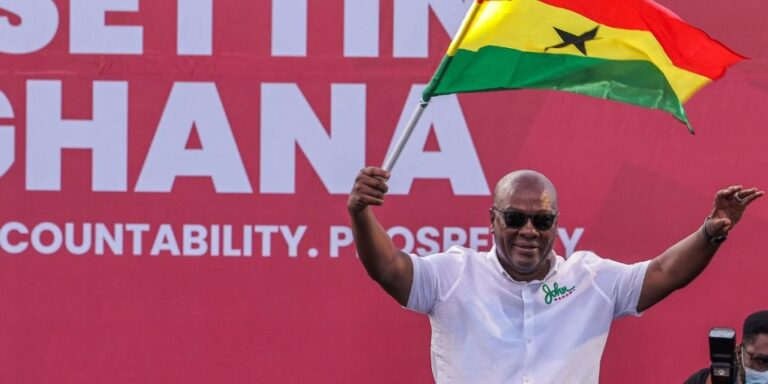
GHANA’S President-elect, John Dramani Mahama, has predicted that his government would face tough times in ‘resetting’ the country.
Mahama, the candidate of the National Democratic Congress (NDC) and a former president, addressed a large crowd of supporters at his Cantonment office in Accra Monday night after the Electoral Commission declared him the winner of the presidential poll conducted on Saturday, December 7.
He said the government of outgoing President Nana Akufo-Ado had plunged the nation into an abyss and the country had witnessed some of its darkest days under the president’s watch.
However, he promised to reverse the trend and put the nation on the right track.
“These eight years (of Akufo-Addo) have witnessed some of the darkest periods of our governance. The crises our beloved country has been through these last several years have left scars on our national psyche which may take some time to erase.
“This mandate also serves as a constant reminder of what things await us if we fail to meet the aspirations of our people and govern with arrogance.
“There’s much to do to salvage our country and reset it. We will have to start with resetting the relationship between citizens and elected officials. We must never forget that the people of Ghana have chosen us to represent their wishes and their best interests. It is the reason we will be initiating important government reforms and sometimes initiate severe measures in the next four years to reset our nation and bring it back on track as the black star of Africa.
“The journey is not going to be easy because the outgoing government has plunged our dear nation into an abyss. “However, we are determined to work together to build the governance we want, and I’m certain; we shall win the battle,” Mahama said.
He thanked all Ghanaians for their continued belief in the nation’s democracy despite the challenges facing the country.
He challenged all elected members of parliament, regardless of their parties, to see the nation as what they jointly own, adding that they should seek a Ghana that works for all citizens and not a privileged few.
According to him, the mandate given to him represents many things for all political actors and those who seek to lead the nation.
He said it showed that Ghanaians had zero tolerance for bad governance.
“We shall work together to restore the shattered confidence in our politics and governance system. This election and its outcome represents an opportunity for a new beginning and we can begin to write a new chapter of our collective story. We need to consciously set the tone for a new direction in which we will be travelling,” he stated.
He called for unity and determination by all citizens to move the nation forward.
While pledging to be a leader for all Ghanaians and move the nation forward, he said, “Our basic needs must be met: affordable housing, healthcare, food and clean water, safe work and fair wages.”
He described his running mate and vice-president-elect, a woman, Jane Naana Opoku-Agyemang, a professor, as “an inspiration.”
“Your decency, your humility and your sense of responsibility added so much to this campaign. The eyes of every young girl and woman, not only in Ghana but in nations across this continent and the world are going to be on you from today. You have not only opened the door, but you’re going to keep the door open for many other women,” he said.
The ICIR reports that Opoku-Agyemang will be the first female vice president in Ghana.
On Sunday, December 8, The ICIRreported that the incumbent vice president and the New Patriotic Party (NPP) candidate, Mahamudu Bawumia, conceded defeat to Mahama while results were being collated.
In an address at his residence in the Cantonment area of Accra, Bawumia said the results his party collated indicated that Mahama won the poll.
“I have just called His Excellency John Dramani Mahama to congratulate him as President-elect of the Republic of Ghana. I said during the signing of the peace pact that I was sure of two things. Ghana will win and peace will reign. The people of Ghana have spoken.”
Mahama and Bawumia had faced each other twice in the presidential elections with Mahama losing in both contests.
Mahama lost as an incumbent seeking re-election in 2016 and in 2020 when he threw his hat in the ring again to face Bawumia’s principal, President Nana Akufo-Ado whose tenure ends in January 2025. Bawumia was Akufo-Ado’s running mate in the two polls.
Bawumia is the first-ever Muslim to seek Ghana’s presidency on a major political party’s platform.
The ICIR reported that the Election Commission announced that Mahama polled 6,328,297 votes, representing 56.55 per cent of total votes cast to defeat Bawumia who garnered 4,657,304 votes, representing 41.61 per cent of total votes cast to come second in an election contested by 12 candidates.
THE administration of President Bola Tinubu has fallen short of its 2024 inflation target as figures consistently exceeded the projected 21.40 per cent throughout the year.
Data from the National Bureau of Statistics (NBS), analysed by The ICIR show that monthly inflation rates ranged between 29.90 per cent in January and 34.19 per cent in June, causing significant economic challenges for Nigerians.
The 2024 national budget had set an ambitious inflation target of 21.40 per cent aiming to stabilise the economy and improve citizens’ purchasing power.
However, this was consistently unmet, with inflation figures peaking at 34.19 per cent in June and remaining above 32 per cent through the latter months of the year.
By October, inflation stood at 33.88 per cent, showing the administration’s inability to rein in price surges across various sectors of the economy.
For many citizens, this wasn’t just about numbers. Throughout 2024, many Nigerians struggled under the weight of rising inflation. The ICIR reports that the persistent rise in inflation has exacerbated economic hardships for millions of Nigerians, with the cost of food, transportation, housing, and other essential goods and services soaring.
The ICIR, in several reports, highlighted how this has reduced the standard of living and plunged more households into poverty.
Citizens and market traders report that the price of staple foods such as rice, garri, and beans has nearly doubled compared to the previous year.
2024 review
Trend
Since President Bola Tinubu came into office on May 29, 2023, Nigeria’s inflationary pressure has surged considerably from 22.4 per cent, caused by the administration’s twin policy of fuel subsidy removal and exchange rate unification that has stoked the country’s economy.
In July 2024, Nigeria’s headline inflation dropped slightly to 33.4 percent from 34.19 percent in June—the first decrease recorded since Tinubu took office in May 2023. The decline was modest, representing a 0.8 percent reduction.
According to the National Bureau of Statistics (NBS), the inflation rate declined by 0.8 per cent compared to the June 2024 headline inflation rate of 34.19 per cent.
The following month, August, the inflation rate fell further to 32.15 per cent, marking the second consecutive decrease. The NBS report showed that headline inflation decreased by 1.25 per cent points when compared to the 33.40 per cent rate reported in July.
The ICIR reported that as of September 2023, Tinubu’s policies set a new inflation record for the nation in 20 years, making his administration sustain inflation rise consistently more than any leader in the nation.
Also, when the inflation rate reached 28.92 per cent in December 2023, The ICIR reported that it consistently increased throughout the year.
Hard turn on citizens
The skyrocketing inflation and the unfriendly policies by the Tinubu administration, in August and October, fuelled widespread protests across Nigeria.
The #EndBadGovernance protest, which took place from August 1 to August 10, was widely referred to as a “hunger protest” or “hardship protest,” with demonstrators expressing their frustration over the worsening economic conditions.
The protesters accused the administration of neglecting the root causes of inflation and failing to take meaningful action to alleviate the suffering of ordinary Nigerians.
They also argued that several of the government’s key policies have exacerbated inflationary pressures. The removal of the petrol subsidy in 2023, though touted as a necessary fiscal reform, led to a dramatic increase in fuel prices, driving up transportation and production costs.
Similarly, they noted that the liberalisation of the naira exchange rate resulted in currency devaluation, which in turn made imports more expensive and contributed to further inflation.
In addition to these policy missteps, financial experts point to other factors that have intensified the inflation crisis. Supply chain disruptions and insecurity in key agricultural regions have made it increasingly difficult for farmers to produce and transport goods safely.
This has led to food shortages, further driving up prices and worsening the cost of living for many Nigerians.
In an interview with The ICIR, Aisha Mohammed, an Abuja-based food vendor, lamented the challenges of affording staple goods. According to her, the rate at which residents patronise her shop has significantly decreased with some of them opting for an instalment good.
“A bag of rice that used to cost around N30,000 last year now costs N95,000 or so. How do they expect people to patronise us? Every day is a struggle for us to get our goods sold out.
“It’s even sad that many people come here to get this stuff in credit. And that doesn’t help the flow of our market,” she said.
Experts weigh in
Financial and economic experts, who spoke with The ICIR, have criticised the Tinubu administration’s inability to meet its set out inflation rate on policy decisions made in the last 18 months.
A developmental economist, Celestine Okeke, explained that the rising cost of petrol is a major contributor to inflation. “When fuel prices go up, it’s not just about households using fuel for generators or cars. But what do the vehicles move around? They move around food, they move people around. So, with the rising cost of fuel, on the one hand, it brings about inflation.
“And you also see that we took our subsidy on fuel and took our subsidy on energy. Distribution companies are going to build their band A, band B, and all of that. And then the foreign exchange too, the subsidy was taken off and cost of almost everything shot up at the same time.
“The government cannot be setting a target of 21.40 per cent when it had gone ahead to remove the subsidies, especially the energy subsidy. Once you remove subsidies on energy, it will reverberate around the entire economy. So, it’s basically the policies that were implemented from 2023 when this decision came in to where we are now. That is what has gotten us into this very place,” he said.
While acknowledging the complexity of Nigeria’s inflation crisis, the analyst emphasised the need for a long-term, holistic approach to boost economic productivity.
“What can the government do to increase productivity? Even in the agricultural sector, there’s so much that needs to be done. For a start, we need to get around the issue of climate change. We need to get around the issue of insecurity that is affecting several farming communities.
“We need to get around the issue of low adoption of technology for farmers and all of that. Since government has taken out the subsidy on fuel also, it needs to begin to find ways to reduce the cost of business oppression for companies…
“Let’s not fool ourselves to think we can beat this inflation thing down in 12 months. To take consistent planning over a long period of time for us to be able to do anything. It just applies to commodity prices,” he said.
THE forced acquisition of land by the Nasarawa State government has left many smallholder farmers, especially women, without a means of livelihood. For these women, their farms were not only a source of income but a lifeline for their families. As government projects move on, the communities they leave behind are struggling to survive. The ICIR reports.
Forty-year-old NenmanNengak wiped her face with the sleeve of her gown as she recalled the tragic day when government officials, escorted by policemen, descended upon her farmland in Angwan Sama, Awe Local Government Area (LGA), Nasarawa State.
For the past eight years, she had cultivated the land which she inherited from her parents, planting maize, guinea corn, soybean, and benniseedto support the education of her five children.
But two years ago, her livelihood was abruptly cut off as state officials seized the land without notice, she recalls.
“They came suddenly, we were told the farm no longer belonged to us and that it was government land now,” Nengak says.
According to her, she was not given time to harvest what she had planted. Instead, she watched in helpless silence as bulldozers uprooted her crops.
Once, Nengak could harvest 20 bags of maize and 30 bags of soybeans. Now, she says she has nothing, and her life has never been the same. The financial strain forced one of her children to drop out of school in Lafia, while others transferred from private to public schools. Each day is a struggle as the only cocoyam crop, she now manages to grow in Angwan Sama,barely covers her family’s most basic needs.
Nenman Nengak
“I don’t know where to get money for food, let alone carry out repairs of the dilapidated parts of our house,” she says, glancing at the crumbling walls.
Nengak’s experience is not an isolated incident. Across villages in Nasarawa State, women farmers recount similar narratives of loss and adversity during interviews conducted by The ICIR.
In 2018, when the Federal Government, in collaboration with the state, designated 22,000 hectares of land for a grazing reserve project, many women farmers were forcibly evicted from their ancestral lands. Many, like Nengak, had little warning, and some faced arrest when they resisted. Ironically, the grazing reserve remains largely unused, leaving women who depended on these lands to grapple with struggles.
Losses that go beyond land
Nasarawa State, like many parts of Nigeria, has grappled with persistent tensions between farmers and herders over competition for land, water and other resources. The grazing reserve initiative was introduced as a way to manage this issue, offering pastoralists a settled area with access to grazing land. In some cases, additional facilities like water points, veterinary services, and livestock markets.
However, a visit to the project site reveals that the initiative has failed to achieve its purpose, as herdsmen have mostly abandoned the designated grazing areas.
In Baure village, not far from Nengak’shome in Angwan Sama, 40-year-old Huldah Illiyah recounts the hardship her family has faced since their farmland was seized without notice or compensation.Her voice barely rises above a whisper as she describes losing the farm her family had tended since 1990.
Huldah Illiyah
“We had big farms where we planted yam, maize, and soya beans. That’s how we survived,” she says, holding her youngest child close.
“They just came and said the land belongs to the government. Our maize was two weeks from harvest, but cows ate what was left after they cleared the land. We don’t know what to do. I can’t pay the school fees of my children anymore, and finding food is a daily struggle.”
Without the farmland, Illiyah and her husband have been forced to rely on small purchases of food. But even that has proven difficult. Attempts to buy new farmland have led to more trouble, as disputes often arise after the sale. Each year, they search for land to rent, but even that has become a nearly impossible task.
“I am begging the government to look at us and our children. We need help,” Illiyah says, her face etched with sadness.
The loss of farmland in a complex web of land deals in Nasarawa State is not limited to small-scale farmers or projects. Helen Yohanna and her husband had once cultivated an expansive five-hectare farm, producing staple crops like maize, rice, and groundnuts. The land, inherited from her husband’s father, has been crucial in providing for their family of seven childrenfor over a decade.
“We used to get a bountiful harvest after each planting season,” she said adding that the experience is now a distant memory.
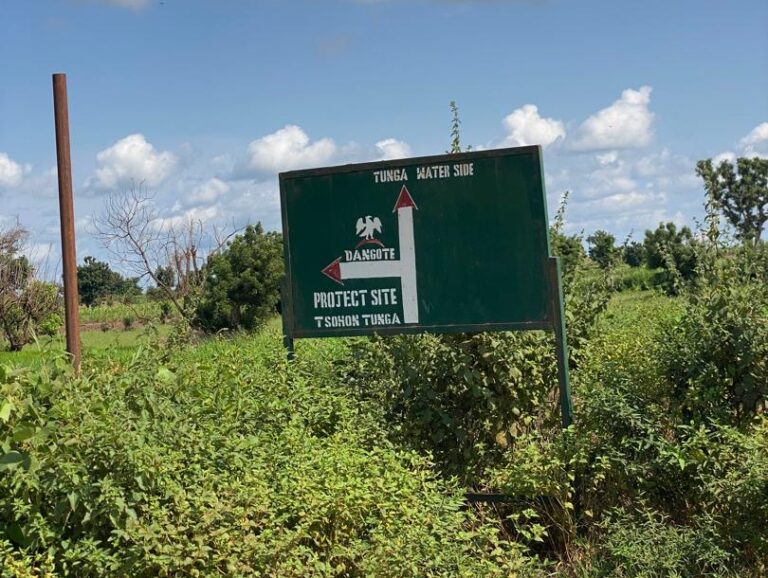
A few years later, their farm was confiscated and cleared to make way for the Dangote Group’s $700 million sugar refinery project in Tunga, Awe LGA. Though the deal, signed in 2017, was touted as a significant investment for Nasarawa, Helen and other smallholders were left with nothing.
“We had just cleared the land and were preparing to plant rice when the authorities arrived. Without notice, they took everything, claiming the land belonged to them. The land in question was one of the lands allocated by the state government to Dangote for sugar refinery,” Yohanna said.
Hellen Yohanna
The signing ceremony of the deed of acquisition, lease, and development agreement for the project took place at the National Sugar Development Council, Sugar House in Abuja. The sugar refinery project comprised 68,000-hectare sugar plantations and two factories with the capacity to produce 430,000 tonnes per annum of refined white sugar, representing about 30 per cent of the country’s consumption and touted to be the largest plant in Nigeria.
“They sprayed chemicals on the land to prevent any further use, and we couldn’t do anything about it,” she says, tears rolling down her cheeks. Since then, life has been a constant struggle. Helen’s harvests have dwindled to almost nothing, and she barely manages to provide for her family.
Yohanna’s family has since moved to Taraba State to try farming on a smaller piece of land, but it is not enough. The rising prices and diminishing resources make feeding her children a tough challenge.
A cycle of poverty and loss
Paulina Mark, a 50-year-old mother of four, saw her livelihood collapse when her farmland was seized by the government last year. The land, which she had inherited from her parents and cultivated for decades, was taken without any notice or compensation. It had been their source of food and income, helping her pay school fees for her children and sustain her household.
Paulina Mark
Paulina sad, “One day, they just came and said the land now belongs to the government. There was no warning, no meeting, nothing. They came and chased us away. We didn’t even have time to gather our crops. Our maize was just two weeks away from harvest when they arrived. After that, cows came and finished the rest.
“Later they sprayed chemicals on the land and fenced the area off with wire. Now, we can’t enter. We even had three boreholes on the farm, but all of that is locked off now. They fenced it and put leather around it to keep people out.”
With their crops destroyed and no access to the land, her family was plunged into crisis.
“We’ve lost everything. There’s no maize, no food at all. We can’t feed ourselves, and my children are no longer going to school because I don’t have money to pay for their fees. We don’t even have money to buy food anymore. We live in fear and poverty,” she lamented.
While pointing put that the loss has taken more than their farm, she said,said, “It has shattered our hopes for the future. Now, we have nothing left.”
A pattern of displacement
Findings reveal that the forced displacement of farmers in Nasarawa State is not a new phenomenon. Over the years, the state government had acquired land for large-scale agricultural and development projects, often at the expense of local communities whose primary livelihood is farming. This trend has led to widespread protests and communal unrest, as residents are living under constant fear of losing the land that sustains their families.
In September, for example, some State Assembly membersraised concerns over a proposed acquisition of 10,000 hectares in AgbashiEkye Development Area of the state by SaroAfrica International Limited. Local farmers in the area, who rely on the land for their income and food security, voiced fears about their future and called on the government to halt the acquisition process. They were concerned that their ability to feed their families and send children to school would be jeopardised.
A similar caseunfolded in Obi and Awe LGAs, where 10,000 hectares of farmland primarily used by Tiv communities were earmarked for a federal agricultural project aimed at improving food security. Although the government justified the acquisition as necessary for development, promising local employment opportunities, the farmers faced harassment from security agencies and lost their crops without compensation. This spurred legal action and backlash from affected communities demanding justice.
The experience of these women farmers in Nasarawa speaks to a larger issue of gender inequality in agriculture. Nigeria’s National Agricultural Gender Policy acknowledges the vital role women play in food production, emphasising the need for equitable access to land and resources. However, the gap between policy and practice becomes glaring in Nasarawa, where development projects displace women farmers without alternatives or compensation.
The state government has defendedits allocation of land for large-scale initiatives such as the Dangote Sugar Refinery and the Federal Government Grazing Reserve, citing the public interest. However, findings by The ICIR reveal a more complex scenario on the ground. For example, the grazing reserve, aimed at reducing farmer-herder conflicts by establishing controlled grazing spaces, remains largely underutilised, casting doubt on its efficacy.
Similarly, the Dangote Sugar Refinery celebrated as a potential economic advantage is yet to fulfil its promises of local economic transformation. Although the refinery has provided employment for some local youth, primarily men, farmers like Yohanna, who were displaced, received no alternative land or benefits from the project. Despite government assurances of uplifting livelihoods, smallholder women farmers are left grappling with the challenge of rebuilding their lives and sustaining their familieswithout compensation.
Dangote Sugar Refinery project site
Although the exact number of affected farmers is unclear, the scale of the displacement is significant. Among those who were interviewed by The ICIR, 15 farmers reported losing their land and livelihoods without any compensation. They described the disruption as widespread, with many more families across the affected areas facing similar struggles.
What does the law say?
The Land Use Act of 1978 vests all land within a state in the hands of the governor, who holds it in trust for the people. While the Act allows the government to acquire land for public purposes, it mandates that affected individuals be compensated for the land, crops, and improvements they lost. However, notice of acquisition and fair compensation are legal requirements that, in many cases, have not been adhered to in Nasarawa State.
Similarly, Section 44 of Nigeria’s Constitution prohibits the compulsory acquisition of property without prompt and adequate compensation, except for public purposes. Experts say non-compliance with these provisions is not only unlawful but also a violation of property rights that can be challenged in the court of law.
Right activists kick
A Nasarawa-based human rights lawyer, Jonathan Jabez, condemned the state government’s alleged forceful acquisition of land, describing such actions as unconstitutional.
“Such acts are not permitted under our laws. For any government to acquire land where communities reside, it must follow established procedures, “he said.
Emphasising the importance of dialogue with community leaders and landowners before taking any action, Jabez said: “Most of these lands are ancestral, with historical and cultural significance. Responsible governments must consult the affected communities and ensure their concerns are addressed,” he explained.
He stressed the necessity of adequate resettlement and compensation for displaced persons.
“Governments should either resettle the affected families or compensate them adequately. Skipping these steps undermines both property laws and constitutional protections,” he said.
On the plight of displaced farmers, Jabez said:“They can file petitions or seek judicial intervention to challenge these actions. Also, they should contact organisations like the Human Rights Commission or Legal Aid Council for support,” he advised.
The cost of development on women farmers
The head of research and advisory atVestance, a consulting firm focused on Nigeria’s agricultural food system, Razaq Fatai, acknowledged the potential benefits of development projects like factories and large-scale agricultural programmes.
According to him, while these initiatives can spur local economic growth, create jobs, and add value through processing, there are serious risks involved if the displacement of smallholder farmers, especially women, is mishandled.
Razaq Fatai
Fatai warns that displacements could jeopardise food security, lead to shortages, increase poverty, and even fuel future conflicts, as smallholder farmers are integral to local food production.
“Without adequate support, the loss of their land could be detrimental to their livelihoods and well-being,” he said.
He said land seizures, particularly those affecting women, exacerbate economic vulnerability and deepen gender inequalities. “For many communities, land is not just an asset. It is tied to identity and cultural heritage. Losing it disrupts lives in ways that financial compensation alone cannot address.”
Fatai suggests that governments can avoid the harmful consequences of displacement by engaging farmers in early consultations.
“Balancing development with the needs of smallholder farmers requires fair compensation and inclusive project planning,” he said, adding that, “Providing alternative livelihoods, securing new land, and supporting agricultural cooperatives can help communities thrive alongside development.”
The founder of Community Action for Food Security (CAFS Africa), Azeez Salawu, stressed that while large agricultural and ranching projects have promising economic benefits, they should not be built on the suffering of local farmers.
“Sustainable land-use policies must protect local livelihoods and promote equitable land ownership. Development should uplift communities, not displace them.”
Salawu notes that the most immediate consequence of these evictions is the loss of livelihoods for smallholder farmers, many of whom rely on their land not only for income but for subsistence.
Azeez Salawu
“When they are evicted from their land, they are left vulnerable to food insecurity, unemployment, and poverty,” he said.
But Salawu makes a more fundamental argument about the importance of food produced by smallholder farmers as compared to mechanised and big farm projects.
“Removing them from their lands could have broader implications on our local food security. For example, In Keffi, smallholder farmers are crucial for food production. Displacing them in favour of large-scale commercial projects could reduce local food availability and diversity, leading to increased food prices and a greater reliance on imported food.”
Salawu suggested that there are alternatives to eviction that could create “win-win situations” for both investors and local farmers. One of them, he says, is integrating farmers into the projects as partners. This approach, he explained, would allow farmers to maintain their livelihoods while benefiting from improved technology, infrastructure, and market access.
He called on the government to ensure transparency in land allocation processes and to guarantee that affected farmers are adequately compensated, resettled, or integrated into the new projects.
Surviving against the odds
Despite the challenges, some women farmers have continued to cultivate small plots of land through rented or borrowed arrangements. Others, like those from Awe, have moved to neighbouring Taraba State to keep farming. Patience Noah, who lost her 50-hectare farm to a state sale to Dangote, recounts the hardship of starting over.
Grazing reserve project site
“We only got two bags last year because the portion is so small,” she says, reflecting on the challenges they face with limited land.
Others, like Illiyah, have been less fortunate. She has spent years moving from place to place in search of land, facing disputes and challenges at every turn.
“We are not finding things easy. It’s only God helping us. This year, we tried to buy some farmland, but even if they sell it to you, it often leads to disputes and challenges. We don’t know what to do. I am begging the government to look at us and our children. We can’t feed our children anymore. We can’t even pay school fees.”
For women like Yohanna, Taraba state offered a temporary solution. There, she and others were given small plots in exchange for a portion of their harvest.
“It’s the only way we’ve managed to survive since we lost our land,” she explained, noting how challenging it is to sustain her family with such limited resources.
Women farmers seek help
The local coordinator of the Small-scale Women Farmers Association (SWOFON) in Awe LGA, Caroline Bala, expressed deep concern over the land seizures that have left women across the state without a stable livelihood.
“This situation has been a nightmare for us. We’ve lost everything including our farms, our incomes, our ability to feed our families. Now we live like beggars, dependent on charity to survive,” she laments.
Caroline Bala
Bala emphasised that the most painful part of the ordeal has been the state government’s lack of communication with affected communities.
“There was no notice, no community meeting, no explanation. Officials came with force, and we were simply expected to leave. Everything we had planted was destroyed, and the land was fenced off before we could gather our belongings.”
Despite numerous appeals to local and state authorities, Bala says that responses have been minimal and dismissive. This issue, she continued, extends beyond Nasarawa State, affecting over 14,000 smallholder farmers under SWOFON.
“This isn’t just happening in one community. The government is prioritising large projects over the people who have sustained Nigeria’s food security for generations. This has to stop, “she says, adding, “We are calling for justice. If the land cannot be returned, then there should be reparations for our crops, or alternative plots to farm. Development should not come at the cost of our lives.”
Bala clarified that women farmers are not opposed to development; they simply believe it should not come at the expense of those who depend on the land for survival. She urged the government to engage affected communities in dialogue and decisions that affect their lives, emphasising that if the government truly values its people, it should listen to their concerns and work toward a solution that benefits everyone.
State government denies forceful eviction of women farmers
In response to allegations of the forced displacement of women farmers from their farmlands in Nasarawa State to make way for the Dangote Sugar Refinery project, the state government denied any knowledge of such claims.
The Special Adviser to Governor Abdullahi Sule on Agriculture, RayannuIlyasu, dismissed reports that women farmers were evicted without compensation. He emphasised that the land used for the refinery project had been dormant for over two decades before being allocated under the administration of former Governor Umaru Tanko Al-Makura.
“I’ve never heard of any clashes or issues arising from the Dangote Sugar Refinery farm since its inception,” Ilyasu stated during a phone interview.
“If there was farming on the land before the project, it was under the past administration, and the affected people would have been duly compensated.”
Ilyasu cited records showing that N3.25 billion was paid as compensation to landowners but noted a possible case of exclusion, as women farmers who spoke with The ICIR denied receiving any such payments. He assured that the state government would investigate the matter.
“If such issues arise, we’ll advise on what to do. But as of now, I don’t have any knowledge of what you’re saying,” he added.
The Special Adviser requested specific details about the affected communities and their demographics, promising to consult local sources and verify the claims thoroughly.
Regarding allegations of unfair displacement linked to the state’s grazing reserve project, the Director of Veterinary Services at the Ministry of Agriculture, Abdullahi Musa, dismissed claims of forced eviction. He explained that the grazing reserve, spanning 26,000 hectares, was originally designated for cattle grazing and gazetted as government property in 1963.
“The grazing reserve was intended for cattle. However, over the years, farmers, many of whom are not indigenes of the state, encroached on the land,” Musa said.
He stated that over 90 per cent of the encroaching farmers hailed from Benue and Plateau States and that their activities lacked legal backing.
“Local authorities illegally sold plots to these farmers, even though the land belongs to the government,” he added.
According to Musa, the government began reclaiming 2,000 hectares in 2019 for a pilot ranching project, following years of failed attempts to resolve the encroachment. He said agreements were reached with the farmers to vacate the specified areas peacefully after the current farming season.
“The government is not evicting farmers without notice,” he said, adding, “The area we planted pastures was not being farmed. Even if anyone claims to have farmed within the reserve, it is still illegal.”
He acknowledged lapses in the government’s earlier failure to develop the grazing reserve, which allowed widespread encroachment.
“We recognise that the neglect of this land created these conflicts, but the current project aims to reduce farmer-herder tensions by designating specific areas for grazing and farming,” Musa said.
The director reiterated the state’s commitment to achieving a peaceful resolution while ensuring that the grazing reserve fulfils its intended purpose. However, there are still unanswered questions about the alleged exclusion of women farmers and the transparency of the compensation process.
GHANA’S Electoral Commission (EC) has declared the National Democratic Congress (NDC) presidential candidate and former President, John Dramani Mahama, as president-elect.
Announcing the election results Monday evening, the EC chairperson, Jean Mensa, said she was delighted that the election was free, fair and acceptable to all.
She said, “As the returning officer for the presidential election, and in fulfilment of my mandate as enshrined in law, I will now declare the outcome of the 2024 election. It is important to note that in Regulation 33:3 of the 1992 Constitution of Ghana, the winner of the presidential election must obtain 50 per cent plus one (vote) at the poll to be declared the winner of the election.
“We have collated the results of the presidential results from all 16 administrative regions of which 267 of the constituencies have been captured. “We have not been able to receive results from nine constituencies because our offices have been besieged by political party supporters, making it impossible to complete the collation process. “That notwithstanding, the presidential results for the 267 constituencies, including the newly created one constituency, clearly established the winner of the 2024 presidential election.
“Simply put, even if all the votes from the nine constituencies were added to the candidates who placed second, it would not change the outcome of the election.
“It is important to note that the commission will update the record on the receipt of the presidential results from the nine outstanding constituencies.”
The results as announced
Mahamudu Bawumia of the NPP: 4,657,304 (41.61 per cent)
Daniel Augustus Lartey Jnr – Great Consolidated Popular Party (GCPP) 60,673 (0.15 per cent)
Christian Kwabena Andrews – Ghana Union Movement (GUM) 60,461 (0.15 per cent)
Kofi Akpaloo – Liberal Party of Ghana (LPG) 5,219 (0.09 per cent)
Mohammed Frimpong – National Democratic Party (NDP) 4,413 (0.04 per cent)
Nana Akosua Frimpomaa – Convention People’s Party (CPP) 23,397 (0.21 per cent)
John Dramani Mahama – National Democratic Congress (NDC) 6,328,297 (56.55 per cent)
Hassan Abdulai Ayariga – All People’s Congress (APC) 17,461 (0.16 per cent)
Kofi Koranteng – Independent Candidate 3,320 (0.03 per cent)
George Twum-Barima-Adu – Independent Candidate 3,091 (0.02 per cent)
Nana Kwame Bediako – Independent Candidate 84,478 (0.05 per cent)
Alan John Kwadwo Kyerematen – Independent Candidate 31,202 (0.28 per cent)
Total valid votes cast = 11,191,422
Total rejected votes = 239,109
Total votes cast = 11,430,531
Total registered voters = 18,774,159
Percentage voter turnout based on the 267 constituencies stands at 60.9 per cent.
She said,”As a commission, we have fulfilled our avowed aspiration to imbibe transparency, accountability, inclusiveness and responsiveness at the heart of our operations. I can confidently say that with the help of God, we have fulfilled this aspiration and the expectation of the citizenry.
“We have conducted elections that are credible, fair, transparent and peaceful. Elections that have ensured that the will of the people, as expressed at the poll, elections that have guaranteed that every vote counts.
“As a country, we take pride in the fact that electoral processes initiated since 1992 uphold and guarantee the voter’s choice. We take pride in the fact that the voter’s choice as expressed at the polls is sacrosanct.”
On Sunday, December 8, The ICIRreported that the incumbent vice president and NPP candidate, Bawumia, conceded defeat to Mahama while reports were being collated.
In an address at his residence in the Cantonments area of Accra, Bawumia said the results his party collated indicated that Mahama won the poll.
“I have just called His Excellency John Dramani Mahama to congratulate him as President-Elect of the Republic of Ghana. I said during the signing of the peace pact that I was sure of two things. Ghana will win and peace will reign. The people of Ghana have spoken.
“The people have voted for change at this time, and we respect that decision with all humility. I thank God Almighty for how far he has brought me, and I submit to His will. I am making this concession speech before the official announcement by the Electoral Commission to avoid further tension and preserve the peace of our country,” he said.
Mahama and Bawumia had faced each other twice in the presidential elections with Mahama losing in both contests.
Mahama lost as an incumbent seeking re-election in 2016 and in 2020 when he threw his hat in the ring again to face Bawumia’s principal, President Nana Akufo-Ado whose tenure ends in January 2025. Bawumia was Akufo-Ado’s running mate in the two polls.
Bawumia, the first-ever Muslim to seek Ghana’s presidency on a major political party’s platform.
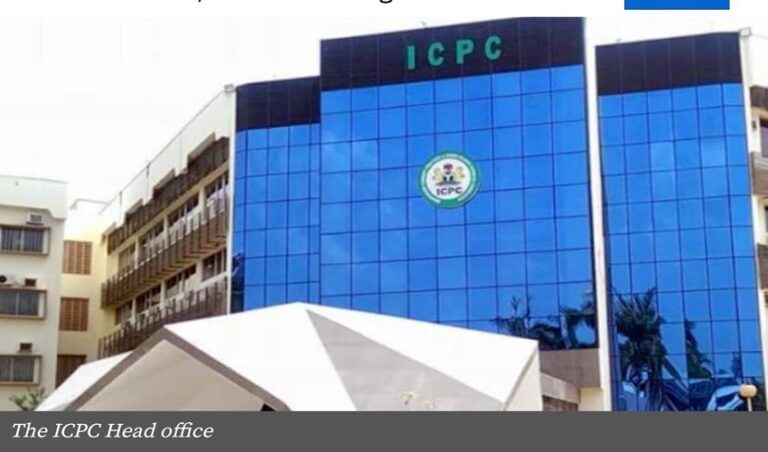
A FEDERAL High Court sitting in Maitama, Abuja, has dismissed an application by a contractor to stop the Independent Corrupt Practices and Other Related Offences Commission (ICPC) from prosecuting him and his company in a 65-million-dollar money laundering case.
The contractor, Tarry Rufus, the chief executive of Good Earth Power Nigeria Limited, is being prosecuted by the ICPC with the former managing director/chief executive officer of the Federal Mortgage Bank of Nigeria (FMBN), Gimba Kumo Ya’u, and the former executive director of FMBN, Bola Ogunsola, over an alleged diversion of $65 million meant for the development of 962 units of residential housing in the Kubwa district of Abuja.
This was disclosed in a statement on Monday, December 9, by the commission’s spokesperson, Demola Bakare.
The judge Yilwa H. Joseph held that the evidence before the court proved that a prima facie case of alleged misappropriation had been established through legal investigation and the court could not hinder the ICPC “from carrying out and performing its statutory duties.”
She noted the applicant’s suit of illegal detention did not hold water, as the court was not provided with evidence to prove so.
The court added that Rufus’ inability to “fulfil the bail conditions therefore, cannot be seen to have amounted to the breach of his fundamental rights by the ICPC and EFCC”.
ICPC had accused Rufus and his company, Good Earth Power Nigeria Limited, of giving and receiving $3.6 million of the contract sum in cash, in contravention of the Money Laundering Act.
“They were also suspected of having directly converted N991,399,255 into $3,550,000.00 and handing over the same to one Jason Rosamond in cash, contrary to Section 18(2) (b) and punishable under Section 18 (a) of the Money Laundering (Prevention and Prohibition) Act, 2022.”
“Rufus, however, in December 2023, filed an application in court to stop the ICPC and the EFCC from inviting or involving him in the case over the alleged $65 million fraud purportedly perpetrated by the ex-managing director of FMBN, Mr. Gimba Kumo Ya’u,” the ICPC stated.
According to the commission, the defendant argued in his application that he committed no infraction while executing the contract, asking that the court order both the ICPC and the Economic and Financial Crimes Commission (EFCC) to release all documents of the land title received for his administrative bail.
He further claimed in his application that his detention by ICPC during its investigation was unlawful and a violation of his fundamental rights.
He subsequently implored the court to award N500 million against the ICPC, EFCC, and FMBN “for initiating frivolous criminal persecution” against him.
The ICPC counsel, O.B. Odogun, argued that the statutory power of investigation vested in the commission through the Act that established it allowed the ICPC to examine petitions of alleged misappropriation diligently.
The ICPC further maintained that Rufus had voluntarily honoured the commission’s invitation to answer questions on suspicious cash flows from the account of Good Earth Power Nigeria Limited and that his inability to meet specified bail conditions was, in its entirety, his responsibility.
THE third edition of Migration & Technology Monitor’s annual Fellowship Programme is seeking journalists with lived experiences of migration to actively contribute to research, storytelling, policy-making, and advocacy related to migration and technology.
The programme aims to continue creating opportunities for people with lived experience of migration to meaningfully contribute to research, storytelling, policy, implementation of technology and advocacy conversations.
“Among our aims is a collaborative, intellectual, and advocacy community committed to border and migration justice” said the organisers.
Fellows are required to participate in monthly webinars, which provide training on project development, ethical storytelling, public outreach, and other essential topics. These sessions also feature guest speakers who aim to learn from and connect with the fellows.
Fellows are expected to present their projects at a public event, such as a conference or workshop, to expand their professional networks.
Displaced or exiled journalists can apply for this year-long fellowship programme.
Fellows will each receive a stipend of US$30,000 for a 12-month period, running from April 2025 to May 2026.
Interested applicants should apply by December 31, 2024 and register here.
THe United Nations Foundation is now accepting applications for its 2025 Polio Press Fellowship for Individual Reporting in Africa.
This fellowship is geared towards journalists interested in reporting stories on polio eradication in Africa.
Upon participating in a series of virtual polio training sessions, selected journalists will receive funding to travel independently to one or more countries in Africa at the forefront of the polio eradication effort to gather stories and interviews with polio survivors, health care workers, community members, families, and health authorities.
Preference will be given to reporters interested in travelling to the following countries: Chad, the Democratic Republic of the Congo, Ethiopia, Niger, Nigeria, Madagascar, and Mozambique.
Journalists who are interested in global health issues can apply for a fully-funded press trip.
Journalists from all countries are encouraged to apply. Selected fellows will receive up to US$10,000 to cover reporting costs.
The deadline for the submission of application is January 3, 2025. Interested applicants can apply here.
HUMAN rights lawyer Dele Farotimi has been granted a N50 million bail by an Ekiti State High Court.
This was disclosed by the African Action Congress (AAC) 2023 presidential candidate, Omoyele Sowore, on his X handle on Monday, December 9.
“The first hurdle was crossed. @DeleFarotimi was granted bail of N50 million naira surety in the like sum with someone with landed property. The case was adjourned to 29 January 2025,” Sowore posted.
The ICIRreported that the Ekiti State Magistrate Court in Ado-Ekiti on Wednesday, December 4, remanded Farotimi in custody after denying him bail following his arraignment on a 16-count cybercrime and defamation charge case instituted against him by nonagenarian lawyer, Afe Babalola.
Farotimi, renowned for his criticism of human rights abuses and advocacy for justice, was arrested following a petition filed by Babalola, a senior advocate.
The charges are detailed under Cybercrimes (Prohibition, Prevention, Etc.). Act, 2015, centers on allegations of defamation stemming from Farotimi’s book, Nigeria and its Criminal Justice System.
The case, with suit number MAD/1,476.C/2024, lists the Ekiti State Commissioner of Police as the complainant, according to Sahara Reporter.
It quoted court filings as saying excerpts from the book allegedly made damaging remarks about Babalola, referring to him in disparaging terms.
The filing shows the prosecution arguing that such descriptions were intended to harm the senior advocate’s reputation.
The ICIR reported how the police arrested Farotimi on Tuesday, December 3. His arrest was exposed by Sowore in a post on his X handle.
Farotimi was subsequently transferred to Ekiti State, where he was later detained by the State Police Command.
His arrest and arraignment have sparked outrage, with notable figures like the former vice president, Atiku Abubakar, and presidential candidate of the Labour Party in the 2023 election, Peter Obi, describing it as a gross misuse of police powers and an assault on democracy and justice.
Also, the Nigerian Bar Association (NBA), on Wednesday,condemned his arrest while also demanding his immediate release.
The NBA strongly condemned the alleged invasion of Farotimi’s law firm and the harassment of lawyers and staff within the premises by the police.
The NBA described the police actions as a troubling breach of the rule of law and the sanctity of the legal profession.
ByTHE Katsina State Police command said it rescued about 20 victims in two kidnap attempts by armed bandits in the state on Saturday, December 7.
The incidents took place in Jibia and Faskari Local Government Areas (LGAs), the command posted on its X handle on Sunday, December 8.
The first incident occurred on December 7, 2024, at about 1900 hours, at Kwanar Makera along the Katsina–Magamar Jibia road, Jibia LGA.
According to the police public relations officer, Abubakar Sadiq Aliyu, a group of bandits, armed with dangerous weapons, AK-47 rifles, opened fire on a moving vehicle.
“The command’s operatives, who were alerted to the situation, quickly mobilised and stormed the scene, engaging the bandits in a fierce gun duel.
“Due to superior firepower, the bandits abandoned their heinous plan as they flee the scene, and all the passengers were successfully rescued,” he said.
Aliyu added that all 10 occupants in the vehicle were successfully rescued unhurt.I
In a similar incident, on the same date at about 20:30 hours, at Marabar Bangori, along the Funtua-Gusau road, Faskari LGA, suspected armed bandits laid ambush on a vehicle conveying passengers, attempting to abduct the occupants.
According to Aliyu, the operatives of the command attached to the Jibia divisional police headquarters, acting on a tip-off, swiftly responded and engaged the bandits in a gun duel, forcing them to abandon their mission and flee the scene with a gunshot.
The state commissioner of police, Aliyu Abubakar Musa, who commended the personnel, charged them to sustain the tempo in the ongoing fight against all forms of crime and criminality in the state.
According to the command, one of the rescued victims was rushed to the hospital due to severe assault inflicted on him by the assailants.
“The victim is currently responding to medical attention,” the command stated.
There has been a series of kidnap attempts and rescue missions by the security forces in Katsina.
In one of its most recent publications, The ICIRreported security forces, comprising the Police and Army rescued four kidnap victims in Dandume Local Government of Katsina State.
RESIDENTS of some communities in the Southeast part of the country, ravaged by erosion, are crying foul over the abandonment of projects meant to provide them succour. Investigations reveal that there is more to these neglected projects than meets the eyes.
Naze and Obibiezena, two communities in Owerri North Local Government Area (LGA) of Imo State, are less than 10 minutes away from the headquarters of the Anambra-Imo, River Basin Development Authority (AIRBDA). In fact, the agency is sitting on ancestral lands donated by these communities.
Sadly, for more than two years now, AIRBDA has failed to execute a flood and erosion project contract it awarded in the communities, making life difficult for residents and threatening economic activities.
Hon. IkennaElezieanya, the current Commissioner for Science and Technology, Innovation and Engineering Services in Imo state, had attracted the contract as a constituency project when he was a member of the House of Representatives representing Owerri Federal Constituency.
Available data on Govspend, an online tool that tracks and analyses federal government spending, shows that the project for flood and erosion control/rural access road, along Naze-Obibiezena road Owerri North LGA, was awarded to two different contractors, with amounts running into over N161million.
A project signpost at another community
A breakdown of released funds shows that on 24 March 2022, Bonita Bay Limited, registered on December 2, 2009, (with Uchenna Nwangwu and Uchechi Ndeze as directors) was paid over N152million (N152,591,371) while Headoarc Associates Limited, which was registered on Jun 16, 2008, (with Okafor Ifeanyi, Okafor Chike and Nwosu Jennifer listed as directors) received over N8.4million (N8,499,507) on 26 Jun 2023, for the 2.8km project.
However, multiple sources, including a community leader, who once worked as Elezieanya’s campaign coordinator in Naze, Ebenezer Ahubuibe, said that no proper construction work was ever done on the road apart from grading and a shallow and incomplete drainage system that has further worsened the state of the road.
On October 2, 2024, the member representing Owerri Municipal, Owerri West and Owerri North in the House of Representatives, Tochukwu Okere, sponsored a motion drawing attention to the unexecuted Naze-Obibiezena road which, according to him, was expected to boost agriculture in Owerri Federal Constituency.
“The road stretches over 50km to Etche in Rivers State and can serve as a bypass from Owerri to Port Harcourt, avoiding heavy traffic from the Owerri -Port Harcourt expressway. Also, people coming from Okigwe Aba and Umuahia can also find the road useful and faster as people coming from Imo State Airport have to pass through the heavy traffic of the Owerri-Port Harcourt expressway,” he reportedly said in the motion.
Headquarters of the Anambra, Imo River Basin Development Authority (AIRBDA), along Agballa
But this is not just a story about Naze and Obibiezena, it is a story that uncovers procurement law violations in AIRBDA- an agency that has become notorious for abandoning and sometimes poorly executing erosion and flooding projects across communities in the Southeast region.
Abandoned Naze Road, commuters’ nightmare
Interestingly, business owners and residents along the Naze- Obibiezena Road said that it was not entirely unusable when Elezieanya decided to capture it in the budget for funding. Although it was constructed without a drainage system 15 years ago during the time of a former senator representing Owerri Senatorial District, Eze Ajoku, the road still served residents.
“The road was always busy, with car owners and motorcyclists always plying through to get to their destinations, each time it developed potholes, community members came together and parched it,” Ahubuibe said.
But in 2022, AIRBDA came with trucks, scooped all the asphalt and took them away, Ahubuibe claimed. He added that residents were happy and hoped that the road would be properly constructed. Elezieanya made a post on his X, saying that he had handed over the road to a contractor.
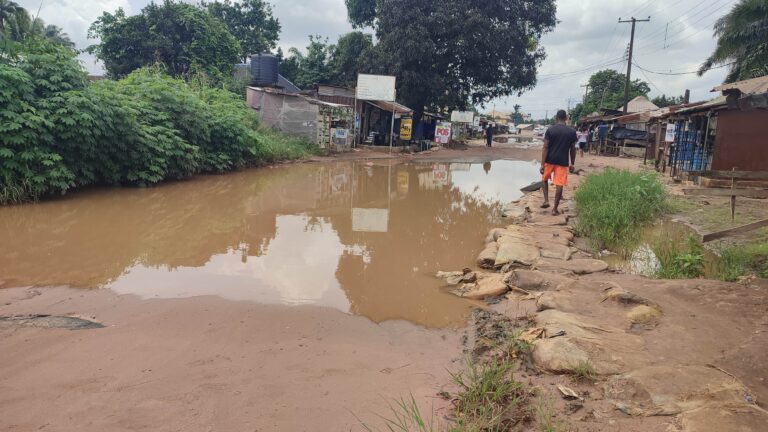
Sadly, two years after the money was released, the project has remained uncompleted, making it impossible to drive through because of potholes that continue to widen. Whenever it rains, the entire road is flooded and the water does not recede for weeks. Only (big) trucks ply through the road.
Pius Aleke says farmlands are often flooded due to lack of drainage system
On Monday, October 28, a Freedom of Information Act (FOIA) request was sent to AIRBDA and Engr. Gerald Osuagwu, the Managing Director of the agency, requesting specific details of the contract, including the approved budgetary provision, the contract execution period, contract value, the amount paid and the level of completion. The headquarters of the agency was also contacted with the same letter on October 29, 2024, demanding answers to the same questions.
Osuagwu, first appointed in 2019, was the Managing Director of the agency when the project was awarded in 2021. He was reappointed after the expiration of his first tenure in June 2023 to serve for another term of four years.
AIRBDA did not respond to the specific questions raised in the FOI request. However, Arthur Iroegbu, who heads the legal department, claimed that the agency hardly abandons projects in communities. He claimed to be aware of the abandoned Naze project but did not avail the details.
“There was a time that the people got agitated about the project and even came to our agency; it was a big issue, but they were addressed”.
He further claimed that the road could have been abandoned due to a lack of funds or lack of transparency on the part of the contractors’ handling projects. However, this investigation revealed that this far from the truth.
Lawmaker gets a share, project subcontracted
While millions of naira were set aside for the project, findings show that not all of them were used for the project. One of the directors at Headoarc Associates Limited, who does not want to be mentioned for fear of victimization, alleged that the project was not originally awarded to the company but Bonita Bay which he claims, came through Elezieanya, the lawmaker who attracted the project.
He said that his company had an understanding with AIRBDA and Elezieanya on how much he (the lawmaker) would be paid from the money for the project so that Headoarc Associates could handle it.
“At the point of payment, a Power of Attorney (giving us the power to execute the project) was prepared and the payment was made to my company.”
“At first, we were concerned about payment since we were not the original owners. But one of the directors at the agency brokered the deal and told us how much we would pay Elezieanya,” he further claimed.
Ripples Nigeria contacted Elezieanya to respond to the allegations that he received some money from the project, but he denied it, claiming that the project was not subcontracted but handled by two contractors.
“There were two projects along the road, one of them was the drainage and the other was the road project itself. But along the line, AIRBDA got a new contractor because they did not trust the first one to handle the project,” he said, adding, “Whoever claims that I got money from the problem is lying, I do not know who the second contractor is.”
Speaking further he said, “It is not a crime to attract a project. If it fails, it is nobody’s problem. Except a proper drainage is constructed on the road, any road project will still fail.”
Bonita Bay could not be reached to react as there were no trace of the company’s contact details online. At Tunde Ogbeha Street, Adisa Estate, Agudu District, Abuja, where the company claims to have its office, a security man there said that there was no office at the location and that it was a residential address.
Meanwhile, residents observed that in January 2024, the agency brought trucks, loaded with white sand and chippings and poured on the road after which a bulldozer was used to scatter the sand along the parts that had developed potholes. This was after it constructed a shallow drainage system that hardly allowed water to pass through.
“When they came, we thought that they wanted to resume drainage construction. As the tipper was dropping off the stones, they were taking pictures to appear as though they were working. Some boys were using shovels to scatter the stones along the road after which they left. That was the last time we ever saw anyone come to work on this road,” Ahubuibe said.
The road diverted to Obieze already being washed by erosion
He said there was neither proper construction, nor blueprint for execution.
Whenever it rains, Ahubuibe’s house and that of other residents are flooded. Three years ago, all the rooms in his compound were submerged. This year, his house was submerged again.
“We do not feel the dividends of hosting the agency, said Ahubuibe, who claims to have safeguarded tractors, rollers and other machines brought for the construction but that were never used. “Our community cannot handle the project because of the cost implication.”
The asphalt that was washed away
In April 2023, Headoarc Associates Limited poured asphalt on the road and by the evening of that same day, when the rain came, everything was washed away. This much was confirmed by Elezieanya who, however linked it to a poor drainage system and not poor quality of work as claimed by his former coordinator.
According to Elezieanya, most houses in the community were built along water channels, a structural problem which makes it difficult for water to flow through the drainage channel constructed.
The company director also confirmed the failed asphalt but also blamed it on the lack of a discharge point for the drainage constructed and its inability to hold the amount of water in the area. He alleged that the communities did not allow his company to provide the discharge point.
“We already had our excavator, grader and pale loader waiting to open up the land where water can run into but they refused and because it wasn’t a state project, we couldn’t force it.”
Residents denied this claim, noting that the company did not request for any discharge point. They said that they were willing to give the contractor every support he needed.
While he acknowledged that the drainage system was the major problem of the area, Ahubuibe said that there was a borough pit along the road where water could be properly channelled.
Even with the claims about the challenge of channelling water along the road, questions have been raised as to why the project was approved without a proper environmental assessment of the area to determine potential risks and ways to mitigate them. Some have also questioed why AIRBDA released funds amounting to N161 million which was only used for the construction of an incomplete drainage system that only worsened the erosion situation in the area.
Iroegbu, the head of legal at AIRBDA said that some of the projects are also not one-offs because of their size and the funds involved.
“When we exhaust the funds available, we have to look for more funds and the project would have to wait. So, between that time and when it is captured in the budget and when the contractor will mobilise to the site, takes a lot of time,”.
Economic activities suffer setback
With the road abandoned, Naze, which once bubbled with economic activities, now feels like a sleepy town. Findings show that some business owners have relocated due to a lack of patronage because of the massive disruption caused by the very poor condition of the road.
Nwachukwu Christian, sells phone accessories by the side on the entrance into the road from Owerri. He said that he hardly makes sales these days because customers are hardly around. He adds that whenever it rains, nobody comes out as the entire road is submerged.
“When the road was still motorable, commuters driving past would stop and pick a few things, but now, we don’t see them again. They use alternative routes to their destinations and only trucks drive on the road now.”
Entering Naze, it is common to see motorcyclists packed on one end, but they are only waiting to carry passengers through Agballa, which is the alternative and long route to Obibiezena and other surrounding communities.
To prevent water from entering their shops, some business owners have constructed buffers. Christian said that they used to construct drainage systems yearly. But because water had overtaken major parts of the road, they could not continue this year. Instead, they are creating walkways with cement bags filled with sand.
Due to its deplorable nature, cement bags are used to construct walkways
Chidiebere Eze, who is into door repairs and owns a shop along the road, said that he is not surprised with the abandonment of the project. According to him, there are similar abandoned projects scattered across the state. He said that his landlord does not bother him and other tenants about rent payments because nothing is moving.
‘They told us when they were leaving this January that they would return to work on the project, but we have not seen them, “he said.
“When they first came in 2022, they took measurements of the road and wrote numbers on the walls of our shops, and we thought they meant business.”
Nkiruka Iruabanachi sells cooking utensils along the road. She hates to talk about the road project which she alleged was only being used by politicians to collect money and line their own pockets. Iruabanachi says she hardly makes sales because customers cannot cross over to her shop.
“Every year, we hear that money has been released, but nothing changes. For two years, we have been suffering, we are tired of talking, all we need is action because we have suffered a lot.”
Abandoned Ebonyi project hurts farmers
Travelling into Ndi Agu Ode and Ndi Agu Aleke, two predominantly agrarian villages in Okposhi Ngbo, a community in Ohaukwu LGA in Ebonyi State famous for cultivating rice, yam and cassava, it is common to see farmlands on both sides of the road.
Apart from being a major contributor to the state’s economy through agriculture, the Ndi Agu Road is one of the shortest routes to Ohaukwu and Izzi local governments headquarters and Abakaliki, the state capital.
But for far too long, farmers in this area have had to spend one hour carrying their crops on their heads to the Okwor market, – one of the busiest in Ngbo – on foot due to the lack of a motorable road. The road constructed over five decades ago had degraded and become unmotorable.
Even education has suffered due to the state of the road as teachers who got posted to the primary and secondary schools located in Ndi Agu Aleke always refuse to resume there considering the cost of transport into the community.
In 2022, in what looked like a ray of hope, Sydsun Global Services Limited, was awarded a contract by AIRBDA for the construction of flood and erosion control works at Ndi Agu Ode – Ndi Agu Aleke Road. The contractor arrived in the community in December 2023. Listed as directors of the company are Jude Sunday Muofunanya, Cynthia Nneka Ikealugbu and Temple Dimeke.
“When the contractor first arrived, we were happy, they told us that they would provide drainage systems and a good road network to ease our suffering, we thought that we had finally been remembered by the government,” said Pius Aleke, a resident of Ndi Agu Aleke.
According to data on Govspend, the company was paid N17,383,311 on 26, March 2024 for the project, four months after it had commenced work.
However, rather than begin the construction from Ndi Agu Ode, where the road starts, in line with the description and what it had told residents of the community, the contractor moved to Ndi Agu Aleke where it graded about a kilometres with one-sided drainage.
Ndi Agu Ode end of the road
Since then, the project has been abandoned, and continues to dilapidate due to erosion. A former councillor, Ubochi Augustine, said that the Ogwawo bridge, which links the two villages to other surrounding communities might collapse soon as a result. He said that the leadership of the community had written letters to the state government to draw attention to the imminent collapse of the bridge and the overall state of the road. Yet, nothing has changed.
The incomplete drainage system at the Ndi-Agu Aleke end now makes it easy for farmlands to be flooded and crops destroyed whenever it rains, a situation which residents say is affecting their income.
It has also become increasingly difficult for motorcycles, a popular means of transport, to ply the road which has led to a massive increase of fares. Chukwuma Ituma, a motorcyclist who operates in the community charges as much as N700 from the market to Ndi Agu Ode and N1,000 to Aleke. This should have been N400 and N700 respectively.
“As a result, we have continued to carry our crops on our heads or wheelbarrow to the market, oftentimes, we follow shortcuts. During the rainy season, the road is always flooded, and sometimes, we cannot even leave our houses,” he said.
“During the dry season, there is dust everywhere.”
A government worker who lives along the Ndi Agu Ode end of the road, which was neither graded nor provided with drainage, said that each time it rains, his house is often flooded because there is no way for water to pass.
“Now, we are creating channels to allow water freely flow into the bridge in the community, but our roads are still being flooded because there is only little, we can do as a community.”
Curiously our investigations show that Sydsun Global Services Limited also subcontracted the project to another company, Precious Joe Nig Ltd, (with Chijioke Agbagbuo Joe and Ngozi Agbagbuo-Chijioke as directors and shareholders). While subcontracting does not violate the procurement law, Vahyala Kwaga, Senior Research and Policy Analyst at Budgit – a Nigerian civil organisation, said that the money may not be utilised effectively for the project as the main contractor may demand a share.
“The project can even be abandoned as a result, “he said, adding, “These are the kinds of things that should be flagged by the civil servants handling procurement but that does not happen.”
At Suite D3, Mazado Plaza Ali Shettima Mungono Street, beside Berger Sales Yard, Utako, Abuja, FCT Abquja, listed as Precious Joe Nig Ltd’s address, the office was sealed with a court order bordering on failure to pay tenement rate. It was also observed that two different companies, C.D.O Bance Nigeria Limited and Ama Yaro Associates Limited, a civil engineering company occupied the office and not Precious Joe.
Project ‘diverted’ to another community in Anambra
For several years, residents of Umuanugo in Ifitedunu, one of the communities in Dunukofia LGA of Anambra State have endured the menace of erosion which has flooded houses, destroyed farms and impacted economic activities. Although it has not claimed any life yet, Patrick Ekwenugo, a leader in the community said that some residents have been swept away by massive erosion that often occurs in the area.
“There is no proper drainage system in the community. The road is often unmotorable. Farmers hardly find motorcycles that can take them to the market, oftentimes, they have to carry their crops and trek long distances before they can get transport,” he said.
In 2017, AIRBDA awarded a contract to help control flood/erosion in Umuanugo, Ifitedunu to Canpas Resources Consultants & Engineering Limited (with Nnagbo Kene, Nnagbo Uchenna, Nnagbo Chuba and Nnagbo Nneka listed as directors). Available data shows that the company received three different payments amounting to N82million (82,076,299) between 2018 and 2020. Canpas Limited received N43.7m on December 19, 2018, N28.5m on May 28, 2019, and N9.6m on November 20, 2020.
However, when our reporter visited the community, there was no trace of the project anywhere. Ekwenugo said that the contractor never showed up till this September when he came and started marking buildings for demolition.
Some buildings have been marked for demolition five years after
“They told us that they will soon come to begin the execution a week later, that is four years after the project was awarded. But we have not seen them. I know about the contract award, but I did not know why it took Canpas this long to come to our community.”
Unknown to Ekwenugo and other residents, the project had been diverted to Obieze, a different community located about 15 minutes from Umuanugo. Just beside the road leading into Obieze, the project signboard reads, “Flood/erosion control in Umuanugo, Ifitedunu, Dunukofia LGA, Anambra State.”
Although it was diverted, Canpas Resources did not also complete the project in the new location. The contractor abandoned the project where it was supposed to begin and moved towards the end of the community- where it laid some asphalt, part of which is already washing away- after constructing two incomplete side drainages.
This reporter could not speak with Canpas as the company’s contact was unavailable online. At Block 9 flat 3 no 9 Yenagoa Street Area 3 Garki, Abuja, where Canpas Resources Consultants & Engineering Limited claims to be located, two staffers said that the office was for Avasoft, a tech firm and not Canpas.
Many residents of Obieze-which is also impacted by erosion- are not aware that the project was not originally theirs. Nnamdi Afukwe, one of them, said that the last time they saw the contractor was in 2020. “We don’t know if he will return,” he said, ruefully.
With the project not executed in Umuanugo, residents have resorted to self-help, constructing drainages to help deal with the menace of erosion. But their efforts have not yielded much results as they still find it difficult to transport crops from their farms to the market. There are shops on both ends of the road. The owners say they hardly make sales whenever it rains, everyone stays indoors.
Procurement law violations
Apart from the non-execution of the projects, findings show that procurement laws were routinely violated in the award and execution of the projects. For instance, it was found that some of the companies to whom the projects were awarded failed to comply with basic provisions of the Companies and Allied Matters Act (CAMA) 2020, to file up-to-date annual returns with the commission.
Evidence of tax payment is part of the requirements for the award of a contract as provided under section 16 6 (d) of the Public Procurement Act of 2007. These companies include Sydsun Global Servies Limited and Precious Joe Nigeria Limited.
In the Anambra State project, the contractor violated the provisions of the act by diverting the erosion project to a different location.
Akingunola Omoniyi, head of the Network for the Actualisation of Social Growth and Viable Development (NEFGAD), a procurement advocacy group, says moving a contract to a different location requires an entirely new procurement process to gain legality.
“The diversion cannot be effected midway or after appropriation by any entity/authority, including the Permanent Secretary of any procuring entity,” he argues.
Reacting to findings by this reporter, Kwaga said that it is disturbing that fiscal transparency as regards the utilisation of funds and the implementation of public works is not done in a systematic way in Nigeria.
He noted that not having consequences following infractions of public finance management rules also creates instability in the system and signals that actions do not have repercussions.
When Headoarc Associates was grading the road with side drainages
“And where this is the (dis)order of things; resources, finance and commercial activity would generally be suboptimal,” he said, adding, “We don’t often measure the losses occasioned by the non-execution of projects in naira and kobo that politicians often get away with being irresponsible and the Executive believes it owes no duty to them.”
Kwaga however, recommended that specialised agencies handling financial crimes like the Economic and Financial Crimes Commission (EFCC) and the Independent Corrupt Practices Commission (ICPC) must collaborate with other agencies and institutions such as the Fiscal Responsibility Commission (FRC), the Auditor General of the Federation (AuGF) and the Budget Office of the Federation (BOF) to tackle the widespread corruption in the public finance management space optimally.
AIRBDA still waiting for MD’s approval
Aside from the FOIA request, which AIRBAD did not respond to, an engineer, John Udemezue, was contacted at the agency, who claims to know about the projects but he said that would not address the issues unless he got clearance from the Managing Director of the agency.
“We are ready with your demands, but it is only the MD’s directive that can make us hand such a serious official document to an outsider,” he said.
“If there are challenges that our benefitting communities are facing, we will not shy away from addressing them because that is our mandate, we are not doing shoddy jobs. Whatever you see us doing is to the best of our knowledge and technical capability and the funding for the respective projects.”
This investigation was supported by the John D. and Catherine T. MacArthur Foundation and the International Centre for Investigative Reporting (ICIR).