THE Federal Government has announced plans to begin addressing the pension backlog for retired workers under the Contributory Pension Scheme (CPS) starting next week(November 17)
The minister of Finance and Coordinating Minister of the Economy, Wale Edun, gave this information during a rally organised by the Nigeria Union of Pensioners Contributory Pension Scheme Sector (NUPCPS) at the Federal Ministry of Finance in Abuja on Tuesday, November 12.
The demonstration drew attention to long-standing grievances among retirees over unpaid contributions and federal government’s faltering in the CPS by exempting some category of public servants from the scheme and wittingly returned the same old pension scheme it has earlier abolished.
The ICIR reports that the pensioners at the demonstration ground cited poor remittances, government’s neglect of CPS and its abrupt stoppage leading to delays in the release of accrued rights portion of retirement benefits to retired workers between 2015 and 2019 as issues seeking the government must address.
During his address, Edun emphasised the government’s determination to make payments with the funds available under the current budget.
“We will start next week to pay everything that we can under the current budget as approved by the National Assembly,” he stated.
He acknowledged the backlog in contributions, which has severely affected retirees, assuring pensioners that their needs are a priority.
Commenting of efforts to tackle the backlogs sustainably, Edun revealed a coordinated effort involving the Office of the Head of Service, the Minister of Budget, and other stakeholders to address the backlog.
“There has been a committee under the Office of the Head of Service which has met with the Minister of Budget and myself. We have a plan for dealing with the backlog under the Contributory Pension Scheme (CPS).
“We are committed to paying it. It has to be paid this year. We are committed to doing that starting from next week,” Edun explained.
He also suggested a potential financial strategy of going to the capital market and raising a means that clears the backlog.
“It’s going to be a question of going to the capital market and raising an instrument that allows that backlog to be cleared once and for all,” he said
He expressed regrets that pensioners had to stage a rally to bring attention to their plight.
He emphasised the government’s commitment to their well-being and pledged accessibility to address their concerns.
“I am not happy that you have had to take this step and I assure you that any time that you or your leaders seek an audience with me, I will be available in the office.
“I was not aware of the Nov. 11 deadline, otherwise, I would never have allowed a situation like this.
“In spite of your age, and your situation in terms of cost of living, it costs money to come here. I would have avoided that as much as I could,” he stated.
The national chairman of NUPCPS, Sylva Nwaiwu, highlighted the union’s ongoing challenges, including the exclusion of pensioners from adjustments to the National Minimum Wage.
He also stressed that accrued rights had not been released for over 20 months. He called on the government to address these gaps urgently to prevent further hardship for retirees.
The ICIR had also in a series of reports highlighted the plights of pensioners in various states across the federation, many of whom live and die in penury as a result of outstanding debts owed them by the sub-national and the federal government.
EDO State Governor Monday Okpebholo, has ordered an immediate and indefinite suspension of all revenue collections across the state.
This directive, announced through a statement from the governor’s spokesperson, Fred Itua, on Wednesday, November 13, in Benin, emphasises strict enforcement.
Okpebholo, who was sworn-in barely 24 hours ago, also instructed the State Commissioner of Police to arrest anyone violating the order.
“The collection of revenues in the state has been suspended indefinitely. Anyone seen collecting revenues on behalf of the state government will be arrested.
“The Commissioner of Police is hereby ordered to arrest anyone who flouts the order and collects any kind of revenue on behalf of the state government,” the statement stated.
It further added that the governor would soon review the issues surrounding revenue collection and decide on the next steps
“The Governor will soon address the issues and the concerns raised and will issue new directives.”
Okpebholo, along with his deputy, Dennis Idahosa, took the oath of office administered by the chief justice of the state, Daniel Okungbowa, at the Samuel Ogbemudia Stadium.
The event comes two months after the APC clinched victory, securing the governorship position at the Dennis Osadebay House.
The Independent National Electoral Commission (INEC) declared Okpebholo, the candidate of the All Progressives Congress (APC), the winner of the governorship election conducted in Edo State on Saturday, September 21.
Okpebholo polled 291,667 votes to defeat his closest rival and the Peoples’ Democratic Party (PDP), candidate, Asue Ighodalo, who won 247,274 votes.
The Labour Party (LP) candidate, Olumide Akpata, garnered 22,763 in the election to occupy a distant third position.
THE Regular Migration Command and Control Centre has begun 24-hour operations on Monday, November 11, at the Nigerian Immigration Service (NIS) headquarters in Sauka, Abuja.
The centre, according to the Interior Minister Olubunmi Tunji-Ojo, who appeared on Politics Today on Channels Television, would enable a real-time monitoring of all international airports in the country, with plans to extend coverage to land and sea borders.
Tunji-Ojo stated that the centre which is located at the Nigerian Immigration Service (NIS) headquarters in Sauka, Abuja, went live for 24-hour operations following an induction programme held about two weeks ago.
He explained that the centre allows comprehensive oversight across international airports in Nigeria.
“It’s there (command centre) 100 per cent complete. Just yesterday we started the 24-hour operation of the command and control centre in the Nigerian Immigration Service Headquarters in Sauka, Abuja. It covers all the Nigerian international airports in the country,” Tunji-Ojo stated.
He further noted plans to integrate the system with Nigeria’s land and sea borders, which he said would further enhance its reach.
He noted that in addition to the airport monitoring, the centre’s Advanced Passenger Information System (API), also allowed immigration officers to receive and assess data from airlines such as KLM prior to passengers’ arrival in Nigeria.
Tunji-Ojo emphasised that this “interactive API” facilitated objective, data-driven profiling, rather than relying on subjective assessments.
“We are also integrating our land and sea borders into that. And the API, I promise, the Advanced Passengers Information System, is often live now. We started receiving data from KLM and a lot of others so have started decrypting profile of people before they come into Nigeria, taking a decision and looking at everything which is integrated to the criminal record system to the interpol and a lot of other things.
“What we do now is no longer subjective profiling, what we do now is objective profiling just like you see anywhere in the world. And what we have in Nigeria is not just an API, it’s an IAPI-an interactive API, the best you can get in the world and i challenge anybody to disapprove that, the minister said.
Tunji-Ojo stressed that to ensure continuous and uninterrupted operations, the federal government has installed a 0.5MW solar farm at the NIS headquarters, powering the centre and its associated facilities, including data and visa approval centres.
Recall that the minister on, October 29, during the induction ceremony for operational officers of the Command and Control Centre for Regular Migration in Abuja, said that “not a single person would be able to come into Nigeria without the NIS pre-profiling the individual.
He said: “What we are doing today is the regular migration command and control centre. Very soon, we will come up with the irregular migration command and control centre.
“We won’t just rely on our airports but ensure that our land and marine borders, anybody coming in, is pre-profiled. Very soon the president will be commissioning the e-gates in our international airports,” Tunji-Ojo said.
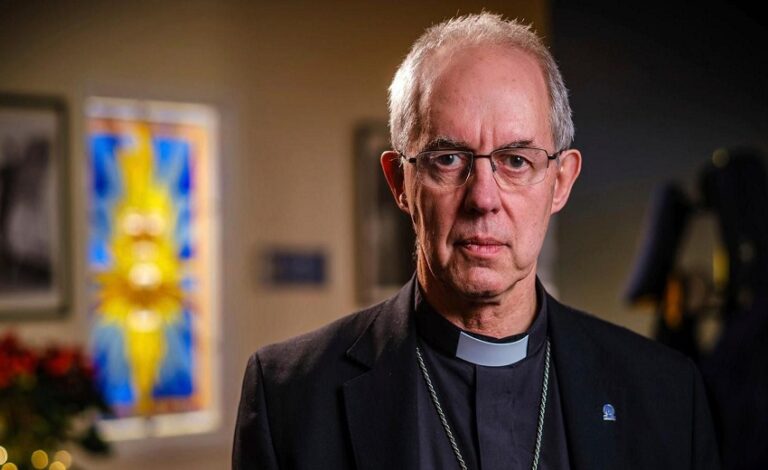
ARCHBISHOP of Canterbury Justin Welby has resigned as head of the global Anglican Church following allegations of covering up abuse by John Smyth, affecting 130 boys and young men in the UK and Africa.
Welby announced his resignation on Tuesday, November 12, stating he takes personal and institutional responsibility for the church’s handling of the abuse scandal.
This followed the release of an independent report, revealing shocking details of John Smyth’s decades-long abuse of over 100 minors at Christian camps in the UK, Zimbabwe, and South Africa.
He acknowledged being informed of the abuse in 2013 but wrongly assumed an appropriate resolution would follow.
Welby committed to meeting victims and delegating safeguarding responsibilities until a risk assessment is complete.
Welby’s resignation emphasises the Church of England’s commitment to change and creating a safer environment.
He expressed sorrow for victims and survivors of abuse and acknowledged the church’s failures at safeguarding the victims.
Welby expressed gratitude to his family, particularly his wife Caroline, for their support throughout his ministry. He prayed his decision would guide the church toward Jesus Christ’s love.
According to the Washington Post, the process of selecting Welby’s successor will kick off with the Crown Nominations Commission, a 16-member group comprised of the Archbishop of York, clergy and laypeople representatives, an Anglican Communion representative, and a prime minister-appointed chair.
This commission will nominate candidates for Archbishop of Canterbury and other English dioceses.
Recall that the Nigerian Anglicans threatened to break away, citing biblical teachings. This followed the Church of England’s General Synod’s recent narrow vote in favour of same-sex marriage, sparking outrage among conservative Anglicans.
The head of the church in Nigeria, Henry Ndukuba, an archbishop, warned that recognising same-sex marriage would lead to a broken sacramental communion between the two churches.
The Nigerian church reaffirmed its dedication to biblical teachings, vowing solidarity with faithful Anglicans opposing same-sex marriage.
The Church of Nigeria’s Primate stated: “Should the Archbishop of Canterbury proceed with same-sex marriage, the Church of England risks broken sacramental communion with the Church of Nigeria and other faithful Anglican provinces.”
The Nigerian church commended bishops, clergy and laity standing against same-sex marriage, affirming dedication to biblical teachings.
The controversy surrounding same-sex marriage and abuse scandals highlights tensions within the global Anglican Communion.
A FORMER lawmaker, John Dyegh, has been arraigned on corruption charges at the Federal High Court (FHC) 1 sitting in Makurdi, Benue State.
The lawmaker who once represented Gboko and Tarka Federal Constituency was arraigned for allegedly violating the provisions of the Independent Corrupt Practices and Other Related Offences Commission (ICPC) Acts 2000 under case number FHC/MKD/CR/184/2024.
According to a statement issued on Tuesday, November 12 by the acting director, Public Enlightenment and Education at the ICPC, Demola Bakare, Dyegh, was arraigned on a five-count charge of abuse of office and money laundering before M. Shitu Abubakar at the FHC in Makurdi, the state capital.
According to the statement, the charges detailed alleged corrupt practices, including Dyegh’s receipt of N18.9 million on May 19, 2014, intended for the construction of school facilities in Guma LGA, Benue State.
He was also accused of allegedly channelling the funds through the First Bank account of Midag Limited, a company in which Dyegh has a substantial interest.
According to the ICPC, this alleged action violates Section 19 of the Corrupt Practices and Other Related Offenses Act of 2000.
Dyegh was further alleged to have received and transferred these funds through Midag Limited and Kangnaan Global Resources Limited, companies associated with him, contrary to the Corrupt Practices Act.
In addition, the charge sheet alleged that Dyegh abused his office by privately benefiting from contracts awarded to these companies while overseeing the related funds as a signatory on their accounts.
At the commencement of the trial, the presiding judge, Abubakar, ordered Dyegh to be remanded at the Nigerian Correctional Center, Makurdi, pending the determination of his bail application, and adjourned the matter till Monday, November 11, 2024.
At the resumed hearing of the case, Defence Counsel S.E. Irabo moved a bail application for his client and prayed to the court to grant him bail, citing health concerns.
The ICPC, represented by Bako Along and T.S. Iorgeen, did not oppose the application.
After listening to the argument of the counsels, the judge, Abubakar, subsequently granted Dyegh bail in the amount of N20 million, including two sureties with international passports and verifiable addresses.
The judge later adjourned the case until January 16, 2025, for a definite hearing of the corrupt suit preferred against the former lawmaker.
THE newly inaugurated Edo State Governor Monday Okpebholo has appointed Cyril Adams Oshiomhole, as Commissioner for Health.
Cyril Oshiomole is the son of Adams Oshiomhole, a senator and leader of the All Progressive Congress (APC), who is a top ally of president Bola Tinubu. The father previously served as the president of the Nigeria Labour Congress from 1999 to 2007 and as governor of Edo State from 2008 to 2016.
He was APC national chairman between 2018 to 2020. He currently serves as a senator representing Edo North.
Meanwhile, Musa Ikhilor, a barrister, was also appointed as Secretary to the State Government (SSG), while Samson Osagie will serve as Attorney General and Commissioner for Justice.
The appointments, announced in a statement by the chief press secretary to the Governor, Fred Itua, on Tuesday, November 12, will require confirmation of the Edo State House of Assembly.
Oshiomhole, the newly nominated Commissioner for Health, according to the statement, holds an extensive background in public health and clinical research.
Okpebholo, along with his deputy, Dennis Idahosa, took the oath of office administered by the chief justice of the state, Daniel Okungbowa, at the Samuel Ogbemudia Stadium.
The event comes two months after the APC clinched victory, securing the governorship position at the Dennis Osadebay House.
The Independent National Electoral Commission (INEC) declared Okpebholo, the candidate of the All Progressives Congress (APC), the winner of the governorship election conducted in Edo State on Saturday, September 21.
Okpebholo polled 291,667 votes to defeat his closest rival and the Peoples’ Democratic Party (PDP), candidate, Asue Ighodalo, who won 247,274 votes.
The Labour Party (LP) candidate, Olumide Akpata, garnered 22,763 in the election to occupy a distant third position.
THE Executive Governor of Plateau State, Caleb Manasseh Mutfwang, has dismissed rumors of an alleged Improvised Explosive Device (IED) being planted at the old Jos University Teaching Hospital (JUTH) site near Terminus Market in Jos North Local Government Area, describing the alarm as false.
In a statement by the Director of Press and Public Affairs to Governor, Gyang Bere, shortly after reports of the alleged powerful explosion, Mutfwang clarified that the scare was caused by a group of individuals who mistakenly identified a ‘heap of polythene bags’ as a potential explosive threat.
Several platforms (not by The ICIR) have reported that a powerful explosion shook the city earlier on Tuesday morning, around 10:30 am, near the densely populated Terminus Market area.
The reports, which also failed to provide detailed information about the explosion and action pictures, reported that eyewitnesses heard a loud bang, followed by scenes of chaos as people ran in fear.
The reports also noted that emergency services, including the police, fire department, and ambulances, rushed to the scene to assist those affected by the blast. Initial reports indicated several injuries, with some witnesses expressing concern over possible casualties, though the full extent of the damage has yet to be determined.
The Governor explained that in response to the alarming reports, security agencies, including the anti-bomb squad from the Plateau State Police Command, immediately launched a thorough cordon and search operation at the scene.
It noted that after a detailed inspection, it was confirmed that there were no explosives present, and the situation was safely resolved.
The Governor emphasised that his administration is committed to ensuring the safety of all citizens and will continue working to restore and maintain peace and security throughout Plateau State.
“The Governor urged all Plateau citizens to remain vigilant and to act as responsible ambassadors of the state, upholding its reputation and rich heritage. He assured the public that his administration is committed to ensuring enduring security across Plateau State, working tirelessly to restore peace and stability to the region.
“Governor Mutfwang called on the people to focus their efforts on supporting the government’s mission for sustainable peace and prosperity. He encouraged residents, especially those near Terminus Market, to continue their daily activities without fear and to promptly report any suspicious occurrences to security personnel for quick action,” the statement added.
Sources, who were residents in Jos City told The ICIR that the rumors of bomb explosions in the area are unfounded, confirming that no such incident occurred. However, they were unable to provide details on what triggered the panic or how it spread.
Police urge residents to go about business activities without fear
Meanwhile the state police command has urged residents to go about their normal business activities without fear, as it noted that the area is safe and free from bomb.
According to a statement by the command spokesperson, Alfred Alabo, the hole, which was said to have housed an IED was found to be safe and free of any explosive devices.
“Upon receiving this report, the Plateau State Commissioner of Police,CP Emmanuel Olugbemiga Adesina, psc immediately ordered the Area Commander Metro and the Officer in Charge of the Command’s Explosive Ordnance Disposal (EOD)
“Unit aka Anti-Bomb Squad to mobilize a team of bomb technicians to the scene in collaboration with the Divisional Police Officer (DPO), “C” Division to assess the situation and take necessary actions. On reaching the scene, the area was immediately cordoned and our EOD Team began examination.
“Upon conclusion of the examination, the hole was found to be safe and free of any explosive devices,” the statement added.
MONDAY Okpebholo, a serving senator has been sworn in as the governor of Edo State following his victory in the governorship election held in September.
Okpebholo, along with his deputy, Dennis Idahosa, took the oath of office on Tuesday, November 12, administered by the Chief Justice of the state, Daniel Okungbowa, at the Samuel Ogbemudia Stadium.
The ceremony was attended by dignitaries including the Minister of Aviation, Festus Keyamo, and former Edo State governor, Adams Oshiomhole, among others.
The event comes two months after the All Progressives Congress (APC) clinched victory, securing the governorship position at the Dennis Osadebay House.
The Independent National Electoral Commission (INEC) declared Okpebholo, the candidate of the All Progressives Congress (APC), the winner of the governorship election conducted in Edo State on Saturday, September 21.
Okpebholo polled 291,667 votes to defeat his closest rival and the Peoples’ Democratic Party (PDP), candidate, Asue Ighodalo, who won 247,274 votes.
The Labour Party (LP) candidate, Olumide Akpata, garnered 22,763 in the election to occupy a distant third position.
The returning officer and vice-chancellor of the Federal University of Minna, Haro Adamu Kuta, while announcing the final results said having met the constitutional requirement for being the winner, Okpebholo was the election winner.
However, his victory was met with widespread criticisms, as some residents of the state thronged the streets against his emergence as the poll winner.
In the run to the election, The ICIRreported that 17 political parties competed for votes in the poll, and three candidates – Peoples Democratic Party’s Asue Ighodalo, APC’s Monday Okpebholo, and Olumide Akpata of the Labour Party (LP) – led the race.
According to reports from the election observers, the election was marred by low voter turnout, manipulation of results, vote buying and logistical inefficiencies.
The ICIRreported that the election was a battle between two godfathers who worked tirelessly to ensure their candidate occupied the Osadebe House.
A former governor and serving senator, representing Edo North, Adams Oshiomole, threw his weight behind Okpebholo, a senator representing Edo Central, while the incumbent, Obaseki, was strongly behind his anointed candidate and businessman, Ighodalo.
There were approximately 2.63 million registered voters but only 2.25 million of these collected their permanent voter’s card (PVC), making them eligible to vote, according to data from INEC.
PERSONS with Disabilities (PWDs) face severe challenges in accessing healthcare in Kano State, Nigeria. Systemic neglect, bureaucratic obstacles, and inadequate medical facilities compound their difficulties. Their struggles at health centres such as Mazan Gudu Health Post and Gabassawa Primary Health Care (PHC) persist. Despite the introduction of the Basic Health Care Provision Fund (BHCPF), which is aimed at improving access to Medicare by the most vulnerable in the country, mismanagement and restrictive policies have left many PWDs without essential services.
A Community bonded by joy and pain
Mazan Gudu, a village in Gabassawa Local Government Area (LGA) of Kano visibly thrives on communal support. The residents of the community marked by brown earth engage in farming and petty trading by day and gather in informal settings by night.
Community members going about their daily activities in Mazan Gudu. Photo: Stephen Enoch
However, Bilkisu Sai’du, a 23-year-old resident of Mazan Gudu, faces a grim reality that shadows the beauty of her community. In 2023, her life was forever altered when her father suffered critical injuries in an accident.
Desperate for immediate medical assistance, they rushed him to the Mazan Gudu Health Post, only to find it locked. With no other option, they raced to another facility, but it was too late. Bilkisu’s father died en-route, leaving her and her mother to fend for their family of twelve.
Physically disabled, Bilkisu now carries the weight of supporting her family.
She sells kosai and koko (beancake and pap) in the mornings and awara at night, striving daily to make ends meet. Following her husband’s death, her mother has also turned to petty trade.
While other family members can access healthcare with relative ease, Bilkisu’s journey for medical help is fraught with challenges. She describes her quests for healthcare as “a hopeless adventure.”
The community has largely abandoned the Mazan Gudu Health Post, deeming it unusable. The facility, run by only one Officer in Charge (OiC), struggles to meet the health needs of hundreds of residents.
To verify these claims, Stallion Times visited the health post on multiple occasions and found it locked up each time.
The building’s exterior is marred by peeling paint and broken windows, while inside crumbling ceilings, rusted beams, and unusable toilets create an unsanitary environment. Basic amenities like electricity and running water are conspicuously absent.
Mazan Gudu Health Post locked when visited. Photo: Stephen Enoch
Bilkisu recounted her daily struggle to access healthcare, sharing her frustrations with the reporter.
“Living with a physical disability is a burden no one should have to bear, but the fight for healthcare is even harder. It was to the failed healthcare system that I lost my father, and now that same system is making my life miserable,” she lamented.
“Visit the Mazan Gudu Health post and you’ll see it’s notorious for being locked and shabby. Whenever I try to get care at Gabassawa PHC, I’m overwhelmed by neglect and deprivation before I’m finally attended to,” Bilkisu added, her voice filled with distress.
Bilkisu Sai’du fakes a smile for the camera. Her smile is a contrast to her daily realities. Photo: Stephen Enoch
Her story is not much different from Barira Alhasan’s, a 34-year-old hearing impaired mother of four, who despises the treatment of PWDs at Gabassawa PHC.
Alhassan faces significant challenges due to the lack of interpreters at the facility.
Conveying her pains to the reporter through a community interpreter, she said, “I know that the PHC isn’t accessible for the hearing impaired, so there is no point going there for my healthcare needs unless I go with someone who can explain to the doctor.”
Barira’s husband introducing her to the reporter in sign language. Photo: Stephen Enoch
A community hosting over 400 PWDs
The village head of Mazan Gudu, Yusuf Abdullahi, voiced his deep frustration over the persistent exclusion of Mazan Gudu Primary Healthcare Centre (PHC) from the Basic Healthcare Provision Fund (BHCPF).
Despite the community’s population of over 5,000, with over 400 residents living with various disabilities, he lamented that the facility has been left without the vital resources needed for adequate healthcare delivery.
Yusuf highlighted the dire situation, emphasizing that these individuals, who are among the most vulnerable, have been denied access to essential health services.
The village head said he has tirelessly advocated for the inclusion of Mazan Gudu in the BHCPF, making repeated appeals to the Kano Primary Healthcare Management Board (KPHMB).
Village head of Mazan Gudu, Yusuf Abdullahi. Photo: Stephen Enoch.
He added that he has provided compelling arguments, illustrating the urgent need for funding to improve healthcare services in a community where many rely on the PHC for their medical needs.
Yet, despite these efforts, he reported that no significant action has been taken to address the deficiencies at the facility.
“The neglect of our health needs is disheartening. We deserve better than this,” Yusuf told the reporter.
Yusuf’s concerns are also echoed by many others in the community who feel abandoned by the healthcare system. They noted that with insufficient medical resources, the facility struggles to meet the needs of its patients, forcing many of them to seek care in distant locations.
This has led to increased health risks and further marginalisation of already vulnerable PWDs.
Yusuf made an urgent need for change saying that the community waits for a response that could transform their healthcare landscape.
Mazan Gudu Health Post, where nobody wants to visit for healthcare. Photo: Stephen Enoch
The BHCPF, established under the National Health Act of 2014, aims to enhance access to essential healthcare services for all Nigerians, particularly the vulnerable and underserved.
The BHCPF also aims to provide a Basic Minimum Package of Health Services (BMPHS) through Primary Healthcare Centers nationwide.
The key objectives of the BHCPF include ensuring the availability of essential drugs and medical supplies, improving the infrastructure and operational capacity of PHCs, and reducing out-of-pocket expenses for healthcare services.
The sick health facilities
Visits to Mazan Gudu Health Post, Gabassawa PHC, Yan Shana PHC and Hungu PHC, showed facilities in poor conditions. Findings at the centres revealed facilities with broken windows, peeling paint, and unsanitary conditions.
The Mazan Gudu facility, in particular, lacks basic amenities like electricity and running water, forcing those who can afford it to seek help from private hospitals or nearby patent medicine stores.
The financially disadvantaged have no choice but to rely on the inadequate Gabassawa PHC, approximately two kilometres away. For persons living with disability, particularly those with mobility constraints, this is an additional hassle in life’s daily grind and accessing healthcare.
‘Watching women suffer is heartbreaking’
The Woman leader in the community, Binta Sule, speaks with profound sadness about the desperate conditions at the PHC and the unique struggles faced by women with disabilities, especially during childbirth.
“It’s heartbreaking to watch these women suffer, particularly when they’re giving birth,” she says, her voice heavy with sorrow.
The absence of proper transportation forces women to be transported on a cart, usually reserved for moving goods and farm produce – a stark symbol of the neglect this community endures.
The cart used to convey patients from Mazan Gudu PHC to Gabassawa PHC when transport options are not available at night. Photo: Stephen Enoch
“We know this facility isn’t functioning as it should, but if we even had just an ambulance, we would have done everything to keep it running. In times of need, it would make all the difference in getting women to the hospital safely,” Binta explains.
She recounts a tragic incident during 2024 Ramadan when a woman lost her life due to the lack of timely transport.
Hajara Bashari’s final moments unfolded like a nightmare, as described by Sule, the Woman Leader in her community.
“The joy of her new baby was palpable when she gave birth at home in the afternoon, assisted by a local birth attendant. We all celebrated when we heard the baby’s first cry,” reflecting on the happiness that quickly turned to despair.”
By nightfall, that joy transformed into a harrowing tragedy.
“Around 9.00pm, Hajara began to bleed uncontrollably. We rushed her to Mazan Gudu PHC, hoping to find help, but the facility was locked, with not a single staff member in sight. We felt utterly helpless,” Sule recounted.
In their desperation, Sule said their group searched for transportation to the nearest healthcare facility, but the only option available was a cow-drawn cart. As they made their way through the darkness, Hajara grew weaker, gasping for breath.
“Time was against us. Before we reached halfway, she succumbed, leaving behind her husband and their newborn baby. It was a devastating day for our entire community,” the leader lamented, her voice heavy with sorrow.
“It’s even beyond sad that both able-bodied women and those with disabilities are sometimes pulled on a cart by a cow to reach the nearest hospital. This isn’t how any woman should be treated by the healthcare system in Kano,” Sule said in anger.
Reflecting on the broader neglect, Sule added, “When it’s time for elections, all our leaders come begging for votes, but after we fulfill our obligations, they forget about us. This has been the cycle, year after year.”
Also, in Gabassawa PHC where residents now seek healthcare, inadequate staff and equipment remain the order of the day. The facility lacks essential infrastructure such as ramps and elevators, making it difficult for wheelchair users.
The absence of sign language interpreters and visual aids further alienates PWDs from essential services.
A health worker, Gazali Ibrahim, a Community Health Extension Worker (CHEW), denied allegations of discriminatory treatment, stating that the facility treats all individuals equally.
The Part II of Accessibility of Physical Structure of the 2018 discrimination against persons with disabilities (prohibition) Act’ a healthcare center should have accessible ramps, wide doorways, and accessible restrooms for PWDs to ensure that they can navigate facilities independently and with ease.
For a PWD with hearing disabilities, the same Act dictates that a centre should have visual alert systems, sign language interpreters, and written communication tools to facilitate effective communication during their visit.
Dashed hope
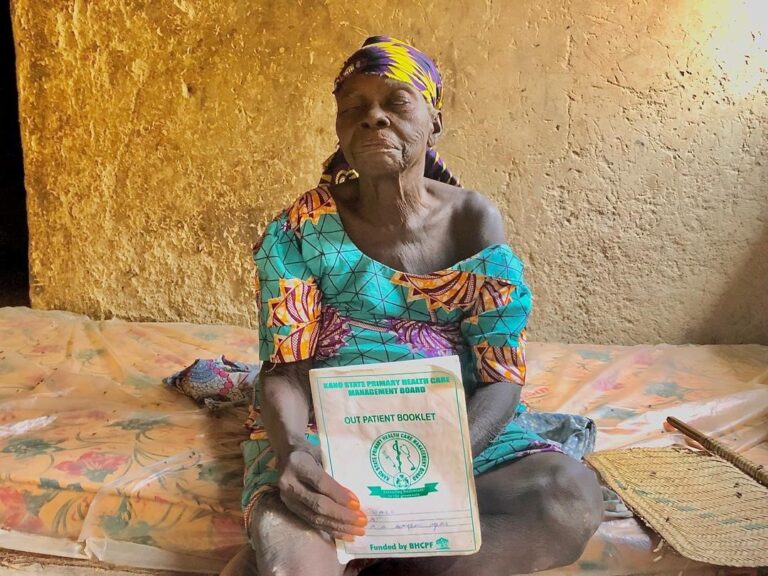
At Yan Shana PHC in Kumbotso LGA, 82-year-old Zainabu Umar, who lost her sight due to an illness, initially felt hopeful as a beneficiary of the BHCPF. However, the facility’s poor conditions and lack of essential services quickly dashed her hopes.
“What are they doing with funds from the BHCPF?” Zainabu questioned after being referred to a distant hospital for a simple test.
Visually impaired Zainabu. Photo: Stephen Enoch
The facility lacks tactile signage, braille labels, and audio communication devices, as well as other essential equipment such as functional diagnostic tools, reliable electricity, clean water supply, and adequate medical supplies.
“So, I felt there was no need to keep going there since it offered me no hope,” she stated.
‘Bureaucracy hampering use of funds’
Further investigation revealed that bureaucratic restrictions imposed by the Kano State Primary Healthcare Management Board (KSPHCMB) prevent the use of funds for necessary renovations and maintenance.
Yan Shana Community members accused the Ward Development Committee (WDC) and the Officer-in-Charge (OIC) of mismanagement, but WDC Chairman, Abubakar Jibrin, blames bureaucratic constraints.
Jibrin disclosed that the Kano State Primary Healthcare Management Board (SPHCMB) restricted the PHC’s use of funds, preventing essential renovations and maintenance.
“The money which is supposed to be paid into our account is over N300,000 but the only money we have been receiving since the beginning of this year is N270,000 and we have been instructed use the funds to purchase drugs only.
“The ban on spending our funds for renovation and other running costs in the center has taken us backwards,” Abubakar lamented.
He also explained that this means Yan Shana PHC is shortchanged more than N30,000.
When asked why these funds are withheld from the PHC, Abubakar stated that he was also oblivious of the reason, stressing that despite several pleas for clarification from the PHCMB, no response was given.
“I have been embarrassed more than two times by community members when they alleged that I siphoned their funds but I try to explain myself and keep assuring them that the facility will be fixed, hoping that the ban on spending funds for renovation will be lifted but all my assurances has failed and they now take my word with a pinch of salt.
“Just last year, we used the BHCPF to purchase a petrol generator to power the PHC when we need energy but it was stolen because we could no longer pay the security man because of the ban on spending our funds asides on drugs.
“If we had liberty to spend our funds the way we want, we would have started making plans on making this PHC accessible to PWDs because they are actually complaining to us about this problem.”
Abubakar Jibrin. Photo: Stephen Enoch
This kind of systemic issues have a negative effect on vulnerable people seeking healthcare, particularly PWDs like 82-year-old Zainabu Umar, who lost her sight in her sixties due to an illness. The shift from a life of ease to one of dependence marked a distressing chapter in her life, where every aspect of her daily routine required assistance.
Women sitting on the bare floor because the PHC cannot afford benches to accommodate them, despite being a beneficiary facility of BHCPF. Photo: Stephen Enoch
Enrolled as a beneficiary of the BHCPF in 2021 at Yan Shana PHC in Kumbotso LGA, she initially felt a glimmer of hope. This support seemed a small compensation for her blindness, reducing her financial burden for healthcare.
However, this hope was short-lived. Yan Shana PHC, despite its accreditation under the BHCPF, was woefully ill-equipped to meet basic healthcare needs.
On a visit, it was evident that the facility lacked adequate seats, forcing women, including those with disabilities, to sit on the floor or thorny mats swarming with insects.
Umar’s frustration grew as she recounted being referred to the Murtala Mohammed Specialist Hospital (MMSH) (a general hospital in Kano city) which is about 11 kilometers away, for a simple blood glucose test — a service the PHC is mandated to provide, according to the BMPHS in the BHCPF guideline of 2020.
Her anger was profound as she questioned, “What are they doing with funds from the BHCPF?” The struggle to receive this essential care only deepened her suspicion of mismanagement by the facility.
She added, “When my son in-law took me to MMSH, the hardship we passed through just because the hospital couldn’t find my referral code for referrals under the BHCPF scheme was horrible. It took a lot of struggle and force before my rest was done. Why do I have to pass through this stress before accessing healthcare?
“Please let the government do something about the poor state of Yan Shana PHC so that people like me would not have to waste so much money travelling long distances to access healthcare when we have a hospital in our locality.”
The reporter took a tour round the facility and reports that the center stands as a stark symbol of a healthcare system in neglect and decay. Lacking accommodation for persons with disabilities (PWDs), the facility stood as a harsh reminder of the healthcare system’s failures, particularly for those like Zainabu, who navigate life with additional challenges.
Sections of Yan Shana PHC. Photo: Stephen Enoch
The toilets are unusable, mucky with broken fixtures, and no running water, emitting a foul stench that saturates the air. Windows are shattered or absent entirely, leaving gaping holes that let in dirt, insects, and the elements.
The Hungu story
Hungu PHC in Albasu LGA faces similar issues, with poor funding and lack of resources exacerbating challenges for PWDs.
Essential services and accessible medical equipment remain scarce, affecting the quality of care and undermining trust.
Zuludeen Alhassan, a visually impaired patient, described feeling invisible at the facility due to inadequate support.
The systemic issues at the Hungu PHC in Albasu LGA, exacerbate challenges for PWDs. Essential services such as accessible medical equipment and trained support staff remain scarce.
This neglect not only affects the quality of care but also undermines the trust and confidence of visually impaired patients like 51-year-old Alhassan who lives in a world devoid of sight, as he depends heavily on the support of others to accomplish even the simplest tasks.
In many instances, staff members are not adequately trained to assist PWDs, leading to unintended neglect or insensitivity. often feels invisible at Hungu PHC, as health workers fail to provide the necessary support for him.
“I sit for hours waiting for someone to notice me,” he said.
“Even when I am attended to, I am not usually satisfied with the quality of health service I am provided with. Active listening is an important skill that health workers need, to have productive interactions with visually impaired patients like me but all the time, they are always in a haste and sometimes I end up taking my prescription wrongly,” he stated.
Alhassan highlighted another significant issue PWDs face – the frequent non – availability of essential drugs.
He opined that the management of the PHC should set aside specific medications for PWDs to ensure they are readily available when needed, but unfortunately, this is not the case.
According to him, purchasing drugs out at pharmacies is really expensive and often lead people to visiting traditional medicine doctors which is cheaper but not as effective as modern drugs.
Alhassan recalls a time when he had to turn to a street beggar to fund his treatment.
“On that day, I waited for long hours as usual but when it was time to collect the my drugs, I was given a prescription and told to buy the drugs from a pharmacy. I was filled with anger as to why the PHC can’t set aside drugs for PWDs.
“I didn’t have the complete money so I turned to a street beggar, to fund my healthcare. If Hungu PHC really cared for PWDs I wouldn’t have to pass through such horrible experience,” Alhassan narrated.
Close observation showed that Hungu PHC lacks essential tactile guiding paths and Braille signage, making it difficult for visually impaired individuals to navigate the premises independently.
Hungu PHC. Photo: Stephen Enoch.
The WDC Chairman of Hungu PHC, Umaru Shehu, explained that due to a ban on using their funds, the centre cannot afford critical services and maintenance, including electricity, water, security, fence repairs, basic painting, and necessary equipment.
Despite repeatedly appealing to the PHCMB to lift this ban, their requests have been unanswered, forcing PWDs and other community members to endure the consequences of these unmet needs.
Shehu told Stallion Times that the facility has not received its complete funds (N320,000) for the past 4 months, although he refused to disclose the amount that is paid to the centre’s BHCPF account which is to be strictly spent on drugs, as instructed by the PHCMB.
Part 6 (39 ) of the 2021 Kano State Persons With Disabilities Law mandate accessible communication services and subsidised medical services for PWDs. However, implementation remains a problem.
The director of Planning, Monitoring, and Evaluation at the Kano State Primary Healthcare Management Board (KSPHCMB) Bashir Sunusi, assured that ongoing reforms would soon improve healthcare facilities.
“You will see changes by December this year,” he promised.
Sunusi also confessed that PWDs in Kano State live in misery. “The need for equal access to medical services is not just a policy matter but a fundamental human right. It is time to turn promises into action and deliver a healthcare system that truly serves all citizens, irrespective of their abilities,” he strongly argued.
According to the recommended mechanisms to strengthen accountability in implementing the BHCPF, health facilities are to produce a plan for how the BHCPF will be spent. Health Facility Committees are to monitor how revenue from the Fund is spent. However, the ban on spending their funds for renovations and other running costs by the PHCMB, shows that Yan Shana PHC and others like has been stifled.
Significant challenges faced by PWDs
The Kano State-led Accountability Mechanism (KanSLAM) is coalition of Civil Society, Government representatives and the media which is dedicated to improving the transparency and effectiveness of healthcare services. The co-chair of KanSLAM, a pharmacist, Maimuna Yakubu, highlighted that facility spot-checks help point to highlight challenges faced by PWDs in accessing inclusive healthcare.
“The stories of these PWDs reflect the broader struggles of the disabled community in Kano,” she pointed out.
Yakubu emphasised that continuous advocacy to the PHCMB and other relevant stakeholders is crucial to overcoming these issues.
“There is a need for PWDs to be included in crucial decision-making processes at the PHCMB to influence policies that suit their healthcare needs,” she advised.
While the PHCMB may have its reasons for restricting funds for renovation and other running costs, it is imperative to allocate specific funding to meet the unique needs of PWDs.
Yakubu said each PHC has its distinct challenges, and lifting the ban on restricted funds is the first step towards improving access to healthcare. Additionally, ensuring targeted funding for PWDs is essential for creating a more inclusive and effective healthcare system.
“For PWDs to surmount these challenges they have to be empowered to advocate for their needs so that policy makers will interface with them and understand their need for better because outcomes because while KanSLAM and other organisations advocate on behalf od the PWDs, their capacity of the PWDs needs to be built to advocate for their healthcare needs themselves.
“There is a need for PWDs to be also included in the crucial decision-making table at the PHCMB so that they can influence policies to suit PWDs healthcare needs. I also want to use this medium to call on the Kano government to sponsor PWDs to read medicine, nursing and other health-related courses in the higher institution so that when they go back to their communities, they will implement the change they desire,” Yakubu advised.
Maimuna Yakubu. Photo: SWODEN
Just like KanSLAM advocates for the access to healthcare for PWDs, the Resource Center for Human Rights and Civic Education (CHRICED) has also been at the frontline of advocacy for the health rights of PWDs to be upheld in the state.
The program officer the Centre, Zuwaira Omar, said CHRICED was at the forefront of the successful signing of the Free Maternal and Child health Law by the Kano House of Assembly.
“Right from time, we have been advocating for the inclusion of PWDs into the all health related programs in the state, asides the BHCPF in the state. I suggest regular town hall meetings between the different leadership structures of PWDs in Kano and PHCMB so that gradually, they will tailor effective mechanisms to address their health care needs,’ Omar suggested.
Law on PWDs’ access to healthcare
Part 6 (39) of the Kano State Persons With Disabilities Law (2022) outlines some responsibilities of the government toward the healthcare needs of PWDs.
For effective implementation of the provisions of this law, it shall be the responsibility of the State Government to ensure that:
(a) Communication services are accessible to PWDs, which shall include sign language interpretation and information in Braille;
(d) PWDs are taken into consideration in the formulation and designs
of educational, health, sports, employment and rehabilitation policies and programmes;
(i) Medical services are subsidised or insurance are provided to PWDs.
In the Discrimination Against Persons with Disabilities (Prohibition) Act, 2018, government shall guarantee that PWDs have unfettered access to adequate health care without discrimination on the basis of disability.
(2) A person with mental disability shall be entitled to free medical and health service in all public institutions.
Improved healthcare delivery assurances to PWDs
KSPHCMB director, Sanusi explained that funding for the BHCPF has been temporarily suspended due to ongoing healthcare reforms, specifically the Sector-Wide Approach (SWAp).
He enlightened that SWAp is a coordinated agreement between governments and donors to streamline aid distribution for health sectors in developing.
According to him, these reforms have affected several health programmes, including the BHCPF.
He noted said that the NPHCDA had directed the pause in BHCPF funding to allow for the implementation of these reforms. The aim is to consolidate various funding streams into a single pool, which will improve the efficiency and effectiveness of fund distribution to health facilities, ultimately enhancing their operations.
Responding to concerns from Mazan Gudu residents about their exclusion from BHCPF benefits, Sanusi carified that the PHCMB does not determine which health posts receive funding. Selection of beneficiary facilities is handled by the NPHCDA, and Mazan Gudu’s case would need to be addressed at that level.
Dorector, Kano State Primary Healthcare Management Board (KSPHCMB) Bashir Sunusi. Photo: Stephen Enoch.
Beneficiaries’ selection process
“The selection process is managed by local government authorities who identify facilities in need,” he said, giving assurance that if Mazan Gudu health post is among the high-volume facilities requiring urgent funds, the PHCMB would advocate for its inclusion in the next funding round presented to the NPHCDA.
According to Sanusi, Recently, the Federal Ministry of Health, through the NPHCDA, conducted an assessment in Kano to determine the operational costs of running PHCs at various levels. In the coming months, facilities are expected to be adequately equipped to serve their communities.
State government’s commitment
“The Kano state governor has shown a strong commitment to healthcare by approving over 80 health-related proposals from the commissioner of health.
The healthcare needs of PWDs will be prioritised during the upcoming renovations to ensure their specific requirements are fully addressed.
“This robust plan for the PHCs which is coming soon and is a game-changer in the kano state health sector and the cost is running into billions, I assure you that on or before December, this year, you will see changes, because the DG of PHCMB, Commissioner of health have given their words and you will see that a lot of facilities in Kano will be greatly improved,” Sanusi assured.
As PWDs live in their misery, hoping for a time when they will have equal access to medical services in Kano, addressing their needs is not just a matter of policy but a fundamental human right.
It is time to turn promises into action and deliver a healthcare system that truly serves all citizens, irrespective of their abilities.
*This report was done with support from the International Centre for Investigative Reporting, ICIR.
THERE is hope for price moderation as the Independent Petroleum Marketers Association of Nigeria (IPMAN) has reached a landmark agreement with Dangote Refinery, directing its members to exclusively source Premium Motor Spirit (PMS) from the refinery to help bring down fuel prices.
IPMAN’s National President, Abubakar Maigandi, announced the agreement on Monday, November 11, during a press conference in Abuja, following a National Working Committee meeting.
This latest development halted IPMAN’s previous plans to import fuel independently and is expected to stabilise the fuel supply and lower costs for Nigerians.
Previously, both IPMAN and the Petroleum Retail Outlets Owners Association of Nigeria (PETROAN) had suggested that competition, including importing fuel themselves, would reduce prices.
However, with the new partnership, IPMAN intended to work directly with Dangote Refinery, streamlining the fuel supply chain and potentially driving down costs by reducing dependence on imports.
PETROAN’s National Public Relations Officer, Joseph Obele, had earlier stated that a competitive, deregulated environment would help bring down fuel prices.
Obele disclosed that the group had incorporated a business unit that would enable it to bring in petrol before December.
It disputed the allegation by Dangote Refinery that the marketers intend to import substandard products at a cheaper rate, saying the claims were not surprising.
Also, the National Assistant Secretary of IPMAN, Yakubu Suleiman, expressed surprise that Dangote had called on IPMAN members to support the refinery, despite previous unsuccessful attempts to foster a working relationship
The refinery, however, maintained that its fuel prices align with international benchmarks, though they are currently higher than the price of imported products.
With the agreement, IPMAN members will source PMS, Automotive Gas Oil (AGO or diesel), and Dual Purpose Kerosene (DPK) directly from Dangote Refinery, supplying IPMAN depots and retail outlets across Nigeria.
“The Dangote Refinery has obliged IPMAN to lift PMS, AGO, and DPK directly for onward supply to IPMAN depots and retail outlets.”
“This arrangement will ensure steady and seamless supply of petroleum products all over Nigeria at an affordable rate for all Nigerians.”
He commended Dangote for fostering this collaboration, highlighting the long-term benefits of supporting local refineries.
Maigandi encouraged IPMAN members to back the initiative, emphasizing that this aligns with the government’s economic goals and could positively impact Nigeria’s foreign exchange reserves.
“All IPMAN members should fully support the Dangote Refinery, as it is the ideal thing to do considering the monumental benefits of backwards integration as a medium for the long-term impact it will have on the foreign exchange market in Nigeria,” Maigandi continued.
“IPMAN members should rely on Dangote Refinery and other Nigerian refineries for products, as this will translate to more job opportunities in Nigeria as well as signify total support for President Bola Ahmed Tinubu’s renewed agenda.”