NIGERIAN-South African model, Chidinma Adetshina, has accepted the invitation by Miss Universe Nigeria to compete at the 2024 edition of the Miss Universe Nigeria pageant competition.
This was shared by the organisation on its official Instagram page on Wednesday, August 14.
“I have decided to participate in the Miss Universe Nigeria 2024 beauty pageant. I am looking forward to participating in Africa’s most prestigious beauty pageant – Miss Universe Nigeria,” she said in a video post.
The ICIR reported that the 23 year old beauty queen withdrew from the Miss South Africa pageant following a series of xenophobic attacks after making it to the top 16 at the pageant competition.
“After much careful consideration, I have made the difficult decision to withdraw myself from the competition for the safety and well-being of my family and, with the support of the Miss South Africa Organisation, I leave with a heart full of gratitude for this amazing experience,” she had said.
Before that, the South Africa Department of Home Affairs in a statement signed by the spokesperson for the Minister, Duwayne Esau,claimed that Adetshina’s mother illegally obtained South African citizenship.
According to the department, the investigation into Adetshina’s case was due to a request received from the organisers of the Miss SA.
However, Adetshina was invited by the Miss Universe Nigeria organisation to participate in the 2024 Miss Universe Nigeria pageant competition.
Adetshina, who is now the 25th finalist at the Miss Universe Nigeria competition will be representing Taraba state.
The pageant is set to be held on August 31 in Lagos, Nigeria.
THE Speaker of the House of Representatives, Abbas Tajudeen, has withdrawn the controversial Counter Subversion and Other Related Bills.
He announced the withdrawal through his Special Adviser on Media and Publicity, Musa Abdullahi Krishi on Wednesday, August 14.
Part of the statement reads, “In response to the voices and concerns of the people, the Speaker of the House of Representatives, Rt. Hon. Abbas Tajudeen, Ph.D., has decided to withdraw the Counter Subversion Bill and other related draft legislation. This decision follows his extensive consultations with a broad range of stakeholders and a careful consideration of the nation’s current circumstances.
“Speaker Abbas Tajudeen, a champion of the people’s interests, has always prioritized listening to the citizens and fostering unity. His decision reflects his commitment to ensuring that the House remains truly the People’s House.”
He acknowledged the significance of the concerns raised and the attention the bill had garnered across the country and beyond. He also reaffirmed that he would never support any action that might disrupt the peace and unity of the nation.
A LAWMAKER representing Kano South, Sumaila Kawu, has said that his total take-home including salary and allowance is N21 million monthly.
He revealed this in an interview with BBC Hausa on Wednesday, August 14, stating that the official pay package was fixed by the Revenue Mobilisation, Allocation and Fiscal Commission (RMAFC).
“My monthly salary is less than N1million. After deductions, the figure comes down to a little over N600,000. Given the increase effected, in the Senate, each senator gets a million every month as running cost,” he said.
Kawu further noted that allowances included office running, newspaper, and local travel, among others.
His revelation came barely 24 hours after the Revenue Mobilisation Allocation and Fiscal Commission (RMAFC) said that each of the 109 senators in the upper chamber received N1.06m in salary and allowances monthly.
According to the Chairman of RMAFC, Mohammed Shehu, it was a form of clarification in response to the controversies about the real amount each lawmaker earns per month.
He said every lawmaker earned N12.72 million yearly while the Federal Government provided N1.4 billion for all 109 senators yearly.
Former President Olusegun Obasanjo had tackled members of the National Assembly on the allowances they get each month, stirring up controversy.
“In your case, with all due respect, you’re not supposed to fix your salaries. But you decide what you pay yourself, the allowances that you give yourselves including newspaper allowances.
“You give yourselves all sorts of things, and you know it is not right. It is immoral, yet you are doing it, the Senate is doing it, and you are beating your chests about it,” Obasanjo said.
Meanwhile, the lawmakers in their response to the former president said the RMAFC fixed their allowances.
Giving a breakdown of the monthly earnings by each senator, the RAMFC’s chairman stated that a monthly salary and allowances of N1,063,860, consisting of a basic salary, N168,866:70; motor vehicle fuelling and maintenance allowance, N126,650:00; and personal assistant, N42,216:66.
The salary also includes, domestic staff,126,650:00; entertainment, N50,660:00; utilities, N50,660:00; newspapers/periodicals, N25,330:00; wardrobe, N42,216,66:00; house maintenance, N8,443.33:00; and constituency allowance, N422,166:66.
The ICIR analysed, in several reports, the remuneration packages of senators, ministers and states’ special advisers appointed and how the salaries, if reinvested, could meet some of the country’s critical needs.
In August 2023, just after the screening and confirmation of all ministerial nominees, the Nigerian Senate President, Godswill Akpabio, announced the payment of a ‘vacation allowance’ to senators as they embarked on a seven-week recess of which the 109 senators received N2 million each, totalling N218 million.
A report by The ICIR however showed how the N218 million ‘holiday allowance’ could benefit Nigeria if redirected to address fundamental problems facing the nation.
UNDER the guise of safeguarding citizens’ financial futures, Aderemi Olufemi Adeoye, the immediate past Police commissioner in Anambra state, allegedly established a network of investment platforms – Alpha Trust Insurance Club (ATIC). Although it was purportedly aimed at enriching the lives of Nigerians, the investigation proved otherwise as many investors said they fell victim of deceit and fraud.
With what seemed like an opportunity to invest his hard-earned money in numerous opportunities marketed by his friend in 2019, Adewole Adewusi was captivated by the prospect of financial growth that he joined the Alpha Trust Insurance Club (ATIC).
His friend had marketed ATIC as an emerging investment club in the process of getting registered with the Lagos State Government and the Corporate Affairs Commission (CAC).
But his belief was that the former Anambra state police commissioner, who was a senior officer at the time, would only join as a member, not as head of the club since it is against Nigerian law for a police officer to own or manage a business.
After he was asked to pay N5,000 for the application form and N100,000 to acquire 50,000 ordinary shares of the club, Adewusi enlisted and subscribed to several offers marketed to all members.
However, during the course of this investigation, Adeoye refunded the amount paid for the shares, which according to Adewusi, violated the agreed terms as the shares were now worth more.
“He paid that back to signify that we have been officially expelled. Despite saying that the shares were now worth N8 each, he paid us using the rate at which we bought at the year of joining. So I got N100,000 for 50,000 shares instead of N200,000 as per current valuation.
His investment, which amounted to N13.4 million (thirteen million, four hundred thousand naira) included N3 million worth of investment in New Jerusalem Estate, Shimawa; N1.1 million investments in Swiss Luxury Estate, Shimawa; N5 million worth of investment in Miami Beachfront Estate Lekki, and another N1.1 million invested in Pavilion Estate, Epe.
Other investments undertaken by Adewusi were at the Sujimoto Banana Island, Ikoyi at N1.9 million; Jerusalem Extension at N2 million and a deposit of N1 million for Crypto Investment.
Some of the debit alerts showing money was paid to ATIC ventures for real estate investment, others.
Although Adewusi could not provide key investment documents, receipts or a Memorandum of Understanding (MoU) to show that he invested in this business, as he said the club did not give out any such thing, many debit alerts seen by The ICIR show that he made payment to an account that carried the business name ATIC.
There was also a certificate of investment for the 50,000 shares he purchased when he first joined the club.
The certificate shows Adewusi obtaining 50,000 shares at the rate of N100,000 shares from ATIC.
“These ‘investments’ were sold at different times (between 2020-2022) by the president of the club, CP Remi Adeoye, without recourse to any investment committee.
He would unilaterally visit a place, meet with an estate agent and announce that the land was legitimate; that the club was going to acquire land on behalf of members, and that those interested should pay by x amount for a plot of land.
“This was the number one red flag. Later we discovered that there was no corporate governance. The man was using his own account to transact business; he was the only one transferring money and paying dividends. the few people around him seemed not to know anything aside from doing what he told them,” he added.
Club registered but no audited account submitted
Adewusi, alongside some other members who spoke to The ICIR, said some of them later asked for the club to be registered, thinking that it would provide an opportunity to have both structure and corporate governance.
But since the club got registered, he said it never submitted an audited account with the Lagos State ministry of commerce, industry, and cooperatives.
“In 2021, he teamed up with Sujimoto Construction Limited and marketed an investment in a project at Banana Island. He asked members to contribute to buying the whole floor of a luxury apartment.
“As usual, there was no discussion or project evaluation. He simply asked members to deposit money and he transferred about N1 billion to the company. Till today, the place has not been developed and money has not been refunded. Yet he is saying those of us who want to leave must lose 30 per cent of our investment even when the developer did not even have approval for the property development.”
33 victims petition IGP
On May 23, 2023, 33 Nigerians who invested in ATIC, wrote to the Inspector General of Police (IG), Kayode Egbetokun, to seek his intervention in the case of the operation of the cooperative, alleged fraudulent diversion, and misappropriation of funds by Adeoye.
The petitioners who claimed to have invested over N500 million also requested that Adeoye be compelled to disengage from running the investments with immediate effect, with an undertaking not to touch or deal in any assets belonging to the club, while also listing offences bordering on 19 gross misconducts against him.
Petition on the activities of Adeoye to IGP by some investors. The petition was also acknowledged by the IGP as seen in the document.
The ICIR contacted the IGP’s office to find out if any action was taken on the petition. But the Force Public Relations Officer (PPRO), Olumuyiwa Adejobi, an Assistant Commissioner of Police (ACP), who promised to inquire and revert failed to do so.
However, in response to the allegations in a report (archived here), Adeoye described the claims in the petition as a smear campaign aimed at tarnishing his reputation, attributing their action to greed and avarice.
According to him, the agitation started when the breakaway group, which had been expelled from the club, learnt that its assets were worth about N20 billion.
After consulting sources beyond the 33 petitioners who were club members, The ICIR gathered that Adeoye’s schemes had inflicted untold suffering upon countless individuals, as he withheld their investments, leaving them in financial ruin.
After speaking to sources and reviewing official documents, The ICIR discovered that investment payments amounting to about N20 million were found to have been paid to the ATIC by members for investment purposes.
This was aside the alleged N500 million worth of investment by the 33 petitioners.
How investors were sold ‘fake’ fortunes
Sometime in 2018, Adeoye began approaching some persons on Facebook, with sources noting that he projected himself to them and many others as an upright person and a champion for victims of fraud. He also claimed to have helped some persons who had been defrauded on the social media platform in the past.
It was gathered that Adeoye’s vision involved members of the cooperative club pooling their resources to invest in various products and investments, with profits distributed based on individual investment levels. He was also said to have put forward the idea that members could benefit from discounted prices by collectively purchasing landed properties in large groups.
Although all the investors who spoke to The ICIR said there was no binding document or MoU between the two parties, their confidence in investing in the business was because it was fronted and led by a senior police officer.
File photo of former Anambra CP, Aderemi Adeoye
In May 2020, ATIC was formally registered with the Lagos State Government as a cooperative multipurpose society. The club was expected to work by inviting members to buy shares and also invest their money to collectively execute a profitable project.
For instance, in July 2020, an individual who wanted to purchase a share in the ATIC business and ventures would pay a minimum of N150,000 to purchase 50,000 units of shares and N10,000 fee for cooperative dues.
The ICIR learnt that one unit of shares was equal to 30 kobo as profit, meaning that every shareholder would get around N15,000 as profit every year. However, investors could pay as much as they wanted to the club in order to purchase land, estate, and other projects, hoping that in a year or two, they would sell at a profit.
In one of Adeoye’s rebuttals, The ICIR observed that eight plots of land valued at N10 million in 2018 were said to be worth N100 million in 2024.
Despite the accrued profits and the promised duration to sell the land to the public or even the ATIC members, investigations revealed that these promises were nothing more than a smokescreen for a scheme designed to defraud innocent investors.
Breaking the law
Through speaking to legal experts, investors and sources and carefully observing documents and alerts, The ICIR gathered that Adeoye violated Nigeria’s extant law, including the Code of Conduct Bureau, the Independent Corrupt Practices Commission (ICPC), and the Nigerian Constitution.
Records from the CAC and documents obtained by The ICIR show that Adeoye is the proprietor of ATIC business and ventures and had always prided himself as the owner. One of such disclosures was contained in an interview with Arise Television.
The club was registered in 2019, with Adeoye as one of the registered proprietors alongside Egbele David Kaykay, and Olarewaju Babatunde Akanbi.
Record from the CAC, affirming Adeoye as one of the registered owners of AITC
What the law says
In Nigeria, public office holders are prohibited from owning businesses, except farming, according to the Nigerian Constitution and the Code of Conduct Bureau. This constitutional provision aims to prevent conflicts of interest and ensure that public officers prioritise their official duties over personal gains.
Although Adeoye became the Anambra state police commissioner a few years after registering the club with the CAC, he had served as the DC (deputy commissioner) operations in the state command between 2021 and 2022.
Prior to this role, he also served as the DC in charge of Finance & Administration at the Force Criminal Investigation Department (FCID), Alagbon, Lagos, and as the DC Police Mobile Force Coordinator for the South-East in Operations to Restore Peace.
According to legal experts, Abdul Mahmud, a human rights lawyer, and Emmanuel C. Ike, a counsel at G.Ofodile Okafor (SAN) & co, the provisions of sections 1 and 2(b) of the 5th schedule part 1 of the Constitution 1999 clearly define who a public officer is, including police bosses.
“By virtue of section 9 of the 5th schedule part 2 of the constitution 1999, all members of the Nigeria police officers come within the meaning of “public officers,” says Mahmud.
Section 1 (a) of the 5th schedule states that: “A public officer shall not place himself in a position in which his personal interest conflicts with his public duties and responsibilities; (b) a public officer shall not engage or participate in the management or running of a private business, profession, or trade. He is only allowed by the constitution to engage in farming.’’
As established by the legal practitioners, the consequences of a breach of the 5th schedule of the Constitution 1999 borders on removal from his position, seizure, and forfeiture of any property acquired in the course of the business and criminal prosecution in a court of law for running a ‘ponzi scheme.’
Breach of trust
Just like Adewusi explained how he lost about N13.4 million to what he described as a ponzi scheme founded by Adeoye, *Azizat (not real name) said she also had her money taken away without any return on her capital.
Azizat noted that she got to know about ATIC and Adeoye in 2020 and invested in the business due to his ‘publicised integrity on social media,’ not knowing that she would have no return on her investment three years after.
Aside from purchasing shares worth N150,000, she estimated her investment to be N3.15 million in land purchases.
According to her, in 2020, she paid N750,000 for a half plot of land to be purchased in Abuja, with the plan of getting her capital back later but the club denied her the opportunity.
She quoted Adeoye as stating that the current value of the land was N4 million per plot, meaning that should the land be sold, she would be expecting N2 million.
She said she also deposited the sum of N400,000 for land at Jerusalem Extension, Ogun state, in 2021. The ICIR sighted various debit alerts showing payment made by Azizat to ATIC for different real estate investments.
Various debit alerts made by Azizat*
Azizat said she further invested in one plot of land on Miami Beachfront, Lagos at N1 million in 2021, with the current value being N5 million and another N1 million investment in Sujimoto Banana Island, Lagos in 2021, with a promise of 300 per cent return on the investment after 2 years. This, she said, was not the case as she was forcibly removed from the club for showing support to the call for accountability.
She further noted that many investors believed that the Sujimoto Banana Island project does not exist as Adeoti lied about getting approval from the Lagos state government to carry on with the construction.
“I started sensing a red flag when there were no updates about our investments, requests, and inquiries were not attended to promptly. In addition, one of the biggest investors, Tosin Adeoti, put up all his shares (about 3,000,000 units) for sale, and the 2023 dividend was also not paid on time, and most investors have yet to receive theirs,” she said.
Adeoye’s alleged failure to pay return of investment and refund money back to investors could be tried at a criminal court for breach of trust and fraud as it is against the country’s extant law, according to Ike, a legal expert who spoke with The ICIR.
“So on the other hand, you register (as a public officer) a company or cooperative pulling funds or investments and all that. That’s already a violation of the Code of Conduct Bureau Act.
“However, the resultant effect of what you are now doing with the money of the subscribers or investors; that they are not getting their money and all these things is actually a fraud. The person is perpetrating fraud because you cannot even show them what you have done with their money, neither is he able to return their money. It is actually a fraud that could ignite a legal suit against him. And the provisions of the law that deal with fraud will come in, whether in the ICPC Act or EFCC,” he explained.
When The ICIR reached out to Sujimoto construction limited for clarification regarding claims made by some of the investors that it never received approval from the Lagos state government before selling the Banana Island project to Remi Adeoye or ATIC, it claimed that it had relevant approvals sought and obtained from the authorities.
“Please further note that within the ambit of protecting and maintaining the confidentiality obligation we owe our partners, we can confirm that we currently have a cordial relationship with ATIC as they have a subsisting private investment with our firm Sujimoto said in response to an email from The ICIR.
The construction company then directed The ICIR to channel any inquiry to ATIC management, which was done but they never replied.
When contacted via phone call, the Lagos State ministry of lands public affairs officer, Deola Harry, said the state could not confirm whether it approved Sujimoto for the said project in Banana Island, in 2021, without the title document, which ATIC failed to provide.
Removed from club for demanding accountability
Azizat was not the only victim of this scheme. In fact, most of the victims who queried the structure of the club were said to have been forcefully expelled from the club without assurance of receiving their capital and profit of investment made.
Screenshot of the message (as sent by Azizat) conveying the removal of 13 members from the group for questioning Adeoye’s actions
Aside from the investors interviewed by The ICIR, about nine names were discovered to have been removed from the club’s business lounge for demanding transparency and the setting up of an investment committee.
Tokunbo Peters, one of the investors, told The ICIR that when he sensed a brewing crisis within the club following the failure of Adeoye to promptly pay investors their shares and provide detailed accounts of the investment made since 2020, he communicated his concerns and decision to exit the club to Adeoye.
But to his surprise, he, alongside other dissent voices, was removed and blocked from the main business lounge of the club and was subsequently migrated to a newly created platform tagged ‘exit lounge’. This was also for a short time as he was later removed from that exit lounge.
“Shortly afterward, I was blocked from the exit lounge by one of the choristers. I had to complain privately and publicly to Remi Adeoye before I was added back. I consider it totally wrong to unilaterally remove people from a club’s platform and declare that they cease to be members, when they were yet to be paid their accrued dividends and monies invested in the club. As long as our money is in the club, we remain financial members of the club. Now we are being made to wait endlessly till God knows before our entitlements would be paid.
“Since the club is said to have assets in excess of N20 billion and since our share purchase capital was invested in acquiring some of those assets, why is it difficult for the ‘financial wizard’ managing the club to convert some of those assets into cash and pay the exiting members?
“As I write, there is no time frame for the payment of the money invested in the club by people like me who have signified our intention to leave, and at the same time we have been removed and blocked from the business lounge of the club,” he added.
A screenshot confirming the expulsion of some of the club members
Investment in crypto despite FG’s ban
In 2021, Adeoye allegedly marketed another investment opportunity to members involving crypto investments despite the federal government’s ban on business transactions in such assets at that time.
File photo of former Anambra CP, Aderemi Adeoye
The Central Bank of Nigeria (CBN) in February 2021 barred banks and financial institutions from dealing in or facilitating transactions in crypto assets, citing money laundering and terrorism financing risks.
According to the apex bank, the directive was prompted by the inherent risks of money laundering and terrorism financing, vulnerabilities inherent in their operations, and the absence of regulations and consumer protection measures.
However, to evade that, Adeoye allegedly instructed members to make payments into ATIC business accounts by making sure not to include the word ‘crypto’ in any of their transactions.
Messages on the club’s Facebook group chat, showed two instances where such directives were passed.
Screenshot of the directive made by Adeoye, instructing members to invest in crypto business despite CBN directive.
Similarly, in June 2022, Adeoye announced a second wave of cryptocurrency investments to members, promising to return their capital by the end of the year. But, much like the first investment in 2021, investors who spoke to The ICIR said they have yet to receive their capital or any dividends.
Adeoye also assured those wishing to discontinue their investments that they would be paid by the end of June 2022, with capital payments to depositors by the year’s end. However, this has not happened, and some of the investors, including Adewusi, who questioned Adeoye, said they have been labeled as ‘criminals.’
In an interview with Arise Television and monitored by The ICIR, Adeoye was asked about the crypto investment more than two twice, but he dodged the question each time, refusing to make any comment on the investment.
Ex- Police chief evades The ICIR’s inquiries
On April 27, The ICIR attempted to reach out to the former police chief through phone calls, text, and WhatsApp messages, but he did not respond. Prior to this, The ICIR reporter tried contacting him via a third party on April 14, 18, and 22, while Adeoye was still the commissioner of Police in Anambra, but he claimed the commissioner was busy planning his retirement, thereby declining to speak regarding the findings.
ATIC yet to submit annual audited accounts since inception- Lagos ministry of commerce
Although the Lagos State Ministry of Commerce, Industry, and Cooperatives in response to a Freedom of Information Act (FOIA) request noted that it does not typically perform audits for cooperative societies in the state, it said it is the duty of all cooperative societies to render their audited accounts along with other relevant returns to the ministry for due assessment and approval.
The ministry said it only conducts the audit of a society’s accounts as may be necessary, such as when petitions are received from members of the society. However, the ministry confirmed that it had received complaints about ATIC, adding that all complaints were being attended to.
FOI response from the Lagos state Ministry of Commerce, confirming that ATIC hasn’t yet submitted its audited account to the ministry
According to the FOIA response which The ICIR obtained on Wednesday, May 8, ATIC has yet to submit its annual audited accounts to this ministry since it was registered.
However, during the Arise Television interview, Adeoye had conceded that the club has not done any auditing since its inception, saying that there was no need for an audit as many members were satisfied with the deposit slips and receipts of transactions posted on its Facebook page.
Just as the investors alleged that Adoeye labelled them criminals, he acknowledged that certain individuals, whom he later referred to as criminals, had requested an audit of the club’s accounts due to their ‘greed’ in late December.
“…Because we run zero expense payment, we have never invited any external auditor to audit the books and our members have been satisfied with it for the past five years, until around December last year to January this year that some members out of greed and, based on the calculation of the current worth of our assets, they said they wanted the account audited and we said there are procedures to follow,” Adeoye told Arise news journalists.
He added that these members were expelled after a meeting of the board of trustees, as they had been threatening the club’s leadership over what he described as ‘imaginary’ money.
“The joint panel took a decision to expel them. Expulsion does not mean they forfeit their investment. They were advised to liaise with the management in an exit lounge we created for them to collect their investment. As I speak to you, the majority of the members have already raised a sum of 150 million to buy all those shares and raise capital for our venture into business,” he said.
Adeoye denies further allegations
While Adeoye failed to respond to messages sent to his phone and pick up calls made to his line, he has publicly denied several of the allegations made against him.
He said he never used his office to harass or threaten members of the club, amass wealth or go contrary to the civil service rule.
By his own interpretation of the civil service rules and Police code of conduct, he noted that a police officer (boss) is not banned from investing in land or property or buying shares.
“There is no law against investing in land or property. The only thing is that you must be able to justify the means. There is no law against being a member of a cooperative. Many public servants are members of cooperatives in their churches with their age mates and age grade in their town unions even in their workplace. I am also a member of the Nigeria police cooperative and when the club I founded was mentioned I had the word ‘limited’ added to it,” he was quoted to have said.
Aside failure to clarify whether the law allows a public servant like him to own and run a business and himself as the president of a cooperative or an investment company, he also failed to clarify whether being a member of a cooperative society is the same as being a founding president and owner of the club.
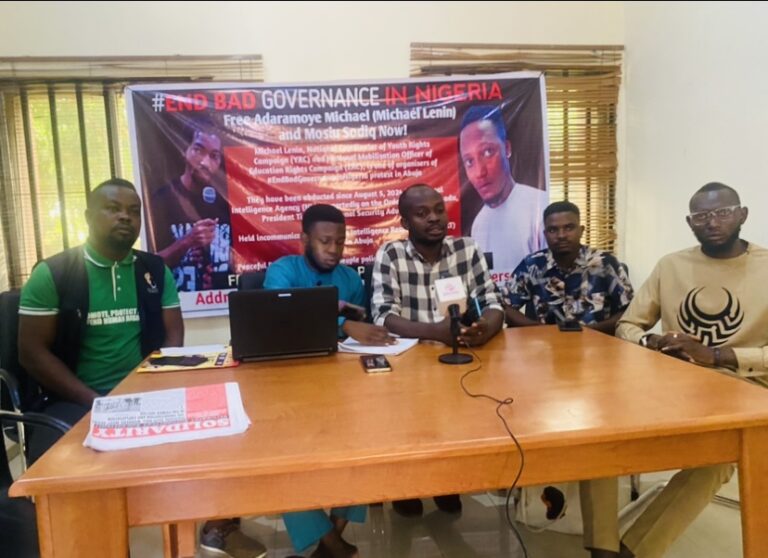
MOBILISERS for the #EndBadGovernance protest held across Nigeria from August 1 to 10 this year have said that Nigerians have the right to request the support of any country in their effort to end bad governance in the nation.
The mobilisers, at a press briefing in Abuja, on Wednesday, August 13, defended citizens’ decision to raise the Russian flag, as widely witnessed during the protest in the northern part of the country, noting that Nigerians had the right to raise any country’s flag during the demonstrations.
Working under the aegis of Network of Abuja Left Group, the group includes representatives from the Initiator, Creative Change Centre, Omole Ibukun; Movement for a Socialist, Akande Daniel; Take it Back Movement, Sydney Godwin; Advocate for a New Nigeria, James Nenge and Gerald Katchy of the Committee for the Defence of Human Rights (CDHR).
They argued that displaying foreign flags, including Russia’s, is an expression of Nigerians’ constitutional right to free speech and solidarity with global struggles against bad governance.
“We must state this clearly that any protester in part of the world has the right to raise the flag or demand for any available international support, to support their democratic right to protest or whatever they are protesting for in their country. It is not unpatriotic. It is not undemocratic. It is the right of those Nigerians who raised the Russian flag to raise it,” said the group.
When asked for comment on reported frozen accounts of the protest organisers, he questioned if they looked like people who had $38 million the federal government claimed it seized from the organisers.
“Do we look like people who have N83 billion in their account?, they queried.
This was as they lampooned President Bola Tinubu, the Inspector General of Police, Kayode Egbetokun, and the Nigeria Army, over their actions to suppress peaceful protesters.
The group, consisting of representatives from five civil society organisations (CSOs) also demanded the immediate scrapping of the State Security Service (SSS) the sacking of the IGP, and the National Security Adviser, Nuhu Ribadu.
While condemning the attack on the Nigeria Labour Congress (NLC) national office in Abuja, the group invited the labour union and other workers in the country for an indefinite massive nationwide protest coming up soon.
Mobilisers demands
While demanding the release of all arrested individuals, they also outlined a series of other demands, including the suspension of the Counter-Subversion Bill.
According to the group, Tinubu’s administration, which they claimed have been draconian, doesn’t want a dialogue in the first place, noting that each of the protesters’ demands must be met before any dialogue could be held.
The mobilisers challenged Tinubu to an open debate to discuss the feasibility of his government meeting demands, which include the return of fuel subsidy and electricity tariffs to pre-May 2023 levels, the restoration of the old minimum wage, and significant investment in public infrastructure, especially education and healthcare.
They urged Nigerians to reject any attempts by the government to dissuade them from participating in the movement, adding that the protests represented a collective effort to bring about real change in Nigeria.
Rejection of alleged counter-subversion bill
Similarly, the protest mobilisers criticised the proposed Counter-Subversion Bill 2024, describing it as a draconian law intended to silence opposition.
“To show that all of the recent repression is not in the interest of national security, the House of Representatives recently introduced a Counter-Subversion Bill 2024.
“This Counter Subversion Bill 2024 is a draconian piece of legislation that claims to impose harsh penalties on people involved in separatist agitations or actions that incite inter-group conflicts, but this bill is a clear attempt to silence dissent voices, stifle the political expression of unions and activist organisations like ours, and maintain the status quo of oppression and inequality,” the group added.
Group threatens to continue nationwide protest, invites NLC
While condemning the attacks on the NLC national office, they urged the union to mobilise its members nationwide to support a second phase of the protest.
“The Inspector General of Police’s justification for the raid on the Nigeria Labour Congress building, citing intelligence about a suspect involved in the Sudan crisis, is a thinly veiled pretext for suppressing dissent.
“This narrative is particularly concerning given the government’s history of using ‘national security as a justification for silencing political opponents and social movements.”
They warned that continued repression would only strengthen the resolve of the movement, which they described as a legitimate struggle for the rights and well-being of all Nigerians.
Decry of arbitrary detention of protesters
In response to the alleged detention of Michael Lenin and other #EndBadGovernance protesters, the group condemned the state’s use of force against peaceful demonstrators and the abduction of key figures involved in the protests.
They expressed concern over the worsening human rights situation, accusing the government of resorting to intimidation tactics to suppress dissent.
The group claimed Lenin, along with others like Mosiu Sodiq had been held without charges, subjected to inhumane treatment, and denied access to legal representation.
Lenin, one of the mobilisers for the protests, was allegedly abducted by security forces in a midnight operation sanctioned by the National Security Adviser, according to the mobilisers.
“Therefore, the attempt to link Comrade Micheal Lenin, the National Coordinator of the Youth Rights Campaign, to some form of foreign-sponsored terrorism because of his political name is not only far-fetched but also farcical and laughable. Comrade Lenin was arrested in the most inhumane manner. He was blindfolded and handcuffed to the back for almost half of a day, and dumped in a freezingly cold cell room where they are followed around by brutal and unstable police IRT officials, even when they want to use the toilet,” the mobilisers said.
The ICIRreported that the SSS and the police had since denied the arrest and detention of Lenin.
The SSS spokesperson, Peter Afunanya, refuted the allegation while fielding questions from journalists, on August 6. “In the case of Comrade Opaoluwa, a trade union leader at the electricity union NUEE, he was picked up by the same squad several days to the protests for being one of the potential sponsors of the protests and dumped at the Police IRT in Abuja like others,” the mobilisers said.
AT least N83 billion in cryptocurrency and fiat money channelled towards the recent nationwide protests has been traced and blocked by the federal government, The PUNCH reports.
The money includes $50 million of cryptocurrency — $38m blocked in four cryptocurrency wallets — and N4 billion contributed by various political actors in Abuja, Kano, Kaduna and Katsina.
The National Security Adviser (NSA), Nuhu Ribadu, was reported to have stated this on Tuesday, August 13, while making his presentation at the inaugural meeting of the Council of State convened by President Bola Tinubu at the Aso Rock Villa, Abuja.
This was as Premium Times reported that the Nigerian government froze more than $37 million worth of cryptocurrency held in wallets believed to be owned by some organisers of #EndBadGovernance protests.
According to the report, the action followed an order by the Federal High Court in Abuja, based on an application by the Economic and Financial Crimes Commission (EFCC).
Similarly, multiple sources reported that Ribadu, during his presentation on ‘The Nationwide Protest and Its Impact on National Security,’ disclosed that the government was able to trace $50m to crypto wallets that were made as donations to the protests, of which the $38m were blocked.
According to him, a European has been identified as the key figure behind the proliferation of foreign flags during the protests and will soon be declared wanted by the police.
“In his presentation, the NSA said the government was able to trace $50m to crypto wallets that were made as donations to the protests. They succeeded in blocking four of those wallets containing $38m.
“They also found out that some political actors contributed N4 billion to fund the protests,” One of the sources, who spoke on condition of anonymity, told The Punch.
The ICIRreported on Tuesday that President Tinubu convened the Council of State meeting to discuss, among other matters, the recent #EndBadGovernance protests, national security, the economy and food security.
Another insider from the Council of State meeting revealed that the local operatives had been detained, while the foreign mastermind was on the run.
The ICIR had on Tuesday, August 12, reported that the Kano State Police Command had moved about 76 suspects arrested for flying Russian flags during the protest to the Force Headquarters, Abuja.
The command said the suspects, which include a foreigner, would be put through a discreet investigation and charged with sedition.
Speaking on the NSA briefing on the interference of the foreign mercenaries, the source added: “The NSA also briefed the Council that there was some element of foreign interference in the protest, that they found out that some foreigners fueled the protests. It was not just about Nigerians protesting against hardship.
“A foreign agent had been found to be connected to it and would soon be declared wanted by the Police. The police will make the announcement this week.
“This agent is a person of interest with his Nigerian collaborators; most of them have been arrested. They are looking for him. But his collaborators in Abuja, Kaduna, Kano and Katsina have been arrested. The NSA also confirmed that eight people died during the protests.”
The ICIRreportedthat insecurity, inflation and a hike in the cost of living among others pushed many Nigerians to stage a nationwide protest held from August 1 to 10.
Tinubu had stopped fuel subsidies and devalued the local currency – the naira – thus causing a spiral hike in food and commodity prices and making life unbearing for many citizens.
THE Dangote Refinery said it has not fixed the price of its petrol product at N600 per litre, debunking media publications and dashing the hope of oil marketers of a price slash when it finally starts production.
A pump price of the premium motor spirit, otherwise known as petrol, has been selling for over N1,000 in many filling stations across Nigeria.
In a statement of Tuesday, August 13 its group’s chief branding and communications officer, Anthony Chiejina, stated that it had not fixed the petrol price.
According to Chiejina, the company’s attention was drawn to media reports announcing marketers’ projection of N600 per litre for Dangote petrol.
“We would like to clarify that the Independent Petroleum Marketers Association of Nigeria (IPMAN) is not our business partner yet.
“We have never discussed the price of Premium Motor Spirit (PMS) with them, and they have no mandate or authority to speak for us, either for good or with hidden transcript,” Chiejina said.
He urged the public to desist from such speculative announcements, adding, “We have our official channels through which we make our views known to our stakeholders.”
It was reported that IPMAN was hoping the Dangote refinery would sell at N600 or N650/litre when it started pumping petrol into the market.
According to the report, dealers under the aegis of the IPMAN believe the Dangote refinery would crash the price of petrol as it did with diesel.
It quoted IPMAN National Vice President Hammed Fashola to have said that the Dangote refinery would bring down the cost of fuel if it gets the needed support, especially crude supply.
While the Dangote refinery faces challenges getting crude oil supply locally and had been at loggerheads with with the regulators, its kick-off of petroleum production raises concerns over the Nigerian National Petrol Company’s (NNPCL) price-control regime, despite deregulation of the petroleum downstream sector.
The NNPCL has been enforcing a price-control regime that does not allow major marketers to enforce a market-driven price even when prices go up in the international market.
Analysts have argued that it was not clear whether Nigeria wants to practice regulated and deregulated markets at the same time.
The former chairman of the Society of Petroleum Engineers (Nigeria Council), Joe Nwakwue, had toldThe ICIR that with diesel, it was easy for the Dangote refinery to fix the price as the market was already there, fully deregulated.
Dangote had slashed the price of diesel when it entered the Nigerian market, but despite repeated announcements to start the production of petrol products, the refinery had faced a bit of delays.
It is almost mid-August, yet it is not certain whether the refinery will finally start petrol production this month.
Meanwhile, the N1,000 petrol price regime, mostly during the protest, was as a result of a glitch in supply occasioned by the recent nationwide “EndbadGovernance protest” which the public relations officer of IPMAN, Chined Ukadike said was a result of cautionary measure by marketers loading products to avoid possible attacks by ‘hoodlums’ under the guise of the protest.
“Note that the marketers sell according to the price and source of their products. Forces of demand and supply keep affecting prices as we are also in a deregulated petroleum regime. The marketers will also put their markup price, add the logistics price and sell. These are the reasons the prices at filling stations differ in a deregulated market,” Ukadike said.
He added that the prices could gradually drop as markers are now loading freely from depots with the official end of the nationwide protest.
THE Central Bank of Nigeria (CBN) has reintroduced the periodic publication of several economic reports to aid informed decision-making and business intelligence for economic managers.
It made this known in a statement on Tuesday, August 13 signed by its acting director of Corporate Communications, Sidi Ali.
The reports include the Purchasing Managers’ Index (PMI), Business Expectations Survey (BES), Inflation Expectation Report, and other macroeconomic indicators.
“The reintroduction of these reports, part of the ongoing data enhancement initiative within the CBN, aims to ensure that the public, policymakers, and the business community have access to essential economic indicators.
“These reports offer valuable insights into the perceptions and outlooks within the business and household sectors. This initiative is part of the Bank’s broader efforts to enhance transparency, promote informed decision-making, and support economic growth,” the apex bank said.
It said the reports would periodically be released on the CBN’s official website, and would be accessible to the public, policymakers, and the business community.
It added that it would be available for economists, analysts, investors, media, and the general public to use and gain a more comprehensive understanding of Nigeria’s economic dynamics to foster a more inclusive economic discourse.
The ICIR can report Nigeria lacks enough data to provide insights into various sectors of its economy.
For instance, the PMI which evaluates the health of the manufacturing, services, and agricultural sectors, along with the business and household expectations reports, are essential for understanding the country’s economic climate.
The CBN had in December 2020 stopped the monthly publication of the BES report and for over a decade, the Stanbic IBTC Bank has been releasing a monthly PMI to reflect the performance of the Nigerian economy.
Its latest report for July shows that business activity has contracted for the first time in eight months, the ICIRreported.
The report indicated that the Nigerian private sector moved back into contraction territory as steep price pressures hit demand and resulted in renewed reductions in both business activity and new orders as input costs and selling prices continued to rise rapidly and business confidence hit a new record low.
In July, business activities recorded a headline PMI of 49.2, down from 50.1 in June and below the 50.0 no-change mark for the first time in eight months.
A PMI reading of above 50.0 points signals expansion in business conditions while below 50.0 reflects a contraction.
THE Council of State has passed a vote of confidence on President Bola Tinubu at its first meeting since Tinubu became president on May 29, 2023.
The Council of State comprises former Presidents and past Heads of State, serving Vice President, the Senate President, Speaker of the House of Representatives, and governors.
The council advises the President on policymaking.
Former Heads of State Yakubu Gowon and Abdulsalami Abubakar participated virtually, while former presidents Goodluck Jonathan and Muhammadu Buhari were physically present at the meeting, which took place at the Presidential Villa in Abuja on Tuesday, August 13.
Former president Olusegun Obasanjo did not participate in person or virtually at the meeting.
He had justified the recent #EndBadGovernance protest, which most probably necessitated the Council’s meeting.
The governors of Kwara, Imo, Kogi, Rivers, andEbonyi, amongothers, were also in attendance at the meeting.
The Council condemned the recent #Endbadgovernance protest which held for ten days across the country.
Minister of Solid Minerals Development, Dele Alake, who briefed journalists after the meeting, described the protest as being laced with wicked motives.
Alake said the National Security Adviser (NSA), Nuhu Ribadu, briefed the council about the events surrounding the just concluded #EndBadGovernance protests.
He claimed the organisers tried to forcefully change the government given the events that characterise the protest.
The minister said the council commended Nigerians for “resisting any unconstitutional move to change government” during the protests.
“I call it a movement to effect a change of regime by force, which was also resisted.
“The council thanked Nigerians at large for resisting any unconstitutional move to change the government. If anybody is not satisfied with the government, there is always an election coming, so you wait for the election and cast your vote.
“So after the NSA’s briefing, generally, he allayed everybody’s fears and spoke on the tightness of the security around the country, and also reassured all and sundry that nobody would be allowed to truncate our hard-earned democracy,” the minister said.
Alake said any change of government must be through the ballots and not through the barrel of the gun or any other unconstitutional means.
He added that the NSA reassured of the readiness of all security agencies to secure the nation’s territorial integrity and to protect its democracy.
Similarly, the chairman of the Governors Forum and Kwara State Governor, AbdulRahman AbdulRazaq who also briefed journalists after the meeting, disclosed that the governors had a private discussion with Tinubu and expressed their confidence in his administration.
The Council of State meeting followed a ten-day protest tagged #EndBadGovernance that almost grounded the nation.
The ICIRreportedthat insecurity, inflation and a hike in the cost of living among others pushed many Nigerians to stage the protest.
Tinubu had stopped fuel subsidies and devalued the local currency – the naira – thus causing a spiral hike in food and commodity prices and making life unbearing for many citizens.
Barely a week after the publication of an investigation funded by the International Centre for Investigative Reporting (The ICIR) the Niger state has paid the backlog of salaries owed to health workers.
The investigation which was done under the International Budget Partnership (IBP) supported SPARK 2 project (Strengthening Public Accountability For Results and Knowledge) and titled ‘Midwives’ Silent Struggle: Delayed Payments Plunge Niger State Healthcare Providers Into Financial Distress, Debts’ was published by Sahara Reporters and several other media organisations.
These midwives, who were employed on a contract basis in 2022 under the Basic Healthcare Provision Fund (BHCPF) and Midwives Service Scheme (MSS) were paid N62,000 each per month and had a backlog salary of six months before the ICIR-funded investigation.
Some of the affected midwives confirmed that they had been paid, but they were cautious about providing additional information about the payment because the agency had warned them not to speak to the media.
When pressed for proof of the payment one of the midwives said, “I just confirmed to you that I have been paid; you can confirm from others and the agency for more details.”
According to sources, the midwives were paid a four-month backlog of their salary depending on how many months each person has been on the job, with some having a backlog of three, four, five, or six months depending on when each person started.
“They were paid for four months, but the July payment was not made,” a source said.
The Agency’s troubling response to the investigation
The Niger state Primary HealthCare Development Agency (NSPHCDA) response to the investigation was not limited to the payment of the backlog. it also took steps to counter report by calling the affected midwives to their head office in Minna, the state capital, away from the place of their primary assignment to record a video titled ‘Midwives’ Silent Struggle: Niger State Healthcare Provider As a Shining Example Through the Basic Healthcare Provision Fund BHCPF’.
The video which was made public sought to discredit the investigation, however, the midwives interviewed in the video all stated they were owed backlogs and have now been paid.
Scene from the videoScene from the video
Interestingly, one of the findings of the investigations is absence and dearth of health workers like midwives at the PHCs visited, against this backdrop, the NSPHCDA still removed these midwives from their PHCs and took them to the state capital to record a counter video, this most likely means some patients will not be receiving health services for that period.
The video was circulated with a rejoinder which started with “Niger State Ministry of Healthcare Development, has chosen to analysed and evaluated the impact of Basic Healthcare Provision Fund BHCPF from a report… by publishing six months of delay instead of two months.” This contradicts the video recorded by the agency which has all the midwives saying they were owed more than two month.
In addition, The ICIR obtained a message sent to the health workers communication channels asking them not to speak with the reporter, while falsely accusing him of impersonation.
Part of the message reads , “I don’t know what he has against Niger state that he wants to use us as bait or scapegoat. May we not fall victims to tools or agents for destroying anyone or any society.”
This is interesting considering the salary owed midwives was what was affecting and “destroying” the “society” as it led to lack of service delivery and absenteeism, as some of the midwives could not afford transport to work.
The attempt to manipulate the narrative and silence the midwives reflects a troubling response to legitimate inquiries about the welfare of essential healthcare providers.
Sources alleged the message to silence midwives was with the knowledge of the state director of Health Planning, Research, and Statistics, Inuwa Junaidu.
Junaidu has however confirmed that the backlog salary has been settled. He said “It has been settled. It is not a rumour sir, and you may wish to confirm from the midwives themselves”.