Home Blog Page 541

‘Neglected’ by government, Nasarawa women farmers resort to self-help, battle high cost of living

The prices of goods and services increased across Nigeria following the removal of fuel subsidies by the federal government in May 2023. The development contributed to the skyrocketing costs of farm inputs, putting farmers in a difficult situation. While large-scale farmers may withstand the burden, the impact is damning for small-scale farmers, especially women. In this report, Nurudeen Akewushola details the struggle of women farmers in Nasarawa State amid the rising cost of living in the country. This story also highlights a lack of policy implementation, which worsens their predicaments. 


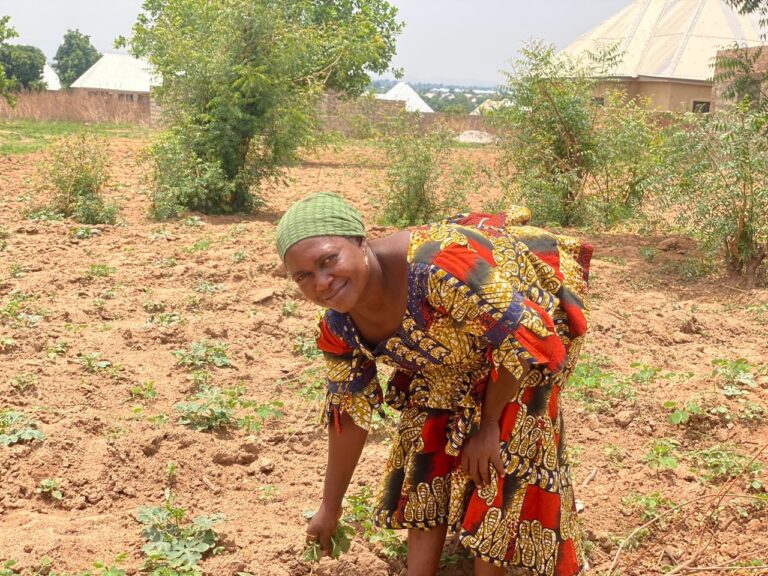
Last year, during the planting season, Cecilia Nekrel, a 32-year-old farmer based in Lafia, the Nasarawa State capital, planted groundnut, guinea corn, melon, and other varieties of cereal crops on six hectares of land. But her hope of feeding her family and turning a profit from harvested produce this year has been dashed.

The farmland she got at N10,000 per hectare the previous year has now doubled. Worse for the mother of six, the harvests she set aside for re-planting got infested by pests, as pesticides have now become a luxury she can no longer afford.

The challenges Nekrel faces, however, are beyond land and agricultural inputs. The male labourers she relies on to plough and tend the land now demand increased wages. Last year, she paid each of them N1,000 per ridge, but this year they want the amount tripled, citing the high cost of fuel and transportation.

Cecilia Nikrel
Cecilia Nikrel

As the rainy season approaches, Nekrel says she can only afford to plant guinea corn and maize on a single hectare — her lowest in the past five years as a farmer. 

“We (farmers) are not able to cultivate anything in large quantities this year because the things have become very expensive.

“Getting fertiliser is one big issue because it is ten times the price of herbicide. How are we going to raise the money for the herbicide and fertiliser that we are going to use on the farm?” she lamented.

Since her husband moved out three years ago to pursue a master’s programme in Jos, Nekrel has been the family’s breadwinner. To earn some income and feed her children, she now sells palm oil and works as a part-time elementary school teacher.

The plight facing women farmers like Nekrel is part of a broader crisis across Nasarawa State, where the majority of small-scale women farmers are struggling to cope with soaring input costs and declining profits. 

Contributing factors

The decision by the Tinubu-led administration to remove fuel subsidies upon assuming office in May 2023 has been a major contributing factor to the situation. The policy shift contributed to the increased prices of goods and services nationwide, with women farmers like Nekrel bearing the brunt.

Many have been forced to scale back their farming operations, and some, like Nekrel, have abandoned farming entirely due to the prohibitive costs.

Farming amid hardship

Gloria Ayuba, a 37-year-old farmer based in Lafia, has had to scale back her operations. Last year, she harvested about ten bags of rice and eight bags of groundnut from seven hectares of land during the farming season. But, this year, she is contemplating reducing her inputs due to the high cost of seedlings and fertiliser. 

“The costs of seedlings and fertiliser have become almost unbearable. I’m not sure I can afford to plant as much this season,” Ayuba told The ICIR

Even if Ayuba could afford seedlings and fertiliser, the biggest hurdle she faces is finding farmland to cultivate. Earlier this year, the farmland owners she has used for the past three years increased the rent on her assigned three plots from N45,000 to N70,000, forcing her to lose the land.

Compounding Ayuba’s challenges is the high cost of hiring labourers due to a lack of access to gender-friendly equipment. With the onset of the rainy season, her hired labourers, who charged her N4,000 per person last year, are now demanding N7,500 each. But that’s not all she has to worry about. 

The hike in transportation is another threat to Ayuba’s farming operations. To sell her produce and buy necessary farm inputs, she frequents the Dendere market, about 10 minutes from her house by tricycle.

However, the cost of transportation to the market has surged to N400 from N200 and doubles when she has to transport harvested produce and other heavy goods. 

Gloria Ayuba/ Credit: Nurudeen Akewushola

Ayuba says she now treks to the market to manage expenses and keep her farming business afloat, noting that this has negatively impacted her income.

With no steady income from farming, the single mother of two has had to withdraw her children from the local community school. Now that they spend all day at home, it has become even more difficult to feed them. 

With no husband to support her, she says she and her two children will have to survive mostly on Garri, a food product derived from cassava.

For Victoria Alkali, 45, another farmer based in Angwan Waziri, soaring inflation and limited access to crucial agricultural loans is a huge challenge.

Due to her inability to pay the recently raised rent rate, she almost lost the land she used to plant maize and millet last year after the landowners increased the rent from N9,000 to N23,000 per hectare.

This year, as rising prices threaten her farming operations, she says her nine children will have to feed on cassava flour because it is cheaper.

“The prices of food have never been this high. There are times we sleep without food. Sometimes, you feel like you want to eat corn meal, but it costs between 1,300 and 1,500 naira per mudu. You end up buying cassava flour instead, which is cheaper but not your desired meal,” she said. 

Gloria Ayuba/ Credit: Nurudeen Akewushola

Most days, her children go to school on an empty stomach but on fairly good days, they take madidi, a thick porridge, gel-like fermented starchy food item made from millet, as breakfast and don’t eat anything else until dinner.

As a single mother, Alkali’s only hope is relying on some support from the government, but whether her hope will be realised remains to be seen.

Failed government support, promises 

Since the beginning of the year, when the cost of living spiked, the government of Nasarawa State claims it has provided continuous support to farmers to ease the hardship. For instance, in February 2024, the state government announced plans to distribute 26,000 bags of fertiliser to smallholder farmers.

The state governor, Abdullahi Sule, who made this pledge during an interview in Abuja after a courtesy visit to the Federal Ministry of Agriculture and Food Security (FMAFS), stated that the initial plan was to distribute 13,000 bags, but it would be doubled to 26,000 bags to further elevate agricultural productivity. 

But many smallholder women farmers, including Alkali, who spoke to The ICIR, say they have never benefited from any of the government’s support programmes and initiatives since the removal of fuel subsidy.

When contacted by The ICIR, the Nasarawa State commissioner for agriculture, Umar Abubakar Dan’akano, could not provide an account of the 26,000 bags of fertiliser promised for distribution since February to smallholder farmers, claiming they were not directly from the ministry. 

 “Those ones you are talking about are NG-cares programmes. I can’t explain them in detail. Including the 26,000 bags of fertiliser. They are interventions from NG-care. It’s not from the ministry,” the commissioner said. 

Nasarawa state Commissioner for Agriculture, Umar Dankano

In May this year, the Nasarawa State government, as part of the Agro-Climatic Resilience in Semi-Arid Landscapes (ACReSAL) programme, rolled out a $250,000 loan initiative borrowed from the World Bank. The interest-free loan was distributed to 620 farmers from 10 local communities, according to Joy Iganya-Agene, the task team leader of ACReSAL.

However, out of the 620 farmers who reportedly benefited from the loan, only 253 were women, indicating a wide gender disparity in the distribution. Notably, of the 253 women, none of the women farmers under the Small Scale Women Farmers of Nigeria (SWOFON) umbrella, including Alkali, received anything. 

The state government has yet to disclose how it selected its list of 620 beneficiaries. There is also no publicly accessible data on the beneficiaries. When asked about the loan distribution and the list of the 620 beneficiaries, the commissioner, Dan’akano, fummed: “Don’t ask me that question. I told you they are NG-care programmes”.

The COVID-19 Action Recovery and Economic Stimulus Program Project (NG-Cares) programme is a $750 million World Bank-funded programme aimed at expanding access to livelihood support and food security services by providing grants to poor and vulnerable households.

According to the state government, Nasarawa State has received about N13.6 billion from the programme since it the program was launched. The government claims that over 11, 000 farmers have benefitted from the project’s agriculture development initiative and 6,000 less privileged persons received N10,000 monthly under conditional cash transfer to improve their livelihood.

On a second call to inquire about the state government’s partnership with NG-care and the method of distribution of the support agriculture development initiative, including the most recent 26,000 bags of fertiliser, the commissioner said he mistook the question and didn’t mean to mention NG-cares. 

The commissioner then claimed that distribution of the 26,000 bags of fertiliser would kick off once approval processes are concluded. He did not specify what kind of approval has delayed the distribution since February. As of the time of filing this report, distribution was yet to commence.

The commissioner further promised that subsequent distributions would consider women farmers, despite not being able to account for how previous interventions have been conducted.

“We will consider them (women farmers). We are going to consider them in the subsequent distributions.

“As I speak to you, there are a lot of arrangements to alleviate the burden of economic hardships on women farmers associations in Nasarawa State. The arrangement regarding that is in top gear, they will be considered in the subsequent interventions,” he said.

In a move to promote gender equity in the agricultural sector, the Nigerian government launched the National Gender Policy in Agriculture in October 2019. The policy set ambitious targets, mandating that at least 50 per cent of all agricultural input distribution, 45 per cent of financing and credit programmes, and 60 per cent of support initiatives must be allocated to women farmers.

Items Before After Description
Urea(50kg) N25,000 N65,000

Nitrogen-based fertilizer

NPK 15-15-15 (50kg) N30,000 N55,000 Balanced NPK fertilizer
Knapsack sprayer N35,000 N65,000 Portable manual sprayer
Insecticide (1 litre) N3,000 N6,000 Chemical for pest control
Mentaforce (1 litre) N4,500 N14,500 Herbicide for weed control
Pre-emergence (1 litre) N3,800 N7,000 Herbicide applied before weed emergence
Paraquat (1 litre) N3,000 N65,000 Non-selective herbicide
Glyphosate (1 litre) N3,500 N6,000 Broad-spectrum systemic herbicide
Cost of labourers (per ridge) N450 N1,000 Labour cost per ridge in farming
Cost of renting farmland(per plot) N10,000 to N15,000 N40,000 to N50,000

Table showing the prices of some selected farm inputs in Nasarawa state before and after removal of fuel subsidy( Source: Market survey and SWOFON women). Data collection date: May 22, 2024.

However, findings show that the implementation of this policy has been lacking, particularly in Nasarawa State. 

The lack of progress in implementing the policy’s mandates also contravenes Nigeria’s obligations under the United Nations Convention on the Elimination of All Forms of Discrimination Against Women (CEDAW), which the country has ratified.

CEDAW obligates signatory states to take steps to end discrimination against women and ensure their full participation in all spheres of life, including access to land, credit, and income in the agricultural sector.

The failure of the state government to provide support tailored to women amid the economic situation is forcing many women out of agriculture, and Nigeria’s overall productivity in the sector is suffering. This is particularly worrisome given the critical role women play in the agricultural workforce; they account for 70 per cent of agricultural workers and 80 per cent of food producers. 

Woman farmer processing melon/ Credit : Nurudeen Akewushola

With women’s contribution to the sector being threatened by inflationary pressures, the agricultural industry, which makes up about 26 per cent of the country’s Gross Domestic Product (GDP), is now at risk of further decline, and government support isn’t getting where it is needed. 

Women farmers seek government’s intervention

A cross-section of women farmers who spoke with The ICIR across various local government areas in Nasarawa State said they have not received any support from the government despite the hardship they are facing. According to the women, they hear about the government’s announcements of distributing palliatives and other support in the news but it never reaches them. 

Nafisat Salisu

“The palliatives, we are not seeing it. We only used to hear they give a palliative somewhere or a particular community get help from the government or they are giving loan or grant in the news, we have never seen or received any of it as women farmers,” Nafisatu Salisu told The ICIR.

According to the coordinator of the Small-Scale Women Farmers Organisation in Nigeria (SWOFON) in Nasarawa State, Jumai Yohanna, this is the reality of over 14,000 farmers in the state’s network, and it is similar for many other SWOFON members nationwide, she asserted.  

In an interview with The ICIR, Yohanna said that the high cost of living and the government’s opaque allocation of agricultural finance and input support have rendered life intolerable for farmers in Nasarawa State.

“If they want to know how these grants can reach us, we will tell them. The way they distribute aid, we only hear on the radio that we are receiving something, but it’s always not true. It never reaches us.”

According to Yohanna, initiating a partnership with the association is one way to improve distribution and ensure that the government’s support programmes are tailored to the needs of the women farmers.

SWOFON Coordinator, Nasarawa state, Jumai Yohanna

However, she also pointed out that securing government loans has been challenging for most women farmers due to the rigorous protocols involved. She explained that the processes are not localised and even when the women farmers manage to meet all the requirements, their efforts do not yield results.

 “They used to ask us to submit an account number, and bring collateral such as car, house, land but even if you provide all these, you will not get anything,” she said.

 These steep collateral requirements go against the gender mainstreaming strategy contained in the National Gender Policy in Agriculture. 

Recognising that women may not be able to raise such collateral, the policy advocates for the reduction of collateral requirements and the use of alternative forms of security that are more accessible to women. 

 The Nasarawa state government has not only consistently ignored the gender mainstreaming strategies outlined in the National Gender Policy in Agriculture but has left women farmers out of its support programmes, unable to account for or publicly showcase beneficiaries of interventions running into multiple billions of naira. 

 In 2012, a group of women farmers formed a cooperative loan organisation called Village Savings and Loan (VSL). This was in response to their limited access to government credit and loans over the years. 

The VSL model involves members contributing small amounts that are pooled together, allowing the group to provide support and financial assistance to one another. 

More than a decade later, the VSL initiative remains a crucial lifeline for these women farmers, helping them navigate financial hardships and enabling them to maintain their farms and sustain their livelihoods.

 To further drive down production costs, the women say they are now replacing commercial fertiliser with do-it-yourself (DIY), organic fertiliser.

Women farmers resort to cheaper alternatives

Women farmers who spoke with The ICIR said they now supplement commercial fertiliser with more organic compost, such as animal manure, and livestock waste, to fertilise their farms due to the high cost of chemical fertiliser. 

Findings by The ICIR showed that 50 kg of urea, the most common fertiliser used by farmers across Nigeria, used to cost N25,000, but is now sold at N65,000. Similarly, 50 kg of NPK fertiliser 15:15:15 has risen to N55,000 from N30,000. 

 “Sometimes I use potash gotten from fire, I will mix it with the dirt, ” Nekrel explained while narrating how she prepares homemade pesticide.

“I also use animals such as chicken waste, (as fertiliser) but due to hot weather chickens hardly survive so I use the faeces obtained from those that survive. Also, I use goat and pig faeces as fertiliser,” she said.

Another farmer, Yohannah Emmanuel, 30, who is a resident of Ungwan Ali, says she often gathers groundnut shells after consumption or processing. The shells are taken to the farm, where they are to be used directly as organic fertiliser. Over time, the shells decompose, adding nutrients and improving soil structure.

Yohanna Emmanuel/ Credit : Nurudeen Akewushola

Sometimes, instead of using the groundnut shells directly, she burns them to create ash. The ash is then collected and used as fertiliser. She also sometimes combines it with human excrement. The groundnut shell ash and faeces are spread over the farm to enrich the soil with essential nutrients that can aid plant growth. 

“That’s what’s helping us,” Emmanuel said, adding: “I don’t have the money to buy fertiliser. Even if I want to buy one, sometimes they sell fake fertilisers in the market. When you go and spray it on your farm, you will have to weed the farm all over again.”

For Alkali, using chicken and cow dung as manure has saved her the high cost of fertilisers. She noted that the inability to afford herbicides exposes her crops to infection. 

“Only rich people can afford to buy fertiliser now because of how costly they have become. I always want to buy herbicides and pesticides, but when I get to the store and see the high prices, I have to find low-cost alternatives,” Alkali explained.

 While women smallholder farmers widely embrace organic composting and manure as a more cost-effective and eco-friendly fertilising practice, they often face the challenge of slower results than chemical alternatives.

Experts have noted that organic fertilisers like animal waste and shell ash have a slower, more gradual impact on crop yields compared to synthetic fertilisers.

Way forward

A report by Cadre Harmonise, a regional initiative focused on food and nutrition analysis indicates that over 5 million Nigerians are at risk of food insecurity between June and August 2024. 

With agricultural productivity declining, experts in the agricultural sector who spoke with The ICIR emphasised an urgent need for macroeconomic stability, improved infrastructure, and targeted support for women farmers to mitigate increasing threats to food production.

 Razaq Fatai, head of research and advisory at Vestance, an agriculture-focused consulting firm, identified the depreciation of the Nigerian currency as one of the major reasons responsible for the increasing cost of farm inputs in the country, urging the government to boost crude oil production to stabilise the currency.

Rasaq Fatai

“The agricultural sector does not operate in isolation. Input prices are often determined by exchange rates. If the Nigerian currency depreciates, inputs become more expensive. To stabilise input prices, we need to boost crude oil production. If we can increase crude oil production to around two million barrels per day, it will increase dollar inflows and help stabilise the currency,” Fatai said.

Fatai also pointed out the need to focus on macroeconomic stability, capacity development, and resource access. He added that these steps will help farmers get better prices for their goods and ensure continuous capacity development and market access.

“Productivity in Nigeria is still very low for almost all commodities compared to other countries. We need to invest heavily in improving the quality of seedlings to boost productivity. More importantly, we need to ensure farmers adopt these better seeds. We need a support system to help farmers access and use quality inputs. This includes investments in better seeds and scaling access to them.”

He also called for extensive government support for women farmers and recommended investing in capacity development for women farmers on best farming practices. 

On his part, the founder of Community Action for Food Security (CAFS Africa), Azeez Salawu, explained that the socio-economic implications of the high cost of living could result in a decline in agricultural productivity, leading to decreased food availability and worsening food insecurity in the country.

Azeez Salawu

He urged the government to provide direct financial support for essential farm inputs to reduce production costs and invest in infrastructure and market access to enable farmers to sell their produce at fair prices, thereby reducing post-harvest loss and increasing their income.

Salawu further urged the government to increase access to affordable credit tailored to women farmers, enabling them to invest in productivity-enhancing technologies. He suggested providing capacity-building sessions to enhance their skills in modern farming techniques and business development. 

He also called for integrated support systems encompassing financial assistance, training, and other services to empower women farmers, stressing the importance of strategically including women farmers in policy formulation to address their specific needs and foster a sense of belonging.

This report republished from Crispng was made possible with support from the International Budget Partnership (IBP), and the International Centre for Investigative Reporting, (ICIR) under the Strengthening Public Accountability For Results and Knowledge (SPARK 2) project. 

We haven’t licensed Dangote refinery — Nigerian government

THE Nigerian Midstream and Downstream Petroleum Regulatory Authority (NMDPRA) said it has not licensed the Dangote refinery even as marketers hope to start getting petrol products from it next month amid fuel scarcity faced in the country.

The Chief Executive Officer (CEO) of NMDPRA, Farouk Ahmed, told journalists on Thursday, July 18, that the refinery was still at the pre-commissioning stage.

He said there were numerous concerns regarding the petroleum products supply nationwide.

“Well, just like you rightly asked, there are lots of concerns about the supply of petroleum products nationwide and the claims by some media houses that we were trying to scuttle the Dangote refinery; that is not so.

“Dangote refinery is still in the pre-commissioning stage. It has not been licensed yet. We have not licensed them yet,” Ahmed was quoted to have said.

According to him, the demand for the Dangote refinery cannot be met by the authorities at this time hence it could lead to energy insecurity and market monopoly.

He said: “So we can not rely heavily on one refinery to feed the nation because Dangote is requesting that we should suspend or stop all importation of petroleum products, especially automotive gas oil (AGO) or jet kero, and direct all marketers to the refinery.

He further asserted that products coming out of the Dangote refinery were of low quality and inferior to import products.

“Dangote refinery as well as some major refineries like Waltersmith refinery, produce between 650 to 1200 ppm. So, in terms of quality, their quality is much more inferior to the imported quality,” Ahmed added.

The Chief Executive Officer of the Nigerian Upstream Petroleum Regulatory Commission (NUPRC), Gbenga Komolafe, also took a turn to describe the claim by the Dangote refinery as “erroneous”, saying that the Petroleum Industry Act (PIA) has provisions that guide willing buyer-willing seller transactions.

The ICIR reports that the management of Dangote Industries Limited (DIL) had earlier accused the international oil companies (IoCs) and insisted that oil companies were frustrating its request to purchase crude feedstock for its refinery.

The Dangote refinery, which has been sourcing crude oil from the United States and expected to commence petrol production in July, had rescheduled the planned commencement to August, The ICIR reported.

The ICIR reports that the recent fuel scarcity that hit most of the filling stations of Nigeria’s sole importer of petroleum products, the Nigerian National Petroleum Company Limited (NNPCL), and other independent and private filling stations have yet to abate amid a hike in pump price.

CBN sells $20,000 to BDCs amid FX distortions

THE Central Bank of Nigeria (CBN) has approved the sales of $20,000 to each of the eligible Bureaux De Change (BDC) amid distortion in the Nigerian foreign exchange market.

The apex bank disclosed this on Thursday, July 18, in a circular signed by its acting Director of Trade and Exchange A. A. Mahdi.

It said the $20,000 to be sold to each BDC operator would come at the rate of N1,450 to a dollar to meet the demand for invisible transactions.

“Following the on-going reforms in the foreign exchange market, with the objective of achieving an appropriate market determined exchange rate for the naira, the CBN has observed the continued distortions in the retail end of the market,” apex bank stated.

According to the bankers’ bank, the distortion was feeding into the parallel market and further widening the exchange rate premium.

“To this end, the CBN has approved the sales of FX to eligible  BDCs to meet the demand for invisible transactions.

“The sum of $20,000 is to be sold to each BDC at the rate of N1,450/$ (representing the lower band of the trading rate of NAFEM in the previous trading day),” CBN said.

It added that all the BDCs were permitted to sell to eligible end users at a margin not more than 1.5 per cent above the purchase rate from CBN.

The recent CBN intervention at the Nigerian FX market comes at a time when the naira is facing constant pressure, depreciating towards N1,600 to the dollar. Earlier this year, the naira had peaked at N1,900 to the dollar.

On Wednesday, July 17, the naira depreciated against the dollar at N1,565/$ at the parallel market from N1,550 on the previous day.

At the official Nigerian Autonomous Foreign Exchange Market (NAFEM), it also depreciated to N1,581.65 from N1,576.66 the previous day.

The CBN had resumed the sales of dollars to the BDCs to stabilise the currency market, after lifting its ban on the operators.

In March, the apex bank sold $10,000 to each of the eligible BDC operators at the rate of N1,251/$1, and also at the rate of  N1,021/$ to BDCs in April.

A check by The ICIR shows a list of 5,691 BDC operators on CBN website, but the apex bank had in March revoked the operating licences of 4,173 BDCs over their failure to meet regulatory guidelines.

Manufacturers kick as customs duty spikes above official FX market rate

NIGERIA manufacturers are kicking against the constant rise in customs duty above the official foreign exchange (FX) rate figure, which they say is not incentivising access to raw material and local production.

Checks by The ICIR have shown that the exchange rate for duties collection by the Nigeria Customs Service (NCS) has risen by N3.00 above the official closing rate of the Naira on the NAFEM window.

The manufacturers, as a result, are seeking a deliberate lowering of the cost of importing manufacturing products and raw materials to lessen Nigeria’s rising inflation.

The director-general of the Manufacturers Association of Nigeria (MAN), Segun Ajayi-Kadir, told The ICIR exclusively that the constant rise in customs-duty rate is stifling local production and importation of raw materials for the manufacturing sector.

“Something needs to be done to deliberately lower the cost of importing manufacturing products and raw materials. What is important is for us to incentivise productivity and not stifle it.

“The manufacturing sector needs to be insulated from the vagaries of the exchange rate since the government reforms are taking a while to materialise,” he said.

Checks on the customs exchange rate portal revealed that the FX rate for duties collection stands at N1584/$ while the naira closed at N1581 to the greenback on the July 17, 2023 according to financial infrastructure group warehousing data.

The current customs duties exchange rate of N1584 /$ is one of the highest since March 2024 when the naira depreciated near the N1600/$ mark. In recent times, the naira has weakened against the dollar despite efforts by the Central Bank of Nigeria (CBN) to boost supply in the foreign exchange market.

The ICIR has earlier reported that the nation’s inflation spike has been partly linked to the incessant hike in import duty, as the country is largely import-dependent.

Nigeria’s inflation is currently at 34.19 per cent in June and the official lending rate at 29.11 per cent which is squeezing lending to the manufacturing sector.

The MAN director-general insists N800/$ rate as recommended by the Presidential Fiscal and Tax Reform Committee (PFTRC) would help inflation moderate make business projections in the productive sector of the economy lesser and bring down costs of end products.

The Nigeria Customs Service (NCS) through the CBN has consistently fixed the exchange rate to reflect the official market rate on the Nigerian Autonomous Foreign Exchange Market (NAFEM) window, hence the regular changes in rate.


End

How 2 health workers stole over 13,000 diapers meant for Kebbi PHC – ICPC

0

TWO health workers in Kebbi State

THE Chairman of the Independent Corrupt Practices and Other Related Offences Commission (ICPC), Musa Adamu Aliyu, has revealed how two health workers in Kebbi State allegedly diverted 13,350 diapers meant for antenatal care at a primary health centre in Sambawa community in the state.

Aliyu made the revelation while addressing participants at a one-day conference organised by the ICPC in Abuja on Thursday, July 18.

While addressing participants on the conference theme: “Engendering Corruption-Free Primary Health Care Delivery For All”, the chairman said of the theft: “Recently, the Sambawa community in Kebbi State sent a petition to us regarding missing antenatal care items for pregnant women and newborn babies donated to a healthcare facility.

“Our preliminary investigation indicated that the missing diapers allocated to Sambawa Primary Healthcare Centre are 13,350 pieces, while the investigation by Kebbi State Primary Healthcare Agency puts it at 3,466.

He said though two staff members of the Sambawa Primary Healthcare Centre, a male and a female, were indicted for the missing items, the commission intended to go all out and unravel the criminal conduct and bring the culprits to book.

Aliyu said the choice of the PHCs in the Federal Capital Territory (FCT) as the pilot for the nationwide conversation on engendering-corruption-free PHC service delivery in the country was to create a comprehensive template that could be replicated in all the six geopolitical zones of the federation.

He said participants were carefully drawn from community healthcare stakeholders to have a holistic and collaborative approach to improving the effectiveness of primary healthcare service delivery.

He added that communities and civil society were becoming more interested in tackling corruption in the health sector.

According to him, the Memoranda of Understanding (MoU) to be signed at the conference would provide opportunities for the cross-fertilisation of anti-corruption ideas and harnessing available resources to address issues that hinder people from enjoying a corruption-free healthcare system in Nigeria.

Speaking at the conference, the Minister of Health, Muhammed Ali Pate, said the nation’s PHCs faced multifaceted challenges, including corruption that must be urgently tackled.

He submitted that corruption in the health sector could not be isolated from other sectors.

Pate said Nigeria had a prosperous future but prosperity would only come if citizens did the right things collectively.

“So when we look at the issue of corruption in Nigeria, which is a long-standing issue, it’s almost everywhere but how do you address it?

“It’s a huge challenge and it’s a systemic challenge. It is also a multi-institutional challenge, it is due to state capacity…what we determine to do about it.

“The volume of mortality is on the poorest when we access Nigeria’s health utilisation and output in the continent compared to so many other countries,” Pate stated.

The minister of Health, ICPC chairman and other dignitaries at the event
The minister of Health (in white attire at the front row), ICPC chairman (beside him on the left) and other dignitaries at the event

He stressed the need to strengthen regulatory bodies so they do not become predators.

In his speech, the chairman House Committee on Anti-Corruption, Kayode Akiolu, posited that the Nigerian health sector was in the middle of a crisis. He said doctors and other medical professionals were leaving the country in droves thereby leaving the sector in bigger crisis.

He listed insufficient manpower, poor working conditions and endemic corruption as some of the challenges facing the sector.

He added that if corruption is tackled in the PHC sector, the impact would be felt in the whole sector.

The keynote speaker and the Mandate Secretary, Health Services and Environment in the FCT, Adedolapo Fasawe, said a health system based on PHC structures functioned toward the values of equity and social solidarity and the right of every human being to enjoy the highest attainable standard of health without distinction of race, religion, political belief, or economic or social condition.

She said Nigeria’s vital health indices ranked among the worst globally and way off the path to meeting the 2030 Sustainable Development Goals (SDGs) Targets:

According to her, Nigeria achieves far less value on funds spent on health.

“Corruption has hampered and continues to bedevil the PHC service delivery in Nigeria.
“In addition, we must adopt the public health approach to making the PHC system corruption-free,” Fasawe stated.

According to her, the inclusion of “Other related Offences” in the nomenclature of ICPC makes non-financial corruption the purview of ICPC and confers on ICPC a sector-wide health system strengthening partner and monitor.

She submitted that corruption thrives in weak systems with non-strategic and comprehensive processes.

There were goodwill messages from the Nigerian Medical Association (NMA), National Primary Health Care Development Agency (NPHCDA), National Health Insurance Authority (NHIA) and National Association of Nigeria Nurses and Midwives (NANNM)

Others are the National Commission for Persons with Disabilities (NCPWD), the Nigerian Union of Journalists (NUJ), the United Nations Development Office on Drugs and Crime (UNODC) and the World Health Organisation (WHO).


READ ALSO:


The ICIR reports that Nigerian PHCs have been mired in corruption, underfunding, low human resources, infrastructural deficits, poor power supply and other ills.

In 2023, this organisation tracked the implementation of the Basic Health Care Provision Fund (BHCPF) and the Midwife Service Scheme (MSS) in 12 states namely Anambra, Ebonyi, Cross River, Akwa Ibom, Ogun, Oyo, Kano, Jigawa, Gombe, Bauchi, Niger and Nasarawa.

Several reports produced from the investigations are available here.

The investigations unearthed the challenges listed above and many more.


Tinubu approves N70,000 as new minimum wage

0

PRESIDENT Bola Tinubu has approved N70,000 minimum wage for Nigerian workers, a N8,000 increase from the earlier N62,000 proposal.

The Minister of Information Mohammed Idris, announced this at the Presidential Villa in Abuja, on Thursday, July 18.

According to Idris, the President made the announcement at the ongoing meeting with leaders of organised labour.

Tinubu’s N70,000 approval represents over 130 per cent increase from the current minimum wage of N30,000.

Meanwhile, according to a report by Arise TV, the labour leaders, Joe Ajaero, President of Nigeria Labour Congress (NLC), and Festus Usifo, President of the Trade Union Congress (TUC), present at the meeting alongside some members of their unions, have agreed to the new minimum wage.

Also, in a post by Tinubu’s media aide, Bayo Onanuga, on Thursday, the President promised to find ways to assist the private sector and the sub-nationals to pay the minimum wage.

The ICIR reported that governors across Nigeria’s 36 states had earlier opposed the N60,000 minimum wage initially proposed by the federal government.

The governors rejected the proposal in a statement by the director, media and public affairs of the Nigeria Governors’ Forum (NGF), Halimah Salihu Ahmed, on Friday, June 7.

The workers had embarked on a strike on Monday, June 3, and relaxed it the following day, to compel the government to agree on an acceptable minimum wage.

The suspension of the industrial action was at the heel of the resolution reached between the federal government representatives and the labour after a six-hour meeting in the evening of Monday, June 3, in  Abuja.

The government agreed to improve the offer beyond the initial N60,000, with President Tinubu ordering the Finance Minister, Wale Edun to prepare a template for the workers’ minimum wage.

House of Reps to donate N648m from salaries to address hunger 

0

MEMBERS of Nigeria’s House of Representatives have promised to donate N648 million as part of their financial contribution to fight hunger across the country. 

The lawmakers will make the donation by slashing 50 per cent of their monthly salaries for six months. 

At a session on Thursday, July 18, which was presided over by the Speaker,  Tajudeen Abbas, his deputy, Benjamin Kalu, moved a motion, urging his colleagues to make the sacrifice as a gesture to support the country.

“This government is doing its best but one year is not enough to address the challenges of this country. I want to plead with our colleagues to sacrifice 50 per cent for six months.

“Our salary is N600,000 a month. I want to plead that we let go of 50 per cent of our salary for six months,” Kalu said.

Nigeria currently has 360 members of the House of Representatives. If each member of the house pays N300,000 monthly, the legislative chamber will be contributing N108 million monthly, which translates into N648 million for six months.

RMAFC calculation

On the contrary, a report by The ICIR shows that according to the Revenue Mobilisation Allocation and Fiscal Commission (RMAFC), a member of the House of Representatives earns as high as N794,087 monthly. 

This is N194,087 higher than the amount declared by the deputy speaker. 

These earnings, however, exclude allowances and loans, which are additional entitlements that come with holding such a position. 

However, if this calculation is used to determine the salary contribution by the House members, the House should be donating as much as N857.61 million (N857,613,960) in six months.

Nigeria’s linger inflation 

The ICIR reported that the latest data from the National Bureau of Statistics (NBS) showed that the country’s headline inflation rose to 34.19 per cent in June from 33.95 per cent in May 2024, increasing by 0.24 per cent points.

Also, the food inflation rose to 40.87 per cent on a year-on-year basis, compared to the 25.25 per cent rate recorded in June 2023.

The increase in the figure has consistently risen since the assumption of President Bola Tinubu in May 2023. 

Tinubu met the inflation rate at 22.41 per cent and became the first President under whose administration the rate consistently jumped for 13 months.

FG makes U-turn, pegs minimum age for tertiary institution’s admission at 16

0

THE Minister of Education, Tahir Mamman, a professor, has made u-turn on his earlier directive mandating the Joint Admissions and Matriculation Board (JAMB) and Nigerian tertiary institutions not to admit candidates below 18 years.

This decision came after objections and appeals from stakeholders, including rectors, registrars, vice chancellor and other principal officers, present at the 2024 admission policy meeting organised by JAMB,in Abuja on Thursday, July 18.

The ICIR reports that Mamman directed JAMB and tertiary institutions to stop admitting under-18-year-old candidates into higher education programmes.

Mamman gave the order in the same meeting, decrying the activities of some parents, whom he said pressured their underage wards to get admission into tertiary institutions.

“JAMB is hereby instructed this year to admit only eligible students. That is those who have attained 18 years by our laws,” the minister said.

The minister emphasised that his stance is supported by Nigeria’s law governing admissions into tertiary institutions, noting that admission bodies should recognise this requirement without being directed to obey it.

“Our laws require students to be in school from six years —Yes, there are those who do that from five—, and remain in primary school for six years, basic education for three years, and secondary school for three years… It doesn’t require a statement of the minister… we are only restating what is in the law,” he added.

His announcement sparked mixed reactions among vice-chancellors, rectors and registrars present at the meeting, with some stakeholders present at the meeting protesting the new minimum admission age.

However, during the review of the memorandum for the 2024 policy meeting on this year’s admissions, Mamman later called for the adoption of 16 years.

The minister agreed that candidates aged 16 and above would be admitted, acknowledging that many of these underage candidates had already taken the UTME without prior knowledge of the directive.

“For practical reasons, we will go with that,” Mr Mamman said.

JAMB pegs varsity cut-off mark at 140

Meanwhile, the Joint Admissions and Matriculation Board (JAMB) has pegged the cut-off mark for admission into the nation’s universities 140.

This development was announced by the JAMB Registrar, Professor Ishaq Oloyede, at the meeting.

The board also fixed 100 as the minimum cut-off point mark for admission into polytechnics and colleges of education.

TotalEnergies sells Nigerian onshore stake at $860m to Mauritian company

FRENCH energy group TotalEnergies has sold its Nigerian onshore oil assets for $860 million to Mauritius-based Chappal Energies.

The company reportedly disclosed on Wednesday, July 17, that the transaction was expected to be concluded by the end of the year, subject to regulatory approvals.

The sale includes an interest in 15 licences producing mostly oil, with production netting 14,000 barrels of oil equivalent per day in 2023.

Three additional licences produce mostly gas and currently account for 40 per cent of TotalEnergies’ Nigeria Liquified Natural Gas (LNG) gas supply.

With the divestment, TotalEnergies joins other oil giants including Exxon Mobil, Eni and Norway’s Equinor which recently sold their Nigerian oil assets to focus on newer, more profitable operations elsewhere.

The divestments and exit of International Oil Companies (IoCs), energy analysts say, signposts a poor operating environment in Nigeria’s oil sector as deep-pocket investors are exiting and divesting in a more favourable environment.

Notably, the French energy giant had in February hinted at its plans to exit the Nigerian onshore oil joint venture, following Shell’s divestment in January this year.

Earlier this year, Shell also agreed to sell its 30 per cent stake in SPDC to a consortium of five mostly local companies for up to $2.4 billion.

At the time, the chief executive officer of TotalEnergies, Patrick Pouyanne, said the company would exit its 10 per cent stake in Nigeria and divest its share because producing oil in the Niger Delta was no longer in line with its health, security and environmental] policies.

The Shell Petroleum Development Company of Nigeria Limited (SPDC) has been struggling with hundreds of oil spills as a result of theft, sabotage and operational issues that led to costly repairs and high-profile lawsuits.

TotalEnergies, however, said it sold its participatory stake in the gas licences to Chappal Energies, but that the share of production would stay in Total’s portfolio, as well as access to the associated infrastructure and pipelines to supply the Nigeria LNG plant with gas.

“This divestment…allows us to focus our onshore Nigeria presence solely on the integrated gas value chain and is designed to ensure the continuity of feed gas supply to Nigeria LNG in the future,” the President of Exploration and Production at TotalEnergies, Nicolas Terraz, was quoted to have said.

TotalEnergies, which produced a total of 219,000 barrels of oil equivalent per day in 2023 in Nigeria, remains a major operator of offshore fields in the West African country.

Chappal Energies focuses on investments in deep value and distressed brownfield upstream assets in the Niger Delta region.

The ICIR reported in an exclusive interview that International Oil Companies’ exit and divestments are affecting Nigeria’s low oil production of 1.2 million barrels per day, having benchmarked the  2024 budget on 1.7 million barrels per day.

“The IoCs move to where there is better fiscal discipline and enabling environment for their operations.

The defaults in the way we are implementing the Petroleum Industry Act is one of the reasons they are exiting the country,” a former chairman of the major Oil Marketers Association of Nigeria, Olatunji Oyebanji told The ICIR in the interview.

Access, GTCO, Fidelity banks kick-start N878.7bn capital raising

ACCESS Holdings, Guaranty Trust Holding Company (GTCO), and Fidelity Bank have kick-started the banking sector recapitalisation, offering shares worth N878.7 billion to existing and new investors.

The banks are currently in the Nigerian stock market to raise capital to meet the Central Bank of Nigeria’s (CBN) minimum capital base of N500 billion each as the three banks operate with international authorisation.

The Central Bank of Nigeria (CBN) had in March this year issued a guideline for the mandatory recapitalisation of banks to reposition the country’s banking system ahead of the federal government’s dream of achieving a $1 trillion economy by 2023.

Kick-starting the move, Fidelity Bank on Tuesday, June 20, opened its application for N127.2 billion combined rights issue and public offer. The offers are expected to close on Monday, July 29.

According to Fidelity Bank, the capital raising comprises a rights issue of 3.2 billion ordinary shares of 50 kobo each at N9.25 per share, and 10 billion ordinary shares of 50 kobo each to the general investing public at N9.75 per share.

The rights issue is pre-allotted based on one new ordinary share for every 10 existing ordinary shares held as of the close of business on Friday, January 5 this year.

On Monday, July 8, Access Holdings commenced its N351 billion capital raising through a rights issue, scheduled to close on Wednesday, August 14, 2024.

The Access Holding rights issue offer of 17,772,612,811 ordinary shares of N0.50 each at N19.75 per share is based on one new ordinary share for every two existing ordinary shares held as of Friday, 7 June this year.

For GTCO, it is offering a public offer of N400.5 billion. On Monday, 15 July, the bank opened its offer for a subscription of 9,000,000,000 ordinary shares of 50 kobo each at N44.50 per ordinary share.

The public offer allotted 50 per cent, corresponding to 4.5 billion offer shares a piece to both the institutional investors and retail investors, stating that the issuer, however, reserves the right to alter the allocation based on the demand to be expressed by each class of investor.

The ICIR reports that while Fidelity Bank gives old and existing shareholders an opportunity to own their shares on NGX, Access Holdings opted for a rights issue, and GTCO for a public offer.

A look at the banking sector index since Fidelity Bank kick-started the capital-raising at the Nigerian Exchange Limited (NGX) shows that bank stocks have appreciated by 4.68 per cent from 831.3 basis points as of June 20 to 870.22 basis points as of July 17.

The share of Fidelity Bank had gained 0.35‬k, rising from N10.40 as of June 20 to N10.75 per share as of July 17.

On the contrary, Access Holdings, which opened its rights issue on July 8, had lost 0.25k declining from N19.60 to N19.35 as of July 17, and GTCO likewise lost 0.1k as its share dropped from N45.60 as of July 15 to N45.50 as of July 17.

Meanwhile, on Wednesday, July 17, the Nigerian stock market declined by 0.04 per cent as the All-Share Index dropped to 100,032.32 points and the market capitalisation to N56.65 trillion, despite positive trading activity levels by investors.

This, however, did not reflect in the market, as 28 companies’ shares gained, surpassing 15 companies’ shares that declined.

Trading activity was positive as total deals, volume, and value of trading stocks rose.

Performance across the sectors was also in the green as the banking, industrial goods, and oil and gas indices recorded gains. On the contrary, the insurance and consumer goods indices recorded a decline.

The top five gainers were United Capital, Africa Prudential, Cutix, Oando, and Julius Berger shares emerged as the top five gainers for the day.

On the downside, RT Briscoe, FTN Cocoa Processors, Tantalizers, Neimeth International Pharmaceuticals, and Consolidated Hallmark Insurance topped the losers’ chart.

While Jaiz Bank was the most traded stock with a volume of 528.49 million units that exchanged hands in 240 trades, Zenith Bank led in traded value, amounting to N3.11 billion.