Home Blog Page 644

Edo Assembly orders chief judge to set up probe panel against Shaibu

THE Edo State House of Assembly has ordered the state Chief Judge, Daniel Okungbowa, to set up a seven-man probe panel to investigate the allegations against the state deputy governor, Philip Shaibu.

 The House reportedly passed the resolution during the plenary on Tuesday, March 19.

The Assembly is accusing the deputy governor of infraction, including exposing public records.


Read Also:

The probe panel is expected to investigate the accusations and make recommendations.

The Speaker, Blessing Agbebaku, led the brief meeting.

Agbebaku had earlier informed the House that the deputy governor’s seven-day window for responding to the impeachment notice had passed.

Agbebaku stated that although the deputy governor received the impeachment notice on March 6, 2024, the House mandated that he be served by alternative methods because of suspected service evasion.

He claimed that on March 12, 2024, the replaced service was published in The Vanguard Newspaper and The Observer, a state-owned newspaper.

He claimed that the notification expired on March 19.

The majority leader, Charity Aiguobarueghan, led a motion directing the Chief Judge to constitute a seven-member committee to probe the petition against Shaibu.

According to Aiguobarueghan, the motion is in accordance with Section 188, Sub-sections Three and Four of the Nigerian Constitution.

Nineteen of the 24 members voted in favour of the motion.

The ICIR reported that the Edo State House of Assembly on Wednesday, March 6, commenced the move to impeach Shaibu.

He is being accused of perjury and revealing government secrets.

The majority leader (Aiguobarueghian) who issued the impeachment notice during plenary, stated that the petition, dated March 5, was signed by 21 of the 24 members against the Shaibu.

Aiguobarueghian further noted that the number of members who signed the petition was more than the two-thirds requirement stipulated in Section 188 (2a) of the Constitution.

The Speaker, who acknowledged the receipt of the petition, said it was based on two grounds and directed the house Clerk, Yahaya Omogbai, to serve the impeachment notice on the deputy governor. 

Shaibu, a former member of the House of Representatives and the former Majority Leader of the Edo State House of Assembly was given seven days to respond to the allegations.

His impeachment notice might not be unconnected to his face-off with the state Governor, Godwin Obaseki.

The move came a few days after Shaibu said he had been receiving impeachment threats over his involvement in the governorship primary of the Peoples Democratic Party (PDP).

He had vowed that nothing would deter him from contesting the Edo governorship election, which he described as his constitutional right.

The ICIR reports that Shaibu was declared a factional governorship primary election winner on February 22.

However, Asue Ighodalo emerged as the winner of another primary held by the party at the Samuel Ogbemudia Stadium in Benin, where he officially became the flagbearer endorsed by the PDP national leadership and the preferred candidate of the state governor.

Energy costs, borrowing funds challenged cement production in Nigeria – Economist

0

HIGH energy costs, cost of borrowing, naira depreciation, and logistics were some of the challenges that manufacturing companies face in Nigeria’s harsh operating environment, says Muda Yusuf, a renowned economist.

Yusuf underscored the challenges while commenting on the House of Representatives’ recent determination to summon Dangote Cement, BUA Cement and another major cement manufacturer over the skyrocketing price of the product.

A 50-kilogram bag of cement has surged to over N10,000 in recent times, and according to the latest World Bank annual ratings, Nigeria is ranked 131 among 190 economies in the ease of doing business.


Read Also:


In a statement on Sunday, March 17, Yusuf, the chief executive officer of the Centre for the Promotion of Private Enterprise (CPPE), said the business of manufacturing was perhaps the most challenging enterprise in the contemporary Nigerian economy, noting that many foreign firms in the sector have either exited the country or downsized their operations.

“Cement production is highly energy intensive, with gas being the major energy source. Gas is priced in dollars for manufacturers in the country, and they sell their products in naira.

“The logistics cost of cement distribution is humongous, given the escalating cost of diesel and the state of the roads. Exchange rate depreciation is taking a huge toll on the cost of imported components of production inputs, including spare parts and machineries.

“Cost of fund is mounting as the CBN continues its aggressive monetary policy tightening. Latest headline inflation for February was 31.7 per cent,” Yusuf said.

He stressed that all these variables were not within the manufacturers’ control and profoundly impact production and operating costs.

Rep members had on Wednesday, March 13, resolved to summon cement manufacturers, alleging exploitative and arbitrary price fixing against them.

Describing it as “unpatriotic”, Yusuf said their remarks could put the cement manufacturers in a bad light against investors and the public, urging the lower chamber to be moderate in the use of language.

He also criticised the remarks as “troubling” since the members have yet to listen to the manufacturers before rushing to criticism.

“For an economy seeking to industrialise, attract investors and create jobs, such commentaries represent negative signalling.

“It is important to stress that matters of this nature requires painstaking and thorough investigation to determine the pricing dynamics and the ramifications of the factors driving prices. This is critical to avoid hasty and emotional conclusions,” he said.

Not ruling out the risk of profiteering increases with monopoly powers in any sector, Yusuf said the risk existed in the Nigeria cement industry as there are few dominant players.

“But this is a regulatory issue that could be addressed within the framework of the Federal Protection and Competition Act of 2018,” he said.

He maintained that the Federal Competition and Consumer Protection Commission (FCCPC) is responsible for ensuring compliance with the Act to protect the interests of the consumers and the public and should be held accountable for any proven lapses.

“Meanwhile, the current ex-factory price of cement by the major players is less than N7,000 per bag. It follows that pricing issues and the culprits could also be within the cement distribution chain over which the manufacturers have limited control,” the CPPE boss said.

He noted that the private sector plays a critical role in the economy, accounting for over 80 per cent of the country’s gross domestic product, providing about 90 per cent of the employment and over 70 per cent of government revenue.

He also pointed out that the cement industry was dominated mainly by indigenous companies paying billions in taxes, creating thousands of jobs, and carrying out corporate social responsibility initiatives.

Okuama: Army denies reprisal attack as troops arrest suspects

0

THE Nigerian Army has denied a reprisal attack on the Okuama community in the Ughelli South Local Government Area of Delta State after nearly a score of soldiers were killed in the community.

The Army in a statement by the Director of Army Public Relations, Onyema Nwachukwu, a Major General, lamented that rather than provide information that could lead to the arrest of the killers, the Okuama community was dishing out propaganda.


Read Also:

According to the spokesperson, using propaganda demonstrated that killing soldiers was a “communally orchestrated attack against legitimate forces.”

The statement noted that the killing of troops of 181 Amphibious Battalion of the Nigerian Army while on a peaceful and mediatory mission, after a reported case of communal clash between Okuama and Okoloba communities in Ughelli South and Bomadi LGAs of Delta State respectively, was not only despicable but should be unreservedly condemned by all.

Onyema stated that the people responsible for the personnel’s deaths would be held accountable regardless of how much deception they chose to spread.

However, he assured law-abiding citizens that there would be no retaliatory attacks in the neighbourhood and advised them to carry out their lawful businesses without fear. 

Reports indicate that about 20 suspects involved in the killings have been arrested.

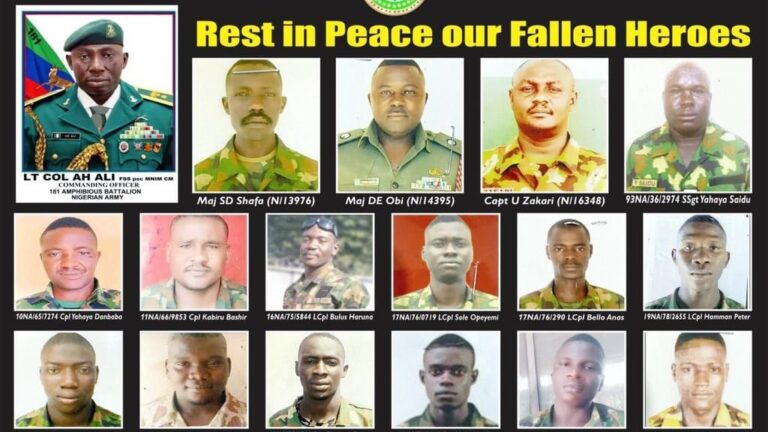
On Monday, March 18, the Defence Headquarters (DHQ) released the names of the Army personnel who were killed on Thursday, March 14, during a peace mission to Okuama.

The officers among the 17 soldiers killed are:

  • A.H Ali, a Lietenant Colonel 
  • S.D Shafa, a major 
  • D.E Obi, a major
  • U Zakari, a captain

The soldiers include:

  • Yahaya Saidu (#3NA/36/2974)
  • Yahaya Danbaba (1ONA/65/7274)
  • Kabiru Bashir (11NA/66/9853)
  • Bulus Haruna (16NA/TS/5844)
  • Sola Opeyemi (17NA/760719)
  • Bello Anas (17NA/76/290)
  • Hamman Peter (NA/T82653)
  • Ibrahim Abdullahi (18NA/77/1191) 
  • Alhaji Isah (17NA/76/6079) 
  • Clement Francis (19NA/78/0911)
  • Abubakar Ali (19NA/78/2162)
  • Ibrahim Adamu (19NA/78/6079) 
  • Adamu Ibrahim (21NA/80/4795)

The ICIR reported On Sunday, March 17, that the Okuama community had been razed.

Residents of the state, including former governor James Ibori, who confirmed this development, shared the video of the arson on Saturday, March 16. 

No group has taken responsibility for the arson. 

Dangote earns over 50% profit from every ₦1 cement sales

DANGOTE Cement Plc earns over 50 per cent profit from every ₦1 sales on its product, The ICIR can report.

An analysis of the company’s five-year financial statements, relative to BUA Cement Plc and Lafarge Africa Plc, revealed that Dangote Cement had consistently earned over 50 per cent profit from every ₦1 sold.

Nigerians are already suffering from the increasing cost of cement, which has skyrocketed recently and is fuelling the rise in rentals and the cost of construction in the building industry.

Dangote Cement is owned by Africa’s richest person, Aliko Dangote; Abdulsamad Rabiu owns BUA Cement; and Holcim Group, a Swiss multinational company, controls Lafarge Africa.

The price of a 50-kilogram bag of cement has risen above ₦10,000 and is getting towards ₦15,000, raising severe concern as most building projects suffer setbacks and landlords gradually increase rents.

In analysing the cement giants’ audited financial statements for 2019 to 2023, The ICIR discovered that Dangote earned more revenue than it spent on production costs as its gross profit margins stayed above 50 per cent.

A gross profit margin is a percentage of a company’s revenue that it retains after subtracting direct expenses, such as labour and materials. It is a vital profitability measure that looks at a company’s gross profit compared to its revenue.

In 2019 and 2020, Dangote Cement earned over ₦0.57 from every ₦1 sales, ₦0.60 in 2021, ₦0.59 in 2022, and ₦0.54 in 2023.

Simply, at a ratio of 60 per cent in 2021, it means for every ₦1 generated, Dangote Cement retained ₦0.60 and attributed ₦0.40 to its cost of sales.

The cost of sales includes all the expenses directly related to producing the goods.

Over the review years, Lafarge Africa increased its gross profit margins to above 50 per cent. In 2019, the company earned ₦0.26 in revenue from every ₦1 sales; it rose to ₦0.47 in 2020, ₦0.49 in 2021, ₦0.53 in 2022, and down to ₦0.51 in 2023.

BUA Cement had not only stayed below 50 per cent in revenue from every ₦1 sales but had also reported relatively steep gross profit margins. It moved from ₦0.47 in 2019 to ₦0.46 in 2020, ₦0.47 in 2021, ₦0.45 in 2022 and ₦0.399 in 2023.

Late last year, BUA Cement initiated a price slash in the bag of cement from about ₦5,500 to ₦3,500.

Experts have told The ICIR that the much-anticipated reduction in the price of a bag of cement to N3,500 by BUA Cement, effective October 1, 2023, would have had immediate and far-reaching benefits. However, the reverse had been the case, as the company’s cement price had increased significantly.

The group head of corporation communications at Dangote Industries Limited, Anthony Chiejina, did not pick up calls and has yet to respond to an enquiry about the company’s cement product hike.

The head of corporate communications at Lafarge Africa, Ginikanwa Frank-Durugbor, responded, “While limestone which is part of our raw materials is locally sourced, we do have significant exposure on other raw materials that are imported or impacted by FX (foreign exchange) including gypsum, gas, spare parts and other ancilliary input costs and services necessary for our operations in Nigeria.

“At Lafarge Africa Plc, we remain committed to ensuring our products are available for our customers at the right price. We maintain our promise of ensuring the consistent quality of all our products and solutions.”

The ICIR could not reach BUA Cement for comment on the continous price hike despite the company’s announcement of price slash.

The table below shows the three cement companies’ revenues, cost of sales, gross profit and calculation of the gross profit margins for the review years.

Dangote Cement Plc (figure in N’m)
2023 2022 2021 2020 2019
Revenue 2,208,090 1,618,323 1,383,637 1,034,196 891,671
Cost of Sales 1,006,278 662,890 551,019 437,970 379,989
Gross Profit 1,201,812 955,433 832,618 596,226 511,682
Margin 0.54427673 0.59038461 0.60176043 0.57651161 0.57384618
Lafarge Africa Plc (figure in N’000)
2023 2022 2021 2020 2019
Revenue 405,502,712 373,244,938 293,086,183 230,572,922 212,999,066
Cost of Sales 198,786,889 177,023,232 150,505,605 121,716,515 157,046,768
Gross Profit 206,715,823 196,221,706 142,580,578 108,856,407 55,952,298
Margin 0.50977667 0.52571833 0.48648004 0.47211271 0.262688
BUA Cement Plc (figure in N’000)
2023 2022 2021 2020 2019
Revenue 459,998,999 360,989,105 257,327,091 209,443,487 175,518,326
Cost of Sales 276,043,486 198,379,891 136,402,954 113,964,695 93,075,293
Gross Profit 183,955,513 162,609,214 120,924,137 95,478,792 82,443,033
Margin 0.39990416 0.45045463 0.46992385 0.455869 0.46971182
Data source: Dangote, BUA and Lafarge Africa’s financial statements, 2019-2023

Reps summons Dangote, BUA

On Wednesday, March 13, the House of Representatives raised a motion to summon the major cement manufacturers before its committee to deliberate on ways out of the hardship arising from the high cost of cement.

The lawmakers are concerned that despite all the raw materials and other factors of cement production being sourced locally, the price keeps rising, questioning the rationale for the arbitrarily increasing costs.

The motion, ‘Arbitrary increase in cement price by cement manufacturers in Nigeria,’ was moved by Gaza Gbefwi from Nasarawa State and Ademorin Kuye from Lagos State.

Gbefwi argued that cement manufacturers have increased the price of their products by up to 50 per cent, leading to sharp hikes in building blocks, the cost of building, and consequently, the price of rent across the country.

The raw materials for the manufacturing of cement, including lime, silica, alumina, iron oxide, and gypsum, are all sourced locally and could not have been affected by exchange rate volatility, The ICIR reports.

Gbefwi continued that factors and elements of cement production were sourced locally and have not changed significantly year-on-year, stressing that cement manufacturers are capitalising on exchange volatility to arbitrarily increase the product’s price while the production cost has stayed the same since last year.

(See the table for the relative changes in cost of production, otherwise known as cost of sales).

He alleged that a small but powerful “cement cabal” was unconsciously inflicting hardship on Nigerians as rent prices and associated services increased.

After other members’ contributions, the Lower Chamber mandated its Committees on Solid Minerals Development, Commerce, Industry and Special Duties to investigate the arbitrary increase in the price of cement by manufacturers in the country like Dangote Cement and BUA Cement.

‘Hike in cement price has started to impact on rentals’

A real estate expert and facility manager, Stephen Jagun, told The ICIR that the surging price of cement is already forcing landlords to increase their rentals.

He lamented that the cement price hike negatively impacts rentals even in the short run.

“As we speak, more people are graduating, getting married, getting jobs, and needing accommodations. Demand for accommodation is rising, but supply has been inadequate. Supply will now be pressured by demand, and in that situation, rent will increase, which is already occurring.

“Rent is becoming outrageous, particularly in the lower sector. If you increase my rent in Ikoyi, I will go to the next neighbourhood closer to Ikoyi if I can’t afford it.”

Jagun explained that demand for accommodation would continue to push rentals for people living in places like Ikorodu, Agege, Egbeda and other lowbrow areas in Lagos State.

“In most of those places, the landlords take the rule to their hands. If you don’t pay quickly, they quit you because somebody would even be waiting to occupy the place and pay more.

“On the rich axis, it is either you remain there if you can still afford it, but if you don’t want to be embarrassed, you quickly leave for cheaper accommodation elsewhere.”

The Lagos State Government plans for one-month rentals, but Jagun said the initiative might fail. “You (Lagos State) are not supplying, and you want to dictate the rent; that plan will create a black market.”

He noted that cement prices have spiked, and every building material cost has risen equally.

He asserted that most construction works have been put on hold due to increasing building materials costs.

“What most contractors do now is to request the owner of the job to provide the materials and pay them for their labour,” adding that others have resulted in using old stocks that could be remodelled.

We got no formal notice of SSANU/NASU’s strike – FG

0

THE Federal Government has expressed displeasure over the seven-day warning strike by the Senior Staff Association of Nigerian Universities (SSANU) and the Non-Academic Staff Union of Educational and Associated Institutions (NASU).

The government through a statement issued on Monday, March 18,  in Abuja, by the Minister of State for Labour and Employment, Nkeiruka Onyejeocha, said it received no formal notice on the strike and appealed to the unions to call off the strike and give room for dialogue.

The statement, signed by the Director of Press and Public Relations in the ministry, Olajide Oshundun, quoted the minister describing the strike as a total disregard for the Federal Government’s concerted effort to address their concern.

The ICIR reported that the Joint Action Committee of SSANU and NASU on Friday, March 15, directed its members to embark on a seven-day warning strike over their withheld salaries.

It urged the unions’ members to adhere strictly to the directive, noting that the developments during the seven days would determine the next call of action.

Read Also: 

Withheld salaries: SSANU, NASU begin nationwide strike today

SSANU, NASU threaten strike over withheld salaries

SSANU, NASU suspend strike, ASUU adamant

The committee had on March 1, threatened to embark on strike over the withheld salaries, raising concerns about the Federal Government’s decision to release four months of similar withheld salaries to members of the Academic Staff Union of Universities (ASUU) while refusing to release those of the non-academic staff.

The ICIR reports that the administration of former President Muhammadu Buhari withheld ASUU members’ salaries when it invoked a ‘no work, no pay’ policy during an industrial action by the lecturers that lasted eight months, from February 14 to October 14, 2022.

The lecturers subsequently suspended the strike following a court order initiated by the Nigerian government.

Similarly, SSANU and NASU embarked on strike for five months between April and July 2022, to compel the Nigerian government to meet its demands as ASUU.

The Buhari government also invoked the ‘no work, no pay’ policy on the striking non-teaching university workers as their ASUU counterparts.

However, in October 2023, President Bola Tinubu pledged to pay four of ASUU’s withheld eight months’ salaries, with the union confirming the commencement of the payment in February.

The Tinubu government has been mum on the SSANU and NASU’s fate, prompting the unions to begin a seven-day warning strike on Monday, March 18.

Reacting to the strike in a statement, the Minister of State for Labour and Employment, Nkeiruka Onyejeocha called on the leadership of the two unions to shelve the action.

According to her, the ministry was not officially notified by the unions of their intention to proceed on the warning strike.

“This is contrary to the provisions of section 18 of the Trade Dispute Act. The ministry got wind of the intended warning strike and it reached out to the leadership of the unions for an emergency meeting in order to avert the strike.

“Unfortunately, a physical meeting could not be arranged between the unions and the Federal Government, but a tele-discussion took place between their leadership and the ministry,” she said.

Onyejeocha also said that the ministry consequently suggested another date – Monday, March 18 – for a proper conciliation meeting, adding that she had hoped that the intended strike would be put on hold pending the outcome of the meeting but the date was rejected by the unions.

The minister, however, maintained that the strike did not serve any useful purpose and should only be resorted to as a last option after exhausting every conciliation effort.

After ICIR report, Rivers dissolves task force, revenue agents

0

THE Rivers State Signage and Advertisement Agency (RISAA) has dissolved all revenue collection agents and task force teams in the state following an investigation by The ICIR.

The investigation, published on Thursday, February 29, revealed how billions being generated as road tax in the state were being pocketed by private individuals.

The RISAA Managing Director, Aye Pepple, announced the dissolution, which took effect immediately, in a statement on Friday, March 15.

“The Rivers State Signage and Advertisement Agency (RISAA) hereby announces the dissolution of all task force, revenue agents, consultants, contractors and representatives doing business on behalf of the agency with immediate effect.

“Furthermore, there will be a revalidation exercise, which commencement date will be communicated to all affected parties, and until this exercise is concluded, the public is advised not to engage in any dealings with anyone on behalf of the agency,” the statement read.

The ICIR reported that at least N55.2 billion was being generated from 62,418 commercial vehicles, 24,432 tricycles and 10, 892 motorcycles in road taxes within the state yearly.

The report also revealed that only 0.41 per cent of this sum got into government coffers, with the rest pocketed by members of a transport union and community touts.

Based on the sum being generated by the transport union, Rivers State Inland Revenue Service (RIRS) was expected to generate at least N2.2 billion from commercial vehicles annually. However, it only reported N223.93 million in road tax throughout 2022.

According to the report, several groups are responsible for the diversion of these funds, including the National Union of Road Transport Workers (NURTW), which reported only a fraction of the taxes collected.

Drivers who refused to pay these taxes were usually beaten or had their vehicles, tricycles or motorcycles confiscated.

Charges imposed on drivers by these groups contributed to the rising cost of transportation in the state.


Court orders Binance to provide data of Nigerian users to EFCC

0

A FEDERAL High Court in Abuja has ordered Binance, a cryptocurrency exchange platform, to provide data of its Nigerian users to the Economic and Financial Crimes Commission (EFCC).

The judge, Emeka Nwite, gave the interim order after ruling on the ex-parte motion moved by the EFCC’s lawyer, Ekele Iheanacho.

The application was filed on February 29.


Read Also:

“That an order of this honourable court is hereby made directing the operators of Binance to provide the commission with comprehensive data/information relating to all persons from Nigeria trading on its platform,” the judge declared.

According to the News Agency of Nigeria (NAN), a certified true copy of the ruling delivered on February 29 was sighted on Monday, March 18, and the interim order was issued to help the EFCC investigate money laundering claims and terrorism financing against the platform.

An EFCC agent, Hamma Bello, stated in the affidavit supporting the motion that he was a member of the commission’s Special Investigation Team (SIT) based in the Office of the National Security Adviser (ONSA).

Bello said that the SIT was notified of the illicit activities (money laundering and financing of terrorism) of Binance after the ONSA established the Technical Committee on Currency Stability and Forex Manipulation.

“The team uncovered users who have been using the platform for price discovery, confirmation and market manipulation, which has caused tremendous distortions in the market, resulting in the naira losing its value against other currencies.

“The damage the platform has caused was clearly explained to the operators of the platform, and they were requested to delist the naira and avail the ONSA on the activities of Nigerians on their platform.

“That from the information afforded to the team by Binance shows that the total trading volume from Nigeria in 2023 alone stood at $21.6 billion,” Bello said in the ex-parte motion marked: FHC/ABJ/CS/259/2024.

He also stated that the group discovered some individuals whose actions on Binance caused the nation’s currency to depreciate, compared with ther currencies.

Bello argued that the information would help the panel complete its inquiry and that the issue was of public interest.

He said granting the application was in the best interest of justice and doing otherwise would impede the commission’s investigations.

The ICIR reported on March 5 that Binance has pulled its services out of Nigeria.

The platform asked Nigerians trading on it to remove all their naira assets, indicating that it is terminating its services in the country.

The Federal Government has been taking harsh measures against Binance management recently. 

In response to the severe actions taken against it by the Nigerian government, Binance, on Tuesday, March 5, deleted all assets linked to the naira.

Binance’s CEO, Changpeng Zhao, was threatened with an arrest order on Monday, March 4, by the House of Representatives.

This was after the ONSA had arrested two executives from Binance in Nigeria in the preceding week while responding to an invitation from the Nigerian government.

The company’s representatives were summoned to testify before the House committee but did not respond.

The committee’s chairperson, Ginger Onwusibe, stated that the members had decided not to receive any representation from anyone other than the Binance executives.

The government has asked the cryptocurrency platform to pay $10 billion to settle claims that it manipulated foreign exchange rates and depreciated the value of the naira relative to the dollar.


Terrorists abduct ’87’ in fresh Kaduna attack

0

TERRORISTS have reportedly whisked away 87 people in the Kajuru Local Government Area (LGA) of Kaduna State.

The attack occurred between the night of Sunday, March 17 and the morning of Monday, March 18, after the terrorists allegedly launched onslaughts on two communities of Gangere and Aguna under the Kufana District of the Kajuru LGA.

Attempts by The ICIR to get the details of the attack from the Kaduna State Police Command spokesperson, Mansir Hassan, were unsuccessful as he neither picked up calls nor responded to messages sent to his mobile line.


Read Also:

However, confirming the incident, one of the communities’ youths, Harisu Dari, told the Punch hours after the attack that the terrorists broke into several shops, stole food supplies and other valuables, and whisked away 87 residents.

According to Harisu, there has been no communication with the kidnapped residents and their captors.

“As of the time I visited the community this morning, security operatives have not been drafted to help restore the confidence of the villagers.

“The villagers are traumatised by the sad development. The government needs to re-strategise in tackling these terrorists,” he said.

The ICIR reports that the attack is the latest incident of insecurity in Nigeria. On March 16, this organisation reported that despite promises of security, 703 persons were abducted within eight days under President Bola Tinubu.

On Sunday, March 3, some women were abducted by terrorists on their way to the bush to get firewood in Borno State.

They were reportedly swooped upon by gunmen in the Bula Kunte Bush, in Ngala Town, where the bandits freed older people among them and went away with the younger women.

Amnesty International (AI) claimed that more than 400 displaced people were abducted in Borno State in the first week of March.

On Thursday, March 7, a school teacher, Sani Abdullahi, said at least 287 students and a principal, Abubakar Isah, were abducted when bandits invaded the Local Education Authority (LEA) Primary and Junior Secondary School, Kuriga, in Chikun Local Government Area of Kaduna State.

Abdullahi said this when the state Governor Uba Sani and some other state officials visited the school hours after the abduction.

He said 187 students were abducted from the secondary school section and 125 from the primary school section of the school, totalling 312 students.

Similarly, the Police in Sokoto confirmed to The ICIR on March 10 that bandits abducted 15 students and a woman in the state.

According to the police, the students were taken from the Gidan Bakuso area of Gada Local Government Area in the state.

Humanitarian reporting fellowship opens for journalists

THE New Humanitarian (TNH) has opened applications for its 2024 Humanitarian Reporting Fellowship for journalists based in the Middle East, Asia, Latin America, or Africa.

The fellowship offers applicants the opportunity to gain skills in reporting, framing, and presenting local stories for global audiences as part of The New Humanitarian’s global newsroom.

It will also run for six months, from May to November and fellows will experiment with multimedia reporting techniques and develop innovative reporting skills.

Read Also:

The TNH says the fellowship is part of its commitment to journalism that authentically represents the communities it serves while providing insight for policymakers, practitioners, government officials, and others interested in improving the lives of people in crises.

The New Humanitarian, for almost three decades, has put quality independent journalism at the service of the millions of people affected by humanitarian crises around the world.

A monthly stipend of US$2,500 will be provided to successful fellows. The deadline for application is March 31. Interested persons can apply here.   

FG begins N40bn mass metering programme in Army formations

THE Federal Government has commenced a N40 billion mass metering programme to end the era of estimated billing in the Nigerian Army formations nationwide.

Speaking during the flag-off of the metering exercise at the weekend, the Minister of Power, Adebayo Adelabu, said that the exercise would be in phases, with the Ikeja Cantonment in Lagos State being the first phase of the exercise.

He said the current exercise would last for six weeks.

Adelabu, in a statement issued on Sunday, March 17, explained that for the current exercise, the sum of N12.7 billion had been released out of a total of N40 billion for the project.

Read Also:

“The mass metering in Army formations nationwide will enable to us know what is consumed every month to ensure appropriate billings and ease of collections. The overall intention is to eliminate and make estimated billing a thing of the past.

“This is one of Mr. President’s objectives as contained in the renewed hope agenda to ensure that electricity supply to the Armed Forces is prioritised and they do not suffer especially in the enjoyment of public utilities,” he said.

Adelabu said the smart meters being installed were tamper-proof and would eliminate energy theft.

Speaking further, the minister said that part of the energy blueprint by the government was to build off-grid power sources such as solar energy for military barracks located in remote areas without grid supply, adding that the meters being installed allow interconnectivity between grid and off-grid solar power supply.

Adelabu said the metering project would be extended to all military formations in the country to provide a 24-hour power supply to the barracks.

In his remarks, the chief executive officer of De Haryor Global Service and engineer in charge of the metering project, Ashade Olatunbosun, said the second phase of the project would begin in Abuja and Enugu, simultaneously, adding that military formations across the 11 distribution companies (DisCos) would benefit from the exercise.

Welcoming the minister to the Army Headquarters during the launch,  A.M Adetuyi, a major-general, said the metering initiative was timely as the brigade headquarters had been facing an epileptic power supply over time.

He said “When I investigated, I found out that we were only being given three hours of electricity daily, and on some days, we do not even get supplied. We have tried to resolve this and we have even involved the state government without any result.

“We also discovered that we were always being given estimated bills, though we would not have minded if the power supply had been regular. However, this commendable metering project has gladdened our hearts.”

On February 20, The ICIR reported the Abuja Electricity Distribution Company (AEDC) threatening to disconnect electricity in the Presidential Villa, military formations across Nigeria, the Federal Inland Revenue Service (FIRS), and other Federal Government ministries, departments and agencies over their refusal to pay over N47 billion outstanding debts as of December 2023.

In the debtors’ list were the Chief of Defence Staff – Barracks and Military Formations owing N12 billion, Ministry of Finance, Ministry of State Petroleum, Ministry of Health, Ministry of Information, Ministry of Education and Ministry of Agriculture.

The list also contained the Ministry of Education, CBN governor’s office, Ministry of Foreign Affairs, Ministry of Budget and Planning, Ministry of Culture and Tourism, Ministry of Interior,  and Ministry of Transport.

Two days after the threat, power to barracks and other military formations was severed, leading to the decomposition of corpses at the Army mortuaries.