THE Organisation of Petroleum Exporting Countries (OPEC) and its allies’ resolve to deepen crude oil production cuts will make Nigeria’s proposed revenue from crude oil sales for 2024 unrealistic.
At a virtual meeting on Thursday, November 30, the cartel, known as OPEC+, announced additional voluntary cuts to 2.2 million barrels per day (bpd) to support the stability and balance of oil markets.
The voluntary cuts by its members are calculated from the 2024 required production level.
At the meeting, which was used to discuss 2024 output amid concerns that the market faces a potential surplus, the cartel said it would raise Nigeria’s production quota to 1.5 million bpd from 1.38 million bpd but that the 8.69 per cent increase would be subject to further consideration.
“In view of current oil market fundamentals, in accordance with the decision of the 35th OPEC and non-OPEC Ministerial Meeting, the completion of the assessment by the three independent sources (IHS, Wood Mackenzie and Rystad Energy) for production level that can be achieved in 2024 by Angola, Congo and Nigeria as follows: Angola at 1,110 t/bd, Congo at 277 t/bd and Nigeria at 1,500 t/bd,” OPEC+ said.
The ICIR reports that “t/bd” means ‘to be decided or to be determined’ as OPEC+ fixed its 37th meeting for June 1, 2024, in Vienna.
Pumping more than 40 per cent of the world’s oil production, the OPEC+ members agreed that Saudi Arabia extends its voluntary cut of one million bpd it has had in place since July; Russia cut its output by 500,000 bpd while other members also voluntarily reduced production, as the geo-political Israel-Hamas war had further increased tensions between many OPEC+ members and Western countries.
The cartel’s output of some 43 million bpd already reflects cuts of about five million bpd, but Nigeria and Angola have been resisting attempts to curb their production.
In June this year, OPEC+ cut Nigeria’s output target for 2024 to 1.38 million bpd from 1.74 million bpd for 2023, further making the country fail to meet its targets for years.
At its previous meeting, OPEC+ had agreed to give Nigeria a 2024 quota of 1.58 million bpd if it could pump that much subject to independent verification.
Tinubu’s 2024 crude oil benchmark unrealistic
At his budget presentation on Wednesday, November 29, President Bola Tinubu said his led administration had “adopted a conservative oil price benchmark of 77.96 US dollars per barrel and daily oil production estimate of 1.78 million barrels per day” after reviewing developments in the world oil market and domestic conditions.
The Federal Government also adopted a naira to US dollar exchange rate of N750/$1 for 2024, The ICIRreported.
It aggregated an expenditure of N27.5 trillion in the proposed budget, of which the non-debt recurrent expenditure is N9.92 trillion. Debt servicing is N8.25 trillion, and capital expenditure will gulp N8.7 trillion for the 2024 appropriation.
It is also uncertain if the economy will grow by a minimum of 3.76 per cent, above the forecast world average, and inflation – currently at 27.33 per cent – will moderate to 21.4 per cent in 2024, as projected by the government.
The budget deficit is projected at N9.18 trillion or 3.88 per cent of gross domestic product (GDP) in 2024, lower than the N13.78 trillion deficit in 2023, representing 6.11 per cent of GDP.
However, in an earlier report, The ICIR analysed that Nigeria’s daily crude production might fall below the 1.78 million bpd budgetary benchmark, according to the African Energy Chamber (AEC) in its ‘The State of African Energy 2024 Outlook’ report.
The AEC projected Nigeria’s daily crude oil output to be 1.51 million bpd 2024. So, compared to the 1.78 million bpd budgetary benchmark, it will represent a 270,000 per day crude oil production shortfall and an N21.05 million daily revenue loss.
Despite the OPEC+ quota reduction system, Nigeria has not met its daily crude production target.
The Federal government and NNPCL blamed low production output on pipeline vandalism, militancy, and other insecurity as oil production declined.
In October, the country’s oil production stood at 1.35 million bpd, the highest production level since the beginning of the year and the most considerable volume since January 2022.
Nigeria opposes oil cut
While Saudi Arabia shoulders the burden of slashing its output by one million barrels a day since July this year, Nigeria contrarily rejected OPEC’s oil quota cut.
Ahead of the OPEC+ meeting on Thursday, November 30, Saudi Arabia and its partners had struggled to agree on oil output quotas for 2024.
The meeting initially set for Sunday, November 26, was delayed four days as Nigeria and Angola opposed a reduction in their crude oil production quotas.
Bloomberg analysts believe that if the OPEC+ don’t reach an agreement, a looming supply surplus could crash crude prices, which would batter the coffers of the 23-nation coalition, which relies on oil revenue to cover government spending.
The Saudi-led alliance had yet to reach an agreement with Angola and Nigeria, which were pushing back against lower quota limits for 2024 that reflect their diminished production capabilities.
In particular, Saudi Arabia, which has been making a voluntary oil production reduction of one million barrels per day since July, is asking other coalition members to reduce their quotas to share the burden of cuts.
But Nigeria and Angola are disputing changes to their oil production targets provisionally agreed upon when OPEC last met in June.
Nigeria is now seeking a quota of 1.58 million barrels per day for 2024, a slight increase from the provisional level.
When the group last announced cuts in April, just nine countries participated. Many others had lost so much production capacity and revenue in recent years that they couldn’t afford to cut further.
Nigeria’s share in global oil sales, contribution to GDP
Nigeria’s oil sector contribution to GDP has declined while its debt portfolio has risen. A quick look at statistics shows that the oil sector’s contribution to GDP slumped from 6.63 per cent in the first quarter (Q1) of 2022 to 4.43 per cent in the fourth quarter of the same year.
In Q1 2023, it increased to 6.21 per cent, plunged to 5.34 per cent in the second quarter, and settled at 5.48 per cent in the third quarter.
The analysis shows Nigeria’s crude oil production to the global volume has recently declined.
Nigeria’s oil contribution to GDP
The ICIR, in its recent report, stated that the entire African-producing oil nations’ 2023 – 2024 output is expected to stay relatively flat at about 6.77 million bpd.
Month-on-month production looks bleaker, with production expected to decline from 6.9 million bpd in January 2024 to approximately 6.62 million bpd in December 2024.
Global output is expected to total more than 84 million bpd next year, a 1.6 per cent increase over 2023.
While the American nations, both north and south combined, are expected to see a marginal four per cent growth in output year over year in 2024, the Middle East is expected to see a more negligible two per cent growth over 2023 output.
Crude oil revenues projections decline over the years
There has been a gradual decline in projected oil revenues since 2022 and recurrently since 2010.
For instance, the Federal Government’s share of oil revenue expected to fund the 2023 budget was estimated at N1.86 trillion, less than the N2.19 trillion of the revised 2022 budget.
The percentage contribution to total revenue in the last three years showed an oil revenue to total revenue proportion of 25.18 per cent in 2021, 21.97 per cent in 2022, and 22.01 per cent in the 2023 proposed call (see chart above).
Production estimate output was 1.8 million bpd in 2020 from 2.3 million bpd in 2019. It was 1.86 million bpd in 2021 and 1.6 million bpd in 2022. In 2023, projected oil production is estimated at 1.69 million bpd.
FIGHTING resumed on Friday, December 1, between Israel and Hamas, following the expiration of the pause observed by both parties.
There was heavy fighting across the Gaza Strip as military personnel resumed operations after failed efforts to extend the truce.
In a post via its official X handle on Friday, the Israel Defence Forces (IDF) announced the resumption of combat operations, stating that Hamas had violated the pause.
“Hamas violated the operational pause and, in addition, fired toward Israeli territory. The IDF has resumed combat against the Hamas terrorist organization in Gaza,” the post read.
Israeli Prime Minister Benjamin Netanyahu disclosed that Hamas refused to release more hostages, which was contrary to the terms of the truce.
Both parties agreed on Tuesday, November 21, to observe a pause in fighting, which would commence on Thursday, November 23, to allow for the release of hostages held since the war began on October 7.
Israel had described the pause as a “lull in fighting,” and it was reported that about eight Palestinians were killed in the West Bank area by Israeli forces during the truce.
The truce had been renewed twice before it ended on Friday.
“With the resumption of fighting, we emphasise, the Israeli government is committed to achieving the goals of the war – to free our hostages, to eliminate Hamas, and to ensure that Gaza will never pose a threat to the residents of Israel,” Netanyahu’s office stated.
According to the Ministry of Health in Gaza, at least 21 people were killed as the war between Israel and Hamas resumed on Friday.
THE Federal Government has raised N585 million to settle fines for inmates languishing in various correctional centres nationwide.
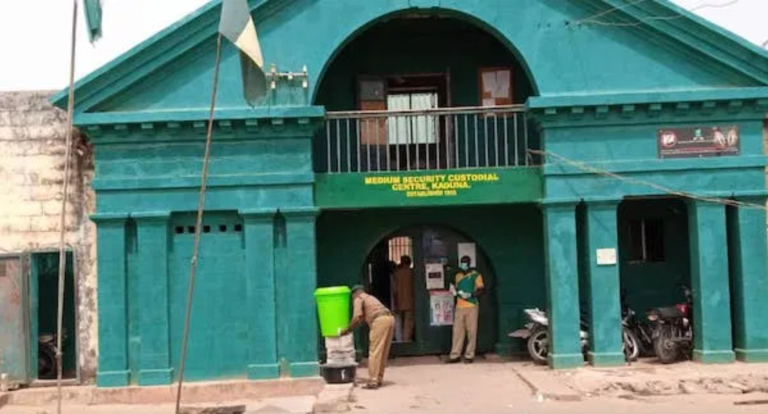
The Minister of Interior, Olubunmi Tunji-Ojo, gave the update on Thursday, November 30, during the release of 150 inmates from the Maximum Security Custodial Centre, Janguza, in Kano state, according to a report by the Punch.
He stated that the inmates were among the 4,068 prisoners the government intended to pay off their fines and allow them to return home.
The ICIRreported that Tunji-Ojo had, on Saturday, November 17, flagged off an initiative at Kuje prison in Abuja and revealed the Federal Government’s plans to settle a sum of N585 million in fines to release 4,068 inmates nationwide.
He said the intention was to decongest custodial centres to enable proper reformation and rehabilitation of offenders to take place.
“Most of the inmates are indigents who cannot afford to pay their fine (and) languishing in custody. The total fund of N585 million was raised by corporate bodies as corporate social responsibility (CSR) for this purpose,” the minister said.
He also said the initiative would only benefit inmates with fines below N1 million.
Represented by an assistant director in the Ministry of Interior, Anayo Romanus-Nzekwe, during the release of the 150 inmates, Tunji-Ojo reiterated that the Federal Government was out to clear over N500 million fines and free the inmates.
“The released inmates were sentenced to various terms of imprisonment with the option of fine and compensation and could not afford to pay their fines and are languishing in custody.
“The sum of N13.4 million was spent in Kano state out of the N585 million raised by philanthropic individuals, groups, and corporate bodies, as part of their corporate social responsibility, for this purpose nationwide,” he said.
Tunji-Ojo further disclosed that each freed inmate was given N10,000 to enable them to return to their various homes and villages.
He urged the inmates to stay off crimes, abide by the instructions and training they received while in custody, and be good ambassadors in their communities.
As of November 27, 2023, data from the Nigerian Correctional Service (NCS) showed that there were 80,461 inmates convicted and awaiting trials, consisting of 78,675 males and 1,786 females, in the 240 custodial centres spread across the 36 states and Federal Capital Territory.
While 25,399 (24,953 male and 446 female) had been convicted for various offences, 55,062 (53,722 male and 1,340 female) were awaiting trials.
The NCS had in 2021 said the correctional centres combined could only take 50,083 inmates.
A FEDERAL High Court in Ikoyi, Lagos, has adjourned the alleged fraud trial of Nigerian singer Azeez Fashola (a.k.a Naira Marley) to March, 2024.
This was disclosed in a statement issued by the Economic and Financial Crimes Commission (EFCC) via X on Friday, December 1.
The singer is standing trial on an 11-count charge bordering on conspiracy and credit card fraud brought against him by the EFCC.
According to the EFCC, one of the credit card details found on a device belonging to the singer had been flagged by Visa, a card payment platform.
“The 10th prosecution witness (PW10) on Thursday, November 30, told Justice Nicholas Oweibo of the Federal High Court Ikoyi, Lagos, how Visa, a card payment platform, flagged one of the credit card details found on a device belonging to the singer, due to fraudulent transactions,” the statement said.
Led in evidence by the attorney for the prosecution, Bilikisu Buhari, an investigator with the EFCC, Dein Whyte (PW10), said: “As part of the findings from the investigation, forensic analysis revealed that malicious programmes that are being used to illegally obtain credit card information, which can be used for card non-present transactions, were found on the device that was recovered from the defendant upon his arrest.”
Whyte also revealed that tools used to confirm the authenticity, current status, and accuracy of credit card details and the location of the card’s issuer were found on the defendant’s device.
The analysis also identified the webpage he had visited on his computer through the defendant’s browser history. Among the websites are ones where credit card numbers are exchanged unlawfully.
He went on to say that the defendant’s credentials, name, and email address were registered on both the phone and the laptop found on him.
“With respect to the card details recovered from the device of the defendant, investigations revealed that he also exchanged those details with other persons,” Whyte answered when the prosecution’s lawyer questioned him about the outcome of his investigation into the credit card information on the defendant’s device.”
He added that one of the cards was reportedly fraudulently used for a transaction by Visa.
According to him, the card details in the defendant’s device neither belonged to him nor were issued to him by any financial institution,” the statement added.
The EFCC said while under cross-examination by the defendant’s counsel, Olalekan Ojo, Whyte informed the court that a letter of investigation was written to Visa and confirmed that the card had been flagged for fraudulent transactions.
But he added that because the investigation was on the card and not the device used for the fraud, Visa did not connect the defendant’s device to the credit card fraud.
Besides, he emphasized that Visa is a payment platform rather than a telecom provider.
The judge, Nicholas Oweibo, adjourned the case to March 6 and 7, 2024, to continue the trial.
Marley is facing an 11-count charge, including conspiracy and credit card fraud, brought against him by the EFCC.
The ICIR reported that Marley and Lagos socialite Balogun Eletu, also known as Sam Larry, regained freedom on Friday, November 17, after spending over 40 days in Police custody.
Marley and Larry were arrested and detained upon their return to Nigeria in connection with the death of musician Ilerioluwa Aloba, popularly known as Mohbad.
Marley was arrested on October 3, 2023, while Larry was arrested on Thursday, September 29, 2023.
The Lagos state Police command public relations officer, Benjamin Hundeyin, said they were released after meeting their bail conditions.
Hundeyin confirmed this to The ICIR in a text message, noting the two were released around 5 p.m. on Friday, November 17.
Their release came 12 days after being granted bail on the condition that they must provide N20 million bond with three sureties and submit their international passports.
The court also ordered them to make weekly appearances at the State Criminal Investigation Department (CID).
The ICIR reports that following the arrest, the two were charged with accusing and harassing the deceased singer by the Lagos State Police Command and taken into custody.
However, both Marley and Sam Larry sternly denied having a hand in the singer’s death.
Oil theft has ballooned into a mega-organised crime in Nigeria, involving various stakeholders; in this three-part report, Anayochukwu Agbo looks at the different angles.
“They call me ‘Engineer’. I have never gone to school, but I have the capacity to even go under the water and attach a pipe to an oil pipeline….”
When the unexpected visitors arrived, *Ibelema Ekiyor was mending his fishing nets at the back of his village home on the banks of River Nun. Some wore different military uniforms. Some wore Ijaw traditional clothes, and others dressed in casual, expensive wear. He had never seen any of them before. They were strangers.
Their leader knew the terrain well. He spoke the Izon Language and whispered to him they had come to see him. He did not have enough seats to go around, but they did not mind. Their mission was more urgent.
The leader of the uniformed men took control after the preliminaries. “We hear that you have stopped this thing that all of us used to chop from. If you don’t come back and continue this job, we will arrest you and put you on national television and tell Nigerians that we have arrested the king of oil theft.”
He did not pretend not to understand what the officer was talking about. He is a retired staff of Shell Petroleum Development Company, SPDC. He was trained in underwater welding and was the best in the department. But at a time, Shell retired him young as emerging technology took over specialised jobs. He had obligations to his family and had to hustle for livelihood. Those in Shell who knew his unrivalled skills in underwater welding gave him referrals to independent businessmen in the Niger Delta.
They made him offers from time to time to do what he was doing for Shell for them, and they took care of him. The money was good. He found himself helping oil thieves to graft illegal pipes onto the Shell pipelines. He did not ask too many questions. He just did his work and minded his business. No one appeared to be hurt.
However, Shell was hurting. And Nigeria, too. They were losing a large volume of crude oil to unknown oil thieves. The expertise deployed by the bunkerers in the successful breaching of pipelines suggested that insiders were involved. After a staff audit, it occurred to them there were idle artisans who could be available to dubious businessmen. The Company knows how to handle conflict with the natives in the creeks.
Like the present visitors, the company’s representatives visited him one day. They apologised for neglecting him. “Please, don’t do it again. We will pay you one million Naira monthly so that you can rest,” they offered.
That was fair enough. He agreed and stayed off the pipelines. He concentrated on fishing to keep fit and earn extra income. But just one month after stopping the illegal hustle, these security men and their business counterparts have brought another complication: a threat and blackmail.
There are many of them who worked in oil companies in the Niger Delta. They had been trained to do this job. But they are not maintained when retired. They do not take away the skills from them so they can deploy the knowledge to help themselves. That capacity exists that Ibelema does it.
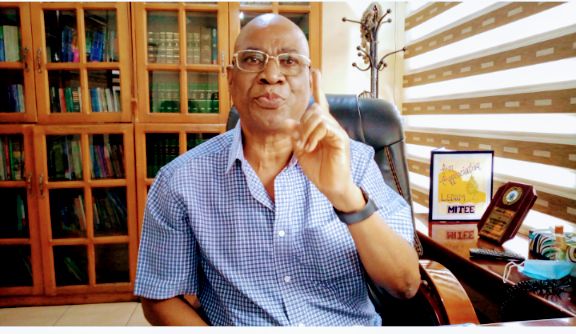
He shared his story with a federal government committee led by then Nigeria Extractive Industries Transparency Initiative, NEITI, Chairman, Ledum Mitee. According to Mitte, a lawyer and veteran of the Niger Delta struggle, Ibelema posed the question to the Committee, “What should I do in the circumstance?”
That was Catch-22. Fredrick Forsyth calls it the devil’s alternative, “whichever one you choose, men must die.”
“We looked at ourselves. We couldn’t answer the question. What do we tell a young man who was blackmailed into doing what he didn’t want to do because the security agencies are co-beneficiaries in what he was doing? So that explains to you the level of the rot in the system and why oil theft may never stop in Nigeria,” says Mitte.
Ledum Mitee, ““We looked at ourselves. We couldn’t answer the question.”
How oil theft started in Nigeria
Oil theft, presently glamourised as illegal oil bunkering, started under the military regime. The first barrel of oil was drilled in Oloibiri, Bayelsa State, in 1956. Ten years later, Nigeria went into a civil war, which lasted till 1970. Yakubu Gowon, a general, was the military head of state of Nigeria till 1975 when he was overthrown in a military coup d’etat
Oil theft first appeared in Nigerian law in 1975. The Petroleum Production and Distribution (Anti-Sabotage) Act 1975 mentions pipeline sabotage and provides penalties, including the death penalty for offenders. But at this time, the focus was pipelines conveying petroleum products, not crude oil. The possibility of crude oil theft emerged in 1984, and the deterrent appeared in The Crude Oil (Transportation and Shipment) Regulation 1984. This law targeted ships, tankers and vessels engaging in unauthorised loading of crude oil within Nigeria or outside any loading ports or terminals in Nigeria.
From this shadowy possibility in 1984, oil theft became a logical reality during Ibrahim Babangida’s regime in 1987/88. A professor of Virology and then minister of petroleum and energy, Tam David West, estimated that Nigeria was losing N10 million annually to crude theft.
A prince of Kula Kingdom, a riverine oil-producing community in Rivers State, Anabs Sara Igbe, has been monitoring oil theft for years. He said oil theft gathered substantial critical mass during the military regime of Sani Abacha. Indeed, he sees Abacha’s regime as the beginning of oil bunkering in the Niger Delta, as it is known today.
How did oil bunkering start? He traces it to when Abacha called out Nigerian youths for the Two-Million-Man March organised by Daniel Kanu to drum up support for his self-succession plan under the vehicle of Youths Earnestly Ask for Abacha, YEAA.
Sara Igbe, “Niger Delta youths couldn’t understand what it means that their development was in the pipeline; so they broke the pipeline and found crude oil.”
“During the march, they saw money; they saw Abuja; they came home to the Niger Delta and demonstrated. The Nigerian government told them the development of the Niger Delta was in the pipeline! They couldn’t understand what it meant that their development was in the pipeline. So they broke the pipeline and saw crude oil. Black gold! That was how they started, in a small way, until the cartel came and high-jacked it from them. That is where we are,” recalled Sara Igbe
By 2013, the Goodluck Jonathan administration put the volume of crude losses at about 150,000 barrels per day. On August 29, 2019, the Ad-Hoc Committee of the National Economic Council (NEC) on Crude Theft revealed that Nigeria lost about 22 million barrels in the first six months of 2019. The cost was put at $1.35 billion. That was the equivalent of five per cent of the year’s budget. According to NEITI, between 2009 and 2019, Nigeria lost 138.4 thousand barrels of crude oil every day, representing seven per cent of average production of two million b/d.
According to NEITI, between 2009 and 2018, Nigeria lost over 505 million barrels of crude oil valued at $40.06 billion and 4.2 billion litres of refined petroleum products worth $1.84 billion respectively, making a total of $41.9 billion. This means that on the average, Nigeria lost $11.47 million daily, $349 million monthly, and $4.2 billion dollars every year for the 10 years.
In the 2020 budget speech at the National Assembly, President Muhammadu Buhari revealed that oil revenues fell below target by 49 per cent as of June 2019. He attributed this to “lower than projected oil production, deductions for cost under-recovery on supply of premium motor spirit (PMS) as well as higher expenditures on pipeline security/ maintenance.”
NEITI reveals that “Pipeline repairs, a direct consequence of vandalism, is a major index of losses in the oil industry. For three years covering 2014-2016, total expenditure on pipeline repairs was N363 billion.”
Put together, NEITI says that between 2009 and 2018, a total of 488,558,873 barrels (488.6 million barrels) of crude oil was lost to theft and sabotage. The Agency observes, “One pattern that seems to occur with disturbing regularity is the sudden spike in volume of losses after two to three periods of comparable values. These extraordinarily high volumes occurred in 2009, 2013 and 2016.”
“Crude oil losses declined to 32.5 per cent between 2014 and 2015 but spiked to the highest percentage increase of 272.6 per cent between 2015 and 2016. This period was described by NEITI as “a period of heightened sabotage activity in the oil producing region.” The Agency equally noted, “The fact that the lowest percentage change was above 30 per cent shows the high volatility in crude oil losses.”
NEITI figures may be well below the actual volume of crude oil Nigeria is losing daily. Sara Igbe puts the loss to about one million barrels daily. He should know better. He lives in the creeks. He knows the spread of the pipelines and the futility of surveillance by compromised security operatives.
Dimensions of oil theft
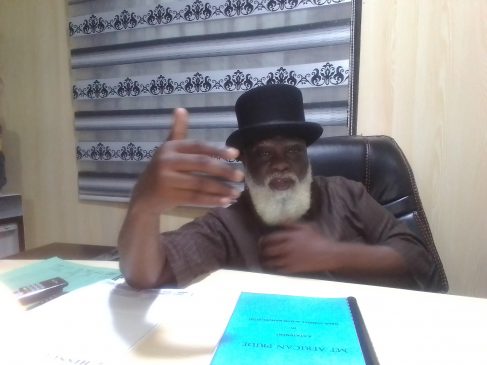
A retired rear admiral and former commander of the Eastern Naval Command of the Nigerian Navy, A.I. Bob-Manuel, when MT African Pride, an all foreign crew standard oil tanker, was arrested on October 8, 2003, describes the dimensions of oil theft as “The Iniquitous Triad.”
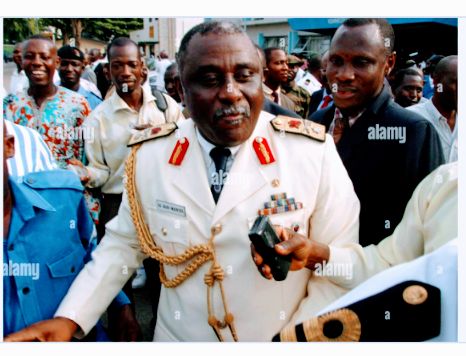
A Rear Admiral, Antonio Bob-Manuel, after he was discharged and acquitted on January 5, 2005.
This triad underlies the modus operandi of the oil thieves. According to him, they operate through a complex network of pipelines, deep in the creeks and rivers of the Niger Delta. It involves a triple relay division of labour, which benefits all stakeholders in the business.
The first group are those who specialise in the vandalisation of pipelines and the evacuation of their content into barges for subsequent transfer into coastal tankers. The barges characteristically have carrying capacities of between 50 – 500 metric tons and are said to be suitable for the movement of cargo in the narrow-confined waters of the creeks.
“This is the home of the domain of the so-called cultists, political thugs, militants and other social misfits that have been terrorising both inland and off-white waters of the Niger Delta. Their campaign of terror is funded mainly from the proceeds of stolen crude oil,” revealed Bob-Manuel.
The second group receives the stolen crude cargo from the barges. Operators at this level use seagoing coastal tankers or self-propelled barges to receive the stolen crude from the barges for subsequent transhipment into much larger vessels.
“The coastal tankers/self-propelled barges are usually stationed at anchorage positions in the inland waters of the Niger Delta from where they are rendezvoused by the barges. They typically have carrying capacities of 1500 – 5000 metric tons and, because they spend much time anchored in the inland waters, are more susceptible to arrest,” says Bob-Manuel.
Most of the arrests made by the Nigerian Navy belong to this category of vessels. Here, the operators are mainly Nigerians acting alone or stealing in concert with foreign accomplices.
The third group wait in predetermined positions out in the open sea to receive the contents of coastal tankers. Operators here employ standard, and, in some reported cases, even supertankers, to transship the stolen crude contents from relatively smaller coastal tankers to refineries in different parts of the world. The carrying capacity of these outsized vessels range from 25mt for standard tankers to over 100,000 mt for super tankers.
The MT African Pride and the Rear Admiral (A.I. Bob-Manuel (Retired)
On October 8, 2003, MT African Pride, a standard oil tanker, was arrested by the Nigerian Navy Ship (NNS) NWAMBA under the command of a captain, Joe Aikhomo, in the Western Naval Command of Nigeria Navy, off the entrance to the Forcados River, in Delta State at about 5pm Nigerian time. It was the largest ship ever arrested. All the crew were foreigners.
At the time of arrest M.T. African Pride had 11, 300 MT of stolen crude oil cargo worth ₦10 billion Naira.
Bob-Manuel says his disclosure on MT African Pride is “an attempt to give a truthful and honest account of events as they occurred; to highlight the deceit in a seriously flawed and contrived administration process that has cost Nigeria so dearly and to appeal, with the deepest sense of humility and concern, for the matter to be revisited.”
At the time of arrest, The MT African Pride had 11,300 mt of stolen crude cargo on board, valued by petroleum industry experts to be $70 million or ₦10 billion then. Bob-Manuel says the supertankers have over four times the carrying capacity of The MT African Pride.The MT African Pride had made three previous trips before her arrest on October 8, 2003, from the recording on its logbook. It had 22 crew members made up of 18 Russians, two Romanians and two Georgians
The operators were mainly foreign nationals stealing in concert with highly placed Nigerians.
Not all the stolen crude is transshipped out of the country. A small fraction is retained in the creeks and processed locally through a crude process called Kpo-fire in Niger Delta parlance for domestic use. The onomatopoeia ‘Kpo’ represents the loud sound the crude oil makes when it reaches its boiling point.
Bob-Manuel was appointed the Flag Officer Commanding the Eastern Naval Command in April 2002.
According to him, the practice then was for such arrested barges to be scuttled (sunk at sea) after evacuation of the contents by Nigerian National Petroleum Company (NNPC) to serve as deterrent to others. “It soon became apparent after my resumption of office that the solution would require much more than the mere arrest and scuttling of barges. The practice never really had the desired impact on the activities of the criminal elements involved in the illegal enterprise. On the contrary, the number of barges hidden in the creeks simply kept on growing,” he lamented.
“The Command found that the high revenue from the business made it possible for the owners of the destroyed barges to quickly replace them. They equally found that prominent Nigerians were involved in the business. These prominent Nigerians “almost always ensured that culprits arrested escaped prosecution in court. The matter was further exacerbated by the myth created in the minds of personnel that those involved belonged to the ruling political class and were therefore ‘untouchable,” regretted Bob-Manuel.
Things moved quickly, and a then Acting Chief of Naval Staff ordered the immediate release of The MT African Pride on the grounds that the ship had NHQ clearance to operate in the Lagos Area in a signal, NHQ 091120 OCT03.
Bob –Manuel called the Acting CNS on the phone and explained why the Western Naval Command cannot release the ship until the then CNS, Vice Admiral S.O Afolayan, who was away on pass, resumed.
Bob-Manuel indicts the Naval Headquarters for the escape of The MT African Pride and the chain of events that followed.
“I doubt very much if the NHQ really used the wealth of information my headquarters supplied in the way it was intended and recommended to be used. If the NHQ had, then the Nigerian public would have witnessed for the first time the arrest and prosecution of some of Nigeria’s most notorious economic saboteurs. Indeed, it may well be said that the failure of NHQ to professionally utilize the information at its disposal heralded the chain of events that ultimately led to the escape of The MT African Pride.”
Bob-Manuel revealed that he was offered $100,000 bribe by a Nigerian agent of the arrested ship to release the ship. The agent, identified simply as Sola, started with an offer of $15, 000 and raised it to $100,000.
A former minister of State for defence (Navy), Olu Agunloye, called him to solicit on behalf of Sola for the release of the ship. “In reply, I told him I was only a custodian of the arrested ship and that the authority to release now rested with Aso Rock, where as a former Honourable Minister, he was better known and recognised than my humble self.”
“About 45 minutes after he made the first call, the former Minister repeated the call to insist that the CNS had again given him assurances that it was well within my competence to release the arrested ship. At this point, I politely requested him to advice the former CNS to formally dispatch a signal or letter to command headquarters ordering or directing the release of The MT African Pride. Expectedly, the CNS never issued any such instruction.”
As the Flag Officer refused to play ball, internal forces in the hierarchy of Nigerian Navy conspired to achieve their aim by other means. Events happened quickly.
There was an internal conspiracy involving officers and men of NNS BEECROFT to illegally transship the crude oil in the arrested The MT African Pride into another vessel, but this was foiled. Prior to this, the trusted Commanding Officer, Codre Akaleme, was relieved of command and replaced by a captain, Edem Duke.
According to Bob – Manuel, “This change in command was to deal a telling blow on future WNC operations in the fight against crude oil theft.”
With Codre Akaleme out of the way the crude cargo of The MT Africa Pride was successfully illegally transshipped on November 2, 2003. Bob – Manuel ordered the new commander of NNS Beecroft, the ship in whose custody the arrested ship was to investigate the crime. The report submitted was a fraud.
“The report attempted to divert attention from the matter under investigation to an unrelated incident. In the event, the report ended up indicting the wrong personnel and even proceeded to have them court-martialed,” revealed Bob-Manuel.
Consequently he set up fresh investigation using the Western Naval Command Intelligence cell. They found that:
The MT African Pride while under custody left anchorage position and put to see on October 31, 2003, at about 1800 hours without clearance from the headquarters of WNC.
The MT African Pride transshipped an undisclosed quantity of crude oil into another vessel of similar size and displacement.
The transshipment was done under the cover of darkness and consequently, the name and identity of the receiving vessel could not be ascertained.
That NNS BEECROFT’s security detail, commanded by Lt. Cdr MC Abubakar (later dismissed) was onboard The MT African Pride on duty and even assisted the ship’s crew in carrying out the transshipment.
That Lt. Cdr Abubakar employed coercion and financial inducement to procure the support and active participation of the ratings in his charge.
That monetary inducement of N250, 000 each was given to the ratings in this regard.
That Lt. Cdr Abubakar refused to disclose how much he was paid for his participation/cooperation.
That Lt. Cdr Abubakar refused to disclose the identities of other co-conspirators from within and without the Nigerian Navy with whom he perpetrated the crime.
Armed with this report, Bob-Manuel ordered the immediate arrest and subsequent trial of Lt. Cdr Abubakar. He was found guilty and sentenced to imprisonment/dismissal from the Naval Service.
On July 5, 2004 Bob – Manuel was relieved of his command and posted to the Armed Forces Command and Staff College, AFCSC, Kaduna, as deputy commandant at a very short notice. It was victory for crude oil thieves. Their only stumbling block was out of the way. He handed over The MT African Pride to his successor, Rear Admiral Kolawole. Whom he described as “a brilliant but pliant officer with limited experience in higher command functions/responsibilities.” He observed, “My posting came at a time the fight against crude oil theft was its peak in the Western Naval Command.”
Just one month after his reposting, the unthinkable happened and The MT African Pride disappeared from Nigeria in the second week of August, 2004. “My immediate reaction was shock and disbelief,” Bob-Manuel recalls. Nigerians were shocked too. The National Assembly summoned Rear Admiral Afolyan, the then CNS, and Tafa Balogun, then Inspector general of police, to give an account of what led to the disappearance of The MT African Pride.
On September 23, 2004, Bob-Manuel appeared before the House Committee on Defence in the furtherance of their investigation. He gave them a low down on the saga, including the $100, 000 bribe. The person who chartered The MT African Pride was established to be Niyi Fafowara.
A few days after his appearance before the House Committee on Defence, Bob-Manuel also appeared before the Navy Board of Inquiry, BOI, whose chairman was hostile to him. He described him thus: “He lacked the strength of character to do a decent job. His leadership of the board was characterized by the absence of honesty of purpose and courage usually associated with such investigative panels.”
The BOI failed to arrive at any meaningful deductions from the submissions made. “The board missed all the vital clues that might have assisted in the apprehension of the vessel’s charterer and other accomplices. It was a contrived board and its findings and recommendations lacked conviction as they were in the main, skewed towards meeting the jaundiced expectations of the convener. Put simply, it was a sham.”
The first report could not find Bob-Manuel culpable and was consequently rejected by NHQ. The Board then forwarded a second report indicting him and recommending that he be tried by Special Court Martial. He was then charged and ordered to appear for trials in October 2004. His trial started on October 27, 2004 with seven charges made against him, out of which the prosecution could sustained only four.
On January 5, 2005, he was found not guilty by the Special Court Martial on all counts. Consequently, he was discharged and acquitted.
Summing up his fight against oil thieves, Rear Admiral Bob-Manuel says, “They must have felt quite uncomfortable with my methods in the Western Naval Command. With their combined influence and power, they appointed me out of WNC and perfected plans to facilitate the escape of The MT African Pride from lawful custody.”
He says he experienced “disappointment and trauma in the course of my trial.”
During his time as the Flag Officer commanding the Western Naval Command, the Command arrested 12 ship, including The MT African Pride. “In all this, not even a single officer or rating who served under me in the WNC ever received an acknowledgement or commendation for services rendered to the good people of Nigeria. Instead, the Command’s noble efforts were received with disapproval and a futile attempt to tarnish the image of the family.”
Bob-Manuel is gnashing his teeth in retirement. His ordeal was only the beginning of the evolution of oil theft in Nigeria. Today, even under President Bola Tinubu, despite the massive noisy hunt for oil thieves, the illegal business continues to thrive.
From just a whisper at the beginning in 1975, oil theft has ballooned to a mega-organized crime in Nigeria, involving various stakeholders and grossing about 1.5 million barrels daily with no hope of an end in sight. It is now a game of the jackals as Part two of this story will show.
*Names with asterisks where changed to protect the identity of the sources
This story was funded by the International Centre for Investigative Reporting, ICIR.
THE Senate has called for stiffer penalties for violence against women in Nigeria.
The Senate also directed the Police to prosecute anyone involved in gender-based violence (GBV).
The senator representing the Federal Capital Territory (FCT), Ireti Kingibe, and 16 other senators moved the motion that led to the Senate’s resolutions on Thursday, November 30.
The resolution was to honour the 16 days of activism against gender-based violence that the United Nations observes yearly from November 25 to December 10.
While making her motion at the Senate chamber in Abuja, Kingibe said women were vulnerable and at risk of GBV.
“More is needed to ensure that women live and are free of violence. The fatalities from GBV are more than 1,000,” she said.
Contributing to the motion, a senator from Kogi Central, Natasha Akpoti-Uduaghan, said women suffered at the hands of other women.
“Nigerian women and the world have suffered at the hands of not just men but women and in various organisations,” Akpoti-Uduaghan stated.
Adams Oshiomhole, who represents Edo North, stated that GBV offenders ought to face stiff penalties for offenders.
“I think we need to review the laws that have to do with violence against women. We need to make the penalties stiffer,” the former Edo state governor said.
He asked the Senate to empower the Police to prosecute offenders.
He added that simply preaching against it would not convince individuals who believe they have the right to oppress others to think differently.
Senate President Godswill Akpabio put the motion to a vote, and it was approved.
Meanwhile, the Federal Government is set to create legal protocols for the prosecution of gender-based violence in schools.
According to the government, the action seeks to launch a standard operating procedure that will produce a legal avenue for the prosecution of gender-based violence in schools.
This was disclosed by the Attorney-General of the Federation (AGF) and Minister of Justice Lateef Fagbemi (SAN) on Tuesday night in Abuja.
He was speaking at the national close-out/handover ceremony of the EU-UN Spotlight Initiative project managed by the United Nations to end violence against women and girls in Nigeria.
The Spotlight Initiative was founded to address the pervasiveness of GBV and other detrimental traditional practices in Nigeria.
The minister said the effort was to counteract the nation’s rising incidence of sexual and gender-based violence or SGBV.
“These are programmes centred on criminal justice actions at the federal and state levels. The ministry will be launching the SoP for the prosecution of GBV.
“It is funded by UNESCO under the EU/UN Spotlight Initiative. The SoP is targeted at determining and responding to GVB when it occurs in our schools.”
He stat that the Ministry of Women’s Affairs and Justice will house the situation room, respectively.
Gender-based violence is a frequent occurrence in Nigeria, especially against women and girls.
It comprises a multifaceted issue deeply rooted in societal norms and cultural dynamics. It also encompasses various forms of abuse, including physical, sexual, emotional, and economic violence, disproportionately affecting women and girls.
On September 3, The ICIRreported how pre-teen girls in the FCT were tortured and made to endure breast ironing to make them look unattractive due to the fear of rape and other forms of sexual abuse.
The ICIRreports that the Federal Government has repeatedly promised to establish specialised courts to hasten the trial of SGBV offenders. The pledge has yet to come to fruition.
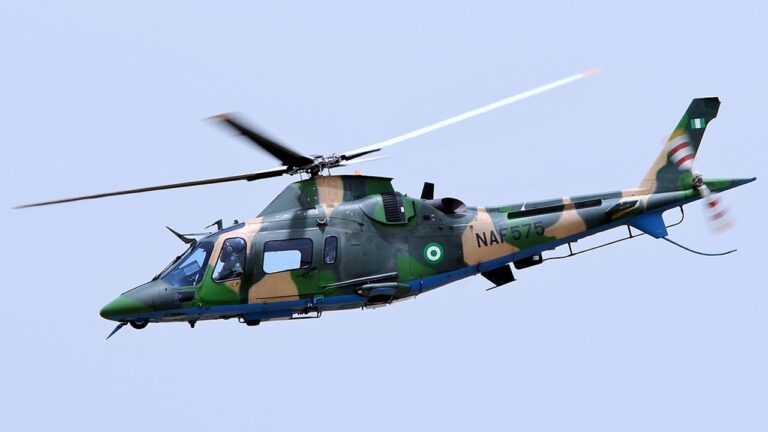
FIVE crew members of the Nigerian military have sustained ‘minor’ injuries after their MI-35P helicopter crash-landed in Port Harcourt, River state on Friday, December 1.
The incident happened at about 7:45 am, shortly after the aircraft took off for an operation against economic saboteurs in the state.
A statement by the NAF director of public relations and information, Edward Gabkwet, an air commodore, said the NAF MI-35P had taken off on an operation against oil thieves.
Part of the statement read, “A Nigerian Air Force (NAF) MI-35P helicopter has crashed at Port Harcourt today, December 1, 2023. The unfortunate incident occurred at about 7.45 am, shortly after the aircraft took off for an operation against economic saboteurs in Rivers state.
“Fortunately, the entire crew of five survived the crash with very minor injuries and are currently being attended to at NAF Medical Centre, Port Harcourt.’
Gabwet said that the Chief of Air Staff, Hasan Abubakar, an air marshal, was on his way to the scene to assess the situation and give further directives on the incident.
“An incident of this nature is yet again a grim reminder of the dangers associated with military flying and the risks NAF pilots and technicians experience in their onerous tasks of defending our nation and deterring criminal elements from their nefarious activities, ” the statement added.
The incident is the latest crash to involve a NAF aircraft in 2023, with a number of casualties.
In July, the Air Force (NAF) FT-7NI trainer aircraft crashed in Makurdi, the capital of Benue State, during a routine training exercise, resulting in injuries to the two pilots onboard.
Similarly, on August 14, The ICIR reported that a Nigerian Air Force MI-171 aircraft on a casualty evacuation mission was gunned down by bandits affiliated to Dogo Gide.
The aircraft, which crashed near Chukuba village in Niger state, at about 1 p.m., was on its way to Kaduna from Niger state.
Meanwhile, The ICIR had, on May 30, reported that Nigeria under former President Muhammadu Buhari experienced a series of military air crashes.
Data garnered from media reports in the last seven years shows that the incidents resulted in the loss of 14 aircraft and claimed the lives of 35 people, including civilians and military personnel.
The report noted that the crashes also imposed significant financial costs on the military and diminished the number of operational aircraft in its fleet.
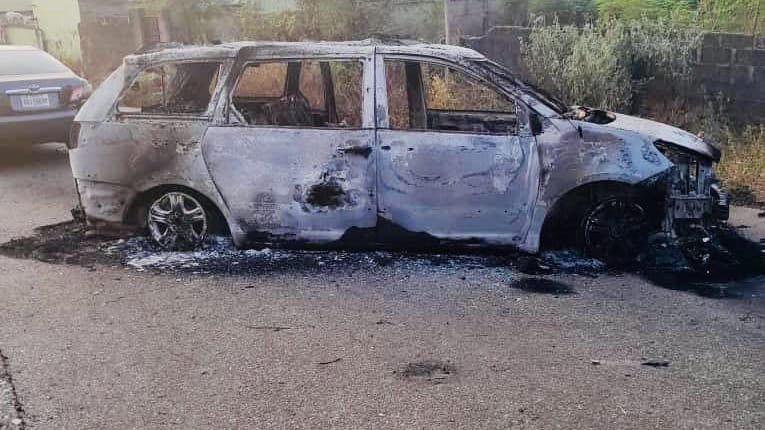
GUNMEN have attacked the residence of the Independent National Electoral Commission (INEC) Resident Electoral Commissioner (REC) for Kogi state Hale Longpet.
According to a statement by INEC on its official X handle, the incident happened in the early hours of Friday, December 1.
The INEC said the armed men who arrived around 3. 30 am engaged the security personnel in a gun duel for over 30 minutes until reinforcement arrived.
“While no lives were lost, property was destroyed in the ensuing gun battle. A team of combined security personnel have been deployed to protect the residence. This incident occurred a day after a mob besieged our state office,” INEC stated.
The election umpire called for a thorough investigation and enhanced security protection for its personnel and assets in the state.
On Thursday, November 30, INEC condemned the siege on its state headquarters in Lokoja by a mob on Wednesday.
A statement by the resident electoral commissioner in the state, Longpet, said the mob barricaded all office entrances and prevented staff access to routine duties.
According to him, the siege also made it impossible for attorneys for the political parties who participated in the recent off-cycle gubernatorial election in the state to view any materials or records used in the poll.
According to the statement, the Nigerian Army’s assistance was necessary to defuse the tension at the state INEC’s headquarters.
The organisation added that security officials had assured that everything would continue without threat to lives and property.
The commission assured all parties and litigants unhindered access to all materials required to pursue their petitions.
Attempts to reach Kogi State Police spokesperson William Aya on Friday were unsuccessful as he did not pick up calls or respond to messages sent to his phone by The ICIR.
The INEC conducted an off-cycle election in Kogi on Saturday, November 11.
Opposition parties, civil society organisations, and Nigerians who are displeased with the conduct of the poll have continued to condemn the exercise and malpractices that allegedly characterised it.
The state is one of the eight states in Nigeria with off-season governorship polls. Others are Anambra, Imo, Bayelsa, Ekiti, Ondo, Edo and Osun
The INEC announced Usman Ododo as the election winner on Sunday, November 12.
The poll was held in 3,508 polling units spread across the 21 local government areas of the state.
In this report, the ICIR highlighted the major talking points from the election.
THE Financial Reporting Council of Nigeria (FRC) has suspended the December 31, 2018, audited financial statement of the Nigerian Maritime Administration and Safety Agency (NIMASA) for noncompliance with financial reporting standards and imposed a penalty of N500 million on the agency.
The FRC disclosed this in a statement made available to The ICIR on Friday, December 1.
It said the action was taken in line with the FRC Act 2011 (as amended) and the Financial Reporting Council of Nigeria-Guidelines/Regulations for Inspection and Monitoring of Reporting Entities.
“The FRC registration numbers of certifiers of NIMASA’s audited financial statement, Dr. Bashir Jamoh (FRC/2017/CIANG/00000016699) and Chudi Offodile (unregistered) are hereby suspended. This suspension renders them incapable of certifying any financial statements in Nigeria.
“The Council hereby imposes a Type 6 penalty of N500,000,000 (Five Hundred Million Naira) for the withdrawal of the 2018 financial statement, in line with Regulation 18 of the FRC Guidelines/Regulations 2014,” FRC stated.
The Council stressed that NIMASA’s 2018 audited financial statements were withdrawn and that the agency was directed to restate its 2018 audited financial statements.
It instructed NIMASA to publish within seven working days of the notice dated November 30 in at least two national newspapers (full page) that its (NIMASA) 2018 financial statements and returns had been withdrawn for noncompliance with financial reporting standards.
The reporting council also directed NIMASA to begin restating its 2018 audited financial statement as enshrined in FRC’s Act.
It said, “This restatement will form the basis for the preparation and submission of audited financial statements for the years ended December 31, 2019, 2020, 2021, and 2022.
“NIMASA is required to file the restated financial statements for 2018, together with the management letters issued by their external auditors, with the Council within 60 days.”
This action against NIMASA serves as a reminder to all reporting entities of their responsibility to comply with prescribed standards and regulations, FRC added.
On July 5, The ICIRreported that the noncompliance of public interest entities to the financial reporting standards raised concerns about the integrity of their financial management, as financial reports are the core of transparency and accountability surrounding their activities.
It also raised concerns about the FRC mandate in holding on to its core values of integrity, accountability, transparency, and fairness, bringing utmost confidence to investors, reputation to oversight, and ensuring quality in accounting, auditing, actuarial, valuation, and corporate governance standards and non-financial reporting issues.
What FRC’s Act 2011 (Act No. 6) says
Under Section 77, Public interest entities mean governments, government organisations, quoted and unquoted companies, and all other organisations which are required by law to file returns with regulatory authorities, and this excludes private companies that routinely file returns only with the Corporate Affairs Commission (CAC) and the Federal Inland Revenue Service (FIRS).
Where the Council reaches a final decision under section 57 to the effect that a public interest entity has failed to comply with any of its decisions under this Act, and with such other financial reporting, accounting, auditing, and financial reporting standards as may be specified under the relevant enactments, the Council shall serve a notice on the entity for an immediate restatement of its financial statements.
THE House of Representatives has approved N61.55 billion Federal Capital Territory (FCT) supplementary budget for the financial year ending December 31, 2023.
This followed the passage of the 2023 Supplementary Appropriation Bill for the FCT through the third reading at plenary on Thursday, November 30.
Out of the approved sum, N12.90 billion is for overhead costs (recurrent expenditure), while N48.65 billion is for capital projects.
The FCT Administration will get N2.2 billion from the overhead costs, the FCT Human Resources Management Department is to receive N3.3 billion, while N2.8 billion, and N1 billion respectively were earmarked for the Department of Information and Communication and the Legal Secretariat.
Others are the Facilities Maintenance and Management Department taking N1.6 billion, the Abuja Environmental Protection Board which will receive N1.5 billion, and the Satellite Towns Development Department which is to get N500 million.
For the capital expenditure, Engineering Services (FCDA) is appropriated N30.54 billion, Public Building (FCDA) gets N15.11 billion, and Bus Rapid Transit and Transport Regulations (BRT&TR) receives N3 billion.
Before the approval, the FCT Minister, Nyesom Wike, had defended the N61.5 billion 2023 supplementary budget before the relevant Senate and House of Representatives Committees.
He said the budget revenue sources would be inflows from Paris Club refund, payee tax liabilities, special intervention funds (palliatives), internally generated revenue (IGR) and the infrastructure support fund.
He pointed out that the top priority projects would include the Abuja rail mass transit, provision of mass transit buses/rehabilitation of existing ones, and expansion of roads.