Home Blog Page 929

Female Rep laments exclusion of women in APC zoning formula

A member of the House of Representatives, Adewunmi Onanuga, has protested the exclusion of women in the All Progressive Congress (APC) zoning formula released ahead of the inauguration of the 10th National Assembly.

Onanuga, who is also a member of the party, said women in the National Assembly were excluded from the zoning formula for leadership positions in the 10th assembly.

The lawmaker representing Remo Federal Constituency said this on Thursday, May 11, while speaking as a guest on Channels Television.

According to her, the party ignored women who indicated an interest in leadership positions.

The APC National Working Committee recently released the zoning arrangement.

The party, in its zoning plans, endorsed Godswill Akpabio from the South-South geopolitical zone as Senate President, and Barau Jibrin, from the North-West, as Deputy Senate President.

Also, in the House of Representatives, the party endorsed Tajudeen Abass from the North-West as Speaker and Benjamin Kalu from the South-East as Deputy Speaker.

Commenting on the development, Onanuga disclosed that she and two other female representatives showed interest in leadership positions in the 10th National Assembly, but they were not given a chance.

According to Onanuga, she aspired for the position of Deputy Speaker.

Frowning at the development, she said the party should have consulted with members before releasing any zoning formula.

“There were three of us who came out, aspiring. The reason we wanted to put our hats in the ring is that we feel that the female gender needed to have a seat at the table of decision-making,” she said.

Onanuga urged the party to stop denying women the opportunity for leadership positions in the Assembly, noting that it is essential for equity to prevail.

“As it is now, there is no balance. 4-0 for presiding officers is not a good balance. We need to engage some more and recognise all those who are aggrieved. I am aggrieved, especially for myself and for the lack of gender balance.

“We are asking that whatever remains in the majority, at least one should come to a woman and two others. We are asking for three out of ten, and I don’t think that is too much.

“The two presiding seats have been taken in the House of Representatives, there are eight more seats — three for the majority leaders and five for the minority leaders. If we are going to go by the 35 per cent affirmative action that has just been won in the court,” she said.

In Nigeria, the influence and representation of women in politics is minimal.

According to the National Bureau of Statistics (NBS), women’s representation continues to decline across all tiers of government in Nigeria.

In the 2023 general election, 378 women ran for Senate and House of Representatives seats, but only 17 were successful.

All the current female senators are not returning.

The NBS said women have never been appointed as Secretary to the Government of the Federation, or elected as President or Vice President, despite constituting almost half of the country’s population.

In 2016 and 2017, six women and 73 men occupied principal positions in the Senate.

The year 2018 and 2019 have the exact figure. In 2019, women had 6.2 per cent representation in the National Assembly, while men occupied 93.8 per cent of the positions.

UN-17 AFCON: Burkina Faso ends Nigeria’s 6th FIFA World Cup dream

0

NIGERIA’S Golden Eaglets on Thursday, May 11, failed to actualise their dream to feature in a 6th FIFA UN-17 World Cup, billed to hold this year in November, after they were eliminated by Burkina Faso in the quarter-finals of the UN-17 African Cup of Nations (AFCON) in Algeria.

Burkina Faso defeated Nigeria 2-1, meaning that the Golden Eaglets could not qualify for this year’s FIFA UN-17 World Cup.

Nigeria is regarded as the most successful country in this biennial international football event with a record of winning the FIFA World Cup five times.

Since the U-17 AFCON started in 1995, this is the first time the Nigerian UN-17 team, the Golden Eaglets, will lose at the quarter-finals stage.

In 1995 the team finished as runners-up; in 1997 failed to qualify and in 1999 ended at the group stage while in 2001, they emerged as champions.

Two years later, they came third. In 2005 they did not progress to the knockout stage while in 2007 they were crowned champions.

They did not qualify for the 2009 and 2011 editions but finished second in 2013.

In 2015, the Golden Eaglets finished fourth. The team did not qualify in 2017. They finished fourth again in 2019.

However, in 2023, they ended their journey for the first time at the quarter-finals stage.

The other quarter-finals encounter of the ongoing UN-17 AFCON on Thursday between Mali and Congo ended 3-0 in favour of Mali.

The victory for Mali and Burkina Faso has propelled them to the semi-finals, where they will continue their pursuit of silverware.

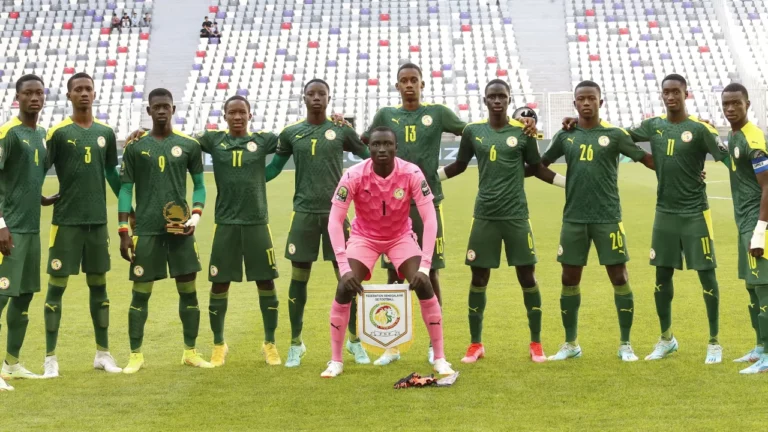
The quarter-finals started on Wednesday with a contest between Senegal and South Africa that produced 5 goals which made Senegal progress to the semi-finals for the first time and also become a debutant for the World Cup. The match was played at the Nelson Mandela Stadium.

The second quarter-finals match between Morocco and the host country, Algeria, ended 3-0 in favour of the Moroccan side. The game was played at the Stade Mohamed Hamlaoui in Constantine.

Morocco, Senegal, Mali and Burkina Faso qualify for FIFA UN-17 World Cup 

The last four teams remaining in the ongoing UN-17 AFCON in Algeria are Morocco, Senegal, Mali and Burkina Faso and being the last four, they will represent the African continent at the FIFA UN-17 World Cup in November.

In the semi-finals, Senegal will slug it out with Burkina Faso while Morocco will play Mali. These matches will come up on Sunday, May 14.

Winners of the semi-finals encounters will play in the final billed to hold on Friday while the losers will play a third-place match on the eve of the final.

BVN issued in Nigeria does not expire – CBN

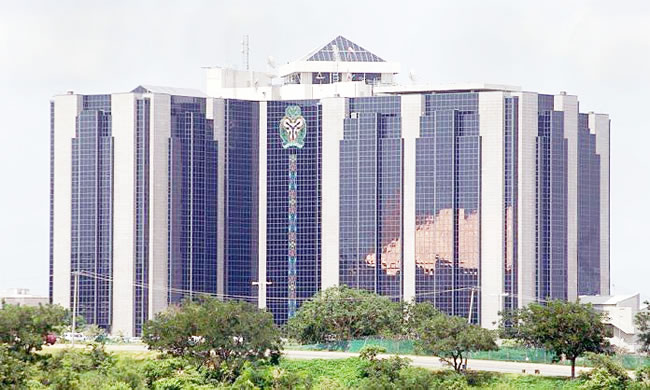
THE Central Bank of Nigeria (CBN) says any bank verification number (BVN) officially issued in Nigeria has no expiry date, debunking reports by some section of the media of expiry status for the number.

The CBN, in a clarification statement issued on May 10 and signed by its Acting Director, Corporate Communications, Isa AbdulMumin, noted that its attention had been drawn to reports suggesting that the (BVN) it issued in collaboration with the Nigerian Inter-Bank Settlement System (NIBSS) expires after a 10-year period.

“Contrary to these claims, we wish to clarify that the BVN issued in Nigeria has no expiry date,” the CBN said.

The apex bank also emphasised that once a customer’s biometrics had been captured and enrolled in the database of the NIBSS, the BVN remains for life.


READ ALSO:


Notably, the CBN, in its regulatory framework for the BVN that it issued in 2021, stipulated that bank customers can only change their records due to certain conditions spelt out in the document, and after being cleared by the relevant authorities.

The apex bank further urged bank customers in the country, especially those whose biometrics had been captured by the system, to continue using their unique identifiers, which it stressed would last their entire lifetime.

Women protest against harmful widowhood practices in Anambra

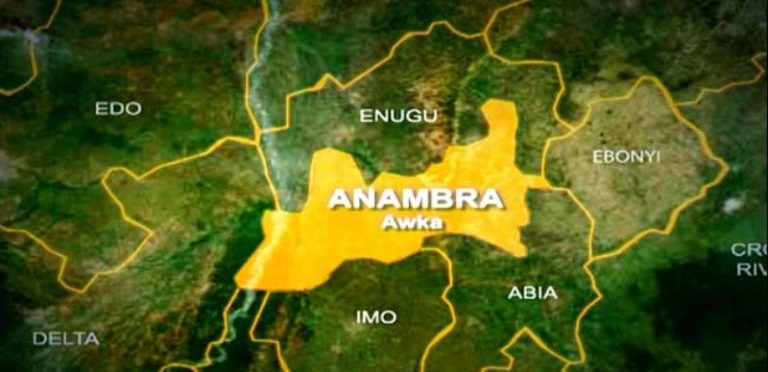
A GROUP of women have kicked against harmful cultural practices which hamper the well-being and dignity of widowed women in Anambra State.

The women protested in Awka, the state capital, on Thursday, May 11.

The protesters, led by the Chairperson of the Agency on Violence Against Persons Prohibition Act in Anambra, Hope Okoye, demanded that the state government punish those perpetrating acts that violate the rights of widows.

They gathered at the Children, Sexual and Gender-Based Violence Court in Awka, and held placards with inscriptions such as: ‘Allow our widows some peace’, ‘Stop all obnoxious laws and harmful widowhood practices in Anambra’, among others.

The women demanded an end to rituals that coerce widows to drink from the water with which their spouses were bathed and prepared for burial.

While addressing the press, Okoye pointed out the need for government to pay attention to the plight of widows and abolish the practices. 

She said there is a need for the girl child and women to be protected from abusive cultural norms.

“We demand that government ensures justice is served on perpetrators of unpleasant widowhood practices against the girl child, women and widows, irrespective of their social status.

“The practice is widespread as it has been observed that several parts of Anambra still perform the ritual,” she said.

There have been calls for the government to make legislation to protect and empower widows in Nigeria, as they are often susceptible to traditional rituals that violate their human rights. 

Several women-centred organisations have pointed out the need to draw attention to the voices and experiences of widows and to galvanise the unique support they require.

Last year, the House of Representatives moved to amend the Violence Against Persons Prohibition Act to prohibit all forms of repressive widowhood practices, provide remedies for victims and penalise offenders. 

In April, the Benue State Government initiated a bill to protect widowed women from harmful practices. Rivers and Bayelsa signed a similar bill into law. 

According to the International Women Society (IWS), 15 million widows in Nigeria are living in abject poverty.

The World Bank estimates that one in ten widows lives in extreme poverty globally. 

 According to the organisation, women are also much less likely to have access to pensions than men. As a result, the death of their husbands can lead to destitution for older women.

The world body also said child widows under 18 at the time of marriage often experience multiple rights violations and must cope with the impact of early marriage and widowhood. 


Presidential poll: Tribunal adjourns Atiku’s petition to May 18

THE Presidential Election Petition Court has adjourned hearing of the petition filed by candidate of the Peoples Democratic Party (PDP) Atiku Abubakar against the victory of All Progressives Congress (APC) flagbearer Bola Tinubu in the February 25 presidential election.

The hearing was adjourned to Thursday, May 18.

The matter was adjourned after the counsel to the petitioners, Chief Chris Uche (SAN), informed the court that counsels representing Tinubu, APC and the Independent National Electoral Commission (INEC) have agreed to discuss how to harmonise and streamline vital areas and components of the pre-hearing conference.

Uche said the counsels involved in the petition intend to set up a team and examine the documents to be used.

According to him, this is to eliminate objections while tendering them during the hearing.

“We intend to do that and conclude between Monday and Tuesday and then prepare a schedule of documents to facilitate the proceedings.”

He noted that the counsels involved in the petition have agreed to file responses to all pending motions, including a recent petition which seeks to have the court proceedings broadcasted live.

The counsels all agreed to come back to court on Thursday, May 18, for the continuation of the pre-hearing session.

The counsel representing INEC, Abubakar Mahmoud, confirmed the agreement, noting that the electoral body applied to strike out specific paragraphs of the petition.

The counsel to the President-elect, Wole Olanipekun, disclosed that he would file his response to the petition seeking a live broadcast of the proceedings.

Responding to the submissions, head of the tribunal, Justice Haruna Tsammani ruled that the petition is adjourned.

He said he has considered the agreement of the parties and directed parties to remain committed to the agreement to enable a quick conclusion of the matter.

Following the declaration of Tinubu as the winner of the 2023 presidential election, Atiku had filed a petition challenging the result declared by the Independent National Electoral Commission (INEC).

He alleged that the poll was marred by irregularities in thousands of polling units.

The PDP candidate asked that the court declare him Nigeria’s President-elect or nullify the election and order a rerun.

He argued that INEC’s failure to transmit the election results in real-time electronically compromised the outcome of the presidential poll.

“By reason of the foregoing, there could not have been any valid and lawful collation and announcement of the result of the election under the Electoral Act, without the prior electronic transmission from the polling units to INEC …IReV portal using the BVAS,” he said.

The pre-hearing of the petition commenced on Thursday morning, May 11.

On March 1, INEC Chairman, Mahmood Yakubu, declared Tinubu the election winner, having polled the highest votes.

Tinubu got 8,794,726 votes.

According to the electoral body, Atiku came second after he polled a total of 6,984,520 votes.

Peter Obi, the candidate of the Labour Party, came third with 6,101,533 votes, while Rabiu Kwankwaso of the NNPP came fourth with 1,496,687 votes.

Obi is also challenging Tinubu’s victory, having also asked the court to declare him the winner or cancel the election and order a rerun.

Doctors set for fresh strike as FG meets ‘none’ of several demands

0

The National Association of Resident Doctors (NARD) may declare a strike next Monday, May 15, The ICIR reports.

This follows the Federal Government’s failure to meet the group’s demands.

On April 29, The ICIR reported how the doctors gave the Federal Government a two-week strike notice over its failure to meet their demands.

NARD threatened it would not “guarantee industrial harmony in the sector nationwide,” from May 13 if the government didn’t meet its demands within two intervening weeks.

The association has extended the deadline till May 15, when it convenes its extraordinary national executive council (NEC) meeting.

The ICIR obtained a circular on the planned meeting on Thursday, May 11.

Some of NARD’s demands include the 2023 Medical Residency Training Fund (MRTF) payment, alleged refusal by the government to pay the salary arrears of 2014/2015 and 2016 to its members, and the arrears of the consequential adjustment of the minimum wage.

They also demanded an immediate increment in the CONMESS salary structure to 200 per cent of the current gross salary for doctors and called for immediate suspension of the bill seeking to stop doctors from migrating abroad.

The doctors equally warned state governments yet to implement the appropriate CONMESS structure, domesticate the Medical Residency Training Act, or improve the hazard allowance paid to their colleagues and other health workers to do so without delay.

Besides, NARD sought immediate massive recruitment of health professionals to replace workers leaving, immediate infrastructural lift in health facilities, and increase in budgetary allocations to health.

On Thursday, May 11, the association’s President, Orji Innocent, told The ICIR that none of his group’s demands had been met, adding that the National Executive Council of the association would decide on strike next week Monday, May 15.

The ICIR reported on Wednesday, May 10, how a former Kaduna State Senator, Shehu Sani, lampooned President Muhammadu Buhari for abandoning the nation’s health challenges and seeking healthcare abroad from the start of his government to the end.

In 2021, The ICIR reported how disagreements between government doctors and other health workers led to the nation’s public hospitals losing nearly 300 days in eight years.

NARD was on strike for several weeks in 2021 following unmet demands by the Federal Government.

FG to spend N22.4bn on meals for prison inmates

THE Federal Government has said it will spend N22.44 billion to feed prison inmates in 2023.

Permanent Secretary, Ministry of Interior, Shuaib Belgore, disclosed this in Abuja on Thursday, May 11, while calling for the reform of correctional facilities in Nigeria.

“The Federal Government budgeted N22.44 billion in the 2023 appropriation to cater for the feeding of inmates.

“There is the need for holistic Corrections reforms, including the modernisation of custodial centres to ensure the reformation and rehabilitation of inmates. Stakeholders have stressed the need to build new facilities and redesign the bail system to actualise why we are here today,” Belgore said.

He decried the rising number of inmates awaiting trial in Nigerian custodial facilities.

In 2021, the Senate Committee on Interior increased the daily feeding allowance for the Nigerian Correctional Service (NCS) from N450 per person to a minimum of N1,000 per day, based on current economic realities.

Senator representing Rivers West Betty Apiafi moved the motion for the increment, arguing that N450 was inadequate to feed adults in a day.

Some lawyers and ex-prison inmates criticised the move to increase the funds, saying corruption would hinder the utilisation of the budgeted sum for the proposed feeding.

The approved sum for feeding inmates makes up over 1 per cent of the 2023 budget which is 21.83 trillion, much of which will be funded by international loans.

Belgore noted on Thursday that the huge amount was further influenced by the increasing number of inmates in custodial facilities across the country.

In 2022, the Federal Government said 75 per cent of inmates in Nigerian custodial centres are awaiting trial.

Minister of Interior Rauf Aregbesola had said the high number of inmates was placing custodial facilities across the country under much pressure and described it as a great challenge.

Aregbesola called for the release of at least 30 per cent of inmates awaiting trail in 2022, a situation which could reduce the costs of maintaining custodial centres in Nigeria.

52,436 inmates awaiting trial nationwide — FG

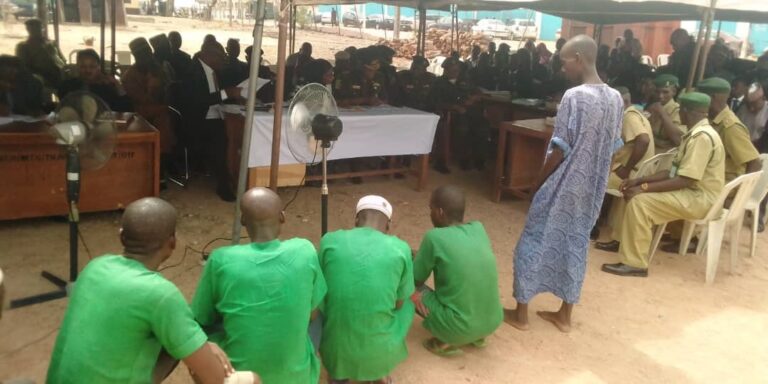
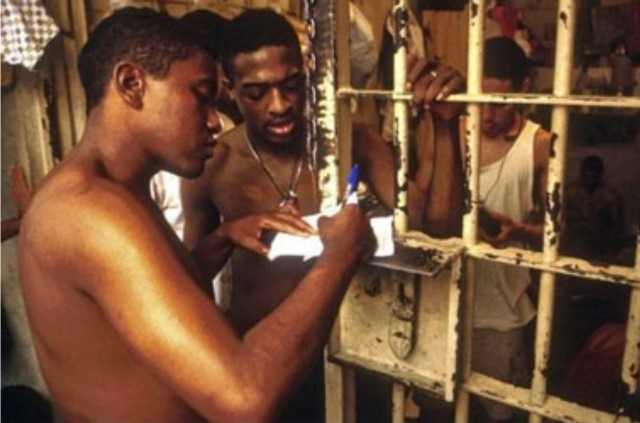
ABOUT 52,436 inmates are currently awaiting trial, and this has contributed to overpopulation in many correctional centres across the country, according to the Federal Government. 

The Permanent Secretary of the Ministry of Interior, Shuaib Belgore, said this on Thursday, May 11, at the High Conference on Decongestion and Corrections Management in Abuja. 

Belgore said there is a steady rise in the custodial centres’ population, noting that at least 80 per cent of the inmates are awaiting trial.

According to him, Nigeria’s 244 custodial centres nationwide are accommodating 75,507 inmates. He added that more than 82 correctional centres are overcrowded.

Belgore noted that there are 23,071 convicted persons in the prisons and about 3,322 of this number are condemned inmates on death row.

“The total number of male inmates is 73,821, and 1,686 are female. Of the 75,507 inmates, 52,436 are awaiting trial, while 23,071 are convicted persons, with 3,322 as condemned inmates on death row.”

He also pointed out that the congestion of custodial centres has led to a huge revenue drain.

Other challenges confronting the custodial centres include dilapidation of facilities, criminalisation of the society and the inability to separate awaiting trial inmates from convicted persons, he said.

Belgore also called for modernisation of custodial centres for appropriate reform and a “quick dispensation of justice”.

He asked for the construction of new facilities and a redesign of the bail system.

“I believe that the discourse at this conference should allocate more time to address the speedy dispensation of justice to reduce the number of inmates awaiting trial.

“In as much as the Ministry of Interior works tirelessly to accomplish the goal of achieving the greater reduction of the number of inmates across our custodial centres, we are determined to ensure that the correctional facilities provide not just a decent accommodation,” he said. 

Why there is a high number of inmates awaiting trial

Despite the passage of the Administration of Criminal Justice Act (ACJA) 2015, which, among other purposes, aims at speedy trial and decongesting Nigerian prisons, there are over 50,000 prisoners awaiting trial in different jails across Nigeria.

Correctional facilities hold 37 per cent more inmates than it is designed to, as per data from Nigerian Correctional Service (NCS).

The data showed that facilities in all the geopolitical zones are either overcrowded or almost at full capacity, except for three states in the North-East.

According to an ICIR report, oversight and negligence on the part of the authorities have led to an increasing population of awaiting trial suspects in custody of the country’s correctional service.

The ICIR findings showed that police and other prosecuting agencies, including the State Security Services (SSS), have contributed to the increase in awaiting trial suspects.

The report showed that the police often filed the wrong cases at the wrong courts. And in other cases, the courts failed to make preliminary findings on cases before ordering the remand of the suspects.

Last year, some CSOs appealed to the Federal Government to decongest correctional centres due to inadequate resources and facilities to accommodate many inmates.

The groups urged the government to create a workable plan for the inmates’ proper reintegration to avoid them returning to their old ways.

Court ruling on NBC fines: What media houses can do

FOLLOWING a court ruling which barred the National Broadcasting Commission (NBC) from issuing fines to radio and television stations nationwide, some lawyers have asked media houses to seek a refund of already paid charges.

A Federal High Court in Abuja had, on May 10, barred the NBC from issuing fines to broadcast stations nationwide.

In the ruling, the presiding judge, Justice James Omotosho, declared that NBC does not have judicial powers to impose penalties on broadcast stations.

The judge held that the NBC Code, which gives the Commission the power to impose sanctions, conflicts with Section 6 of the Constitution, which vested the authority in the law courts.

The judge also set aside fines imposed on 45 broadcast stations by NBC.

In 2019, NBC fined 45 broadcast stations the sum of N500,000 each over alleged ethical infractions in that year’s general elections. The Commission said the stations had to be sanctioned for allowing politicians to utter abusive, inciting and provocative statements during broadcast programmes.

Displeased, the Incorporated Trustees of Media Rights Agenda filed a suit against NBC in 2020.

The group asked the court to declare the sanctions procedure applied by NBC in imposing the fine on the broadcast stations a violation of the right to fair hearing under Section 36 of the 1999 Constitution (as amended) and Articles 7 of the African Charter on Human and Peoples Rights (Ratification and Enforcement) Act (Cap AQ) Laws of the Federation of Nigeria, 2004.

Justice Omotosho, while ruling on the matter, said the Commission acted as the complainant, court and judge when it considered the alleged infractions.

The judge noted that the Nigerian Broadcasting Code did not confer judicial powers on NBC to impose criminal sanctions or penalties.

He pointed out that NBC has no power to conduct a criminal investigation that would lead to a criminal trial and imposition of sanctions.

In recent times, the NBC has been accused of always imposing fines on media houses that are trying to hold the government to account, in a bid to silence them.

Lawyers react

Some lawyers reacted to the judgment in separate interviews with The ICIR. While some told the media houses to head to court to seek a refund of money already paid as fines, others demanded the restructuring of the NBC.

A lawyer, Festus Ogun, said the NBC lacks the power to impose fines. He also added that media organisations are entitled to a full refund of penalties paid.

“The judgment of the court is a welcome development. Some of us have always maintained that the NBC lacks the power to arbitrarily and unilaterally impose fines on media houses. 

“Indeed, given that the imposed fine is illegal, the media organisations are entitled to a full refund of the purported fine.”

He said the fine has always been the price media organisations pay for free speech, which is unacceptable in a democratic society.

“Media organisations should demand a full refund of the illegally obtained fines. NBC should apologise to them, too,” he added.

Also speaking, a legal practitioner Abdulkareem Musa said the media houses should have asked for a refund.

“They should have asked the court to order a refund. If the court did not order that, they may have to institute another legal action to demand refund,” Musa said.

Another lawyer, Abiola Kolawole, in a chat with The ICIR, said he believes the NBC will appeal the matter.

Abiola added that the NBC may only make a refund if the stations file a suit to recover the money.

“I don’t think it’s a Supreme Court ruling . It can be appealed. They won’t make any refund, at least for now, unless the stations file a suit against them to recover the money. That’s after they have appealed to the Supreme Court,” he stated.

In his own comment, a lawyer and a law lecturer Sam Amadi while speaking on Arise TV Morning show on Thursday, May 11, said the real issue is that NBC should follow due process and refrain from being an appendage of the Ministry of Information.

“I think at the court the real issue we should see is that NBC should be under due process provision which like any other regulator, the process for determination will be clear, a process for review will be clear.”

Noting that the court ruling is “good news”, Amadi said asking NBC not to impose fines might constrain the body.

He added that in doing its job, the NBC should give a fair hearing to all parties before imposing sanctions.

“But they have to have the safeguard of fair hearing, of giving the other parties right to be first heard before you sanction them. The NBC does not see itself as a regulator but see itself as an adjunct of the Ministry of information.

“It is a regulator, and its rules and procedure should be very clear,” Amadi added.

The role of the Minister Of Information, Lai Mohammed

Lai Mohammed became the Minister of Information in 2015, and his ministry directly supervises the NBC.

In 2019 shortly after his reappointment as the Minister of Information, Lai Mohammed said online news outlets will be regulated

During the inauguration of a seven-man committee set up and charged with implementing reforms in the National Broadcasting Commission (NBC), the minister said the committee is to implement recommendations supposedly approved by President Muhammadu Buhari.

Mohammed said the President approved an amendment to the NBC Act, enabling the Commission to license WebTv and radio stations, including foreign broadcasters.

Some media houses penalised in recent years by NBC

In July 2018, NBC fined Raypower FM N500,000 for inflammatory comments.

The sanction was for what it termed “provocative, inflammatory and divisive comments” made by anchors of Political Platform, a current affairs programme aired on the radio station.

A statement issued by NBC’s Head of Public Affairs, Maimuna Jimada, noted that the comments were against the NBC code.

In October 2020, the agency imposed a sanction of N3 million each on Channels Television, African Independent Television (AIT), and Arise TV for gross violation of the Broadcast Code, which involved using unverifiable online video footage of the #ENDSARS protest on social media.

Armstrong Idachaba, NBC acting Director-General, also announced that DAAR Communications, owners of AIT and Raypower, would be fined separately for using an unverifiable news item on the fire incident at the National Christian Centre.

In April 2021, The ICIR reported that NBC suspended and fined Channels TV N5 million for speaking with a spokesperson of the Indigenous People of Biafra (IPOB

According to the NBC, Channels TV breached the broadcast code.

NBC told the Managing Director of Channels TV that the TV station erred by allowing a leader of the Indigenous People of Biafra (IPOB) to make secessionist and inciting declarations without caution.

The regulator accused the news channel of allowing the guest speaker to make derogatory, false and misleading statements about the Nigerian Army, despite being proscribed by a court of law.

Also, in November 2021, the Commission fined Arise TV N2 million for publishing a fake INEC statement on Tinubu’s alleged US drug trafficking case.

In the statement on November 12, 2022, the NBC said it monitored the use of a press release by Arise News, purportedly signed by Independent National Electoral Commission (INEC) spokesperson Festus Okoye, alleging that the Commission was investigating an order of forfeiture issued by a United States court against the presidential candidate of the All Progressives Congress (APC) Bola Tinubu, to prosecute him.

In August 2022, the NBC fined Trust TV N5 million over a documentary on bandits terrorising Zamfara and other parts of the North-West.

The documentary titled “Nigeria’s Banditry: The Inside Story” was aired by the station on March 5, 2022.

According to the Commission, the fine was imposed on Trust TV because its broadcast of the said documentary contravened sections of the National Broadcasting Code.

The NBC recently fined Channels TV N5 million over a comment made by the Vice Presidential Candidate of the Labour Party (LP) Datti Baba Ahmed.

Baba-Ahmed had said in the interview with Channels TV that whoever swears in Tinubu on May 29 may be aborting the nation’s democracy.

According to him, Tinubu, who is the President-Elect, has not met the constitutional requirement to be declared the President.

Reacting, the NBC said Datti’s comments on Seun Okinbaloye-anchored “Politics Today” on Wednesday, March 22, was capable of inciting public disorder and therefore violated some sections of the broadcasting code.

Only 13 states implemented above 80 per cent of their 2022 budget

DATA collated by BudgIT, a non-governmental civic organisation, has shown that 13 out of the 36 states in Nigeria implemented 80 per cent of their budgets for the 2022 fiscal year.

The 13 states are Kogi, Nasarawa, Ekiti, Ondo, Osun, Ogun, Jigawa, Kaduna, Zamfara, Bayelsa, Delta, Edo and Gombe.

The budget implementation report (BIR) is prepared and released by each state’s budget and planning unit showing the breakdown of the spendings of their ministries, departments and agencies (MDAs) for the year. 

According to BudgIT data, only 29 states had presented, on their respective websites, the performance reports from the first to the fourth quarter of 2022 

The ICIR analysis of the total revenue, including over-budgeting of each state, revealed that Delta state had the highest performance ranking with 146.59 per cent when compared with its fiscal budget approved for 2022.

Gombe, Edo, Kaduna and Bayelsa followed with 101.03 per cent, 99.33 per cent,  98.02 per cent and 97.14 per cent respectively.

Others include Kogi at 86.11 per cent, Ekiti at 95.95 per cent, Ondo at 83.73 per cent, Osun at 86.64 per cent, Ogun at 82.86 per cent, Jigawa at 86.40 per cent, and Zamfara at 86.28 per cent.

Cross River and Sokoto states ranked the least on the performance ranking with 38.45 per cent and 39.54 per cent, respectively, of their budgets implemented in 2022.

By the end of 2022, Kwara and Bauchi states had only published three-quarters of their BIR documents. By this development, both states had implemented 67.98 per cent and 58.36 per cent, respectively, of their budgets.

Also, Benue, Sokoto, and Rivers states had published only two-quarters of their BIR documents which translated to 51.26 per cent, 39.54 per cent, and 42.22 per cent, respectively, implemented in the 2022 fiscal year. 

The Acting Head of Open Government and Institutional Partnerships, BudgIT, Iyanuoluwa Bolarinwa, told The ICIR that the report was aimed at maintaining subnational transparency and the ability to get conversations going around in the states.

Bolarinwa mentioned that with 80 per cent of the state releasing their BIR documents, there was a level of progress in accountability of funds spent in the state.

“The report is to understand how the states are making progress in the aspect of making funds for their states to ensure that capital expenditure is not suffering, and also recurrent expenditures are not also suffering,” he added.

Data on the total revenue of Yobe state could not be verified, while Plateau state had not published their BIR document for 2022.