A LEGAL practitioner, Kayode Ajulo, has said the coronation of King Charles III on Saturday, May 6, is a good avenue to seek for pardon on behalf of the embattled former Deputy Senate President, Ike Ekweremadu.
The ICIRreported that Ekweremadu and his wife, Beatrice, who were found guilty of organ trafficking in March had been sentenced in what became a landmark judgment in the United Kingdom (UK).
This is the first time anyone would be convicted under the UK Modern Slavery Act for an organ harvesting conspiracy.
Ekweremadu would be jailed for nine years and eight months.
His wife Beatrice was sentenced to four years and six months imprisonment, while the family doctor Obinna Obeta received a 10-year prison term.
Speaking on Channels TV on Friday, May 5, Ajulo noted that the correspondences written to plead for the release of Ekweremadu were attempts to truncate the legal process.
He noted that the letters were not the best solution.
“Now that Ekweremadu has been sentenced, this is the time to do that (ask for pardon). Tomorrow King Charles III will be coronated as the King of England, as the Head of State.”
The legal practitioner stressed that King Charles’ coronation could be used as an opportunity to solicit for royal prerogative.
“There is what is called royal prerogative for pardon, I believe anybody that wants to write a letter, anybody that wants to make a plea for Ekweremadu, this is the best time to ask the sovereignty of the United Kingdom. That is His Majesty King Charles III to pardon Ekweremadu.
“The precedent has been there since as far back as 1717, King George did the same. In 2003 and even as close as 2021, the same thing happened. Sovereigns can do that and I believe that is the plea we need to do for Ekweremadu, not to be writing and interfering with the conduct of the court.”
Former President Olusegun Obasanjo, the House of Representatives and the Senate all wrote to the UK court to plead for leniency for Ekweremadu.
ABOUT a decade ago, the Bauchi state Galambi Cattle Ranch was a green woodland with thick vegetation and ample forest resources providing cool shade with a sense of tranquility to the communities around it.
The existence of different species of trees with varied shapes and sizes made it a comforting abode for the residents, farmers, and herders alike.
Established about 50 years ago, the 7,000-hectare Galambi Cattle Ranch was reserved specifically for grazing livestock owned and controlled by the government, the managing director of the ranch, Nasiru Sani said.
However, the Bauchi State government failed to continue with the ranch years after, hence, its purpose of establishment could not sustain; only herders and farmers occupy the forest in the recent time.
The ranch was among the six Bauchi state-owned assets proposed for leasing in 2022 for 25 years, and H&Y Global Ventures acquired Galambi Cattle Ranch for N150 million.
The ICIR confirmed that farmers pay N5,000 per hectare in every farming season.
Despite being owned and controlled by the state government, brash timber producers and charcoal makers gradually began to invade the ranch cutting down trees, leading to monumental devastations with rapid desertification of the area that formerly housed and protected several communities against climatic catastrophes.
This was done even with the establishment of the Bauchi State Galambi Cattle Ranch Board, which among other responsibilities, was to oversee and monitor the activities in the ranch against intruders on behalf of the state government.
As the years passed, the trees that embellished the ranch began to vanish; one by one, the former agrarian land is now a desert of scorching sun and grievous seasonal windstorms.
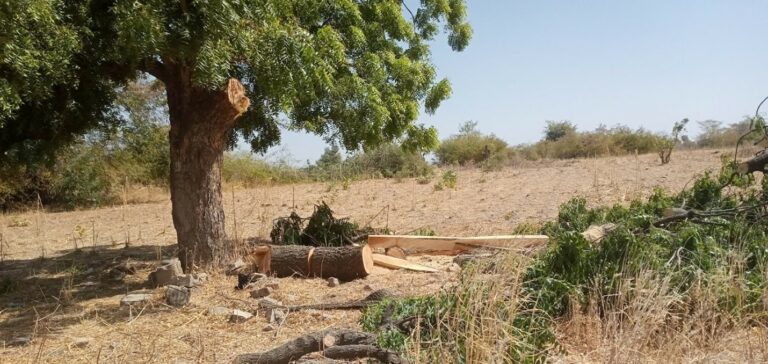
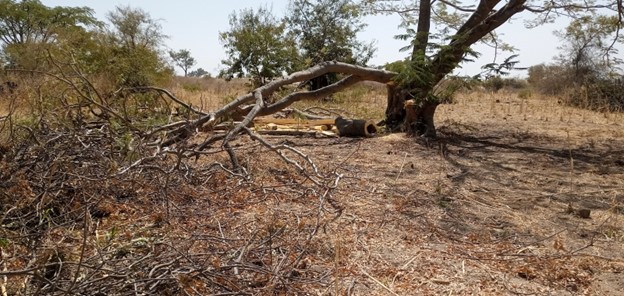
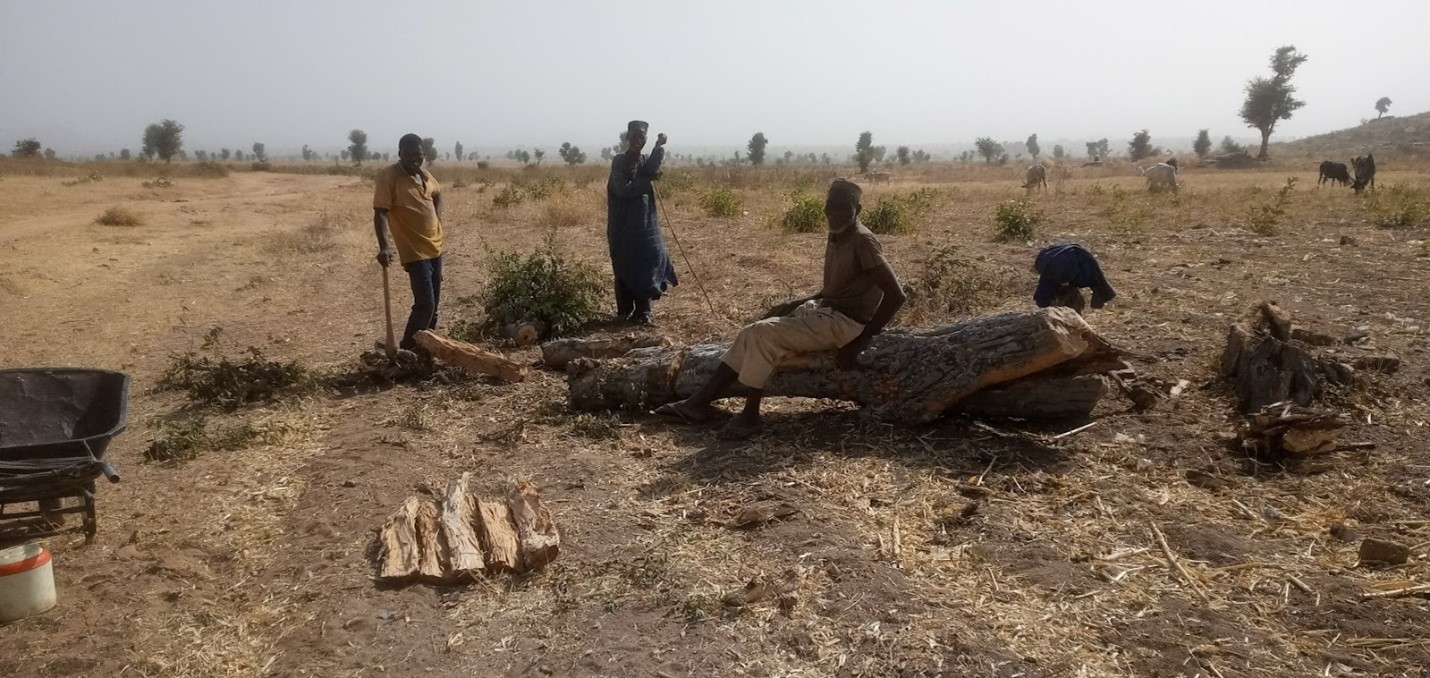
Destroyed trees at Galambi Cattle Ranch. Photo by Babaji Usman Babaji/The ICIR 2023
The trees that formed the vegetation were destroyed to shambles, and the vast land turned into a desert – the remaining few desolate saplings are toiling to survive in the presence of the board’s staff that receive their monthly salaries from taxpayers who suffer it in turn.
The persistent and indiscriminate destruction of trees in the recent past exposed neighbouring communities to deadly windstorms and other disasters associated with deforestation.
Its negative impact on coomunities could be traced by everyone; diminishing grazing grasses and fertile land, streams serving thousands of animals (wild and domestic) are rapidly shrinking, hence, posing a threat to the existence of the communities.
As the cutting of trees was nonselective, even trees bearing fruits are also not exempted, hence, the communities are not only exposed to myriad environmental degradation but also to socio-economic bruises, thereby making life more miserable.
With eroded farmlands and diminished grazing lands, – due to the desertification of the land that runs deep every year – the competition between the herders and farmers in the area intensified and become blatant.
It is not only the indiscriminate cutting down of trees that worries the defenseless locals but its devastating effect on the environment and human lives.
Over one hundred buildings – public and residential – were shattered down by the windstorm accompanied by dust in a terrible manner.
For instance, in June 2022, a windstorm, believed to be unprecedented, wreaked havoc on the communities neighbouring the ranch.
Over one hundred buildings – public and residential – were shattered down by the windstorm accompanied by dust the villagers said.
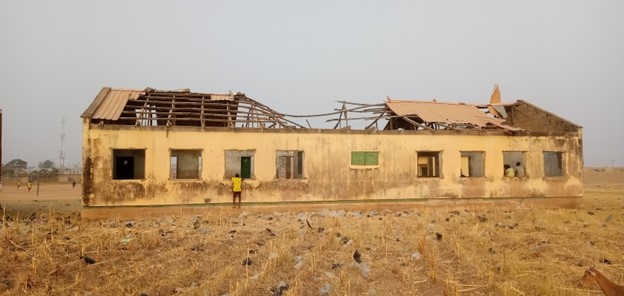
Residential apartment destroyed by storm in Zungur community, Bauchi State. Photo Babaji Usman Babaji/The ICIR 2023
How illegal logging is affecting host communities
The dark windstorm could not be forgotten by the villagers soon, only if more dreadful one strikes, “its devastating effect remained unabridged, the village head of Nasarawa, Zungur District, Ibrahim Usman, said.
Amina Abubakar, 50, a resident of Dajin community of Tafawa Balewa local government, a community about 8 km away from the ranch, recalled when she was amassing her clothes against being doused by rainwater. Unknown to her, it was not a usual thunderstorm – but a combination of horrible wind and dark dust that would leave several locals in agony.
Amina argued that the residents have never seen the like of such a deadly windstorm in the history of the area, “The storm was full of sand with terrible sounds. It was on Friday”, she recalled.
She told The ICIR that the wind wreaked havoc and left many people with different degrees of injuries and several buildings in tatters.
Her daughter Zainab Abubakar, 18, sustained a leg fracture while two others sustained injuries on that ‘black Friday’, “and everyone ran for his dear life”, she said.
“It was totally bizarre weather. We were coming back from a stream close to our house when the storm started blowing hard and we missed our path occasionally. It was frightening, and we thought it was the end of the world.”
Amina explained that the wind surge hit several residential houses in areas like Liman Katagum, Jamda, Mararaban L/Katagum, Galambi, Zungur, Luda, Baram, etc in Bauchi and some parts of Tafawa Balewa Local Governments.
Hassan Musa, the Chiroman Jamda bemoaned the excessive water inflow to their homes in the rainy season.
He explained that the land degradation in Jamda community causes intermittent flooding into their residential apartments giving the residents sleepless nights.
“Last year, we complained about the trenches to be filled by sand, it was futile, and they are still advancing and wreaking havoc on locals”, he said.
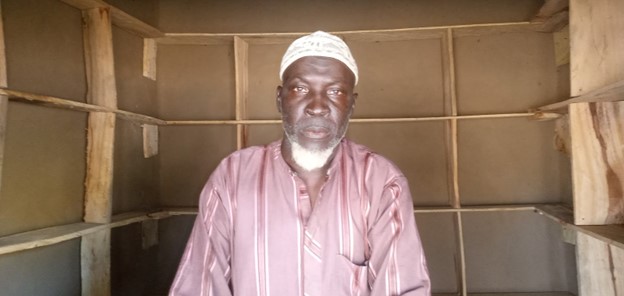
Hassan Musa (Chiroman Jamda) Photo BabajI Usman Babaji/The ICIR 2023
The new road constructed that passed through the community created excitement on residents’ faces, Chiroma held that the marauding waters spewing into the houses during the rainy season dashed their smiles.
“We pleaded with them (road constructors) to help make some culverts and drainages or to fill the trenches, they finished the road and left,” he told TheICIR, but they did not.
He grieved that the trenches have advanced to the village and increased every year, “We have a lot of problems, but the most pressing one is these trenches and troughs throughout these places.”
For Bala Musa, another victim, the brazen windstorm was the repercussion of the persistent cutting down of trees in the area for timber production and charcoal making.
With two trees grown at his house, Musa said they could not resist windstorms “because all other trees in the area were cut down and few ones left uprooted by the windstorm.”
“When there were trees here just about five years ago, you can’t stare at those places. But the timber and charcoal makers continued cutting the trees unchallenged; the trees are no more now”, he stressed.
Musa explained that he lost his two residential houses, his five livestock in 2022, and one other alongside his house furniture a couple of years earlier due to the seasonal windstorms, “I remained for several months without a house,” he stated.
Musa who is currently renting a house in Bayara, a suburb of Bauchi town, recounted that he has never seen such a dreaded windstorm with house roofs flying over people.
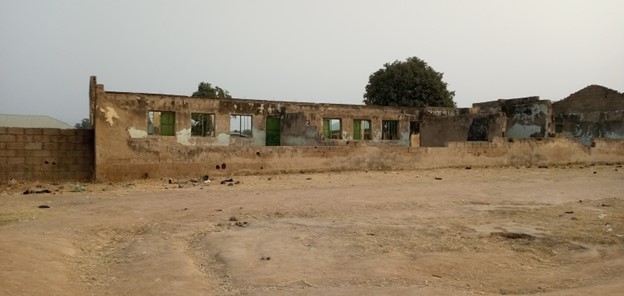
A primary school in Liman Katagum, Bauchi state ravaged by a windstorm, Photo Babaji Usman Babaji / The ICIR 2023.
He noted that he gets terrified whenever he sees thunder because it reminds him of the last year’s devastating June incident.
Musa held that the changes in the weather in the area started in the last five years, arguing that the alterations and consequences of deforestation increase yearly.
He explained that he used to think that the storms were inevitably natural disasters, he later learned that trees play a pivotal role in wind protection, absorbing and slowing down the flow of water, as well as regulating the local climate.
He alleged that the horrors are being done under the nose of the staff of the Galambi Cattle Ranch, “they get permission from the guards even before starting their work”, Musa said. “While others preferred working during the night on some occasions.”
Farmers pain…
In Mararan Katagum, a community about 20 km from Bauchi, the capital of Bauchi state, and about 4km away from Galambi ranch, Aliyu Mohammed, 37, a peasant farmer, stands on a bank of a stream close to his farmland, staring at the deforested landscape.
With the presence of some shrubs and a few saplings, the encroaching desert is obvious and could be defined by everyone.
He said about a decade ago, Galambi ranch was a forest with decent vegetation good for the ecosystem and pride for people who had lived there for generations.
Shades and leaves from the varied trees adorned the ranch with fertile soil, a haven for farmers and herders, and even a tourist centre for local visitors.
He argued that deforestation of the area for timber production, charcoal, firewood, and farming has consumed a larger portion of the ranch, thereby exposing the land to “land degradation.”
“Today, besides these trees, you can see, one here and the other there, all others were cut down for timber production, charcoal, and domestic activities.
He said the wanton destruction of the forest resources was intensified just a few years ago. “This place you see over there, you could not see it six years back – the vegetation was thick”, he said.
Mohammed noted that their harvests are significantly declining on a yearly basis. “Despite cultivating larger farmland, the harvest is very poor. In the last seven years, I was generating tremendous farm produce, but now, is moving backward every year.”
Herders groan…
Further, into the bushes of the ranch, a 23-year-old herder Musa Ja’oji, recounts a similar ordeal. “Nothing is left in this bush now,” he lamented.
He said edible grasses parch up sooner than required – the herders and shepherds rely on stored fodders and feeds, as the straws do not last long, forcing them to sell their skeletal cows at extremely low prices.
“By March you can’t see anything here for animals to feed on; they will all finish and no foliage or even dried grass for them. Animals are hardly managed here in these years; we will soon move southward for greener pasture”.
“It’s December now. The stalks of the crops are still remaining in farmlands, that’s the reason you can see them (cows) strong and healthy so far”, Ja’oji stated.
Ja’oji, while bemoaning the illegal cutting down of the trees, corroborated that it is the levity of the government officials. “How can someone enter here with a cutting machine without their (staff) knowledge?”
During The ICIR’s visit to the faraway part of the ranch, only some of the areas had some big trees that could help thwart windstorms and, sadly were also under destruction.
Some trees presumably planted for environmental protection purposes, such as Neem trees (Azadirachta indica) and Gmelina Arborea were also bladed to the ground apparently for timber production as shown in this video clip.
At the aged structures of the ranch deep inside the area, seven trees were cut down for timber just a day before the visit, and another nine semi-dried ones were axed down for charcoal and other domestic reasons.
Neem tree (Azadirachta indica) felled by loggers at Galambi Cattle Ranch Bauchi State. Photo Babaji Usman Babaji / The ICIR 2023
The findings suggested that the entire ranch would be stripped of trees in a couple of years, including the toiling saplings, unless the destruction is halted.
Timber producers claim professionalism
Amadu Salisu, a timber producer, claimed that he selects trees for timber production meticulously and professionally, “I consider the trees I cut. There are some of us that cut trees indiscriminately, but the majority of us are professionals and diligent in selection.”
He insisted that there is no relationship between the trees destroyed and the abnormal windstorms in the communities.
Amadu Salisu revealed that there are several other timber producers who get trees from the ranch, noting that some of them are doing so with the knowledge of the ranch staff.
Salisu declined to comment on whether they present incentives or tokens to the staff for their business.
Ali Abdullahi, a charcoal maker and wood fetcher, said the business is his source of income, “do you think I am doing this willingly? This is a tedious job, and I am doing it with no alternative. It has become my source of income.”
The 68-year-old man argued that if he had better work, he would not go to the bush for wood or charcoal making.
He attributed the windstorm ravaging communities as a natural phenomenon while the changes as “universal and inevitable.”
Abdullahi asserted that the Galambi ranch’s staff have never sent him out of the area for his business, and he doesn’t know them personally.
About two-thirds of the expansion of desertification can be attributed to changes in natural climate cycles, while the remaining third is likely “due to human-driven shifts”, according to a study in 2018.
Deforestation and other human activities are some of the factors exacerbating desertification every year. Some of these issues perists depite funds allocated for ecological projects by the federal government.
Government reacts…
The managing director of Galambi Cattle Ranch, Sani, said the management of the ranch and the Bauchi State government are doing the needful to protect the ranch from deforestation. “We don’t allow them to cut trees from the ranch”, he claims.
Sani stated that they have prosecuted an offender in 2021 at Bauchi State Environmental Mobile Court, which prosecutes culprits in line with environmental laws in the state.
According to him, in the last couple of months, they have not received a report of tree cutting in the ranch, and they don’t “officially” allow the destruction of trees for whatever reason.
Sani debunked the claim that some of the staff are abating the menace by conniving with culprits for a token, though he could not deny the broad defacement of the vegetation in the ranch.
Galambi Cattle Ranch in view. Babaji Usman Babaji/The ICIR 2023
He said the cutting of the trees in the ranch is intermittent and they are doing their best to halt it, “so anyone that tells you that we are not trying is lying. We have an official vehicle that whenever we receive a report of such acts, we would swiftly rush to the scene and apprehend the offender.”
“As far as Galambi Cattle Ranch is concerned, we don’t allow it, and our staff working there inform us if there is any intrusion,” he argued.
Responding to why the ranch is stripped of vegetation and proven evidence of destruction of the trees based on The ICIR’s visit to the area, he said “You know the ranch is a big land. It’s about 7,000 hectares of land, we can’t cover everywhere at a time.”
With the continuous defacement of trees in Bauchi State Galambi Cattle Ranch amid the authority’s nonchalant attitude, the area would completely be stripped of vegetation, and this would expose villagers’ livelihoods to more environmental hazards.
NIGERIANS in Sudan who indicated interest in leaving have all been successfully evacuated from the country’s capital, Khartoum, according to the Federal Government.
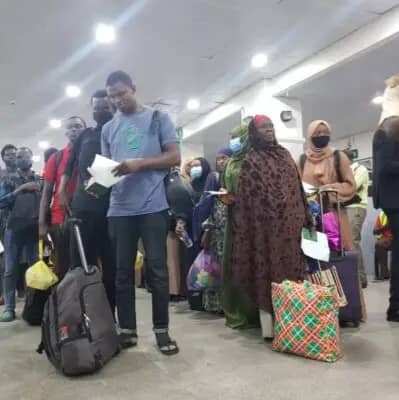
The Permanent Secretary in the Federal Ministry of Humanitarian Affairs, Sani Gwarz, disclosed this on Friday, May 5, while receiving the second batch of 130 evacuees at the Nnamdi Azikiwe International Airport, Abuja.
The second batch of evacuees arrived at the Pilgrims Terminal of the airport at precisely 3:10 pm local time on board TARCO aircraft B373-300 from Port Sudan.
According to Gwarz, Nigerians stranded in the North African country due to the unrest have all been conveyed to the safe zones where they will be airlifted.
“I’m happy to announce that we have successfully removed everybody. Everybody that needs to be removed, has been taken out of Khartoum. None of your colleagues today are in Khartoum; all of them have moved.
“You were the first batch to move out of Khartoum and sent to the Egyptian border. We still have a few of them, while some have already arrived in Nigeria.
“Though, the majority of them will be arriving in the next eight hours or more, So by that time, no Nigerian would have been left at the Egyptian border,” he said.
According to him, almost 1,700 people are waiting to be flown to Nigeria from Egypt and Port Sudan and adequate arrangements have been made for their flight.
He also noted that the N100,000 stipend given to the evacuees was life-saving support for those coming from a distressing situation.
“Some of you may have encountered difficulties or all of you, but it will soon be over and you will be reunited with your families and the trauma will be over.
“So, we welcome you back home and look forward to peace returning not only in Sudan but in the whole of Africa and the world at large,” he said.
The ICIR reported that the stranded Nigerians had to be transported by road to Egyptian and Ethiopian border because of the risk of evacuating from Sudan airport.
The Ministry of Foreign Affairs disclosed that flight operations in Sudan were difficult and unsafe due to the tension in the country.
As disclosed by the ministry, citizens are to be first evacuated by road to the Egyptian or Ethiopian border before they are flown to Nigeria.
The ICIR also reported that the first batch of Nigerians fleeing the crisis arrived in Abuja late on Wednesday, May 3.
The batch comprised a total of 376 persons and each of them received N100,000 cash for transportation to their various homes.
THE Lagos State Police Command has taken responsibility for the fire outbreak at the Alaba International Market.
The ICIR had earlier reported that fire razed parts of the market on Friday, May 5.
The director of the Lagos State Fire and Rescue Services Margaret Adeseye, who confirmed the incident to newsmen, said the fire impacted makeshift stalls within the market, commonly referred to as shanties.
Adeseye said efforts by firefighters to contain the inferno were resisted by some irate youths around the market.
She also disclosed that shops in the market were not affected by the fire outbreak.
However, in a series of tweets hours later, the state police spokesperson, Benjamin Hundeyin, said it was police officers from the Ojo division that the shanties on fire.
While dismissing earlier reports on the incident, Hundeyin said the officers recovered some weapons from suspected criminals at the shanties.
“This is a false narrative! Acting on credible information, police officers from Ojo division raided shanties around the market, arrested suspected criminals, and recovered some weapons,” he said.
“The shanties were thereafter set on fire. Alaba Int’l Market is NOT on fire!”
Lagos, a densely populated city, has experienced many fire outbreaks that resulted in loss of lives and property.
In 2019, a fire outbreak occurred at the popular Balogun market on Lagos Island, which is known for huge volumes of sale of textile and fashion items. The inferno destroyed many shops and goods worth millions of naira.
Similarly, in 2020, a fire outbreak was recorded at the popular Abule-Egba pipeline area of Lagos, which led to the loss of lives and property.
In March, fire gutted a spare parts market in the Ajegunle area of Lagos state, destroying items worth millions on naira.
The cause of these fire incidents has often been attributed to factors like power surge, poor safety measures, inadequate fire-fighting equipment, and poor infrastructure.
Last month, a fire incident was reported at Queens College, in the Onike area of the state.
No casualty was recorded in the incident as men of the state fire service quickly put out the fire.
THE suspended Adamawa State Resident Electoral Commissioner (REC), Hudu Yunusa Ari, has been granted administrative bail by the Police.
This was disclosed in a statement on Friday, May 5, by the Nigeria Police Force (NPF) spokesperson, Olumuyiwa Adejobi.
“The Nigeria Police Force hereby confirms that Barr. Hudu Yunusa-Ari, the Suspended Adamawa State Resident Electoral Commissioner (REC), who has been in custody for interrogations by the Police in the course of investigations into allegations of impropriety during the supplementary gubernatorial pools in the state, has been granted administrative bail by the Police while investigations subsist.
“He is expected to report at the Police Headquarters every weekday while investigations are ongoing on the matter,” Adejobi stated.
Ari was suspended by the Independent National Electoral Commission (INEC) for “illegally” declaring a winner in the Adamawa State governorship election.
INEC later wrote to the IG of Police, Usman Baba, for Ari’s immediate arrest and prosecution.
The decision to write the IGP was taken at a meeting of INEC’s top hierarchy in Abuja on April 18.
In a statement released after the meeting, the Commission said it would brief President Muhammadu Buhari on the REC’s conduct.
The Police arrested Ari on May 2 after INEC said it was unaware of the suspended REC’s whereabouts.
Adejobi stated that the Police Election Planning, Monitoring, and Evaluation Team arrested Ari in Abuja.
Meanwhile, The ICIRreportedthat the suspended Resident Electoral Commissioner (REC) said he acted according to the provision of the law during the Adamawa April 15 supplementary election.
Ari made this pronouncement in a letter addressed to the IGP, the chairman of INEC and the director-general of the Department of State Services (DSS).
He explained that his role in the controversial declaration of the governorship election was to avert the impending danger posed by delay in announcing the results.
Ari declared Aishatu Dahiru Binani of the All Progressives Congress (APC) winner of the election while the collation of results was still going on.
According to Electoral Act, 2022, the Returning Officer, rather than the REC, has the power to declare the winner of an election.
Incumbent governor and Peoples Democratic Party (PDP) candidate Adamu Fintiri was leading in the supplementary votes counted in 10 out of the 20 local government areas when the REC announced Binani as the winner.
The ICIRreported that the INEC headquarters in Abuja summoned Ari minutes after he declared Binani, the winner.
The Commission also invited its other staff involved in the declaration to Abuja and consequently suspended the collation of results of the supplementary poll.
PDP candidate, Fintiri, was eventually declared winner of the election.
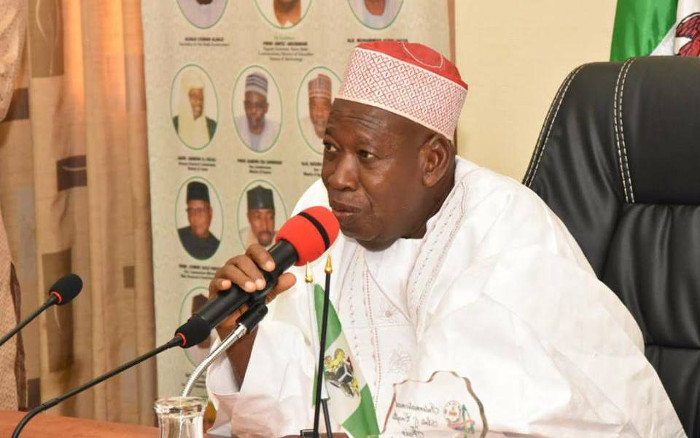
THE Governor of Kano State, Abdullahi Ganduje, says the former Minister of Niger Delta Affairs, Godswill Akpabio, has been endorsed as the next Senate President of Nigeria.
Ganduje disclosed this during a courtesy visit to the Cross Rivers governor, Ben Ayade, in Calabar.
According to him, the Senate Presidency has been zoned to the South-South geopolitical zone.
Ganduje did not explain if it was a decision of the All Progressives Congress (APC) leadership but he described the decision to nominate Akpabio as a done deal.
“The Senate President of the Federal Republic of Nigeria will come from the South-South and it is no other person than the former governor of Akwa Ibom.
“The uncommon governor, the uncommon minister who is going to be the uncommon Senate President. So we have resolved that.
“I am giving you assurance, we are waiting for the D-Day that he will be the Senate President of Nigeria,” Ganduje said.
Governors of the All Progressives Congress (APC) had earlier recommended that the position of Senate President should be zoned to either South-East or South-South regions.
The governors, under the umbrella of Progressive Governors Forum (PGF), recommended that the regions be considered in the zoning formula for the choice of the presiding and principal officers of the 10th National Assembly.
They recommended the zones for the consideration of the President-Elect, Bola Tinubu.
They also recommended that the position of Speaker of the House of Representatives should be zoned to either the North-West or the North-Central regions.
The governors also proposed that the position of Majority Leader, Deputy Majority Leader and Chief Whip should be used as compensation for those that may be asked to step down from running from the four presiding officers’ positions.
Nigeria’s 10th National Assembly will be inaugurated in the first week of June. Different interest groups nationwide are already lobbying for the positions of Senate President and Speaker of the House of Representatives.
Shortly after the inauguration, members of the Senate will elect new presiding officers.
Based on the results declared by the Independent National Electoral Commission (INEC), the ruling All Progressives Congress (APC) retained the majority of the Senate and House of Representatives seats, with 57 and 162 members, respectively.
NO FEWER than 20 million people have died of COVID-19 worldwide, the World Health Organization (WHO) has said.
The Director-General of the agency, Tedros Ghebreyesus, a doctor, said on Friday, May 5, that the tolls logged by countries and presented to the agency were much lower than the WHO’s estimates.
“COVID-19 has turned our world upside down. Almost seven million deaths have been reported to WHO. But we know the toll is several times higher, at least 20 million,” Ghebreyesus said in a video by the AFP.
On May 2, The ICIRreported the WHO as saying global health systems had started improving three years after the pandemic surfaced.
The ICIR reports that COVID-19 cases as of 16:00hours (GMT) on Friday, May 5, stood at nearly 700 million (687,600,968), according to Worldometer, a platform collating global data on the disease.
Worldometer and WHO puts the number of deaths from the pandemic at May 5 as nearly seven million. However, the figures vary, with WHO having 6,921,614 and the latter having 6,869,839.
Nigeria recorded 266,675 confirmed cases of the disease and lost 3,155 data from Worldometer, and WHO shows.
WHO said in a report on Tuesday, May 2, that services such as sexual, reproductive, maternal, newborn, child and adolescent health, nutrition, and immunisation, as well as treatment of infectious diseases, neglected tropical diseases, and non-communicable diseases, among others, had recorded improvements in hospitals.
Most countries also apply what they learned during the COVID-19 pandemic, including institutionalising innovative service disruption mitigation strategies into their routine health service delivery, according to WHO.
Nigeria is among nations whose health systems benefitted from the pandemic because of huge investments in health infrastructures largely by the private sector and an increase in the national budget for health.
In a series of reports, The ICIR verified the procurement of multi-billion naira equipment in federal hospitals in 2022 and reported how they boosted service delivery.
Globally, between 2020 and mid-2022, the virus battered economies, resulting in near hyperinflation in countries.
An unprecedented pandemic in a century, COVID-19 denied many people their livelihoods, disrupted health systems, and severed millions of people’s access to basic healthcare.
The world appears to have contained the pandemic with the help of vaccines and other pharmaceutical and non-pharmaceutical interventions.
THE second batch of Nigerians fleeing the crisis in Sudan arrived at the Nnamdi Azikiwe Airport, Abuja, on Friday, May 5.
A total of 130 Nigerians returned with the second batch from Port Sudan, and according to NIDCOM Head of Media, Public Relations and Protocol Unit Abdur-Rahman Balogun, the returnees were mostly women.
They were welcomed by the Permanent Secretary of the Federal Ministry of Humanitarian Affairs, Disaster Management and Social Development (FMHADMSD) Nasir Sani-Gwarzo, Director-General of the National Emergency Management Agency (NEMA) Mustapha Ahmed, among other government officials.
The ICIR reported that Nigerians in Port Sudan had begun boarding the TARCO Aviation airlines on Friday morning. More Nigerians are expected back into the country from Aswan, according to Balogun.
“Today, Friday May 5, 2023, we are expecting arrivals from Aswan (Azman and Max Air) and Taco Aviation from Port Sudan.,” Balogun said earlier.
The first batch of evacuees returned late on Wednesday, May 3 and received N100,000 cash each for transportation to their various homes.
There were 376 Nigerians who landed at the Nnamdi Azikiwe Airport in Abuja on Wednesday.
The evacuation had taken longer than expected due to the inability of the Nigerian government to airlift citizens directly out of Sudan, as the warring parties failed to heed calls for a ceasefire.
As a result, the government contracted bus operators in Sudan, and on Wednesday, April 26, the Nigerians embarked on the journey from Khartoum, the Sudan capital, to Egypt by road.
Others, including the latest set of returnees, were evacuated via the Port Sudan route, as the Egyptian authorities denied Nigerians entry into their territory.
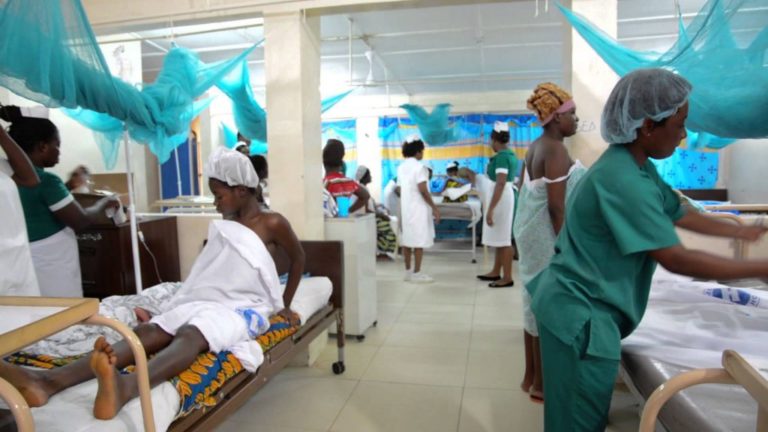
THE United Nations Population Fund (UNFPA) has advised Nigeria to recruit additional 70,000 midwives to help reduce maternal and child mortality in the country.
The agency said shortage of midwives and increasing brain drain had been linked to an ‘outrageous’ maternal mortality ratio of 512 per 100,000 live births in the country.
It said the shortage had been more acute in Northern Nigeria, “where essential maternal and reproductive health care needs are unmet”.
In a statement to commemorate the 2023 International Day of the Midwife, UNFPA Executive Director Natalia Kanem, a doctor, said in addition to hiring more midwives, health authorities should allow them to be more involved in health care services.
The organisation explained that evidence showed that competent midwives could provide 90 per cent of essential sexual and reproductive health care.
It argued that midwives accounted for only 10 per cent of the health workforce because they were underutilised and in short supply.
“Many health systems continue to marginalise this mostly female workforce and treat midwives poorly in terms of pay, working conditions and opportunities to cultivate skills. This, along with a global shortage of 900,000 midwives, reflects an assumption that they are not essential healthcare workers. Nothing could be further from the truth.”
UNFPA said midwives are important in a world where a woman dies every two minutes due to pregnancy or childbirth.
According to the agency, having skilled midwives is one of the most important ways to avert preventable maternal and newborn deaths.
It said more mothers and babies survived and thrived in countries that invested in a capable midwifery workforce.
“Midwives provide essential information on sexual and reproductive health, including family planning, and help people navigate often-sensitive issues in a variety of contexts, including in humanitarian settings. Midwives are often the only healthcare workers serving people in hard-to-reach places.
“The consequences of not having enough skilled midwives are alarming. Decades of progress in preventing maternal deaths have ground to a halt. Every single year, 287,000 women globally lose their lives giving birth; 2.4 million newborns die, and an additional 2.2 million are stillborn.”
By closing the number of midwives deficit, UNFPA said nations would prevent two-thirds of maternal and newborn deaths and save over 4.3 million lives annually by 2035.
The agency said it had helped countries educate and train 350,000 midwives in line with international standards to help improve the quality of care they provide.
A check by The ICIR showed that the Nursing and Midwifery Council of Nigeria (NMCN) licensed over 250,000 midwives and nurses in Nigeria.
The ICIR also reports that many nurses in Nigeria trained as midwives and vice versa.
In 2022, The ICIR investigated and published a series of reports from 12 states on the state of primary health centres (PHCs) where midwives and nurses mostly work.
The reports tally with UNFPA’s concerns in the story. Some of the reports are here, here and here.
AFRICAN Development Bank Group President Akinwunmi Adesina (AfDB) has called on young university graduates to sieze the moment and be instruments of change in a world beset by increasing socio-economic challenges.
Delivering the keynote speech at America’s Calvin University Commencement ceremony, Adesina told the audience, including 700 graduates, “The world faces many simultaneous challenges, promising a future of exciting and infinite possibilities, in which you have a role to play,”
Foremost among these challenges are climate change, food insecurity and a lack of universal access to affordable healthcare, he added.
Adesina shared with the graduates the difficult times and conditions he went through as a university student at America’s Purdue University.
During that period, Adesina said, he ran out of the small stipend he had and often had to walk many kilometres, enduring the winter cold, to and from lectures.
“One day a bus driver came to my aid by topping up my transport fare. I also drew the sympathy of my professors, who rallied to pay for tuition and upkeep.
“Many years later, I won the World Food Prize, the Nobel Prize for Agriculture,” he recalled.
He then enthused, “How could my professors have known at the time that they were helping someone who would later become a World Food Prize laureate?
“How would they have known they were helping someone who would later become president of the African Development Bank Group? In front of me today I see builders and shapers of hope.
“You have been well prepared to go into the world to be the change makers. You have received a world-class education. You have been exposed to great ideas, and you’ve worked alongside faculty and students from all around the world.”
In his remarks, Calvin University’s president Wiebe Boer extolled Adesina’s qualities as “a man of great accomplishments.”
Calling Adesina his mentor, Boer said, “Everywhere he goes, no matter how high, no matter how powerful, no matter how big the checkbook, he never forgets those less fortunate.”
Nain Miranda Duarte, the president of Calvin University’s Student Senate, recounted the economic difficulties his family endured and how he had benefited from people’s generosity from his early days in the slums of Nicaragua to be a graduate from a top American university.
Duarte said the combined income of his parents then was only $50 a month, which amounted to only $1.67 a day for a family of seven.
“Together, we stand here today because of those who decided to be God’s hands and feet and who actively exemplified the power of generosity. Class of 2023, it is my turn, it is your turn, to be that anonymous donor that allows others to finish their high school education. It is our turn to make impossible dreams a reality,” Duarte said.
Adesina was first elected president of the AfDB Group in 2015 as the institution’s eighth head.
Under his leadership, the bank achieved its highest capital increase in 2019. Last year, the African Development Bank Group and donor countries agreed to an $8.9 billion replenishment of the African Development Fund (ADF), which provides concessional loans and grants to low income African countries.