
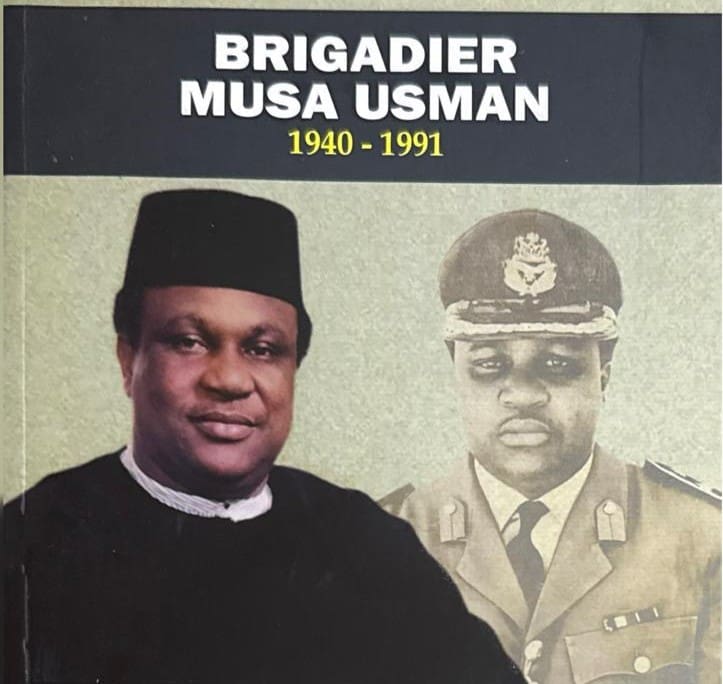

Vice-President Kashim Shettima is expected to unveil a new biography of the late Brigadier Musa Usman, the first military governor of Nigeria’s defunct North-Eastern State, at a public ceremony in Abuja.
According to a statement issued on behalf of the Musa Usman family by Hassan Tanimu Musa Usman, the presentation will take place on Monday, September 14, at the NAF Conference Centre, Kado, Abuja, from 10 am. The statement clarified that admission to the event is free, and members of the public, academics, students and media practitioners are invited.
The 363-page book, titled Brigadier Musa Usman (1940–1991): Service and Impact, is written by renowned journalists and respected authors Mahmud Jega and Theophilus Abbah, documenting the history of the first military governor of Nigeria’s former North-Eastern State
Usman became military governor of the North-Eastern State after Nigeria’s military government created the state on May 27, 1967, as part of a major restructuring of the country’s administrative map.
An official Nigerian Government Gazette dated May 31, 1967, records the appointment of then Major Musa Usman to act as Military Governor of the North-Eastern State by then Head of the Federal Military Government, Lieutenant-Colonel Yakubu Gowon.
He remained governor until July 1975 and was succeeded by Colonel Muhammadu Buhari following the military coup that removed Gowon from office. Historical records identify Usman as the first governor of the North-Eastern State.
The North-Eastern State was broken up during the state-creation exercise of the 1970s. In 1976, it was divided into Borno, Bauchi and Gongola, with a subsequent state creation producing the six states that now occupy much of the territory, which are Borno, Yobe, Bauchi, Gombe, Adamawa and Taraba states.
Shettima is scheduled to serve as Special Guest of Honour and formally unveil the book, while Major General Ibrahim Badamasi Haruna, a former Federal Commissioner for Information, will chair the event.
Major General Ike Omar Sanda Nwachukwu is expected to deliver the keynote address, while Professor Abubakar Siddique Mohammed, Director-General of the Centre for Democratic Development Research and Training at Ahmadu Bello University, Zaria, will review the book.
Former Secretary to the Government of the Federation, Ambassador Babagana Kingibe, is listed as Book Presenter.
Borno State Governor Babagana Umara Zulum is expected to serve as Chief Host, with the governors of Adamawa, Bauchi, Gombe, Taraba and Yobe states as co-hosts.
The gathering is expected to bring together political leaders, retired military officers, academics, journalists and members of the Usman family to examine the life and legacy of one of the military officers who played a significant role in the early administrative history of Nigeria’s post-independence North.
The ICIR reports that Usman was born in 1940 and began his military career in the Nigerian Army before transferring to the Nigerian Air Force.
Biographical accounts show that he received military training at institutions in Ghana and Britain, including the Royal Military Academy Sandhurst, and later served in the Nigerian Air Force. He was appointed to command the service at a relatively young age before becoming governor of the newly created North-Eastern State.
His career also unfolded during one of the most turbulent periods in Nigeria’s political history, including the 1966 coups, the creation of new states in 1967 and the Nigerian Civil War.
As governor, Usman was confronted with the enormous task of administering a territory covering what are now several states and bringing disparate communities and administrative structures under a new state government.
Accounts of his administration highlight efforts in infrastructure, education, healthcare and economic development. One of the projects associated with his administration was the development of the Ashaka cement project, which was eventually commissioned in 1979.
Historical accounts also credit Usman with playing a role in determining the administrative capital of the new state, noting that he established a committee to assess Bauchi, Maiduguri, Mubi and Yola as possible headquarters, with considerations including housing, transport, communications, water and electricity.
The new biography contains a foreword by former Head of State General Yakubu Gowon, who served as Nigeria’s military ruler when Usman was appointed governor.
According to the family statement, Gowon described Usman as a man of integrity and honesty and credited his administration with significant infrastructural development in the North-East.
“Brigadier Musa Usman, who served as Governor of the North-Eastern State, was known for his integrity and honesty,” Gowon wrote. “His administration achieved significant results, as evidenced by the substantial infrastructure present in the North-East region of Nigeria today. He was responsible for investing in many of these developments,” he added.
Former Head of State General Abdulsalami Abubakar also contributed a recollection of Usman, describing him as a senior officer to whom he was junior during the formative years of the Nigerian Air Force.
“The late Brigadier Musa Usman wasn’t my colleague; he was my boss,” General Abdulsalami reflected. “I was a cadet when the late Brigadier was posted to the Nigerian Air Force in Kaduna as Commandant. At the early stage of the air force, the authorities thought it necessary to bring a Nigerian officer to study the system under the command of the Germans to get the air force going… the authorities felt to bring an officer [Brigadier Musa Usman] to stabilise the system,” he said.
The recollection places Usman within the early efforts to develop a Nigerian-led air force after the departure of foreign technical personnel who had helped establish the service.
Usman’s political legacy is particularly significant because the North-Eastern State he governed has disappeared from Nigeria’s present administrative map.
The state existed for less than a decade, but its territory subsequently became the foundation for six states and a population spread across some of the country’s most historically and politically important communities.
Brigadier Musa Usman died in 1991, aged 51. Biographical records state that he subsequently worked in the private sector after leaving military service, including as a director of the former Bank of the North.

Nanji is an investigative journalist with the ICIR. She has years of experience in reporting and broadcasting human angle stories, gender inequalities, minority stories, and human rights issues. She has documented sexual war crimes in armed conflict, sex for grades in Nigerian Universities, harmful traditional practices and human trafficking.