
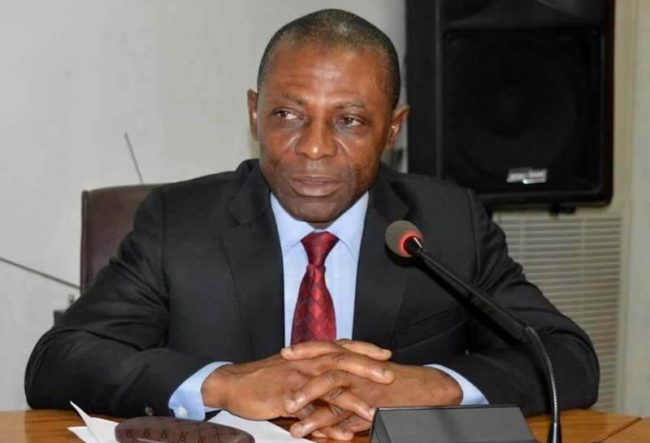

ANTHONY Ayine, Auditor General of the Federation, says the Excess Crude Account (ECA) violates the Nigerian constitution and should be either discontinued or legalised.
This was contained in the annual report of the Auditor-General on the accounts of the Federation of Nigeria for the year ended December 2016.
Ayine pointed out that constitution stipulates that all government revenues shall be paid into the federation account. He also added that the office of the Auditor-General had consistently pointed out the illegality in FG’s continuous maintenance of the ECA since 2007, but nothing was done about it.
According to the report, more than N361.2 billion was deducted from the ECA in 2016, classified as ‘PPT/Royalty’, before the balance was paid to the Federation Account.
“Examination of records and documents presented to the Audit Team in respect of the Excess Crude Account (ECA), revealed that a sum of N361,230,422,517.15 summarized below and classified as PPT/Royalty was deducted from total Oil and Gas revenue collected before the balance was paid to the Federation Account,” the report read.
“These deductions would appear to contravene the provisions of Section 162 (1) of the Constitution of the Federal Republic of Nigeria, 1999 which states that ‘The Federation shall maintain a special account to be called “The Federation Account” into which shall be paid all revenues collected by the Government of the Federation’.
“Efforts made by the audit team to obtain legal authority for the creation of Excess crude Oil/PPT/Royalty Account proved abortive.
“This observation has been consistently mentioned in my previous reports since the year 2007 without any positive action taken by the Federal Government to address this anomaly.”
HISTORY OF THE ECA
The Excess Crude Account is an account used to save oil revenues above the approved benchmark fixed by the government. For instance, according to the 2018 budget, the benchmark for crude oil is $51 per barrel, but the international price of the commodity currently stands at between $71 and $72 per barrel. It means that the excess $20 dollars made from the sale of a barrel of crude will be paid into the ECA.
The Excess Crude Account was established in 2004 by then President Olusegun Obsanjo, following a meeting of the Honorary International Investors Council (HIIC). The HIIC is an organization of prominent investors from around the world that advises the Nigerian government on matters pertaining to the country’s economic development.
Though the objective for the creation of the ECA was a good one — to protect the nation’s economy from external shocks using monies saved from crude oil sales –, there was no law to back it up. The account was supposed to be operated jointly by the three tiers of government,but over the years, successive Presidents have unilaterally approved withdrawals from the account.
In 2008, and again in 2011, the 36 state governments instituted legal actions to prevent the federal government from operating the ECA and making unilateral deductions from the account.
HISTORY OF NON-ACCOUNTABILITY
In an editorial published by The Punch on March 1, 2018, Rose Oko, a member of the Nigerian Senate,was quoted as making the following statement: “It was reported that the ECA increased from $5.16 billion in 2005 to over $20 billion in 2008, and decreased to less than $4 billion by 2010, with no known tracking of its operations.”
Oko was said to have made the comments in support of a motion seeking to abolish the “illegal” ECA.
In 2015, Adams Oshiomhole, the Governor of Edo State, publicly accused then Finance Minister, Ngozi Okonjo-Iweala of illegally withdrawing billions from the ECA. Okonjo-Iwela responded by saying that he had the approval of then President Jonathan to make the said withdrawals.
More recently, the National Economic Council (NEC), comprising the Vice President, the 36 State Governors and the Governor of the Central Bank of Nigeria (CBN), ‘approved‘ the withdrawal of $1 billion from the ECA to boost the counter terrorism operations in the North East. Though the governors of Ekiti and River States, Ayodele Fayose and Nyesom Wike respectively, said they were opposed to the agreement.
However, despite the controversy surrounding the approval, and without the approval of the Senate, President Muhammadu Buhari gave approval for the sum of $496 million to be forwarded to the government of the United States of America for the purchase of fighter jets to be used in the fight against terrorism. Again, this is in contravention of section 80 (3 and 4) of the 1999 constitution as amended.
BEST WAY FORWARD
In his recommendations, Anthony Ayine, the Auditor-General, urged relevant government agencies, as well as the Federation Accounts and Allocation Committee (FAAC), to “initiate the process to legalise the creation of the Excess Crude Oil/PPT/Royalty Account through the National Assembly”.
The Senate had adopted a motion in 2017 calling on the federal government to abolish the ECA, but rather, should pay all monies made from selling crude oil above the benchmark price into the federation account in compliance with constitutional provisions.
Of the two options, it is left to be seen which one the government will take.