

June 27 started as a day to commemorate the birthday of disability rights advocate Helen Keller, who was the first deafblind person in the U.S. to earn a bachelor’s degree. Since then, the day has been dedicated to celebrating International Day of Deafblindness, also known as International Day of Persons with Deafblindness.
Deafblindness is a condition characterised by little or no useful hearing and little or no useful sight. Because of this, deafblind people require varied management plans to improve their outcomes in areas such as communication, education, work, and general life satisfaction.
According to the Helen Keller National Centre, the theme for this year is: “Connected by Touch: Breaking Barriers, Building Bridges.” It highlights the fundamental role of touch in communication, connection, and access for deafblind individuals.
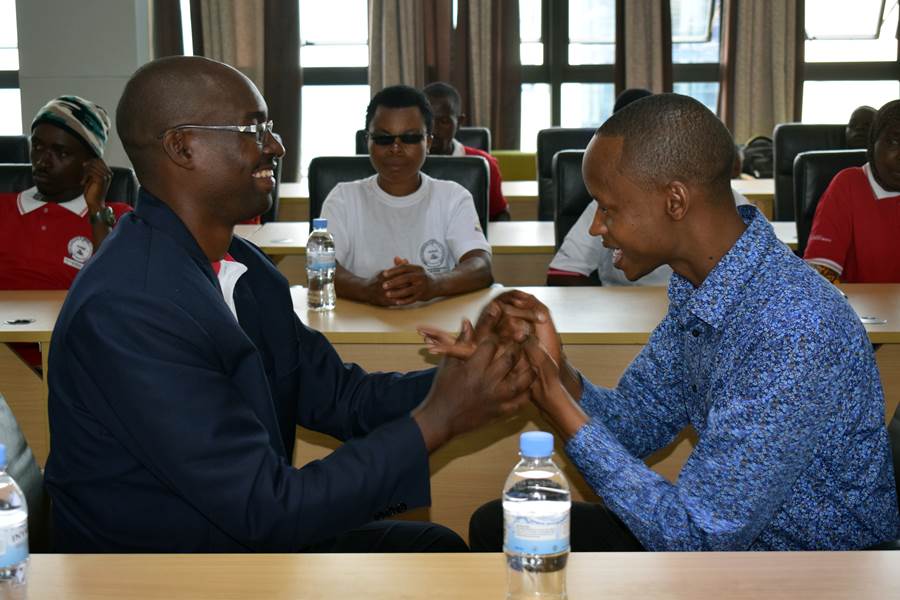
Touch is said to be the foundation of how deafblind individuals navigate the world. From protactile language, tactile sign language, and haptics to the use of braille, assistive technology, and everyday interaction. Through touch, deafblind individuals communicate, learn, work, and thrive.
In December 2023, James Lalu, Executive Secretary of the National Commission for Persons with Disabilities (NCPWD) revealed that 35.1 million persons are currently living with disabilities in Nigeria. This means that 16% of Nigeria’s 216.8 million population has some form of disability. The ICIR observed that no official statistics or census is tracking the number of people living with deafblindness or dual sensory impairments in the country.
Speaking with The ICIR in commemoration of the day, the Vice President of the National Association of Persons with Physical Disabilities, Beatrice Awala Mube, called for unity and inclusion in the education sector, saying it will prevent deafblind children from being overlooked.
“The disability community strongly advocates for inclusive education, where children with disabilities and children without disability learn under the same roof but in a different classroom to promote inclusion,” she said.
“With this system, you can agree with me that deafblind children will be fully included under the principles of leave no one behind,”
Regarding the barriers to tracking this population, Mube pointed to national policy failures. Speaking from her perspective within the Joint National Association of Persons with Disabilities (JONAPWD), she explained that the inability to monitor and support deafblind individuals stems from a lack of policy enforcement rather than a lack of existing laws.
“The major barriers are the poor implementation of the Discrimination Against Persons with disabilities prohibition Act 2018,” she said.
Given the high cost of communication tools and equipment, she emphasised that the government must take responsibility for learning tools.
“My take on this is, if the Government can input working tools and implement them for other organisations, learning instructional materials for deafblind children should not be an exception. We from JONAPWD have always advocated for import-free duties from all forms of assistive device mobility aids for all persons with disabilities,” she noted.
However, speaking from a perspective as a visually impaired leader who has managed these systemic gaps firsthand, Ishaku Adamu, former National President of the Nigeria Association of the Blind and the current National Secretary for JONAPWD explained that structured inclusion had begun for the deafblind, following a directive from the World Blind Union to identify and organise the population. The initiative, he said, led to the recent launch of a national association to ensure they can represent themselves.
“We received a letter from the World Blind Union instructing all member states to start mobilising, identifying those who are deaf-blind and trying to put them into a kind of formidable or well-organised structure or association, so that they can advocate for themselves,” he said.
Adamu acknowledged that deafblind individuals face severe neglect, even within the disability community, and said their ongoing integration into the national frameworks will better accommodate them.
“There is nothing we do in the Joint Association of Persons with Disabilities that we leave them behind. We make sure they are part of the advocacy in whatever we do. We call them the most marginalised among the disability group, you know, even their voices are less heard, so we always try to give them a kind of opportunity, because deafblind and those with intellectual disability, they have been neglected for long, even within disability community.”
He also highlighted the mode of communication for them, where he mentioned the two trainings they undergo.
“One is the tactile mode, where we communicate by touching the body, and the other person also has to touch you to understand the communication. The second one is training them to understand technology. They can learn Braille. After learning braille, certain technologies will help them to adapt.”
He concluded by calling on the government to implement policies that provide support for visually impaired and deafblind individuals as they face the same economic exclusion. Adamu also urged the government to remove all import duties on assistive devices and support local manufacturing to make the tools both available and affordable. He stressed that government ministries must explicitly include these devices in their annual budgets so they can be purchased and distributed for free to those who need them.
Zainab Abdulrasaq ia a reporter and a fact-checker with The ICIR. She believes that accountable citizenship starts with an accountable government, which is why she highlights injustice and everyday struggles through her reporting, one story at a time. She adores reading and can be reached via zabdulrasaq@icirnigeria.org and @blackbookishgirl on Instagram/Medium