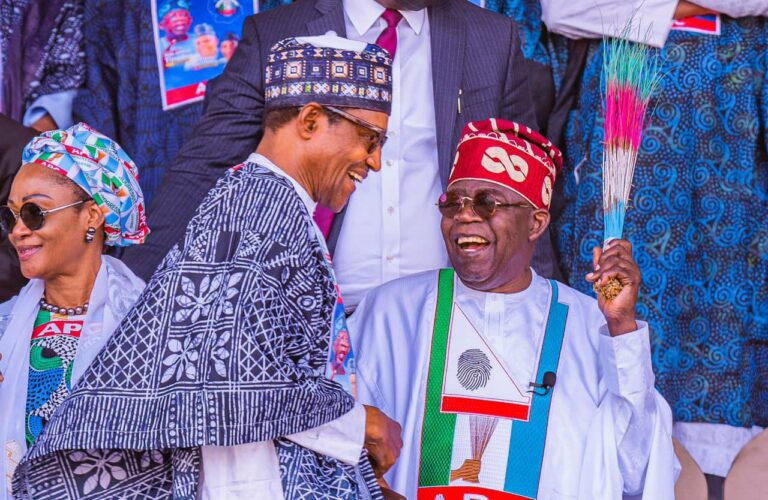
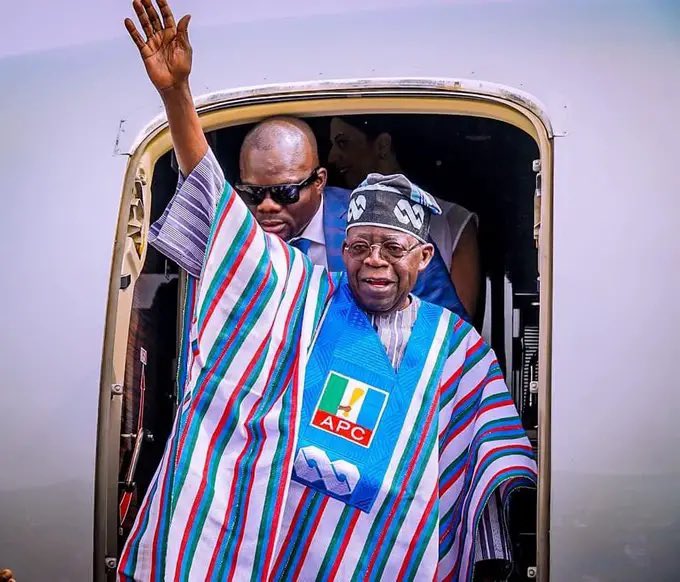
THE anxiety over who succeeds President Muhammadu Buhari may have ended as the Independent National Electoral Commission (INEC), on Wednesday, March 1, declared the candidate of the ruling All Progressives Congress (APC), Bola Tinubu, winner of the Presidential Election conducted on February 25.
Tinubu polled 8,794,726 votes to defeat a dozen other candidates, including three major ones, namely the Peoples Democratic Party’s Atiku Abubakar, Labour Party’s Peter Obi and New Nigeria Peoples Party’s Rabiu Kwankwaso, according to the election results announced by INEC chairman, Mahmood Yakubu, a professor, at 4:00 am on March 1.
Atiku came second with 6,984,520 votes, Obi followed closely with 6,101,533 votes, and Kwankwaso got 1,496,687.
Tinubu and Atiku topped in 12 states, Obi won 11 states plus the Federal Capital Territory (FCT), and Kwankwaso led in one state.
States won by the major contenders are:
Tinubu: Rivers, Borno, Jigawa, Zamfara, Benue, Kogi, Kwara, Niger, Osun, Ekiti, Ondo, Oyo and Ogun states.
Atiku: Katsina, Kebbi, Sokoto, Kaduna, Gombe, Yobe, Bauchi, Adamawa and Taraba states. He also won in Osun, Akwa Ibom and Bayelsa states.
Obi: Edo, Cross River, Delta, Lagos, FCT, Plateau, Imo, Ebonyi, Nasarawa, Anambra, Abia and Enugu states.
Kwankwaso: Kano State.
The ICIR reports that some of the parties who lost the election may reject the result and head to court.
Here are major things to know about the President-Elect
Many controversies have surrounded Tinubu’s birth, age, education and wealth.
He is named Adekunle Bola Ahmed Tinubu and claims to have been born in Lagos State on March 29, 1952, meaning he’s 70 years.
He attended St. John’s Primary School, Aroloya, Lagos and Children’s Home School in Ibadan. Tinubu graduated from Chicago State University, where he read Accounting, but there have been questions about the secondary school he attended.
Tinubu worked with Mobil Nigeria in the 1980s as an accountant and revealed how he became rich years later.
Political adventure
Tinubu ventured into politics and was elected Senator on the Social Democratic Party’s platform to represent Lagos West in 1992.
The former Head of State, Sani Abacha, dissolved the country’s Third Republic in which Tinubu was a federal lawmaker.
The President-Elect was forced into exile following his strong opposition to the military government, which annulled the 1993 presidential election won by the late Moshood Abiola.
In 1998, Tinubu returned to Nigeria after Abacha’s death and won the Lagos State governorship election primaries through the Alliance for Democracy (AD).
He eventually won the governorship poll. He also got re-elected for a second and final term as Lagos State governor in 2003.
Tinubu, fondly called Jagaban (a traditional title he got in Borgu, Niger State), has since become a kingmaker in Lagos State after leaving office as governor. He has been very influential in the emergence of leaders at all levels in the state.
The ICIR reports that Tinubu played a huge role in the ouster of former President Goodluck Jonathan, who sought re-election in 2015.
He was also very instrumental in the election of the incumbent President Muhammadu Buhari in 2015 and his re-election in 2019.
He is regarded as the National Leader of the ruling APC.
Tinubu merged his Action Congress of Nigeria (ACN) with Buhari’s Congress for Progressive Change (CPC), the All Nigeria Peoples Party (ANPP), splinter groups from the All Progressives Grand Alliance (APGA), and the Peoples Democratic Party (PDP) in 2013 to form the APC.
US drug deal indictment, docked, freed by CCT
In September 2011, the Code of Conduct Tribunal (CCT) docked him for operating foreign accounts when he was a governor.
There have been reports, includingthis andthis, of how the United States, through court injunction, took over $460,000 suspected to be proceeds of heroin business in Tinubu’s account.
The opposition parties, including the PDP and LP, used the drug indictment to warn Nigerians of the dire consequences the habit could impose on the nation if the elected President truly sympathises with illicit drug barons.
A great philanthropist and investor in Nigeria
Tinubu has touched many lives, including those he built from scratch to become successful leaders. His political entrepreneurship provokes envy, perhaps one of the reasons he won votes across the country in the keenly contested presidential election.
He runs a business empire, including Oriental Hotel, First Nation Airline, The Nation Newspaper, and TV Continental.
Before the June 6 2022 APC presidential primary in Abuja, many believed it was all over for the President-Elect because of high politicking in the APC.
Tinubu’s supposed recruit, Yemi Osinbajo, a professor and incumbent Vice President, had picked the N100 million APC nomination and expression of interest form – in apparent readiness to confront his former principal.
Despite Osinbajo’s declaration for the presidency against Tinubu, the APC reportedly endorsed the Senate President, Ahmed Lawan, as the presidential flag-bearer.
That was not enough to stop the former Lagos State governor.
While seeking delegates’ votes in Abeokuta, Ogun State, Tinubu said it was his turn to be Nigeria’s president.
He eventually won the primary, defeating several aspirants, including Osinbajo, Lawan, Kogi State Governor Yahaya Bello, and former Minister of Transportation Rotimi Amaechi.
Tinubu’s health and old age are a worry to many
Many Nigerians are worried about Tinubu’s age following the crisis posed by Buhari’s ill health during his first term in office. The ICIRreportedhow Buhari beat late former President Umar Yar’Adua’s record in foreign medical trips. Buhari also confessed that old age negatively affected his performance.
This organization also reported how the president-elect makes repeated blunders while addressing the public.
About Tinubu’s family
The President-Elect is married to Remi Tinubu, a three-time Senator.
The family is blessed with children.
Tinubu will be sworn in on May 29 to replace Buhari, who will end his two terms of four years apiece.
In his victory speech on Wednesday, March 1, the President-Elect promised to be fair to all.
Tinubu is expected to pacify and unify a nation further divided along religious and ethnic lines by the election by offering good governance. Nigeria has been plagued with three problems, namely corruption, insecurity and poor economy which Buhari vowed to address when seeking office.
THE Heads of the Election Observation Missions of the Commission of the Economic Community of West African States (ECOWAS) and the Africa Union (AU), have called on Nigeria’s political parties and their candidates to settle electoral disputes through peaceful means and dialogue, in accordance with the law.
In a joint statement issued on Wednesday, the coalition noted with concern signs of increasing tensions in the country following the country’s 25th February general elections.
“We remain confident in the strong commitment of the Nigerian government and her people to peace, stability, and development and reaffirm our commitment to accompany the country in advancing these important goals.
“We also urge the security agencies to continue to professionally discharge their duties with utmost respect for the rule of law,” the statement said.
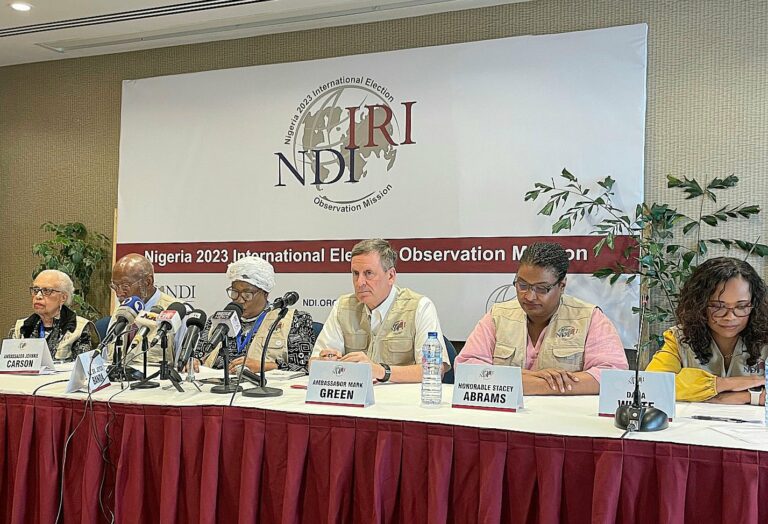
Earlier, the Joint Election Observation Mission (JEOM), involving the International Republican Institute (IRI) and the National Democratic Institute (NDI) and led by former President of Malawi Joyce Banda, said that logistical challenges and multiple incidents of political violence overshadowed the electoral process and impeded a substantial number of voters from participating.
The coalition added: “Ongoing currency and fuel shortages also imposed excessive burdens on voters and election officials, and Nigerian marginalised groups, especially women, continue to face barriers to seeking and obtaining political office.”
It however, congratulated the people of Nigeria for their resilience and enthusiasm to participate in the process and “a strong desire to have their voices heard”.
In the same vein, the European Union Election Observation Mission (EU OM) said despite the fact that presidential and parliamentary elections were held as scheduled, there were considerable operational failures which dampened trust in the process.
EU chief observer Barry Andrews, also faulted the Independent National Electoral Commission (INEC) for withholding critical information during various stages of the election process and delays in the deployment of election materials to many polling units on election day.
“Public information about key electoral procedures and precise data was not readily available, including the safeguards for the integrity and reliability of the BVAS, the process of collecting PVCs, voter registration updates, and the rationale of court orders changing candidate lists. Publication of such information would have notably enhanced the transparency and certainty of the process,” Andrews said.
The introduction of the Bimodal Voter Accreditation System (BVAS) and the INEC Results Viewing Portal (IReV) were perceived as an important step to ensure the integrity and credibility of the elections.
However, uploading of results using the BVAS did not work as expected and the presidential election results forms started to appear on the portal very late on election day, raising concerns.
“In 16 of 37 observed polling units, staff had difficulties understanding and completing results forms. The figures in the results forms did not reconcile in 9 out of 37 of observations. In 24 out of 37 units, the results were not posted publicly and in 22 of 37 units, the form was not uploaded using BVAS,” the EU chief observer added.
Electoral disputes are handled mainly by courts, with ad hoc election tribunals established for results challenges.
The courts are broadly accessible for addressing pre- and post-election disputes, including rights of appeal but enforcement is weak partly due to gaps in law.
As of 23 February, there were at least 1250 pre-election cases, among them at least 600 in the Court of Appeal and at least 80 appealed to the Supreme Court, underlining a highly litigious electoral environment.
The foreign election observation groups of over 150 members deployed across all six geopolitical regions, noted that despite the clamours for reforms to the Electoral Act 2022, Nigerians were mostly not impressed by the conduct of the 2023 presidential and national assembly elections.
Entries should focus on themes of courage and leadership in combating corruption, especially through promoting transparency, accountability, and the rule of law, and of human rights and/or anti-corruption generally. Contestants may submit up to four images.
The Allard Prize Committee will select up to six photographs as winners. Each winning entrant will receive CAD1,000 (US$735).
Professional and amateur photographers who cover human rights issues or anti-corruption efforts can apply for this prize.
The deadline for the submission of the application is May 1, 2023. Interested applicants can apply here.
VERMONT Law School (VLS) is accepting applications for its 2023 Summer Media Fellowships.
Selected journalists will participate in VLS’s Summer Session, during which internationally recognised scholars and leaders in environmental law and policy gather to share their expertise.
Featured courses include biodiversity protection, environmental crimes, undercover investigations of animal operations and more.
The 70-year-old former governor of Lagos State and Nigeria’s political kingmaker will inherit a Nigeria that is faced with a fractured polity, national security threats and economic challenges including skyrocketing cost of living.
Tinubu polled 36% of the 24,965,218 votes cast in the 25 February presidential election whose outcome is being disputed by his closest rivals.
To emerge as Nigeria’s President, Section 134 of the constitution states that a presidential candidate must score the highest number of votes cast at the election. In addition, the candidate must also score at least a quarter of the votes cast in each of at least 25 states in the Federation including the Federal Capital Territory. Tinubu met this requirement.
His closest rivals Atiku Abubakar of the Peoples Democratic Party got 29% and the Labour Party’s Peter Obi got 25% of the votes cast. Both parties had earlier described the poll as a sham and demanded a cancellation.
The PDP and Labour Party protested the inability of the Independent National Electoral Commission, INEC, to upload the Presidential election results, from each of the 176,606 polling units, on an electronic portal accessible to all citizens as earlier promised.
The electoral commission blamed its failure to upload the results on failing internet network across the country.
Tinubu’s campaign was largely based on his record as governor of Lagos state, Nigeria’s commercial capital. He was, however, defeated in Lagos by Obi, a former governor of Anambra State, southeast Nigeria.
Obi’s relatively unknown Labour Party galvanised the interest of young, urban dwellers and took the country’s two-party system to task in the 2023 presidential election.
Nigeria has the largest population of youth in the world, with a median age of 18.1 years. About 70% of the population are under 30, and 42% are under the age of 15. The youth are often left with the shorter end of the stick when it comes to governance and economic indices.
Outside of Lagos, Tinubu won most other states in his home region of the south-west. He also secured the constitutional requirement of scoring at least 25% of votes cast in 24 states of the federation.
Widely believed to be the political kingmaker responsible for the emergence of President Muhammadu Buhari in 2015, Tinubu is loved and loathed in almost equal measures.
His admirers describe him as Nigeria’s number one political strategist, a technocrat, an astute administrator, a talent spotter and nurturer. They give him credit for the recent development of Lagos, Nigeria’s commercial capital.
Critics see a different Tinubu. They point to controversies surrounding his age, parental ancestry, educational background and health. Allegations of corruption have lingered though he has been tried and acquitted.
As an academic and journalist who has reported Nigeria’s politics for more than three decades, I offer my assessment here of Tinubu.
Tinubu’s fight to re-validate that election was what brought him into national political consciousness. He openly opposed the annulment and worked to restore democracy in Nigeria.
He and others became targets of military elimination and he had to flee abroad. Tinubu coordinated and largely funded the campaign for democracy in Nigeria from exile.
At the dawn of the return to democracy in 1999, Tinubu emerged as the governor of Lagos State, the country’s commercial capital.
But his time in office was dominated by a long battle with the federal government over his decision to create new local governments in Lagos. This angered the President Olusegun Obasanjo led federal government which took the decision to withhold the monthly federal allocation that was due to the state.
Until then, no state in the country was thought to be capable of surviving without monthly federal allocations. Tinubu was able to raise the state’s internal revenue, which sustained it through that period. Since then, Lagos has kept increasing its capacity to fund itself. In 2022, only six of Nigeria’s 36 states were capable of surviving independently.
Tinubu was the only governor, out of six, in the south-west region of Nigeria who won re-election in 2003 on the platform of the then opposition party, Alliance for Democracy. The other five governors all lost their second term bid to opponents fielded by the ruling Peoples Democratic Party under then president Olusegun Obasanjo. Tinubu is believed to have won due to his popularity among Lagos voters.
He has remained influential in the state and is popularly described as the godfather of Lagos politics, having played a substantial role in the emergence of his successors as Lagos governor.
Bridge builder and nurturer of talent
Tinubu is often described by his admirers as a political bridge builder. He is reputed to be able to spot and nurture talent. Many of those he has spotted have become high performers in Nigeria’s politics and governance.
For instance, he appointed Nigeria’s current vice-president, Yemi Osinbajo, a law academic, as attorney general and commissioner for justice in Lagos State. In 2015, he nominated Osinbajo as vice-president to Buhari.
Tinubu has also been instrumental in the emergence of many ministers and special advisers in the Buhari’s cabinet, former and current members of the National Assembly, and former and current state governors who were his aides and political followers.
In Nigerian politics, identity issues such as family and ancestral lineage often play a key role in how candidates are assessed.
The late Alhaja Abibat Mogaji, the powerful leader of the association of market traders who had the title of Iyaloja General of Lagos and Nigeria, was widely acknowledged as Tinubu’s mother. She died in 2013, aged 96.
But critics insist that she could not have been his biological mother. They argue that Tinubu has a different identity from what is in the public domain. His family has countered such rumours.
His age is another source of dispute. Tinubu says he is 70. His critics say he is probably older than that. His critics also insist that he is unhealthy and unfit to be president, a claim he and his supporters have refuted.
Allegations of corruption have clung to him over the years. He has never been convicted. Under former president Goodluck Jonathan, he was charged before the Code of Conduct Tribunal but acquitted. This was a boost for his image. His supporters argue that if he was truly corrupt, he would have been convicted, especially since he was an opposition politician.
The kingmaker is President-elect
In 2015, Tinubu led a political movement that gave birth to the All Progressives Congress party, a coalition of opposition parties that eventually defeated the Peoples Democratic Party at the presidential poll.
It was the first time since 1999, when Nigeria returned to democratic rule, that a ruling party and sitting president had lost an election.
Tinubu is widely believed to be the political kingmaker responsible for Buhari’s success in 2015. He is also believed to have supported Buhari in his second term bid in 2019.
Now, he has emerged as President-elect and successor to President Buhari whose tenure officially ends on 29 May.
This article has been revised to reflect the election results
IN contravention of Nigeria’s public procurement law, at least five public projects worth ₦1.2 billion were awarded to Obtuse Tech Engineering and Construction Limited, a company in which a federal lawmaker, Ahmed Satomi, holds significant interests.
Satomi, who represents Jere federal constituency at the federal House of Representatives, established Obtuse Tech Engineering and Construction Limited, with company registration number RC1114389, in May 2013, according to records at the Corporate Affairs Commission (CAC), with himself and Ali Garga Bukar as directors and shareholders.
Satomi, who currently sits on the board of the company, was seeking re-election to the Nigerian House of Representatives in the 2023 elections.
While Satomi established Obtuse Tech Engineering and Construction Limited and was both shareholder and director at incorporation in 2013 alongside Bukar, UDEME found that he recused himself as a director in the company according to a resolution filed with the CAC on February 2, 2018 – a year before he assumed office.
However, Satomi has continued to influence the award of government contracts to Obtuse Tech Engineering and Construction Limited from FERMA – which he oversees – and other government agencies. In several documents cited by UDEME, Satomi continues to be listed as the contact person for the company.
Ahmed Satomi
Sources familiar with the lawmaker’s activities revealed that his trend of awarding or influencing the award of government contracts to his firm dates back to his time as head of two government agencies: the Borno State Road Maintenance Agency (BORMA) and the Borno State Emergency Management Agency (BSEMA). UDEME could not independently verify this, but we traced five recent projects to the company over a seven months period of investigation.
Of these five projects executed by the lawmaker’s firm, three are zonal intervention projects (ZIPs) he nominated between 2019 – when he was elected – and 2022. The ZIPs were awarded by the Federal Road Maintenance Agency (FERMA), an agency Ahmed exercises oversight control on by virtue of his position as Vice Chairman, House Committee on FERMA.
Breach of several laws
In 2020, FERMA awarded a ₦113 million contract for the construction of vegetation control and solar streetlights in the Old Maiduguri Khaddamari/Dala Ngomari area, to Ahmed’s Obtuse Tech Engineering and Construction Limited. The agency also contracted the company for the reconstruction of the Kwajaffa Crescent/Jamilu Road in Maiduguri, worth ₦250 million.
One of the contract award documents
The following year, the company was awarded ₦113 million for the construction of a road with drainage in the Jere, Maiduguri area.
Other projects found to be linked to the Satomi’s company include the construction of the 3.7km Jiddari Polo road and drainage within Jiddari Polo, Jere LGA (₦649,364,226.75) and the construction of a stormwater outfall within Jiddari Polo, Jere LGA (₦88,171,114.92) –both awarded by the Borno State Ministry of Works.
These actions clearly violate the provisions of Nigeria’s code of conduct bureau and tribunal act. Section 5 of the code states that “a public officer shall not put himself in a position where his personal interest conflicts with his duties and responsibilities,” just as he or she shall not “engage or participate in the management or running of any private business, profession or trade” as provided by section 6 of the act.
Contract documents of some of these government projects awarded to Obtuse Tech, sighted by UDEME, specifically listed Satomi as the official contact person of the construction firm.
One of such is a letter introducing Obtuse Tec Engineering and Construction Limited as a contractor for the Kwajaffa Crescent/Jamilu Mosque Road, Maiduguri – one of the five projects under review in this report.
The letter with reference number FMPWH/SPU/IL/2020/015/I/693 and dated March 18, 2021, was signed by Akinola Suara, a deputy director of special projects at the Federal Ministry of Works and Housing, and addressed to the ministry’s federal controller in Borno state. The title reads: “SDGs/ZONAL INTERVENTION/CONSTITUENCY/DIRECT MANDATE PROJECTS: INTRODUCTION OF CONTRACTOR”.
Official contract document listed the lawmaker as the company’s contact person.
In another aberration of extant laws, UDEME found that Obtuse Tech Construction and Engineering Limited had also defaulted on its annual returns to the federal government, leading to the declaration of the company as “inactive” by the Corporate Affairs Commission (CAC).
Records at the CAC revealed that the company last filed its annual returns in 2017 – two years before it was awarded the projects.
The filing of annual returns is a crucial obligation for companies incorporated in Nigeria. It allows the government to ascertain the operations of companies that seek to get public contracts.
All companies incorporated in Nigeria are required by law to file their annual returns with the CAC at least once yearly. Companies that fail to comply are classified as “inactive” by virtue of sections 417 – 424 of the Companies and Allied Matters Act (CAMA) 2020.
The award of contracts to Obtuse Tech Engineering and Construction Limited violates Section 14 of the Public Procurement Act 2007. Section 16(8)(d) of the Act disqualifies a company from participating in procurement proceedings or holding government contracts if it “is in arrears regarding payment of due taxes, charges, pensions or social insurance contributions, unless such bidders have obtained a lawful permit with respect to allowance, deference of such outstanding payments or payment thereof in installments.”
UDEME could only trace five of the projects, however, sources familiar with the company’s activities said it receives a lot of such contracts.
For instance, in 2021, Satomi’s company was also awarded the contract for the construction of an 8.2km road project across the Baga road market – Jajeri – Umarari – Bulabulin and another one running through the Texaco – Churchkime – Abdu One Road. These contracts are valued at N2.8 billion naira.
Projects poorly executed – residents
UDEME visited sites of the five projects executed by Obtuse Tech Engineering and Construction Limited for an on-the-spot assessment.
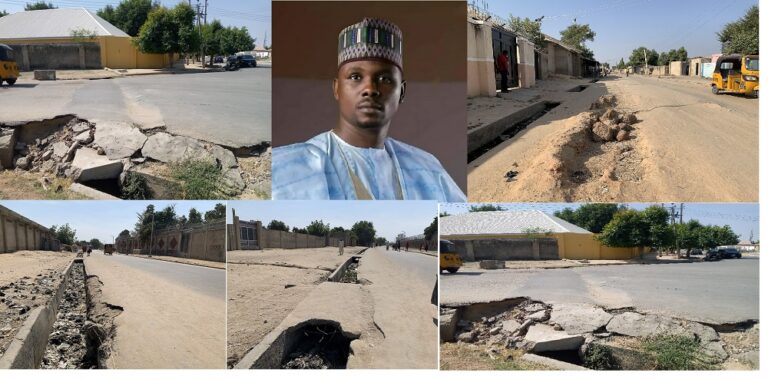
Parts of the N250 million-naira Kwajaffa – Jamilu road were observed to be deteriorating with breakages. Residents who spoke to UDEME registered their displeasure over the status of the project which they attributed to poor execution by Mr Satomi’s company.
The Kwajaffa – Jamilu road
A resident, Bulama Abba, faulted the quality of materials used in the construction of the project. “It’s just a year since they completed this road, but it has started fading and breaking,” he said.
Another resident, Jamilu Musa said the poor condition of the road and drainage placed residents at risk during rainfall.
“Which kind of construction is this? In between the road and drainage, there are holes not properly covered with gravel. We suffer very well during the rain because water does not flow into the drainage,” he said, adding that the road was not durable and would not stand the test of time.
It is a similar experience for residents of Jiddari Polo, where the lawmaker’s company undertook the construction of a 3.7km road and drainages as well as a stormwater outfall – both valued at over N730 million naira.
Jiddari Polo road
Despite the construction of these projects, residents say the flooding problem confronting them still persists – a situation they attribute to the poor execution of the road and drainage projects.
“The road has been constructed, but we are not happy because it was not done properly. The road is fading, breaking, and the drainage water is not flowing well. When it rains, it could take up to five days for the water to clear up,” community head of Jiddari Polo, Mustapha Fantami said.
Barely a year after it was constructed, residents in the Kasuwan Shanu area of Jere, Maiduguri have also expressed concerns over the deteriorating condition of the road and drainage constructed by Obtuse Tec Engineering and Construction Limited.
State of the Kasuwan Shanu road and drainage
Abduwa Isa, a resident, lamented the poor work done by the contractors. “The government has done their part, but the construction company did bad work for us. For instance, they left a large hole in the middle of the road and after they completed this road, but came back to patch it with cement and concrete.”
Isa noted that the community had to crowdfund to fix parts of the culverts that had crumbled.
In the Khaddamari/Dala/Ngomari area, it is a better experience for residents who commended the government for the provision of solar street lights. Tanko Abubakar, the village head of Dala said the installation of the streetlights has given the area a new and improved look.
“These street lights have given us full security; at night you can move anywhere without fear. The government has done well, we need more of these developments in our community,” he said.
In September 2022, a report by HumAngle showed how a drainage project handled by Obtuse Tech Engineering and Construction Limited had worsened flood risks in Bulabulin Garandam community, channelling water into the homes of residents and creating large bodies of stagnant water that now serve as make-shift swimming pools for children in the area. The drainage is part of the 2.8 billion naira Baga-Jajeri-Umarari-Bulabulin road project awarded to the company by the Borno state government.
Picture 8: The streetlight projects in Dala and Ngomari areas
Across Satomi’s constituency, there is an airwave of fear of criticising the lawmaker, as such an action could attract vicious attacks from his supporters. One of his constituents, Fadila Abdulrahman, experienced this In January 2022, after thugs loyal to the lawmaker beat her mercilessly over a Facebook post critical of his performance. The thugs were arrested by the police, but Mr Satomi dissociated himself from the incident in a statement.
Lawmaker mum on issue
UDEME reached out to Satomi, for comments, but he did not respond. Calls to his mobile number were left unanswered.
When contacted, Mohammed Umar Shuwa, Satomi’s media aide, declined comments on the issue. “Who gave you my number? I cannot give you somebody’s information like that,” he blurted, ending the call abruptly. Further calls to his line were also unanswered.
Lawmaker’s conduct unlawful – Lawyers, Civil Society
Meanwhile, Ilevbaoje Uadamen, head of BudgIT Foundation’s Tracka, said public officers have made it a tradition to award contracts to themselves in Nigeria. To solve the problem, Uadamen suggests that anti-graft agencies investigate and prosecute government officials found to be engaged in such conducts.
“You can’t be a referee in the same game you are playing. The EFCC and ICPC should enforce the provisions of the code and conduct under the Public Procurement Act if lawmakers act against any of the laws.”
Human rights and constitutional lawyer, Inibehe Effiong, described the conduct and activities of the lawmaker as a breach of his oath as a public officer.
“The conduct of that lawmaker is not just a breach of his oath he swore as a public officer, but an abuse of the code of conduct bureau and tribunal act,” he said.
Effiong noted that Satomi engagement with the company “The only business or profession a public officer is permitted to undertake is farming. Any other engagement is illegal. That is the position of the law.”
Hyedima Mshelia, a lawyer at the Bwala and Co law firm, said Satomi’s conduct was also contrary to the provisions of the Public Procurement Act, which barred public officers from engaging in execution of government projects or receiving gains from the same.
Section 57 (9) of the Public Procurement Act (2007) states that: “Every public officer involved directly or indirectly in matters of public procurement and disposal of assets shall: (a) divest himself of any interest or relationships which are actually or potentially inimical or detrimental to the best interest of government and the underlying principles of this Act; and (b) not engage or participate in any commercial transaction involving the federal government, its ministries, extra-ministerial departments, corporations where his capacity as public officer is likely to confer any unfair advantage – pecuniary or otherwise on him or any person directly related to him.”
Another lawyer, Obia Sunday of Keena Partners, said the lawmaker’s conduct put him in a position of conflict with his duties and responsibilities and that he risks being jailed.
“A lawmaker should not be a beneficiary of any government contract, and neither should his friends or relatives. It is not fair if the person disposing of is also the person receiving,” he said.
“If a public officer directly or indirectly attempts to influence in any manner the procurement process to obtain an unfair advantage, the law makes provision for a term of imprisonment not less than five years without a fine, even a summary dismissal from government services and the case should be heard in Federal High Court. The law under section 58 of the Public Procurement Act 2007 provides for these offenses,” he said.
The Act in section 57(12)(b) describes “conflict of interest” as existing where a government official, “possesses a direct or indirect interest in or relationship with a bidder, supplier, contractor or service provider that is inherently unethical or that may be implied or constructed to be, or make possible personal gain due to the person’s ability to influence dealings.
In the past, there have been reports of government officials who engaged in sharp practices that granted them personal gains from the public procurement process through the influence of the award of government contracts to their own companies and/or those owned and/or operated by their relatives, friends and associates, in violation of extant laws.
Some of them include the current governor of Bauchi state, Bala Mohammed; former governor of Lagos State, Bola Ahmed Tinubu; Ebonyi state governor, Dave Umahi; Peter Nwaoboshi, a senator representing Delta North and his colleague representing Kano North, Barau Jibrin. During a public probe into the accounts of the Niger Delta Development Commission (NDDC) in 2021, the then Minister of the Niger Delta, Godswill Akpabio accused members of the National Assembly of being beneficiaries of NDDC projects.
We will investigate – ICPC
UDEME reached out to the Independent Corrupt Practices and Other Related Offences Commission (ICPC) – an anti-graft agency with a focus on executive and constituency projects – for comments. Officials of the commission, whom the UDEME team visited for comments on the investigation, said the commission would investigate the case and react accordingly. They declined to have their names mentioned because they are not authorised to speak on the matter.
UDEME is a member of the steering committee of the ICPC’s Constituency and Executive Projects Tracking Group (CEPTG).
THE West African Elders Forum (WAEF) has applauded Nigerians for their “resilience and patriotism” during the February 25 presidential and National Assembly elections, but cautioned politicians on taking actions that could jeopardise the collective stability and peace of the nation.
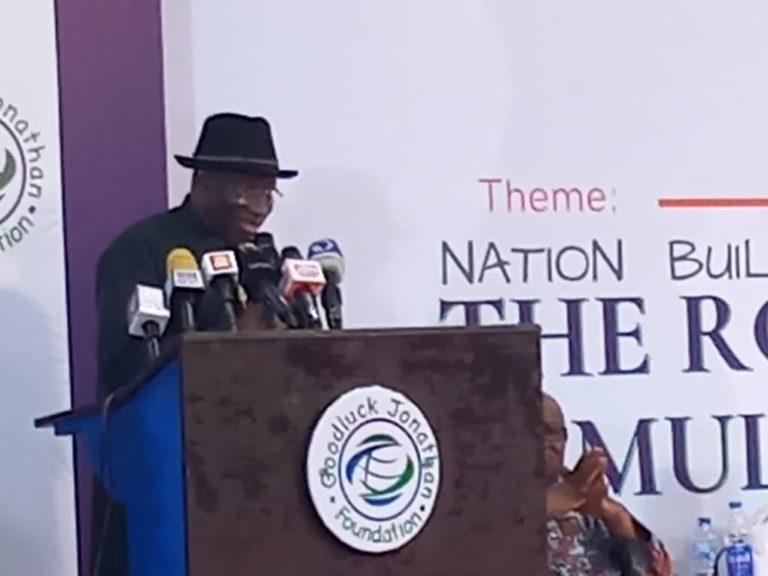
The Forum, in a statement jointly issued on Tuesday, February 28 by the Head of Mission to Nigeria 2023 and former President of the Republic of Ghana John Mahama, and the former president of Nigeria Goodluck Jonathan, called on all those who contested as presidential candidates, political parties and their supporters to maintain and embrace peace.
It urged dissatisfied politicians to rather use all available constitutional means and methods to sort out their concerns and grievances.
The statement read, “We hope to sustain this Mission until the electoral processes are successfully concluded. We, therefore, urge everyone to be circumspect in their actions and responsibilities during this moment in order not to jeopardize the collective stability and peace of the nation.”
THE President-elect, Bola Tinubu, says his leadership will treat all Nigerians fairly and equitably.
According to him, his administration is ready to adopt a different approach that will satisfy the yearnings of Nigerians for a functional country.
Tinubu, in his acceptance speech, vowed to ensure good governance, economic growth and the safety of all citizens.
“Now, to you, the young people of this country, I hear you loud and clear. I understand your pains and yearnings for good governance, a functional economy and a safe nation that protects you and your future.
“Remodelling our precious national home requires the cooperative efforts of all of us, especially the youth. Working together, we shall move this nation as never before,” he said.
He called for calm, urging citizens and the opposition to seek redress in court rather than resort to violent street protests.
“I know some candidates will be hard put to accept the election results. It is your right to seek legal recourse. What is neither right nor defensible is for anybody to resort to violence. Any challenge to the electoral outcome should be made in a court of law, not in the streets,” he said.
Tinubu commended the Independent National Electoral Commission (INEC) for conducting a “free and fair election,” stating that the few lapses noted were immaterial to the election outcome.
Tinubu won the election with 8,794,726 votes, defeating the other 17 candidates to score the highest number of votes.
He also had over 25 per cent of the votes cast in 30 states, more than the 24 states constitutionally required.
The INEC chairman, Mahmood Yakubu, declared him the winner in the early hours of Wednesday, March 1.
He also announced that Atiku Abubakar of the Peoples Democratic Party (PDP), came second with 6,984,520 votes.
Labour Party candidate Peter Obi came third with 6,101,533 votes, while Rabiu Kwankwaso of the New Nigeria People’s Party (NNPP) came fourth with 1,496,687 votes.
A Certificate of Return will be presented to the President and his vice by 3:00 pn on Wednesday at the National Collation Centre.
PRESIDENT Muhammadu Buhari has congratulated All Progressives Congress (APC) candidate Bola Tinubu shortly after he was declared winner of the 2023 Presidential Election.
The chairman of the Independent National Electoral Commission Professor Mahmood Yakubu made the declaration early on Wednesday, March 1, at the National Collation Centre in Abuja.
Tinubu won the election after polling 8,794,726 votes in the Saturday, February 25 presidential election.
The candidate of the Peoples Democratic Party (PDP), former Vice President Atiku Abubakar came second with 6,984,520 votes.
Labour Party (LP) candidate Peter Obi followed closely with 6,101,533 votes, while Rabiu Kwankwaso of the New Nigeria Peoples Party (NNPP) had 1,496,687 votes.
Reacting to the INEC declaration, Buhari in a statement released by the Senior Special Assistant to the President Garba Shehu congratulated Tinubu for winning the election.
The statement read:
“I congratulate His Excellency Bola Ahmed Tinubu on his victory. Elected by the people, he is the best person for the job. I shall now work with him and his team to ensure an orderly handover of power.
“The election was Africa’s largest democratic exercise. In a region that has undergone backsliding and military coups in recent years, this election demonstrates democracy’s continued relevance and capability to deliver for the people it serves.
“Within Nigeria, the results reveal democracy’s ripening in our country. Never has the electoral map shifted so drastically in one cycle. In the presidential elections, states in all regions across the nation changed colour. Some amongst you may have noticed my home state amongst them. The winning candidate did not carry his own home state either. That happens during a competitive election. Votes and those that cast them cannot be taken for granted. Each must be earned. Competition is good for our democracy. There is no doubt the people’s decision has been rendered in the results we look at today.
“That is not to say the exercise was without fault. For instance, there were technical problems with electronic transmission of the results. Of course, there will be areas that need work to bring further transparency and credibility to the voting procedure. However, none of the issues registered represent a challenge to the freeness and fairness of the elections.
“I know some politicians and candidates may not agree with this view. That too is fine. If any candidate believes they can prove the fraud they claim is committed against them, then bring forward the evidence. If they cannot, then we must conclude that the election was indeed the people’s will – no matter how hard that may be for the losers to accept. If they feel the need to challenge, please take it to the courts, not to the streets.
“However, to do the latter means they are not doing it in the interest of the people, but rather to inflame, to put people in harm’s way and all for personal, selfish gains.
“After a degree of polarization that necessarily accompanies any election, it is now time to come together and act responsibly. I call on all candidates to remember the peace pledge they signed just days before the election. Do not undermine the credibility of INEC. Let us now move forward as one. The people have spoken.”